What's inside
- Key Takeaways
- Quick Picks
- How We Chose These Picks
- Comparison: The Six Picks Side by Side
- What actually separates one portable monitor from another?
- How should you set up a portable monitor for a full working day?
- Which cable should you reach for first, USB-C or HDMI?
- Why did portable monitors all start to look the same?
- How does a general portable monitor survive a full travelling day?
- How do you keep a travel screen alive for years?
- Which mistakes send general travel screens back to the shop?
- How do the six picks divide by traveller type?
- What does setting up for the first time actually involve?
- Which pairs of picks should be compared head to head?
- What will you know after a month that no review can tell you?
- Which accessories genuinely matter for a general travel screen?
- How should the same screen serve three different rooms?
- What should a buyer know about warranties and secondhand examples?
- What should you do when the screen stays black?
- Is a portable monitor a good gift?
- One last test before the bag closes?
- What is the one-sentence verdict on the whole class?
- Who Should Skip This Class Altogether?
- What belongs on the last-minute checklist before you order?
- Final Recommendation
- Frequently Asked Questions
- In which unexpected places does a travel screen prove itself?
- Related Guides
As an Amazon Associate I earn from qualifying purchases. This post may contain affiliate links at no extra cost to you.
widgetverdict.com is reader-supported. When you buy through links on our site, we may earn an affiliate commission.
Finding the best portable computer monitors worth carrying means looking past the glossy product photographs and into the titles themselves, because the honest facts of this class are printed there for anyone willing to read slowly.
A portable monitor earns its keep in the gaps of a working day: the hotel desk that is really a dressing table, the kitchen counter commandeered between meetings, the second spreadsheet that refuses to share a laptop panel with the video call sitting on top of it.
This guide treats the class broadly on purpose. Business travellers who expense a screen once and carry it for years shop differently from students who need a second display for a single semester, yet both groups end up reading the same listings, so the six picks below are judged side by side on panel, stand, cover and cabling rather than on badge prestige.
Notice how the titles themselves divide the field. ASUS and Lenovo sell engineering language — kickstands, anti-glare coatings, plug-and-play promises — while MNN, KYY, InnoView and AOC sell the bundle: a smart case, a speaker, a cover that doubles as furniture. Neither pitch is dishonest; they simply answer different anxieties, one about durability, the other about value on day one.
Six screens follow, and the order is a judgement, not a ranking of panels: the early picks solve the most common travelling problems, the later ones serve narrower briefs, and every one of them can be the right answer for the right bag.
Key Takeaways
- Every linked pick here is a 15.6-inch or 16-inch 1080p IPS screen, so the real contest is stands, covers and cabling, not resolution.
- The ASUS ZenScreen MB169CK is the stand specialist, with a 360-degree kickstand and dual USB-C ports named in its title.
- The Lenovo ThinkVision M15 is the business-travel entry, a 15-inch FHD mobile monitor from a corporate display line.
- MNN, KYY and InnoView all bundle a case or cover, which matters because a travel screen lives or dies by what protects its panel in a bag.
- The AOC 16T20 adds VESA mounting and built-in speakers to the budget end, a combination none of the other five titles claim.
- One USB-C cable carrying picture and power is the convenience baseline; HDMI remains the fallback for older laptops and consoles.
Quick Picks
| Pick | Badge | Why it is here |
|---|---|---|
| MNN Portable Monitor 15.6″ | Value Opener | A 1080p IPS panel, HDR mention, one-cable USB-C and a smart case at the accessible end of the class. |
| KYY Portable Monitor 15.6″ | Speaker Included | An FHD IPS extender with cover, HDR wording and a built-in speaker for travellers who present aloud. |
| InnoView Portable Monitor 15.6″ | Widest Compatibility | The compatibility champion: laptops, desktops, phones, tablets and three console families in one title. |
| ASUS ZenScreen MB169CK | Stand Specialist | Dual USB-C, a 360-degree kickstand and anti-glare IPS from the line that defined the category. |
| Lenovo ThinkVision M15 | Business Travel | A 15-inch FHD mobile monitor from the ThinkVision line that equips corporate laptop fleets. |
| AOC 16T20 16 Portable | VESA Plus Speakers | A 16-inch IPS screen with VESA mount, speakers, smart cover and mini HDMI in one slim shell. |
How We Chose These Picks
The shortlist began with a ruthless filter: a general portable monitor must connect to a modern laptop in one cable and to an older one in two, because a class-defining screen cannot strand half the machines its owner will meet. Models that demanded proprietary docks or exotic adapters never reached the judging stage at all.
Stand design was weighed next, and weighed heavily, because this guide’s premise is that the general buyer has no single desk. A screen that only works on the one surface it was photographed on is a studio prop, not a travel tool, so kickstands, folding covers and VESA patterns each earned marks for the range of rooms they unlock.
Finally, the bundle was priced in attention. A case in the box removes a second purchase and a second decision; a speaker in the frame removes a question from every video call. Picks that arrived complete were credited for it, and picks that arrived bare were asked to justify the omission with excellence elsewhere.

MNN Portable Monitor 15.6″ — Value Opener
MNN built its portable line by selling the complete travelling kit in a single box, and this 15.6-inch model shows that formula clearly. The title promises an IPS panel at full HD, an HDR mention, USB-C described as one-cable, and a smart case, which together cover the four questions a first-time buyer usually asks in order.
Panel behaviour is the honest starting point. IPS at this size gives wide viewing angles, which matters when a screen sits at an angle on a train tray or gets shared across a small table. Full HD across 15.6 inches keeps text at a familiar sharpness for anyone stepping up from a typical laptop display, so documents need no squinting and no scaling surprises.
The smart case deserves more respect than accessory lists usually give it. A portable panel is glass and backlight pressed thin, and the case is what stands between that panel and the keys, chargers and hardback notebooks sharing its bag. MNN folding the case into the product rather than selling it separately removes a purchase many buyers forget until the first scratch.
HDR in the title should be read modestly: on a screen of this class it signals acceptance of an HDR signal rather than cinema-grade highlights, yet for streamed video and console play through the HDMI port it still marks a willingness to handle modern sources gracefully.
MNN’s model also suits the buyer who shares a home office. Its case keeps the panel presentable on a shelf between uses, its connections greet a partner’s laptop as readily as your own, and its picture asks for no adjustment when the room’s light changes through the day. General-purpose screens live or die on this kind of domestic diplomacy, and the MNN handles the politics of a shared desk with unusual grace for its class.
- Panel: 15.6-inch FHD IPS, per title
- HDR: stated in title
- Connections: USB-C and HDMI, per title
- Carry: Smart Case included, per title
- Extras: low blue light mode, per title
Strengths
- Full HD IPS panel suits shared viewing angles
- Smart case included for panel protection
- USB-C one-cable wording matches laptop use
Trade-offs
- HDR claim is signal acceptance, not high-end brightness
- Brand support network is smaller than ASUS or Lenovo
- Speaker provision is not claimed in the title
Best for: first-time portable buyers settling panel, case and cabling in one purchase.
Not suited for: travellers who need a rigid metal kickstand instead of a folding case stand.
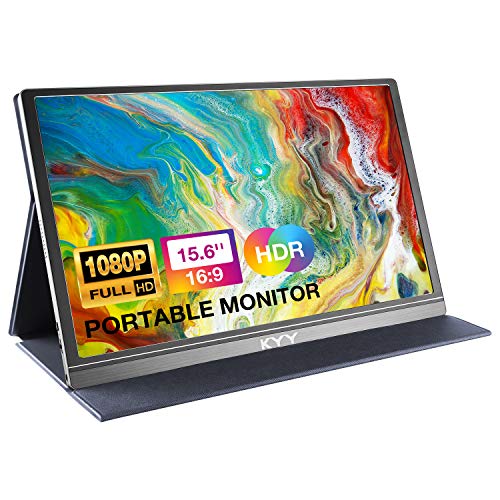
KYY Portable Monitor 15.6″ — Speaker Included
KYY positions this screen squarely as a laptop extender, and the title repeats that job twice, which is a useful clue about who should buy it. This is a screen for people whose laptop stays the centre of the setup and who simply need its desktop doubled, at a desk, in a hotel, or across a meeting table.
The built-in speaker separates it from several rivals here. Laptop speakers vary wildly, and a presenter who moves rooms all day cannot rely on the host machine for audible playback. A speaker inside the second screen means the video window and its sound travel together, so a clip dragged onto the portable panel keeps its voice.
Its cover follows the familiar folding pattern: protection during transit, then a grooved stand on arrival. That arrangement is light and simple, though it asks for a reasonably flat surface, so café tables with wobbly tops will test your patience more than a kickstand design would.
HDR wording and gaming language round out the title, and both should be weighed as versatility signals. A traveller who works spreadsheets by day and connects a console by night gets one panel that acknowledges both lives, even if neither use pushes the hardware to theatrical extremes.
For KYY’s screen, picture the school-run professional: laptop open at the kitchen table, a lesson or a briefing on the second panel, sound coming from the screen itself so the laptop can stay muted against household noise. The speaker stops being a bullet point in that scene and becomes the reason the product exists, and buyers whose days resemble it should rank this pick above its paper position.
- Panel: 15.6-inch 1080p FHD IPS, per title
- Connections: USB-C and HDMI, per title
- Audio: built-in speaker, per title
- Carry: cover included, per title
- HDR: stated in title
Strengths
- Built-in speaker keeps video sound with the picture
- Cover protects the panel and folds into a stand
- USB-C and HDMI cover laptops old and new
Trade-offs
- Cover stand needs a flat, steady surface
- No VESA mounting is claimed in the title
- No kickstand means fewer tilt positions
Best for: presenters and tutors whose second screen must also carry the sound.
Not suited for: desk users planning a VESA arm mount for a semi-permanent setup.

InnoView Portable Monitor 15.6″ — Widest Compatibility
Read the InnoView title as a guest list. Laptop, desktop, MacBook, phones, tablet, PS5 and PS4, Xbox and Switch all get named, which makes this the pick for households and offices where a portable screen gets borrowed constantly and must greet whatever device is handed to it.
That breadth is plausible because the connection pair is the universal one: HDMI for the fixed and older machines, USB-C for the modern portable ones. A desktop with no spare monitor, a phone that needs a bigger canvas for a presentation, a console travelling to a relative’s house — each finds a door into this panel.
The protective case and built-in speaker complete the borrowing-friendly picture. A screen that circulates needs armour more than a screen with one owner, and a speaker removes the separate question of where sound comes from when a phone or console is the source.
InnoView sells several near-identical sizes, so the discipline with this pick is checking the exact listing variant before ordering. The title here is the 15.6-inch FHD model with case and speaker; siblings in the same range swap sizes and bundles, and the differences hide in precisely the words buyers skim.
InnoView’s traveller should be imagined at a relative’s house, commandeering the dining table with a console for the children and a laptop for the inbox. A screen that connects to everything in the building, survives in its case, and carries its own sound is the one that gets invited back, and the InnoView’s title reads like it was written by someone who has made exactly that trip.
- Panel: 15.6-inch FHD 1080p, per title
- Connections: HDMI and USB-C, per title
- Audio: built-in speaker, per title
- Carry: protective case included, per title
- Hosts: laptop, desktop, MacBook, phones, tablet, consoles, per title
Strengths
- Broadest host list of any pick in this guide
- Protective case suits shared or borrowed use
- Speaker included for console and phone sources
Trade-offs
- Many similar InnoView variants invite ordering mistakes
- No stand mechanism beyond the case is described
- No VESA claim appears in the title
Best for: shared households and offices where one screen serves many different devices.
A single fixed desk station with a mounted arm asks for VESA hardware this circulating, case-and-speaker panel does not claim.

ASUS ZenScreen MB169CK — Stand Specialist
ASUS effectively invented the modern USB-C travel monitor with the ZenScreen line, and the MB169CK reads like a summary of lessons learned across that history. The headline features are not the panel — a sensible 1080p anti-glare IPS — but the furniture around it: a 360-degree kickstand and two USB-C ports.
A kickstand that swings through a full circle changes where a portable screen can work. It can prop the panel low for writing, upright for calls, or flipped for showing content to someone seated opposite, and it does all of that without a case being folded into origami first. For people who set up in unfamiliar rooms daily, that mechanical freedom is the product.
Dual USB-C ports answer the pass-through problem. A laptop with one free port and a monitor that consumes it leaves nowhere for power or a peripheral; a second port on the screen gives the chain somewhere to continue. The title’s plug-and-play promise fits the same philosophy: arrive, open, connect, work.
Anti-glare coating is the quiet professional feature. Hotel rooms, glass-walled offices and bright cafés all throw reflections at glossy panels, and a matte surface keeps text readable without a brightness war the battery always loses.
The ZenScreen MB169CK rewards a specific ritual: arriving at a client’s office, flipping the kickstand, turning the panel to face the room, and beginning before anyone has found a spare monitor cable. Consultants sell confidence as much as analysis, and a screen that deploys like a practised gesture is a small part of the performance. That theatre, backed by dual ports and a glare-free panel, is the ASUS premium made tangible.
- Panel: 15.6-inch 1080p anti-glare IPS, per title
- Stand: 360 kickstand, per title
- Connections: dual USB-C, per title
- Setup: plug and play, per title
- Hosts: MacBook and PC, per title
Strengths
- 360 kickstand adapts to rooms and audiences
- Dual USB-C eases single-port laptop chains
- Anti-glare IPS stays readable under bright light
Trade-offs
- No HDMI port is claimed in the title
- No speaker is claimed in the title
- No case is named, unlike the budget picks
Best for: consultants and trainers who set up in a different room every day.
Not suited for: owners of HDMI-only older laptops needing a direct connection.

Lenovo ThinkVision M15 — Business Travel
The ThinkVision M15 carries the shortest title in this guide, and that brevity is itself information. Lenovo sells this screen through business channels to companies equipping thousands of laptop users, and corporate listings favour restraint over adjectives, so the facts offered are size, resolution class and lineage.
ThinkVision lineage matters because it implies a design brief written by IT departments. Such buyers care about a screen that matches the laptop fleet’s look, survives a warranty process without drama, and behaves identically across hundreds of desks. A 15-inch FHD panel in black is exactly the unglamorous specification that brief produces.
Fifteen inches rather than 15.6 trims the footprint slightly, which frequent flyers notice when a screen shares a carry-on with a laptop, shoes and a wash bag. The difference is small on paper and real in a packed sleeve, and it signals that Lenovo tuned this model for movement rather than for maximum canvas.
Buyers choosing the M15 are therefore buying predictability. It will not win a features auction against the bundle-heavy budget picks, and it is not trying to; its promise is that the screen arriving at a branch office in another city behaves exactly like the one at headquarters.
Lenovo’s M15 makes most sense inside an ecosystem. The buyer already carries a ThinkPad, already trusts the service network, already owns a bag sized by the same design office. Adding the M15 is less a purchase than an adoption, and its value compounds with every trip where the screen and the laptop behave like relatives rather than strangers introduced by a cable.
- Panel: 15-inch FHD, per title
- Colour: black, per title
- Line: ThinkVision mobile monitor, per title
- Resolution class: Full HD, per title
- Form: mobile monitor for travel, per title
Strengths
- Corporate lineage promises consistent behaviour
- Slightly smaller 15-inch footprint packs easily
- Understated black finish matches business laptops
Trade-offs
- Title states few extras, so check the listing carefully
- No case or speaker is claimed in the title
- No stand details are given in the title
Best for: business travellers whose employer standardises on ThinkVision equipment.
Not suited for: bargain hunters counting bundled accessories per purchase.

AOC 16T20 16 Portable — VESA Plus Speakers
AOC’s 16T20 is the pick that refuses to choose between travelling and staying put. Its title lists a smart cover and ultra-slim body for the road, then adds a VESA mount for the days the screen comes home and joins a desk arm, and that dual citizenship is rare enough at this end of the market to anchor a recommendation.
The 16-inch panel is a touch larger than the 15.6-inch norm, and the title is unusually explicit elsewhere too: 1920 by 1080 resolution, 60Hz refresh, USB-C plus mini HDMI, built-in speakers and low blue light all get named. A buyer can reconstruct nearly the whole product from the title alone, which inspires more confidence than a wall of adjectives.
Mini HDMI deserves a practical note. It carries the same signal as full HDMI through a smaller socket, so the cable in the box matters; losing it means buying a mini-to-standard lead rather than raiding the drawer of ordinary HDMI cables every household owns.
Speakers plus VESA plus cover make the 16T20 the natural second screen for a hybrid worker: mounted and cabled at the home desk during the week, slipped into its cover for the monthly trip, with no separate purchases mediating either life.
AOC’s 16T20 invites a longer imagination: this month it travels, next month it mounts above the home desk when a reorganisation promotes it, the month after it returns to the bag for a project abroad. Screens that can change roles survive their owners’ changing lives, and the VESA thread in this pick’s housing is a small, cheap insurance policy against the day the travel stops.
- Panel: 16-inch FHD IPS, 1920×1080, per title
- Refresh: 60Hz, per title
- Connections: USB-C and mini HDMI, per title
- Mounting: VESA mount, per title
- Extras: built-in speakers, smart cover, low blue light, per title
Strengths
- VESA mount allows a proper desk-arm setup
- Speakers and smart cover both included
- Title specifies resolution and refresh plainly
Trade-offs
- Mini HDMI needs its specific cable, not a standard one
- 60Hz suits work, not high-refresh gaming
- Larger 16-inch body fills more of a small bag
Best for: hybrid workers splitting time between a mounted home desk and travel.
Not suited for: players chasing refresh rates above 60Hz on the road.
Comparison: The Six Picks Side by Side
| Pick | Badge | Defining fact from its title |
|---|---|---|
| MNN Portable Monitor 15.6″ | Value Opener | Panel: 15.6-inch FHD IPS, per title; HDR: stated in title |
| KYY Portable Monitor 15.6″ | Speaker Included | Panel: 15.6-inch 1080p FHD IPS, per title; Connections: USB-C and HDMI, per title |
| InnoView Portable Monitor 15.6″ | Widest Compatibility | Panel: 15.6-inch FHD 1080p, per title; Connections: HDMI and USB-C, per title |
| ASUS ZenScreen MB169CK | Stand Specialist | Panel: 15.6-inch 1080p anti-glare IPS, per title; Stand: 360 kickstand, per title |
| Lenovo ThinkVision M15 | Business Travel | Panel: 15-inch FHD, per title; Colour: black, per title |
| AOC 16T20 16 Portable | VESA Plus Speakers | Panel: 16-inch FHD IPS, 1920×1080, per title; Refresh: 60Hz, per title |
Lay the six side by side and a pattern emerges: the panels are cousins, the furniture are strangers. Choose the stranger whose habits match your rooms, and the cousin’s picture will satisfy you for years, because at this size and resolution the industry’s panels long ago stopped being the problem.
What actually separates one portable monitor from another?
Start with the stand, because the panel class barely moves across this guide. Every linked pick renders full HD on IPS or an IPS-class panel, so sharpness and colour will feel familiar whichever box you open. What changes your day is furniture: a kickstand that sets its own angle, a cover that folds into a prop, or a VESA mount that hands the job to an arm. Judge the furniture first and the picture second, in that order, for this entire category.
Next, count the ports on your laptop, not on the monitor. A machine with two free USB-C sockets welcomes any pick here. A machine with one socket, already promised to its charger, pushes you toward dual-port designs or toward keeping a small hub in the bag. The monitor’s own port list only matters relative to the scarcity it meets.
Then weigh the bundle honestly. A case you would otherwise buy separately is real value; a speaker you will never use because your laptop’s audio is excellent is decoration. Read each title as a shopping list and price only the items on it that solve your actual problems.
How should you set up a portable monitor for a full working day?
Height is the ergonomic battle. A portable screen propped on a desk sits lower than a laptop on a stand, and eight hours of looking down at it writes itself into your neck by Thursday. Raise the panel on a stack of books, a laptop riser or its own case until the top edge nears eye level, then tilt it back slightly; the geometry matters more than the brand of the screen.
Arrange the software before the furniture hardens. Set the portable panel as an extension rather than a mirror, park persistent items — chat, mail, reference documents — on the second screen, and keep the document you are actively writing on the laptop in front of you. Mirroring wastes the purchase; extending is the entire point.
Manage light last. Turn the portable panel away from windows where you can, prefer anti-glare models where you cannot, and resist solving reflections with maximum brightness, which drains the host battery and tires your eyes in equal measure.
Which cable should you reach for first, USB-C or HDMI?
USB-C is the elegant answer when the laptop supports video over that port: one lead carries picture and power, the desk stays clean, and packing takes seconds. The titles in this guide repeat USB-C for a reason — it is the connection the category was rebuilt around.
HDMI is the resilient answer. It asks nothing clever of the host, works with desktops and consoles and older laptops, and separates power into its own question, which you then answer with the monitor’s second port or an adapter. When a USB-C connection produces a black screen, HDMI is the diagnostic that tells you whether the panel or the port is at fault.
Carry both. The pair weighs almost nothing, and the traveller with both cables is immune to the two classic failures: a laptop whose USB-C port carries data only, and a meeting-room screen that speaks nothing but HDMI.
Why did portable monitors all start to look the same?
The general class exists because laptops converged. Once every serious machine shipped with a 13 to 16-inch screen and a USB-C port, a standardised second panel became possible, and the products in this guide are that standard made physical. Understanding the convergence explains the sameness buyers notice: the industry agreed on the brief, and now competes on execution.
Execution differences hide in tolerances. Two screens can share a panel specification and differ in hinge stiffness, case stitching, cable quality and the honesty of their titles. This guide cannot measure tolerances from listings, so it grades what listings prove and flags what they omit, which is the most a buyer can fairly ask of any guide.
The healthy way to shop the class is therefore shortlisting by furniture, verifying by title, and deciding by the room you work in most. The panel will be fine. Panels, at this mature stage of the category, are almost always fine; it is the life around the panel that separates a delight from a drawer ornament.
How does a general portable monitor survive a full travelling day?
Dawn in a serviced apartment: the MNN or the KYY comes out of its case, the laptop wakes, and the desk that was a dressing table becomes an office with two windows onto the work. The general portable monitor’s first gift is this transformation, repeated in a thousand rented rooms, and it never stops feeling slightly like a magic trick.
Mid-morning brings the video call, and the second screen shows its social side. Faces gather on the portable panel at a natural size while the document under discussion stays open on the laptop, so nobody’s expression shrinks to a postage stamp the moment real work appears. Colleagues on the other end never see this arrangement, yet they feel its effect in your undivided-looking attention.
Lunch is a move to the kitchen counter, where the kickstand screens justify themselves. A folding cover wants a placemat’s worth of flat, calm surface; a kickstand plants itself on a chopping board’s territory and holds. Anyone who has worked a full day from a small flat knows this hour decides which screen gets bought twice.
The afternoon slump tests brightness and glare. West-facing windows turn glossy panels into mirrors, and the anti-glare picks in this guide keep working while their shinier rivals demand curtain negotiations. It is the least glamorous hour of the day and the one where coating choices quietly pay their rent.
Evening reverses the flow: the work screen becomes the household screen, showing a film in a bedroom that has no television, or a recipe at reading distance while dinner happens around it. A general portable monitor earns its storage space in these second shifts, and the picks with speakers ask the fewest favours of the room.
Packing away closes the loop. Case, cable, screen, bag — a thirty-second ritual when the kit was designed as a kit. The general class lives on this repeatability: not the best screen for any single hour, but a good screen for every hour, which is a harder and more useful thing to be.
How do you keep a travel screen alive for years?
A general travel screen dies by a thousand small insults rather than one catastrophe, so its care is a routine of small kindnesses: the case closed properly, the cable coiled loosely, the panel never used as a shelf for the laptop it serves. Owners who build those habits keep these screens for the length of a career.
The connectors deserve a glance each month. USB-C sockets collect pocket lint with quiet dedication, and a port cleaned gently with a wooden pick restores connections that owners often misdiagnose as cable failures. Five minutes of attention here prevents the most common false alarm in the whole category.
Brightness habits shape lifespan too. A panel run at maximum output in every room ages its backlight faster than one matched to the light around it, and the anti-glare models in this guide make lower settings comfortable, which is a longevity feature disguised as a viewing feature.
Keep the firmware question simple: if the maker offers an update that names your exact model, apply it at a desk with wall power, never mid-trip. Most portable monitors will live their whole lives on their factory software quite happily, and stability is worth more than novelty in a tool carried for work.
Which mistakes send general travel screens back to the shop?
General buyers make general mistakes: they shop the class as if it were a television purchase, chasing panel numbers while the stand, the case and the cable decide their actual happiness. The errors below are the ones that surface in returns and in drawers full of nearly-new screens.
- Assuming every USB-C port on a laptop carries video, when some carry data and charging only — the port’s capability, not its shape, decides whether a one-cable setup works.
- Buying the screen and forgetting the stand question, then propping a glass panel against hotel water glasses for a week.
- Ordering a near-identical sibling model because the range names blur together, and receiving a different size or bundle from the one reviewed.
- Running the panel at full brightness all day to fight glare, then blaming the monitor for the laptop battery dying by mid-afternoon.
- Treating a bundled cover as optional luggage and carrying the panel loose, which is how most portable screens meet their end.
Every error on that list is a furniture or logistics error wearing a technology costume. The encouraging news is that all of them can be caught at the title-reading stage, which is why this guide keeps dragging your attention back to those unglamorous lines of listing text.
How do the six picks divide by traveller type?
The weekly flyer should start from weight and protection and work backwards to features. For that traveller the case-carrying picks — MNN, KYY, InnoView — are the natural shortlist, because their panels arrive armoured and their stands are the cases themselves. A flyer who chooses a bare kickstand model must budget a sleeve and a moment of packing discipline into every single departure.
The monthly driver can afford the larger, furniture-rich picks. AOC’s VESA-ready 16T20 and the ASUS MB169CK both make sense in a car-based life, where the screen travels in a boot rather than over a shoulder and can be as clever as it likes about stands, because the walk from car park to desk is measured in metres, not miles.
The home-based hybrid worker should invert the usual priorities entirely: stand quality first, mounting second, panel third, portability last. That ordering pushes the kickstand and VESA picks up the list and the cover-stand models down it, not because the covers are worse products but because a screen that lives on one desk is furniture before it is luggage.
The student traveller, finally, should buy completeness over cleverness. A bundled case, a speaker for shared video, connections that greet a library desktop and a games console alike — the InnoView and KYY profiles — will serve a semester of unpredictable rooms better than a specialist’s screen chosen for one perfect desk that may not exist.
What does setting up for the first time actually involve?
Unbox onto a clear table and inventory before connecting anything: panel, case or stand parts, the USB-C lead, any HDMI lead, and the quick-start card. First setups fail most often at this humble stage, when a cable assumed present turns out to be an optional extra, and discovering that at a clear table at home beats discovering it in a serviced apartment at midnight.
Connect USB-C first if your laptop offers a video-capable port, and give the panel a full ten seconds to negotiate before touching anything. Modern screens and laptops introduce themselves politely but not instantly, and the impatient replugging that follows a slow first handshake causes more false faults than any defect in this entire category.
Open the display settings while the excitement is fresh and arrange the two rectangles as they physically sit, set the scaling you can read comfortably, and choose extension rather than mirroring. These three decisions, made deliberately once, are the difference between a second screen that feels designed and one that feels haunted.
Finish by rehearsing the pack-away: case closed, cable in its pocket, stand folded as designed. The first setup is the only one you will ever perform slowly, so spend its slowness building the ritual that a hundred future hurried setups will copy without thinking.
Which pairs of picks should be compared head to head?
Compare the MNN with the KYY if your shortlist is budget-shaped. Both bundle protection and promise one-cable convenience; the KYY’s speaker and the MNN’s HDR mention are the honest separators, and the right choice depends on whether your second screen must talk. Let that single question decide, because everything else between them is a matter of taste in cases.
Compare the ASUS MB169CK with the AOC 16T20 if your shortlist is furniture-shaped. Kickstand against VESA-plus-cover is a genuine philosophical split: freedom in strange rooms against permanence at a home desk. Buyers who travel weekly should lean ASUS; buyers who travel monthly and mount at home should lean AOC, and neither will envy the other.
Compare the Lenovo M15 with the InnoView if your shortlist is temperament-shaped. Corporate restraint against consumer generosity: the Lenovo promises consistency, the InnoView promises completeness. The correct answer is whichever promise your own history believes — the traveller burned by missing accessories should take the bundle, the traveller burned by flaky gadgets should take the badge.
What will you know after a month that no review can tell you?
You will know your true stand preference, which is a fact about your body and your rooms rather than about any product. Some owners discover they prop and forget; others adjust their screen six times a day and need furniture that invites adjustment. The first month teaches this in a way no specification can, which is why generous return windows matter in this category.
You will know your battery truth: the real, personal exchange rate between a second screen and your laptop’s unplugged hours, in your brightness habits and your working light. That number, once known, reorganises how you pack — charger always, hub sometimes — and it is different for every owner of the identical screen.
You will know whether the second screen became a habit or a garnish. Habit screens are set up without decision, in rooms where they were never planned; garnish screens wait for special occasions that dwindle. The picks in this guide were chosen to become habits, but the final vote is cast by your furniture, your bag and your mornings, in that order.
Which accessories genuinely matter for a general travel screen?
A sleeve matters when the pick ships without a case, and it matters immediately, not eventually: the first unprotected journey is statistically the dangerous one, because habits have not formed yet. Choose a sleeve with a rigid face or real padding, sized to the panel rather than to the laptop it accompanies, and treat its cost as part of the screen’s price when comparing picks.
A second USB-C cable, video-rated and kept in the travel bag permanently, is the accessory veterans buy after their first forgotten-lead incident. The home cable lives at the desk; the travel cable lives in the bag; neither is ever borrowed for a phone. This small duplication abolishes the category’s commonest failure at the cost of one modest purchase.
A compact stand or riser matters only to the cover-stand owners, and only if their posture complains. Buy it after a month of real use rather than in the first flush of accessorising, because many travellers discover their rooms provide books, shelves and boxes that do the job with local charm and no luggage weight at all.
Almost everything else marketed to this class — screen protectors for a panel that lives in a case, exotic cleaning kits, cable jewellery — solves problems the category does not have. The general portable monitor is a mature tool; its genuine needs are protection, a spare lead and, occasionally, height, and money spent beyond those is decoration.
How should the same screen serve three different rooms?
In the home office it should be boring: same position, same angle, same windows in the same places, day after day, because the home desk is where habits compound. Set it once with unusual care, even measuring the height against your eye line, and then defend the arrangement against the household’s entropy like a gardener defending a border.
In the hotel room it should be fast: out of the case, onto the desk, connected, working, inside two minutes, because travel evenings are short and the screen competes with dinner. This is where the kickstand picks justify their existence and where a traveller learns whether their kit ritual was designed or merely accumulated.
In the shared family room it should be gracious: turned toward the sofa, speakers carrying a film, cables routed where feet and pets cannot find them. A screen that only knows how to be an office tool will be resented in this room; the picks with speakers and friendly stands become part of the household’s evenings and earn their storage space twice over.
What should a buyer know about warranties and secondhand examples?
Portable monitors are attractive secondhand purchases — panels date slowly and connections are standard — but the inspection must be physical: dead pixels at full-white and full-black, a hinge or kickstand worked through its range, the supplied cable tested rather than assumed. A used screen that passes those three checks at a fair discount is one of the category’s genuine bargains.
Warranty value scales with travel intensity. A screen that flies weekly lives a riskier life than one that commutes by car, and the stated warranty on picks like the ASUS ACE variant should be read by frequent flyers as part of the specification, worth real money in their personal arithmetic even if a home-based buyer shrugs at it.
Keep the order confirmation and the serial number photographed in the same cloud folder as your travel documents. Claims for equipment that fails abroad are won by paperwork assembled in advance, and the thirty seconds spent filing them is the cheapest insurance premium in the whole travelling office.
What should you do when the screen stays black?
Stay calm and change one variable at a time, starting with the cable: swap in the supplied lead or your labelled spare, because leads are the commonest culprits and the cheapest test. Then change the port, then, if the room allows, the host — a phone or a second laptop — until the blackness follows either the screen or the setup, and the diagnosis makes itself.
Check the laptop’s display settings before suspecting hardware, because a machine set to show only its built-in panel will ignore a healthy second screen in perfect silence. Extend, do not mirror blindly, and confirm the operating system can see a second rectangle at all; half of all ‘faulty’ portable monitors are settings wearing a disguise.
If the panel lights for other hosts but never for yours, revisit the port question with fresh humility: capabilities vary between machines that look identical, and the answer is a different connection route, not a louder complaint. The screen is a witness, not a culprit, in almost every black-screen story this category tells.
Is a portable monitor a good gift?
For the right recipient, it is an unusually thoughtful one: the student whose essays sprawl, the new remote worker furnishing a first desk, the parent whose video calls deserve a bigger stage. The gift succeeds when the giver has quietly verified the recipient’s laptop ports in advance — a small espionage that separates a delight from an exchange.
Bundle the ritual with the object: the screen, its case if it lacks one, and a card that says where the cable lives and which port to use. Gifts of technology fail at setup more often than at specification, and a giver who attends the first connection — in person or by call — converts the present from a project into a pleasure.
Avoid the gift when the recipient’s hardware is unknown and unaskable, or when their working life is proudly single-screened. A portable monitor is a workspace opinion, and like all opinions it should be given only where it will be welcomed as one.
One last test before the bag closes?
Set the whole kit up in the worst room you regularly use — the dim spare room, the glaring kitchen, the borrowed desk with one socket — and work there for one full hour before the return window closes. A general portable monitor that passes its owner’s worst room will pass every better room without discussion, and the hour is cheaper than the exchange.
What is the one-sentence verdict on the whole class?
A general portable monitor is the rare technology that disappears into competence: it will not thrill a specialist or shame a professional, it will simply give every laptop you own a second horizon in every room you work in, and after a month of that quiet multiplication the single-screen life feels like reading through a keyhole — which is why this unglamorous class, bought by furniture and verified by title, outsells every exciting alternative in the catalogue.
Who Should Skip This Class Altogether?
One desk, one desktop monitor, and no working journeys in between: that combination leaves this class with nothing to solve. A portable monitor exists for workspace away from home, so a household without that gap is purchasing luggage, however elegant the panel folded inside it may be, and a tablet already riding along covers the lightest travel days.
What belongs on the last-minute checklist before you order?
- Check that your laptop’s USB-C port carries video, or plan the HDMI route with its separate power answer before ordering.
- Choose the stand for the surface you use most often: kickstand for variety, folding cover for flat desks, VESA for a home station.
- Confirm whether a case or cover is in the box, and add a sleeve to the same order if the title does not name one.
- Decide whether the screen needs its own voice; if your calls and media will live on it, pick a model whose title claims speakers.
- Compare the panel size with your laptop’s, since matched heights make the two-screen desktop feel like one wide desk.
- Read the chosen listing’s title once more at checkout, because these ranges swap sizes and bundles between near-identical names.
Final Recommendation
Choose by furniture and by fleet: the screen whose stand, cover and ports match the rooms and machines you actually use will delight you long after the panel specifications have blurred together, because at this resolution and size the picture was never the hard part.
Buy the screen whose furniture matches your rooms, and the general class will repay you every single day it travels.
Frequently Asked Questions
Do portable monitors need their own power supply?
Most USB-C models draw power through the same cable that carries the picture when the host supports it, which is why the titles lean on one-cable language. HDMI sources cannot feed power, so an HDMI setup needs power delivered separately through the monitor’s USB-C port. Either way, the energy comes from somewhere — usually the laptop battery or a wall adapter you supply.
Will a 15.6-inch portable monitor match my laptop screen size?
Often closely, since 15.6 inches is also a common laptop size, and matched heights make dragging windows between screens feel natural. The 15-inch ThinkVision and 16-inch AOC in this guide bracket that norm deliberately: one packs smaller, the other shows slightly more. Measure your laptop’s panel diagonally before assuming a match.
Can these screens work with a phone?
Several titles here name phones outright, including the MNN, InnoView and AOC picks. A phone with USB-C video output can drive the panel directly; phones without it need an adapter path, and the experience then depends on the phone’s desktop mode rather than on the monitor. Check your handset’s video-out support before counting on this use.
Is 1080p enough on a portable screen?
At 15 to 16 inches viewed from a normal working distance, full HD keeps text clean and interfaces familiar, and it asks little of the host graphics or battery. Higher resolutions exist in portable form — the 4K guide in this series covers them — but they trade battery life and scaling fiddliness for sharpness most office work cannot spend.
What protects a portable monitor in a bag?
A fitted case or smart cover, which is why so many titles here advertise one. The panel face is the fragile surface; it should ride against padding, never against keys or chargers. If a pick ships without a cover, budget for a sleeve in the same order rather than after the first journey.
In which unexpected places does a travel screen prove itself?
On the night train, the screen earns its fare in a space designed for one person and a paperback. The tray is narrow, the light is borrowed, and the work is the kind that benefits from a reference window that never sleeps. Travellers who shop for best portable computer monitors with rail journeys in mind learn to prize a stand that grips a small surface and a panel that stays readable at modest brightness, because the carriage offers neither a wide desk nor a spare socket, and the screen that thrives there will thrive almost anywhere a working day can invent.
At a borrowed kitchen table, the setup must be a guest: quick to arrive, tidy in its cabling, gone before dinner without a trace. Screens chosen for best portable computer monitors face this test in relatives’ houses and holiday rentals everywhere, and the ones with self-contained stands and single-cable manners pass it gracefully, leaving the table’s owner with nothing to forgive and the worker with a full day honestly worked.
In the conference corridor, the second screen becomes a collaboration surface: a chart turned toward a colleague, a draft shared standing up, a queue of slides reviewed between sessions. The best portable computer monitors picks with presentable stands and wide viewing angles serve this scene best, because the audience is never seated squarely and the meeting is never in a meeting room, and portability proves itself in these unplanned minutes more than in any planned presentation.
On a pop-up shop counter, the portable screen faces the customers: the lookbook, the queue number, the story of the product. A panel bought for best portable computer monitors that can turn its face outward — kickstand reversed, cover folded back — becomes signage, till display and portfolio in rotation, and that outward-facing talent is worth checking in a title before assuming every screen can perform it.
Related Guides
Three neighbouring guides continue the story of the travelling screen: start with our guide to portable monitors with 4K resolution, continue to the gaming portable monitors roundup, and finish with USB-powered portable monitors explained.



[…] exploring with the portable monitor guide for a creator desk setup, then compare our 4K portable monitor picks for reviewing footage, and finish with the gaming […]