What's inside
- Key Takeaways
- Quick Picks
- How Did We Shortlist Chargers Instead of Mere Stands?
- Why Does the Puck-versus-Holder Distinction Matter So Much?
- The Six Chargers in Detail
- Side by Side: Cables, Keychains, Docks and a Full Power Bank
- How Do You Charge an Apple Watch Well Away From Home?
- What Mistakes Do Apple Watch Charger Buyers Keep Making?
- Final Recommendation
- How Does Sleep Tracking Change the Charging Question?
- What Should a Two-Watch Household Do Differently?
- How Do You Keep a Magnetic Charger Working for Years?
- Which Charger Belongs in the Car, the Office and the Gym Bag?
- How Can You Tell a Good Third-Party Puck From a Poor One?
- What Does a Sensible Watch-Charging Kit Look Like at Each Budget of Effort?
- Why Do Some Watches Charge Slowly on a Perfectly Good Puck?
- Frequently Asked Questions
- One Last Check Before You Order Any Watch Charger
- Related Guides
As an Amazon Associate I earn from qualifying purchases. This post may contain affiliate links at no extra cost to you.
widgetverdict.com is reader-supported. When you buy through links on our site, we may earn an affiliate commission.
Where to buy: the chargers in this guide are sold through Amazon, and each product name in the Quick Picks table and in the detailed reviews links to its listing, so you can check the exact variant before ordering. Apple Watch charging looks simple — a small magnetic puck and a cable — yet the market around it is crowded with docks, stands and keychain gadgets that do not all do the same job, so start with the table, note which entries actually contain a charging puck, and then read the detail sections for the ones that fit your nightstand or your travel wash bag.
Anyone hunting for the best wireless chargers for apple watch owners quickly discovers a trap built into the category: a beautiful stand is not necessarily a charger. Some bedside docks include the magnetic puck that delivers power, while others are merely holders shaped to cradle the puck that came in your watch’s box — furniture, not electronics. This guide keeps that distinction at the centre. The six picks below are charging devices in their own right: Apple’s own magnetic fast-charge cable, a full power bank with a watch charger built into it, two pocket keychain chargers with their own batteries, and two travel docks whose titles describe fast charging and nightstand duty. Anything that only holds a puck you must supply yourself has been left out of the picks and is discussed only as a warning.
The practical split is between home and away. At home, the question is whether you want the plain official cable dropped behind the nightstand or a dock that props the watch up for Nightstand Mode, showing the time sideways like a tiny alarm clock. Away from home, the question becomes independence: a keychain charger with a small battery inside can revive a watch in a handbag, a car or a festival tent without any socket at all, while the Anker power bank in this list charges the watch and the phone from one reservoir during a whole trip.
Key Takeaways
- A stand that needs your own puck is a holder, not a charger; every pick here delivers power itself, according to its listing title.
- Apple’s own Magnetic Fast Charger to USB-C cable is the reference point for charging speed and guaranteed fit across watch generations.
- The Anker MagGo power bank pairs a 10,000mAh battery with a built-in watch charger, covering watch and phone on one trip.
- JOYROOM’s 2000mAh keychain charger and the 2500mAh pocket charger trade capacity for total socket independence.
- The foldable travel dock and the SwanScout stand aim at nightstand presentation, including Nightstand Mode support named in one title.
- Series compatibility in these titles runs remarkably wide, from the earliest watches through the Ultra line, but read your exact model against the listing.
Quick Picks
| Pick | Badge | Why it earns its place |
|---|---|---|
| Apple Apple Watch Magnetic Fast Charger to USB-C Cable (1 m) | The official reference | Apple’s own magnetic fast-charge cable in a one-metre USB-C form, the baseline every third-party option is judged against. |
| Anker MagGo Power Bank for Apple Watch, 10,000mAh 35W Max | Best for whole trips | A certified 10,000mAh power bank with a watch charger and a built-in USB-C cable for the phone beside it. |
| JOYROOM Portable 2000mAh Wireless Charger Compatible for Apple | Best keychain companion | A compact magnetic watch charger with its own 2000mAh battery, shaped like a keychain for daily carry. |
| 2500mAh Portable Charger for Apple Watch, Stocking Stuffers for | Best pocket backup | A pocket-size 2500mAh magnetic charger with snap-on hold and overcharge and overheat protection named in its title. |
| Upgraded for Apple Watch Charger, Foldable Travel Fast Charging | Best travel dock | A foldable charging dock that stands the watch up, supports Nightstand Mode and folds flat for a wash bag. |
| SwanScout Charger Stand for Apple Watch 12/11/10/9/8/7/6/5 | Best bedside angle | A charging stand with an adjustable angle, described as fast charging, for watches from recent series through the Ultra line. |
How Did We Shortlist Chargers Instead of Mere Stands?
The first test applied to every candidate was embarrassingly simple: does the object itself deliver power to the watch? A surprising share of products marketed with the word charger in their names are moulded cradles that expect you to thread your existing Apple puck through a slot. Those holders can be lovely furniture, and this guide does not sneer at them, but they cannot revive a watch when your one official puck is lost, broken or in another city — which is precisely when a second charger matters. Every pick below passed the self-contained test on the evidence of its listing title.
The second test was breadth of compatibility. Apple Watch charging has stayed magnetically consistent across generations, and the titles here reflect that: JOYROOM lists Series 11 down through Series 1 plus SE and Ultra models, the foldable dock names Series 12 through 2 with SE and Ultra generations, and SwanScout covers a similarly wide span. Wide claims deserve a calm check against your exact model on the product page, but the direction of travel is reassuring: one good charger can serve a household’s mixed watches.
The third test was honesty about what each object is. A 2000mAh keychain gadget is not a nightstand solution and a bedside stand is not a travel companion, so the shortlist deliberately spans the category’s real shapes rather than crowning six near-identical pucks. Readers who charge several Apple devices from one pad should also look at Best Multi-Device Wireless Chargers for iPhone, where watch charging joins phone and earbuds charging on shared stations.
Why Does the Puck-versus-Holder Distinction Matter So Much?
Because the disappointment arrives at the worst moment. A traveller who packs a handsome dock, arrives at a hotel and discovers it is an empty cradle for a puck left at home owns a paperweight with excellent industrial design. The same confusion strikes gift buyers: a stand given to a new watch owner whose only puck is already installed behind their own nightstand adds furniture, not function. Reading listings for the words that describe an actual charging element — magnetic charger, fast charging, a battery capacity of its own — protects against that mistake, and it is why the spec boxes in this guide state plainly what each title does and does not say.
There is a second, quieter reason. Holders route your official puck’s cable through moulded channels, and if that puck is the fast-charge model your watch came with, the arrangement works well; but the holder itself contributes nothing electrical. When you compare a holder’s price against a true charger’s price, you are comparing furniture against electronics, and the true charger deserves the larger share of a budget because it is the part that can fail, age or be lost. Buy holders for looks if you like them — after the charging itself is covered twice over.
Fast charging adds one more layer. Newer Apple Watch generations can charge markedly faster with a fast-charge-capable puck and a suitable USB-C power source, which is why Apple’s own cable in this guide carries the words Magnetic Fast Charger in its name. Third-party titles that promise fast charging are making a claim worth testing against your watch’s behaviour in the first week, while the product can still be returned if the promise evaporates in practice.
The Six Chargers in Detail

Apple Apple Watch Magnetic Fast Charger to USB-C Cable (1 m) — The official reference
Every category has a control sample, and this is it: Apple’s own magnetic fast charger, one metre long, terminating in USB-C. Its title is almost aggressively plain — no capacity figures, no compatibility list, no adjectives beyond fast — because Apple is selling the puck that defines the standard rather than arguing with it. If your watch shipped with a slower or older cable, or if the original has vanished into the upholstery of a car, this cable restores the exact charging behaviour the watch was designed around.
The one-metre length is a considered middle: long enough to drop from a nightstand socket to the surface beside a bed, short enough not to coil into a nest inside a travel pouch. USB-C termination means it pairs with the same wall adapters and power banks that now charge your phone and laptop, so a traveller can feed it from almost any modern brick. Owners of recent watch generations stand to gain the most, since fast charging is a conversation between puck, power source and watch; pair this cable with a weak old USB-A adapter and you have voluntarily slowed the whole chain.
What the official cable does not do is present the watch. It lies flat, the watch rests on it face-up, and Nightstand Mode’s sideways clock display is not part of the arrangement unless you prop the watch creatively. It also contains no battery, so socket access is assumed. Those are not flaws so much as definitions: this is the pure charging instrument, the one against which every dock, stand and keychain below should be measured for speed and fit before their extra talents are weighed.
- Form: magnetic charging puck on a cable, from Apple itself
- Cable length given in the title: 1 m
- Connector named in the title: USB-C
- Charging claim in the title: Magnetic Fast Charger
- Battery inside: none — the title describes a cable, so a USB-C power source is required
Strengths
- First-party fit and fast-charge behaviour with no compatibility guessing.
- One-metre USB-C cable pairs with the adapters and power banks you already carry.
- The reference purchase when a lost or damaged original puck needs replacing.
Trade-offs
- Lies flat, so there is no upright nightstand presentation.
- No internal battery means a socket or power bank is always required.
- Plain-cable pricing buys function only, with no dock furniture included.
Best for: an owner replacing a lost puck or upgrading an older watch’s cable to the fast-charge standard.
Not suited for: a bedside user who wants the watch propped sideways as a clock every night.

Anker MagGo Power Bank for Apple Watch, 10,000mAh 35W Max — Best for whole trips
Anker looked at the travel problem — watch dies on day two, phone dies on day three, two chargers, two cables, one hotel socket — and built a single reservoir for both. The title describes an officially certified 10,000mAh battery pack with a built-in USB-C cable and a watch charger, rated 35W maximum, naming the iPhone 17 series alongside Samsung handsets, iPad and AirPods. That breadth turns it into a trip’s entire charging department in one object.
The watch charger is the headline because it is the rarest feature in power banks: most packs, however large, leave the watch to its own puck. Here the watch snaps onto the pack itself, so a traveller can leave the official cable at home entirely and still revive the watch in a train seat or a departure lounge. The built-in USB-C cable handles the phone in parallel fashion, and 10,000mAh is a serious reservoir shared between a small watch battery and a phone, stretching across a long weekend of top-ups for both.
Certification language in the title matters for watch charging in particular, because the watch is fussy about its magnetic partners and an uncertified puck can behave erratically. Anker’s officially certified wording is therefore a functional claim, not decoration. The honest trade-offs are size and commitment: this is a full power bank, not a keychain, and it asks you to consolidate around it. Travellers who already carry a phone power bank should see it as a replacement that absorbs the watch job too, not as an additional brick.
- Battery capacity printed in the title: 10,000mAh
- Output figure in the title: 35W max
- Built-in elements named: USB-C cable and an Apple Watch charger
- Certification wording in the title: officially certified
- Other devices named: iPhone 17 series, Samsung, iPad, AirPods and more
Strengths
- Charges the watch directly, ending the need to pack a separate watch puck.
- Ten thousand milliamp-hours covers phone and watch across a long weekend.
- Built-in USB-C cable keeps the phone side of the kit self-contained too.
Trade-offs
- Full power-bank size is overkill for a nightstand-only charging problem.
- Consolidation means one lost object takes the whole charging kit with it.
- Home users gain little over a simple cable plugged in beside the bed.
Best for: a frequent traveller who wants watch and phone charging in a single certified reservoir.
Not suited for: a bedside-only user who never charges a watch away from home.

JOYROOM Portable 2000mAh Wireless Charger Compatible for Apple — Best keychain companion
The JOYROOM takes the opposite philosophy from the Anker: shrink the reservoir until it can live on a keyring. Its title describes a portable 2000mAh wireless charger in a compact magnetic keychain style, compatible with an unusually complete roll of watches — Series 11 through Series 1, the SE line and the Ultra generations up to Ultra 3. A charger that hangs beside your house keys is a charger that is present for the unplanned moments: the watch fading at a wedding, in an office, in a car outside a gym.
Two thousand milliamp-hours is a modest tank, and the right mental model is revival rather than routine: this gadget exists to pull a watch back from empty to useful, a few times over, without any socket. Because it carries its own battery, it works in the places cables cannot — a handbag, a coat pocket, a festival field. The magnetic snap described in the title holds the watch against the charger while it rides in a bag, which matters, since a wireless charger that separates from the watch inside a rucksack delivers nothing but warmth to the lining.
The compatibility list deserves a slow read, because it quietly solves the household problem: a keychain charger that serves a partner’s older Series watch and your Ultra alike earns its ring space. What it will not do is replace a nightstand routine for a heavy user who drains a watch daily with workouts and sleep tracking; the capacity is a safety net, not a utility supply. Bought with that expectation, it is the pick most likely to produce a story that begins with the words luckily I had this on my keys.
- Battery capacity given in the title: 2000mAh
- Style described in the title: compact magnetic, keychain style
- Compatibility roll in the title: Series 11/10/9/8/7/6/5/4/3/2/1, SE, Ultra lines
- Colour named in the title: Black
- Socket needed while charging the watch: none, thanks to the internal battery described in the title
Strengths
- Keychain form means the charger is present for unplanned low-battery moments.
- Internal battery revives a watch with no socket, cable or puck anywhere nearby.
- Exceptionally wide series compatibility covers a whole household’s watches.
Trade-offs
- Two thousand milliamp-hours is a safety net, not a daily charging supply.
- The gadget itself must be remembered and refilled between rescues.
- Small magnetic face demands the watch stay seated while it rides in a bag.
Best for: a forgetful charger who wants watch rescue hanging beside their house keys.
Not suited for: a heavy daily user needing a full-capacity charging routine away from sockets.

2500mAh Portable Charger for Apple Watch, Stocking Stuffers for — Best pocket backup
This pocket charger sits a step up from the JOYROOM in capacity and a step sideways in personality — its title literally frames it as a stocking stuffer for women and men, which is a fair description of a small, giftable gadget with a serious job. Inside the pocket-size body sits a 2500mAh battery, a strong magnetic snap-on connection, a keychain design, and protection against overcharge and overheating named explicitly in the title. That protection wording is worth noticing in a category of anonymous gadgets, because a battery that rides against a watch in a pocket should be able to describe how it behaves when things get warm.
The extra five hundred milliamp-hours over the JOYROOM buys a little more revival per outing, and the strong magnetic snap addresses the pocket charger’s core anxiety: separation. A watch and charger that part company inside a jeans pocket charge nothing, so magnetic grip is not a luxury feature here but the mechanism of the whole product. The keychain loop gives it a home on a bag zip or a belt loop for people whose pockets are already negotiated territory.
Gift framing aside, judge it as an instrument: it is a reserve tank for people whose watch routinely outlasts their day by less than the watch does. Runners who track an evening run after a full workday, nurses on long shifts, travellers crossing time zones with sleep tracking running — these are the users for whom a pocket revival at the right moment is worth more than a faster nightstand. It will not fast-charge like the official cable and it will not present the watch like a dock; it simply refuses to let a dead watch end an evening.
- Battery capacity stated in the title: 2500mAh
- Connection described in the title: strong magnetic snap-on
- Protection named in the title: overcharge and overheat safe
- Carry style in the title: pocket-size, keychain design
- Series list: the title does not enumerate series, so confirm your model on the product page
Strengths
- Slightly larger battery than the keychain rival extends each rescue session.
- Strong magnetic snap keeps watch and charger together inside a pocket.
- Named overcharge and overheat protection suits a battery carried on the body.
Trade-offs
- Gift-season framing hides a tool that still needs regular refilling to help.
- No series roll in the title means compatibility homework falls on the buyer.
- Pocket charging is a revival pace, not a rival to the official fast cable.
Best for: a shift worker or runner whose watch fades before the day does, far from sockets.
Not suited for: a buyer wanting one charger to serve as the household’s only nightstand solution.
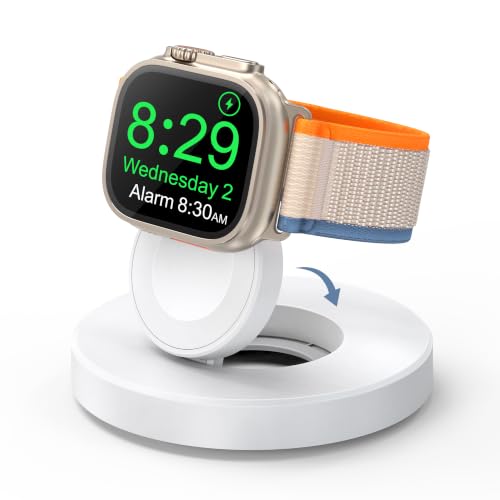
Upgraded for Apple Watch Charger, Foldable Travel Fast Charging — Best travel dock
Most travel chargers ask the watch to lie flat in a suitcase world; this one folds. The title describes a foldable travel fast-charging dock and portable wireless charging stand, compatible with iWatch Series 12 through 2, SE and the Ultra generations, with Nightstand Mode support and a white finish. Folded, it is a slim object in a wash bag; opened at the destination, it stands the watch upright so the sideways clock face works on a hotel nightstand exactly as it does at home.
Nightstand Mode is the feature that separates a dock from a puck for many owners. The watch becomes a bedside clock with an alarm display, and that small nightly pleasure is a genuine reason people keep a stand by the bed for years. A travel version of that ritual is more valuable than it sounds: hotel rooms are dark, unfamiliar and full of furniture at shin height, and a glowing clock face at a known angle is a small mercy at three in the morning in a strange city.
The title calls this unit a charger and a charging stand together, describing fast charging as its own function rather than a cradle for your puck — that is the basis on which it sits in these picks rather than in the warning category, and buyers should still confirm the in-box contents on the product page, as with any dock. The folding hinge is the part to treat kindly; like every travel hinge it will be opened and closed hundreds of times, and forcing it past its stop is how good docks die young. For the road warrior who hates the flat-puck hotel experience, this is the pick that travels like a cable and performs like furniture.
- Form described in the title: foldable travel dock and charging stand
- Charging claim in the title: fast charging
- Compatibility roll in the title: Series 12-2, SE, Ultra 4/3/2/1
- Display feature named in the title: Nightstand Mode support
- Colour named in the title: White
Strengths
- Folds flat for packing, then stands the watch up for nightstand duty.
- Nightstand Mode support preserves the bedside-clock ritual in hotel rooms.
- Wide series compatibility spans recent watches and the Ultra generations.
Trade-offs
- The folding hinge is a moving part that punishes rough handling.
- No internal battery is described, so a socket at the destination is assumed.
- White finish will show travel grime sooner than a dark dock would.
Best for: a hotel-hopping traveller who uses the watch as a bedside clock every night.
Not suited for: a camper needing socket-free charging from an internal battery.

SwanScout Charger Stand for Apple Watch 12/11/10/9/8/7/6/5 — Best bedside angle
SwanScout’s stand is the homebody of this group: a charger stand, model 505A in the title, covering Apple Watch Series 12 down through 5 plus the Ultra and SE lines, described as fast charging with an adjustable charging angle. That adjustable angle is its argument. A fixed stand decides your viewing geometry for you; an adjustable one lets a tall nightstand, a low dresser and a desk monitor shelf each get a face angle that can actually be read at a glance.
The series roll in the title is worth pausing on, because it includes the Ultra generations and the newer SE releases, which tells you the charging face is sized and magnetised for the current watch family rather than inherited from an older design. A stand lives in one place for years, so that currency matters more than it would in a disposable gadget: the 505A is bought for the nightstand you have now and the watch you will buy next.
As with the foldable dock above, this guide includes the SwanScout because its title presents it as a charger — fast charging is claimed as the stand’s own behaviour — and not as a passive cradle; the standing warning of this article still applies when you shop beyond this list, where near-identical silhouettes may hide an empty puck slot. Verify the box contents on the product page before ordering any stand, this one included, and you will never meet the hotel-room disappointment described earlier. Judged as bedside equipment, the adjustable face and broad compatibility make it the most considered home pick here.
- Model named in the title: SwanScout 505A
- Charging claim in the title: fast charging
- Stand feature in the title: adjustable charging angle
- Compatibility roll in the title: Series 12/11/10/9/8/7/6/5, Ultra and SE series
- Battery inside: the title describes a stand, not a power bank, so plan on a fixed power source
Strengths
- Adjustable angle adapts the clock face to different nightstand heights.
- Current series and Ultra compatibility suits a stand bought to serve for years.
- Upright presentation makes full use of the watch’s nightstand display.
Trade-offs
- A fixed bedside object offers nothing to the traveller or the camper.
- Stand purchases always deserve a box-contents check for the charging element.
- Angle adjustment is one more joint to keep free of dust and grit.
Best for: a bedside user whose nightstand height makes fixed-angle stands hard to read.
Not suited for: a minimalist who wants the official cable and no furniture at all.
Side by Side: Cables, Keychains, Docks and a Full Power Bank
| Charger | Shape | Own battery | Signature trait from title |
|---|---|---|---|
| Apple Magnetic Fast Charger to USB-C Cable (1 m) | Cable puck | None | Official fast-charge reference |
| Anker MagGo Power Bank for Apple Watch | Power bank | 10,000mAh | Watch charger plus built-in USB-C cable |
| JOYROOM Portable 2000mAh Wireless Charger | Keychain | 2000mAh | Widest series roll in the group |
| 2500mAh Portable Charger for Apple Watch | Pocket keychain | 2500mAh | Strong snap, overheat protection named |
| Upgraded Foldable Travel Fast Charging Dock | Folding dock | None described | Nightstand Mode on the road |
| SwanScout Charger Stand 505A | Bedside stand | None described | Adjustable viewing angle |
The table exposes the category’s real axis, which is not speed but location. Cable and stands belong to fixed places with sockets; the keychain and pocket chargers belong to the moving day; the Anker bank belongs to the whole trip, swallowing phone duty as well. Choosing well means naming the location where your watch actually dies. For most owners that location is embarrassingly consistent — the same sofa evening, the same long shift, the same day-two of every trip — and the right charger is simply the one designed to be standing there. Readers building a wider charging station for several gadgets at once can compare these single-purpose tools with the multi-device pads in Best Affordable Fast Wireless Chargers, where watch charging is one seat at a larger table.
How Do You Charge an Apple Watch Well Away From Home?
Build the habit before the trip, not during it. The night before departure, charge the watch fully, charge whichever portable charger you are bringing fully, and put them in the same pocket of the same bag, because separation is the root of most travel charging failures. Keychain owners should clip the gadget to the bag it will actually travel in rather than to house keys that stay in a hotel safe. Power-bank travellers using the Anker should also confirm the phone cable plan, since the built-in USB-C lead is the phone half of that system.
During the day, charge the watch in its dead zones: the shower, the breakfast, the hour it sits unworn anyway. A watch that tops up during those natural removals rarely needs a heroic evening session, and the pocket chargers are sized exactly for those opportunistic windows. In a car, feed a cable puck from the vehicle’s USB-C outlet or a power bank rather than letting the watch ride unworn and uncharged on the seat. In a tent, the battery-carrying picks are the only honest options, and rationing them for the watch alone — not lending them to phones — keeps the safety net intact.
At the hotel, recreate the home geometry as closely as your pick allows: dock users open the stand where the watch can be seen, cable users drop the puck in the same spot nightly, and everyone keeps the charger away from the bathroom’s steam. On the final night, refill the portable charger as faithfully as the watch, because the journey home is when delays stack up and a reserve spent on day one is a reserve that no longer exists.
What Mistakes Do Apple Watch Charger Buyers Keep Making?
The champion mistake, already flagged but worth repeating in the mistakes section it deserves, is buying a holder believing it is a charger. Any stand whose description revolves around fitting, cradling or routing your existing puck is furniture. The second mistake is buying a second charger that lives in the same room as the first: duplicates help only when they are distributed across the places a life actually happens — nightstand, desk, car, gym bag, travel pouch. A charger in the wrong building is a charger you do not own in any useful sense.
Third, buyers ignore the power source half of fast charging. A fast-charge puck fed by an elderly low-output adapter performs like a slow puck, and the savings made on the adapter are paid back in nightly minutes for years. Fourth, keychain chargers get bought and then never refilled, becoming decorative by the third week; clip yours where the refill ritual happens, beside the nightstand charger, so topping it up is part of the same gesture. Fifth, gift buyers choose the prettiest stand without checking whether the recipient’s watch generation is in its compatibility roll — the titles here print those rolls prominently, and thirty seconds of reading prevents the polite, useless gift.
Final Recommendation
Anchor the kit with Apple’s own cable if speed and certainty matter most, since it defines the behaviour everything else imitates. Add the Anker MagGo bank when trips regularly kill both watch and phone, or a keychain charger — JOYROOM for the widest compatibility, the 2500mAh pocket unit for its stronger snap and named protections — when the watch fades in the middle of ordinary days. Choose the folding dock to carry the nightstand ritual into hotels, and the SwanScout when the home nightstand’s geometry demands an adjustable face. A watch that tracks your sleep, your runs and your heart deserves a charging plan as deliberate as the data it gathers, and every pick above covers one honest version of that plan.
How Does Sleep Tracking Change the Charging Question?
The Apple Watch’s charging problem used to be simple: it slept on the nightstand while its owner slept in the bed. Sleep tracking broke that arrangement, and every pick in this guide is really an answer to the question sleep tracking created — when, exactly, does a watch that is worn twenty-three hours a day get fed? The practical answers cluster into three windows. The morning window belongs to the fast-charge cable and the docks: watch off at the bathroom door, onto the puck, and a meaningful charge accumulates across a shower, teeth and breakfast. The evening window belongs to the stands, topping the watch up while its owner reads or watches television with the watch off the wrist for an hour. The opportunistic window belongs to the battery picks, which feed the watch wherever it happens to be removed — a desk drawer at work, a gym locker, a car seat.
Owners who track sleep seriously should measure their own windows honestly for a week. If your morning routine is twelve frantic minutes, no puck on earth will save a sleep-tracked watch, and the evening window has to become the main charge, with the dock waiting where you actually spend that hour rather than where furniture catalogues think you spend it. If your mornings are leisurely, Apple’s cable on the bathroom counter outperforms every nightstand arrangement, because the charge happens while the watch cannot be worn anyway. The keychain chargers rescue the failures of both systems: the forgotten evening, the rushed morning, the night spent on a friend’s sofa where no charger of yours exists.
There is also a battery-health angle worth a calm sentence. A watch topped up in two moderate windows lives most of its life in the comfortable middle of its charge range, which is gentler treatment than nightly collapses to empty followed by a full charge. You do not need to obsess over percentages, but a charging layout that makes small, frequent top-ups easy — a puck where the watch already rests — quietly serves the watch’s longevity as well as your schedule.
What Should a Two-Watch Household Do Differently?
Couples and families running two or more watches discover that charging becomes a tiny logistics problem with its own diplomacy. Two watches on one nightstand puck means a rota, and rotas fail at exactly the tired moment they are needed. The better pattern is separation by territory: one charger per watch, each living where that watch’s owner undresses, reads or works. The wide compatibility rolls in these titles help here, because a JOYROOM keychain or a dock that spans Series 1 to the Ultra generations can serve whichever watch lands on it, letting a spare charger float between rooms without a compatibility argument.
Travel sharpens the problem and rewards the Anker’s consolidation: one bank feeding both watches across a weekend removes two pucks and two cables from the packing list, and its reservoir is deep enough that two small watch batteries barely dent what the phone needs. At home, consider giving the second watch the folding dock even if it mostly lives in a drawer, because a charger that travels well also serves as the household’s spare when the main puck fails — and pucks do fail, usually on the Sunday night before a Monday race.
Finally, label nothing and argue about nothing: the households that manage this well simply own enough charging points that scarcity never starts the negotiation. Counted against the price of the watches themselves, a puck per person plus one battery-carrying spare is a modest insurance layout, and it converts a nightly micro-conflict into a non-event.
How Do You Keep a Magnetic Charger Working for Years?
Magnetic pucks fail quietly and mechanically rather than electronically. The charging face collects pocket lint, desk dust and the fine grit of travel bags, and a dirty face weakens both the magnetic grip and the coupling, showing up as a watch that charges slowly or slips off in the night. A wipe with a dry cloth every few weeks, and a habit of seating the watch with a small deliberate press rather than a hopeful drop, keeps the connection honest. Keychain chargers deserve the same wipe more often, since their faces live unprotected against keys and coins.
Cables die at their ends. The official cable’s most stressed point is where it leaves the puck and where it meets the USB-C plug, so route it without sharp bends, never use the cable to fish the puck out from behind furniture, and let a dock’s cable channel do the bending work where one exists. Folding docks should be opened by their bodies rather than by levering the charging face, and stands should be dusted like the furniture they are, because grit under a watch back is grit pressed against the charging face every night.
Battery-carrying picks age by their cells. A keychain charger left flat for a year may never recover its full reservoir, so give the JOYROOM and the pocket charger a quarterly outing or at least a quarterly top-up, and store them half-charged in a cool drawer rather than baking in a car glovebox. Treated that way, the whole kit — cable, dock, keychain and bank — should outlast the watch it was bought for and greet the next one already trained.
Which Charger Belongs in the Car, the Office and the Gym Bag?
Peripheral locations are where second chargers earn their keep, and each location has its own physics. The car offers power but punishes loose objects: a cable puck fed from the vehicle’s USB-C outlet works if the watch can rest somewhere it will not slide into the footwell at the first roundabout, which in practice means a cupholder ritual or a short drive forgone. Many drivers do better with a keychain charger clipped inside the centre console, feeding the watch during a commute without any cable choreography at all.
The office offers a desk, a drawer and long stationary hours — ideal puck territory, except that an official cable at work is a cable that cannot also be at home, which is the entire argument for owning the second one. Office charging pairs naturally with the evening-window habit: the watch feeds at the desk during the last hour of work and arrives home full enough to track sleep without a nightstand session. The gym bag is the harshest environment of the three, full of moisture, chalk and impacts, and it suits the sealed, battery-carrying pocket chargers best; a dock has no business in a kit bag, and a bare cable will emerge tangled around a water bottle every single time.
Notice what this tour implies: the right number of chargers for an active watch owner is rarely one and often three, distributed across the geography of a week. That is not upselling; it is the arithmetic of a device that is worn almost constantly and can only charge when removed. Place the chargers where the removals happen, and the watch’s battery stops being a topic of conversation altogether.
How Can You Tell a Good Third-Party Puck From a Poor One?
Start with the magnet. A good puck takes the watch with a confident, centred snap and holds it against a gentle shake; a poor one lets the watch wander off-centre, where charging slows and heat rises. Then watch the first session: the watch should announce charging promptly and hold that state steadily rather than flickering as it shifts. Heat deserves a hand test after twenty minutes — warmth is normal in magnetic charging, but a puck that feels properly hot against the watch’s back is wasting energy that should have become battery.
Certification language, like the officially certified wording in the Anker title, is the shortcut through all of this testing, because the watch’s maker has already done the laboratory work. Where a title offers no such language, the first-week tests above become your certification process, and buying from a listing with an easy return path is part of the method. Judge a puck by a week of mornings, not by an afternoon: the failures that matter are the three-in-the-morning detachments, and only real nights reveal them.
What Does a Sensible Watch-Charging Kit Look Like at Each Budget of Effort?
Strip the problem to its minimum and the kit is one charger, well placed. For the owner who sleeps without the watch, that minimum is already satisfied by whichever pick lives on the nightstand — the official cable for the purist, the SwanScout for the reader of clock faces, the folding dock for the person whose nightstand is often a hotel’s. Everything beyond that single point is bought with experience: the first dead-watch morning teaches the value of a second location, and the first trip teaches the value of a battery that needs no socket.
The middle kit, which suits most owners who track sleep or train daily, pairs a home anchor with a roaming rescue. Home anchor choices divide by taste in furniture, as the detail sections describe. The roaming half is a genuine fork: the JOYROOM and the pocket charger assume the watch travels alone and dies alone, while the Anker bank assumes the phone is equally thirsty and solves both thirsts from one reservoir. Pick the fork that matches your travel photographs — solo watch on a wrist at a conference, or watch and phone together in every airport mirror selfie — and the kit assembles itself.
The complete kit adds distribution: a puck at the office, a keychain in the car, the dock by the bed and the bank in the travel pouch, each cheap in attention because each lives where it works. Owners who reach this layout rarely think about watch charging again, which is the real product being bought in this category — not magnets, not stands, but the absence of a recurring small worry. Build toward it one honest failure at a time, letting each dead-watch moment nominate the next charger, and you will never own a gadget this guide would call furniture by mistake.
Why Do Some Watches Charge Slowly on a Perfectly Good Puck?
When a watch crawls on a charger that should feed it briskly, work through the chain in order before blaming the puck. The power source is the first suspect: fast charging is a negotiation that needs a capable USB-C adapter at the other end of the cable, and an elderly phone plug from a drawer can silently cap the whole arrangement. Swap in the strongest adapter you own for one night and observe. The second suspect is seating: a watch resting a millimetre off-centre, held by a weak magnet or a gritty face, couples poorly and warms instead of charging, so clean the puck, reseat the watch deliberately and listen for the confident snap. The third suspect is the watch itself, which slows its intake when hot — a watch taken straight from a sunny run or a sauna-warm bathroom will sip politely until it cools, and that patience is protection, not malfunction. Work the chain in that order and most slow-charge mysteries resolve without a purchase; the ones that remain, consistent across adapters and nights, are the puck quietly asking to be replaced.
Frequently Asked Questions
Is a charging stand the same thing as a charger?
No, and the difference decides purchases. A true charger contains the magnetic element that delivers power, while some stands merely hold the puck you already own. The picks in this guide were chosen because their titles describe charging as their own function; with any stand anywhere, confirm the box contents before paying.
How many watch charges fit in a 2000mAh keychain charger?
A watch battery is small, so even a modest 2000mAh reservoir holds several watch charges in principle, reduced in practice by conversion losses. Treat the JOYROOM as a multi-rescue safety net for days and weekends rather than as a metered supply, and refill it after any trip where it worked hard.
Can one power bank really charge both my watch and my phone?
Yes — that is precisely the Anker MagGo’s design, with a watch charger built into a 10,000mAh bank alongside a built-in USB-C cable for the phone. It replaces two separate travel chargers with one reservoir, at the cost of carrying a full-size power bank.
Does fast charging matter for a watch?
It matters in the morning-after scenario: a watch worn all night for sleep tracking needs a meaningful charge during a shower and breakfast, and a fast-charge puck like Apple’s own cable is built for exactly that window. Slow pucks still complete the job overnight without any difficulty.
Will these chargers work with my older Apple Watch?
The compatibility rolls printed in these titles are unusually generous — JOYROOM reaches back to Series 1, and the docks span most modern generations including SE and Ultra models. Match your exact series against the listing before ordering, especially for the pocket charger whose title does not enumerate models.
What should I check first when a new stand arrives?
Confirm the charging element is in the box and seat the watch on it immediately, watching for the charging indication and a secure magnetic hold. Test the full routine that night — angle, clock display, cable routing — while returning it is still effortless if the stand turns out to be a holder in disguise. Readers who prefer a permanently upright charging face for phones as well may also enjoy Best Upright Wireless Fast Chargers.
One Last Check Before You Order Any Watch Charger
Run a thirty-second audit against your own wrist and your own rooms. Name your watch’s series and check it against the compatibility roll of the pick you favour, because the rolls differ — the pocket charger’s title stays silent on models, while JOYROOM prints nearly the whole family tree. Decide where the charger will live and be specific: not the bedroom, but the left side of the nightstand where the socket already feeds a lamp, or the centre console, or the wash bag that actually travels. Confirm the power source that location offers, an adapter strong enough for fast charging if pace matters to you, or a charged battery if the location has no socket at all. That tiny audit, done before the order rather than after the delivery, is the difference between a charger that disappears into your routine and another object in the drawer of almost-right gadgets.
Related Guides
- Best Multi-Device Wireless Chargers for iPhone
- Best Affordable Fast Wireless Chargers
- Best Upright Wireless Fast Chargers


