What's inside
- Key Takeaways
- Quick Picks
- How Did We Choose These Helicopter Headsets?
- Why Does the U-174 Plug Matter So Much?
- Passive or Active Noise Reduction in a Helicopter?
- The Six Helicopter Headsets, One at a Time
- A Field Guide to the Six: Plug, Power and Philosophy
- Which Buying Errors Ground Helicopter Headset Shoppers?
- How Should You Care for a Helicopter Headset?
- What Should You Buy for the Second Seat?
- When in Your Flying Life Should You Buy Which Tier?
- Final Recommendation
- Frequently Asked Questions
- Related Guides
As an Amazon Associate I earn from qualifying purchases. This post may contain affiliate links at no extra cost to you.
widgetverdict.com is reader-supported. When you buy through links on our site, we may earn an affiliate commission.
One plug defines this entire category, and it is not the plug most aviation headsets use. The best helicopter headsets terminate in the U-174, the single helicopter plug that carries both ears and the microphone through one connector into the helicopter’s audio panel. Fixed-wing general aviation headsets use two plugs, one for the headphones and one for the microphone, and that dual-plug arrangement does not become helicopter-compatible by wishful thinking. Adapters exist, and this guide will discuss them honestly, but an adapter cable is an accessory, not a headset, and no adapter appears among the picks. Every headset below is a genuine helicopter-plug instrument: two passive David Clark classics, a value-minded KORE with its U-174 named in the title, and three active noise reduction flagships from Bose and Lightspeed whose helicopter variants carry the U-174 in their own titles.
Where to buy: Amazon lists all six, and the linked names lead to the precise listings checked for this guide. Aviation headsets are configured products, and the same model name can hide a fixed-wing variant beside the helicopter one. Before ordering, read the plug description in the listing you are about to buy with the same care you would give a preflight checklist. The correct model with the wrong plug is the wrong headset, and it will not announce its error until it meets the aircraft.
Key Takeaways
- The U-174 single plug is the defining requirement; a dual-plug GA version of the same model is a different product for purchasing purposes.
- Passive David Clark headsets and active ANR flagships serve different cockpits, budgets and flight durations, and both philosophies are represented here.
- Three picks carry Bluetooth, useful for phone and audio pairing on the ground and in suitably equipped aircraft, never as a substitute for the wired panel connection.
- The KORE H1 is the only pick whose title spells out its U-174 plug alongside a gel ear seal and an included headset bag.
- Bose and Lightspeed each field an ANR flagship here, differentiated by details such as Lightspeed’s dual Bluetooth on the Zulu 4 and FrameFit ear seals.
- Adapters can bridge a GA headset into a helicopter in a pinch, but they add a failure point and are a workaround, not an equivalence.
Quick Picks
| Pick | Badge | Why it is here |
|---|---|---|
| David Clark H10-13H | The passive benchmark | The helicopter variant of the most recognized headset family in aviation, built for durability above all. |
| David Clark H10-36 Helicopter Headset | The fleet workhorse | Another H10-series helicopter model with the same passive, serviceable philosophy. |
| KORE H1 Helicopter Pilot Headset – Passive Noise Reduction | Best value with stated plug | Passive reduction, gel seals, an AUX port and the U-174 named outright in the title. |
| Bose A30 Bluetooth Aviation Headset – Lightweight Comfortable | Best ANR flagship | Adjustable active noise reduction and Bluetooth in the U174 configuration stated by its title. |
| LIGHTSPEED Zulu 3 Premium ANR Aviation Headset with Noise | Best long-tour comfort | Premium ANR with Bluetooth, sold explicitly in the Heli U-174 plug configuration. |
| LIGHTSPEED Zulu 4 ANR Aviation Headset – with Dual Bluetooth | Best connected flagship | Dual Bluetooth and FrameFit ear seals on Lightspeed’s newer ANR platform, in Heli U-174 form. |
How Did We Choose These Helicopter Headsets?
Plug first, everything else second. A candidate had to be a helicopter-plug headset in its own right, either by carrying the U-174 in its title, as the KORE, Bose and both Lightspeeds do, or by being a recognized helicopter variant within its model family, as the two David Clarks are with their H designations and helicopter-specific listings. Dual-plug general aviation versions of these same famous models were excluded even when they were cheaper or easier to find, because recommending them in this guide would be recommending the wrong instrument. Adapter cables were likewise excluded from the picks: they are discussed below as the compromise they are, not dressed up as headsets.
Within the plug-correct field, we balanced the two great philosophies of cockpit audio. Passive headsets, the David Clarks and the KORE, reduce noise with seal and mass, need no batteries, and tolerate decades of rough handling. Active headsets, the Bose and the Lightspeeds, add electronic noise reduction powered by batteries, and they transform long flights in loud airframes at the cost of complexity and a power dependency. A working pilot, a student, a tour operator and an owner-flier weight those philosophies differently, so the guide keeps both honest rather than crowning one.
Finally, we favored listings whose titles let a buyer verify the configuration without detective work. Aviation gear is too expensive and too safety-adjacent for coy listings, and the picks below state their helicopter intent in words.
Why Does the U-174 Plug Matter So Much?
Helicopter audio panels are wired for a single-plug headset connection, a military-derived standard that routes microphone and both ear channels through the U-174 connector. Plug a dual-plug GA headset’s two connectors into a helicopter and there is simply nowhere correct for the second plug to go. This is not a matter of audio quality or adapter convenience at the level of principle; it is physical compatibility with the aircraft’s panel, as binary as a key fitting a lock. That is why this guide treats plug configuration as the first specification and why a famous model’s GA variant, however excellent in a Cessna, earns no place here.
Adapters deserve their fair paragraph. A GA-to-helicopter adapter cable can let a dual-plug headset work in a helicopter, and for a pilot who already owns a beloved GA headset and flies helicopters occasionally, that is a rational purchase. But an adapter is a cable with connectors at both ends, an extra failure point dangling in a vibrating cockpit, an extra thing to forget in the flight bag, and an extra junction where audio can degrade. It converts compatibility; it does not convert the headset. A pilot whose primary flying is rotary-wing should own a native U-174 headset and treat any adapter in the bag as a spare-tire solution for passengers or emergencies.
One more plug discipline: verify the exact variant at checkout even within these picks. The Bose A30 and Lightspeed Zulu lines are sold in multiple plug configurations across aviation, and the titles used here specify the helicopter configuration, U174 and Heli U-174 respectively. The listing in your cart is the contract. Read its plug line the way you would read a fuel gauge, personally and without delegation.
Passive or Active Noise Reduction in a Helicopter?
Helicopters are loud in a particular way: rotor and transmission noise is continuous, broad and physically present through the airframe, and flight durations range from twenty-minute lessons to full working days. Passive reduction, the David Clark and KORE approach, works by sealing the ear inside a cup and letting mass and material absorb what they can. It is always on, never needs a battery, and its performance is honest and stable across years. Its ceiling is set by physics: at some point the seal has done all it can, and the remaining noise is simply there, managed by endurance rather than eliminated.
Active noise reduction adds a second layer: microphones sample the incoming noise and electronics generate an opposing signal that cancels a portion of it, especially in the low frequencies where rotor noise lives and passive seals struggle. The Bose A30’s adjustable ANR and the Lightspeed Zulus’ ANR systems exist precisely for that low-frequency battle, and pilots who fly long legs routinely describe the difference in terms of fatigue at the end of the day rather than decibels at the start. Less noise admitted means less volume needed for the radio, less listening effort per transmission, and a pilot who arrives sharper. The costs are batteries that must be alive for the magic to work, electronics that dislike abuse more than a David Clark does, and purchase prices that reflect flagship positioning even though we discuss no figures here.
The practical synthesis most working pilots reach is contextual. Training environments, flight schools and tour fleets favor passive headsets for their indestructibility and zero power logistics. Owner-pilots and professionals flying long days favor ANR and guard its batteries like a checklist item. Students should ask their school what the fleet uses before buying anything, because matching the school’s plug and philosophy avoids a semester of small frictions. Nobody’s philosophy is wrong; each is an answer to a different working day.
The Six Helicopter Headsets, One at a Time
Notice the shape of the field as you read: two passive classics, one passive value challenger, and three active flagships. Your cockpit’s noise, your flight lengths and your tolerance for batteries will sort them faster than any ranking could.

David Clark H10-13H — The passive benchmark
The H10-13H is the helicopter member of the H10 family, and the H10 family is as close as aviation comes to a universal dialect. The green David Clark headset is the one in the school fleet, the one in the tour company’s bin, the one instructors hand students without a word of explanation because none is needed. The 13H carries that lineage into the helicopter cockpit with the family’s defining virtues: passive noise reduction through a serious ear seal, a noise-canceling microphone of the electret tradition the brand helped standardize, and construction that treats being dropped on ramp concrete as a normal Tuesday.
Understand what you are buying philosophically. There is no battery, no Bluetooth, no active circuitry to configure or to fail. The headset works at the temperature of a cold-soaked cabin and after a year in a flight bag, identically, because there is almost nothing in it that can decline. David Clark’s support ecosystem and parts availability are the deepest in this guide, a fact that matters over the decade-long horizons these headsets actually serve. Ear seals, head pads and microphone parts for H10-family headsets are aviation’s equivalent of a common tire size: obtainable anywhere the hobby is practiced.
The trade is comfort physics over long durations. A passive headset achieves its seal with clamp and cushion, and after several hours some pilots feel that bargain in their jaw and temples, particularly with sunglasses arms trapped in the seal. The noise floor, while well managed, remains the passive floor, higher than what the ANR flagships below admit. For lessons, tours, utility work and any flying measured in legs rather than in cross-country epics, the H10-13H’s answer is complete. For a pilot whose working day is six hours of continuous rotor noise, the active sections of this guide exist, and this headset becomes the unkillable spare in the bag rather than the primary instrument.
Buy it, also, as a statement about fleet compatibility. A student who trains in H10-family headsets at school and owns the helicopter variant personally moves between cockpits without relearning fit, microphone position or volume habits. In a discipline where attention is the scarcest resource, that familiarity is a safety feature disguised as convenience.
- Configuration: helicopter variant of the H10-13 family, per the listing
- Noise reduction approach: passive, through ear seal and cup design
- Power requirement: none; no battery-dependent features
- Microphone: the family’s noise-canceling cockpit microphone tradition
- Bluetooth and ANR: neither is claimed for this model in its listing title, and neither should be expected
Strengths
- Legendary durability and the deepest parts and service ecosystem in the guide.
- No batteries or electronics means identical performance on every flight, indefinitely.
- Fleet familiarity transfers directly from flight-school cockpits to your own flying.
Trade-offs
- Passive noise floor cannot match the ANR flagships on long, loud working days.
- Seal pressure accumulates over multi-hour wear, especially over sunglasses arms.
- No Bluetooth or auxiliary connectivity for phone audio on the ground.
Best for: a student, instructor or utility pilot wanting the proven passive helicopter headset with lifetime support.
Not suited for: a pilot flying continuous long days who needs electronic cancellation to manage end-of-day fatigue.

David Clark H10-36 Helicopter Headset — The fleet workhorse
The H10-36 occupies the same philosophical ground as its sibling above, and its presence in this guide is not redundancy but recognition of how David Clark fleets actually work. The H10 line spans several helicopter-suitable models whose differences live in details of fit, microphone specification and intended fleet role rather than in any change of doctrine. The H10-36’s title states its helicopter purpose without ornament, and the headset behind it follows the family recipe: passive reduction, a cockpit microphone built for noisy transmissions, and a frame that can be serviced rather than replaced when a part wears.
Why would a buyer choose between two passive David Clarks? In practice, because fleets standardize. An operator whose bins already hold H10-36 headsets gains spares commonality, interchangeable seals and one maintenance routine by continuing with the model. An individual buyer often chooses by fit nuance and availability on the day, and either David Clark answers a student’s or working pilot’s needs with the same core promise. This is a category where the brand’s floor is so high that intra-family choice is a matter of logistics and personal fit rather than of quality tiers, and pretending otherwise would manufacture a distinction the products themselves do not claim.
The same passive physics apply as with the 13H: no batteries, no active cancellation, a seal doing honest work, and a noise floor that long-day pilots may eventually outgrow into an ANR primary headset. The H10-36 also shares the family’s second career: headsets like this become the passenger headset, the spare headset, the headset lent to a visiting pilot, long after their owner upgrades, because they simply refuse to stop working. Budget for it as infrastructure rather than as a gadget and its value becomes obvious across a flying decade.
Fitting advice applies to both David Clarks and is worth stating once, carefully. The microphone boom should sit at the corner of the mouth, close enough that you speak across it rather than into the distance, and the ear seals should be replaced when they stiffen, because a hardened seal silently taxes both comfort and noise reduction. A passive headset’s performance is its seal’s performance, and seal maintenance is the entire servicing philosophy in one sentence.
- Configuration: helicopter headset within the H10 family, as titled
- Noise reduction approach: passive, seal-based
- Power requirement: none
- Role in a fleet: standardized, serviceable, interchangeable with family parts practice
- ANR and Bluetooth: not claimed in this model’s listing title; treat it as a purely passive instrument
Strengths
- Fleet standardization value for operators already running H10-family headsets.
- Serviceable construction with wear parts treated as replaceable, not fatal.
- Zero power logistics suits schools, tour bins and spare-headset duty perfectly.
Trade-offs
- Same passive noise ceiling as any seal-only design on long loud days.
- Distinctions from its H10 sibling are matters of fit and fleet, not of capability leaps.
- No connectivity extras for pilots who want phone audio in the same headset.
Best for: an operator or pilot standardizing on the H10 family for everyday helicopter work.
Not suited for: a buyer seeking active cancellation or Bluetooth as primary features rather than fleet simplicity.
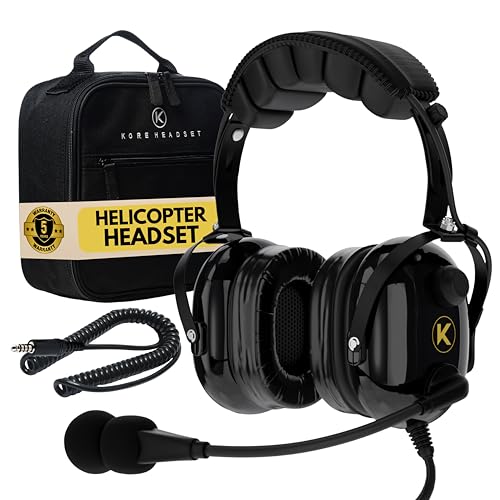
KORE H1 Helicopter Pilot Headset – Passive Noise Reduction — Best value with stated plug
The KORE H1 earns immediate trust in this guide for a clerical virtue: its title does the buyer’s homework out loud. Passive noise reduction, noise canceling microphone, mono, gel ear seal, adjustable headband, AUX port, U-174 plug and a headset bag are all stated in one breath. In a category where famous brands sometimes make you excavate the plug configuration, KORE prints it on the door. The gel ear seal deserves particular attention, because gel seals conform around sunglasses arms better than many foam seals do, and helicopter pilots, who fly in bright conditions over reflective terrain, wear sunglasses as equipment rather than as style.
Mono deserves an honest explanation rather than an apology. The H1 delivers mono audio, and in the helicopter panel context that is a legitimate configuration: many helicopter audio systems are mono at heart, radio communications are mono by nature, and the pilot’s core need is intelligibility of transmissions, not stereo staging. A buyer whose panel and habits are stereo-oriented should register the specification and decide consciously. A buyer whose world is radio clarity in a working cockpit may never miss the second channel, and the title’s candor lets that decision happen before money moves, which is all a guide can ask of a listing.
The AUX port adds a modest modern grace, a wired path for audio from a portable device where panel rules and operator policy allow it, and the included bag acknowledges the reality that headsets live in transit. KORE does not carry David Clark’s half-century of fleet history, and its long-term parts ecosystem is correspondingly younger; that is the honest trade behind its challenger positioning. For a student buying a first native U-174 headset, a private pilot equipping a second seat, or anyone who wants the plug stated in the title and gel comfort around their sunglasses, the H1 is a coherent, self-aware product that knows exactly which pilot it serves.
- Plug: U-174, stated explicitly in the listing title
- Noise reduction approach: passive, with gel ear seals
- Audio: mono, as stated in the title
- Extras named in the title: AUX port, adjustable headband, headset bag included
- Microphone: noise canceling, per the title
Strengths
- The most transparent title in the guide; plug, seal and audio configuration all declared.
- Gel seals accommodate sunglasses arms, a daily reality in helicopter cockpits.
- AUX port and included bag cover the small practicalities other listings leave to chance.
Trade-offs
- Mono audio will not suit pilots whose panels and preferences are stereo-centered.
- Younger brand means a shallower long-term parts and service track record than David Clark’s.
- Passive design shares the seal-only noise ceiling of the other non-ANR picks.
Best for: a student or private pilot wanting a native U-174 headset with gel seals and no configuration guessing.
Not suited for: a pilot requiring stereo audio delivery as a firm condition of their cockpit setup.

Bose A30 Bluetooth Aviation Headset – Lightweight Comfortable — Best ANR flagship
The Bose A30 is what the passive classics look like after forty years of materials science and signal processing have their say. Its title for this listing specifies the configuration that matters here, U174, and pairs it with the A30’s defining claims: a lightweight comfortable design, adjustable ANR and a noise cancelling microphone, with Bluetooth aboard. Adjustable active reduction is the thoughtful detail. Cockpits differ, flight phases differ, and a pilot’s desire for ambient awareness differs between a busy ramp and a quiet cruise; selectable levels of cancellation let the headset adapt to the moment rather than imposing one electronic personality on every phase of flight.
Bose’s comfort argument is structural. The A30 was designed to distribute its presence with low clamping force, betting that a long flight is won by what the pilot stops noticing. In a helicopter, where vibration and noise already tax the body, a headset that disappears physically while quieting the world electronically changes the end of the day: radio calls need less volume, listening effort drops, and the pilot steps out of the aircraft with measurably more of themselves left. That is the flagship proposition in one sentence, and the A30’s reputation among professional pilots rests on it more than on any single feature bullet.
Bluetooth, on an aviation headset, should be understood correctly. It pairs the headset with phones and tablets for ground operations, flight planning calls, and audio where the operator and regulations permit; the panel connection remains the wired U174 link, and the headset’s certification story is about that wired instrument. Battery discipline is the A30 owner’s standing duty, because ANR is an electronic feature with an appetite, and a flagship flown with dead batteries is a passive headset with delusions. Pilots who adopt a battery ritual, spares in the bag and a check on the preflight, will find the A30 the most complete instrument in this guide. Pilots who resent rituals should look honestly at the David Clarks, which will never once ask them for a battery.
One configuration warning, repeated because it is the costliest click in this category: the A30 is sold across aviation in more than one plug arrangement. This guide’s pick is the U174 configuration named in this listing’s title. If the listing in front of you says anything else in its plug description, you are looking at a sibling variant meant for a different panel, and no similarity of name or appearance changes that.
- Plug configuration in this listing: U174, stated in the title
- Noise reduction: adjustable ANR, active electronic cancellation
- Connectivity: Bluetooth, for pairing alongside the wired panel connection
- Design emphasis in the title: lightweight, comfortable, low-fatigue wear
- Microphone: noise cancelling, per the title
Strengths
- Adjustable ANR adapts cancellation to flight phase and cockpit, not just to a lab.
- Low-clamp comfort design targets the end-of-day fatigue that defines professional flying.
- Bluetooth covers ground communications and permitted in-flight audio pairing gracefully.
Trade-offs
- ANR depends on batteries; a neglected charge quietly demotes it to passive duty.
- Flagship positioning demands flagship care in handling and storage.
- Multiple plug variants exist across the model line, so configuration must be verified at checkout.
Best for: a professional or owner-pilot flying long rotary days who wants adjustable cancellation and low fatigue.
Not suited for: a pilot unwilling to maintain a battery routine, for whom a passive David Clark will serve more honestly.

LIGHTSPEED Zulu 3 Premium ANR Aviation Headset with Noise — Best long-tour comfort
Lightspeed built the Zulu line by listening to pilots complain about premium headsets, and the Zulu 3’s title for this listing removes the category’s central ambiguity in parentheses: Heli U-174 plug. What arrives is a premium ANR headset with noise cancelling and Bluetooth, configured natively for helicopters, from a company whose entire identity is aviation audio rather than a division of a larger electronics empire. That focus shows in the line’s priorities: ear seals engineered as a comfort system, a frame built for daily professional use, and audio tuned for the specific misery of rotor noise rather than for music first.
The Zulu 3’s long-standing reputation rests on endurance comfort. Tour pilots, instructors and commercial operators who wear a headset as a working uniform evaluate it across a season, not a demo, and the Zulu family earned its following in exactly that evaluation. The ear seal design distributes pressure over a broader area, the headband avoids the single hot spot that plagues lesser designs by hour three, and the ANR takes the low-frequency rotor burden off the pilot’s nervous system for the length of the duty day. Bluetooth handles the phone pairing that modern operations assume, from dispatch calls on the ramp to permitted audio in the air.
Positioned against the Bose A30, the Zulu 3 is a difference of philosophy more than of tier. Bose emphasizes adjustability of cancellation and a featherweight feel; Lightspeed emphasizes seal comfort and a robust, pilot-owned durability culture, including a maker known for standing behind working headsets. Neither is the correct answer for every head. The practical advice is cranial: if you can try both at a pilot shop or through a colleague, an hour of wear will tell you more than any guide, because at flagship level the remaining differences live on your particular skull. What can be said without reservation is that the Zulu 3 in Heli U-174 form is a native helicopter instrument of the first rank, not an adaptation.
Battery stewardship applies here as to every ANR pick: the cancellation is electronic, the Bluetooth is electronic, and the pilot who treats the headset’s power like fuel, checked and never assumed, will never discover its passive fallback mode at altitude.
- Plug configuration in this listing: Heli U-174, stated in the title
- Noise reduction: premium ANR with noise cancelling microphone system
- Connectivity: Bluetooth, per the title
- Design emphasis: long-duration seal comfort for professional duty days
- Maker focus: aviation-only manufacturer, per the brand’s positioning in this category
Strengths
- Native Heli U-174 configuration stated outright, with no variant ambiguity in this listing.
- Seal and headband comfort engineered for full professional duty days.
- Aviation-specialist maker with a service culture aimed at working pilots.
Trade-offs
- ANR and Bluetooth both draw on batteries that demand a standing routine.
- Premium tier ownership means premium care; it is not a flight-school bin headset.
- Fit preference versus the Bose flagship is personal and best settled by wearing both.
Best for: a tour or commercial pilot whose headset is a daily uniform and whose days are long.
Not suited for: a flight school equipping a fleet bin, where passive David Clarks absorb abuse more economically.

LIGHTSPEED Zulu 4 ANR Aviation Headset – with Dual Bluetooth — Best connected flagship
The Zulu 4 is Lightspeed’s newer flagship statement, and its title advertises the two ideas that distinguish it from the Zulu 3 above: dual Bluetooth and FrameFit ear seals, in the Heli U-174 configuration. Dual Bluetooth answers a thoroughly modern cockpit reality. The contemporary pilot’s audio world includes a phone and a tablet running flight software, and a headset that can maintain two Bluetooth relationships reduces the pairing-and-repairing shuffle that interrupts preflight flow. Used within an operator’s rules, it is the difference between a headset that joins your electronic flight bag ecosystem and one that merely tolerates it.
FrameFit ear seals address the other modern reality: pilots wear things on their faces. Sunglasses are near-universal in helicopter work, and every spectacle arm that crosses an ear seal is a small leak in the noise barrier and a pressure point in waiting. A seal designed to accommodate frames, which is the promise in the FrameFit name, protects both the ANR system’s working conditions and the pilot’s temples across a long day. Since active cancellation performs best when the passive seal beneath it is intact, seal engineering is not a comfort garnish on an ANR headset; it is part of the noise reduction system itself, and Lightspeed’s decision to headline it suggests the company understands its own physics.
Against its Zulu 3 sibling, the Zulu 4 asks the flagship buyer’s usual question: are the newer connectivity and seal ideas worth choosing the latest platform? For a pilot buying a headset expected to serve a decade, starting on the newer platform with the fuller Bluetooth story is a defensible default, provided the fit suits. For a pilot who found the Zulu 3’s fit perfect and whose operation needs one Bluetooth link at most, the older model remains entirely rational. Both are native U-174 instruments in these listings, both carry Lightspeed’s ANR approach, and the choice between them is about your devices and your face, which is exactly where flagship choices should be decided.
The standing ANR caveat completes the picture: dual Bluetooth and active cancellation are electronic luxuries with a power budget, and the Zulu 4 rewards the same battery discipline as every active pick in this guide. Build the ritual once and the flagship disappears into the flying, which is the highest compliment working equipment can earn.
- Plug configuration in this listing: Heli U-174, stated in the title
- Connectivity: dual Bluetooth, the fullest pairing claim in this guide
- Ear seals: FrameFit, designed with spectacle frames in mind per the name
- Noise reduction: ANR, active cancellation over the passive seal
- Platform position: Lightspeed’s newer flagship above the Zulu 3
Strengths
- Dual Bluetooth matches the phone-plus-tablet reality of modern flight bags.
- FrameFit seals defend both comfort and cancellation for sunglasses-wearing pilots.
- Newest platform in the guide for buyers planning a decade of service.
Trade-offs
- Richest electronic feature set carries the richest battery discipline in the guide.
- Advantages over the Zulu 3 narrow sharply for pilots with a single Bluetooth device.
- Flagship care and handling expectations apply, as with the Bose.
Best for: a connected professional pilot running phone and tablet together who wears sunglasses on every flight.
Not suited for: a single-device pilot who would pay for dual Bluetooth and never pair a second device.
A Field Guide to the Six: Plug, Power and Philosophy
| Headset | Plug | Noise approach | Power | Bluetooth |
|---|---|---|---|---|
| David Clark H10-13H | Helicopter variant | Passive | None | No |
| David Clark H10-36 | Helicopter model | Passive | None | No |
| KORE H1 | U-174, stated | Passive, gel seal | None | No, AUX port instead |
| Bose A30 | U174, stated | Adjustable ANR | Battery for ANR | Yes |
| Lightspeed Zulu 3 | Heli U-174, stated | ANR | Battery for ANR | Yes |
| Lightspeed Zulu 4 | Heli U-174, stated | ANR | Battery for ANR | Dual |
Read down the power column and the guide’s deepest division appears. Everything above the line runs forever on nothing; everything below it trades that immortality for quiet. Neither column is the correct one. The correct one is the one that matches the length of your flying days and the reliability of your charging habits, and only you know both of those numbers.
Which Buying Errors Ground Helicopter Headset Shoppers?
The costliest error is the variant error: ordering a beloved model in its general aviation dual-plug form and discovering the mismatch at the aircraft. It happens because model names are identical, photographs are identical, and the plug difference lives in a line of text the buyer skimmed. The defense is procedural. Read the plug description aloud at checkout, the way you would read a checklist item, and confirm U-174 or the helicopter variant in the actual listing being purchased. The second error is subtler: buying an adapter as the plan rather than as the backup. An adapter-dependent setup works until the day it is forgotten, frayed or borrowed, and in aviation the day a workaround fails is rarely a convenient one. Native plug first; adapter as the spare, never as the strategy.
The third error is philosophical mismatch. A student buys a flagship ANR headset for a training environment where it will be knocked around school ramps and shared cockpits, then winces at every scuff; or a working pilot buys passive to save money and spends the savings on fatigue across a season of long days. Match the instrument to the environment it will actually inhabit. The fourth error is neglecting the seal. On passive headsets the seal is the whole noise reduction system, and on ANR headsets it is the foundation the electronics build on; hardened, cracked seals quietly demote every pick in this guide, and they are cheap, scheduled maintenance compared with the headsets they protect.
Pilots comparing across the wider hangar may also want Best David Clark General Aviation Headsets for the fixed-wing side of the family story, Best General Aviation Headsets for the dual-plug world in its own right, and Best Aviation ANR Headsets when the active-cancellation question itself is the subject.
How Should You Care for a Helicopter Headset?
Treat the headset like the flight instrument it is. Store it in its bag or case, never loose in a vehicle footwell, and keep the microphone boom parked rather than bent into improvised shapes. Wipe ear seals after hot days, because sweat and sunscreen are solvents on a schedule, and inspect the cable along its length monthly; vibration environments find cable weaknesses early, and a fray discovered on the ground is a nuisance while the same fray discovered by static at altitude is a workload. For ANR models, batteries are a checklist culture: fresh cells or a charged unit before the flying day, spares in the bag, and a standing rule that the headset’s power state is verified, never assumed.
Fit checks deserve a seasonal rhythm. As seals age they stiffen, and the change is gradual enough to escape notice while comfort and noise performance erode together. Replacing seals on schedule restores a passive headset to its specification and gives an ANR headset back the foundation its electronics expect. Finally, keep the purchase paperwork and serial information with your other aircraft documents. Premium aviation headsets are serviced, warrantied and sometimes upgraded across years of ownership, and the pilot who can produce a serial number in one minute gets a different service experience from the pilot excavating a flight bag at the counter.
What Should You Buy for the Second Seat?
Owner-pilots eventually face a question the solo buyer never considers: what goes on the passenger’s head? The economics and the physics both point the same way. Passengers fly shorter legs, care most about hearing the pilot and the radio clearly, and subject a headset to the handling of someone who does not own it. That profile is the passive picks’ home ground. A David Clark in the second seat delivers intelligibility and survives being adjusted by unfamiliar hands, dropped on the ramp and stored imperfectly, while the KORE H1 equips a second seat with its plug stated, gel comfort for a passenger’s sunglasses and a bag to live in between flights. Reserving the ANR flagship for the pilot’s own head is not stinginess; it is matching each seat’s instrument to each seat’s actual duty.
There is also an instructional dimension. Instructors who fly with students in the student’s own new headset spend the first lesson partly as audio technicians, checking microphone position and volume habits. A school-standard passive headset shortens that ritual to nothing, because the instructor already knows the instrument on the student’s head. Students buying their first headset should weigh that hidden curriculum honestly: the finest ANR flagship cannot teach as efficiently as a familiar passive headset in a school environment, while the same flagship becomes the correct purchase the month the license is earned and the long solo days begin. Sequence matters in aviation purchases as surely as in checklists, and the headset wardrobe of a maturing pilot, passive first and active when the days lengthen, reflects a rational order rather than a compromise.
Operators carrying passengers commercially have a third consideration, which is fleet hygiene and turnaround. Headsets that wipe down quickly, take replacement seals in seconds and present no battery state to verify between legs keep a tour operation moving. That is the H10 family’s natural habitat, and it is why the bins of working operators look so monotonously green. The flagship ANR headsets serve the crew; the passive fleet serves the business, and a well-run operation owns both kinds without confusing their roles.
When in Your Flying Life Should You Buy Which Tier?
Before the first lesson, buy nothing until the school tells you its plug and its fleet practice, because a headset purchased in ignorance of the training environment is a gamble disguised as enthusiasm. During training, the passive tier is the rational instrument: durable, standard, and sufficient for legs measured in fractions of a day. The student who finishes training owning a healthy David Clark or KORE owns an asset with a permanent second career as a spare and passenger headset, so the purchase is never wasted even when it is eventually succeeded.
At the point where flying becomes work, or where personal flying stretches into full days, the ANR tier stops being a luxury and becomes fatigue management, which is a safety discipline wearing a comfort costume. Professionals should evaluate the Bose and Lightspeed flagships by wear, across the longest realistic day available to them, and should treat the trial as seriously as any other equipment evaluation in their operation. Private pilots flying occasional long cross-country days sit between the poles, and for them the deciding question is frequency: a flagship flown monthly must justify itself against a passive headset flown monthly, and often the honest answer is that the passive pick plus a future upgrade path serves better than flagship guilt.
Across every tier, the plug discipline never changes. U-174 native, verified in the listing, at every purchase, for every seat. Tiers are about noise philosophy and comfort across time. The plug is about whether the headset and the aircraft can speak at all, and it outranks every other line in this guide.
Final Recommendation
Start with the plug and end with your working day. Every pick here is a genuine U-174 helicopter instrument, so the remaining choice is philosophical: the David Clarks and the KORE for seal-based honesty that never needs a battery, the Bose A30 for adjustable cancellation in a featherweight frame, and the Lightspeed Zulus for seal comfort and, in the Zulu 4, the fullest Bluetooth story in the hangar. Students should buy durability, professionals should buy back their end-of-day sharpness, and everyone should verify the variant in the cart one final time before paying. In a cockpit, the right headset is the one you stop thinking about; choose the one whose compromises you will never have to think about either.
Frequently Asked Questions
Can I use my fixed-wing headset in a helicopter with an adapter?
Mechanically, an adapter cable can bridge a dual-plug GA headset to a helicopter’s U-174 socket, and as an occasional measure it works. As a primary plan it adds a dangling failure point, a forgettable component and a junction where audio quality can suffer, in the most vibration-rich cockpit in general aviation. Pilots who fly helicopters regularly should own a native U-174 headset, which is why no adapter appears among this guide’s picks and why every pick is a helicopter-plug instrument in its own right.
How can I tell the helicopter version of a model from the GA version?
Read the listing’s own configuration language. In this guide, the KORE states U-174 outright, the Bose states U174, and both Lightspeeds state Heli U-174 in their titles, while the David Clarks are listed as helicopter variants of their family. The dual-plug GA versions carry different designations and plug descriptions. If a listing does not let you confirm the plug in words, treat that silence as a stop sign rather than as a detail to resolve after delivery.
Is ANR worth it for helicopter flying specifically?
For long days, the case is strong, because rotor and transmission noise concentrates in the low frequencies where active cancellation outperforms a passive seal and where listening fatigue accumulates. For lessons, short tours and utility legs, passive headsets remain entirely adequate and far harder to kill. The honest variable is your duty length multiplied by your seasons of flying: the more hours the headset will mediate between you and rotor noise, the more the ANR flagships earn their keep.
What does mono mean on the KORE H1, and should I care?
It means the headset delivers a single audio channel rather than separate left and right channels, stated openly in its title. Radio communication, the core of cockpit audio, is mono by nature, and many helicopter panels are mono systems. A pilot whose priority is transmission clarity in a working cockpit may never notice. A pilot with a stereo panel who values stereo audio should choose one of the other picks consciously, which is exactly the decision the KORE’s transparent title enables.
Can I use the Bluetooth on these headsets for radio communication?
No. The panel connection that carries your radio transmissions is the wired U-174 link on every pick here. Bluetooth pairs the headset with phones and tablets for ground use and for audio functions where an operator’s rules permit, and on the Zulu 4 two such devices can be paired. Think of Bluetooth as the headset’s relationship with your flight bag, and the plug as its relationship with the aircraft, and you will never confuse their roles at a critical moment.
How long should an aviation headset last?
Measured in years and often in decades for the passive David Clarks, whose wear parts are replaceable and whose design contains nothing electronic to age. ANR flagships add batteries and circuitry to the lifespan equation, and their longevity depends on handling and power habits, though both makers here build for professional service lives. Across all six, ear seals are the scheduled replacement that keeps performance honest, and the headset that is stored cased, wiped down and seal-maintained will outlast an identical one lived loose in a flight bag by an embarrassing margin.
Should a student buy the same headset the school uses?
Usually yes for the first purchase, provided it is the helicopter-plug variant as every pick here is. Familiarity removes a layer of friction from lessons where attention belongs on flying, and a school-standard passive headset retains permanent value as a spare afterward. The exception is the student with a known sensitivity to noise or pressure who has discussed it with their instructor; comfort that keeps a student flying is a training investment, and in that case an ANR model chosen deliberately, and verified as the U-174 variant, is a reasonable first purchase rather than an extravagance.
What should I verify in the first flight with a new headset?
Four things, in order. Sidetone and radio clarity at your normal speaking voice, with the microphone at the corner of your mouth. Seal behavior with your actual sunglasses on, not in theory. Comfort at the forty-minute mark, when initial impressions have faded and pressure points begin their testimony. And, on an ANR model, the battery state habit: confirm you know where the indicator lives and what a low state looks like before it surprises you in flight. A headset that passes those four checks in your own aircraft has been properly introduced to your flying; everything after is service.
Do helicopter headsets work in fixed-wing aircraft?
The plug that defines this guide is the obstacle in reverse: a U-174 helicopter headset does not plug directly into a fixed-wing panel built for dual plugs. Adapters exist for that direction too, with the same workaround status they carry everywhere in this guide. Pilots who genuinely split their flying between rotor and fixed-wing either keep a headset for each world or accept the adapter as a deliberate, inspected part of their kit. What no pilot should do is assume the crossover in either direction, because the panels were standardized separately and the plugs are strangers by design.
Why do so many helicopter pilots still choose passive headsets?
Because in their working pattern the passive virtues compound: no battery can be forgotten, no circuit can fail on a cold morning, no scuff matters, and the headset that works today will work identically in a decade with nothing but fresh seals. Professionals whose days are short legs and constant handling are not behind the times; they are optimizing for a different variable than the long-haul pilot, which is certainty. The ANR flagships win the quiet contest. The passive classics win the certainty contest, and cockpits have always respected certainty.
Related Guides
- Best David Clark General Aviation Headsets
- Best General Aviation Headsets
- Best Aviation ANR Headsets


