What's inside
- Key Takeaways
- Quick Picks
- How Did We Judge a Category Where the Headline Feature Is Often Missing?
- What Does aptX Actually Do, and Why Do Buyers Chase It?
- How Can You Verify a Codec When a Listing Will Not Tell You?
- The Six Neckbands, Pick by Pick
- Why Choose a Neckband Over True-Wireless Buds at All?
- How Should You Read Battery Claims in This Category?
- Codec Evidence, Battery Claims, and Sealing — the Six Neckbands Compared
- How Do You Get the Best From a Neckband Day to Day?
- Which Neckband-Buying Mistakes Cost the Most?
- Final Recommendation
- Frequently Asked Questions
- Related Guides
As an Amazon Associate I earn from qualifying purchases. This post may contain affiliate links at no extra cost to you.
widgetverdict.com is reader-supported. When you buy through links on our site, we may earn an affiliate commission.
Where to buy: All six neckband models here sit on Amazon, but shop the codec claim before the colour: only two of the six listings actually document an aptX-family codec — and that distinction is the whole story here.
The neckband is the most practical shape in wireless audio: a light collar that carries the battery and controls, earbuds that retract or magnetically dock when not in use, and nothing to fish out of a pocket when a call arrives. Shoppers searching for the best neckband headsets bluetooth aptx are usually chasing a specific promise inside that practical shape — the aptX codec family’s cleaner, lower-latency Bluetooth audio. This guide honours that search honestly, and honesty requires a warning up front: of the six listings in this roundup, exactly two name an aptX-family codec in their titles. One states aptX; one states aptX HD. The other four listings say nothing about codecs at all, and this guide will not claim aptX for them — their spec boxes record the silence, each in its own words, and the buying-guide sections explain how to verify a codec before money changes hands.
That split is not a defect in the roundup; it is the most useful thing the roundup can show you. The four silent listings are strong neckband products on other axes — a 200-hour battery claim, a heavy-duty work model, waterproof sport designs — and they are included because many buyers who start by searching for aptX actually need endurance or durability more. But if aptX is your requirement — because your phone transmits it, because you watch video and hate lip-sync drift, because you have heard the difference on your own music — then only two picks here can be recommended on evidence, and the article says which two, every time the subject arises. Read the codec sections first if that is you; read the endurance sections first if it is not.
Key Takeaways
- Only two of the six listings name an aptX-family codec: the Retractable Neckband (aptX) and the HomeSpot JY300 (aptX HD, plus LC3 and Auracast readiness).
- The other four listings — N18, DEWALT, TERUBIN, Kinobo — are silent on codecs in their titles; no aptX claim is made for them anywhere in this guide.
- A codec only works when both ends speak it: your phone or laptop must also support aptX or aptX HD for the benefit to exist.
- Endurance splits the field dramatically — stated playtimes run from 20 hours to the TERUBIN’s claimed 200 hours.
- Water resistance is stated on four listings (IPX4 on the aptX neckband; IPX7 on the N18 and Kinobo; waterproof claims on the TERUBIN).
- Verify codecs in the manufacturer’s full specification, not the product name — a listing title that omits the codec is telling you something.
Quick Picks
| Pick | Badge | Why it earns its place |
|---|---|---|
| Retractable Neckband Bluetooth Headphones (aptX) | The documented aptX pick | aptX stereo stated in the listing, retractable buds, vibration call alert, CVC 6.0 noise cancelling, IPX4, 20H playtime. |
| HomeSpot JY300 Neckband Headphones (aptX HD) | The aptX HD flagship | aptX HD and LC3 support stated, Auracast ready with app support, and a 40-hour battery — the codec completist’s pick. |
| N18 Neckband Bluetooth Earbuds | The light waterproof all-rounder | Bluetooth 6.0, IPX7 waterproofing, ultra-lightweight build, magnetic earbuds, 20H playtime — codec unstated. |
| DEWALT Heavy Duty Neckband Headphones | The jobsite neckband | Heavy-duty build, 30H runtime and noise isolation from a tool brand — codec unstated in the listing. |
| TERUBIN Neckband Bluetooth Headphones (200H) | The endurance outlier | A claimed 200-hour playtime and waterproofing — the battery-first pick, codec unstated. |
| Kinobo Neckband Bluetooth Headphones (120H) | The long-haul sport pick | A claimed 120 hours, Bluetooth 6.0, IPX7 waterproofing and a TF card slot — codec unstated. |
How Did We Judge a Category Where the Headline Feature Is Often Missing?
We applied a rule this category badly needs: a codec exists in this guide only where a listing states it. Product names, brand reputations, and chipset gossip were all disqualified as evidence. That rule produces the roundup’s shape — two documented codec picks and four picks sold on other virtues — and each of the four carries its codec silence openly in its spec box, phrased around that product’s own documentation, so a reader can see at a glance which purchases are codec-certain and which are codec-unknown. Where a listing did state a codec, we stated it precisely: aptX on the Retractable Neckband, aptX HD on the HomeSpot JY300, alongside its LC3 support and Auracast readiness.
Beyond codecs, we weighted the axes neckband buyers actually live with. Battery endurance, because the neckband’s whole appeal is a device that is simply always ready — the stated figures here span 20 to 200 hours, an absurd range that itself deserves scrutiny, and the pick sections treat the largest claims as claims to verify rather than facts to repeat. Water resistance, because neckbands live at gyms, on runs, and on jobsites. And call features — vibration alerts, noise-cancelling microphones — because for a large share of neckband owners the device is a phone tool first and a music tool second.
What Does aptX Actually Do, and Why Do Buyers Chase It?
Bluetooth audio is compressed for transmission, and the codec is the compression language. The baseline every Bluetooth audio device speaks is SBC — serviceable, universal, and nobody’s idea of high fidelity. aptX, from Qualcomm, compresses more cleverly: it preserves more of the music’s detail at a similar bitrate and, just as importantly for many buyers, it transmits with lower latency, so the sound of a video stays married to the picture. aptX HD raises the ceiling further, carrying higher-resolution audio for listeners whose music files and hearing can use it. LC3, the newer codec the HomeSpot JY300 also names, is the Bluetooth LE Audio standard’s answer — efficient and modern — and Auracast, which the same listing claims readiness for, is the broadcast system that will let one source feed many listeners in public spaces.
Two conditions gate all of this, and buyers ignore both at their expense. First, the codec is negotiated between source and headset: an aptX headset paired with a phone that does not transmit aptX falls back to a shared codec, usually SBC, and the aptX you paid for never happens. Many Android phones support aptX; many other devices do not, and the answer lives in your phone’s specification, not in the headset’s box. Second, the benefit scales with the source material and the listener: aptX’s clarity shows on well-recorded music in a quiet room, and matters less on a podcast heard over a train. None of this diminishes aptX — it remains the single most meaningful audio upgrade in this product class — but it explains why this guide insists on documented support and a compatible phone before calling any pick “the aptX one”.
There is a hierarchy of codec needs hiding inside this topic, and placing yourself in it honestly saves money. At the base sit speech listeners — podcasts, audiobooks, calls — for whom every codec here, documented or not, is effectively transparent, because speech survives compression gracefully. Above them sit casual music listeners in noisy places, where the environment masks what a better codec preserves. Then come attentive music listeners in quiet rooms, where aptX earns its reputation, and at the top the high-resolution collectors and the screen-first users, for whom aptX HD and low latency are respectively the point of the purchase. The six picks map onto that hierarchy without any of them being “bad”: the undocumented four serve the lower tiers admirably on other virtues, and the documented two exist for the upper tiers. The only genuine error is buying for a tier you do not inhabit — in either direction. Music listeners may shrug at compression differences; video watchers cannot shrug at a voice arriving a blink after the lips move, and gamers least of all. The HomeSpot JY300’s listing explicitly courts gaming alongside its aptX HD support, which is the right pairing of claim and audience. If your neckband will serve films, calls with video, or games, codec choice is a picture-quality decision as much as a sound-quality one.
How Can You Verify a Codec When a Listing Will Not Tell You?
Treat the listing title as the first witness, not the last. When a title names the codec — as two here do — the claim is on the record and can be held against the product. When a title is silent, go to the manufacturer’s own specification page or manual for the exact model, and look for the codec list in the Bluetooth section; a maker who supports aptX almost always prints it there, because it is a selling point worth the ink. Silence in both places should be read as absence: assume the headset speaks SBC and AAC-class baseline codecs until documentation proves otherwise, and price it accordingly.
One more verification source is often overlooked: the chipset conversation in owner communities and teardowns, where the Bluetooth chip inside a model gets identified and its codec support read off the chipmaker’s own datasheet. That evidence is genuinely useful — a chip that cannot speak aptX settles the question negatively with authority — but treat it as corroboration rather than a substitute for the manufacturer’s word, because manufacturers can and do enable or omit codecs in firmware on the same silicon. The hierarchy of evidence runs: manufacturer’s specification for your model first, the negotiated codec your phone reports second, community chipset findings third, and advertising adjectives nowhere. Most Android phones report the active Bluetooth codec in their developer options or Bluetooth settings while audio plays, and many music apps display it as well. Pair the headset, play something, and read what was actually negotiated — that screen is the ground truth of your purchase, and checking it inside the return window converts codec marketing into codec fact. Buyers of the four undocumented picks here should run exactly that test if codec matters to them; buyers of the two documented picks should run it anyway, to confirm their phone is holding up its end of the negotiation.
Finally, beware the adjective fog around this subject. Phrases like “HD sound”, “HiFi stereo” — the Kinobo listing uses the latter — and “high-definition audio” describe aspirations, not codecs, and appear on products with entirely ordinary Bluetooth stacks. The only words that certify a codec are the codec’s own name, printed by the manufacturer, for that model. This guide has applied that standard to itself throughout: where you see aptX claimed below, the listing claimed it first.
The Six Neckbands, Pick by Pick

Retractable Neckband Bluetooth Headphones (aptX) — The documented aptX pick
This is the straightforward answer to the search that brought you here: a neckband whose listing states aptX stereo outright, wrapped in the format’s most convenient wearing idea — retractable earbuds that spool into the collar when a conversation, a doorway, or a till needs your ears, and pull out to exactly your length when the music resumes. Retraction sounds like a gimmick until you have lived with fixed cables snagging on gym equipment and desk edges; as a daily mechanism it is the difference between buds that are always where you left them and buds that migrate. The listing adds a vibration call alert — the collar buzzes against your neck, so a call announces itself in a pocketed-phone, noisy-room world where a ringtone loses — and CVC 6.0 noise cancelling for the microphone side of calls.
The retractable mechanism deserves a closer look, because it changes the neckband’s daily geometry. On a fixed-cable model, the buds hang at a length chosen by the manufacturer, and the surplus cable loops against your chest, catches on buttons and seatbelts, and transmits every brush of fabric as noise up the wire. Retraction lets each side pay out only the length your neck and ears actually need, and spools the rest away — the hanging loop shrinks, the snag points vanish, and the buds return to their housings with a tug rather than dangling when you take them out. For office workers who drop their buds twenty times a day to talk to colleagues, that return mechanism is the feature they will still be praising in month six, long after the codec has become simply how their music sounds.
Its stated numbers are the modest, believable kind: IPX4 sweatproofing, which covers workouts and drizzle rather than submersion, and 20 hours of music playtime, which covers a working week of commutes or several long gym sessions between charges. Read against the roundup’s endurance outliers, 20 hours looks small; read against the codec table, this is one of only two picks whose audio claim is documented, and for the buyer whose phone transmits aptX and whose listening is music and video, that documentation is worth more than a battery figure measured in weeks. This is the pick to buy when the codec is the point and the neckband is the vehicle.
- Codec: aptX stereo, stated in the listing
- Earbuds: retractable into the neckband
- Call features: vibration call alert; CVC 6.0 noise cancelling for calls
- Water resistance: IPX4 sweatproof
- Playtime: 20H music playtime as stated in the listing
Strengths
- Documented aptX support — one of only two codec-certain picks in this roundup.
- Retractable buds end cable snag and give an exact fit length every time.
- A vibration alert catches calls that a ringtone would miss in noisy settings.
Trade-offs
- 20 hours is the joint-shortest endurance here — weekly charging is part of ownership.
- IPX4 shrugs off sweat and drizzle but is not a swimming or downpour rating.
- The retraction mechanism is a moving part; it rewards users who pull the buds gently.
Best for: an aptX-phone owner who listens to music and video daily and wants the retractable, always-ready neckband format.
Twenty hours of playtime is the ceiling its title states, so anyone chasing multi-day endurance should look past the aptX badge to the 200-hour listings below.

HomeSpot JY300 Neckband Headphones (aptX HD) — The aptX HD flagship
The JY300 is the most codec-complete listing in this roundup by a distance: aptX HD for high-resolution wireless audio, LC3 support for the LE Audio generation, Auracast readiness for the broadcast future, app enhancement, and a 40-hour battery — double the aptX neckband’s endurance — stated in the same breath. Its listing names gaming among its uses, which aligns with the low-latency logic of the aptX family, and workouts and commuting alongside. If your phone supports aptX HD and your standard is “the best-documented wireless audio in a neckband”, this is the only pick that answers in full.
There is a listening scenario where the JY300’s documentation pays off immediately, and it is worth picturing because it separates codec theory from codec practice. A commuter with a capable Android phone, a library of well-recorded albums, and a forty-minute train ride sits in the one environment where neckband listening gets serious: seated, settled, and attentive. There, aptX HD’s extra resolution is not an abstraction — it is the difference between a compressed haze around cymbals and voices and the recording as it was mastered, delivered by a collar that also survives the walk at both ends. Add the gaming case at home, where the aptX family’s latency keeps effects synchronised with the screen, and the JY300’s specification reads less like a feature list and more like a description of two specific, common evenings.
The future-facing claims deserve a calm reading. Auracast readiness and LC3 support are genuine specifications, but their usefulness depends on the transmitters around you — Auracast broadcasts are arriving in airports, gyms, and venues gradually, not universally — so buy the JY300 for what it does today with aptX HD and its battery, and treat the LE Audio features as a head start rather than a present-tense benefit. The app support cuts both ways in the usual manner: it promises adjustment and updates, and it asks you to install an app for a pair of earbuds. For the codec-driven buyer this roundup was built for, though, the JY300 is the flagship by documentation, and documentation is the currency this entire category trades in.
- Codecs: aptX HD and LC3 support, stated in the listing
- Broadcast: Auracast ready, with app enhancement
- Battery: 40 hours as stated in the listing
- Stated roles: gaming, workouts, commute
- Water resistance: the listing title does not publish an IP rating for this model — check HomeSpot’s specification if workouts in rain are planned
Strengths
- aptX HD is the highest documented codec tier in this roundup.
- LC3 and Auracast readiness future-proof the purchase beyond today’s phones.
- Forty hours doubles the other documented-codec pick’s endurance.
Trade-offs
- aptX HD’s benefit needs a phone that transmits it and music that rewards it.
- Auracast sources are still rare in daily life, so that readiness is potential, not present use.
- No IP rating in the title — wet-weather athletes should verify before relying on it.
Best for: a listener with an aptX HD-capable phone who wants the most complete codec documentation available in a neckband, plus gaming and commuting range.
Without an aptX HD source at the phone end, its flagship codec never engages and every track falls back to plain Bluetooth, however good the hardware is.

N18 Neckband Bluetooth Earbuds — The light waterproof all-rounder
The N18 makes its case without any codec claim at all, and this guide respects the honesty of that: its listing leads with Bluetooth 6.0, an ultra-lightweight build, IPX7 waterproofing, magnetic earbuds that snap together at the chest, a microphone, deep bass tuning, and 20 hours of playtime. That is a coherent sport-and-commute product — light enough to forget, sealed enough for rain and sweat and a rinse under the tap, current-generation Bluetooth for a stable link — sold on wearing virtues rather than audio-codec ones. Buyers whose listening is podcasts, calls, and workout playlists will find the codec question genuinely academic here. The magnetic snap deserves its sentence: buds that click together at the chest end the small hunt that opens every listening session with loose designs, and on a run they keep the unused bud from bouncing against a collarbone for five kilometres. Small mercies of that kind, repeated daily, are what owners actually praise about neckbands a year in — long after codec debates have faded — and the N18’s listing is essentially a bundle of them.
Its spec box, accordingly, records the codec position plainly: the N18’s listing title names no audio codec, so none is claimed, and a buyer for whom aptX is a requirement should either verify codec support in the manufacturer’s full documentation or choose one of the two documented picks above. What can be said on evidence is that Bluetooth 6.0 is the newest Bluetooth generation in this roundup alongside the Kinobo, which speaks to connection stability and efficiency rather than to any particular audio codec. As an all-rounder at the light end of the format, the N18 is easy to recommend — for the job its listing actually describes.
- Bluetooth: 6.0
- Water resistance: IPX7 waterproof
- Build: ultra-lightweight; magnetic earbuds
- Playtime: 20H as stated in the listing
- Codec: the N18’s listing title is silent on audio codecs — consult the manufacturer’s full specification if aptX matters to you, as it is not claimed here
Strengths
- IPX7 sealing is the joint-strongest water rating in this roundup.
- An ultra-light build and magnetic buds suit all-day, forget-it-is-there wear.
- Bluetooth 6.0 is current-generation for connection stability.
Trade-offs
- No codec is documented in the title, so aptX seekers cannot buy it on evidence.
- 20 hours matches the aptX pick’s endurance without matching its codec.
- Bass-forward tuning flatters workouts and may crowd quieter, detailed listening.
Best for: a runner or commuter who wants the lightest, best-sealed everyday neckband and listens to speech and playlists rather than high-resolution music.
Codec hunters should pass: the title documents Bluetooth 6.0, IPX7 sealing and 20-hour playtime, yet names no aptX variant anywhere in its specification.
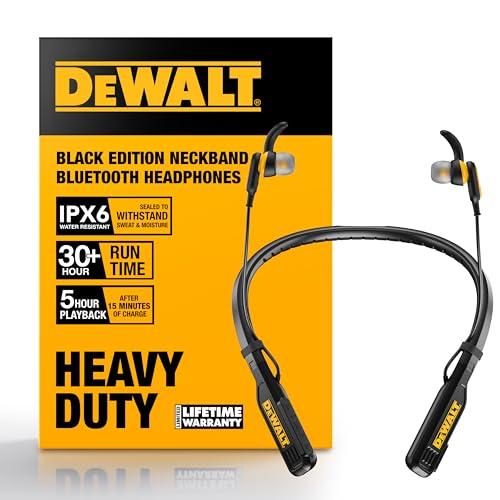
DEWALT Heavy Duty Neckband Headphones — The jobsite neckband
DEWALT’s entry is the workwear of this roundup: a heavy-duty magnetic neckband with a stated 30-hour runtime, noise isolation, hands-free calling with a microphone, in the black livery of the tool brand. Its imagined day is not the gym but the site and the workshop — a collar that survives being dropped in a toolbox, buds that isolate against machinery noise while the radio plays, and a battery that covers most of a working week of breaks, commutes, and hands-free calls. For tradespeople, that brand context is not decoration; it signals the product was specified by people who know what a neckband meets in a site bag. Magnetic buds matter more in that working day than in any other here: gloves off, buds out for the foreman’s word, buds snapped back together at the chest where they cannot dangle into a saw’s path or a bucket of fixings. The neckband format is arguably safer on a site than any loose-bud design for exactly that reason — nothing small enough to drop into machinery, nothing trailing long enough to snag — and a heavy-duty collar leans into the format’s native advantage rather than fighting it.
The codec discipline applies here without exception: DEWALT’s listing title names no audio codec, and so this guide claims none for it — the specification to verify in DEWALT’s documentation if aptX is on your requirement list. What the title does support is the endurance and isolation story, and one caution rides on the word isolation: passive noise isolation from fitted buds is not hearing protection, and a jobsite with a documented protection requirement needs rated protection, not a neckband, however heavy-duty its build. Judged as a durable communications-and-music collar for working days, the DEWALT is the roundup’s specialist; judged as an audiophile codec purchase, it offers no evidence, and this guide will not manufacture any.
- Build: heavy duty, magnetic earbuds, black edition
- Runtime: 30H as stated in the listing
- Audio: noise isolation (passive, from fit) per the listing
- Calls: hands-free with microphone
- Codec: DEWALT’s title for this model does not mention an audio codec — the manufacturer’s datasheet is the place to confirm codec support before buying for aptX
Strengths
- A heavy-duty build briefed for toolbags and site conditions, not desk drawers.
- Thirty hours covers most of a working week between charges.
- Passive isolation suits noisy environments where awareness breaks are still needed.
Trade-offs
- No codec is stated in the title, so codec-driven buyers have nothing to rely on.
- Passive isolation is not rated hearing protection — site rules still apply.
- The work-first tuning and build will feel overbuilt for pure office use.
Best for: a tradesperson or workshop user who wants a rugged neckband for music and hands-free calls across a working week.
Not suited for: a worker whose site mandates documented hearing protection as the ear’s only cover, because a neckband’s isolation is not a protection rating.

TERUBIN Neckband Bluetooth Headphones (200H) — The endurance outlier
The TERUBIN’s listing makes one enormous claim and builds the product around it: 200 hours of playtime. Taken at face value, that is more than eight days of continuous listening, or a month of commutes, between charges — a figure so far beyond the category’s norms that this guide presents it exactly as what it is, the manufacturer’s stated claim, and advises the obvious verification: endurance claims vary with volume and codec, and a buyer whose purchase rests on this number should test the first charge against their own listening week. If the claim holds even approximately, the TERUBIN rewrites the ownership routine — charging becomes a monthly event rather than a weekly chore, and the neckband becomes the one device that is never dead when grabbed.
Who actually needs a month between charges? More people than the gym-and-commute marketing imagines. The long-haul driver whose cab is their office and whose charging points are shared; the site worker on a remote rotation where a forgotten cable is a week of silence; the traveller crossing time zones with a bag already full of other devices’ chargers; the older listener who simply does not want another device demanding nightly attention. For those owners, endurance is not a spec-sheet trophy but the entire product, and a headset that asks for power four times a year respects their lives in a way a technically superior, weekly-charged rival does not. The TERUBIN is aimed squarely at them, and its claim deserves testing precisely because, if true, it is decisive.
The rest of the listing is conventional in the good sense: stereo neckband earbuds with a microphone, waterproofing claimed without an IP numeral in the title, and sports, workout, and office roles named. The codec entry follows this guide’s rule without bending: the TERUBIN’s title names no audio codec, so none is claimed here, and its buyer’s codec verification path runs through the manufacturer’s documentation. This is the battery-first pick of the six, recommended to the traveller, the field worker, and the chronically uncharged — buyers for whom a dead headset is the only audio failure that has ever actually ruined their day.
- Playtime: 200H as claimed in the listing — the largest figure in this roundup by a wide margin
- Water resistance: described as waterproof in the listing, without an IP numeral in the title
- Calls: microphone included
- Stated roles: sports, workout, office
- Codec: no codec is named anywhere in the TERUBIN listing title — buyers needing aptX should obtain the manufacturer’s codec list for this model before ordering
Strengths
- A claimed 200-hour endurance dwarfs every other figure here, if it holds in use.
- Charging becomes a rare event — the format’s always-ready promise, maximised.
- A plain, versatile brief covers sport, work, and office without specialisation.
Trade-offs
- The headline figure is a claim to verify against your own volume and usage, not a measurement this guide can confirm.
- Waterproofing is claimed without a published IP numeral in the title.
- No codec is documented, so it cannot answer an aptX requirement on evidence.
Best for: a heavy listener, traveller, or field worker whose overriding need is a neckband that is never out of charge.
Paper proof is where this listing runs thin — 200 hours of playtime are claimed, but no named codec and no numbered IP rating stand behind the endurance.

Kinobo Neckband Bluetooth Headphones (120H) — The long-haul sport pick
The Kinobo splits the difference between the TERUBIN’s endurance claim and the N18’s sport specification: a claimed 120 hours of playtime, Bluetooth 6.0, IPX7 waterproofing, noise cancelling, HiFi stereo positioning, and a feature none of the other five offers — a TF card slot, letting the neckband play music stored on a card with no phone involved at all. That slot is a genuinely different idea of independence: the runner who leaves the phone at home, the worker whose phone is banned from the floor, the traveller conserving a phone battery across a long day. One hundred and twenty hours is, like the TERUBIN’s figure, a manufacturer’s claim to be tested against your own usage — but even discounted heavily, it describes a device charged a handful of times a season.
The codec note for the Kinobo must be written carefully, because its listing uses the phrase “HiFi Stereo”, which is a sound-quality aspiration and not a codec name. Following this guide’s standing rule, no aptX or other codec is claimed for the Kinobo: its title names none, and a buyer who needs one documented should consult the manufacturer’s specification for this model or choose a documented pick. What the listing does document — Bluetooth generation, IP rating, endurance claim, card playback — makes the Kinobo the most self-sufficient sport neckband here, and for phone-free listening it has no rival in the six.
- Playtime: 120 hours as claimed in the listing
- Bluetooth: 6.0
- Water resistance: IPX7 waterproof
- Playback: TF card slot for phone-free music
- Codec: the Kinobo listing title advertises HiFi stereo sound but names no Bluetooth audio codec — treat codec support as unconfirmed until the manufacturer’s specification says otherwise
Strengths
- A TF card slot enables genuinely phone-free listening — unique in this roundup.
- IPX7 sealing plus a 120-hour claim suits sport across a whole season.
- Bluetooth 6.0 keeps the phone link current when the phone does come along.
Trade-offs
- The 120-hour figure is a claim to verify, like all outsized endurance numbers.
- Card playback means managing a music library on a card, a chore streaming has retired for most listeners.
- “HiFi stereo” is not a codec — aptX remains undocumented for this model.
Best for: a runner or worker who wants phone-free, card-based music and week-spanning endurance in a sealed sport build.
Not suited for: a listener whose library lives in streaming apps and whose codec requirement is documented aptX, because the card slot serves neither.
Why Choose a Neckband Over True-Wireless Buds at All?
The question deserves a direct answer, because true-wireless buds dominate the advertisements while neckbands dominate certain working days. A neckband cannot be lost one bud at a time down a drain or a train platform gap; its battery is measured in days rather than the hours a charging case metes out; its controls are physical, findable by touch, and attached to something too large to misplace in a pocket’s lint. For calls, the collar puts a microphone and a vibration motor against your body — a call is felt, not just heard. Runners and riders get a device that stays put when a bud would work loose; workers get a collar that survives being worn under a hi-vis and over a fleece in the same hour.
The honest costs run the other way. A neckband is visible in a way buds are not, it has cables — however short, however retractable — where buds have none, and its audio ceiling, codec for codec, is set by the same Bluetooth link, so the format itself buys convenience rather than fidelity. That is precisely why the codec question matters so much inside this format: since the neckband’s virtues are practical, the audio has to justify itself on documentation, and a buyer choosing between these six is really choosing which practical virtue — codec certainty, endurance, sealing, durability, or phone-free playback — their own day values most. The format’s fans are not behind the times; they have simply priced the risk of a lost bud and a dead case, and declined to pay it.
How Should You Read Battery Claims in This Category?
Battery figures are the softest numbers in consumer audio, and this roundup contains the full spectrum of their reliability. At one end sit the modest, specific claims — 20 hours of music playtime, 30 hours of runtime, 40 hours of battery — stated plainly and roughly in line with what the format’s physics allows. At the other end sit 120 and 200 hours, figures that imply a collar carrying a genuinely large cell and a test protocol run at gentle volume. Neither end should be read naively. The modest figures are typically measured under the same favourable conditions as the enormous ones; the enormous ones are not necessarily false, merely unverifiable from a listing, and both kinds shrink under real use — high volume, a hungry codec, cold weather, and a battery ageing through its second year.
The buyer’s defence is to convert claims into a personal unit: days of your listening between charges. Divide any claim by your honest daily listening hours, then halve the result for the TERUBIN and Kinobo-class figures until your own first month proves otherwise, and you will land near the truth for every model here. Note also what endurance buys beyond convenience: a battery cycled weekly ages four times faster than one cycled monthly, so the long-endurance models are not merely lazier to own — their cells should hold their capacity longer across the years, which is a durability argument hiding inside a battery claim. Judge the claim sceptically, by all means; just judge it in days and cycles, not in raw hours admired or mocked.
Codec Evidence, Battery Claims, and Sealing — the Six Neckbands Compared
| Neckband | Codec in listing title | Stated playtime | Water rating in title | Signature feature |
|---|---|---|---|---|
| Retractable Neckband | aptX | 20H | IPX4 | Retractable buds, vibration alert |
| HomeSpot JY300 | aptX HD (+ LC3) | 40 hours | Not in title | Auracast ready, app support |
| N18 | None named | 20H | IPX7 | Ultra-light, magnetic buds |
| DEWALT Heavy Duty | None named | 30H | Not in title | Heavy-duty work build |
| TERUBIN | None named | 200H claimed | Waterproof, no numeral | Endurance claim |
| Kinobo | None named | 120H claimed | IPX7 | TF card playback |
How Do You Get the Best From a Neckband Day to Day?
Start with the negotiation your ears cannot hear: confirm what codec your phone and the headset actually agreed on. On most Android phones the active codec is visible in Bluetooth settings or developer options while music plays; check it once, and you will know whether your aptX purchase is delivering aptX or quietly running a baseline codec because the phone declined. If the phone is the limiting side, no headset upgrade will change the result — the honest fix is to know it, and to judge the headset on its other virtues with open eyes.
Fit is the second daily variable, and neckbands forgive more than most formats: the collar carries the weight, the buds carry only themselves. That weight distribution is why a neckband can be worn through a full shift in a way sealed in-ear buds rarely tolerate — there is no battery mass hanging from the ear canal, and the collar’s contact is spread across the neck rather than concentrated in two earpieces. Wearers who remove ordinary buds by lunchtime with aching ears routinely finish the day in a neckband without thinking about it, and for call-heavy jobs that endurance of fit is worth more than any single specification in this roundup. Use the tip size that seals without pressure, route the cables — on the non-retractable models — so they do not saw at the collar’s edge when you turn your head, and learn the collar’s controls by touch in the first week, because a neckband’s promise is that the phone stays in the pocket. For calls, remember that the microphone lives on the collar, not at your mouth: in wind or a loud street, a hand cupped near the collar or a step into shelter does more for your caller’s comprehension than any noise-cancelling label, though the CVC-equipped aptX pick here works the problem from the electronics side as well.
Charging habits interact with codec choice in a way spec sheets never mention: the higher codecs and the loudest volumes draw the battery hardest, so the listener who buys aptX HD and runs it at full tilt on a train is living at the expensive end of their headset’s endurance curve, while a podcast listener at half volume on a baseline codec coasts. When you calibrate your own days-per-charge figure in the first fortnight, calibrate it on your real content at your real volume — a figure learned on quiet evening listening will betray you on the first loud, codec-hungry travel day, which is of course the day a dead neckband hurts most. An IPX4 neckband wants a wipe after a sweaty session, not a rinse; an IPX7 model tolerates the rinse and the rainstorm. Dry the buds before they dock or retract, charge on a rhythm matched to the model’s real endurance rather than its claimed one — you will learn your own figure within a fortnight — and treat the very large endurance claims in this roundup as hypotheses your first month of use will confirm or correct. A neckband is a low-maintenance device by design; the owners who get years from one are simply the owners whose habits match the ratings they actually bought.
Which Neckband-Buying Mistakes Cost the Most?
The expensive mistake in this category is assuming a codec from a product’s name, its price, or its marketing adjectives. Buyers pay aptX money for headsets whose documentation names no codec, then blame Bluetooth for the ordinary sound that arrives. The defence is the discipline this guide has applied throughout: the codec exists where the manufacturer prints its name for that model — in the title, the specification, or the manual — and nowhere else. The second mistake is the mirror image: dismissing the four undocumented picks as failed aptX products, when three of them were never codec products at all and excel at endurance, sealing, or durability instead. Match the pick to the requirement you actually have.
A related trap is buying the codec for a library that cannot use it. Low-bitrate streaming tiers, voice memos, and decades-old MP3 rips arrive pre-compressed; no codec downstream can restore what the file never contained, and aptX HD’s headroom goes unheard through them. Audit your actual listening before paying for the top tier — an honest hour with your own most-played albums tells you whether you live in the tier where HD documentation matters, or in the tier where the Retractable Neckband’s standard aptX, or even a well-sealed undocumented model, already exceeds your material. An aptX HD headset paired with a phone that transmits only baseline codecs is an ordinary headset wearing a badge; check your phone’s codec support before the headset’s, every time. Fourth, endurance claims get read as guarantees: figures are measured at moderate volume on a manufacturer’s chosen codec, and your loud commute on a different codec will spend the battery faster — treat the biggest numbers as best cases and you will never be stranded by them. And fifth, water ratings get rounded up in the buyer’s head: IPX4 is sweat and drizzle, waterproof-without-a-numeral is a claim to clarify, and only the IPX7 models here have a stated rating that contemplates serious wet.
Final Recommendation
If aptX brought you here, buy it where it is documented. The HomeSpot JY300 is the complete codec purchase — aptX HD, LC3, Auracast readiness, and the stronger battery — for listeners whose phones can feed it; the Retractable Neckband is the honest everyday aptX buy, trading endurance for a retractable mechanism and a call alert that earns its place daily. If your real requirement is different, say so and buy accordingly: the TERUBIN or Kinobo for endurance that borders on the implausible and deserves your verification, the N18 for light, sealed, current-generation everyday wear, the DEWALT for a working week’s punishment. What this category rewards is a buyer who reads titles the way this guide has — believing exactly what is printed, verifying what is not, and letting the codec claim, the battery claim, and the water rating each stand or fall on their own evidence.
Frequently Asked Questions
Which of these neckbands actually support aptX?
Two, on the evidence of their listings: the Retractable Neckband, which states aptX, and the HomeSpot JY300, which states aptX HD alongside LC3 support. The N18, DEWALT, TERUBIN, and Kinobo listings name no audio codec in their titles, so this guide claims none for them. If a codec matters to you, verify any model in the manufacturer’s full specification before buying — and confirm your phone transmits the codec too.
What is the difference between aptX and aptX HD?
aptX HD is the higher-tier member of the family, designed to carry higher-resolution audio than standard aptX, which itself improves on the baseline SBC codec in detail and latency. Both require support at both ends of the link. Listeners with high-resolution music libraries and capable phones hear the HD tier’s case most clearly; for compressed streaming and video, standard aptX already delivers the family’s main benefits.
Why does my aptX headset not sound different?
Probably because the link never negotiated aptX. The codec is chosen jointly by phone and headset; if the phone does not offer aptX, the pair falls back to a shared baseline. Check the active codec in your phone’s Bluetooth settings while music plays. Source material matters too — a spoken podcast at low bitrate gives any codec little to work with, while well-recorded music in a quiet room shows the difference plainly.
Should I believe a 200-hour battery claim?
Treat it as the manufacturer’s best-case figure, measured under their conditions — typically moderate volume and a chosen codec — and expect your own mileage to be lower. Even heavily discounted, a claim of that size implies weeks of typical use, which is the practical point. Verify with your own first charge cycle: track your listening hours for a fortnight and you will know your real number, which is the only one your charging routine should trust.
Can I use a neckband for calls at work?
Yes — the format is built for it, with the microphone on the collar and controls at the chest. The Retractable Neckband adds a vibration call alert and CVC noise cancelling aimed at calls, and the DEWALT is positioned for hands-free working days. In loud or windy settings, shelter the collar or step aside for important calls; a collar microphone sits further from the mouth than a boom, and physics still applies.
What should I do if my phone does not support aptX?
Buy on the other virtues, knowingly. A phone without aptX negotiates a baseline codec with every headset in this roundup, so the documented-codec premium buys you nothing today — though it may pay off with your next phone, which is a legitimate reason to choose the JY300 or the Retractable Neckband as a forward-looking purchase. Otherwise, let endurance, sealing, and build decide among the N18, DEWALT, TERUBIN, and Kinobo, and revisit the codec question when the phone changes.
How long should a neckband battery last in real use?
Translate the claims into your own days. A 20-hour model serves a commuter roughly a working week; 30 to 40 hours stretches to two weeks for moderate listeners; the 120- and 200-hour claims, even halved for real-world volume and codec draw, imply a month or more. The right question is not which figure is biggest but which charging rhythm fits your life — nightly, weekly, or monthly — and then to buy the model whose realistic, discounted figure lands on that rhythm with margin to spare.
Is a neckband a good choice for video and gaming?
It can be, and the codec is the reason. Video and games punish latency — the gap between action and sound — far more than music does, and the aptX family’s lower latency is its most tangible benefit for screen use. Of these six, the HomeSpot JY300 names gaming in its listing and documents aptX HD; the Retractable Neckband documents aptX. For the four undocumented models, latency performance is simply not stated in their titles, so a screen-first buyer should treat them as unproven for that job until tested with their own phone and their own games.
What does a TF card slot add to the Kinobo?
Independence from the phone. Music stored on a card plays directly from the neckband, which suits runners who leave the phone behind, workers whose phones are not allowed on the floor, and travellers rationing phone battery. The cost is maintaining a card library in a streaming era. No other pick in this roundup offers it, and for the phone-free listener it outweighs the codec documentation the Kinobo lacks.
Related Guides
- Best Monitor Headsets for Studio
- Best Headsets for Simultaneous Interpretation
- Best Tactical Headsets


