What's inside
- Key Takeaways
- Quick Picks
- How did we judge headsets built for the loudest office on wheels?
- Why does a boom microphone matter more in a truck than anywhere else?
- How long should a trucker headset’s battery actually last?
- What does a driver owe a new headset in its first week?
- How do cab headsets handle wind, windows and weather?
- Which six headsets hold a conversation together at highway speed?
- How do the six truck headsets divide the work?
- How should a driver set up and test a new cab headset?
- What separates a truck headset from a car headset?
- How do you choose between the BlueParrott ladder and the marathon challengers?
- What should a fleet or family buyer standardise on?
- What mistakes do drivers make when buying a cab headset?
- Final Recommendation
- Frequently Asked Questions
- Related Guides
As an Amazon Associate I earn from qualifying purchases. This post may contain affiliate links at no extra cost to you.
widgetverdict.com is reader-supported. When you buy through links on our site, we may earn an affiliate commission.
Where to buy: all six headsets below link to checked Amazon listings from BlueParrott, LEVN, BRAMMAR and Sarevile, the brands that actually build for the cab rather than adapting office gear.
The best truck bluetooth headsets are not office headsets that wandered into a cab. They are single-ear Bluetooth headsets built around one brutal fact: a diesel cab at highway speed is one of the loudest workplaces anyone legally works in, and dispatch, family and fleet managers still expect to hear every word. The tool for that job is a boom microphone parked close to your mouth, noise cancellation tuned for engines and wind, and a battery that treats a fourteen-hour day as a starting point.
One honesty note governs everything below. When a listing claims a noise-cancellation percentage, ninety-six percent and similar figures, that number comes from the manufacturer’s own testing in the manufacturer’s own conditions. We quote those figures as manufacturer-claimed throughout this guide, because no independent standard exists for comparing them across brands. What can be compared honestly is design: how close the boom sits, how the headset handles wind, how long the battery is rated to last and how the controls behave when your eyes are, correctly, on the road.
Three BlueParrott models anchor the guide, because that brand has specialised in trucker headsets for years and its B350-XT, B450-XT and B550-XT form a genuine ladder of comfort and features. Three challengers from LEVN, BRAMMAR and Sarevile compete on battery life and price, with rated talk times that stretch past sixty hours. The right pick depends on your routes, your cab and how much of your day is spent talking.
Key Takeaways
- Noise-cancellation percentages in this category are manufacturer-claimed figures from each brand’s own testing; compare designs and boom placement, not just the biggest number.
- A boom microphone close to the mouth is the real technology here, giving your voice a head start over engine and wind noise.
- BlueParrott’s three picks form a ladder: the B350-XT for value and weather sealing, the B450-XT for padded comfort, the B550-XT for voice control.
- LEVN and BRAMMAR answer with rated talk times around sixty-five hours, turning charging into a weekly event.
- Single-ear designs keep the road audible, which is the point: situational awareness is a safety feature, not a compromise.
- Physical mute buttons and large controls matter in a cab, where a touchscreen is the last thing a driver should be hunting for.
Quick Picks
| Pick | Badge | Why it earns its place |
|---|---|---|
| BlueParrott B350-XT Trucker Headset | The weatherproof workhorse | IP54 sealing, a manufacturer-claimed 96 percent noise cancellation figure and 24-hour rated talk time in the lightest BlueParrott here. |
| BlueParrott B450-XT Trucker Headset | The comfort upgrade | Padded, wider cushioning and the same manufacturer-claimed 96 percent cancellation make it the long-shift BlueParrott. |
| BlueParrott B550-XT Trucker Headset | The hands-free flagship | Full voice control, IP54 sealing and the family’s strongest feature set for drivers who should never touch a button. |
| LEVN Trucker Bluetooth Headset | The 65-hour challenger | A rated sixty-five working hours, AI noise cancelling and a dedicated mute button at a challenger price. |
| BRAMMAR Trucker Bluetooth Headset | The long-talk all-rounder | Sixty-five hours of rated talk time, AI noise cancellation and multipoint in a headset priced for owner-operators. |
| Sarevile Trucker Bluetooth Headset | The budget route in | Bluetooth 5.2, an upgraded AI noise-cancelling microphone and a mute control at the most accessible price in the guide. |
How did we judge headsets built for the loudest office on wheels?
We started with the microphone, because in a cab the microphone is the product. Every pick uses a boom that places the capsule near the corner of the mouth, and every pick claims serious noise cancellation for the outgoing voice. Those percentage claims are reported as manufacturer-claimed, since brands test differently and no shared standard exists. What we weighed instead was the plausibility of the whole design: boom length and stiffness, wind handling, microphone heritage and whether the brand’s reputation was built in cabs or in call centres.
Battery came second, judged as rated talk time against a driver’s real week. A headset rated at twenty-four hours covers most days with margin; the sixty-five-hour challengers change the routine entirely, letting a driver charge on a rest day instead of nightly. We also looked for multipoint connections, because a working driver juggles a personal phone, a work phone or an ELD tablet, and re-pairing at a truck stop is nobody’s hobby.
Comfort and controls closed the judging. A trucker headset is worn for hours over a cap, against sunglasses arms and through summer heat, so cushion design and weight distribution matter. Controls must be physical, large and findable by touch: answer, mute and volume should never require a glance. IP ratings for dust and rain resistance scored where offered, because cabs are kinder to electronics than loading docks are.
One more consideration shaped the final six: how a headset behaves at the day’s edges. The first call happens in a cold cab with gloves half on; the last happens in the dark at a destination that is not home. Controls that can be found by a tired hand, a battery readout that can be asked for rather than guessed, and a fit that does not punish the final hour all scored in our reading. Products are usually reviewed at their freshest; truckers live with them at their most depleted, and this guide tried to judge from the depleted end.
We also gave weight to what happens after the purchase: whether a brand’s headsets can be re-bought identically next year, whether chargers and cushions exist as spare parts, and whether a driver asking other drivers about a model gets recognition or blank looks. A cab headset is working equipment with a service life, and the ownership ecosystem around it is part of the product in a way that never appears in a feature list.
Why does a boom microphone matter more in a truck than anywhere else?
Noise cancellation is a ratio game. Software and microphone arrays can only suppress so much; the rest of the battle is won by making your voice arrive louder than the noise to begin with. A boom that ends near your mouth captures speech at close range, where it is strong and detailed, while the engine, tyres and wind are comparatively distant. That head start is why a modest boom headset in a cab outperforms a clever earbud whose microphones sit on the side of your head, surrounded by the very noise they are trying to reject.
Wind deserves its own sentence, because it defeats more headsets than engines do. A microphone exposed to moving air hears turbulence as roar, so cab headsets shape their booms and windscreens to keep the capsule sheltered, and drivers learn to crack a window differently once they know the microphone is listening. When a brand quotes a cancellation figure, remember it was earned in that brand’s test conditions, manufacturer-claimed and not directly comparable with a rival’s number earned in a different room with a different rig.
The practical test is simple and every driver in this guide’s audience already knows it: call dispatch on the roughest stretch of your regular route, at speed, with the window where you like it. If the person on the other end asks you to repeat the exit number, the headset has failed the only review that matters, whatever its percentage says.
How long should a trucker headset’s battery actually last?
Talk time ratings in this category are manufacturer figures measured in controlled conditions, and real results slide with volume, temperature and how much noise cancellation the headset is doing. Even discounted, the spread in this guide is meaningful. The BlueParrott trio is rated around twenty-four hours of talk time, which maps to roughly two long driving days or one very long one with calls throughout. The LEVN and BRAMMAR challengers claim around sixty-five hours, which maps to a working week and turns the charging cable into a rest-day appliance.
The right target depends on your rhythm. Team drivers and long-haul routes reward the marathon batteries, because a headset that dies on day three of five is a genuine problem at a stop with no spare. Regional and day-cab drivers who park at home nightly can treat twenty-four hours as effectively infinite, provided the headset actually reaches its cable each night. Standby time, often rated in the hundreds of hours on these models, matters for drivers whose headset waits in the cab between shifts.
Charging speed is the hidden third figure. A headset that recovers hours of talk time from a short plug-in at a fuel stop forgives a forgotten overnight charge. However you choose, build the routine around your fuel stops and rest breaks, the moments your hands are already free, rather than adding a new ritual to the bunk.
What does a driver owe a new headset in its first week?
A fair trial at full volume of real work. Wear the headset for complete shifts rather than test calls, because comfort verdicts delivered in a depot car park reverse themselves by hour nine. Make the difficult calls, the windy stretch, the noisy dock, the dispatcher who mumbles, because a cab headset’s worth is defined by its worst hour, not its best. Adjust the boom once, deliberately, and then leave it alone; headsets are blamed daily for positions their owners never actually set.
By the week’s end, decide with evidence. If callers stopped asking for repeats, if the ear is not sore, if the battery routine has already become invisible, the headset has passed the only review process this industry trusts. If it has failed, the failure will be specific, fit, stamina or clarity, and this guide’s ladder exists so that a specific failure points at a specific next pick rather than at the category as a whole.
How do cab headsets handle wind, windows and weather?
Wind is the cab headset’s final exam. A microphone hears moving air as noise with no pattern to cancel, so the defences are physical before they are electronic: a boom that keeps the capsule out of the direct airstream, a windscreen over the microphone, and a wearing position that shelters the capsule behind the driver’s own head where possible. Drivers learn their headset’s preferences quickly, that a window cracked two inches is fine and four is a hurricane, and they adjust the cab rather than the call, because the person on the other end cannot hear the compromise, only the result.
Weather extends the test beyond the cab door. Loading docks, fuel islands and yard checks put the headset in rain, dust and cold that stiffens cheap plastics and drains batteries faster than their ratings assume. This is where the BlueParrott pair’s IP54 sealing stops being a line on a box and becomes the reason a headset is still working in its second winter. Challenger headsets without a stated rating are not necessarily fragile, but the rating is a promise tested by someone else, and drivers are right to value promises that have been examined.
Which six headsets hold a conversation together at highway speed?

BlueParrott B350-XT Trucker Headset — The weatherproof workhorse
The B350-XT is the BlueParrott most drivers should look at first, because it concentrates the brand’s cab expertise into its most accessible and most weather-ready model. The IP54 rating means dust and water splashes are shrugged off, which matters for drivers who take calls on docks, in yards and through weather that office headsets never meet. BlueParrott claims its microphone cancels ninety-six percent of background noise, a manufacturer-claimed figure from the brand’s own testing, and the design behind the claim is sound: a stiff, well-placed boom that holds the capsule close through a full shift of head movement.
Talk time is rated at twenty-four hours, with standby stretching far longer, so the headset covers a long day and waits patiently through days off. The fit is the lightest of the BlueParrott trio, with a wearing style that sits over one ear and a headband that tolerates caps. Controls are big, raised and glove-aware in spirit: answer, volume and the multifunction button can be found by a thumb that is not looking at them. For a driver whose phone is also the dispatch line, the B350-XT simply gets on with the job.
Its compromises are the ladder’s logic. The cushioning is slimmer than the B450-XT’s, so drivers who prioritise plushness on twelve-hour days may feel the difference by evening. There is no full voice-control suite of the B550-XT flagship. What remains is the honest core of the range: proven noise handling, weather sealing and a price that leaves room in the budget for the second headset many drivers keep as a spare.
The B350-XT is also the BlueParrott most likely to be recommended driver to driver, which in this industry is the review that matters. Truck-stop wisdom is a brutal filter: products that fail in cabs acquire reputations quickly, and products that survive acquire the opposite. The B350-XT’s combination of sealing, simplicity and price has passed that filter for years, and a new driver could do worse than simply buying the headset the car park already trusts.
Drivers in cold climates add one more vote for the B350-XT: its controls remain operable with light gloves, and its sealed body does not mind the condensation cycle of a cab that freezes overnight and warms by noon. Equipment that survives January earns a driver’s loyalty in a way summer performance never quite does. The cheapest BlueParrott being also the hardiest is a pleasant inversion of the usual pricing logic, and the range is more coherent for it.
Fleet managers keep a soft spot for the B350-XT for a practical reason: it survives the handover. A headset that moves between drivers, cabs and seasons needs to tolerate being dropped in footwells, left on dashboards in summer and worn over every kind of cap, and the sealed, simple B350-XT absorbs that life better than fancier stablemates. Its controls are also the easiest in the family to teach a new driver in ninety seconds at a depot door. When a product’s job includes being borrowed, durability and simplicity outrank almost everything else on the sheet.
- Connection: Bluetooth, single-ear
- Noise claim: 96 percent, manufacturer-claimed
- Talk time: up to 24 hours, manufacturer rated
- Rating: IP54 dust and splash resistant
Strengths
- IP54 sealing suits docks and bad weather
- Boom design keeps voice ahead of cab noise
- Lightest and most accessible BlueParrott here
Trade-offs
- Slimmer cushioning than the B450-XT
- No voice-control suite
- 24-hour rating trails the marathon challengers
Best for: drivers who work outdoors as much as in the cab and want proven noise handling without flagship pricing.
Not suited for: drivers whose top priority is plush, padded comfort across the longest shifts.

BlueParrott B450-XT Trucker Headset — The comfort upgrade
If the B350-XT is the workhorse, the B450-XT is the same horse with a better saddle. BlueParrott’s pitch for this model is comfort: a larger, padded ear cushion and a headband built to spread pressure, aimed at drivers who wear a headset for most of a waking day. The microphone story matches its sibling, with the brand claiming ninety-six percent background noise cancellation, manufacturer-claimed as all such figures here are, delivered through the same close-boom geometry that makes dispatch hear the driver instead of the drivetrain.
The rated talk time is again twenty-four hours, and the control layout follows the family pattern of large, tactile buttons that a driver can work without a glance. Where the B450-XT earns its step up is in the accumulation of small mercies: the cushion seals a little better against the ear, the padding forgives the arm of a pair of sunglasses, and the whole headset feels less present at hour ten than slimmer designs do. Drivers who end shifts with a sore ear are the exact audience, and they tend to describe this model in relieved terms.
The trade is weight and weather. The B450-XT gives up the B350-XT’s IP54 headline, so dock work in the rain belongs to the cheaper sibling, and the extra padding adds a little bulk in the bunk. Voice control stays reserved for the flagship above it. None of that dents the core case: for a driver whose headset is effectively part of the uniform, comfort is not a luxury feature, it is the feature, and this is the BlueParrott built around it.
Drivers who wear hearing protection or ear defenders at delivery sites sometimes ask whether a padded headset complicates the swap. The B450-XT’s single-ear design keeps the changeover simple, one ear always free, the headset quick to lift and settle, and that choreography matters in work that alternates between cab quiet and site noise-protection rules. It is a small operational kindness designed into the category’s very shape, and the comfort model expresses it best.
There is a passenger-side benefit to the B450-XT’s comfort that solo drivers miss: team drivers sleep beside a partner who is on the phone. A well-sealed cushion keeps call audio contained, so the resting driver’s bunk stays quieter while the working driver talks. Anything that protects a co-driver’s sleep protects the whole operation, and teams choosing headsets together should weigh containment alongside the wearer’s own comfort. It is the rare spec that is also a courtesy.
The B450-XT’s padding has a second effect beyond comfort: seal. A cushion that sits evenly against the ear keeps more of the caller’s voice in and a little more of the cab out, which means lower listening volumes across a shift, and lower volumes are kinder to a driver’s hearing over a career. Drivers who run older, louder equipment often find this model is where callers stop sounding like they are calling from another vehicle. It is the BlueParrott for the driver who has already decided the brand and is now deciding how the tenth hour of the day should feel.
- Connection: Bluetooth, single-ear
- Noise claim: 96 percent, manufacturer-claimed
- Talk time: up to 24 hours, manufacturer rated
- Fit: padded cushion and wide headband
Strengths
- Padded fit built for full-shift wear
- Same proven boom and noise handling
- Large tactile controls for eyes-free use
Trade-offs
- No IP54 rating like the B350-XT
- Slightly bulkier in the cab and bunk
- Voice control reserved for the flagship
Best for: long-shift drivers who finish sore-eared days on slimmer headsets.
Not suited for: drivers who spend half the day on wet docks and need the sealed model.

BlueParrott B550-XT Trucker Headset — The hands-free flagship
The B550-XT is BlueParrott’s flagship, and its headline is not a percentage but a behaviour: you can run it by voice. Answer or reject calls, check the battery and trigger a phone’s voice assistant by speaking, with hands staying on the wheel where they belong. In a profession where a glance at a phone is both dangerous and, in many jurisdictions, an offence, voice control is not a gimmick. It is the safest interface a headset can offer, and the B550-XT builds the whole product around it.
The rest of the flagship brief is complete. The IP54 rating returns, sealing against dust and splashes. The noise cancellation claim matches the family’s manufacturer-claimed ninety-six percent, through the same disciplined boom design. Talk time is rated at twenty-four hours. A customisable Parrott Button adds a physical shortcut for the function a driver uses most, whether that is a speed dial to dispatch, a mute toggle or a push-to-talk style app, and the headset’s app support lets fleets and owners configure behaviour rather than accept defaults.
Flagship pricing is the obvious cost, and the feature set asks a little of the owner: voice control works best after a few minutes of setup and learning its commands. Drivers who make two calls a day will not use half of what they paid for. Drivers whose phone rings all day across a noisy network of docks, dispatchers and customers will use all of it, and for them the B550-XT is not the expensive BlueParrott, it is simply the finished one.
There is a dignity argument in the flagship’s design that drivers articulate better than marketers: the headset treats the cab as a workplace and the driver as its professional. Voice control, a programmable button and weather sealing are the equipment language of respect, the same language as a good seat and a working air conditioner. Programmes and owner-operators who invest in that language tend to keep their people, and their headsets, longer.
The B550-XT’s voice control also changes the missed-call maths of a driving day. Calls that would once have gone to voicemail because answering meant a hand leaving the wheel get answered by a word, and dispatchers notice which drivers are reachable. Reachability is a professional reputation in this industry, built one answered call at a time. The flagship’s price buys that reputation a tool, and for drivers whose work comes through the phone, the return is not abstract.
The Parrott Button deserves its own paragraph, because drivers configure it in ways the manual never imagined: one-touch dial to a spouse, a mute that can be trusted in a yard conversation, or a shortcut into the app a fleet actually runs on. That configurability is the flagship’s deeper point. The B550-XT treats the driver as a professional with a workflow rather than a consumer with a phone, and it bends around the workflow instead of demanding the reverse. Fleets standardising on it are buying that respect as much as the voice control on the box.
- Connection: Bluetooth, single-ear
- Noise claim: 96 percent, manufacturer-claimed
- Talk time: up to 24 hours, manufacturer rated
- Extras: full voice control, Parrott Button, IP54
Strengths
- Voice control keeps hands on the wheel
- IP54 sealing for yard and dock work
- Customisable button for your most-used function
Trade-offs
- Flagship price in this guide
- Voice features reward a setup session
- Over-specified for light call volumes
Best for: high-call-volume drivers who want calls answered and ended without touching anything.
Not suited for: drivers who make a couple of calls a day and would never use the voice suite.
LEVN Trucker Bluetooth Headset — The 65-hour challenger
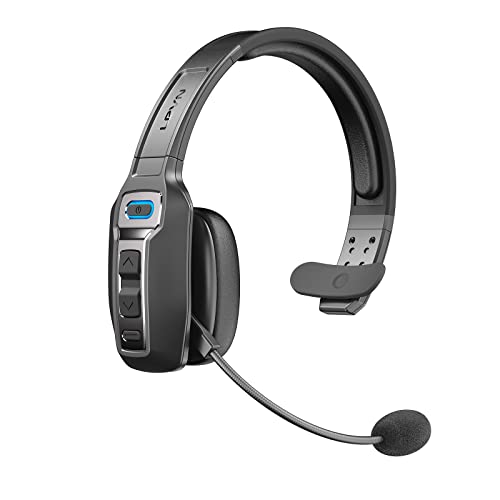
LEVN’s trucker headset attacks the BlueParrott ladder from the battery side. The rated working time is sixty-five hours, a manufacturer figure that, even treated with the usual caution, describes a different ownership experience: charge it on a day off and stop thinking about it. For long-haul drivers whose week is measured in thousands of miles, that stamina is not a spec-sheet flourish, it is the removal of a nightly chore and a failure mode at once.
The microphone uses AI noise cancelling in LEVN’s description, with a boom placing the capsule close to the mouth in the now-familiar geometry this whole category depends on. A dedicated mute button sits where a thumb can find it, which matters when a driver needs to cough, confer with a passenger or handle a yard conversation without the call hearing it. Multipoint connection lets the headset hold a phone and a second device together, covering the personal-plus-work phone pairing many drivers run.
The honest caveats are about heritage and feel. LEVN does not carry BlueParrott’s decades of cab-specific reputation, and the materials and cushion design read as functional rather than premium. Noise-cancellation claims here are, as throughout this guide, manufacturer-claimed and not cross-comparable. What LEVN offers is a clear trade: proven-brand polish exchanged for stamina and price. Drivers who charge rarely and talk constantly may find that trade points entirely their way.
LEVN’s rated standby deserves a mention alongside its talk time, because a headset that waits in a cold cab between shifts should wake ready rather than flat. Long standby turns the LEVN into equipment that lives in the truck permanently, charged on rest days and forgotten between them. That permanence suits drivers whose personal organisation runs on fixed places for fixed tools, which is to say, most drivers who last in the job.
LEVN’s headset also travels well off the truck. The same stamina and boom clarity that serve a cab serve a warehouse shift, a delivery round or a long day of site work, and drivers whose work mixes driving with physical tasks at both ends will find the headset does not care which part of the day it is. Versatility is rarely the headline in this category, but a headset bought once and used everywhere is worth two specialised ones left in the wrong vehicle.
The LEVN’s mute button placement hints at a design team that watched drivers work. Muting in a cab is rarely about secrecy; it is about the cough, the yawn, the word with the yard hand and the toll-booth exchange, all of which happen with the call live and the wheel held. A thumb-reachable physical mute serves those moments in a way an app toggle never will. Combined with the marathon battery, the LEVN’s proposition sharpens: it is built for drivers whose calls are woven through physical work, not for drivers who sit and talk, and it prices that understanding fairly.
- Connection: Bluetooth with multipoint
- Microphone: AI noise cancelling boom
- Working time: up to 65 hours, manufacturer rated
- Controls: dedicated mute button
Strengths
- Week-scale rated battery life
- Multipoint for two-phone drivers
- Mute button placed for thumb use
Trade-offs
- Less cab heritage than BlueParrott
- Functional rather than premium materials
- Noise claims are manufacturer-claimed only
Best for: long-haul drivers who want charging to be a weekly event, not a nightly one.
Not suited for: drivers who value a premium fit and finish over battery stamina.

BRAMMAR Trucker Bluetooth Headset — The long-talk all-rounder
BRAMMAR enters the same argument as LEVN, a sixty-five-hour rated talk time and AI noise cancellation, and makes it for the owner-operator watching every equipment dollar. The proposition is that the two things a driver feels daily, battery freedom and being understood by dispatch, do not have to carry a flagship badge. The boom microphone follows the category’s close-placement discipline, the mute button is a physical control rather than an app setting, and multipoint connection keeps two phones in play.
In use, headsets at this tier live or die on the unglamorous details, and BRAMMAR covers the expected ones: a wearing style that can swap ears, controls sized for touch rather than sight, and a build light enough that the headset is forgotten between calls. The AI noise cancelling is aimed at the steady roar of the cab, and callers in the brand’s target use hear the driver forward in the mix, which is the whole test. As ever in this guide, the cancellation performance is a manufacturer claim, not a laboratory comparison against the BlueParrotts.
Buyers should weigh the same unknowns as with any challenger brand: long-term durability data is thinner, replacement parts and support networks are smaller, and resale value is modest. None of that matters much at this price if the headset survives a year of shifts, and the arithmetic for many drivers is exactly that simple. BRAMMAR is the pick for a driver who would rather replace a headset occasionally than overpay for one permanently.
BRAMMAR also makes a sensible first headset for the driver who has been shouting into a phone on speaker and knows the arrangement is failing. The step from speakerphone to a boom headset is the largest quality jump in this entire category, larger than any step between the picks themselves, and BRAMMAR prices that jump within reach of a single week’s fuel budget. Guides should say this plainly more often: the best headset is usually the one that replaces the worst arrangement.
Owner-operators should run BRAMMAR’s numbers the way they run fuel maths. A headset at this tier that lasts a year of shifts costs less per working day than the coffee that accompanies it, and its sixty-five-hour battery removes a daily charging stop from the routine. Even if a driver later upgrades to a flagship, the BRAMMAR retires into the spare role with its value intact. Few purchases in a cab offer that kind of downside protection, and value buyers are right to notice.
BRAMMAR’s multipoint deserves emphasis for a specific modern pattern: the ELD and the phone. Many drivers now run a tablet or second device for logs, loads and navigation alongside the phone that carries dispatch and family. A headset holding both connections lets the important audio find the ear without a pairing ritual at every stop. In that light the BRAMMAR is less a budget BlueParrott alternative than a tool shaped for the two-screen cab, and drivers living that pattern will feel the design’s priorities every single shift.
- Connection: Bluetooth with multipoint
- Microphone: AI noise cancellation boom
- Talk time: up to 65 hours, manufacturer rated
- Controls: physical mute button
Strengths
- Marathon rated talk time
- Multipoint covers work and personal phones
- Strong value for owner-operators
Trade-offs
- Thinner long-term track record
- Smaller support and parts network
- Cancellation figures are manufacturer-claimed
Best for: owner-operators who want week-long battery and clear calls without flagship spend.
Not suited for: fleet buyers who need a big-brand support contract behind the headset.

Sarevile Trucker Bluetooth Headset — The budget route in
Sarevile’s headset is the guide’s entry point, the one a driver buys to find out whether the single-ear boom life suits them before spending flagship money. It runs Bluetooth 5.2 for a stable phone connection, carries an upgraded microphone with AI noise cancelling in the brand’s description, and includes the mute control that experienced drivers treat as non-negotiable. The on-ear wearing style keeps the road audible, and the headset is light enough to be worn speculatively for a shift and judged honestly at the end of it.
That judgement, for many drivers, comes back positive on the essentials: calls are clear enough that dispatch stops asking for repeats, the boom holds its position, and the battery covers full days of ordinary call volume without the sixty-five-hour heroics of the LEVN and BRAMMAR. The Sarevile is also a sensible second headset, the spare that lives in the door pocket against the day the main headset is left at home or flattened by a bunk mishap, a role where its price is a genuine virtue.
The limits are the tier’s limits. Rated battery life is measured in days rather than a week, the build uses simpler materials, and the brand’s noise-cancellation claim, manufacturer-claimed like every figure here, should be read as intent rather than measurement. Drivers in the loudest cabs, on the longest routes, with the heaviest call loads should climb the ladder to BlueParrott or the marathon challengers. Everyone else can start here and know exactly what extra money would buy.
The Sarevile’s on-ear lightness has one more use: it is the headset least likely to be removed and lost during a busy stop. Drivers keep it on through fuel, paperwork and the walk to the counter, because it asks nothing of the ear it sits on, and a headset that stays worn is a headset that stays owned. Loss and breakage end more budget headsets’ careers than audio quality ever does, and wearability is the defence.
The Sarevile’s Bluetooth 5.2 connection is worth a sentence of respect, because connection stability is where budget headsets most often cheat. A modern radio that holds its pairing through fuel stops, cab restarts and phone updates removes the daily friction that makes drivers abandon cheap headsets even when the audio is fine. Sarevile spent its budget in the right order, connection first, cosmetics later, and the result is a starter headset that behaves like it intends to be kept.
There is a training-wheels honesty to the Sarevile that experienced drivers respect. Not every new driver knows whether they will take to a boom headset at all, and a modest first purchase answers that question in a week of real shifts. If the answer is no, little is lost; if yes, the Sarevile becomes the spare and the upgrade path through this guide is already mapped. Fleets trialling headsets for a whole intake class use the same logic at scale. A product that makes a category testable is doing more work than its price suggests.
- Connection: Bluetooth 5.2, single-ear
- Microphone: AI noise cancelling, upgraded capsule
- Controls: mute button on the headset
- Style: on-ear, lightweight
Strengths
- Most accessible price in the guide
- Stable Bluetooth 5.2 connection
- Works well as a first headset or a spare
Trade-offs
- Battery rated in days, not a week
- Simpler materials throughout
- Noise claim is manufacturer-claimed
Best for: drivers trying the boom-headset life for the first time, and anyone needing a capable spare.
Not suited for: the loudest cabs and heaviest call loads, which deserve the flagship tier.
How do the six truck headsets divide the work?
| Pick | Form | Connection | Standout trait |
|---|---|---|---|
| BlueParrott B350-XT | Single-ear | Bluetooth | IP54 sealing, lightest BlueParrott |
| BlueParrott B450-XT | Single-ear | Bluetooth | Padded comfort for long shifts |
| BlueParrott B550-XT | Single-ear | Bluetooth | Full voice control, Parrott Button |
| LEVN Trucker | Single-ear | Bluetooth multipoint | 65-hour rated working time |
| BRAMMAR Trucker | Single-ear | Bluetooth multipoint | 65-hour rated talk time, value |
| Sarevile Trucker | Single-ear | Bluetooth 5.2 | Budget entry and spare duty |
Two strategies divide the table. BlueParrott sells refinement: cab heritage, weather sealing, comfort tiers and, at the top, voice control, all on twenty-four-hour rated batteries. The challengers sell stamina: sixty-five-hour ratings and multipoint at lower prices, with less polish and thinner track records. The Sarevile sits below both as the low-risk way in. None of these headsets is stereo or sealed against the road, deliberately, because hearing the road is part of the job.
Note, finally, what no row of this table claims: not one of these headsets promises to make a cab quiet for the driver. They make the driver clear to everyone else while the cab stays exactly as loud as the road made it. That asymmetry is the category’s honesty, and any product that promises the reverse should be read with the suspicion this guide has applied to percentages throughout.
How should a driver set up and test a new cab headset?
Pair it at home, not at a fuel stop. Connect the headset to your phone, make a test call to a friend or to dispatch’s non-urgent line, and adjust the boom until your voice sounds close and full rather than thin; a finger’s width from the corner of the mouth is the usual starting point. Set the wearing side to match where the window and the door sit in your cab, and learn the mute and answer buttons by touch with your eyes closed, because that is how you will use them at speed.
Then run the honest test: a call on your regular route’s loudest stretch, at your normal cruising speed, with the window and vents where you like them. Ask the other end one question, whether they can hear the truck, and listen to how they answer. A good cab headset makes the truck a rumour in the background. If it is a headline, reposition the boom before blaming the model, since placement fixes more call-quality complaints than any other single adjustment.
Finally, build the charging habit into an existing ritual: the same stop, the same cable, the same day of the week for the marathon-battery models. Headsets fail drivers through flat batteries far more often than through broken electronics, and a routine beats a resolution every time.
What separates a truck headset from a car headset?
Drivers of cars can borrow almost any Bluetooth earpiece and survive, because a modern car cabin is a quiet, sealed room that does half the headset’s work for it. A truck cab is a workplace bolted to an engine, with hours-long calls, dispatch discipline, dock work in weather and regulations watching every hand movement. Truck headsets exist because that combination breaks consumer gear in a month: batteries sized for commutes, booms sized for silence, controls sized for eyes. The category’s ruggedness is not styling; it is the accumulated memory of everything the road has broken before.
That is also why this guide never apologises for the picks’ size or single-ear shape. A truck headset is closer to a power tool than to jewellery, judged by whether the job gets easier and safer with it on. Drivers reading reviews written for commuters should translate accordingly: their noise is louder, their days are longer and their need is more professional, and the equipment that respects those facts tends to look like the six headsets above.
How do you choose between the BlueParrott ladder and the marathon challengers?
Start with your charging reality. If your routine reliably includes a nightly stop where a cable waits, the BlueParrotts’ twenty-four rated hours are effectively unlimited, and the choice becomes about sealing, padding and voice control. If your week is a long-haul pattern where the headset may not see a charger for days, the challengers’ sixty-five-hour ratings stop being a luxury and become the specification the whole purchase hangs on. Battery questions in this category are really schedule questions wearing a disguise.
Then decide what your second year looks like. BlueParrott ownership includes a deep spare-parts and replacement ecosystem and a model range that lets a driver upgrade within familiar controls. Challenger ownership includes a lower entry price and the freedom to treat the headset as a consumable. Neither philosophy is wrong; they belong to different kinds of operation, and a driver who knows which operation they are running will find this guide’s table reads itself.
What should a fleet or family buyer standardise on?
Standardising a cab headset across several drivers buys the same virtues it buys in an office: one control layout to teach, one charging cable to stock, one spare that serves everyone. The difference is that cab standardisation must survive personal fit, because a headset a driver hates will live in the glovebox while its owner shouts at a phone on speaker. The BlueParrott ladder is built for this tension: a fleet can standardise on the brand and the controls while letting drivers choose their rung, sealed, padded or voice-controlled, without retraining anyone.
For a family or a small operation buying two or three, the marathon-battery challengers complicate the maths pleasantly. A LEVN or BRAMMAR as the main headset and a Sarevile as the shared spare covers a week of failures for less than one flagship, and the spare’s existence changes behaviour: nobody nurses a dying headset through a route when a working one is in the door pocket. Whichever standard you choose, write the charging routine into the same checklist as fuel and logs, because in practice that is where headsets are actually kept alive.
What mistakes do drivers make when buying a cab headset?
The classic error is comparing noise-cancellation percentages across brands as if they were measured on the same rig. They were not; each figure is manufacturer-claimed under that brand’s own conditions. A ninety-six from one maker and a ninety-eight from another tell you almost nothing about which headset will serve your cab better. Boom placement, wind handling, fit and battery are the comparable facts, and they are the ones this guide is organised around.
Second, drivers buy stereo or sealed headsets that block the road out. In a cab, hearing a siren, a horn, a tyre going wrong or a loader’s shout is not ambience, it is information. Every pick here is single-ear for that reason. If a headset promises to isolate you from the world at highway speed, it is solving the wrong problem beautifully.
Third, people underestimate call volume when judging battery. Twenty-four rated hours sounds like plenty until a dispatch-heavy week turns the headset into a second phone line. Count your real talk hours for a week before choosing between the BlueParrott tier and the sixty-five-hour challengers; the honest number usually surprises its owner.
Fourth, buyers skip the spare. A trucker’s headset is safety-adjacent equipment, and a single point of failure on a five-day route is a planning error, not bad luck. The budget picks in this guide exist partly so that a second headset in the door pocket costs less than the stress of going without.
Final Recommendation
The centre of this guide is the BlueParrott B450-XT: the family’s proven noise handling in its most comfortable form, sized for the drivers who wear a headset longest. Drivers who work docks and yards should step sideways to the B350-XT for its sealing, and drivers drowning in calls should step up to the B550-XT, whose voice control is the safest interface in the category. That ladder exists because BlueParrott earned the cab the slow way, and it shows in the details.
The challengers earn their places on stamina and price. The LEVN and BRAMMAR headsets, with their sixty-five-hour ratings, suit long-haul weeks where charging chances are rare, and the Sarevile is the sensible first headset or spare. Choose by your route pattern and your call load, not by the biggest percentage on the box, remembering that every such figure here is manufacturer-claimed.
Whatever you mount on your ear, position the boom before the wheels roll, learn the mute by touch, and let the headset’s only job be making your voice the calmest sound in the cab.
Frequently Asked Questions
Are the noise-cancellation percentages on these headsets reliable?
They are manufacturer-claimed figures, each produced under the claiming brand’s own test conditions, and there is no shared industry standard that makes them directly comparable. Treat them as a statement of intent and design focus. The comparable facts are boom placement, wind handling, fit and rated battery life, which is why this guide is organised around those instead.
Why are all the picks single-ear instead of stereo?
Because a driver needs to hear the road. Sirens, horns, mechanical trouble and people outside the cab are all information, and a sealed stereo headset filters them out along with the engine noise. Single-ear designs keep one ear on the job and the other on the world, which is the correct division of attention at highway speed.
Can these headsets connect to two phones at once?
The multipoint models can: the LEVN and BRAMMAR hold two connections, and the BlueParrott range supports pairing with multiple devices in the way drivers typically use for a work and personal phone. Check the specific model’s behaviour if seamless switching matters to you, and pair both phones before a route rather than at a stop during one.
How do I know if a headset will be comfortable over a cap or sunglasses?
Look for padded, adjustable designs and treat the first week as a trial. The B450-XT is this guide’s comfort pick precisely because its cushion and headband spread pressure around cap seams and glasses arms. Wear any new headset for a full shift before a long route, adjust the band looser than feels natural at first, and swap ears occasionally on the longest days.
What does an IP54 rating actually protect against?
IP54 means the headset is protected against dust ingress that would interfere with operation and against water splashes from any direction. In driver terms: loading-dock drizzle, yard dust and a spilled drink are survivable events. It does not mean submersible, and no headset here should be treated as waterproof in a storm or a wash bay.
Is voice control on the B550-XT worth paying for?
If your phone rings all day, yes. Answering, rejecting and checking status by voice keeps both hands on the wheel and your eyes on the road, which is worth money in a job where attention is the safety system. If you take a handful of calls a day, the same money buys comfort or battery elsewhere in this guide, and the flagship’s talents will mostly sit idle.
Related Guides
Cab audio is one corner of headset buying; the guides below cover the neighbouring worlds of desk platforms, single-ear phone duty and voice-driven work.
- Best mono Bluetooth phone headsets for drivers and desk workers
- Best Microsoft Teams headsets with genuine certification
- Best sounding wireless headsets for dictation and voice work
- Best VoIP Headsets
- Best Noise-Cancelling Headsets for Transcribing


