What's inside
- Key Takeaways
- Quick Picks
- How We Chose These Picks
- What Is the Difference Between Microphone Noise Cancelling and Listening ANC?
- How Much Noise Can a Cancelling Microphone Really Remove?
- Which Noises Does Your Home Actually Make?
- How Does Microphone Cancellation Affect How Natural You Sound?
- What Should Remote Workers in Shared Homes Prioritise?
- How Do the Six Picks Compare on Cancellation?
- What Does the Rest of the World Hear? A Room-by-Room Guide
- How Can You Get the Most From a Noise Cancelling Microphone?
- How Do Call Platforms and Software Suppression Interact With Headset Cancellation?
- What Mistakes Do Buyers Make in This Category?
- How Do You Compare Two Cancelling Headsets Fairly?
- When Is the Answer a Different Product Entirely?
- How Should You Talk About Noise With the People You Live With?
- How Does Cancellation Perform Outdoors and in Transit?
- Final Recommendation
- One Last Consideration Before You Order
- A Note on Gifts and Shared Purchases
- Frequently Asked Questions
- Related Guides
As an Amazon Associate I earn from qualifying purchases. This post may contain affiliate links at no extra cost to you.
widgetverdict.com is reader-supported. When you buy through links on our site, we may earn an affiliate commission.
Where to buy: the six headsets below are sold on Amazon, and before the picks, this guide owes you one clarification that will save you a wrong purchase — read the next two paragraphs first, because “noise cancelling” in this category does not mean what most shoppers assume.
Here is the honest starting point for anyone searching for the best noise cancelling headsets. In the headset world — the world of boom microphones, calls, and meetings — noise cancelling almost always describes what happens to YOUR voice on its way to the other person. The microphone system works to suppress the noise around you so callers hear you instead of your room. It does not mean the earcups generate active noise cancellation that silences the world for your listening, the way premium music headphones do. Some models add passive isolation from their earcup seal, and one pick below includes ANC in its listing aimed at the work-call use case, but the core promise of this entire category is microphone-side: ENC and ANC techniques applied so that you sound clear in a loud place.
That distinction decides whether you are in the right guide. If your problem is “my colleagues hear my kids, my dog, and my espresso machine,” these six headsets are aimed precisely at you, and several are very good at it. If your problem is “I want silence on a flight and rich music,” you want active noise cancelling headphones from a different category, and no honest reviewer should sell you a call headset as a substitute. With that settled, this guide judges the six picks on the terms that matter here: how completely the microphone separates your voice from your surroundings, how clearly you hear callers in return, and how wearable the headset stays while doing it.
The picks span the realistic shapes of the category: two Logitech wireless models with noise-canceling microphones, a wireless headset that puts ANC and ENC in its name with a flip-to-mute mic and dongle, a dongle-and-base work headset, and two wired options — an on-ear JIAMQISHI and Jabra’s Evolve 20 — proving that microphone noise cancelling is not a wireless-only feature. Wired models often surprise people here: a boom near the mouth plus cancelling design can outperform costlier wireless rivals at the single task of making you understood.
Key Takeaways
- In headsets, “noise cancelling” primarily means your microphone suppresses room noise for your callers — not active silence for your own listening.
- Boom placement does much of the work: a mic near your mouth gives the cancelling system a strong voice signal to defend.
- The Logitech Zone Vibe 100 and Zone 301 bring noise-canceling mics to wireless, multipoint-style working days.
- One pick lists both ANC and ENC with a flip-to-mute mic and dongle, aimed squarely at noisy work environments.
- Wired picks from JIAMQISHI and Jabra show microphone cancelling does not require a battery.
- Judge these headsets by call recordings of your own voice, not by how quiet your room feels to you.
Quick Picks
| Pick | Badge | Why it earns its place |
|---|---|---|
| Logitech Zone Vibe 100 | Best wireless all-rounder | A lightweight over-ear headset whose noise cancelling microphone keeps hybrid workers clear on calls. |
| Logitech Zone 301 | Best Logitech Bluetooth option | A wireless Bluetooth headset with a noise-canceling mic in graphite, built for computer-based work. |
| ANC ENC Wireless Headset with Dongle | Best for very noisy rooms | ANC and ENC in the listing, a flip-to-mute microphone, and a dongle for dependable PC connection. |
| Wireless Headset with Mic for Work | Best with charging base | A noise cancelling mic, USB dongle, and charging base forming a tidy fixed-desk system. |
| JIAMQISHI USB Headset | Best wired on-ear value | A wired USB headset whose noise cancelling microphone handles home-office noise without any battery. |
| Jabra Evolve 20 | Best wired dual-ear focus | Jabra’s 2025 dual-ear office headset pairs a call microphone with coverage that helps you concentrate. |
How We Chose These Picks
Because the category’s name invites confusion, our first filter was definitional: each pick had to offer microphone noise cancelling as a stated, central feature — the suppression of ambient sound in the outgoing voice channel. Headsets that merely had closed earcups and a marketing adjective were excluded. We then checked that the microphone design supported the claim: boom or stalk placement near the mouth, since distance from the mouth is the enemy every cancelling system fights.
Connection variety was deliberate. Wireless models dominate shoppers’ imagination for this category, but wired USB headsets perform the same microphone task with no battery and often at lower cost, so two wired picks earned places on merit. Among the wireless models we favoured those with a USB dongle option, because a dongle gives the microphone’s processing a stable channel to the PC and removes pairing as a variable during the working day.
We also read each listing for honesty about its own feature. The pick that names both ANC and ENC is presented in this guide as a work-call headset whose cancellation story centres on the microphone and the call, not as a music headphone rival. Where a listing’s language is ambitious, the review below says what a buyer should realistically expect: a voice that stays clear in noise, not a cone of silence.
What Is the Difference Between Microphone Noise Cancelling and Listening ANC?
They solve opposite problems in opposite directions. Microphone noise cancelling — often labelled ENC, for environmental noise cancellation — works on the sound leaving you. Microphones sample your surroundings, processing separates your voice from the steady and sudden noises around it, and the caller receives a feed where your speech dominates. Your own ears hear the room exactly as before; the magic happens entirely for the person on the other end. This is the technology in every pick in this guide, and for people whose work is being understood, it is the one that earns money.
Listening ANC works on the sound arriving at you. Microphones on the earcups sample ambient noise and the headphones generate an opposing signal that reduces it before it reaches your ears. It excels against steady, low sounds — aircraft cabins, air conditioning, train rumble — and it is a feature of music-focused headphones, usually with no boom microphone at all. A headset can include some listening-side reduction, and earcup seal adds passive isolation in many designs, but a call headset’s reason to exist is the outgoing direction.
The practical test when shopping is one question: whose experience does this feature improve? If the listing’s cancellation language sits beside the microphone — “noise cancelling mic,” “ENC,” “clear calls in noisy environments” — it is about your voice. If it sits beside battery figures for flights and music, it is about your listening. Confusing the two is the single most common disappointment in this category, and it is entirely avoidable once the directions are clear.
How Much Noise Can a Cancelling Microphone Really Remove?
Set expectations by noise type. Steady, predictable sounds — fans, air conditioning, traffic hum, the merged murmur of an office — are what these systems eat best, because the processing can model them and subtract them continuously. Your voice, close and loud at the boom, survives easily by comparison. Intermittent sounds are harder: a door slam or a dog’s single bark may poke through before the system adapts, though sustained barking fares worse against a good ENC setup than most owners expect — the system learns it as background within moments.
What no microphone system can do is remove a competing voice at the same distance as yours. A partner taking a call two metres away will leak into yours, because to the microphone that voice looks like signal, not noise. Physical answers — distance, a door, a boom positioned close — still matter, and the headsets below perform best when the wearer helps them: mic near the mouth, gain set sensibly, the loudest noise sources behind the microphone’s least sensitive side where the design allows.
Judge results from the caller’s chair. Record a test call in your real environment, with your real noises running, and listen to the recording as your colleague would. That ten-second experiment tells you more than any specification, and it is the standard this guide applied when ranking how seriously to take each model’s claims.

Logitech Zone Vibe 100 — Best wireless all-rounder
The Zone Vibe 100 earns its place here on the strength of a noise cancelling microphone inside the most wearable wireless design in this guide. Logitech built it as a lightweight over-ear headset in graphite with advanced multipoint connections, aimed at hybrid workers, and the microphone story matches the brief: your voice stays forward and intelligible while the ordinary soundtrack of a home — heating, a distant vacuum, street noise through a window — is pushed down to where callers stop noticing it.
The flip-up mic arm deserves credit for more than tidiness. A boom that parks against the headband returns to the same position every time you flip it down, and consistent mic position is half of consistent cancellation: the processing is tuned for a known distance from your mouth, and the Vibe’s arm preserves that distance across a day of calls. The over-ear cushions add passive isolation for your side of the call, so in a moderately noisy home you also hear callers more easily, even though — per this guide’s opening honesty — that is seal, not active silence.
Wireless trade-offs apply as always: charging becomes a habit, and Bluetooth occasionally needs a reconnect after a laptop sleeps. Multipoint softens the second issue for people whose calls arrive on phone and computer alike. As a single headset that makes a hybrid worker sound professional from a real house, it is the most balanced answer in this category.
- Connection: Wireless Bluetooth, multipoint
- Microphone: Noise cancelling, flip-up arm
- Wearing style: Over-ear, lightweight
- Colour: Graphite
Strengths
- Noise cancelling mic keeps home-office voices clear for callers.
- Flip-up arm restores exact mic position for every call.
- Multipoint suits laptop-and-phone working days.
Trade-offs
- Listening-side quiet comes from cushion seal, not full ANC.
- Battery routine is part of ownership.
- Bluetooth reconnection can occasionally need attention.
Best for: hybrid workers who must sound clear from imperfect homes. Not suited for: travellers wanting active silence for music on flights.

Logitech Zone 301 — Best Logitech Bluetooth option
The Zone 301 is Logitech’s straightforward wireless Bluetooth headset with a noise-canceling mic, finished in graphite and built for compatibility with the computers people work on. Where the Vibe 100 leans lifestyle-light, the 301 reads as the office sibling: a businesslike wireless headset whose job is to make your outgoing voice clean and your incoming calls easy to follow, day after day, without drama.
Its microphone performs the category’s central trick with Logitech’s usual competence. In a home office with a fan running or an office with neighbours talking, the noise-canceling design keeps your speech in front and lets the room recede. Callers will still detect an unusually loud event — a dropped pan will announce itself — but the continuous background that makes people sound “remote” is exactly what this class of processing removes, and the 301 removes it convincingly.
Choose between the two Logitechs by routine. The 301 suits a worker anchored to one computer who wants wireless freedom within the room; the Vibe’s multipoint and lighter lifestyle fit suit the device-switchers. Both ask for charging discipline, and neither pretends to be a music headphone. Within the honest boundaries of this category, the 301 is a clean, professional execution of the noise-canceling brief.
- Connection: Wireless Bluetooth
- Microphone: Noise-canceling mic
- Wearing style: Over-ear headset
- Colour: Graphite
Strengths
- Dependable noise-canceling voice pickup for computer work.
- Businesslike design suits client-facing video calls.
- Wireless freedom within the room without dongle management.
Trade-offs
- Single-device focus is less flexible than multipoint rivals.
- No active listening cancellation; seal does that work.
- Charging must fit your routine or mornings suffer.
Best for: computer-based workers wanting Logitech’s wireless voice clarity. Not suited for: constant switching between a phone and a laptop.

ANC ENC Wireless Headset with Dongle — Best for very noisy rooms
This headset puts its whole pitch in its name: an upgraded ANC and ENC wireless headset with a microphone for work, a flip-to-mute design, and a dongle included. Read that name through this guide’s opening lens — the cancellation story here is about your calls sounding clear in noisy places, with ENC naming the microphone’s environmental noise work explicitly. For buyers whose environment is genuinely hostile — a shared flat, a busy household, a desk near a road — that explicit focus is the right shopping signal.
The flip-to-mute microphone is a genuinely thoughtful control for noisy homes. Flipping the boom up to mute is a physical gesture you can perform mid-sentence without finding a button, and in a house where interruptions arrive unannounced, the difference between a gesture and a software hunt is the difference between privacy kept and a household conversation broadcast to a client. The dongle, meanwhile, gives the PC connection a dedicated channel, removing Bluetooth pairing from the list of things that can wobble before an important call.
Expectations should stay calibrated. This is a value-tier work headset, not a flagship; its cancellation will tame the steady and the ordinary impressively for its class, while build refinement and long-term support trail the Logitech and Jabra names here. Judge it by the test this guide keeps recommending — a recorded call from your noisiest room — and it has every chance to be the pick that surprises you.
- Connection: Wireless with USB dongle
- Microphone: Flip-to-mute mic
- Cancellation: ANC and ENC as listed, call-focused
- Use case: PC work calls
Strengths
- ENC focus targets exactly the noises that ruin home calls.
- Flip-to-mute is fast, physical, and unambiguous.
- Dongle gives PCs a stable connection without pairing.
Trade-offs
- Value-tier build and support trail the big brands.
- Not a substitute for music-focused ANC headphones.
- Very loud one-off sounds can still break through.
Best for: workers in genuinely noisy homes who need call clarity first. Not suited for: audiophile listening or silent-cabin expectations.

Wireless Headset with Mic for Work — Best with charging base
This work headset combines a noise cancelling mic with the two logistics features that decide whether wireless headsets succeed at a fixed desk: a USB dongle for the PC and a charging base the headset lives on. The cancellation handles the audio problem — your voice separated from your room for the caller’s benefit — while the base handles the human problem, which is that headsets not given a home end up uncharged in a drawer.
On calls, the boom-fed noise cancelling delivers the expected professional result: speech clear, household wash subdued, and the dongle connection behaving with wired-like indifference to the laptop’s Bluetooth mood. The base also imposes a tidiness that matters more than minimalists admit; a headset with a parking place is a headset that is charged, findable, and not tangled in a cable nest when the meeting invite pings.
As an unbranded system it asks you to trade badge confidence for system design, and its cancellation, while effective for ordinary home noise, should be tested against your worst room before you rely on it for client work. Travellers will also find the base stays behind. For a permanent home desk, though, the combination of a cancelling mic and a charging ritual that runs itself is a persuasive package.
- Connection: Bluetooth plus USB dongle
- Microphone: Noise cancelling mic
- Dock: Charging base included
- Use case: PC and phone work calls
Strengths
- Charging base guarantees a ready headset each morning.
- Dongle connection keeps PC calls stable.
- Noise cancelling mic presents your voice professionally.
Trade-offs
- Unbranded support is less predictable than Logitech or Jabra.
- Base anchors the system to one desk.
- Extreme noise still needs a recorded-call test to verify.
Best for: fixed home desks where routine beats features. Not suited for: hot-desking or travel-heavy weeks.
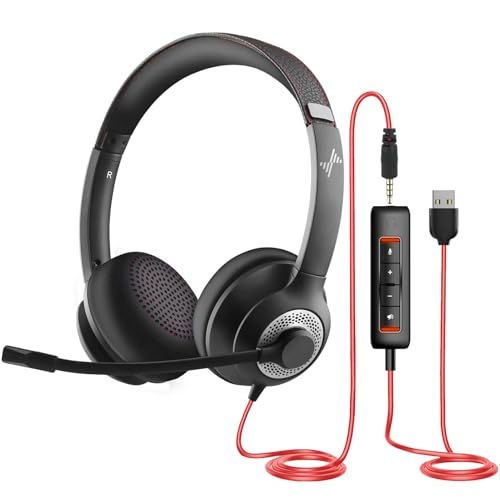
JIAMQISHI USB Headset — Best wired on-ear value
The JIAMQISHI is the standing rebuttal to the assumption that microphone noise cancelling requires wireless electronics and a battery. It is a wired USB headset — on-ear computer headphones with a noise cancelling microphone and in-line controls — and for the single task of making your voice clear to callers from a home office, it competes out of its price class, because geometry does so much of the work: a boom near the mouth gives the cancelling design a strong voice to defend.
In practice, callers hear what they need: your speech in front, the fan and the street pushed down, no pairing quirks and no battery mathematics before a long day. The wired connection also means the cancelling behaviour is identical on every call, with no wireless codec variability. The on-ear lightness suits intermittent callers, and in-line controls keep mute honest. Your own listening experience is the modest part — on-ear seal gives limited passive isolation, so a loud room remains audible to you even while your callers hear you cleanly. That asymmetry surprises people; it is also exactly how this category works.
Value-brand caveats about long-term durability apply, and continuous all-day callers will want a fuller design. But for a home worker whose callers keep hearing the house instead of the human, this wired pick fixes the outgoing problem directly and cheaply.
- Connection: Wired USB
- Microphone: Noise cancelling microphone
- Controls: In-line controls
- Wearing style: On-ear
Strengths
- Boom-fed cancelling makes your voice clear at a value price.
- No battery, no pairing — identical behaviour every call.
- Light on-ear fit suits intermittent calling.
Trade-offs
- Limited passive isolation for your own listening.
- On-ear pressure builds over continuous long sessions.
- Value-brand longevity is a shorter record.
Best for: home workers whose callers hear too much of the house. Not suited for: listeners wanting their own room silenced too.

Jabra Evolve 20 — Best wired dual-ear focus
The Evolve 20’s contribution to this guide is the combination of a call microphone from Jabra’s professional line with dual-ear coverage that helps your side of the experience. Its microphone keeps your voice clean for callers in the Jabra manner — present, natural, with the room trimmed — while the comfortable dual-ear design of the 2025 edition defends your concentration in a shared office or a busy home. It is the wired pick for people who want both directions improved as far as a call headset honestly can.
Note the honesty of that framing, because the Evolve 20 demonstrates this category’s truth well: the dual-ear coverage reduces what you hear of the room by seal and by giving you a clear stereo image of the call, not by generating anti-noise. Within those terms it is excellent. Agents and home workers in moderately noisy spaces find calls easier to follow, listening fatigue lower, and their own microphones delivering the professional standard callers expect.
It shares wired limits — a cable’s radius, no use away from the computer — and buyers whose real wish is silence on a train should return to this guide’s introduction and choose a different category with our blessing. For call-centred noise problems at a desk, the Evolve 20 is a refined, fleet-proven answer.
- Connection: Wired USB, USB-A/USB
- Microphone: Built-in mic for calls
- Wearing style: Comfortable dual-ear
- Edition: 2025 Edition
Strengths
- Jabra voice quality keeps callers focused on you.
- Dual-ear coverage aids your concentration in shared spaces.
- Wired consistency: no battery or pairing variables.
Trade-offs
- Room reduction for you is seal-based, not active cancellation.
- Cable fixes your working radius.
- Dual-ear isolation hides doorbells and household calls.
Best for: desk workers wanting both directions of a call improved. Not suited for: travel listening, where music ANC headphones belong.
Which Noises Does Your Home Actually Make?
Before choosing among these picks, it helps to inventory your own noise honestly, because different households produce different enemies. The steady-state home — fan, fridge hum, traffic wash, rain — is the easiest opponent, and every pick in this guide handles it well; choose on comfort and connection. The rhythmic home — a washing machine cycling, a neighbour’s music with a beat, a partner’s exercise video — is harder, because rhythms give processing less stability to model, though good boom placement still carries the day. The chaotic home — children, dogs, doorbells, deliveries — defeats cancellation at its spikes no matter the model, and the honest tools there are a door, a schedule, and a flip-to-mute gesture you can perform without thinking.
Work patterns matter as much as rooms. A support agent in continuous conversation gives the processing a constant voice signal to defend, and sounds superb. A manager who speaks in bursts across long listening stretches gives it a harder job, because each new sentence must re-establish itself against the room. Neither pattern is a reason to avoid the category; both are reasons to test with your real calls rather than a demo, and to value boom position discipline more than any processing claim.
One more inventory item: the noises you make. Mechanical keyboards, squeaky chairs, a desk that drums when you type — near-field sounds close to the microphone are the hardest for any system, because proximity makes them loud. Moving the keyboard, softening the desk, and angling the boom away from the worst offender are free upgrades that outperform the price gap between any two picks in this guide.
How Does Microphone Cancellation Affect How Natural You Sound?
There is a real tension inside every cancelling system: suppress the room too gently and callers hear your kitchen; suppress too aggressively and your voice loses its edges, sounding processed, watery, or oddly distant, with soft consonants and quiet asides swallowed along with the noise. The better implementations in this guide sit in the sensible middle — your voice remains recognisably yours, with the room turned down like a fader rather than deleted. When you test a headset, listen for your own naturalness in the recording, not only for the absence of noise. A caller who hears a clean but human voice trusts the conversation; a caller who hears a robot in a void starts wondering what else is being filtered.
Breath and mouth sounds are the processing frontier where models differ most. A boom close to the mouth captures plosives and breath blasts that gentle processing handles gracefully and aggressive processing turns into strange artefacts. Boom angle solves most of it — slightly below and beside the mouth rather than directly in the airstream — which is why this guide keeps returning to position. The microphone’s physical relationship to your face is the one setting no software update can fix later.
Music in the background deserves a specific warning. Cancelling systems are built for noise, and music — structured, tonal, voice-like in places — can confuse them into warbling artefacts in your call audio. If your household plays music during your calls, the reliable fixes are distance and a closed door. Technology will handle the fan; Beethoven requires architecture.
What Should Remote Workers in Shared Homes Prioritise?
Start with the mute. In a shared home, interruptions are not hypothetical; they are scheduled by people who cannot see your calendar. A physical, instant, unmistakable mute — ideally a boom flip, as two picks here offer — is worth more than a marginal processing improvement, because the cost of the wrong five seconds is not audio quality but privacy. Second, prioritise the dongle where it is offered: shared homes often mean shared, congested wireless environments, and a dedicated connection removes one variable from the morning.
Third, think about the signal your headset sends on camera. A boom reads as “at work” to housemates as much as to colleagues, and households develop a useful etiquette around it — boom down means do not enter. That social function is unglamorous and real. Finally, be honest about the limits this guide opened with: in a genuinely chaotic shared space at peak hour, the best purchase may be a door lock and a family schedule, with the headset as the second line of defence. The picks above are excellent second lines. Buy them for what they are, and arrange the first line yourself.
How Do the Six Picks Compare on Cancellation?
| Headset | Connection | Cancellation focus | Wearing style | Strongest suit |
|---|---|---|---|---|
| Logitech Zone Vibe 100 | Bluetooth multipoint | Noise cancelling mic | Over-ear | Hybrid working days |
| Logitech Zone 301 | Bluetooth | Noise-canceling mic | Over-ear | Single-computer wireless |
| ANC ENC Wireless Headset | Wireless with dongle | ANC and ENC, call-focused | Over-ear with flip-to-mute | Very noisy rooms |
| Wireless Headset with Mic for Work | Bluetooth plus dongle | Noise cancelling mic | Dual-ear with base | Fixed home desk |
| JIAMQISHI USB Headset | Wired USB | Noise cancelling mic | On-ear | Wired value |
| Jabra Evolve 20 | Wired USB | Call mic plus dual-ear seal | Dual-ear | Office concentration |
Every row improves the caller’s experience of your voice; none promises the active silence of music headphones. Within that honest frame, choose by environment and routine: the ANC ENC model for hostile rooms, the Logitechs for wireless polish, the base-equipped headset for a fixed desk, and the two wired models when you want the cancellation without a battery in the equation.
What Does the Rest of the World Hear? A Room-by-Room Guide
It helps to walk your own home with a caller’s ears. The kitchen is the worst room most houses offer: hard surfaces reflect your voice back at the microphone from six directions, appliances hum at several pitches, and the kettle is a timed ambush. A cancelling boom tames the hum admirably and the reflections partially, but the kitchen will always tax a call more than a carpeted room does. The home office with a door remains the champion environment, not because of any technology but because soft furnishings and a closed door do the first half of the cancelling before the microphone wakes up. Between those poles sits the bedroom-office and the living-room desk, where cushions and curtains quietly earn their keep every call.
Outdoor-adjacent spaces deserve a specific warning. A desk beside an open window in summer hands the microphone wind, traffic swells, and the irregular punctuation of passers-by — the least predictable diet in this entire guide. Closing the window during calls is worth more than the price difference between any two picks here. Similarly, a desk sharing a wall with a television room will leak the television’s voices through the wall in a way no processing fully forgives, because voices are what the system is built to preserve. Placement is policy: choose the desk’s wall as carefully as the headset.
The optimistic conclusion is that most homes are one or two small decisions away from being good call environments, and the headsets in this guide are sized for the noise that remains after those decisions. Audit the room first, spend on the microphone second, and your callers will assume you work somewhere far quieter than you do.
How Can You Get the Most From a Noise Cancelling Microphone?
Position first, settings second, expectations third. Place the boom tip near the corner of your mouth and keep it there; every centimetre of drift weakens the voice signal the cancelling system defends and lets the room gain ground. Speak at a consistent, natural volume rather than leaning in and out, because steady input lets the processing model your surroundings more accurately. If your headset offers a sidetone or monitoring option in its software, a touch of it helps you hear your own level and stop shouting over household noise you assume is leaking.
Help the system with the room. Close the door if there is one. Put the loudest steady noise — a fan, an air conditioner — where it competes least, and remember that a competing voice nearby defeats any cancelling design, so coordinate call times in shared homes where you can. Then verify from the other side: record a test call with your ordinary noises running and listen as a caller. Adjust one variable at a time — boom position, then gain — until the recording sounds like a person in a quiet room having a normal conversation.
Wireless owners should keep the dongle in a front-facing port where possible and keep the headset charged; a microphone’s processing cannot compensate for a connection gasping at the edge of range or a battery in its final minutes. Small disciplines, consistently applied, are what separate owners who praise these headsets from owners who return them.
How Do Call Platforms and Software Suppression Interact With Headset Cancellation?
Your voice passes through more than one noise filter before it reaches a colleague. The headset’s own microphone processing is the first; the meeting platform’s suppression is the second; and some operating systems add a third. Stacked thoughtfully, these layers cooperate — the headset delivers a strong, close voice, and the software trims what remains. Stacked carelessly, they fight: aggressive software suppression on top of aggressive headset processing clips word beginnings, swallows quiet asides, and produces the underwater quality that makes colleagues ask if you are unwell. The practical rule is to let the hardware do the heavy work and set the software to its gentler modes, then verify with a recording rather than with hope.
Platforms differ in what they offer and in what they call it, and their settings reset more often than users expect — an app update, a new laptop, a switched audio device can quietly return suppression to a default that no longer suits your headset. When your call quality changes for no visible reason, the settings page is a likelier culprit than the hardware. Build the habit of a monthly thirty-second recording check; it catches settings drift, boom hinge wear, and a household that has grown louder by degrees, all before your colleagues stage an intervention.
There is also an asymmetry worth exploiting: your callers’ platforms cannot fix your microphone, and your headset cannot fix theirs. In a regular meeting, the group’s audio quality is set by its worst microphone, which is why teams that standardise on competent headsets — several picks in this guide exist for exactly that fleet logic — hear an improvement out of proportion to the hardware. One good microphone helps one voice. Six good microphones transform the meeting.
For recorded and customer-facing calls the stakes rise again, because the recording is permanent and the listener cannot ask you to repeat yourself. Test the full chain — headset, platform, recording — before the calls that matter, and keep the test recording. It is the only honest spec sheet your particular voice, room, and software will ever have.
What Mistakes Do Buyers Make in This Category?
The defining mistake is buying a call headset to solve a listening problem — expecting aeroplane silence from a product whose cancellation faces outward. This guide has repeated the distinction because it causes more returns than every other error combined. The second mistake is the mirror image: buying music ANC headphones for work calls and discovering the tiny built-in microphone makes you sound distant and roomy to colleagues. The two categories are both legitimate; they are simply aimed in opposite directions.
Technique mistakes follow. Owners wear the boom down by their chin and blame the processing; they crank input gain until the room is amplified alongside the voice; they test the headset in a quiet room at midnight and conclude the cancelling does nothing, when the feature only proves itself against actual noise. Test in your real environment, at your real working hour, from a recording — the method matters as much as the model.
How Do You Compare Two Cancelling Headsets Fairly?
Build one test and refuse to improvise a second. Choose your worst realistic calling conditions — the room, the hour, the appliances running — and record the same thirty seconds of speech on each headset, at the same distance from the same noises, with the boom positioned as carefully as you know how. Then listen to the recordings back to back, ideally the next day, and score three things in order: how present your voice is, how far the background has receded, and how natural your voice still sounds. That order matters. A headset that wins on background removal but turns you into a underwater announcer has lost the comparison that counts, because callers forgive a faint hum far sooner than a strange voice.
Resist testing in a quiet room, where every cancelling system looks identical because there is nothing to cancel, and resist testing with music playing loudly beside you, which no system in this category is designed to defeat and which will make excellent headsets look broken. The fair test is your real life at its ordinary worst. It is also worth testing a failure you will actually meet: walk toward the noisy part of the house mid-sentence, open the door, run the tap. Systems differ in how gracefully they degrade, and grace under degradation is what your callers will experience weekly.
If you cannot test two headsets physically, borrow the method for one: record your current setup under the same conditions, then record the new headset when it arrives, and let the comparison against your own baseline — rather than against a showroom memory — decide whether the purchase earned its money within the return window.
When Is the Answer a Different Product Entirely?
Sometimes the honest recommendation leaves this category. If your suffering is on the listening side — you cannot concentrate because you hear the house — the tool is a pair of active noise cancelling headphones or a dual-ear headset’s seal plus discipline about doors, and no microphone feature will substitute. If your callers’ problem is actually your internet connection breaking up, a new headset will polish a signal that never arrives; fix the connection first. If the noise source is a single loud appliance on a timer, the cheapest noise cancelling in this entire guide is a changed laundry schedule.
There is also a room-level answer that deserves mention before any purchase: soft furnishings, a door that closes, and a desk positioned away from the kitchen do more for call audio than the gap between any two picks here. Buy the headset for the noise that remains after the room has done its part. That ordering — architecture, then habits, then hardware — sounds unglamorous in a shopping guide, and it is the ordering that produces the calls where nobody mentions audio at all, which is the highest praise this category ever earns.
And if, after the room and the habits, your callers still hear your house more than you, then the picks above are exactly the right shopping list — chosen, all six, for the outgoing direction that is your actual problem.
How Should You Talk About Noise With the People You Live With?
The last variable in call audio is diplomatic. Most household noise is not malice; it is other people’s lives proceeding on schedule, and the worker who treats every kettle as an offence will lose the household’s cooperation within a month. The arrangements that actually work are boring and mutual: a shared calendar that marks the uninterruptible calls, a door signal everyone respects — the closed door, the boom-down headset — and reciprocity, where the worker’s own noise discipline during other people’s calls and study is visibly equal. Headsets with flip-to-mute booms help here beyond their audio: the boom’s position becomes a household semaphore, down for “in a call,” up for “available,” legible across a room without a word exchanged.
Children deserve a specific, kind protocol rather than a ban they cannot parse: what a closed door means, what to do in a genuine emergency, and the promise that the door opens at stated times. Households that negotiate this once, calmly, stop renegotiating it daily. And when the arrangement fails — a toddler delivers a keynote address to your client call — remember that the mute gesture and a sense of humour have saved more professional reputations than any processing chip. Clients live in houses too.
None of this diminishes the hardware. It completes it. The picks in this guide handle the physics of noise; the household handles the sociology; and the calls that result, clear and unembarrassed, are the product of both systems working at once.
How Does Cancellation Perform Outdoors and in Transit?
A growing share of calls happen in motion — a walking meeting, a train platform, a school run — and it is fair to ask how this category’s microphone work survives the street. Wind is the honest answer’s villain: moving air across a microphone capsule creates noise at the source, before any processing can reason about it, and even good ENC audibly struggles on a gusty pavement. Steady traffic wash, by contrast, is exactly the predictable background these systems eat, and a caller will often hear a pavement call more cleanly than the walker experiences it. The practical techniques are unglamorous: turn your back to the wind, let your body shield the boom, and pause the important sentence for the passing lorry rather than competing with it.
Transit sits between the two: a train’s hum is modelable, its announcements are not, and the carriage’s other passengers are the competing-voice problem wearing seats. The wireless picks in this guide serve mobile callers best, with the dongle models reverting to Bluetooth away from the desk — a reminder to check how each headset connects to a phone before assuming your desk setup travels. None of this changes the category’s centre of gravity, which is the desk and the home. But for the worker whose office is increasingly a route rather than a room, microphone cancellation is the difference between a walking meeting that works and one that apologises itself to death.
Final Recommendation
If your callers hear your household more than they hear you, start with the ANC ENC wireless headset for hostile rooms or the Logitech Zone Vibe 100 for a polished hybrid life, and take the Zone 301 if your world is one computer. Fixed-desk workers should consider the base-equipped work headset, and anyone who distrusts batteries can solve the same problem wired with the JIAMQISHI or the Jabra Evolve 20. Our closing advice for this category is a test rather than a product: whichever you choose, record one honest call from your noisiest room — the headset that makes that recording sound like a quiet office has earned your money, and every pick above was chosen because it can.
One Last Consideration Before You Order
Return to the question this guide opened with and answer it in one sentence: whose noise is the problem — yours, for your callers, or the room’s, for you? If it is yours for your callers, every pick above is aimed at it, and your remaining work is choosing by connection, fit, and routine. If it is the room’s for you, close this guide with our blessing and shop the listening category instead; no purchase in these pages will satisfy that need, and a guide that pretends otherwise would be selling you a return label. Clarity about the direction of your problem is worth more than any single feature compared in the pages above, because it decides whether the box that arrives solves the problem you actually have.
A Note on Gifts and Shared Purchases
These headsets are frequently bought by one person for another — a partner equipping a home office, a parent setting up a student, a manager surprising a team — and the direction rule in this guide is the gift-giver’s best friend. Ask what the recipient’s callers complain about, not what the recipient hears, and you will buy the right category every time. If the complaint is “you sound far away” or “I can hear your whole house,” a pick from these pages will land as a genuinely thoughtful gift, because it fixes the experience of everyone the recipient talks to. Add the receipt, keep the return path open for fit, and resist adding a second gadget to the box: in this category, one correct headset beats a bundle of almost-right accessories.
Frequently Asked Questions
Will a noise cancelling headset make my room silent for me?
No — and any listing implying otherwise deserves suspicion. In this category, cancellation works on your outgoing voice so callers hear less of your room. Earcup seal reduces some noise for you passively, but active silence for listening is a feature of music-focused ANC headphones.
What does ENC mean on a headset listing?
Environmental Noise Cancellation: processing that suppresses surrounding noise in the microphone signal. It targets steady sounds like fans and traffic and the general wash of an office, so your voice arrives cleaner to the other side of the call.
Can these headsets remove another person’s voice near me?
Not reliably. A nearby voice looks like signal to a microphone, not noise. Distance, a closed door, and scheduling around a partner’s calls remain the real fixes; cancellation handles the non-voice background.
Is a wired headset’s cancelling as good as a wireless one’s?
It can be, because boom position and processing matter more than the cable. The wired picks in this guide make callers hear a clear voice without any battery, which is why they earned their places.
How should I test a headset’s noise cancelling fairly?
Record a call in your real working environment with your ordinary noises running, then listen to the recording as your caller would. Judge the voice’s clarity against the background, not how the room felt to you while wearing it.
Do noise cancelling microphones help with echo on calls?
Indirectly. Echo usually comes from the other side’s speakers feeding their microphone, or from your own audio leaking back through a poor seal. A boom headset with a good fit removes your side of that equation: your callers’ voices stay in your earcups instead of leaking into your microphone, and your voice reaches the system once, cleanly, rather than twice. If echo persists, the cause is almost always at the other end or in the room’s acoustics, and no microphone upgrade at your desk will cure it — though a polite suggestion that the other party try a headset often does.
Related Guides
Immersive hardware with a different kind of headset is covered in Best Vr Headsets. For voice chat built for play, see Best Gaming Headsets With Microphone, and for carrying it all, Best Affordable Laptop Backpacks.
Related guide: Best Noise-Canceling Mic Headsets
Related guide: Best Noise-Cancelling Headsets for Transcribing



[…] floor should read Best Call Center Headsets, and anyone whose main problem is a loud room will find Best Noise Cancelling Headsets […]