What's inside
- Key Takeaways
- Quick Picks
- How Did We Assemble This Restaurant Shortlist?
- Why Does Full-Duplex Matter More in a Kitchen Than Anywhere Else?
- Which Crew Positions Should Actually Wear a Headset?
- The Six Crew Intercom Systems in Detail
- What Does a Quieter Kitchen Do for the Dining Room?
- How Do These Systems Fit Counter Service, Food Trucks, and Events?
- How Do You Train a Crew That Has Never Worked on a Net?
- Crew Size, Range, and Endurance — How the Six Stack Up for a Service
- How Do You Set Up a Crew Net That Survives a Friday Night?
- What Do Restaurants Get Wrong When Buying Crew Headsets?
- Final Recommendation
- Frequently Asked Questions
- Related Guides
As an Amazon Associate I earn from qualifying purchases. This post may contain affiliate links at no extra cost to you.
widgetverdict.com is reader-supported. When you buy through links on our site, we may earn an affiliate commission.
Where to buy: Amazon carries all six crew intercom systems in this guide, from a two-person starter set to a five-headset kit that can put the whole pass on one conversation.
A restaurant runs on shouted fragments — “fire table twelve”, “eighty-six the salmon”, “I need hands” — thrown across a loud room at people who are usually moving. The best restaurant headsets replace the shouting with a full-duplex intercom: every headset on the system can talk and listen at the same time, the way a phone call works, so the kitchen, the pass, the floor, and the host stand share one continuous conversation instead of a volley of yells. The six systems below are crew intercoms of exactly that kind, from SYNCO and Eartec, sized from two headsets to five, and this guide frames them honestly: they are team intercom systems that restaurants can put to work across kitchen, floor, and counter shifts.
That framing matters, because it sets a boundary this guide will not blur. Dedicated drive-thru intercom hardware — the lane systems with vehicle detection, outdoor speaker posts, and timer integration made by specialists such as HME and 3M — is a different product category, and none of it appears in the pool this roundup was built from. What is here is arguably more useful to most restaurants: belt-free, base-station-free crew headsets that a kitchen team, a serving team, and a counter team can wear through a service, hand over at shift change, and redeploy tomorrow for a function or a food truck. Judge them as crew communication, set up around your pass and your floor plan, and they are excellent. Judge them as a drive-thru lane system and you are asking the wrong product the wrong question.
Key Takeaways
- All six systems are full-duplex crew intercoms — everyone can speak and hear simultaneously, with no push-to-talk turns.
- Crew size is the first decision: the systems here cover two, four, and five people per set, from SYNCO and Eartec.
- Stated ranges run from up to 1000ft on the Eartec UltraLITE HD line to 1148ft on the SYNCO XTalk X5 and 1640ft on the SYNCO XPro2.
- SYNCO’s three systems each state a 24-hour working time; Eartec’s listings emphasise DECT interference-free operation instead.
- Ear configuration matters across a shift: Eartec offers single-ear (UL2S) and dual-ear (UL4D, UL5D) variants for different noise and awareness needs.
- None of these is a dedicated drive-thru lane system — they are crew intercoms for kitchen, floor, and counter teams.
Quick Picks
| Pick | Badge | Why it earns its place |
|---|---|---|
| SYNCO XTalk X4 Intercom Headset System | The four-person service crew pick | Four full-duplex headsets with a stated 24-hour working time — pass, grill, floor lead, and host on one net. |
| Eartec UL2S UltraLITE HD Intercom (2-Person) | The two-person starter | Single-ear, DECT interference-free, up to 1000ft — the pass-to-kitchen link for a small brigade. |
| Eartec UL4D UltraLITE HD Intercom (4-Person) | The dual-ear four-crew pick | Four-person full duplex with dual-ear headsets for louder kitchens where both ears need cover. |
| Eartec UL5D UltraLITE HD Intercom (5-Person) | The full-brigade pick | Five dual-ear headsets on one net — the largest fixed crew size in this roundup. |
| SYNCO XTALK X5 Intercom System | The long-range five-crew pick | Five-person full duplex at 2.4GHz with a stated 1148ft range and 24-hour working time. |
| SYNCO XTalk XPro2 Intercom System (2-Person) | The far-apart pair pick | Two headsets with a stated 1640ft stable range and wide noise cancellation — kitchen to a distant counter or store room. |
How Did We Assemble This Restaurant Shortlist?
We started from the service, not the spec sheet. A restaurant intercom must be full-duplex — a kitchen cannot work in push-to-talk turns while hands are in pans — so every system here talks and listens simultaneously. It must need no base station bolted to a wall and no belt pack trailing a wire, because restaurant staff move between kitchen heat, dining-room polish, and a cellar staircase within one shift; both brands here build self-contained headsets, which is why the roundup is theirs. And it must be sized in crews, so we spread the six across two-, four-, and five-person systems, with single-ear and dual-ear variants, rather than pretending one size serves a café and a banqueting operation equally.
We weighted published working numbers the way a manager would. Range figures are stated for five of the six — the XTalk X4’s title, unusually, gives its 24-hour working time without a range figure, and its pick section says so. Battery endurance is SYNCO’s stated theme at 24 hours across its three systems; Eartec’s listings instead stake their claim on DECT interference-free operation and a 1000ft range across the UltraLITE HD line. Those are two different philosophies — endurance versus spectrum discipline — and the pick sections treat them as such rather than inventing the missing figure for either brand.
Why Does Full-Duplex Matter More in a Kitchen Than Anywhere Else?
Push-to-talk is a discipline of free hands and pauses, and a kitchen has neither. A cook mid-service cannot find a button with a pan in one hand and tongs in the other; a server carrying plates cannot press anything at all. Full-duplex removes the button from the conversation: the headset is simply live, like a phone call that lasts the whole shift, and a call of “hands, please” lands the moment it is spoken, in the ears of exactly the people wearing headsets, without competing with the extractor hood, the ticket printer, and the dining room’s Friday-night volume. The expo — the person running the pass — becomes a calm voice in everyone’s ear instead of the loudest shouter in the building, and the whole service drops a register in volume and in temper.
There is a subtler gain: continuity. On a full-duplex net, the floor can warn the kitchen about the allergy table walking in while the kitchen is still plating the previous course; the host can ask for a realistic wait time and get an answer from the person actually looking at the rail of tickets. Information in a restaurant decays in seconds — a table’s mood, a dish’s remaining minutes, a spill in the walkway — and a live net moves it at the speed of speech. That is the real product being bought here. The headsets are just how it is worn.
Safety rides on the same channel. A burn, a fall on a wet floor, a aggressive guest at the bar — the fastest response in a restaurant is the one that reaches every position at once, in a normal speaking voice, without anyone leaving their post to raise an alarm. Managers who have run both ways note that incidents get reported sooner on a net, partly because reporting costs the reporter nothing: no walk, no shout, no audience of guests. That is not a feature any listing here advertises, and it should not be oversold — a headset is not an emergency system — but as a by-product of a live channel it is real, and in a building full of knives, fryers, and wet tiles it is worth having.
Full-duplex also disciplines itself. Because everyone hears everyone, crews develop brevity on their own: short calls, names first, no monologues during the rush. Managers consistently find that a team on a live net talks less overall than a team shouting — the channel is shared, audible, and slightly formal, and the kitchen’s traditional foghorn communication turns out to have been a workaround for bad tools rather than a culture anyone misses.
Which Crew Positions Should Actually Wear a Headset?
Start with the pass. The expo or head chef is the net’s natural hub — the person who fires courses, calls for hands, and hears every station’s timing. Give the second headset to the floor lead or maître d’, whose information — arrivals, allergies, complaints, a table ready to order — is perishable and whose legs currently carry it across the room a hundred times a night. The third headset, on a four- or five-person system, belongs to the kitchen’s second voice: the larder or grill cook who fields the expo’s questions when the head chef’s hands and attention are committed. The fourth and fifth extend the net to the host stand and to the bar or counter, the two positions whose coordination with the kitchen is otherwise done by semaphore and hope.
There is one more position worth a deliberate decision: the person who expedites drinks or runs the counter in a hybrid format. In a counter-service hybrid, that person is the customer’s face and the kitchen’s customer at once, and a headset — single-ear, so the room stays audible — turns their questions to the kitchen from a walk into a sentence. Several of the systems here earn a second look from hybrid operators for exactly that reason, and the two-person sets in particular map onto the format’s two hubs: the pass and the till. Decide the position list on paper before ordering, tape it inside the charging shelf, and let it — not enthusiasm — fix the crew size you buy.
Resist the urge to headset everyone. A net with twelve voices is a meeting, not a tool; the discipline of full-duplex depends on the channel staying mostly quiet so that a call cuts through. Servers in the dining room often do not need to transmit at all — they need to receive the call that their table’s mains are on the pass, which some operations handle by putting the floor lead on the net as their relay. Small brigades should note the two-person systems here are not toys: a two-headset net between the pass and the floor lead captures most of the value in a forty-cover restaurant, and the larger systems earn their size only when the building or the brigade genuinely spreads across four or five voices.
Shift handover is the other sizing question. Headsets are worn for a service, wiped, and handed to the next shift — which means the crew size you are buying for is the largest single service’s net, not the whole staff list. A restaurant running a four-voice net across lunch and dinner needs four headsets and a charging routine between services, not eight headsets. Buy for the service, staff the net by position rather than by person, and the arithmetic stays sane.
The Six Crew Intercom Systems in Detail

SYNCO XTalk X4 Intercom Headset System — The four-person service crew pick
The XTalk X4 is the natural centre of this roundup for a mid-size restaurant: four full-duplex headsets, a stated 24-hour working time, and a listing written for event production and film crews — people whose working pattern, a coordinated team spread across a space on a live net all day, is the closest cousin of a restaurant service. Four headsets map onto the classic service net without waste: expo, floor lead, second kitchen voice, and host or bar. Twenty-four hours of stated working time covers the double-shift reality of hospitality — lunch service, a turnaround, dinner service — without the net dying at nine in the evening, which is precisely when it is earning its keep.
Picture the X4 across a real Friday. At six, the expo takes the pass headset, the floor lead takes theirs, the grill cook and the host complete the net, and the first check — a round of names, each voice answering — takes twenty seconds. Through the rush, the net carries the evening’s small change: a table moved, a steak re-fired, a birthday cake timed to a main course’s last five minutes. None of those messages justifies a person crossing the room; all of them currently do, in a restaurant without headsets, at the cost of the crossing person’s own work. The X4’s four voices are sized to that traffic exactly — it is a system for the restaurant whose problems are coordination problems, which is to say most restaurants, most nights.
One gap in the listing deserves a manager’s attention: the X4’s title publishes no range figure, unlike its SYNCO siblings. In a single-room restaurant that omission barely matters — the kitchen and floor of most dining rooms sit well inside any modern intercom’s comfortable reach — but a site with a cellar, a garden room, or a separate prep kitchen should test the X4 across its own floor plan, or look at the X5 and XPro2, whose listings do state their distances. Judge this system as the endurance-first, four-voice net for a conventional dining room, and its specification is coherent on its own terms.
- Crew size: 4 headsets, full duplex
- Working time: 24H as stated in the listing
- Stated origin use: event production and film crews
- Range: no distance figure in the listing title — walk-test sites with cellars, gardens, or separate prep spaces
- Ear configuration: the listing title does not specify single or dual ear for this system — check SYNCO’s product details against your noise needs
Strengths
- Four headsets match the standard service net — pass, floor, second kitchen voice, host — without surplus.
- A stated 24-hour working time spans lunch and dinner services on one charge cycle.
- Full-duplex conversation suits hands-busy kitchen work where push-to-talk would fail.
Trade-offs
- No range figure in the title, so spread-out sites must test rather than calculate.
- Four voices is a ceiling; a banqueting operation needing six positions must step outside this system.
- The listing’s production-crew framing means restaurant buyers should confirm mounting and accessories for kitchen wear themselves.
Best for: a mid-size restaurant running a four-position net across a single dining room and kitchen through a full double service.
Not suited for: a site split across distant buildings or floors, because the listing gives no range figure to underwrite that layout.

Eartec UL2S UltraLITE HD Intercom (2-Person) — The two-person starter
The UL2S is the smallest commitment in this roundup and, for many restaurants, the correct one: two single-ear full-duplex headsets on Eartec’s DECT platform, interference-free by design, with a stated range of up to 1000 feet. The two-person net is the pass and the floor lead — the two positions whose communication carries a small service — and single-ear wearing is the right call for both: the expo keeps one ear on the kitchen’s own sounds, the floor lead keeps one ear on the dining room, and neither is sealed away from the room they are managing. DECT matters in a restaurant more than a spec sheet suggests, because a dining room is a thicket of Wi-Fi, Bluetooth speakers, card machines, and a hundred phones; a system working in DECT spectrum steps around that crowd rather than through it.
A two-person net also has a training economy the larger systems cannot match: two people learn the etiquette in an evening, and their discipline becomes the template the rest of the brigade copies when the net grows. Start a sceptical team on the UL2S and the culture is set by its two most important voices — the pass and the floor — before a third headset is ever unboxed. That sequencing argument is why this smallest system is a strategic purchase rather than a timid one.
Eartec’s UltraLITE design is also the established shape of this product class — a self-contained headset with no belt pack — which suits staff who bend, reach, carry, and climb cellar stairs. The honest limit is arithmetic: two voices. The UL2S is a link, not a network, and a restaurant that already knows it needs the host stand and the bar on the net should buy the four- or five-person systems instead of planning to stretch a pair. As a first intercom for a small brigade — or as the dedicated kitchen-to-floor link in a house that coordinates the rest by eye — it is the cleanest starting point here.
- Crew size: 2 headsets, full duplex
- Wearing: single ear
- Platform: DECT, interference-free per the listing
- Range: up to 1000ft as stated in the listing
- Belt pack: self-contained headset design (UltraLITE line)
Strengths
- Single-ear wearing keeps one ear on the room — right for an expo and a floor lead.
- DECT operation sidesteps the Wi-Fi and Bluetooth congestion of a dining room.
- A stated 1000ft range covers a restaurant, its cellar, and its terrace with room to spare.
Trade-offs
- Two headsets is a link, not a network — no third voice can join the conversation.
- Single-ear coverage gives less isolation in a genuinely loud kitchen than the dual-ear models.
- The listing states no working-time figure, so endurance planning should consult Eartec’s documentation.
Best for: a small restaurant whose service turns on one link — the pass talking to the floor lead — across a full evening.
Not suited for: a brigade that needs the host stand and bar on the net from day one, because a two-headset system cannot grow a third voice.

Eartec UL4D UltraLITE HD Intercom (4-Person) — The dual-ear four-crew pick
The UL4D scales the Eartec formula to four people and changes the wearing proposition: dual-ear headsets, both ears covered, on the same DECT interference-free platform with the same stated up-to-1000ft range. Dual-ear is a kitchen decision. In a room with extraction roaring, pans clattering, and a ticket printer chattering, a second earcup is not luxury — it is the difference between hearing the expo’s call the first time and asking for it twice, and it protects the wearer’s hearing comfort across a long, loud shift in a way a single ear cannot. Four dual-ear headsets put the whole kitchen leadership and the floor lead inside the same quiet conversation while the room stays loud around them.
Dual-ear wearing has one more kitchen-specific benefit worth naming: it survives the pass’s worst acoustic moment, the simultaneous roar of extraction at full tilt, a salamander alarm, and a dining room at Friday volume bleeding through the door. In that minute, a single-ear wearer is functionally deaf on the net’s side and the room’s side at once, while the dual-ear wearer still has the expo’s voice isolated in both ears. Kitchens that run that minute nightly — most busy ones do — should weight it heavily. A floor lead in dual-ear headsets is partially sealed from the dining room — from the dropped glass, the calling guest, the chair scraping back — so some operations will prefer dual-ear in the kitchen and single-ear on the floor, a mix this fixed four-dual-ear system does not offer within one box. Read the UL4D as the loud-kitchen answer: where the building’s noise is the problem, covering both ears for all four voices is the coherent choice, and Eartec’s DECT discipline keeps the net clean while it does it.
- Crew size: 4 headsets, full duplex
- Wearing: dual ear
- Platform: DECT, interference-free per the listing
- Range: up to 1000ft as stated in the listing
- Stated role: team communication for crews
Strengths
- Dual-ear coverage keeps calls intelligible in a loud kitchen without raised voices.
- Four headsets cover the full service net in one system.
- DECT operation avoids the dining room’s Wi-Fi and Bluetooth traffic.
Trade-offs
- Dual-ear wearing reduces the floor lead’s ambient awareness of the dining room.
- The configuration is fixed — no single-ear variant inside this system for floor staff.
- Working time is not stated in the title; multi-service days should be planned from Eartec’s documentation.
Best for: a loud, busy kitchen running a four-voice net where calls must land first time over extraction and pan noise.
Not suited for: a quiet, intimate dining room whose floor lead must hear a guest’s murmur unaided, because dual-ear coverage works against that awareness.
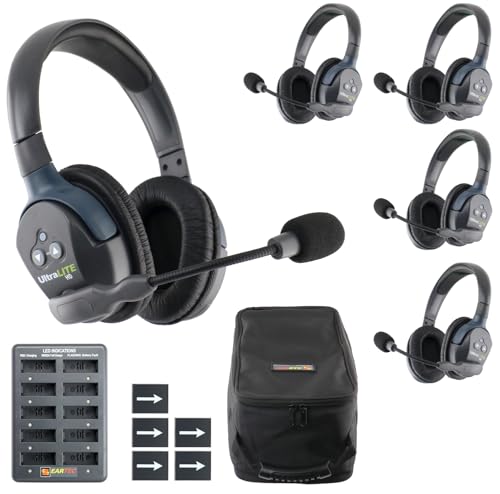
Eartec UL5D UltraLITE HD Intercom (5-Person) — The full-brigade pick
The UL5D is the largest fixed crew in this roundup: five dual-ear full-duplex headsets, up to 1000ft of stated range, from a U.S. company whose UltraLITE line is built for crew work. Five voices is the full brigade pattern — head chef on the pass, two station voices in the kitchen, the floor lead, and the host or bar — and at that size the intercom stops being a convenience and becomes the restaurant’s nervous system: every position that originates or consumes time-critical information is inside one conversation. Banqueting and large-format restaurants, where the kitchen and the function room may be a corridor apart, are the natural home for this scale.
Consider the banqueting day this system was born for. Two hundred covers, a kitchen brigade of eight of whom five hold coordinating roles, a function room a corridor and a fire door away from the pass, and a toastmaster’s schedule that moves the whole evening in five-minute increments. In that building, the alternative to an intercom is a runner — a person whose entire job is carrying sentences between rooms — and the UL5D retires that job. The head chef fires courses against the speeches; the floor lead confirms the top table is seated before anything leaves the kitchen; the host stand warns both about the taxi rank situation at eleven. Five voices is not excess on that day; it is the minimum viable nervous system, and the system’s stated range covers the corridor without anyone thinking about it.
Five headsets also test a restaurant’s discipline, and the pick should be read with that in mind. A five-voice net stays useful only if the crew keeps calls short and addressed; the system provides the channel, not the etiquette. The dual-ear configuration across all five suits the kitchen-weighted crew this system implies. And as with its Eartec siblings, the listing leads with range and duplex rather than a working-time figure, so a house running very long banqueting days should confirm endurance from Eartec’s documentation and build the charging routine around the answer. For the operation that genuinely fields five coordinating voices, though, this is the one-box answer in the six.
- Crew size: 5 headsets, full duplex — the largest in this roundup
- Wearing: dual ear
- Range: up to 1000ft as stated in the listing
- Maker: U.S. company, professional-grade positioning per the listing
- Working time: not stated in the listing title — verify against your longest banqueting day in Eartec’s documentation
Strengths
- Five voices cover the complete brigade — kitchen stations, pass, floor, and host — on one net.
- Dual-ear headsets keep the net intelligible across a large, loud operation.
- A stated 1000ft range spans big footprints, function rooms, and terraces.
Trade-offs
- Five headsets is surplus — and charging overhead — for a forty-cover dining room.
- A five-voice net demands call discipline or it becomes background chatter.
- Dual-ear for the host stand may isolate the very person who must hear the door.
Best for: a large restaurant or banqueting operation coordinating five positions across a big floor plan through long services.
Not suited for: a small bistro buying capacity “just in case”, because three of the five headsets would live in a drawer while their batteries age.

SYNCO XTALK X5 Intercom System — The long-range five-crew pick
The X5 matches the UL5D’s five-person crew size and answers with SYNCO’s stated numbers: a 1148ft range — the longest figure attached to a five-person system here — and the family’s stated 24-hour working time, on a 2.4GHz full-duplex platform. That combination suits the spread-out hospitality site: the hotel restaurant whose kitchen serves a terrace and a pool bar, the wedding venue whose prep kitchen sits across a courtyard, the food hall whose counter team coordinates with a central kitchen. Where the Eartec five-crew sells spectrum discipline, the SYNCO five-crew sells distance plus endurance, and a buyer with a genuinely large footprint should weigh those stated figures heavily.
The 2.4GHz platform is the honest counterweight: it shares spectrum with the venue’s Wi-Fi and every guest’s phone, so a site already struggling with wireless congestion should test the X5 in its own building during a busy service rather than trusting the range figure’s confidence. Range and interference are different axes — a system can reach far and still contend for airtime — and SYNCO’s listing stakes its claim on the reach and the working time. For the venue whose problem is distance, that is the right claim; for the venue whose problem is a saturated spectrum in a compact room, the Eartec DECT systems make the competing case, and the choice between them is a property question, not a brand question.
- Crew size: 5 headsets, full duplex
- Platform: 2.4GHz
- Range: 1148ft as stated in the listing
- Working time: 24H as stated in the listing
- Stated origin use: theatre, event, stage, filming crews
Strengths
- The longest stated range on a five-person system in this roundup, for spread-out sites.
- A stated 24-hour working time covers double services and long event days.
- Five full-duplex headsets match the UL5D’s crew size with a different technical philosophy.
Trade-offs
- 2.4GHz shares air with venue Wi-Fi — congested buildings should test before committing.
- The listing does not specify ear configuration in its title, so kitchen-noise fit needs confirming.
- Five headsets is more fleet than a compact single-room restaurant can use.
Best for: a spread-out venue — hotel restaurant, wedding site, food hall — coordinating five voices across distance through a long day.
Not suited for: a compact dining room in a Wi-Fi-saturated building, where the X5’s range is wasted and its band is busiest.

SYNCO XTalk XPro2 Intercom System (2-Person) — The far-apart pair pick
The XPro2 takes the two-person format and stretches it: a stated 1640ft stable range — the longest figure anywhere in this roundup — plus wide noise cancellation and the family’s 24-hour working time. Two headsets at that distance describe a specific restaurant geography: the kitchen and the far counter, the main building and the garden kitchen, the bakery and the shop it supplies across a market hall, the chef and the stores manager whose walkie-talkie currently crosses a car park. Where the UL2S is the intimate in-room link, the XPro2 is the link between places, and its noise cancellation speaks to the environments at the ends of that link — a dock door, a market’s roar, a terrace in the wind.
There is also a growth story hidden in the pair format. A two-headset link is how many operations first prove the concept to a sceptical brigade — the chef and the floor lead wear them for a month, the rest of the team watches the shouting stop, and the argument for the four- or five-person net makes itself at the pass. Buying the pair with the longest stated range keeps that first purchase useful even after the bigger net arrives, because a long-range pair remains the right tool for the stores run, the market trip, and the off-site event. Few first purchases in a restaurant survive their own success; this one is designed to.
Its listing names boating and events among its uses, which translates to hospitality plainly enough: this is the pair for staff who work far apart and outdoors-adjacent. The discipline of this guide requires noting what the title does not state — ear configuration is not specified — and a buyer should confirm the wearing style against the roles involved. But as a two-voice purchase, the XPro2’s proposition is distinct from the UL2S’s: choose between them by measuring your building. Inside one dining room, the Eartec’s DECT calm is the virtue; across a site measured in hundreds of feet, the SYNCO’s stated reach is the whole argument.
- Crew size: 2 headsets, full duplex
- Range: 1640ft stable range as stated in the listing — the longest figure in this roundup
- Noise feature: wide noise cancellation per the listing
- Working time: 24H as stated in the listing
- Ear configuration: not specified in the listing title — confirm the wearing style with SYNCO for your roles
Strengths
- A stated 1640ft range links positions that are effectively in different places.
- Wide noise cancellation suits dock doors, markets, and terraces at the ends of the link.
- Twenty-four-hour stated working time matches the longest hospitality days.
Trade-offs
- Two voices only — the net cannot absorb a third position.
- Its range is wasted inside a single room, where a DECT pair may run cleaner.
- Wearing configuration must be confirmed from product details rather than the title.
Best for: two key positions separated by real distance — kitchen to garden kitchen, bakery to shop counter, chef to stores — across a long day.
Not suited for: a single-room restaurant choosing a first intercom, because the XPro2’s defining virtue, reach, solves a problem that room does not have.
What Does a Quieter Kitchen Do for the Dining Room?
Guests never see the intercom, but they hear its absence. The traditional kitchen announces itself through the pass — names shouted, pans answered at volume, the low roar of a team communicating by lung power — and in open-kitchen formats that noise is piped directly into the dining room as atmosphere, whether the guests ordered it or not. A crew on a full-duplex net works at conversational level. The expo’s voice arrives in ears, not in the room; the floor lead’s requests leave the dining room silently instead of crossing it. Chefs who have made the switch describe the change in the room’s register before they mention any operational gain: the kitchen sounds calm, and a calm kitchen reads to guests as a competent one.
There is a staff-welfare side that managers should not wave past. Shouting is tiring, and a service spent projecting over extraction noise leaves voices — and tempers — frayed by ten o’clock. A net that lets the team speak at normal volume for six hours returns a fresher crew to the final service and a less abrasive kitchen culture to the trainees learning inside it. None of that appears in a listing’s title, and the listings here quite properly stick to range, duplex, and working time. But the buyer deciding between a crew intercom and another year of shouting is really deciding about the room’s sound and the team’s throats, and those are legitimate line items in a hospitality business where both are part of the product.
How Do These Systems Fit Counter Service, Food Trucks, and Events?
The counter-service format — order at the till, food from a pass, a runner to the tables — compresses the restaurant into three positions that are often twenty feet and one loud room apart. A two-headset net between the pass and the counter captures most of the win: the kitchen calls a tray ready the moment it lands, the counter warns the kitchen about the bus tour that just walked in, and neither message requires a person to cross the room during the rush. The UL2S’s single-ear wearing suits the counter especially, where the wearer’s other ear belongs to the customer in front of them. Food trucks push the same logic into a tighter box with a louder generator: a pair of headsets between the window and the grill ends the shouted order relay that currently travels two metres through steam and extractor noise.
Events and outside catering are where these systems’ origins — SYNCO’s listings name event production outright, and Eartec’s line is built for crews — stop being a caveat and become the point. A wedding breakfast in a hired hall has no installed infrastructure at all: the kitchen is a marquee annex, the floor is a lawn’s worth of tables, and the coordinator’s voice is the only system the day has. A self-contained intercom that arrives in a case, needs no base station, and covers a stated thousand feet or more is precisely the tool that work imagines. Restaurants that cater — most ambitious ones do — should weigh that second life when choosing crew size: the five-person system that is surplus on a Tuesday in the dining room is exactly right at a Saturday wedding, and a system bought for both calendars earns its shelf space twice.
How Do You Train a Crew That Has Never Worked on a Net?
Expect the first week to be worse than shouting, and plan for it. Staff who have never worn a live microphone speak into it as if it were a telephone in a quiet office — too softly for the kitchen to hear over its own noise — or they forget the channel is open and narrate their frustrations to the entire brigade. The fix is a ten-minute rehearsal before a quiet service, not a memo: everyone on the net, the expo running a mock rail of tickets, each position making and acknowledging its standard calls until the pattern — name, message, acknowledgement — is muscle memory. Run the rehearsal again with the extractors on and the room at working volume, because that is the acoustic the net actually lives in, and voices calibrated in silence will not carry through it.
Two habits need explicit teaching because they are counterintuitive. The first is that the net is not private: anything said is heard by every position, including the trainee whose dish is being discussed, so feedback about a person’s work happens off-net, face to face, as it should. The second is microphone manners around guests — a floor lead wearing a live headset must remember that a conversation at a table is also, potentially, a broadcast to the kitchen, and the professional habit is to treat the mic as always hot, because on a full-duplex system it is. Restaurants that teach those two habits in week one keep their nets; restaurants that discover them by incident tend to blame the equipment and shelve it by month two, which is the commonest real-world failure of crew intercoms and entirely a training failure.
Finally, appoint an owner. One person — usually the manager who championed the purchase — holds the charging routine, the fault log, and the authority to retrain a position whose net discipline slips. Systems without an owner decay by consensus: everyone assumes someone else charged them, wiped them, or reported the crackle in headset three. The technology in this roundup is mature and simple; what separates the restaurants still using it in year three from those with a dusty case in the office is almost entirely that single named owner and the closing checklist they defend.
Crew Size, Range, and Endurance — How the Six Stack Up for a Service
| System | Crew | Ears | Stated range | Stated working time |
|---|---|---|---|---|
| SYNCO XTalk X4 | 4 | Not in title | Not in title | 24H |
| Eartec UL2S | 2 | Single | Up to 1000ft | Not in title |
| Eartec UL4D | 4 | Dual | Up to 1000ft | Not in title |
| Eartec UL5D | 5 | Dual | Up to 1000ft | Not in title |
| SYNCO XTALK X5 | 5 | Not in title | 1148ft | 24H |
| SYNCO XTalk XPro2 | 2 | Not in title | 1640ft | 24H |
How Do You Set Up a Crew Net That Survives a Friday Night?
Setup begins with positions, not headsets. Walk the floor plan and mark where each net member actually works — the pass, the floor lead’s station, the host stand — then test the link from the worst pair of positions: kitchen to cellar, kitchen to the far end of the terrace, through the walk-in’s steel door if anyone will ever call from inside it. Range figures are clear-air promises; your building’s masonry, refrigeration, and steel are the real specification, and ten minutes of testing before the first service is worth more than any number in this guide. Assign headsets to positions and label them — tape and a marker — so that “the pass headset” is a specific object that returns to a specific charger, and a fault can be reported against a unit rather than against the system.
Then set the etiquette before the first ticket. Names first, then the message, then an acknowledgement for anything time-critical: “Marco — fire twelve’s mains.” “Firing.” Keep the net for coordination, not conversation; the dining room’s gossip will kill the channel’s usefulness faster than any interference. Agree the three calls that outrank everything — an allergy, an accident, a dish that must not leave the kitchen — and that those words silence all other traffic. Brief every new starter on the net before their first service, because one person narrating their evening into a live channel teaches the whole crew to stop listening.
Charging deserves a sentence of its own in a restaurant, because the building’s rhythm fights it. The natural charge window is overnight, in the office or on a shelf by the pass — decide which, fix the chargers there permanently, and make “headsets on charge” a line on the closing checklist next to “ovens off”. SYNCO’s stated 24-hour working time forgives a forgotten night in a way a shorter-endurance system would not, carrying a lunch service on yesterday’s charge; treat that forgiveness as insurance, not as the routine. A fleet that starts every day full is a fleet whose manager never has to ask, mid-service, whose headset just died.
Close the day with the unglamorous routine that keeps the system alive: headsets wiped down — kitchen grease and earpieces are enemies — seated on their chargers by position, and any fault from the service reported the same night rather than discovered at tomorrow’s setup. Grease is the restaurant-specific hazard no listing mentions: it films over earpieces, works into seams, and degrades both hygiene and audio. A thirty-second wipe per headset at close is the cheapest maintenance in the building, and the manager who builds it into the closing checklist will still be running the same fleet when the restaurant down the road is on its third set.
What Do Restaurants Get Wrong When Buying Crew Headsets?
The first error is categorical: expecting a crew intercom to be a drive-thru system. If your operation’s bottleneck is the lane — order accuracy at the speaker post, car-to-window timing — that is dedicated drive-thru hardware with vehicle detection and lane timers, made by specialists whose products are not in this roundup, and no crew headset substitutes for it. What these six systems transform is the human coordination inside the building: kitchen to floor, pass to host, counter to kitchen. Buy them for that job and they excel; buy them for the lane and the disappointment is structural, not a defect.
The second error is over-crewing the net. Every added voice raises the channel’s noise floor of chatter and the fleet’s charging burden, and a headset bought for a position that speaks twice a service is a battery ageing in a drawer. Third: ignoring the building. A range figure measured in open air meets its truth in your walk-in, your cellar stairs, your steel-clad kitchen — test in the building, at service, with the doors shut. Fourth: forgetting the handover. Headsets shared across shifts without a wipe-and-charge routine become unhygienic and unreliable within a month, and the failure gets blamed on the brand. And fifth: putting the wrong ears on the floor. A host sealed into dual-ear headsets cannot hear the door; match ear configuration to the position’s need to hear the room, as the single-ear UL2S and the dual-ear Eartecs let you do deliberately.
Final Recommendation
Most restaurants should start where the service actually lives. A small brigade needs the UL2S’s calm two-voice link between the pass and the floor; a mid-size house running four positions through lunch and dinner is the XTalk X4’s home ground, with the UL4D as the answer when the kitchen’s noise demands dual-ear coverage; a large or banqueting operation should choose between the UL5D’s DECT discipline and the X5’s stated reach by testing its own building; and the XPro2 serves the pair of positions separated by real distance. Whichever system you choose, label the headsets by position, teach the net’s etiquette before the first service, and wipe them down at close — a crew that can speak quietly to each other, all service long, runs a calmer room, a hotter pass, and a dining room full of guests who never hear the machinery of their evening working at all.
Frequently Asked Questions
Can these headsets run a drive-thru lane?
No — and this guide is explicit about it. These are crew intercom systems for the team inside the building. A drive-thru lane needs dedicated hardware: an outdoor speaker post and microphone, vehicle detection, and lane timing, made by drive-thru specialists. Restaurants with a lane should budget for that category separately and use a crew system like these six for the kitchen, floor, and counter coordination behind it.
How many headsets does a restaurant actually need?
One per coordinating position on the largest single service — not one per employee. Most dining rooms run on two to four voices: the pass, the floor lead, a second kitchen voice, and the host or bar. Five-person systems suit banqueting and large-format sites. Headsets are assigned to positions and handed over between shifts, with a wipe and a charge in between.
What is the difference between DECT and 2.4GHz systems here?
The Eartec UltraLITE HD line works on DECT, a spectrum set apart from the Wi-Fi and Bluetooth traffic that saturates a dining room, and its listings emphasise interference-free operation. SYNCO’s systems work at 2.4GHz and stake their claims on range and 24-hour working time instead. In a compact, wireless-crowded room, DECT’s separation is attractive; across a large site, SYNCO’s stated distances lead. Test in your own building either way.
Single-ear or dual-ear for restaurant work?
It depends on the position’s other listening job. The pass and the floor lead usually keep one ear on their room — the kitchen’s sounds, the dining room’s mood — which suits the single-ear UL2S. Staff inside a loud kitchen, whose only listening job is the net itself, hear calls more reliably with both ears covered, as on the UL4D and UL5D. The host stand, which must hear the door and the phone, is the position most often harmed by dual-ear coverage.
Will a stated 1000ft range really cover my restaurant?
Almost certainly, with margin — but the figure is a clear-air measurement, and your building spends it through masonry, steel, refrigeration, and floors. The practical test is the worst pair of positions at service time: kitchen to cellar, kitchen to terrace end, walk-in door closed. Every system here should be walked through that test in its first week; a link that holds there will hold anywhere in the building.
What happens when a headset fails mid-service?
With a labelled-by-position fleet, the failure is a swap, not a crisis: the position takes the spare — every operation should hold at least one charged spare beyond its net size, or accept a borrowed headset from the least critical position — and the faulty unit is set aside for the fault log at close. What a crew must not do is troubleshoot on the net during service, narrating the fault to all positions. Agree the drill in advance: swap first, report at close, and let the system’s owner handle the warranty conversation on a quiet morning.
How should headsets be cleaned between shifts?
Wipe every headset at handover — earpieces and any surface that touched skin or kitchen air — and seat it on its charger by position. Kitchen grease films earpieces and seams, degrading hygiene and audio together, so the wipe is functional, not cosmetic. Report any crackle, weak ear, or damaged strap the same night; a fault logged at close is a swap at setup, while a fault discovered mid-service is a voice lost from the net.
Related Guides
- Best Neckband Headsets with Bluetooth aptX
- Best Monitor Headsets for Studio
- Best Headsets for Simultaneous Interpretation


