What's inside
- Key Takeaways
- Quick Picks
- How Were These Six Tour Systems Selected?
- What Actually Decides Whether a Group Hears the Guide?
- How Should You Size a System to Your Group?
- Six Tour Guide Systems, Examined One by One
- Ear Hooks, Earbuds, and Speakers — How Should Guests Listen?
- What Changes When Tours Run Outdoors, in Weather, or With Two Guides?
- Range, Battery, and Fleet Size — the Six Systems Compared
- How Do You Run a Tour Day on a Receiver Fleet?
- Where Do Tour System Buyers Usually Go Wrong?
- Final Recommendation
- Frequently Asked Questions
- Related Guides
As an Amazon Associate I earn from qualifying purchases. This post may contain affiliate links at no extra cost to you.
widgetverdict.com is reader-supported. When you buy through links on our site, we may earn an affiliate commission.
Where to buy: Amazon lists every system in this roundup, from a ten-receiver museum kit with its own charging case to a handheld whisper system built for thirty listeners at a time.
A tour guide system lives or dies on a pavement, not in a showroom. The group is strung out along a gallery, half of them are photographing something behind you, a bus is idling at the kerb, and your voice has to arrive in thirty ears at conversational level without you raising it. The best tour guide headsets are really small broadcast systems — a transmitter and microphone on the guide, a receiver and earpiece on every guest — and the buying questions that matter are pedestrian ones: how many receivers come in the box, how far the link honestly reaches, how long the batteries last across a full guiding day, and how the whole fleet charges overnight. The six systems below were chosen because their listings answer most of those questions in numbers.
Two brands carry most of this field. Retekess appears three times here in three genuinely different configurations — a second-generation T130U bundle, an ear-hook TT106S bundle, and the same TT106S family name that also appears in interpretation kits at a very different size — while AGJ fields two bundles at fifteen and thirty receivers, PANDAAR a compact ten-receiver kit, and IndoorLink a handheld whisper system. Read the counts carefully: with tour systems, the bundle is the product, and a model name shared between a 15-receiver kit and a 60-receiver kit describes a family, not a capacity. This guide quotes each bundle’s own numbers and treats them as different products, because on the day, they are.
Key Takeaways
- Receiver count is group size: the bundles here run from PANDAAR’s 10 receivers to the AGJ and IndoorLink kits at 30, with Retekess T130U at 32.
- Two systems publish a 200-metre range — the T130U and the TT106S ear-hook bundle — while the others describe range in words the buyer should test against their own route.
- Battery claims differ in kind: the T130U states 40H and the TT106S states 50H in their listings, the numbers a full-day guide should plan around.
- Charging splits the field — slotted charge cases (T130U, PANDAAR) versus a charging base (TT106S) versus a single charger (AGJ bundles).
- The TT106S name covers multiple bundle sizes; this article’s TT106S is the 1 TX / 15 RX ear-hook kit, a different purchase from larger bundles of the same family.
- IndoorLink’s handheld transmitter suits whisper-style guiding in museums and exhibitions where a worn mic is impractical.
Quick Picks
| Pick | Badge | Why it earns its place |
|---|---|---|
| Retekess T130U Tour Guide System (2 TX, 32 RX) | The full-day flagship | Two transmitters, thirty-two receivers, a stated 200M range, 40H battery figure and a 32-slot charge case. |
| Retekess TT106S Earhook Tour Guide System | The ear-hook lightweight | Open ear-hook receivers, one-key operation, a stated 200m/656ft range and 50H figure, with a charging base. |
| AGJ Wireless Tour Guide System (1 TX, 15 RX) | The mid-size straightforward kit | One transmitter and fifteen receivers with a charger — a single-guide, single-group working size. |
| AGJ Wireless Tour Guide System (2 TX, 30 RX) | The two-guide step-up | Two transmitters and thirty receivers with a storage case, for a lead guide plus a second voice or a split group. |
| PANDAAR Wireless Tour Guide System (1 TX, 10 RX) | The small-group case kit | Ten receivers and a 10-slot charge case — the right scale for museum and church groups that stay small. |
| IndoorLink Handheld Wireless Tour Guide System | The whisper-tour handheld | A handheld transmitter with thirty receivers, pitched at whisper guiding in museums, exhibitions and factories. |
How Were These Six Tour Systems Selected?
We required complete working bundles — a transmitter and a stated number of receivers in one listing — because a tour operator buys a group size, not a component. Listings that publish their working numbers earned preference: range in metres, battery life in hours, case slots counted. Where a listing trades in phrases instead — AGJ’s bundles give receiver counts but no range or battery figures in their titles, and IndoorLink promises a wide working range without a number — the pick sections keep the distinction visible and tell you what to verify, rather than converting adjectives into specifications on the maker’s behalf.
We also deliberately spread the roundup across the real shapes of guiding work. There is a two-transmitter flagship for the operator running a lead and an assistant, ear-hook receivers for guests who will not tolerate an earbud, a handheld whisper transmitter for hushed galleries, and three levels of single-guide kits at ten, fifteen, and thirty receivers. A buyer should be able to find their own working day somewhere in that spread — and, just as usefully, to see the kits that are wrong for it, because an oversized system is not a safer purchase; it is more inventory to charge, carry, count, and lose.
What Actually Decides Whether a Group Hears the Guide?
Distance on a tour is not the distance on the box. A stated 200 metres is a clear-air figure between a transmitter and a receiver with nothing in between; a real group inserts stone walls, a cathedral’s worth of masonry, forty bodies, and the guide’s own back turned toward the stragglers. What decides audibility in practice is margin — a link with generous range headroom degrades gracefully as the group stretches, while a link working at its limit drops the last five guests every time the group rounds a corner. That is why the two listings here that publish 200-metre-class figures earn attention, and why every buyer, whatever the claim, should walk their own longest stop with a receiver before the season starts.
The second decider is the earpiece, because a guest who removes it hears nothing at all. Ear-hook receivers, like the TT106S bundle’s open design, sit on the ear and let the guest keep some awareness of the room — a genuine virtue in a gallery, where total isolation feels antisocial, and on a street, where traffic awareness is safety. In-ear earpieces seal better against a noisy plant floor or a windy harbour wall. Match the wearing style to the loudest stop on your route, not the quietest, and remember that comfort is an audio feature: the best receiver in this roundup is the one still in the guest’s ear at the final stop.
There is a fourth decider that operators discover in their second season: interference from the environment’s other radios. A venue running its own wireless microphones, a neighbouring group’s system on a nearby channel, even a dense thicket of visitor phones can crowd the spectrum a tour system works in. The T130U’s listing explicitly advertises less-interference voice transmission in digital mode, and the TT106S works at 2.4GHz among the crowd — different strategies for the same crowded world. The practical defence is procedural rather than technical: arrive early enough to test in the venue as it will be, not as it is at dawn; if a channel sounds busy or a receiver crackles at a particular stop, change the system’s channel at setup rather than apologising at the stop. Guides who build a ten-minute RF walk into their arrival routine almost never have an interference story to tell; guides who unbox at the meeting point collect them.
The third decider is the guide’s own microphone discipline. A transmitter’s mic — worn, headset-style, or handheld — rewards a steady distance from the mouth and a voice at conversational level; guides who shout into the mic distort every receiver at once, and guides who turn their head away from a fixed mic fade for the whole group simultaneously. The systems here cannot fix technique, but the two-transmitter kits acknowledge a related truth: a second transmitter lets an assistant or a guest speaker take the narration without a handover of sweaty hardware mid-sentence.
How Should You Size a System to Your Group?
Size to the group you actually take, plus spares, not to the largest group you can imagine. Count your typical maximum honestly — most operators know it within two people — then add a small reserve of receivers for the day a booking swells, a receiver fails, or a guest pockets one at the cathedral door. The bundles here map onto real operations cleanly: ten receivers for the boutique museum tour, fifteen for the standard walking group, thirty to thirty-two for the coach party and the factory visit. Buying one size up is defensible; buying three sizes up purchases charging burden, carrying weight, and loss exposure that a season of guiding will make you regret weekly.
Transmitter count is a staffing question wearing a spec’s clothing. One transmitter means one voice: fine for the solo guide, limiting the moment a colleague co-guides, a translator joins, or a site manager wants to address the group at the factory gate. Two transmitters — the T130U and the larger AGJ bundle — cover those patterns and provide a hot spare if the guide’s unit fails mid-tour, which is the failure that otherwise ends the day. If your operation ever runs two groups simultaneously, note that two transmitters in one kit are one system with shared charging, not two independent systems; separate departures are better served by two smaller kits than by splitting one large one and discovering the case cannot be in two car parks at once.
Do not overlook who else has to understand the system. Deputies, seasonal guides, and the colleague who covers your sick day all inherit the fleet, and a system only its owner can set up is a fragility disguised as expertise. The kits with one-key receivers and slotted cases are teachable in minutes; whatever you buy, write the setup on one card kept inside the case lid — channel, handout order, collection count, charging plug — so the fleet’s knowledge lives with the fleet. Operators who do this discover that their system survives staff changes intact, which is a longer horizon than most buying guides consider and exactly the horizon a working tour business lives on.
Finally, size the charging to the turnaround. A guide finishing at six and starting at nine the next morning needs the fleet charged, counted, and cased overnight without heroics. Slotted cases — the T130U’s 32 slots, PANDAAR’s 10 — make that a glance; a charging base, as with the TT106S bundle, keeps a smaller fleet tidy; a single charger, as the AGJ listings describe, asks the operator to rotate units or accept a longer charge window. None of these is disqualifying, but the right answer depends on whether your fleet is ten receivers or thirty-two, and whether tomorrow’s group is booked before tonight’s has even returned.
Six Tour Guide Systems, Examined One by One

Retekess T130U Tour Guide System (2 TX, 32 RX) — The full-day flagship
The T130U is the most completely specified bundle in this roundup, and its listing reads like a checklist written by someone who has run tours: two transmitters, thirty-two receivers, a stated 200-metre range, digital mode, a 40-hour battery figure, less-interference voice transmission, and a 32-slot charge case. Each number answers a failure a guide has actually met. The range covers the stretched-out factory visit; the 40H figure covers the long day and forgives a forgotten overnight charge; the second transmitter covers the co-guide, the translator, and the spare; the case covers the count at the end of the day, when thirty-two receivers come home in pockets, palms, and handbags.
Put the T130U in its natural habitat and the specification coheres. A plant tour crosses a yard, enters a hall of running machinery, and gathers at a line where the manager wants to speak; a coach operator’s city day strings six stops across a centre where the group repeatedly disperses and regathers. Both patterns punish a weak link and reward a second transmitter, and both end with a headcount at a door. The 40-hour figure also suits the operator who runs the same fleet across a weekend of departures without a charging window between them — endurance, in a working fleet, is really scheduling freedom wearing a number.
Note what the case arithmetic says: thirty-two slots for thirty-two receivers is an exact fit, which means the transmitters live outside the case or the operator accepts a full case with no slack for a spare receiver. Plan for that — a small separate pouch for the two transmitters is the obvious answer — rather than discovering it at the first pack-down. The listing names factory and travel use, and that pairing is credible: this is the kit for the operator whose groups are coach-sized and whose days are long, in buildings and on streets where the link has to survive bodies and distance together. Smaller operations should read its virtues as a warning about scale: every one of those thirty-two receivers is a unit to charge, issue, collect, and eventually replace.
- Transmitters / receivers: 2 TX, 32 RX
- Range: 200M as stated in the listing
- Battery figure: 40H as stated in the listing
- Mode: digital, with less-interference voice transmission per the listing
- Charging: 32-slot charge case included
Strengths
- The fullest published spec in this group — range, battery, and counts all stated in numbers.
- Two transmitters cover co-guiding and provide a working spare for the guide’s own unit.
- Thirty-two receivers match a full coach party without rationing earpieces at the door.
Trade-offs
- The 32-slot case exactly fits the receivers, leaving no slot slack for spares or the transmitters.
- A 32-unit fleet is heavy administration for an operator whose groups actually run at twelve.
- Digital-mode benefits depend on a clean channel plan when other systems share the venue.
Best for: a factory-tour or coach-tour operator running groups near thirty, with long days and a second voice to accommodate.
Not suited for: a solo guide whose groups stay under fifteen, because the extra seventeen receivers become charging and counting overhead on every single tour.

Retekess TT106S Earhook Tour Guide System — The ear-hook lightweight
This TT106S bundle — one transmitter, fifteen receivers — is built around a wearing idea: open ear-hook receivers that rest on the ear rather than plugging it. For a walking tour, that choice has real consequences. Guests keep their awareness of the street and the room, the hook fits over glasses more gracefully than many earbuds, and a receiver that does not seal the ear can be worn for a two-hour walk without the pressure fatigue that makes guests quietly remove sealed earpieces. The listing adds one-key operation, which is the receiver interface a guest can be taught in one sentence at the kerbside: press, listen.
Trade shows, which the listing names, are this bundle’s second home and worth picturing: a booth presenter or a stand guide addressing a shifting knot of visitors who join and drift away, in a hall saturated with other exhibitors’ wireless. An ear-hook receiver handed over in seconds, with one key to press, suits that churn far better than a fitted earpiece ritual — and the open design lets a visitor keep talking to a companion without feeling sealed off from the stand. The 2.4GHz band is crowded in an exhibition hall, so a channel check at setup is part of the job, but the format rewards exactly the quick, hygienic, low-friction handout this kit is built around.
The published figures are strong for a mid-size kit: a stated 200m/656ft range and a 50H battery figure, the longest endurance number in this roundup, delivered with a charging base rather than a slotted case. Fifty hours reframes the charging routine — a fleet that runs several tours between charges suits an operator guiding intermittently through the week. Be clear-eyed about the family name, though: TT106S bundles exist at other sizes, including a much larger interpretation configuration, and this fifteen-receiver ear-hook kit is its own product. Order by the counts in this listing, not by the model name alone, and you will get the system this section describes.
- Transmitters / receivers: 1 TX, 15 RX
- Receivers: open ear-hook style, one-key operation
- Range: 200m/656ft as stated in the listing
- Battery figure: 50H as stated in the listing
- Band: 2.4GHz; charging base included
Strengths
- Open ear hooks keep guests aware of their surroundings — a safety and courtesy virtue on streets and in galleries.
- The stated 50H figure is the longest battery claim here, suiting multi-tour weeks.
- One-key receiver operation minimises the kerbside tutorial for each new group.
Trade-offs
- Open hooks seal less than in-ear pieces, so the loudest stops — plant floors, harbour walls — test them hardest.
- One transmitter means one voice; a co-guide or translator needs a different bundle.
- A charging base is tidier than loose cables but less audit-friendly than a slotted case at collection time.
Best for: a walking-tour or trade-show guide with groups around fifteen who values guest comfort and awareness over sealed isolation.
Not suited for: a guide leading tours through genuinely loud industrial spaces, where an open ear hook lets the environment compete with the narration.
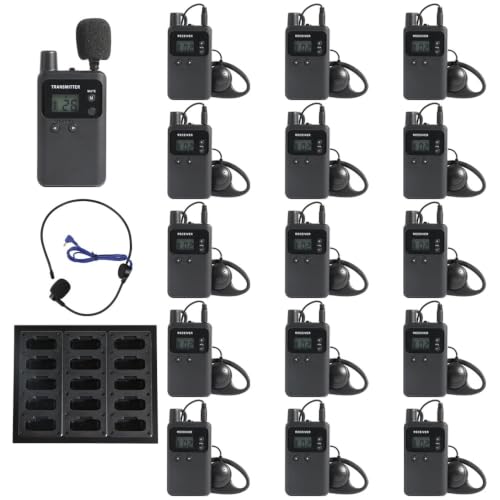
AGJ Wireless Tour Guide System (1 TX, 15 RX) — The mid-size straightforward kit
AGJ’s fifteen-receiver bundle is the plain-spoken option in this roundup: one transmitter, fifteen receivers, one charger, a microphone-and-speaker system described for factory, school, court, and church translation work. Fifteen is the size of the classic walking group — large enough to be a business, small enough for one guide to hold together at a crossing — and a single-transmitter kit at that size keeps the morning routine to its minimum: charge, hand out, collect, count to fifteen.
The listing’s restraint cuts both ways, and this guide will not paper over it. Its title publishes no range figure and no battery duration, so a buyer cannot check this kit against a long route or a long day from the listing alone; those numbers exist in AGJ’s documentation and should be pulled before the kit is committed to a route with a distant final stop. What the listing does establish is the bundle’s shape and its intended settings, and for a school running museum days or a church running a translated service with a modest group, the shape may be exactly right. Buy it for the simplicity, but verify the two missing figures first — they are the difference between a kit that fits your route and one that fades at its far end.
- Transmitters / receivers: 1 TX, 15 RX
- Charging: 1 charger per the listing
- Stated roles: factory, school, court, church translation
- Range: no distance figure in the listing title — confirm AGJ’s documented range against your longest stop
- Battery: no duration figure in the listing title — confirm the documented figure before planning full-day tours
Strengths
- Fifteen receivers match the standard single-guide walking group without surplus inventory.
- A one-transmitter, one-charger routine is the simplest fleet administration in this roundup.
- The named settings — school, church, factory, court — are fixed-venue uses where routes are known and testable.
Trade-offs
- Range and battery figures are absent from the title, so route planning needs the manufacturer’s documentation.
- A single charger stretches the overnight routine if receivers return fully flat.
- No second transmitter, so a failed guide unit ends the tour’s audio rather than degrading it.
Best for: a school, church, or small operator running one group of about fifteen over a known, repeatable route.
Not suited for: an operator planning long-distance outdoor routes sight unseen, because the listing itself offers no range figure to plan them against.

AGJ Wireless Tour Guide System (2 TX, 30 RX) — The two-guide step-up
AGJ’s larger bundle doubles everything that matters in its smaller sibling: two transmitters, thirty receivers, and a storage case joining the charger. That doubling changes the kind of work the kit can carry. Thirty receivers serve the coach party; two transmitters serve the lead guide and the person who actually knows the factory floor, or the guide and the interpreter on a bilingual tour, or simply the guide and a charged spare riding in the case against the day the main unit fails at the meeting point. The storage case matters at this size — thirty receivers loose in a bag is a tangle and a counting problem, while thirty receivers in a case is a fleet.
The same documentation caveat applies as with the fifteen-receiver AGJ: the title states counts and contents but no range or battery figures, and at thirty receivers the cost of discovering a shortfall is higher, because a coach party cannot be asked to huddle closer. Pull AGJ’s documented figures, walk your longest route with a receiver at the back of the group, and then this bundle’s straightforward value — double capacity, double voices, one case — can be judged on evidence. For courts and churches running translation alongside tours, the two-transmitter layout also maps onto a main speaker plus interpreter pattern that single-transmitter kits cannot serve at all.
- Transmitters / receivers: 2 TX, 30 RX
- Charging and storage: 1 charger and 1 storage case per the listing
- Stated roles: court, church translation, factory, school
- Range: the listing title gives no distance figure — obtain AGJ’s documented range before committing to spread-out sites
- Battery: the listing title gives no duration figure — obtain the documented endurance for full-day planning
Strengths
- Thirty receivers and two transmitters cover the coach party and the two-voice tour in one bundle.
- A storage case keeps a thirty-unit fleet countable and transportable.
- The second transmitter doubles as insurance against a guide-unit failure at departure.
Trade-offs
- Unpublished range and battery figures demand homework that the Retekess listings pre-answer.
- One charger for a thirty-receiver fleet makes the overnight charge a planned rotation, not an afterthought.
- Splitting the bundle across two simultaneous departures strands the shared case and charger with one group.
Best for: an operator running coach-size groups or two-voice formats — guide plus interpreter, guide plus site expert — on repeatable routes.
Not suited for: two guides departing simultaneously from different sites, since the shared case and single charger make this one fleet, not two.

PANDAAR Wireless Tour Guide System (1 TX, 10 RX) — The small-group case kit
PANDAAR’s kit is the smallest complete system here — one transmitter, ten receivers, a 10-slot charge case — and its smallness is a considered answer to a real niche. The museum tour capped at ten, the church group that never exceeds a minibus, the factory whose visitor policy limits parties to ten hard hats: these operations do not need thirty receivers, and they benefit from a fleet that charges in one small case, carries in one hand, and counts to ten at the door. The listing names museum, church, and factory tours plus translation, which is precisely the small-group circuit.
Small fleets also change the economics of loss and failure in the operator’s favour. When a receiver in a thirty-two-unit fleet dies, it is one thirty-second of capacity and easily ignored until three more follow it; when a receiver in a ten-unit fleet dies, the operator feels it at the next booking and replaces it promptly — small systems get maintained because their margins are visible. The same visibility applies to guests: a guide handing a receiver to each of ten people can look each of them in the eye, confirm the earpiece is in and the volume is right, and start the tour with a group that is genuinely connected. That per-guest attention is a quality the largest systems structurally cannot offer, and for high-value small tours — the curator-led gallery hour, the specialist’s factory visit — it is worth more than spare capacity.
The 10-slot case deserves emphasis because at this scale it changes the ownership experience entirely. There is no bag of loose receivers, no separate charging ritual — the case is the system, opened at the start, closed at the end, its ten slots a standing inventory. As with the AGJ listings, PANDAAR’s title publishes no range or battery figures, so the buyer’s verification duty stands: confirm the documented numbers against your building. But a small indoor operation — a museum’s galleries, a church’s sanctuary — is the easiest environment in this category to test, and a kit that passes a walk of your own galleries with a receiver in the furthest room has answered the only range question that matters to you.
- Transmitters / receivers: 1 TX, 10 RX
- Charging: 10-slot charge case included
- Stated roles: museum, church, factory tours, translation
- Range: no distance figure appears in the listing title — walk-test your own galleries or sanctuary before the season
- Battery: no duration figure appears in the listing title — check PANDAAR’s documentation for day-length planning
Strengths
- A case-sized fleet of ten is the lightest administration in this roundup — charge, carry, count, done.
- The slotted case gives small operators the same inventory discipline as the big systems.
- Ten receivers match capped group sizes exactly, with no surplus units to store or lose.
Trade-offs
- An eleventh guest has no receiver; group growth means a second kit or a larger one.
- Range and battery figures must come from documentation, not the listing.
- One transmitter leaves no spare voice if the guide’s unit fails mid-tour.
Best for: a museum, church, or visitor attraction whose groups are capped near ten and whose tours run indoors on familiar ground.
Not suited for: an operator whose bookings regularly swell past ten, because the fleet ceiling is the product’s defining limit.

IndoorLink Handheld Wireless Tour Guide System — The whisper-tour handheld
IndoorLink’s system is the odd one out in form, and deliberately so: the transmitter is handheld, built for whisper guiding. In a museum gallery, a courtroom visit, an exhibition hall, or a place of worship, the guide often cannot wear a headset microphone and project — the whole point is a murmur that reaches the group’s earpieces and nobody else’s peace. A handheld unit suits that posture: raised to the mouth for a comment, lowered while the group looks, passed to a curator or official for a remark without re-fitting a worn mic. The bundle carries thirty receivers, so the whisper scales to a full visiting party.
Whisper technique is a skill the equipment assumes. The guide speaks at a true murmur, close to the handheld mic, at a steady distance — the moment the murmur rises into a normal voice, the room hears it and the etiquette is broken; the moment it drops or the unit drifts from the mouth, the receivers lose it. Groups also need one sentence of instruction: the voice in their ear will be quiet by design, and they should set their receiver volume at the first stop, in the quietest room, rather than at the meeting point’s bustle. Guides moving from conventional touring to whisper work usually need two or three tours to calibrate — pitch, pace, and the discipline of lowering the unit while the group looks — after which the format’s intimacy becomes its selling point: guests lean in, literally, and a whisper tour feels like being confided in for an hour.
The listing promises a wide working range without publishing a distance, and it names church, factory, museum, and exhibition use. Treat the range phrase as an invitation to test in your own space — whisper venues are indoor, wall-rich environments where a clear-air figure would mislead anyway, and a receiver walked through your actual galleries tells the truth in ten minutes. The handheld form has its own honest cost: a guide who gestures, points, holds a tablet, or manages tickets gives up a hand to the transmitter, and over a long day that trade is felt. For the hushed, stop-and-look rhythm of gallery guiding, though, the handheld whisper unit is not a compromise version of the other five — it is the only one designed for the room’s etiquette first.
- Transmitters / receivers: handheld transmitter, 30 receivers (1T30R)
- Style: whisper tour guide audio system per the listing
- Stated roles: church, factory visit, museum visit, exhibition, court
- Range: described as a wide working range in the listing, with no distance figure in the title — test it across your own rooms
- Charging: the listing title does not describe a charge case for this bundle — confirm the charging arrangement with IndoorLink
Strengths
- A handheld transmitter matches whisper guiding’s etiquette — speak, lower, let the room stay quiet.
- Thirty receivers give the hushed format a full party’s capacity.
- The transmitter can be passed to a curator or official for a remark without refitting worn gear.
Trade-offs
- One of the guide’s hands is committed to the transmitter for the whole tour.
- Range is described, not numbered, in the listing — venue testing is the buyer’s job.
- Charging arrangements are unstated in the title, so the overnight routine needs confirming.
Best for: a museum, exhibition, or court-visit guide whose tours are quiet, stop-heavy, and built around short comments to a group of up to thirty.
Not suited for: a guide who narrates continuously while walking and gesturing, because a handheld transmitter punishes exactly that style over a full day.
Ear Hooks, Earbuds, and Speakers — How Should Guests Listen?
The receiver’s electronics get the attention, but the transducer at the guest’s ear decides whether the tour is heard. Three listening arrangements appear across this category, and the six picks divide among them in instructive ways. The TT106S bundle’s open ear hooks rest on the ear’s outer curve: nothing enters the canal, ambient sound still reaches the guest, and the receiver can be worn over glasses arms without disturbing them. For a city walk — traffic to remain aware of, a companion to chat with between stops, a church’s own music to hear under the commentary — that openness is the design’s whole point, and its cost appears only where the environment is loud enough to compete with an unsealed ear.
In-ear earpieces, the pattern the case-based kits here ship with their receivers, trade that openness for isolation and level. A sealed earpiece delivers the guide’s voice at lower volume against a noisy background, which is why factory tours — where the group walks past running machinery and the guide competes with the plant itself — favour them. The hygiene duty is heavier: the part that enters the ear is the part that must be cleaned or re-tipped between guests, and the part guests are most likely to find uncomfortable if the fit is wrong. Operators running both environments sometimes keep both styles in the case, issuing hooks for the morning’s city walk and sealed pieces for the afternoon’s plant — an inexpensive flexibility that the receiver fleet already supports, since the earpiece is the interchangeable part.
The third arrangement hides inside the AGJ listings’ own description: a tour guide microphone and speaker system. Some AGJ deployments use a small speaker rather than individual earpieces for very small or stationary groups, which trades privacy and noise control for zero handout — nothing to issue, nothing to collect, nothing to clean. For a classroom or a small church group seated together, that can be the pragmatic answer; for a walking group strung along a street it cannot, because a speaker’s voice dies with distance and competes with the street itself. Read the AGJ bundles as earpiece systems for touring purposes — that is how their receiver counts make sense — and treat any speaker use as a stationary bonus rather than the main event.
What Changes When Tours Run Outdoors, in Weather, or With Two Guides?
Weather is the unlisted specification in every tour system. Rain finds earpieces, wind finds microphones, and cold finds batteries. None of the six listings publishes a weather rating in its title, so this guide assigns none — instead, plan defensively. A guide’s transmitter worn under a jacket stays drier and its mic stays calmer than one clipped outside in the wind; receivers handed out with a simple instruction — keep it in a pocket, only the earpiece out — survive drizzle that would trouble exposed electronics. Cold shortens every battery’s day, which is another argument for the published endurance figures on the Retekess pair: a fleet with 40 or 50 stated hours has margin to spend on a frosty morning, while a fleet of unknown endurance should be charged the night before a cold tour without exception, and ideally kept in a warm room rather than a cold vehicle overnight.
Two-guide operations change the arithmetic and the choreography together. With two transmitters — the T130U or the larger AGJ — decide in advance whether the second transmitter is a co-guide channel guests can select, a translator’s channel, or a hot spare muted in the case, because each pattern implies different instructions at handout and different behaviour when something fails. Co-guiding on one channel, with the two guides handing narration back and forth, suits the lead-plus-expert pattern: the factory manager speaks at the line, the guide resumes on the walk, and guests never touch their receivers. Split groups on separate channels suit parallel language groups, but then handout instructions double in importance — a guest on the wrong channel hears a stranger’s tour in another language and concludes the system is broken. Write the pattern on the setup sheet, rehearse the handover once, and the two-transmitter kits repay their premium in the first week.
Range, Battery, and Fleet Size — the Six Systems Compared
| System | TX / RX | Stated range | Stated battery | Charging |
|---|---|---|---|---|
| Retekess T130U | 2 / 32 | 200M | 40H | 32-slot case |
| Retekess TT106S (this bundle) | 1 / 15 | 200m/656ft | 50H | Charging base |
| AGJ (1 TX, 15 RX) | 1 / 15 | Not in title | Not in title | 1 charger |
| AGJ (2 TX, 30 RX) | 2 / 30 | Not in title | Not in title | 1 charger + storage case |
| PANDAAR | 1 / 10 | Not in title | Not in title | 10-slot case |
| IndoorLink | 1 handheld / 30 | Described as wide | Not in title | Not stated in title |
How Do You Run a Tour Day on a Receiver Fleet?
The day starts the night before, with the fleet in its case or on its base and the count confirmed — not assumed — against the slots. In the morning, receivers come out in order and go back into the same slots at the end; a case that returns with an empty slot has told you a receiver is missing while the group is still within call, which is the only moment that information is worth having. At the meeting point, the handout is a thirty-second ritual: receiver on, earpiece in, channel already set by you during setup, volume demonstrated once. Guests should never be handed a receiver and left to discover its controls at the first stop, because the first stop is where your narration sets the tone and a third of the group is still pressing buttons.
During the tour, guide to the back of the group, not the front. The guests furthest from you are the ones your link reaches last and your voice reaches never; a pace that keeps the group bunched at crossings, a pause at corners until the tail arrives, and narration timed for when the group is gathered rather than strung along a stairwell will do more for audibility than any range figure. Keep a spare receiver in your own pocket — the guest whose unit fails mid-tour gets a swap in seconds and remembers the recovery, not the failure. At the final stop, collection is part of the farewell: receivers in at the door or the coach step, counted against the case before the group disperses, because a receiver discovered missing after the coach leaves is simply gone.
Accessibility deserves a place in the routine rather than an apology at the door. Guests with hearing aids, guests with one stronger ear, guests who simply find earpieces uncomfortable — every operator meets them weekly. A spare receiver with the volume set higher, an ear-hook alternative for the guest who cannot tolerate an in-ear piece, and a habit of asking quietly at handout whether anyone needs the volume adjusted will rescue more tours than any equipment upgrade. Note, too, that these systems carry the guide’s voice only; they are not hearing loops and make no accessibility certification claims in their listings, so venues with formal accessibility obligations should treat receiver handout as one layer of welcome, not as compliance.
Between tours, the fleet wants fifteen honest minutes: earpieces wiped and inspected, damaged tips replaced, receivers seated in their slots, the case closed on a full count. Earpieces are the hygiene front line of a shared system and the part guests judge you by; a clean, intact earpiece signals a professional operation before you have said a word. Operators who build this quarter-hour into the schedule keep fleets alive for seasons; operators who treat it as optional discover erosion — a receiver a month, a charger mislaid, a case that no longer tells the truth — until the system quietly stops being one.
Where Do Tour System Buyers Usually Go Wrong?
The classic misjudgement is buying the bundle by its model name. Families like the TT106S span several bundle sizes across different listings, and a buyer who orders the name without fixing the transmitter and receiver counts can receive a fifteen-receiver kit for a forty-person operation — or the reverse. Read counts, not names. A second error is sizing to the imaginary maximum: the once-a-year group of fifty does not justify a fifty-receiver fleet that burdens the other fifty weeks; rent or borrow for the exceptional day and own the system your calendar actually runs.
Range optimism is the third trap. A stated figure is measured kindly; your route includes the cathedral’s stone, the factory’s steel, and the bodies of the group itself. The listings that publish no figure are not necessarily shorter-legged — they are simply unmeasured in public, which is why the walk-test of your own longest, hardest stop outranks every number in this guide, including the published ones. Fourth: neglecting the second voice. Buyers plan for the guide and forget the interpreter, the site expert, the trainee shadowing the tour — then discover a one-transmitter kit cannot carry them. And fifth, the quiet killer: no collection discipline. Fleets are not lost in dramatic thefts; they evaporate one pocketed receiver at a time, in operations that never count at the door.
Final Recommendation
For the operator whose tours are long, large, and professional, the Retekess T130U is the complete answer in this group: published range and battery figures, two transmitters, thirty-two receivers, and the case to keep them honest. Walking-tour guides with mid-size groups should look hard at the TT106S ear-hook bundle for its guest comfort and its stated endurance, while the AGJ pair offer straightforward value at fifteen and thirty receivers for buyers willing to pull the documented range and battery figures themselves. PANDAAR’s ten-receiver case kit is the right-sized system for capped indoor groups, and IndoorLink’s handheld is the specialist for rooms where the guide must whisper. Pick the bundle whose counts match your calendar, walk your hardest stop with a receiver before the season opens, and count the fleet at every door — do those three things and the system you buy this year will still be complete, charged, and earning compliments three seasons from now.
Frequently Asked Questions
How many receivers should a tour system have?
As many as your typical maximum group, plus a small reserve for failures, losses, and the day a booking swells. In this roundup that logic maps to ten receivers for capped museum groups, fifteen for the standard walking tour, and thirty to thirty-two for coach parties and factory visits. Buy for your calendar, not for the largest group you can imagine, and hire extra capacity for the exceptional day instead.
Is a stated 200-metre range enough for outdoor tours?
For most walking tours, comfortably — groups rarely stretch beyond a few dozen metres. The figure is a clear-air measurement, though, and walls, vehicles, terrain, and the group itself all spend it. The honest test is your own route: walk your longest stop and your most obstructed corner with a receiver before relying on any figure, published or not.
What is the difference between the TT106S bundles?
Bundle contents. The TT106S is a receiver family sold in several configurations; the kit reviewed here carries one transmitter and fifteen ear-hook receivers with a charging base, while a larger configuration elsewhere pairs four transmitters with sixty receivers for interpretation work. Same family name, different product — always order by the transmitter and receiver counts in the specific listing.
Why would a guide choose a handheld transmitter?
For whisper guiding. In galleries, exhibitions, courts, and places of worship, the guide speaks in a murmur that should reach the group and no one else; a handheld unit is raised for a comment and lowered while the group looks, and it can be passed to a curator or official without refitting a worn microphone. The cost is a committed hand, which suits stop-and-look tours better than continuous walking narration.
What should I check in the first week of owning a system?
Run three tests before the system carries a paying group. First, the range walk: your longest and most obstructed stop, with a receiver at the back of an imaginary group. Second, the endurance day: a full guiding day on one charge, noting what remains at the end, so your charging routine is built on your own numbers rather than a listing’s. Third, the handout rehearsal with colleagues playing guests — time it, simplify the instructions until the whole ritual takes half a minute, and write the final version of those instructions down. A system that passes all three in week one will not surprise you in week ten.
Do these systems work for translation as well as tours?
Several listings say so directly — both AGJ bundles and the PANDAAR kit name church or court translation among their uses. Mechanically the systems are the same: one voice, many receivers. A single-language interpreted service maps well onto a one-transmitter kit; multi-language interpretation needs a channel and a transmitter per language, which is a different buying problem with its own guide on this site.
Can one system serve two tours at the same time?
Only if it was bought as two systems in spirit. A two-transmitter bundle can feed two groups on separate channels, but the receivers, the case, and the charging are shared — splitting them across simultaneous departures means splitting the fleet and its discipline, and one group will end up short. Operators who regularly run parallel tours should own two complete kits sized to each group; operators who occasionally overlap can stagger departures around one flagship fleet and a small backup kit.
How should receivers be cleaned between tours?
Wipe earpieces after every tour, inspect tips for damage or blockage, and replace worn tips on sight rather than on a schedule. Seat receivers in their case or base slots for charging, and keep the case closed on a full count. The routine takes minutes and is what separates a fleet that lasts seasons from one that erodes a unit at a time.
Related Guides
- Best Restaurant Headsets
- Best Neckband Headsets with Bluetooth aptX
- Best Monitor Headsets for Studio


