What's inside
- Key Takeaways
- Quick Picks
- How Were These Kids Desks Chosen?
- What Size Desk Does a Child Actually Need?
- Where Should a Child’s Desk Live?
- How Do the Six Compare Side by Side?
- How Should Parents Choose Between Fixed and Adjustable?
- Building the Homework Habit Around the Desk
- What About Screens at a Child’s Desk?
- Second Desks, Siblings and the Handover Problem
- Care and Feeding: Making a Child’s Desk Survive Childhood
- Common Mistakes When Buying a Kids Desk
- Frequently Asked Questions
- Final Recommendation
- Related Guides
As an Amazon Associate I earn from qualifying purchases. This post may contain affiliate links at no extra cost to you.
widgetverdict.com is reader-supported. When you buy through links on our site, we may earn an affiliate commission.
Where to buy: All six sets in this guide are sold on Amazon, so begin by looking closely at the BOLUO Wooden Kids Desk with Storage, a wooden desk and chair set with a drawer and cabinet for the 8-to-10 age band. The best kids desks are not small office desks; they are furniture sized for bodies that change size every year, and the six here answer that problem in six different ways — fixed wooden sets, height-adjustable study desks, a tilting desktop with its own light, an electric sit-stand desk for children, and one small chair desk for the youngest writers of all.
A child’s desk has three jobs that an adult’s desk never faces. It must fit a body that will be measurably taller by next school year. It must survive treatment no office would tolerate — glue, paint, leaning, standing on the chair to reach the shelf above. And it must persuade a child to sit at it voluntarily, which is a design problem involving colour, ownership and the feeling that this corner of the room is theirs. The picks below were chosen against those three jobs, not against adult criteria shrunk down.
Parents should also know what this guide does not do: it makes no medical or posture-cure claims for any desk. Height adjustability and tilting tops are discussed as fit and comfort features — ways of matching furniture to a growing child — and families with specific health questions should take them to the professionals who know the child. What furniture can honestly promise is fit, sturdiness and an invitation to sit down and work, and the six here are judged on exactly that. Readers furnishing a whole student room rather than a child’s corner will find the next size up in our Best Durable Computer Desks guide, where the desks assume a sitter who has stopped growing.
Key Takeaways
- Age bands differ sharply: the Delta Children chair desk suits the youngest, the BOLUO names ages 8–10, the GITAWUSA claims 3–12 years.
- Three designs adjust in height — the Rengue and GITAWUSA manually, the FLEXISPOT electrically.
- The Rengue adds a 55-degree tiltable desktop and an LED light with 3 modes and brightness control.
- Storage runs from the Delta’s under-seat bin to the Guidecraft’s hutch and shelves.
- The FLEXISPOT publishes the only capacity figure here: 154 lbs, over a 32 x 20 inch white desktop.
Quick Picks
| Pick | Badge | Why it earns its place |
|---|---|---|
| BOLUO Wooden Kids Desk with Storage | The wooden starter set | A white wooden desk and chair with drawer and cabinet storage, sized for ages 8–10. |
| Rengue Kids Desk and Chair Set | The tilting study station | Height adjustable with a 55-degree tiltable desktop, LED light, drawer and metal hook. |
| GITAWUSA Kids Desk and Chair Set | The graffiti-topped grower | Height adjustable for ages 3–12, with a graffiti-friendly top, side bookshelf and storage. |
| Guidecraft Kids Media Desk and Chair Set | The hutch classic | A wooden navy workstation with hutch and shelves, from an established children’s furniture maker. |
| FLEXISPOT Electric Height Adjustable Kids Desk | The motorised sit-stand | Electric height adjustment for ages 3–10, 32 x 20 inch desktop, 154 lbs capacity. |
| Delta Children Chair Desk with Storage Bin | The first-desk chair | A chair desk with a storage bin beneath, Greenguard Gold Certified, in a Spider-Man design. |
How Were These Kids Desks Chosen?
By age first. A desk for a four-year-old and a desk for a ten-year-old share a category name and almost nothing else, so the list was built to cover the childhood span with honest specialisations rather than six identical claims to suit everyone. Where a listing publishes an age band, the review quotes it and reasons inside it; where it does not, the review reasons from the design — a chair desk with a storage bin is furniture for the early years whatever its listing says, and pretending otherwise would help nobody.
Adjustment was the second criterion, because growth is the category’s central fact. Three of the six adjust in height, by hand or by motor, and their reviews discuss what that adjustment is for: keeping feet supported and the desktop at a workable height across school years, so the desk is refitted rather than replaced. The fixed sets were chosen for what they offer instead — storage, sturdiness, a hutch’s worth of shelves — for the years their size fits.
The third criterion was storage, because a child’s desk fails by clutter faster than by any other route. Drawers, cabinets, hutches, bookshelves and one under-seat bin all appear below, and the reviews treat them as the difference between a desk that stays a desk and one that becomes a shelf with a chair. Specifications quoted come from the listing titles; where a title is silent — on dimensions for several of these sets — the review flags the silence and sends the tape-measure questions to the product page. Families comparing against adult standing desks for an older child should also read our Best Pneumatic Sit-Stand Desks guide, where the adjustment mechanisms are compared for grown-up frames.
What Size Desk Does a Child Actually Need?
Less than parents fear, and more specifically than listings admit. A young child’s work — drawing, early writing, a tablet, a parent’s laptop for a call — fits on a modest top; what matters is that the chair lets feet rest supported and the surface sits at a height where shoulders are not hunched to reach it. The chair desk format, represented here by the Delta Children, solves the whole equation in one object for the smallest children: seat and surface arrive already proportioned to each other.
By the middle years — the BOLUO’s stated 8–10 band — the workload changes character: homework books open beside a notebook, a laptop or tablet joins the paper, and storage for the accumulating apparatus of school becomes the desk’s real job. That is why the sets aimed at this band lead with drawers, cabinets and hutches. A top that fit a six-year-old’s drawing will technically fit a nine-year-old’s homework too, but the homework will colonise the bed and the floor around a desk with nowhere to put things.
The growth question has two honest answers. Buy the adjustable desk — Rengue, GITAWUSA or FLEXISPOT — and refit it as the child grows, accepting a higher initial complexity. Or buy the fixed desk sized for now — BOLUO, Guidecraft, Delta — and accept that it will be handed down, sold on or promoted to a sibling in a few years. Both are respectable strategies; the mistake is buying a fixed desk two sizes too big in the name of growing room, because a child dwarfed by their desk will simply work somewhere else.
Noise is the placement factor families underestimate. A desk beside the television’s wall or under a teenager’s bedroom inherits a soundtrack that homework loses to, nightly. The best corner in the house for a child’s desk is the boring one — away from the screens, away from the through-route to the kitchen, lit decently and dull in every other respect. Children concentrate where the room gives them nothing better to attend to, and the desk’s job is to be the most interesting object in a deliberately uninteresting corner.
Where Should a Child’s Desk Live?
The bedroom is the default, and for older children the right one: homework needs a door that closes on the household’s noise, and a desk in the child’s own room becomes part of the territory that makes study feel like their project rather than a supervised activity. The sets with hutches and shelves — the Guidecraft especially — are designed for that permanent installation, anchoring a corner of the room as the study corner.
Younger children often work better within sight of the household. A small desk in the kitchen’s corner or the living room’s edge lets a parent cook and supervise in the same glance, and the compact sets — the Delta chair desk above all — suit that semi-public life, moving between rooms as the day requires. The folding of study into family space is not a compromise for the early years; it is how homework habits are actually built, one supervised half-hour at a time.
Light decides the final placement more than furniture does. A desk under a window gains daylight and loses the screen to glare by mid-afternoon; a desk in a dark corner needs a lamp, which is why the Rengue’s built-in LED light is a placement feature as much as a study one — it frees the desk from the room’s lighting geography. Wherever the desk lands, the test is the same: the child should be able to see the page without shadowing it with their own head, at the hours homework actually happens.

BOLUO Wooden Kids Desk with Storage — The wooden starter set
The BOLUO is the traditional answer, done in white wood: a desk and chair set for the 8-to-10 band, with a drawer and a cabinet giving the set two kinds of storage — the drawer for the daily tools of homework, the cabinet for the bulkier apparatus of school life. That pairing is the set’s real intelligence. A single drawer alone fills and jams by October; a drawer plus a cabinet lets a child sort, and sorting is the habit the desk is really teaching.
Wood is the second argument. In a category of boards and laminates, a wooden set carries the furniture feel that persuades a child the desk is a possession rather than an appliance, and it ages by scuffing gracefully instead of peeling. White is the finish risk and the finish reward at once: it brightens a child’s room and shows every pencil mark, which families should weigh honestly. Many will decide the brightness is worth the wiping.
The age band deserves respect in both directions. For an eight-year-old, this set is sized as a workstation for the homework years that matter — books, notebooks, a tablet, a lamp. For a child well past ten, the same set becomes a squeeze, and the listing’s honesty about its band lets parents plan the handover rather than discover it. The title publishes no dimensions, so the tape-measure work — the set’s footprint against the room’s corner — belongs on the product page before ordering.
As a first real desk for a child graduating from the kitchen table, the BOLUO makes the strongest ceremonial case in this guide: a chair of one’s own, a drawer of one’s own, a cabinet for the treasures. Children rise to furniture that treats them as workers, and this set’s whole design is that compliment, paid in wood.
- Format: desk and chair set, wooden
- Stated ages: 8–10 years
- Storage: drawer and cabinet
- Finish: white
- Dimensions: the listing title publishes none — the manufacturer’s own documentation is where to confirm the footprint
There is a hand-me-down logic to the BOLUO worth naming: a plain white wooden set passes to a younger sibling without carrying a theme the next child disowns, and wood takes a fresh coat of paint better than any laminate when the second owner wants a colour of their own. Families buying for the eldest of several children are really buying for all of them, and this set is built for that relay.
Strengths
- Drawer plus cabinet gives a child two tiers of sorting.
- Wooden build feels like furniture, not equipment.
- An honestly stated age band makes planning easy.
Trade-offs
- Fixed size — the set is outgrown on schedule.
- White shows pencil, pen and paint faithfully.
- No height adjustment for the years within the band.
Best for: an 8-to-10-year-old getting a first proper study desk of their own.
Not suited for: a tall eleven-year-old, whom the stated age band honestly excludes.
See the BOLUO wooden desk set on Amazon if the homework years deserve real furniture.
Rengue Kids Desk and Chair Set — The tilting study station
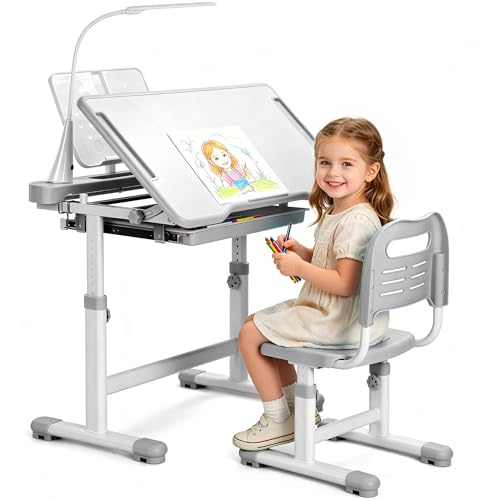
The Rengue is the most engineered set in this guide: height adjustable, a desktop that tilts to 55 degrees, an LED light with 3 modes and brightness control, a storage drawer and a metal hook, in grey. Each feature answers a recognisable study problem. The tilt brings a book or worksheet up toward the eyes instead of asking the neck to go down to the desk. The light puts illumination where the work is, in a choice of modes for different hours. The hook takes the school bag off the floor and off the chair.
Height adjustment is the feature that justifies the set across years: as the child grows, the desk and chair rise to meet them, keeping feet supported and the surface at a working height. That refitting is the difference between a desk bought for a school stage and a desk bought for childhood. The grey finish is the grown-up choice in this list — a colour a child is less likely to disown at eleven than a pastel or a character theme, which matters for a set designed to stay in service.
The cautions are the honest costs of features. A tilting desktop needs its pencils corralled — the drawer earns its keep — and anything left loose on a tilted surface will demonstrate gravity. The light needs power, so the desk’s placement inherits a cable question. And the listing title does not publish the set’s dimensions or its height range in figures, so parents fitting a specific corner or a specific tall child should confirm both on the product page.
For the child who reads as much as writes — books propped at an angle, drawing at a slope, homework under a proper light — the Rengue is the most complete study station here, and its completeness is aimed at the habits parents actually hope homework will build.
- Format: desk and chair set, height adjustable
- Desktop: tiltable to 55 degrees
- Light: LED with 3 modes and brightness control
- Storage: drawer, plus a metal hook
- Height range in figures: absent from the listing title — check the manufacturer’s documentation for the numbers
The Rengue also understands the school bag, which most desks pretend does not exist. A bag on the floor is a trip hazard and a bag on the chair is a theft of the seat; the metal hook gives the bag a home at the desk’s side, where its contents — the reading book, the permission slip, tomorrow’s kit — stay in the study zone. Small hooks and drawers are how desks quietly teach the geography of being organised.
One more Rengue virtue belongs to the parents: adjustability postpones the next purchase decision. Every year a set can be refitted is a year the family does not re-enter the furniture market, and the saving is not only money but the disruption of replacing the room’s study corner mid-childhood. Desks that grow are bought once and argued about once, which any parent who has assembled flat-pack at midnight will price correctly.
Strengths
- Tilting top suits reading and drawing as much as writing.
- Built-in light frees placement from the room’s lamps.
- Height adjustment refits the set as the child grows.
Trade-offs
- Loose items slide on a tilted top; the drawer must be used.
- The lamp’s cable ties the desk to a socket’s neighbourhood.
- Grey is sensible now and must still please at age eleven.
Best for: a reader and drawer whose homework mixes books, art and writing.
Not suited for: a desk placed far from any socket, where the light cannot be powered.
Look at the Rengue study set on Amazon when the book deserves an angle and the page deserves a light.

GITAWUSA Kids Desk and Chair Set — The graffiti-topped grower
The GITAWUSA claims the widest span in this guide — ages 3 to 12 — on the strength of height adjustment, and adds two features aimed squarely at how children actually treat desks: a graffiti-friendly tabletop that invites drawing on the desk itself, and a side bookshelf that keeps the reading pile off the work surface. The graffiti top is a small act of design honesty. Children draw on desks; a surface that welcomes it, within its own rules, ends a hundred small conflicts and turns the desk into the child’s territory in the most literal way.
The side bookshelf is the storage idea here, and it suits the reading-heavy child: books stand beside the knee, visible and reachable, rather than stacked on the top where homework needs to spread. Combined with the set’s storage, the layout teaches the same sorting lesson as the BOLUO’s drawer and cabinet, in a different dialect — the shelf for what is read, the storage for what is used.
A 3-to-12 claim should be read with the respect and the scepticism it deserves. Height adjustment can genuinely carry a desk across much of that span, but the chair, the top’s size and the child’s dignity all change across it too, and a set that fits a preschooler’s art sessions will be asked very different questions by a twelve-year-old’s laptop homework. The listing title publishes neither dimensions nor the height range in figures; parents buying for the older end of the claim should verify both on the product page, and parents buying for the younger end should expect the desk to be refitted, not replaced, as the years pass.
In grey, like the Rengue, the set chooses longevity of taste over the excitements of colour — a defensible trade for the longest-serving furniture in the child’s room.
- Format: desk and chair set, height adjustable
- Stated ages: 3–12 years
- Surface: graffiti table for drawing
- Storage: side bookshelf plus storage
- Desktop dimensions: not given in the listing title — the manufacturer’s documentation holds them
The graffiti top deserves a second thought from the parent’s side of the purchase. A surface designed to be drawn on is also a surface that forgives the marks it was not designed for — the stray pen line, the sticker residue, the homework done in permanent marker by an optimistic seven-year-old. Desks that can only be kept perfect make children careful in the wrong way; this one makes the desk a place where work, including messy work, is allowed to happen.
Strengths
- The longest claimed service life in the guide.
- A drawing-welcoming top ends the graffiti wars.
- Side bookshelf keeps books off the homework surface.
Trade-offs
- The wide age claim needs verifying at its older end.
- A graffiti top invites marks beyond its borders too.
- Grey restraint may bore a child who wanted colour.
Best for: an artistic child whose desk should last and be drawn on.
Not suited for: a twelve-year-old’s full laptop setup without checking the top’s size first.
Check the GITAWUSA desk set on Amazon if the desk might as well be the sketchbook.

Guidecraft Kids Media Desk and Chair Set — The hutch classic
Guidecraft is a name children’s furniture buyers have met for years, and this media desk set shows the maker’s habits: a wooden writing table with a hutch and shelves, a matching chair, in navy. The hutch is the design’s centre of gravity. Shelves above the work surface give a child the vertical storage that small desks usually lack — books standing, supplies boxed, the current treasures displayed — while the top itself stays clear for the work of the moment.
The listing calls it a media desk and a student’s workstation, and the hutch serves both lives: the shelves that hold readers and workbooks in the school week hold the tablet’s accessories and the craft supplies at the weekend. Navy is a considered colour — deeper and more forgiving than the BOLUO’s white, more characterful than grey, and a tone that suits the bedroom this set will anchor. As furniture, this is the most room-defining pick in the guide: a corner becomes a study when it arrives.
The honest limits are fixity and footprint. A hutch desk does not adjust, does not fold and does not apologise; it occupies its corner permanently, and its size is what it is. The listing title publishes no dimensions, so the corner must be measured and the figures confirmed on the product page — a hutch’s height in particular needs checking against sloped ceilings and the shelf or picture rail already on the wall. Families in rented homes or small rooms should weigh that permanence; families furnishing a child’s room for the long term will find it the point.
There is also the matter of the maker. Established children’s furniture brands write their listings plainly and answer for their products, and in a category where a desk must survive a childhood, that accountability is a feature as real as the hutch.
- Format: desk and chair set, wooden, with hutch
- Storage: hutch and shelves above the work surface
- Finish: navy
- Stated setting: kids bedroom, study
- Overall height with hutch: the listing title gives no figure — verify it in the manufacturer’s documentation
The Guidecraft’s hutch also creates something no other pick here offers: a display. Children work harder in a corner that shows their work back to them — the certificate on the hutch shelf, the model on the top ledge, the current book standing upright like a shop window. A desk with shelves above it becomes a small gallery of the child’s own seriousness, and that feedback loop is worth as much as the storage the shelves provide.
Strengths
- Hutch shelves give vertical storage small desks lack.
- An established children’s maker stands behind the set.
- Navy finish defines a study corner handsomely.
Trade-offs
- Fixed size and permanent footprint; no adjustment.
- The hutch’s height must be checked against the room.
- Too much furniture for a temporary or rented corner.
Best for: a child’s bedroom being furnished properly, for years, around a study corner.
Not suited for: a rented room where furniture must stay light and movable.
View the Guidecraft media desk on Amazon when the study corner deserves a hutch and a name you know.

FLEXISPOT Electric Height Adjustable Kids Desk — The motorised sit-stand
The FLEXISPOT brings the adult standing-desk idea down to childhood scale: an electric, motorised sit-stand study table for ages 3–10, with a 32 x 20 inch white desktop and a published capacity of 154 lbs. The motor is the headline, and its real purpose in a child’s desk is not standing — though children, given the option, stand and fidget and perch in rotation — but refitting. A desk that rises at a button’s press gets adjusted the day the child grows, not the year after anyone notices the hunch.
The published figures are the most complete in this guide: a desktop size and a capacity, stated plainly. Thirty-two by twenty inches is a genuine work surface for the stated ages — books, a tablet or laptop, drawing materials — and 154 lbs of capacity is structural headroom a child will never approach, which is exactly what capacity in children’s furniture should be: boring. FLEXISPOT’s name comes from the adult standing-desk world, and the transfer of that engineering downward is the set’s credibility.
The questions the title leaves open are the chair and the detail: this listing is for the desk, and the seating must come from elsewhere, matched to the desk’s heights as the child grows. The height range in figures is also a product-page check. And a motorised desk in a child’s room raises the household rules question — the button will be pressed for joy as well as for fit, and families should decide in advance whether the desk is a tool or, occasionally, a ride. The capacity figure suggests the engineering will survive the joy; the homework may not.
For a family already converted to standing desks in the adult office, this is the coherent choice: the child’s furniture speaks the same language as the parents’, adjusts as continuously, and will be refitted on schedule because refitting costs nothing but a button.
- Format: electric height adjustable desk, motorised sit-stand
- Stated ages: 3–10 years
- Desktop: 32 x 20 inches, white
- Capacity: 154 lbs as published
- Chair: not part of this listing — seating is chosen separately
Parents who work at standing desks themselves will recognise the FLEXISPOT’s subtler benefit: the child sees homework and posture treated as adjustable things, fitted to the worker rather than endured by them. That is a household culture worth more than any single feature. The desk also future-proofs the room’s layout, because a surface that changes height can serve as a craft table, a display stand or a side desk in its second life without a single tool.
The white desktop deserves a practical note: it is the best surface in this guide for a child who works with colour, because colours read true against white in daylight and under lamps alike, and young artists are serious about that accuracy even when they cannot name it. It will also record every experiment honestly, which in a child’s room is less a flaw than a diary.
Strengths
- Electric refitting actually happens, unlike manual adjustments.
- The most completely published figures in the guide.
- Sit-stand variety suits children who work in motion.
Trade-offs
- No chair is included; seating is a second decision.
- A motor invites play that families must set rules for.
- Needs a socket within cable reach, like any electric desk.
Best for: a family that wants the child’s desk refitted as reliably as the adults’ desks.
Not suited for: a room with no spare socket near the study corner.
Open the FLEXISPOT kids desk on Amazon if adjustment should happen at a button, not a toolbox.
Delta Children Chair Desk with Storage Bin — The first-desk chair
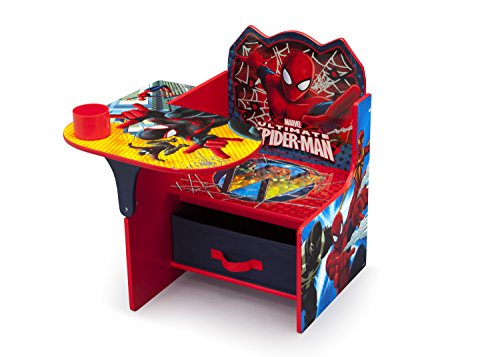
The Delta Children chair desk is the youngest idea in this guide: a chair with a desk surface attached, a storage bin under the seat, a Greenguard Gold Certified build, and a Spider-Man design. For the child who is not yet at school — drawing, sticker books, the first letters practised beside a parent — this format is not a small desk but a different and better thing: a self-contained station that can live in the kitchen, the living room or the bedroom and move between them as family life requires.
The storage bin under the seat is the feature parents will bless. The crayons, books and current projects live inside the chair itself, so the station tidies itself in one gesture and the living room floor returns to the adults in the evening. The certification named in the listing — Greenguard Gold — speaks to the product’s materials testing, a consideration that matters most for the youngest children, who interact with furniture at closest quarters.
And then there is Spider-Man, who should be discussed as the serious feature he is. A first desk competes with every other attraction in a young child’s day, and a beloved character on the furniture is an invitation no plain finish can match. The counterweight is time: characters are outgrown, and this desk’s service life is the early years by design. Families should buy it as what it is — the perfect first station for a defined season — rather than asking it to be a school desk later.
Delta Children is another established name in children’s furniture, and the chair desk format is one of its long-standing designs; the listing’s brevity reflects a product that parents largely understand on sight. The title publishes no dimensions, so the doorway-and-corner arithmetic is minimal for an object this size, but the seat height against a specific small child is worth a product-page glance.
- Format: chair desk with attached surface
- Storage: bin under the seat
- Certification: Greenguard Gold Certified, per the listing
- Design: Spider-Man
- Seat height and dimensions: not published in the listing title — the manufacturer’s documentation carries them
The Delta’s portability writes its own family scene: the chair desk starts the morning in the kitchen beside a parent with a laptop, moves to the living room for the afternoon’s drawing, and hosts a bedtime book in the bedroom — one small station following the child through the house’s day. Fixed furniture cannot do that, and for the years when a child’s work is mostly companionship with paper, following is the whole job.
Strengths
- A complete first station: seat, surface and storage in one object.
- The under-seat bin makes tidying a single gesture.
- A character design invites the youngest children to sit and work.
Trade-offs
- The early-years format is outgrown by design.
- Character styling dates faster than plain finishes.
- Too small for school-age homework with books and devices.
Best for: a preschool child whose drawing and first letters need a station of their own.
Not suited for: primary-school homework, which needs a full desk and chair set.
Find the Delta Children chair desk on Amazon when the first desk should also be the favourite seat in the house.
How Do the Six Compare Side by Side?
| Desk | Format | Adjusts | Storage | Stated ages |
|---|---|---|---|---|
| BOLUO Wooden | Desk and chair set | No | Drawer and cabinet | 8–10 |
| Rengue | Desk and chair set | Height, plus 55-degree tilt | Drawer and hook | Not stated in title |
| GITAWUSA | Desk and chair set | Height | Side bookshelf and storage | 3–12 |
| Guidecraft Media | Desk and chair set with hutch | No | Hutch and shelves | Not stated in title |
| FLEXISPOT Electric | Desk only | Electric height | None stated | 3–10 |
| Delta Children | Chair desk | No | Under-seat bin | Early years by design |
Read the table by childhood stage rather than by features. The Delta owns the preschool years outright. The middle years split three ways: the BOLUO for storage and furniture feel, the Rengue for reading and drawing under light, the GITAWUSA for the longest adjustable run. The Guidecraft furnishes the permanent study corner, and the FLEXISPOT serves the family that treats refitting as a button press. A household with several children will likely own two of these across a decade, in sequence, and that is the category working as intended.
Budget enters honestly here: adjustable and electric mechanisms cost more than fixed frames of similar material, and the premium buys years rather than features. Spread across a childhood, a refitted desk is usually the cheaper object; bought for a single stage, it is an expensive way to own unused travel in a frame. The arithmetic differs by family, and the guide’s fixed sets exist precisely so that both arithmetics have a good answer.
How Should Parents Choose Between Fixed and Adjustable?
By counting children and counting years. One child, a clear age band, a room being furnished properly: the fixed sets — BOLUO for the 8–10 homework years, Guidecraft for the permanent corner — give furniture solidity and storage that adjustment mechanisms rarely match. Several children in sequence, or one child whose growth is outpacing every pair of trousers: the adjustable sets convert one purchase into several years of fit, the Rengue and GITAWUSA by hand, the FLEXISPOT by motor.
Then weigh the child’s actual work. Reading and art argue for the Rengue’s tilt and light. Drawing on the furniture itself argues for the GITAWUSA’s forgiving top. A child who works in motion — standing, perching, sitting in rotation — argues for the FLEXISPOT. A child whose desk must hold a term’s worth of apparatus argues for drawers, cabinets and hutches over mechanisms. Parents furnishing for an older, taller student should cross-check against our Best Home Office Desks for Gamers and Coders guide before deciding the child has outgrown this category entirely.
Finally, involve the child in the finish and the feel, within the shortlist the adults have vetted. A desk chosen partly by its owner gets used as territory; a desk imposed gets used as storage for the bed’s overflow. The choice among six sound options can safely be the child’s — the vetting, the measuring and the budget remain the parents’.
Building the Homework Habit Around the Desk
A desk succeeds when the routine around it succeeds, and the routine is built from small consistencies: the same time, the same corner, the bag on its hook or the bin under the seat, the surface cleared at the end so the next session starts clean. Parents choosing between the six here should imagine the routine each one implies. The BOLUO’s routine is sorting — drawer for tools, cabinet for bulk. The Rengue’s is preparation — bag hung, light on, book tilted. The Delta’s is tidying in one gesture, bin loaded, station carried away.
The desk also needs a boundary with the rest of the room’s life. A study corner that doubles as the household’s dumping ground teaches that homework is the room’s lowest priority; a corner defended — even in a small room, even by nothing more than agreement — teaches the opposite. Hutches and shelves help here physically, because a desk with its own vertical territory is harder to colonise than a bare top at everyone’s elbow height.
Finally, let the desk age with the child in small ceremonies: the refit when trousers are replaced, the drawer re-sorted each term, the hutch shelf rearranged for the new school year’s subjects. Adjustable desks make the refit literal, but every desk here can be re-consecrated. Children return to furniture that is periodically made new for them.
What About Screens at a Child’s Desk?
Schoolwork now arrives through a screen as often as through a book, and the desks here divide by how naturally they host one. The FLEXISPOT’s 32 x 20 inch desktop was plainly sized with a device in mind, and its sit-stand range lets a tablet or laptop be met at the child’s height standing or sitting. The Guidecraft’s media framing — it is in the product’s name — anticipates a screen among the shelves. The BOLUO’s cabinet swallows a tablet and its case at night, which is its own kind of screen policy.
Placement matters more than specification. A screen at a child’s desk should sit at a distance the desk’s depth can provide, with the room’s light arranged so the display is not fighting a window; the Rengue’s lamp, aimed at paper, should not be assumed to solve screen glare. Families setting rules about recreational screen time will find the desk an ally: work happens at the desk, and the desk is a defined place, which makes the rule spatial and therefore easier for a child to keep.
Second Desks, Siblings and the Handover Problem
Families rarely buy one child’s desk; they buy a sequence, and the sequence goes better when each desk is bought with its successor in mind. The Delta chair desk hands down perfectly within the early years — a younger sibling inherits the station just as the elder graduates to a set with storage. The BOLUO and Guidecraft hand down as furniture, their plain finishes surviving the change of owner. The adjustable sets complicate the relay in a good way: the Rengue, GITAWUSA or FLEXISPOT can be refitted downward for the next child, which turns one purchase into two children’s whole desk history.
The mistake is the opposite plan — buying each child a desk themed to that child’s current passion, at full size, with no thought for the next room it must fit. Themed furniture ages in dog years. The plain and the adjustable age in human ones, and in a house with three children the difference compounds into real money and real storage space saved.
When the second child arrives at desk age, resist giving them the leftovers by default. A desk refitted, repainted or re-shelved for its new owner — a hutch rearranged, a drawer emptied and lined, a chair newly theirs — carries the message that the work corner is a privilege of growing up, not a hand-me-down of it. The furniture in this guide is sturdy enough for the relay; the ceremony is up to the parents.
Care and Feeding: Making a Child’s Desk Survive Childhood
Children’s desks are cleaned by negotiation and maintained by whoever loses the negotiation, so choose and plan accordingly. Surfaces that forgive — the GITAWUSA’s drawing-friendly top, the Guidecraft’s navy, the BOLUO’s repaintable wood — reduce the maintenance argument to a wipe. White surfaces, the BOLUO’s finish and the FLEXISPOT’s desktop, ask for a weekly pass and repay it by showing the room bright; families should decide which temperament is theirs before ordering, not after the first ink incident.
Moving parts need a termly check. Height mechanisms — cranks, pins, the FLEXISPOT’s motor — should be run through their range each school term, both to keep them free and to catch the moment the child has outgrown the current setting. Tilting desktops like the Rengue’s should have their hinges checked for the pencil that inevitably migrates into them. None of this is onerous; all of it is the difference between a desk that serves a childhood and one that serves until the first wobble is declared fatal.
And plan the ending at the beginning. A desk with a known next owner, a known wall in the next home, or a known resale route is a desk that will be looked after. The sets in this guide were chosen partly for that afterlife — wood that repaints, mechanisms that refit, formats that hand down — because the true cost of a child’s desk is measured across all the children and rooms it serves.
Common Mistakes When Buying a Kids Desk
The first is buying two sizes too big for growing room, producing a desk the child cannot use comfortably now and resents by the time it fits. The second is the mirror error: a charming first desk bought with no plan for the school years that follow immediately behind it. The third is ignoring storage, then watching homework migrate across the bed, the floor and the kitchen table because the desk has nowhere to put anything.
The fourth mistake is placing the desk where the room has space rather than where the light is, then wondering why the child prefers the kitchen table. The fifth is forgetting the chair in sets that do not include one — the FLEXISPOT’s seating is a separate, necessary decision, matched to the desk’s heights. The sixth is treating the character finish as a long-term investment: themed furniture is a season’s joy, bought best with its handover already planned.
One last encouragement: the desk does not need to be perfect to work. A sound desk, in a lit corner, with storage the child understands and a routine the household keeps, will carry homework from the first letters to the last primary exams — and the six above were chosen so that every family reading can find that desk at the stage their child is actually in.
Frequently Asked Questions
What age should a child get a first desk?
When they start producing work that needs a home — drawing seriously, practising letters, sitting with books by choice. For many children that is the preschool years, which is the Delta chair desk’s territory. The desk-and-chair sets become the right answer when school homework arrives and books need storage beside the worker.
Is height adjustability worth it?
It is worth it when the desk must serve across growth — several years, or several siblings in sequence. It is worth less when the desk is bought for one defined stage, where a fixed set’s storage and solidity serve better. The electric version, the FLEXISPOT, earns its premium by making the adjustment actually happen.
Does a tilting desktop really help?
It helps the activities that happen on a slope in every other context: reading a book, drawing, working through a worksheet. The Rengue’s 55-degree tilt brings the page toward the eyes rather than asking the child to fold over the desk. It helps writing on loose paper least of all, since paper slides — which is why the same set includes a drawer and a flat mode of working.
How much storage does a child’s desk need?
Enough that everything homework requires can leave the surface at night. In practice that means one closed space for tools and one open space for books — the BOLUO’s drawer and cabinet, the Guidecraft’s hutch shelves, the GITAWUSA’s side bookshelf all answer the same equation in different shapes. A desk with no storage becomes a display of clutter within a month.
Can one desk really last from age 3 to 12?
The GITAWUSA claims that span on the strength of height adjustment, and the mechanism can honestly cover much of it — but the chair’s size, the top’s area and the child’s self-image all change across those years too. Treat the widest claims as a long service life with refits, verify the dimensions at the older end on the product page, and expect the desk’s role to evolve from art station to study desk along the way.
Should the chair match the desk?
In the sets — BOLUO, Rengue, GITAWUSA, Guidecraft — the chair arrives proportioned to the desk, which removes the commonest fit problem in children’s furniture. With the FLEXISPOT, where seating is separate, choose a chair whose height lets feet rest supported at the desk’s sitting settings, and expect to replace or refit it as the child grows even though the desk itself adjusts. A mismatched chair under a perfect desk undoes the desk’s work nightly.
Desk in the bedroom or the living room?
Follow the child’s age and the household’s rhythm. Preschoolers work where the adults are, which makes the Delta’s movable station the living-room answer. School-age children increasingly need a door and a defended corner, which suits the bedroom sets — BOLUO, Rengue, GITAWUSA, Guidecraft. The FLEXISPOT serves either room, provided a socket is nearby. When in doubt, start the desk where homework supervision actually happens; a desk in the wrong room is furniture, while a desk in the right room is a habit.
Final Recommendation
For the classic homework years, the BOLUO is the recommendation: wooden, storied with drawer and cabinet, and honestly sized for ages 8–10. For the child who reads and draws at their desk, take the Rengue and its tilting, lit surface; for the longest adjustable run, the GITAWUSA; for the family that refits by button, the FLEXISPOT; for the permanent study corner, the Guidecraft; and for the very first station of all, the Delta chair desk, character and bin included. Match the desk to the child’s current stage rather than a hoped-for one, and measure the corner before the courier is booked. The right kids desk is the one the child is sitting at, voluntarily, a month after it arrives.
Related Guides
- Best Home Office Desks for Gamers and Coders
- Best Durable Computer Desks
- Best Pneumatic Sit-Stand Desks


