What's inside
- Key Takeaways
- Quick Picks
- How Were These Portable Cases Selected?
- The Six Portable Cases, Reviewed in Full
- How Do the Six Portable Cases Compare at a Glance?
- How Should You Choose a Portable Case Without Stranding Your Hardware?
- The Ergonomics of Carrying a Computer
- Six Journeys: One for Each Case
- A Second Look: Portable Cases in Weekly Service
- Small-Case Cooling Literacy: Ceilings, Envelopes and Honest Processors
- Packing the Portable PC: The Journey System
- The Desk at the Far End
- Common Mistakes When Buying a Portable PC Case
- Living Small Day to Day: The Six at Home
- Upgrading Inside a Small Case
- Frequently Asked Questions
- Noise, Heat and Company at the Destination
- A Note on Buying the Case and the Components as One Decision
- What Should You Verify in the Full Listing Before Ordering?
- Final Recommendation
- Related Guides
As an Amazon Associate I earn from qualifying purchases. This post may contain affiliate links at no extra cost to you.
widgetverdict.com is reader-supported. When you buy through links on our site, we may earn an affiliate commission.
Where to buy: The JONSBO Z20 with its detachable carrying handle leads the list and its Amazon listing is the first stop; every other pick below is linked inside its own review, and that link leads directly to the Amazon page where you can check the case that fits your journey.
The best easily portable pc cases start from a heretical thought: the desktop computer was never meant to be furniture. Before the glass towers and the metre-wide desks, a computer was a machine you could move — and for students, renters, LAN regulars, hot-desk workers and people whose lives happen in more than one room, it still should be. Portability in a case is not one feature but a stack of them: a footprint small enough to carry under an arm or by a handle, a layout that keeps real hardware inside despite the size, clearances stated honestly so the build can be planned, and a structure that tolerates being picked up weekly rather than once a decade.
The six designs here are all small-form-factor builds, but they divide by ambition. At one end, the JONSBO Z20 is a micro-ATX mini tower that thinks like a shrunken performance case, with support for a 240mm AIO and a 160mm cooler. At the other, the Metalfish T40 and the JOYJOM are mini-ITX enclosures in the sandwich-and-riser tradition, where the graphics card folds behind the motherboard and every millimetre is argued over. Between them sit a mesh JONSBO ITX box that swallows an ATX power supply, a Mechanic Master case designed around dorm and portable-office life, and an acrylic V500 that treats portability as a DIY aesthetic. Every title below states its own key clearances, and this guide holds each case to its own numbers.
A handle deserves a word of its own, because four of these six wear one and it changes the owner’s behaviour more than any specification. A handled case gets carried — to the television, to a friend’s desk, to the car — while a handle-less small case gets admired and left in place. Portability that requires two arms and a prayer is portability in name only. Readers planning the full travel system should also read our thinking on carrying solutions and solid panels, starting with Best PC Cases Without a Side Panel Window, since a machine that moves often is a machine whose panels take the world’s small knocks.
Key Takeaways
- Portability is a stack: small footprint, a real handle, stated clearances and a layout that keeps genuine hardware viable.
- The JONSBO Z20 is the performance pick — micro-ATX, detachable handle, 240mm AIO support and a 160mm cooler ceiling.
- The Metalfish T40 is the smallest discipline: SFX power, a 70mm cooler ceiling and 206mm of graphics card.
- The JONSBO C6-ITX accepts an ATX power supply up to 140mm and a 170mm tower cooler in a handled mesh shell.
- The Mechanic Master C24 balances a 245mm graphics card and 135mm cooler for dorm and portable-office builds.
- The V500 is the acrylic DIY option, with a carry handle and 320mm of graphics-card room across M-ATX and ITX.
Quick Picks
- Best Portable Performance — JONSBO/JONSPLUS Z20 Black Micro-ATX Mini Tower: a mini tower with a detachable carrying handle, high-performance hardware compatibility, support for a 240 AIO and coolers up to H160mm.
- Best True SFF — Metalfish T40 Mini ITX Case: a small-form-factor shell with a detachable handle, SFX and SFX-L power support, a 70mm CPU cooler ceiling and 206mm GPU room.
- Best Mesh Airflow — JONSBO C6-ITX Black Mini ITX Handled Mesh PC Case: a handled mesh chassis for mini-ITX and Mini-DTX, taking an ATX power supply up to 140mm and a 170mm tower cooler, with tool-free opening.
- Best for Dorms and Desks That Move — Mechanic Master C24 Mini ITX Case with Handle: a handled ITX case supporting a 135mm air cooler, SFX power and a 245mm graphics card, pitched at dorm and portable office builds.
- Best DIY Character — V500 Portable M-ATX/ITX Computer Case: a portable mini-tower with a carry handle and transparent acrylic side panel, supporting a 320mm graphics card on M-ATX or ITX.
- Best Aluminium Riser Design — Aluminum Mini ITX Case with PCIe 3.0 Riser, JOYJOM: an aluminium SFF case with a PCIe 3.0 riser and stated support for a discrete graphics card.
How Were These Portable Cases Selected?
The first filter was carry reality: a case had to be small enough, in format and in spirit, to be moved by one person without a trolley, and a handle — detachable or fixed — counted heavily because it converts intention into habit. The second filter was stated clearances. Small cases live and die by millimetres, so titles that publish their cooler ceilings, graphics-card lengths and power-supply formats were preferred, and each review below is built around the figures its own title declares. Where a title leaves a dimension open, the spec box says so rather than borrowing from a sibling model.
The third filter was build honesty. A portable case that only fits exotic, compromised hardware is a sculpture; each pick here accepts a recognisable class of parts — SFX or ATX power, a named cooler height, a real graphics card — so a complete, useful computer genuinely fits inside. The set balances the two great SFF philosophies, the shrunken tower and the riser-folded sandwich, because portable builders divide into those tribes and both deserve a champion. Builders who also need legacy drive bays in a travel-friendly life will find an interesting tension in Best PC Cases With 5.25 Drive Bays, where the bay-equipped cases make their own case for staying put.
The Six Portable Cases, Reviewed in Full

JONSBO/JONSPLUS Z20 Black Micro-ATX Mini Tower PC Case
The Z20 is what happens when a mini tower refuses to think small. Its title lists a detachable carrying handle, a mini size, compatibility with high-performance hardware, support for a 240 AIO and clearance for a cooler of H160mm, in black, for micro-ATX. That combination — liquid or a genuinely tall air cooler, in a case with a handle — is rare, because cooling hardware is usually the first sacrifice at the altar of portability. The Z20 declines the sacrifice. A builder can assemble a machine with real thermal headroom, then detach the handle for a clean desk look or attach it and walk out.
The detachable part matters more than it first appears. A fixed handle is a commitment to a silhouette; a detachable one lets the case be two objects — furniture at home, luggage away. Micro-ATX is the other quiet advantage: boards and parts for the format are plentiful and sensibly priced compared with the ITX premium, and the extra board room eases the build. For the LAN regular who wants performance without the small-parts tax, or the student whose one machine must do everything everywhere, the Z20 is the guide’s most complete answer.
Strengths
- Detachable handle gives carry convenience without a permanent luggage silhouette.
- 240mm AIO support and 160mm cooler clearance are exceptional at this size.
- Micro-ATX format keeps board choice broad and the build unhurried.
Trade-offs
- The title does not state a graphics-card length, so that figure belongs on the pre-order checklist.
- A mini tower is portable, not pocketable — it remains a two-handed lift when fully built.
- High-performance hardware in a small shell rewards careful fan planning.
Spec mini box
- Format: micro-ATX mini tower
- Handle: detachable carrying handle
- Liquid support: 240 AIO
- Cooler clearance: up to H160mm
- Positioning: high-performance hardware compatible
- Colour: black
Best for: a performance build that travels to LANs, terms and desks without giving up real cooling.
Not suited for: an ultra-compact brief where every litre of volume must justify itself twice.
Check the graphics-card guidance on the Z20 listing on Amazon — with the cooler figures already stated in the title, the card length is the last measurement the build needs.

Metalfish T40 Mini ITX Case
The T40 is the purist’s entry: a mini-ITX small-form-factor case in black, supporting SFX and SFX-L power supplies, a 70mm CPU cooler and a 206mm graphics card, portable with a detachable handle. Every number in that title describes a discipline. The 70mm ceiling means low-profile cooling and a processor chosen with its thermal envelope in mind; the 206mm card length means the compact class of graphics cards, which has matured into genuinely capable hardware; the SFX power formats keep the shell’s volume for components rather than supply.
What that discipline buys is the smallest complete computer in this guide that still takes a discrete graphics card — a machine that can be carried in one hand, set on a shelf, taken to a desk in another building or another city as hand luggage thinking rather than freight thinking. It suits the minimalist traveller, the hot-desker, the second-machine owner, the builder who enjoys the SFF puzzle for its own sake. Builds inside it are planned, not accumulated, and its owners tend to speak of it the way sailors speak of small boats: everything aboard earns its place.
Strengths
- Genuinely small SFF shell with a detachable handle for one-hand journeys.
- SFX and SFX-L support keeps the power supply proportionate to the case.
- Stated cooler and GPU ceilings make the build plannable to the millimetre.
Trade-offs
- A 70mm cooler ceiling excludes tall air coolers and demands efficient processors.
- 206mm of card room means the compact GPU class only.
- SFF builds reward patience; cable room is earned, not given.
Spec mini box
- Format: mini-ITX, small form factor
- Handle: detachable
- Power supply: SFX and SFX-L
- CPU cooler ceiling: 70mm
- Graphics-card room: 206mm
- Colour: black
Best for: a compact, efficient gaming or work machine that travels as hand luggage rather than cargo.
Not suited for: a flagship card and a tower cooler, which exceed every ceiling the title states.
Price the compact card and low-profile cooler alongside the T40 on Amazon — in SFF, the case and its components are a single decision, and this title gives the numbers to make it well.

JONSBO C6-ITX Black Mini ITX Handled Mesh PC Case
The C6-ITX takes the opposite route to smallness from the T40: a handled mesh case for mini-ITX and Mini-DTX boards that accepts an ATX power supply up to 140mm long and a tower cooler up to 170mm, with tool-free opening, in black. Linger on those figures. A 170mm tower cooler is full-size cooling — the class of cooler that big towers use — inside a handled ITX shell, and ATX power support means the supply from a previous build may simply move across. The mesh construction completes the philosophy: a small case that breathes through its skin rather than apologising for its size.
Tool-free opening is the ownership detail that compounds. A case designed to be opened without a screwdriver gets opened — for dust, for a drive swap, for the small experiments of an evolving build — and a portable machine that is easy to service is a machine that stays healthy on the road. The C6-ITX suits the builder who wants SFF convenience without the SFF parts tax: standard power, serious air cooling, a handle on top, and a mesh that keeps the whole arrangement honest in warm rooms and crowded desks.
Strengths
- 170mm tower-cooler clearance is remarkable in a handled ITX case.
- ATX power supply support up to 140mm eases reuse and replacement.
- Mesh construction and tool-free opening suit warm rooms and frequent servicing.
Trade-offs
- The title does not state a graphics-card length, so verify it against the chosen card.
- Mesh shows interior shadowing and offers little acoustic containment.
- Mini-DTX and ITX boards only — micro-ATX owners should take the Z20 above.
Spec mini box
- Format: mini-ITX / Mini-DTX (SP MB in the title)
- Handle: handled design
- Power supply: ATX, up to 140mm length
- Tower cooler clearance: 170mm
- Access: tool-free opening
- Finish: black mesh
Best for: a small, air-cooled build using standard parts, carried often and serviced easily.
Not suited for: a silent-room brief, since mesh sides let the build be heard as well as cooled.
Bring your cooler’s height to the C6-ITX listing on Amazon — the 170mm figure in its title is the headline, and confirming the card length beside it completes the plan.

Mechanic Master C24 Mini ITX Case with Handle
The C24’s title is a small essay in balanced SFF design: a mini-ITX case with a handle, in black, supporting a 135mm CPU air cooler, an SFX power supply and a 245mm graphics card on an ITX motherboard, pitched as ideal for dorm and portable office builds. Where the T40 is stricter and the C6-ITX is airier, the C24 splits the difference with judgement. The 245mm card length reaches beyond the shortest compact cards into the mainstream dual-fan class; the 135mm cooler ceiling accepts respectable mid-height air cooling; SFX power keeps the shell honest.
The dorm and portable-office framing is precise, because those are the lives where a PC changes rooms and buildings on a schedule rather than an occasion. A student carries it home at term’s end and back in January; a consultant carries it between a flat and a client site; a hot-desker carries it because the desk is not theirs. For those rhythms the C24’s balance — real card, real cooler, real handle, no exotic requirements — is the specification that matters, and its black finish keeps it credible in every one of those rooms.
Strengths
- 245mm graphics-card room reaches the mainstream dual-fan class.
- 135mm cooler support and SFX power form a balanced, buildable specification.
- Handle and ITX footprint suit scheduled moves between rooms and buildings.
Trade-offs
- SFX power supply is required; an ATX unit from an old build will not transfer.
- The title names no liquid-cooling support, so plan on air.
- ITX boards carry their usual premium and port limits.
Spec mini box
- Format: mini-ITX
- Handle: fitted
- CPU cooler support: 135mm air cooler
- Power supply: SFX
- Graphics-card support: 245mm
- Stated habitats: dorm, portable office
- Colour: black
Best for: a student or mobile professional whose one machine must game, work and relocate on a calendar.
Not suited for: liquid-cooling plans, or a build centred on reusing an ATX power supply.
Dorm-bound builders should start at the C24 on Amazon and plan the card and cooler against its stated 245mm and 135mm — the pair of numbers that define this case’s sweet spot.

V500 Portable M-ATX/ITX Computer Case
The V500 is the character actor of the set: a portable mini-tower with a carry handle and a transparent acrylic side panel, described as a DIY desktop case, supporting a 320mm graphics card across M-ATX and ITX motherboards, in black. The 320mm figure is the surprise — it is the longest card clearance in this guide, longer than many full towers of a few years ago, inside a case whose first adjective is portable. Paired with the acrylic panel, the proposition is a machine built to be seen and built to be moved, assembled by an owner who enjoys the DIY part of the description.
Acrylic deserves its honest paragraph. It is lighter than glass and will not shatter, which suits a travelling case; it also scratches more readily and flexes where glass stays rigid, which suits a careful owner. For a LAN-and-events machine that lives a sociable life, that trade can be exactly right — the panel survives the journey’s bumps, and its owner accepts the patina. The dual M-ATX/ITX board support widens the parts choices, and the handle completes the brief. This is the portable case for the builder who treats the machine as a project with a social life.
Strengths
- 320mm graphics-card support is the longest stated figure in this guide.
- Acrylic panel is light and shatter-resistant, suiting a travelled machine.
- M-ATX and ITX board support keeps the build flexible.
Trade-offs
- Acrylic scratches more easily than glass and needs gentle cleaning.
- The title states no cooler ceiling or power format, so both belong on the verification list.
- A DIY character implies assembly patience is part of the purchase.
Spec mini box
- Format: portable mini-tower, M-ATX / ITX
- Handle: carry handle fitted
- Side panel: transparent acrylic
- Graphics-card support: 320mm
- Colour: black
- Cooler and PSU figures: the title leaves these open, so the manufacturer’s documentation is the deciding source before parts are ordered
Best for: a sociable, frequently moved build with a long graphics card and an owner who enjoys the making.
Not suited for: a pristine-display brief, where acrylic’s scratch habit will irritate daily.
Long-card owners should look first at the V500 on Amazon — 320mm in a handled mini-tower is a rare combination, and the listing’s remaining figures complete the picture.
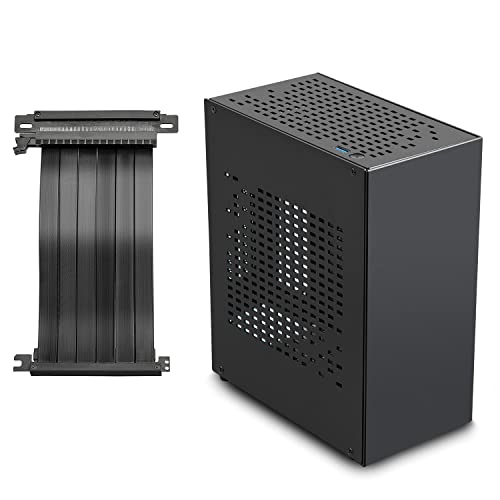
Aluminum Mini ITX Case with PCIe 3.0 Riser, JOYJOM Mini PC Case
The JOYJOM closes the list with the SFF tradition’s most elegant trick: an aluminium mini-ITX case with a PCIe 3.0 riser, a small-form-factor shell that supports a discrete graphics card by folding it behind the motherboard on a ribbon of circuitry. The riser is the enabling idea of the whole sandwich genre — the card lies flat along the case’s spine instead of standing out from the board, and the volume collapses to something closer to a hardback book than a tower. Aluminium is the right material for the genre: light for carrying, rigid for its weight, and pleasant in the hand.
The title is sparing with figures — no cooler ceiling, no card length is stated — and the review respects that silence: this is a case to buy from its full documentation, with the intended card and cooler measured in advance. What the title does promise is the genre itself, executed in aluminium with a named riser generation, and for the experienced SFF builder that is a complete proposition. It suits the traveller who wants a real GPU in the smallest credible footprint and is fluent in the planning that footprint demands. First-time small-build owners may find the C24’s stated balance a gentler introduction; the JOYJOM is for the builder who already speaks millimetres.
Strengths
- PCIe 3.0 riser enables the compact sandwich layout with a discrete GPU.
- Aluminium construction keeps a carried case light and rigid.
- True small-form-factor footprint for desks and bags that towers cannot enter.
Trade-offs
- The title states no cooler or card dimensions, so documentation-led planning is essential.
- Riser layouts demand careful cable and airflow planning.
- SFF component choice is narrower and often dearer than mainstream formats.
Spec mini box
- Format: mini-ITX, small form factor
- Material: aluminium
- Riser: PCIe 3.0 included per the title
- Graphics: discrete GPU support stated
- Colour: black
- Clearances: not stated in the title — verify every figure in the manufacturer’s documentation before ordering components
Best for: an experienced SFF builder wanting a GPU-equipped machine in the smallest aluminium footprint.
Not suited for: a first build, or any parts list assembled before the documentation has been read.
Experienced builders can examine the JOYJOM aluminium case on Amazon — bring the documentation habit with you, because this genre rewards it more than any other in the guide. Readers whose portable machines must also stay hushed at the destination will find the acoustic half of the planning in Best Quiet Pc Mid Tower Cases.
How Do the Six Portable Cases Compare at a Glance?
| Case | Format | Handle | Cooler figure stated | GPU figure stated | Power format |
|---|---|---|---|---|---|
| JONSBO Z20 | Micro-ATX mini tower | Detachable | 160mm / 240 AIO | Not stated in the title | Not stated in the title |
| Metalfish T40 | Mini-ITX SFF | Detachable | 70mm | 206mm | SFX / SFX-L |
| JONSBO C6-ITX | Mini-ITX / DTX | Handled | 170mm tower | Not stated in the title | ATX to 140mm |
| Mechanic Master C24 | Mini-ITX | Fitted | 135mm | 245mm | SFX |
| V500 Portable | M-ATX / ITX mini-tower | Carry handle | Not stated in the title | 320mm | Not stated in the title |
| JOYJOM Aluminium | Mini-ITX SFF | Not stated in the title | Not stated in the title | Riser layout, GPU stated | Not stated in the title |
The table is a planning instrument more than a ranking. Every row states a different bargain between volume and capability: the Z20 spends volume on cooling, the T40 saves volume at cooling’s expense, the C6-ITX spends it on standard parts, the C24 balances the ledger, the V500 spends it on card length, and the JOYJOM folds the whole question flat with a riser. The right row is the one whose stated figures contain your parts list with a margin.
How Should You Choose a Portable Case Without Stranding Your Hardware?
Plan backwards from the parts, in the order the small case will punish mistakes. Graphics card first: its length is the least forgiving figure, and the titles here state it for four of the six — 206mm, 245mm, 320mm, and unstated figures that must be pulled from documentation for the Z20, C6-ITX and JOYJOM. Cooler second: 70mm, 135mm, 160mm, 170mm and the AIO route divide the set cleanly, and the processor should be chosen to live under the chosen ceiling rather than hoping the ceiling was optimistic. Power third: SFX, SFX-L or ATX formats are stated for half the list and decide whether an existing supply transfers or a new one joins the budget.
Then plan forwards from the journey. Count the carries in a typical month and be honest about their shape: stairs favour the handled minis, car boots favour everything here, air travel thinking favours the smallest SFF shells. A case carried twice a year can be a snug puzzle; a case carried twice a week must open easily, close securely and balance in the hand. The tool-free C6-ITX and the detachable-handle pair understand weekly life; the riser-folded JOYJOM understands the long haul. Choose for the calendar, not the photograph.
The Ergonomics of Carrying a Computer
A handle is a promise about weight distribution, and the promise deserves scrutiny. A well-placed handle sits over the build’s centre of mass, so the case hangs level rather than tipping toward its power supply; a detachable handle, as on the Z20 and T40, adds the further virtue of disappearing at the desk. Weight itself is the silent specification of this category: a small case full of components is denser than it looks, and the honest test is the full journey — down the stairs, across the car park, up the venue’s steps — rather than the lift off the desk. Cases in this guide keep that journey one-handed or comfortably two-handed; a build that needs a rest stop on the stairs has outgrown its brief, whatever the title promised.
Balance interacts with layout in ways builders discover empirically. A graphics card at one end and a supply at the other can make a small case carry like a toolbox or like a brick depending on orientation, and the handled designs here were laid out by makers who understood that the handle’s position is an engineering decision. The owner’s contribution is packing discipline at the destination end: peripherals in a separate small bag rather than lashed to the case, cables coiled inside a pocket rather than trailing, the machine carried by its handle rather than by a panel edge. Portability is a system whose last component is the hand.
Six Journeys: One for Each Case
The Z20’s defining journey is the term-time migration: a performance machine, built without compromise for a student’s budget, carried from a family home to a hall of residence and back at Christmas, Easter and summer. The detachable handle goes on for the station, off for the desk, and the AIO means the machine that arrives is the machine that left — no derating for travel, no second, lesser computer waiting at the other end.
The T40’s defining journey is the working week split between two desks in two postcodes. It rides in a car footwell or a train bag, asks for a square of desk the size of a placemat, and runs a real workload at both ends. Its owner chose the smallest complete answer on purpose, and the journey rewards the choice every single week, in the currency of never once thinking about transport.
The C6-ITX’s defining journey is the house-party LAN: carried by its handle through a friend’s hallway, opened without tools on the kitchen table to settle a cable, breathing through its mesh in a warm room full of machines. It is the sociable mechanic of the set — standard parts, easy access, nothing precious — and its journeys are measured in evenings rather than miles.
The C24’s defining journey is the first job: a dorm machine that graduates to a rented flat’s desk, then to a hot-desk office, its handle making each relocation a one-trip affair. Its balanced clearances mean the graduation upgrades — a better card within 245mm, a stronger cooler within 135mm — happen inside the same shell, and the case becomes the constant in a changing decade.
The V500’s defining journey is the show circuit of its owner’s social life: modding meetups, LANs, the friend’s garage build day. The acrylic panel shows the build, the handle moves it, the 320mm clearance means the build it shows can be a serious one. It collects journeys the way its panel collects micro-scratches — as evidence of a life lived out loud.
The JOYJOM’s defining journey is the flight-adjacent one: the smallest footprint in the guide, riding where towers cannot, for the builder whose work or play genuinely happens in several cities. Its riser-folded layout is the engineering that buys the ticket, and its owner — fluent, prepared, documentation-first — is the traveller the genre was invented for.
A Second Look: Portable Cases in Weekly Service
Weekly service is the audit these cases were built for, and it is mostly about small frictions compounding kindly or cruelly. The Z20’s detachable handle becomes a ritual — on for the venue, off for the desk — and its AIO keeps a hard-worked machine composed in rooms that are not its own. The T40’s service story is about presence: it is the machine that actually comes along, to the workshop weekend, the relative’s house, the second desk, because carrying it costs nothing. Smallness that gets used beats capability that stays home.
The C6-ITX ages like a good tool roll: the mesh breathes in every room it visits, the tool-free panels make the monthly dust-out a two-minute habit, and the standard power supply means a failure in year three is a same-day errand rather than a specialist order. The C24 becomes invisible in the best way — the dorm machine that simply relocates with its owner’s life, term by term, its balanced clearances never quite becoming the story. The V500 collects the patina of a social life, acrylic scuffs and all, and its owner reads them as mileage. The JOYJOM, finally, serves the traveller who has the whole SFF liturgy by heart, and rewards that fluency with the smallest bag footprint of the six.
Small-Case Cooling Literacy: Ceilings, Envelopes and Honest Processors
Every figure in this guide’s titles is a thermal statement wearing a dimensional disguise. A cooler ceiling of 70mm, as on the T40, is really a statement about processor choice: the efficient chips, the ones designed to run hard inside a laptop’s power budget philosophy, are the natural citizens of such a case, and they reward the pairing with silence as well as safety. A ceiling of 135mm or 160mm widens the citizenry to mainstream performance parts; 170mm in the C6-ITX admits the big air coolers outright; and the Z20’s 240mm AIO route replaces the ceiling question with a radiator answer. Read the ceilings as the case’s honest advice about what should live inside it, and the build will never fight its home.
Graphics cards tell the same story in length. The 206mm class is engineered for efficiency at a size; the 245mm class is the mainstream’s compact dual-fan heartland; the V500’s 320mm admits cards whose cooling apparatus assumes tower volumes, and pairing such a card with a small case demands that the case’s airflow be planned rather than presumed. None of these pairings is wrong. All of them are contracts, and the SFF builder’s core skill is reading a contract before signing it in components.
Packing the Portable PC: The Journey System
The case is the first layer of the journey, not the whole of it. Around it, the seasoned portable builder assembles a small system: a padded sleeve or bag for the venues where the handle alone is not enough, a cable kit that lives with the machine rather than in a drawer, a photograph of the rear panel for reassembly in unfamiliar light, and a destination habit — the same perch, the same power strip logic — that makes setup a routine instead of a puzzle. The handled cases here shorten every part of that system, because a machine designed to be carried arrives with its dignity intact and its panels unmarked.
The car deserves its sentence: a handled SFF case rides best wedged upright on a footwell floor or flat in a boot with nothing heavy for company, and the smallest of them — the T40, the JOYJOM — can ride in a padded bag on a seat like the valuable instrument they are. What they should never do is slide loose. A computer’s enemies in transit are movement and surprise, and both are abolished by ten seconds of arrangement. The portable case buys the right to travel; the owner’s ritual keeps the right exercised safely.
The Desk at the Far End
Portability is usually judged at departure and experienced at arrival, so the far desk deserves planning too. A small case asks little — a placemat of surface, a socket, air that is not a cupboard’s — and gives back the whole desk for the actual work, which is why hot-deskers and dorm residents defend the format so warmly. Owners who travel between two fixed desks often duplicate the cheap half of the setup at both ends — monitor arm or stand, keyboard, cables waiting — so the case itself is the only thing that journeys, sliding into a prepared berth in minutes. That duplication, modest as it sounds, is the difference between a portable PC as a concept and a portable PC as a Tuesday.
There is a social dimension at the far end as well. A machine that arrives small and sets up quietly changes its owner’s welcome: the guest who brings a tower brings a furniture problem, while the guest who brings a handled mini brings a party trick. Venues, friends and family all learn the difference quickly, and the invitations follow the smaller machine. Portability, in the end, is partly a social specification, and these six cases meet it at six different sizes of ambition.
Common Mistakes When Buying a Portable PC Case
The first mistake is measuring the case and not the components: in SFF, the card, the cooler and the supply are the dimensions that matter, and every one of them is either stated in these titles or waiting in the documentation. The second is buying the smallest shell for the hottest parts — a 70mm cooler ceiling is a contract, and a processor chosen against it will spend its life throttling in a case that was only obeying its title. The third is forgetting the carry itself: a case without a handle, or with a handle that digs and swings, will be carried less, and a portable PC that stays home is just a small PC.
The fourth mistake is treating the riser as a detail. In the JOYJOM’s genre the riser is the architecture, and its generation and routing shape the whole build. The fifth is neglecting the destination: a portable machine needs a perch, a power point and airflow at the far end too, and the owner who scouts those once enjoys every trip after. Small cases forgive nothing and reward everything — plan like it, and they are the most liberating PCs in this entire site.
Living Small Day to Day: The Six at Home
At home, the Z20 sits like a well-kept secret: a mini tower that looks ordinary until a benchmark or a game reveals what its cooling headroom permits. Its owner lives with a machine that never has to explain itself — no thermal asterisks on the spec sheet of daily life, no apologetic fan roar during a film. The handle, detached, lives in a drawer, and its presence there is a standing invitation the owner accepts often enough to justify everything.
The T40 at home is a study in enough. Enough power for its owner’s actual games and work, enough silence for a bedroom desk, enough presence to be carried to the sofa side for a film on the big screen. Owners of the smallest cases often report a discipline dividend: storage stays curated, the parts list stays honest, and the machine’s limitations — chosen, stated, understood — stop feeling like limitations within a month.
The C6-ITX at home is the tinker’s companion. Its tool-free panels come off for the pleasure of it as often as for need; its mesh keeps a warm room from becoming a thermal negotiation; its standard power supply means the spares box from a previous build remains useful. It is the case most likely to be opened on a Sunday morning, and the least likely to punish the habit.
The C24 at home is the reliable roommate: unobtrusive in black, adequate to everything the week asks, ready to leave when the calendar says so. Its balance means it is rarely the topic of conversation, and for a dorm or a first flat that is the highest praise available — the computer as appliance, in the honourable sense, present for the work and the play alike.
The V500 at home is the project on display: acrylic catching the light, a long card visible in its mini-tower, a build that gets discussed. Its owner chose character and clearance together, and the home desk shows it — this is the portable case that behaves like a showcase until the moment its handle turns it back into luggage.
The JOYJOM at home nearly vanishes: a black aluminium sliver that visitors mistake for an accessory until it wakes a discrete GPU and a full workload. Its domestic virtue is the desk it returns — surface for books, for paper, for a second screen — and its owner guards that surface jealously, which is to say the case has reorganised a life around its smallness, exactly as intended.
Upgrading Inside a Small Case
Small cases change the upgrade ritual from a spree into a sequence. One component at a time, clearances re-measured against the title’s figures, the old part sold or handed down while its replacement is still a rumour — that is the rhythm the format teaches, and it produces builds that are always current where it matters and never bloated where it does not. The handled cases add a kindness to the ritual: the machine can be carried to the best-lit table in the house for the work, opened there, and carried back, which turns an upgrade from a floor-crawling expedition into a bench task.
Plan the sequence by the contracts already discussed. The card is bounded by its stated length, the cooler by its ceiling, the supply by its format; storage and memory are the free variables, and they are where small builds quietly grow over the years. A portable case bought against honest figures will accept that growth gracefully for a long time — which is the final answer to the suspicion that small means disposable. These six are not starter cases. They are a different, deliberate destination.
Frequently Asked Questions
Is micro-ATX or mini-ITX better for a portable build?
Micro-ATX, as in the Z20, gives broader, cheaper board choice and an easier build in a still-carryable shell. Mini-ITX goes genuinely small — T40, C24, JOYJOM — at the price of tighter clearances and SFX thinking. Choose by how small the journey needs the machine to be.
Can a portable case really cool a gaming build?
Yes, within its stated figures. The Z20 supports a 240mm AIO and a 160mm cooler; the C6-ITX takes a 170mm tower cooler. The T40’s 70mm ceiling is the honest limit of its class and pairs with efficient parts. The titles state the contracts; builds that respect them run cool.
What does a PCIe riser do in the JOYJOM?
It lets the graphics card mount flat behind the motherboard instead of standing perpendicular, collapsing the case’s volume. It is the defining layout of the sandwich-style SFF genre.
Are detachable handles a gimmick?
No — they are the difference between a case that looks like luggage at the desk and one that only becomes luggage for the journey. The Z20 and T40 both treat the handle as equipment, not styling.
Which pick suits a student best?
The Mechanic Master C24 was pitched by its own title at dorm life, and its balanced 245mm card and 135mm cooler support fit a student’s one-machine life. The Z20 is the step up for a student whose build leans performance-first.
How should a handled case be carried in a car?
Upright and wedged so it cannot slide — a footwell floor is ideal for the smaller shells — with nothing heavy sharing its space. The handle is for the walking parts of the journey; in the car, placement and restraint do the protecting, and a padded bag adds a further layer for the smallest cases.
Do portable cases hold their value?
Good ones do, because the SFF community is measurement-literate: a case with honest stated clearances, a sound handle and a clean layout finds its next owner quickly. Aluminium and well-kept mesh examples travel between builders for years, which is one more sense in which these machines refuse to stay in one place.
Noise, Heat and Company at the Destination
A portable machine performs in other people’s rooms, and its manners travel with it. Small cases concentrate their components, so fan curves set at home in an empty house may announce themselves in a quiet spare room or a shared office; the courteous portable builder sets a gentle curve as the default and a performance curve as the exception, and chooses components — the efficient processor under a 70mm ceiling, the dual-fan card inside 245mm — whose manners are structural rather than negotiated. The mesh C6-ITX will always be the most audible of the six at full tilt, by the same physics that makes it the coolest traveller; the AIO-cooled Z20 can be the most discreet under load, its radiator fans turning slowly in a larger space.
Heat at the destination follows the same social logic. A small case exhausts into the room it occupies, and a summer venue full of machines is a thermal commons: the build that arrives with headroom — cooling ceiling respected, intake paths clear, dust blown out before the trip — contributes its share without crisis. These are small courtesies with a long memory among the people who host portable PCs, and they complete the category’s hidden specification: a case is portable, in the end, when its owner gets invited back with it.
A Note on Buying the Case and the Components as One Decision
In tower building, the case is often bought last, around an existing parts list. In portable building the order reverses, and the reversal is liberating: choose the shell whose journey matches the life, read its stated contracts, and let the contracts edit the parts list before money is spent. The card that is 12mm too long is not a tragedy discovered at midnight; it is a line item changed at noon. The supply in the wrong format is a filter applied in the shop, not a return arranged from the desk. Every pick in this guide publishes enough of its contract — in its title or its documentation — to make that order of operations possible, and the builders who adopt it speak of SFF not as a constraint but as the most honestly planned corner of the hobby.
What Should You Verify in the Full Listing Before Ordering?
Portable cases concentrate the cost of a wrong assumption, so the verification list is short and absolute. Where the title leaves a figure open — card length on the Z20 and C6-ITX, cooler and power figures on the V500, clearances on the JOYJOM — pull the number from the manufacturer’s documentation and write it beside the parts list before anything is ordered. Confirm the handle’s nature, fixed or detachable, and picture the actual carry: the stairs, the car park, the venue door. Confirm the power format against the supply in hand or in basket. And confirm the board format twice, because ITX, DTX and micro-ATX are neighbours that do not forgive assumption. Five minutes of this is the entire difference between a portable build that assembles like a story and one that stalls at the first panel.
Final Recommendation
Let the journey choose. For performance that travels, the JONSBO Z20 is the most complete portable case here — real cooling, a detachable handle, micro-ATX sense. For the smallest honest gaming machine, the Metalfish T40 states its discipline in numbers and keeps it. For standard parts in a handled shell, the JONSBO C6-ITX is the pragmatist’s delight; for dorm and desk-hopping balance, the Mechanic Master C24; for a long card and a DIY soul, the V500; and for the aluminium sandwich at its most compact, the JOYJOM. A desktop that can go where its owner goes is not a compromised desktop — it is the original idea of a personal computer, restored. Pick the handle that fits your life, and take the machine with you.
One last rehearsal is worth more than any accessory: build the machine, pack the journey once at home, carry it down the stairs and around the car, and set it up in another room. Every friction found in rehearsal — a cable 10cm short, a handle grip that tires the hand, a perch that wobbles — is a friction removed from the real trip, and the cases here are good enough that the rehearsal usually ends with the owner slightly surprised at how little stood between the two desks. That surprise is the category’s whole promise, kept.
Measure the parts, respect the ceilings, and let the smallest honest machine win — the road, the stairs and the far desk will all thank you for it, and so will the owner who discovers, somewhere around the tenth journey, that the computer has quietly become the easiest thing in the house to take anywhere at all, bar none, on any day of the week, in any weather the calendar offers.
Related Guides
- Best PC Cases With 5.25 Drive Bays
- Best PC Cases Without a Side Panel Window
- Best Quiet Pc Mid Tower Cases


