What's inside
- Where to Buy
- Key Takeaways
- Quick Picks
- How the picks were chosen
- Comparison table
- How should a family choose the best baby monitor with two pan tilt zoom cameras?
- WiFi versus local links, stated plainly
- Screens, batteries and the nightly routine
- Small observations from two-room life
- Two children, two rhythms: living with the system
- Setting up two rooms that actually work
- Common mistakes
- Frequently asked questions
- Final recommendation
As an Amazon Associate I earn from qualifying purchases. This post may contain affiliate links at no extra cost to you.
[SITE_DOMAIN] is reader-supported. When you buy through links on our site, we may earn an affiliate commission at no extra cost to you. Prices and availability change; check the Amazon listing for the current details.
Where to Buy
VTech 2-Camera Pan-Tilt-Zoom Monitor – View on Amazon
HelloBaby 2-Camera Monitor – View on Amazon
HelloBaby HB6550-2 Dual Camera – View on Amazon
VTech Smart WiFi 2-Camera Monitor – View on Amazon
Motorola Nursery 2-Camera Monitor – View on Amazon
Blemil 6in Split Screen 2-Camera Monitor – View on Amazon
Each line above opens the Amazon listing for one of the six two-camera monitors in this guide, so screen size, battery claims and included cameras can be confirmed exactly as titled before ordering. All six bundles include two cameras and a parent unit or app-based viewing as described in their titles.
The best baby monitor with two pan tilt zoom cameras solves a geometry problem that single-camera households discover at the worst hour: two children, two rooms, one viewpoint. A pan-tilt-zoom camera in each nursery, feeding one parent screen that can show both rooms at once or sweep between them, turns the nightly question of which child to watch into a settled routine. Every pick in this guide ships with two cameras that pan, tilt and zoom remotely, and the differences that matter are how the signal travels, how long the parent unit runs, and how the screen divides its attention.
A note on framing belongs at the front. This guide describes monitoring features only: camera movement, night vision, two-way talk, temperature displays, battery life and range as titled by each manufacturer. A monitor is a convenience for checking a room; it makes no medical claims, offers no health guarantees and replaces no safe-sleep practice, and nothing in these reviews should be read otherwise. One pick, the VTech Smart WiFi model, connects through WiFi and an app; the other five are non-WiFi designs, several explicitly using FHSS transmission, a split stated accurately in every review because it decides how the system behaves in homes that prefer to keep nursery cameras off the internet.
Range figures in titles assume ideal conditions, screens vary from 3.2 inches to a generous 6 inches, and battery claims stretch from a working day to well past a full one. The reviews below read each title carefully and judge the complete two-room system, parent unit included, rather than the cameras alone.
Installation day decides more of a two-camera system’s success than any specification in this guide. Cameras placed in haste end up watching the wrong corner, parent units live beside signal-blocking masonry, and the first full night becomes an unpaid product test. An hour of deliberate setup, testing each camera’s sweep against the crib it must cover, checking the parent unit from the rooms where evenings actually happen, and routing every cable with care, converts the same hardware into a system the household trusts by the second night. The models below all reward that hour; none can substitute for it.
Key Takeaways
- All six systems pair two remote pan-tilt-zoom cameras with split-screen or scanning viewing for two rooms.
- Five picks are non-WiFi designs, several FHSS-based; only the VTech Smart model uses WiFi and an app.
- Parent-unit screens range from 3.2 inches to 6 inches, and battery claims run from 17 hours to 30 hours.
- Night vision, two-way talk and temperature sensing appear across the list, as titled per model.
- Range claims reach 1000ft under ideal conditions; walls and floors reduce real-world reach considerably.
- These monitors describe rooms and movement; they carry no medical or safety guarantees of any kind.
Quick Picks
| Pick | Badge | Why it earns a place |
|---|---|---|
| VTech 2-Camera Pan-Tilt-Zoom Monitor | Non-WiFi two-room staple | A no-WiFi VTech system with two pan-tilt-zoom cameras, 17-hour battery, 1000ft range, night vision and a temperature sensor for twins and two rooms. |
| HelloBaby 2-Camera Monitor | Compact screen, full features | A no-WiFi HelloBaby system with a 3.2-inch screen, infrared night vision, remote pan-tilt-zoom, ECO mode, two-way talk, 1000ft range, eight lullabies and temperature display. |
| HelloBaby HB6550-2 Dual Camera | 30-hour FHSS traveller | A 5-inch dual-camera no-WiFi monitor with hack-proof FHSS, 30-hour battery, 1000ft range, auto scan, VOX and a travel-portable pitch. |
| VTech Smart WiFi 2-Camera Monitor | The WiFi and app option | VTech’s Smart WiFi system with two cameras, free app viewing at home or from anywhere, 1080p split screen on a 5-inch HD display, pan-tilt-zoom and night vision. |
| Motorola Nursery 2-Camera Monitor | Split-screen classic name | A Motorola Nursery no-WiFi system with two cameras, 5-inch split screen, pan-tilt-zoom, night vision, two-way talk, long battery life, 1000ft range and temperature sensor; VM75-2, listed as a 2026 model. |
| Blemil 6in Split Screen 2-Camera Monitor | Largest screen in the guide | A Blemil system with a 6-inch split screen, two cameras, 4000mAh battery, no WiFi, remote pan-tilt-zoom, auto night vision, ECO mode, two-way talk and 1000FT range under ideal conditions. |
How the picks were chosen
Screen size was weighed for split-screen legibility, where two images share one display and small panels ask more of tired eyes. The ordering favours balanced all-round systems first, then specialists in screen size, battery or connectivity. Night vision was treated as essential rather than optional, given how much monitoring happens in darkened rooms. Ease of setup was valued, because a system installed during a nap window has no time for networking puzzles. Each review names the household rhythm its system fits, from twins in separate rooms to a nursery plus playroom pairing.
Admission required two cameras in the box, each with remote pan, tilt and zoom, since a fixed second camera solves only half the two-room problem. Where a title left a detail unstated, the spec box says so instead of assuming a sibling model’s feature. The same off-network thinking appears in barn Cameras Without Wi-Fi barn Cameras Without Wi-Fi, though there the cameras watch livestock rather than nurseries. Temperature sensing was noted where titled, as a room-comfort feature that helps dress a room appropriately. Lullabies and similar extras were treated as pleasant additions, never as reasons to choose a system alone.
Bundle completeness was verified per title, confirming two cameras are genuinely included rather than merely supported. The final list keeps the WiFi choice honest and singular, so families preferring local-only systems can shop five deep. No pick was credited with any health or safety capability, and the reviews describe features in plain functional terms throughout. Audio features such as VOX and ECO modes mattered, because a screen that wakes for sound and sleeps otherwise saves battery and parental attention. Travel portability counted for the model that advertises it, since grandparents’ houses and holidays recreate the two-room problem elsewhere.
Range claims were recorded with their ideal-conditions framing intact, rather than converted into promises. Prices and ratings were excluded from scoring, as both shift constantly and neither describes the system in the home. Two-way talk earned credit as titled, letting a parent soothe from the hallway or the garden without entering and restarting the settling process. Systems were separated first by connection type, because the WiFi-versus-local decision shapes privacy preferences, setup and phone use. Parent-unit battery claims were compared as titled, since the screen is the part of the system carried from room to room all evening.

1. VTech 2-Camera Pan-Tilt-Zoom Monitor
Non-WiFi two-room staple
- Connection: No WiFi, as titled
- Cameras: 2 cameras with remote pan-tilt-zoom
- Battery: 17-hour battery, as titled
- Range: 1000ft range, as titled
- Features: Night vision and temperature sensor; model VM924-2
VTech’s VM924-2 states its philosophy in its title: no WiFi, two cameras, remote pan-tilt-zoom, and a design pitched at twins and two rooms. The parent unit’s battery is titled at 17 hours, the range at 1000ft, and the feature list includes night vision and a temperature sensor, the complete vocabulary of a local monitoring system. For households that want nursery cameras entirely off the home network, this is the guide’s most direct answer from its most established monitor name.
Range through two floors and a brick wall is a fraction of the open-air figure on the box, for every brand equally. Camera placement at crib-corner height, angled down, covers the mattress without blind wedges at the edges. Temperature displays inform blanket and clothing choices as room conditions, nothing more and nothing less. Pan and tilt range decide whether a camera can follow a climbing toddler’s favourite corner without a physical visit. Lullaby features are garnish: pleasant at bedtime, irrelevant at the moment a parent is choosing between systems.
A parent unit that lives on a kitchen counter all day needs battery claims measured in tens of hours, not single digits. Mounting a camera securely, with its cable well beyond reach, is part of installation rather than an afterthought. Zoom on nursery cameras is for framing and detail at crib distance, not for surveillance across a field. FHSS local transmission keeps the nursery feed inside the home’s walls by design. Split-screen viewing changes the emotional arithmetic of two rooms, replacing scheduled checking with a single settling glance.
Grandparents benefit from systems whose parent unit needs no phone, no account and no password ritual. Battery claims assume typical cycling; a screen held on continuously will always finish sooner than the headline. Two-way talk works best as a first response, with a familiar voice often resettling a stirring child before feet touch the floor. App-based viewing extends the nursery picture to a phone in another building, a convenience some families prize and others decline. The best system is the one whose screen a tired parent can read at a glance, half awake, in the dark.
Seventeen hours of parent-unit life covers the full arc from morning nap to the last check before the adults sleep, and the pan-tilt-zoom control from the parent unit means reframing a camera never requires slipping into a dark room. Temperature sensing supports the ordinary, practical business of judging whether a room runs warm or cool for the bedding chosen.
Families wanting phone viewing from outside the home should look at the WiFi sibling below instead, since this system’s local design is a deliberate boundary, not a missing feature. Within that boundary, the VM924-2 is complete and uncomplicated.
Strengths
- No-WiFi local system from an established monitor brand
- 17-hour parent battery and 1000ft titled range
- Temperature sensor and night vision included
Trade-offs
- No phone or app viewing from outside the home
- Screen size Not stated in the listing title – verify with the manufacturer documentation
- Range figure reflects favourable conditions rather than multi-wall homes
Best for: a two-room household seeking a no-WiFi VTech system with a full day’s parent-unit battery
Not suited for: a travelling parent seeking phone access to the nursery feed, because this local system offers no app viewing
For the established-name, off-network route to two-room coverage, Check price on Amazon and confirm the VM924-2 bundle in the listing.

2. HelloBaby 2-Camera Monitor
Compact screen, full features
- Connection: No WiFi, as titled
- Screen: 3.2-inch screen
- Cameras: 2 cameras with remote pan-tilt-zoom and audio
- Features: Infrared night vision, ECO mode, 2-way talk, 8 lullabies, temperature display
- Range: 1000ft range, as titled
HelloBaby’s two-camera system packs the full feature vocabulary into a compact form: a 3.2-inch screen, infrared night vision, remote pan-tilt-zoom cameras, ECO mode, two-way talk, a 1000ft titled range, eight lullabies and a temperature display, all without WiFi. The small screen is the honest trade here, buying portability and simplicity; on a nightstand or carried in a pocket between rooms, a 3.2-inch parent unit is unobtrusive in a way the larger panels below are not.
Twins in one room can still justify two cameras, each trained on one crib with no compromise angle between them. A scanning mode that rotates between cameras suits sound-led checking, while true split-screen suits constant visual reassurance. Night vision range and clarity decide whether a blanket’s rise and fall is actually visible at 3 a.m. A second camera often ends up watching a playroom by day, which is why pan range matters beyond the nursery. VOX-style sound activation lets the screen rest dark until a room makes itself heard.
Range through two floors and a brick wall is a fraction of the open-air figure on the box, for every brand equally. Battery claims assume typical cycling; a screen held on continuously will always finish sooner than the headline. A second camera often ends up watching a playroom by day, which is why pan range matters beyond the nursery. VOX-style sound activation lets the screen rest dark until a room makes itself heard. Zoom on nursery cameras is for framing and detail at crib distance, not for surveillance across a field.
Split-screen viewing changes the emotional arithmetic of two rooms, replacing scheduled checking with a single settling glance. FHSS local transmission keeps the nursery feed inside the home’s walls by design. Lullaby features are garnish: pleasant at bedtime, irrelevant at the moment a parent is choosing between systems. Grandparents benefit from systems whose parent unit needs no phone, no account and no password ritual. Camera placement at crib-corner height, angled down, covers the mattress without blind wedges at the edges.
ECO mode matters in daily rhythm, letting the unit rest quietly and wake with sound, which stretches both battery and parental nerves. Two-way talk and the lullaby set cover the soothing toolkit, while the temperature display handles the room-comfort check. For a nursery plus a playroom, or twins in compact rooms, the system’s scale feels deliberately matched.
Split-screen viewing on a 3.2-inch display asks more of the eyes than the 5-inch and 6-inch rivals below, particularly for checking fine detail in both rooms at once. Buyers who know they will live in split-screen mode should weigh the larger panels; buyers who mostly listen and glance will find this size entirely sufficient.
Strengths
- Complete feature set in a compact, portable system
- ECO mode and two-way talk support the nightly routine
- No-WiFi design with 1000ft titled range
Trade-offs
- 3.2-inch screen is the smallest here for split-screen detail
- Battery duration Not stated in the listing title – verify with the manufacturer documentation
- Lullaby count is a minor feature beside core monitoring
Best for: a compact-home household seeking a full-featured no-WiFi system with a pocketable parent unit
Not suited for: a parent seeking large split-screen detail, because the 3.2-inch display divides into small images
If the parent unit should disappear into a pocket between rooms while still covering two cameras, Check price on Amazon and review the ECO and talk features in the listing.
3. HelloBaby HB6550-2 Dual Camera
30-hour FHSS traveller
- Connection: No WiFi, hack-proof FHSS as titled
- Screen: 5-inch display
- Battery: 30-hour battery, as titled
- Range: 1000ft range, as titled
- Features: Pan-tilt-zoom, night vision, 2-way audio, auto scan, VOX, travel-portable
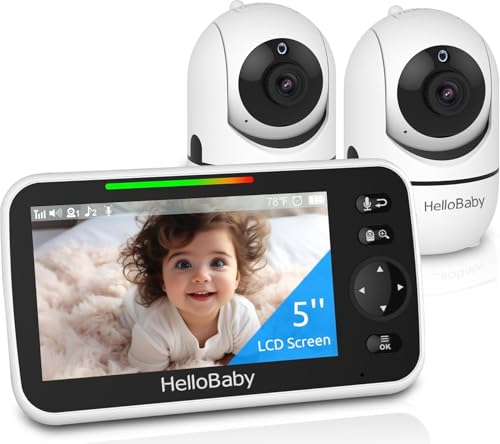
The HB6550-2 is HelloBaby’s endurance flagship: a 5-inch dual-camera monitor on FHSS transmission the listing calls hack-proof, with a 30-hour battery, 1000ft range, night vision, two-way audio, auto scan and VOX, packaged with travel in mind. Thirty hours is the headline that changes behaviour, since a parent unit charged every other day forgives the forgotten overnight plug that strands lesser systems by breakfast. The 5-inch screen gives split-screen viewing room to breathe.
Pan and tilt range decide whether a camera can follow a climbing toddler’s favourite corner without a physical visit. A parent unit that lives on a kitchen counter all day needs battery claims measured in tens of hours, not single digits. The best system is the one whose screen a tired parent can read at a glance, half awake, in the dark. Twins in one room can still justify two cameras, each trained on one crib with no compromise angle between them. Temperature displays inform blanket and clothing choices as room conditions, nothing more and nothing less.
Two-way talk works best as a first response, with a familiar voice often resettling a stirring child before feet touch the floor. Night vision range and clarity decide whether a blanket’s rise and fall is actually visible at 3 a.m. App-based viewing extends the nursery picture to a phone in another building, a convenience some families prize and others decline. A scanning mode that rotates between cameras suits sound-led checking, while true split-screen suits constant visual reassurance. Mounting a camera securely, with its cable well beyond reach, is part of installation rather than an afterthought.
Two rooms side by side only reassure when each half of the screen stays clear enough to read instantly. The best system is the one whose screen a tired parent can read at a glance, half awake, in the dark. Battery claims assume typical cycling; a screen held on continuously will always finish sooner than the headline. Range through two floors and a brick wall is a fraction of the open-air figure on the box, for every brand equally. Night vision range and clarity decide whether a blanket’s rise and fall is actually visible at 3 a.m.
Auto scan and VOX divide the monitoring labour intelligently: the system can rotate attention between rooms and wake for sound, while the parent intervenes only when the pattern breaks. The travel-portable framing suits families splitting weeks between home and grandparents, where a self-contained local system sets up in minutes without touching anyone’s network settings.
FHSS local transmission is the privacy story here, keeping the feed on a dedicated link rather than the household WiFi. As with every local system in this guide, that choice also means no viewing from beyond the parent unit’s range, a boundary this model wears as its main selling point.
Strengths
- 30-hour battery is the longest claim in this guide
- 5-inch screen with auto scan and VOX modes
- FHSS local link with travel-friendly setup
Trade-offs
- No app or remote viewing beyond the parent unit
- Temperature sensing Not stated in the listing title – verify with the manufacturer documentation
- Two-room coverage still bounded by the 1000ft ideal range
Best for: a family seeking a 5-inch FHSS system with a 30-hour battery for home and travel
Not suited for: a parent seeking nursery pictures on a phone at work, because the FHSS link serves the parent unit only
For the longest battery claim here wrapped around a proper 5-inch screen, Check price on Amazon and check the travel accessories in the listing.

4. VTech Smart WiFi 2-Camera Monitor
The WiFi and app option
- Connection: Smart WiFi with free app, as titled
- Screen: 5-inch HD screen with 1080p split screen
- Cameras: 2 cameras with pan-tilt-zoom
- Viewing: At home or from anywhere via app, as titled
- Features: Night vision; model VM901-2HD
The VM901-2HD is the guide’s single WiFi system, and it earns its place by serving the household the other five cannot: one where a parent at work, or a grandparent in another town, should be able to look in through the free app. At home it behaves like its siblings, with two pan-tilt-zoom cameras feeding a 5-inch HD screen whose split-screen view is titled at 1080p, plus night vision for the dark hours. The dual nature, local screen plus remote app, is the entire proposition.
Lullaby features are garnish: pleasant at bedtime, irrelevant at the moment a parent is choosing between systems. Zoom on nursery cameras is for framing and detail at crib distance, not for surveillance across a field. A second camera often ends up watching a playroom by day, which is why pan range matters beyond the nursery. Grandparents benefit from systems whose parent unit needs no phone, no account and no password ritual. Mounting a camera securely, with its cable well beyond reach, is part of installation rather than an afterthought.
Camera placement at crib-corner height, angled down, covers the mattress without blind wedges at the edges. Twins in one room can still justify two cameras, each trained on one crib with no compromise angle between them. A parent unit that lives on a kitchen counter all day needs battery claims measured in tens of hours, not single digits. VOX-style sound activation lets the screen rest dark until a room makes itself heard. A scanning mode that rotates between cameras suits sound-led checking, while true split-screen suits constant visual reassurance.
FHSS local transmission keeps the nursery feed inside the home’s walls by design. Temperature displays inform blanket and clothing choices as room conditions, nothing more and nothing less. App-based viewing extends the nursery picture to a phone in another building, a convenience some families prize and others decline. Two-way talk works best as a first response, with a familiar voice often resettling a stirring child before feet touch the floor. Pan and tilt range decide whether a camera can follow a climbing toddler’s favourite corner without a physical visit.
That flexibility asks for the usual connected-device commitments: a WiFi network to join, an app account to keep, and updates to accept. Households comfortable with smart-home routines will find the setup familiar and the anywhere access genuinely useful at the two-room stage, when checking a sleeping toddler from the office closes a mental loop. Households who chose this category specifically to avoid nursery cameras on the internet should simply shop the other five.
The listing’s promise to see both rooms at home or from anywhere is stated accurately here as a viewing feature, nothing more. Judged purely as a two-camera pan-tilt-zoom system with a strong screen, the VTech Smart stands level with the best local systems before its app advantage is even counted.
Strengths
- App viewing from anywhere extends coverage beyond the home
- 1080p split screen on a 5-inch HD parent display
- Two pan-tilt-zoom cameras with night vision
Trade-offs
- Requires WiFi and an app account, unlike the five local systems
- Remote viewing depends on home internet uptime
- Battery duration Not stated in the listing title – verify with the manufacturer documentation
Best for: a connected household seeking two-room coverage on both a parent screen and a phone app
Not suited for: a household seeking nursery cameras kept off the internet, because WiFi and app access define this model
When the nursery picture should reach a phone across town as easily as the screen down the hall, Check price on Amazon and review the app terms in the listing.

5. Motorola Nursery 2-Camera Monitor
Split-screen classic name
- Connection: No WiFi, as titled
- Screen: 5-inch split screen
- Cameras: 2 cameras with pan-tilt-zoom and audio
- Features: Night vision, 2-way talk, temperature sensor
- Range and power: 1000ft range and long battery life, as titled; model VM75-2 (2026 model)
Motorola’s Nursery entry, the VM75-2, covers the category’s essentials with a familiar name: no WiFi, two pan-tilt-zoom cameras, a 5-inch split screen, night vision, two-way talk, a temperature sensor and a 1000ft titled range, with long battery life claimed in qualitative terms. The 5-inch split screen is the centrepiece, sized for the two-images-at-once viewing that defines this category’s daily use, and the feature list leaves no common box unticked.
For parents who also check in from a phone, the split view has to work beyond the parent unit. App-based viewing extends the nursery picture to a phone in another building, a convenience some families prize and others decline. A scanning mode that rotates between cameras suits sound-led checking, while true split-screen suits constant visual reassurance. VOX-style sound activation lets the screen rest dark until a room makes itself heard. Pan and tilt range decide whether a camera can follow a climbing toddler’s favourite corner without a physical visit.
Grandparents benefit from systems whose parent unit needs no phone, no account and no password ritual. The best system is the one whose screen a tired parent can read at a glance, half awake, in the dark. A second camera often ends up watching a playroom by day, which is why pan range matters beyond the nursery. Two-way talk works best as a first response, with a familiar voice often resettling a stirring child before feet touch the floor. Range through two floors and a brick wall is a fraction of the open-air figure on the box, for every brand equally.
Temperature displays inform blanket and clothing choices as room conditions, nothing more and nothing less. Camera placement at crib-corner height, angled down, covers the mattress without blind wedges at the edges. Zoom on nursery cameras is for framing and detail at crib distance, not for surveillance across a field. Night vision range and clarity decide whether a blanket’s rise and fall is actually visible at 3 a.m. Twins in one room can still justify two cameras, each trained on one crib with no compromise angle between them.
The listing’s identification as a 2026 model signals a current production unit rather than old stock, a small but real comfort in a category where designs linger. Motorola’s nursery line carries recognition among grandparents and gift-buyers, which matters more than enthusiasts admit: a system the whole family can operate without instruction is a system that gets used correctly at 2 a.m.
Battery life is described qualitatively in the title rather than with the hour counts rivals advertise, so buyers for whom endurance is decisive should verify the figure in the manufacturer documentation. On features, screen and local privacy, the Motorola stands squarely in the guide’s leading group.
Strengths
- 5-inch split screen sized for genuine two-room viewing
- Complete feature set including temperature sensor
- No-WiFi local design from a recognised nursery brand
Trade-offs
- Battery life stated qualitatively rather than in hours
- VOX or ECO modes Not stated in the listing title – verify with the manufacturer documentation
- Lullabies Not stated in the listing title – verify with the manufacturer documentation
Best for: a gift-buying family seeking a recognised-brand 5-inch split-screen system without WiFi
Not suited for: an endurance-first household seeking a stated hour count, because the title describes battery life only as long
For a familiar name on a full-size split screen with the complete feature checklist, Check price on Amazon and verify the battery figure in the manufacturer documentation linked from the listing.

6. Blemil 6in Split Screen 2-Camera Monitor
Largest screen in the guide
- Connection: No WiFi, as titled
- Screen: 6-inch split screen
- Battery: 4000mAh battery, as titled
- Cameras: 2 cameras with remote pan-tilt-zoom
- Features: Auto night vision, ECO mode, 2-way talk, 1000FT range (ideal condition) as titled
Blemil’s system makes one argument loudly: screen size. Its 6-inch split-screen display is the largest in this guide, and for parents who live in two-images-at-once mode, that extra diagonal translates directly into legibility at arm’s length, across a kitchen, in the dark. Around the screen sits a complete local system: two remote pan-tilt-zoom cameras, a 4000mAh battery, auto night vision, ECO mode, two-way talk and a 1000FT range the title itself qualifies as an ideal-condition figure, an honesty this guide appreciates and repeats.
A parent unit that lives on a kitchen counter all day needs battery claims measured in tens of hours, not single digits. Battery claims assume typical cycling; a screen held on continuously will always finish sooner than the headline. Mounting a camera securely, with its cable well beyond reach, is part of installation rather than an afterthought. Lullaby features are garnish: pleasant at bedtime, irrelevant at the moment a parent is choosing between systems. FHSS local transmission keeps the nursery feed inside the home’s walls by design.
Zoom on nursery cameras is for framing and detail at crib distance, not for surveillance across a field. Grandparents benefit from systems whose parent unit needs no phone, no account and no password ritual. Two-way talk works best as a first response, with a familiar voice often resettling a stirring child before feet touch the floor. Camera placement at crib-corner height, angled down, covers the mattress without blind wedges at the edges. Battery claims assume typical cycling; a screen held on continuously will always finish sooner than the headline.
Night vision range and clarity decide whether a blanket’s rise and fall is actually visible at 3 a.m. Mounting a camera securely, with its cable well beyond reach, is part of installation rather than an afterthought. Temperature displays inform blanket and clothing choices as room conditions, nothing more and nothing less. Range through two floors and a brick wall is a fraction of the open-air figure on the box, for every brand equally. Twins in one room can still justify two cameras, each trained on one crib with no compromise angle between them.
The title’s mention of 150 languages is unusual in this category and points to menu localisation, a genuine convenience in multilingual households. ECO mode handles the wake-on-sound routine, and the no-WiFi design keeps the system in the local camp with five of its six rivals. The brand is less established than VTech or Motorola, which some buyers will weigh against the screen advantage.
Battery capacity is given in milliamp-hours rather than hours of use, so direct endurance comparisons need the manufacturer documentation. On the metric the category’s heaviest users feel nightly, picture size per room, nothing else here goes further.
Strengths
- 6-inch split screen is the largest in this guide
- Complete local feature set with ECO mode
- Title states its range figure as ideal-condition honestly
Trade-offs
- Battery given as 4000mAh rather than hours of use
- Brand is less established than VTech or Motorola
- Temperature sensing Not stated in the listing title – verify with the manufacturer documentation
Best for: a split-screen devotee seeking the largest parent display for constant two-room viewing
Not suited for: a brand-loyal buyer seeking an established nursery name, because Blemil is the newer label here
If two rooms deserve the biggest possible window on the parent unit, Check price on Amazon and check the 4000mAh battery details in the listing.
Comparison table
| Pick | Headline specification | Defining trait |
|---|---|---|
| VTech 2-Camera Pan-Tilt-Zoom Monitor | No WiFi, 17-hour battery | 1000ft range, temperature sensor |
| HelloBaby 2-Camera Monitor | No WiFi, 3.2-inch screen | ECO mode, 8 lullabies, temperature display |
| HelloBaby HB6550-2 Dual Camera | No WiFi FHSS, 5-inch screen | 30-hour battery, auto scan, VOX |
| VTech Smart WiFi 2-Camera Monitor | WiFi with free app | 5-inch HD, 1080p split screen |
| Motorola Nursery 2-Camera Monitor | No WiFi, 5-inch split screen | Temperature sensor, 1000ft range |
| Blemil 6in Split Screen 2-Camera Monitor | No WiFi, 6-inch split screen | 4000mAh battery, ECO mode |
How should a family choose the best baby monitor with two pan tilt zoom cameras?
Weigh brand maturity for firmware and support against the screen or battery advantages of newer labels. The precision demanded by nursery cameras contrasts with cameras to Record a Golf Swing cameras to Record a Golf Swing, yet both reward honest specification reading. Check what the box includes twice, confirming two cameras rather than two-camera support. Match screen size to viewing habit, since constant split-screen watchers feel every inch and occasional glancers feel none. Value VOX and ECO modes if the screen should rest, and constant split-screen if it should not.
Count the rooms and the sightlines honestly; two cameras solve two rooms, while one large shared room may only need one viewpoint moved well. Treat range figures as ideal-condition ceilings and picture the actual walls and floors between camera and parent unit. Decide how the second camera earns its keep by day, perhaps watching a playroom, so the system works beyond bedtime. Cable management is part of the installation, with every cord routed well beyond a child’s reach. A household that knows its connection philosophy will find the rest of the decision surprisingly short.
Start with the connection decision, because WiFi with an app and a local FHSS link are philosophies, not features, and the household’s comfort decides. Read battery claims against the family’s charging discipline, favouring long claims where routines are chaotic. Travel patterns matter, because a portable local system recreates the home setup anywhere in minutes. Gift purchases should favour recognised brands and simple setup over marginal feature advantages. Keep expectations feature-shaped: these systems show rooms and carry voices, which is exactly their job.
Consider who else operates the system; grandparents argue for parent units that need no phone or account. Two-way talk earns its place when a voice alone often resettles the household’s particular children. When two finalists tie, choose the screen the family’s tired eyes preferred in the first ten seconds. Temperature displays help judge a room’s comfort for bedding choices, a modest and genuinely useful role. Plan camera positions before ordering, including power outlet reach and a secure mount in each room.
WiFi versus local links, stated plainly
Mixed households sometimes run a local system nightly and accept its boundary as the price of simplicity. An app system’s reach is also its responsibility: keeping the app, account and home network in good order. Both types in this guide offer pan, tilt, zoom, night vision and talk, so the connection truly is the dividing question. Local systems use a dedicated radio link between cameras and parent unit, with FHSS designs hopping frequencies as titled. A local system’s boundary is also its simplicity: no accounts, no passwords, no dependence on broadband uptime.
Power cuts interrupt both, but a local system recovers by itself the moment power returns. Setup time differs, with local systems typically pairing out of the box and app systems asking for network credentials. The WiFi model in this guide joins the home network and offers app viewing from anywhere with an internet connection. Neither approach is a verdict on a family; they serve different comfort levels with connected devices in children’s rooms. Range behaves differently too, since app viewing travels by internet while local viewing ends at radio range.
Reading the title’s connection line carefully prevents the commonest disappointment in this category. Others value a grandparent’s ability to peek in from another city more than any local purity. A household that has already decided its smart-home posture has effectively decided this section too. Guests and babysitters operate a parent unit instantly, while app access needs sharing steps planned ahead. Choose once, choose deliberately, and the remaining five decisions in this guide become easy.
Screens, batteries and the nightly routine
Volume range matters in both directions: loud enough over a shower, gentle enough not to wake the room it sits in. The parent unit is the product a family actually touches, and its screen and battery shape satisfaction more than camera optics. Battery claims between 17 and 30 hours divide households into nightly chargers and every-other-day chargers. ECO and VOX modes stretch any battery by resting the screen until a room asks for attention. Testing the system for a week of naps before relying on it for nights is the experienced parent’s quiet trick.
A kickstand or stable base sounds trivial until the unit must stand on a crowded nightstand nightly. Brightness at the lowest setting matters at 3 a.m., when a screen that cannot dim becomes a bedside lamp. Charging cable length decides whether the unit lives where the family wants it or where the outlet dictates. Button simplicity beats menu depth when the operator is half asleep and holding a bottle. Two cameras double the placement options but not the charging burden, since cameras typically stay plugged in.
A 3.2-inch screen suits listening-led monitoring with occasional glances, and slips into a pocket between rooms. A 5-inch screen is the category’s balanced point, large enough for split-screen and small enough to live on a counter. Ultimately the nightly routine grades every specification, and it grades them at the least forgiving hour. A 6-inch screen rewards constant watchers and grandparents, at the cost of a unit that stays put more than it travels. The routine that survives is the one with the fewest steps between a sound in the night and a picture on the screen.
Small observations from two-room life
A monitor’s microphone teaches parents the household’s true soundscape within the first week. Visitors often ask about the second camera before the first, sensing the two-room logic immediately. A parent unit kept at comfortable brightness protects the adults’ sleep as surely as the children’s. Siblings born years apart restart the system’s career just as its retirement was being discussed. The cameras’ pan range gets its sternest test when a toddler discovers the room’s far corners.
A household that labels its charging cable ends the nightly archaeology of identical black cords. Sound sensitivity tuned once, properly, rarely needs revisiting as the children grow. The split screen at breakfast, showing two sleeping children, is a small domestic luxury owners mention often. Monitors travel to grandparents in a tote bag more easily than almost any other nursery equipment. A system bought for twins frequently ends its days watching a puppy, a workshop or a front step.
The category’s maturity shows in how little setup drama modern systems cause. Parents consistently rank a trustworthy screen above every novelty feature in retrospective surveys of their own habits. Two rooms, one glance, no doors opened: the formula is simple because the need is. When the last child leaves the crib years behind, the system’s quiet service is easy to forget and hard to overstate. Its final nursery duty is often supervising the room’s transformation into a child’s own kingdom.
Two children, two rhythms: living with the system
Camera lenses collect dust in real nurseries and deserve an occasional wipe during sheet changes. Twins rarely synchronise their worst nights, which is the entire argument for watching both rooms at once. Parents describe the best monitor as the one they stopped thinking about entirely. Travel weeks reveal whether the system’s setup was truly simple or merely memorised. Bedtime routines staggered by half an hour let one parent unit supervise two settlements in sequence. The parent unit’s place in the evening geography of the home becomes fixed within days.
Two rooms covered well change the emotional texture of an evening more than any single feature suggests. A camera repositioned for a climbing toddler is a normal chapter, not a failure of the first installation. That second career is worth remembering at purchase, since build quality outlives the crib. The system’s quiet success is measured in doors not opened and sleeps not interrupted. When the nursery years end, the cameras often retire to workshops, entrances and playrooms. Siblings sharing a room can still justify the second camera when a playroom needs daytime eyes.
A household’s second system, bought for a second home or a grandparent’s house, usually matches the first. Night feeds go more gently when a glance at the screen replaces a creaking door opened to check. The older child’s camera gradually becomes a playroom eye, extending the system’s useful life by years. Sound-led households learn each room’s normal noises within a week and hear only the exceptions afterwards. Grandparents on duty benefit from a system already set to the household’s preferred viewing mode. A toddler’s room and a newborn’s room ask different things of the same camera pair.
Setting up two rooms that actually work
Grandparents benefit from a five-minute rehearsal with the parent unit before the first babysitting night. Cables routed behind furniture and secured along their run stay out of reach and out of the picture. A scanning setup suits sound-led households, while locked split-screen suits visual checkers, and the choice is personal. Volume and brightness presets found during a calm afternoon will not be discoverable at 3 a.m. The setup hour ends with a full dark-room test, the closest rehearsal for the nights that matter.
Testing the sweep from the parent unit, rather than by eye at the camera, reveals the true coverage. Night vision should be checked in the room’s real darkness, not in a lamplit approximation. Travel setups should be rehearsed at home once, so a holiday rental holds no surprises. Spare charging cables in the rooms where the parent unit travels remove its commonest failure. A household that keeps bridge Cameras for Macro and Landscapes bridge Cameras for Macro and Landscapes by the door for garden close-ups will recognise the same principle at work here: equipment placed deliberately gets used well.
The second camera’s daytime job, perhaps a playroom watch, deserves the same placement care as the nursery. Camera placement begins with the crib’s far corner, the point a pan range most easily misses. Twins in separate rooms benefit from naming the cameras in the unit’s menu by child and room. A parent unit’s evening home is usually a kitchen counter, and its signal deserves testing there first. A system checked weekly, lenses wiped and mounts confirmed, stays trustworthy across the whole nursery period.
Common mistakes
Leaving camera cables within reach during installation is an oversight to correct on day one, not day thirty. Forgetting grandparents and sitters in the usability calculation adds training sessions nobody scheduled. Choosing local by default, then missing app viewing during a work trip, is the same mistake in mirror image. Expecting the titled range through several walls and floors disappoints buyers who read an ideal-condition figure as a promise. Assuming a second camera must watch a second child overlooks the playroom duty that makes these systems useful for years.
Judging split-screen on the smallest display, then living in split-screen mode, strains eyes nightly. Overvaluing lullaby counts and novelty extras distracts from screen, battery and link, the trio that decides satisfaction. Skipping the nap-week trial means the first full night doubles as the product test. Choosing WiFi by default, without discussing the household’s comfort with nursery cameras online, creates friction no feature can settle. Placing the parent unit beside a microwave or dense masonry and blaming the cameras misdiagnoses a range problem.
Comparing milliamp-hours directly with hours of claimed use mixes two different measures and misleads the shortlist. Treating any monitor as a safety device misreads its role; it is a viewing and listening convenience, as this guide states throughout. Mounting a camera where its pan range still misses the crib’s far corner wastes the very feature the system was bought for. Buying a two-camera system without confirming two cameras are in the box, rather than merely supported, is the category’s classic trap. Ignoring battery claims until the parent unit dies mid-evening teaches the endurance lesson the expensive way.
Frequently asked questions
Do these monitors provide any medical or health monitoring?
No. Every system here is a viewing and listening convenience offering camera movement, night vision, two-way talk and, on some models, room temperature display. None makes medical claims or safety guarantees, and none replaces safe-sleep practices or direct supervision.
Which picks work without WiFi?
Five of the six: the VTech VM924-2, both HelloBaby systems, the Motorola VM75-2 and the Blemil are all non-WiFi designs, with the HelloBaby HB6550-2 specifying FHSS transmission. Only the VTech Smart VM901-2HD uses WiFi and an app.
What does the 1000ft range really mean?
Titles quote range under favourable, typically open-air conditions, and one listing says ideal condition explicitly. Walls, floors and dense building materials shorten real reach substantially, so placing the parent unit centrally in the home gives the fairest result.
Can both cameras be watched at once?
Yes, that is the point of the category: the Motorola, VTech Smart and Blemil advertise split-screen viewing directly, and the other systems offer split or auto-scan viewing of their two cameras as described in their listings.
How long do parent-unit batteries last?
Claims here run from the VTech’s 17 hours to the HelloBaby HB6550-2’s 30 hours, with the Blemil stating capacity as 4000mAh instead. Screen-on-constantly use shortens any claim, while VOX and ECO modes extend it.
Is a bigger screen always better?
For constant split-screen viewing, the 6-inch Blemil and 5-inch models are easier on the eyes. For listening-led monitoring with occasional glances, the compact 3.2-inch HelloBaby is less intrusive and more portable. The nightly routine, not the specification, decides.
Final recommendation
Five local systems and one WiFi traveller make the choice cleaner than the category usually manages. The VTech VM924-2 and Motorola VM75-2 are the established-name local anchors, the HelloBaby pair split compact value from 30-hour FHSS endurance, the Blemil owns screen size, and the VTech Smart stands alone for app viewing from anywhere. None promises anything beyond seeing and hearing two rooms well, which is precisely the job.
Split-screen devotees should start from the largest displays and work down. Endurance claims deserve respect in proportion to the chaos of the charging routine. Two cameras earn their cost when both rooms genuinely need eyes, nightly. Installation care, especially cable routing and secure mounting, belongs in the purchase plan. The playroom second life of a nursery camera extends the system’s value for years.
Every system here was judged on its link, its screen, its battery and the honesty of its title. No feature in this guide substitutes for the household’s own safe routines. Listening-led households can happily trade screen size for portability. Choose the system whose parent unit fits the nightstand, the pocket and the hand that will hold it. The connection philosophy should be settled before any feature comparison begins.
Two dark rooms, two small sleepers and one calm glance that covers both: that quiet nightly moment is what every camera, screen and battery in this guide was really bought for.
Related guides
- Best Small Body Cameras
- Best Used Full-Frame Mirrorless Cameras: Second-Hand Bodies Worth Buying in 2026
- Best Thermal Imaging Cameras Hunting: Six Handheld Thermal Monoculars for Night Observation
- Best Mirrorless Cameras for Bird Photography: Crop Reach, Fast Bursts and the Lens Question Answered First