What's inside
- Where to Buy
- Key Takeaways
- Quick Picks
- How the picks were chosen
- Comparison table
- How should a landowner choose the best barn cameras without wifi?
- Coverage, SIMs and the real cost of cellular
- Power in the field: solar, batteries and seasons
- Field notes from the yard
- Livestock routines the cameras quietly join
- The first month with a cellular barn camera
- Common mistakes
- Frequently asked questions
- Final recommendation
As an Amazon Associate I earn from qualifying purchases. This post may contain affiliate links at no extra cost to you.
[SITE_DOMAIN] is reader-supported. When you buy through links on our site, we may earn an affiliate commission at no extra cost to you. Prices and availability change; check the Amazon listing for the current details.
Where to Buy
Barn Owl RangeCam Cellular – View on Amazon
SEHMUA 4G LTE Solar Camera – View on Amazon
Amouu 4G LTE Horse Stable Camera – View on Amazon
Reolink 2K+ 4G LTE Camera – View on Amazon
SPYPOINT Flex-M Twin Cellular – View on Amazon
ANRAN 4G LTE Solar Camera – View on Amazon
Each line above opens the Amazon listing for one of the six cellular barn cameras in this guide, so SIM arrangements, trial terms and included solar panels can be checked exactly as titled before ordering. Cellular cameras differ in what the box includes, and those details decide the first month’s true cost.
The best barn cameras without wifi share a secret that should not stay secret for a single paragraph: all six picks in this guide are 4G LTE cellular cameras. That is simply how remote monitoring works when a barn, stable or pasture sits beyond the farmhouse router’s reach. The camera connects to a mobile network instead of WiFi, sends its pictures to a phone wherever the owner happens to be, and asks in return for the two things cellular service always asks for: coverage at the mounting point and a SIM plan whose terms govern the running cost. Stating that plainly matters, because a camera bought for a dead-zone hollow will disappoint no matter how strong its other features are.
The six divide by temperament. Purpose-built farm systems from Barn Owl and Amouu address livestock routines directly, one promising compatibility with all U.S. networks, the other shaped for horse stables with a stated 5000mAh battery. Solar-powered pan-tilt models from SEHMUA, Reolink and ANRAN chase the general outbuilding brief, with colour night vision and two-way talk, while SPYPOINT’s Flex-M Twin takes the trail-camera road, photographing activity on a free photo plan with GPS and a fast trigger. Foaling season, lambing, equipment sheds and remote gates all appear in these cameras’ working lives.
Every review below repeats the governing truth in its own terms: check coverage first, read the SIM and subscription terms in the listing, and treat solar panels as partners to batteries rather than magic. A barn camera is a small communications system, and the plan is part of the product.
A cellular barn camera’s first month is an education disguised as ownership. The owner learns where the signal truly lives, which yard events deserve alerts and which are the farm cat’s nightly theatre, and how the sun’s slow seasonal slide changes the solar panel’s fortunes. Cameras that survive this apprenticeship, tuned rather than merely installed, settle into the farm’s routines so completely that their absence during a later outage feels like a missing sense. The six picks differ in how much tuning they invite, but all reward an owner who treats the first month as calibration rather than verdict.
Key Takeaways
- All six picks are 4G LTE cellular cameras; no-WiFi here means the mobile network does the carrying.
- Coverage at the exact mounting point decides viability before any feature comparison begins.
- SIM and subscription terms govern running costs, and they differ: built-in SIMs, included SIMs, SIM-not-included and a free photo plan all appear.
- Solar power features on four picks, reducing battery visits to exposed outbuildings.
- Pan-tilt models with colour night vision and two-way talk suit yards and sheds; the SPYPOINT twin suits trails and gates.
- Battery figures are stated only where titles state them; the Amouu’s 5000mAh is the clearest example.
Quick Picks
| Pick | Badge | Why it earns a place |
|---|---|---|
| Barn Owl RangeCam Cellular | Purpose-built farm system | A Barn Owl RangeCam cellular system for off-grid monitoring with solar power, no WiFi, and stated compatibility with all U.S. networks, for farm, ranch and property surveillance. |
| SEHMUA 4G LTE Solar Camera | 360-degree solar sentinel | A 4G LTE cellular solar camera with no WiFi, 360-degree live view, 2K colour night vision, PIR motion sensing, two-way talk and a built-in SIM card. |
| Amouu 4G LTE Horse Stable Camera | Stable-focused watcher | A 4G LTE stable camera needing no WiFi, battery powered at 5000mAh, with HD live view, night vision and motion alerts; SIM card not included. |
| Reolink 2K+ 4G LTE Camera | Solar pan-tilt all-rounder | A Reolink 2K+ 4G LTE cellular camera with SIM card included, no WiFi needed, 360-degree pan-tilt, colour night vision, smart AI detection and non-stop solar power. |
| SPYPOINT Flex-M Twin Cellular | Trail-camera twin pack | A twin pack of SPYPOINT Flex-M cellular trail cameras with night vision, a free photo plan, automatic multi-network LTE selection, GPS, 0.4-second trigger, 28MP photos and 720p video with sound. |
| ANRAN 4G LTE Solar Camera | Trial-first solar PTZ | An ANRAN off-grid 4G LTE solar camera with no WiFi, 360-degree wireless coverage, built-in SIM, a 37-day trial with subscription required, colour night vision, two-way audio and PIR detection for farm, barn and RV use. |
How the picks were chosen
Weather exposure was assumed for every pick, as barns and pastures offer no climate control. Trail-camera virtues, trigger speed, GPS and photo plans, were judged on their own terms for the SPYPOINT rather than against live-view rivals. The final six cover stables, yards, sheds, gates and trails, which is the honest map of barn monitoring. Pan-tilt coverage counted for yards and barns, where one camera sweeping a wide arc replaces several fixed viewpoints. Each listing’s SIM arrangement was read as a primary specification, since it determines setup friction and monthly obligation.
Claims about network compatibility were recorded as titled, including one system’s statement that it works on all U.S. networks. Admission required genuine off-WiFi operation, which in practice meant 4G LTE cellular designs across the entire shortlist. Battery information was reported only as titled, resisting the temptation to convert capacities into invented day counts. Solar provision earned weight for outbuildings where mains power is absent or inconvenient, while noting shade and season limit its gift. Two-way talk was valued for yards and stables, where a voice can settle animals or address a visitor at a gate.
Trial periods were noted where titled, since a 37-day trial changes the risk of testing coverage at a doubtful site. Prices and ratings were excluded from judgement, keeping attention on coverage, power and terms. Where titles stayed silent, the spec boxes say so rather than borrowing a sibling model’s claims. The precision of a different pursuit appears in cameras to Record a Golf Swing cameras to Record a Golf Swing, yet barn buyers will recognise the same lesson: match the tool to the terrain. The ordering leads with the purpose-built farm system, then solar pan-tilt models, then the trail-camera alternative.
Ease of plan management mattered, because a camera watching a foaling stall must never lapse over an administrative detail. Night vision type was distinguished, colour versus conventional, because identifying a animal’s condition or a vehicle’s colour at midnight has practical value. Subscription-required wording was kept visible wherever a title states it, because surprise renewals sour good hardware. Each review states who should not buy it, most often the owner whose land lacks the coverage the camera needs. No camera here was credited with local-recording virtues its title does not claim, keeping the guide’s promises inside the listings.

1. Barn Owl RangeCam Cellular
Purpose-built farm system
- Connection: Cellular, no WiFi; works on all U.S. networks as titled
- Power: Solar power provision
- Use: Farm, ranch and property surveillance, off-grid monitoring
- Model: RangeCam 2 system
- Plan terms: SIM and plan detail Not stated in the listing title – verify with the manufacturer documentation
Barn Owl builds for exactly one customer, and the RangeCam’s title shows it: a cellular security camera system for off-grid monitoring with solar power, no WiFi, and compatibility stated across all U.S. networks, aimed at farm, ranch and property surveillance. The all-networks claim is the practical headline, because rural coverage is patchwork, and a camera that can ride whichever carrier actually reaches the barn removes the commonest failure in this category before it happens.
Equipment sheds justify cameras on different grounds: not welfare, but the plain record of a door opening at midnight. GPS tagging on trail images helps place activity across a large property without guesswork. The best barn camera is the one still reporting on the hundredth ordinary day, not the one with the longest launch feature list. The free photo plan model suits owners who want pictures of events rather than a continuous live window. Metal roofs and silos shadow signals, and a few metres of relocation often outperforms a more expensive camera.
A foaling camera earns its keep on the one night a mare chooses, after weeks of uneventful straw and patience. Pan-tilt sweep turns one mounting point into a yard-wide watch, from water trough to gate to feed store. A shared family login spreads the watching across the household during lambing’s long rota. Weatherproofing claims deserve respect but not worship; a small hood above any camera repays its cost. A camera above a calving pen should be mounted before the season, tested, and then left entirely alone.
Coverage maps are promises drawn by others; the only true test is a phone held at the mounting point itself. Cellular signal at a metal-clad barn can differ wildly between the yard and the far wall, so testing positions matters. Battery visits to a pasture camera should be scheduled like fence checks, routinely and before they become urgent. Two-way talk at a stable door can calm a restless horse with a familiar voice from the farmhouse. A trail camera at a gate records comings and goings without demanding live attention at all.
Solar provision suits the system’s off-grid pitch, keeping a camera on a remote pasture or an unpowered outbuilding reporting without a cable run. Barn Owl’s farm-first design language, from its mounting to its plan structure, addresses livestock routines rather than suburban doorbells, and owners comparing spec sheets should weigh that specialisation: everything here exists because a farmer asked for it.
Plan terms are not detailed in the title, so the listing’s SIM and subscription arrangements deserve careful reading before ordering, as with every cellular pick. For properties where one carrier dominates, the flexibility may be surplus; where coverage varies by field, it is the whole argument.
Strengths
- Stated compatibility with all U.S. networks
- Purpose-built for farm and ranch surveillance
- Solar-powered off-grid design
Trade-offs
- SIM and plan terms require reading in the full listing
- Live-view and night-vision detail Not stated in the listing title – verify with the manufacturer documentation
- Specialist system may exceed a single-shed brief
Best for: a ranch operator seeking a solar cellular system that rides whichever network reaches the land
Not suited for: a smallholder seeking the simplest single-shed camera, because a multi-network system answers a bigger brief
For the farm-built system whose network flexibility matches patchwork rural coverage, Check price on Amazon and read the plan terms carefully in the listing.

2. SEHMUA 4G LTE Solar Camera
360-degree solar sentinel
- Connection: 4G LTE cellular, no WiFi, built-in SIM card
- View: 360-degree live view
- Night vision: 2K colour night vision
- Detection: PIR motion sensor
- Audio: Two-way talk
SEHMUA’s camera assembles the modern solar-cellular formula completely: 4G LTE with a built-in SIM, solar power, a 360-degree live view, 2K colour night vision, PIR motion detection and two-way talk, with no WiFi involved. The built-in SIM shortens the path from box to barn wall, and the full-circle live view lets one camera survey a yard, a pen and a gate in sequence rather than committing to a single fixed stare.
Data plans sized too small fail silently at the month’s busiest moment, so headroom is a feature. Colour night vision helps distinguish a dark bay horse from shadow, a lame gait from a trick of infrared grey. A solar panel angled for winter sun keeps a camera alive through the season when nights are longest and checks most valuable. Motion alerts need tuning on a farm, where cats, swallows and shifting hay all volunteer as events. Night checks by camera spare both the animals’ rest and the owner’s boots on the worst February paths.
A foaling camera earns its keep on the one night a mare chooses, after weeks of uneventful straw and patience. A solar panel angled for winter sun keeps a camera alive through the season when nights are longest and checks most valuable. Motion alerts need tuning on a farm, where cats, swallows and shifting hay all volunteer as events. Battery visits to a pasture camera should be scheduled like fence checks, routinely and before they become urgent. Coverage maps are promises drawn by others; the only true test is a phone held at the mounting point itself.
Two-way talk at a stable door can calm a restless horse with a familiar voice from the farmhouse. GPS tagging on trail images helps place activity across a large property without guesswork. The best barn camera is the one still reporting on the hundredth ordinary day, not the one with the longest launch feature list. A shared family login spreads the watching across the household during lambing’s long rota. Equipment sheds justify cameras on different grounds: not welfare, but the plain record of a door opening at midnight.
Colour night vision at 2K gives midnight checks real information: coat colours, a visitor’s clothing, the difference between the farm dog and something else. PIR sensing, which triggers on heat movement rather than pixel change, filters much of the blowing-tarpaulin false alarm traffic that plagues farm cameras. Two-way talk completes a package aimed at owners who manage outbuildings actively rather than merely recording them.
As a cellular camera, its ongoing life runs through the built-in SIM’s plan, whose terms sit in the listing and deserve the same attention as the hardware. Solar placement decides winter reliability, so the panel deserves the sunniest honest spot the mounting allows.
Strengths
- Built-in SIM simplifies cellular setup
- 360-degree live view with 2K colour night vision
- PIR detection and two-way talk included
Trade-offs
- Plan terms for the built-in SIM must be read in the listing
- Solar reliability depends on panel placement and season
- Brand specialisation in farm systems is less deep than Barn Owl’s
Best for: a yard owner seeking a solar 360-degree camera with colour night vision and a built-in SIM
Not suited for: a trail watcher seeking photo-based monitoring, because this live-view design answers a different brief
If one solar camera should sweep the whole yard in colour after dark, Check price on Amazon and review the built-in SIM’s plan terms in the listing.

3. Amouu 4G LTE Horse Stable Camera
Stable-focused watcher
- Connection: 4G LTE, no WiFi needed; SIM card not included
- Power: 5000mAh battery, long battery life as titled
- View: HD live view
- Features: Night vision and motion alerts
- Use: Barn camera for horses, battery powered
Amouu names its arena in the title: a horse stable camera on 4G LTE with no WiFi needed, battery powered with a stated 5000mAh capacity, offering HD live view, night vision and motion alerts. The stable focus shows in the priorities, since a foaling or box-rest watch needs a dependable live picture and timely alerts more than it needs 360-degree sweeps or cinema resolution. Battery power frees placement from outlet geography, which in real stables means the camera can finally sit where the view is right.
Metal roofs and silos shadow signals, and a few metres of relocation often outperforms a more expensive camera. Data plans sized too small fail silently at the month’s busiest moment, so headroom is a feature. Cellular signal at a metal-clad barn can differ wildly between the yard and the far wall, so testing positions matters. The free photo plan model suits owners who want pictures of events rather than a continuous live window. Night checks by camera spare both the animals’ rest and the owner’s boots on the worst February paths.
A trail camera at a gate records comings and goings without demanding live attention at all. Colour night vision helps distinguish a dark bay horse from shadow, a lame gait from a trick of infrared grey. Pan-tilt sweep turns one mounting point into a yard-wide watch, from water trough to gate to feed store. A camera above a calving pen should be mounted before the season, tested, and then left entirely alone. Weatherproofing claims deserve respect but not worship; a small hood above any camera repays its cost.
A shared family login spreads the watching across the household during lambing’s long rota. Weatherproofing claims deserve respect but not worship; a small hood above any camera repays its cost. Pan-tilt sweep turns one mounting point into a yard-wide watch, from water trough to gate to feed store. Two-way talk at a stable door can calm a restless horse with a familiar voice from the farmhouse. A camera above a calving pen should be mounted before the season, tested, and then left entirely alone.
The listing states plainly that the SIM card is not included, and this guide repeats it in the same spirit: budget the card and its plan as part of the purchase, choosing a carrier whose signal genuinely reaches the stable yard. That honesty cuts both ways, since owners with an existing spare SIM or a preferred carrier may prefer supplying their own.
No solar provision is claimed in the title, so the 5000mAh battery implies a visiting rhythm for recharging that should match the stable’s routine. For the weeks of foaling watch, when the camera’s value concentrates, that rhythm is a small price; for a forgotten pasture corner, a solar rival suits better.
Strengths
- Stable-specific design with HD live view and alerts
- Stated 5000mAh battery frees placement from outlets
- Clear SIM-not-included wording avoids setup surprises
Trade-offs
- SIM card and plan are separate purchases
- No solar charging claimed in the title
- Resolution is HD rather than the 2K of some rivals
Best for: a stable owner seeking a battery-powered foaling and box watch with motion alerts
Not suited for: a pasture owner seeking months without a battery visit, because no solar provision is claimed
For the stable-first camera whose battery placement follows the horses rather than the wiring, Check price on Amazon and plan the SIM card alongside the order.

4. Reolink 2K+ 4G LTE Camera
Solar pan-tilt all-rounder
- Connection: 4G LTE cellular, SIM card included, no WiFi needed
- View: 360-degree pan-tilt
- Night vision: Colour night vision at 2K+ as titled
- Detection: Smart AI detection
- Power: Non-stop solar powered, as titled
Reolink brings its security-camera pedigree to the pasture with a 2K+ cellular model whose title is a checklist of the category’s desires: SIM card included, no WiFi needed, 360-degree pan-tilt, colour night vision, smart AI detection and non-stop solar power. The included SIM removes the first errand, the pan-tilt covers the yard, and the AI detection promises to sort people and vehicles from the general motion of farm life, which is where alert fatigue is won or lost.
Night checks by camera spare both the animals’ rest and the owner’s boots on the worst February paths. Cellular signal at a metal-clad barn can differ wildly between the yard and the far wall, so testing positions matters. The best barn camera is the one still reporting on the hundredth ordinary day, not the one with the longest launch feature list. A foaling camera earns its keep on the one night a mare chooses, after weeks of uneventful straw and patience. Coverage maps are promises drawn by others; the only true test is a phone held at the mounting point itself.
GPS tagging on trail images helps place activity across a large property without guesswork. The free photo plan model suits owners who want pictures of events rather than a continuous live window. Colour night vision helps distinguish a dark bay horse from shadow, a lame gait from a trick of infrared grey. A solar panel angled for winter sun keeps a camera alive through the season when nights are longest and checks most valuable. Metal roofs and silos shadow signals, and a few metres of relocation often outperforms a more expensive camera.
A trail camera at a gate records comings and goings without demanding live attention at all. Equipment sheds justify cameras on different grounds: not welfare, but the plain record of a door opening at midnight. Motion alerts need tuning on a farm, where cats, swallows and shifting hay all volunteer as events. Battery visits to a pasture camera should be scheduled like fence checks, routinely and before they become urgent. Data plans sized too small fail silently at the month’s busiest moment, so headroom is a feature.
Reolink’s ecosystem maturity is a quiet asset: apps, settings and support structures refined across a large camera range tend to behave predictably at the moments a foaling alert arrives. ‘Non-stop solar’ is the title’s own phrasing and should be read as a design aim served by sensible panel placement, not as a repeal of winter. Even so, among the solar picks this is the most completely specified.
Cellular running costs still apply through the included SIM’s plan after any introductory arrangements, and the listing’s terms deserve reading before the camera goes up. Owners in deep shade or at northern latitudes should treat solar as a strong partner to the battery rather than its replacement.
Strengths
- SIM included with 360-degree pan-tilt coverage
- Smart AI detection targets farm alert fatigue
- Established brand ecosystem and solar power
Trade-offs
- Ongoing plan terms apply to the included SIM
- Solar performance depends on placement and season
- Feature depth may exceed a single-purpose stable brief
Best for: a mixed-farm owner seeking a solar pan-tilt camera with smart detection and the SIM included
Not suited for: a minimalist keeper seeking a fixed photo-only watch, because this live pan-tilt system does far more
For the most completely specified solar pan-tilt package in the guide, Check price on Amazon and check the included SIM’s plan terms in the listing.

5. SPYPOINT Flex-M Twin Cellular
Trail-camera twin pack
- Connection: Cellular LTE with automatic multi-network selection; free photo plan as titled
- Photos: 28MP photo, 720p video with sound
- Trigger: 0.4-second trigger, 90ft motion detection and flash range as titled
- Features: Night vision and GPS, waterproof
- Pack: Twin pack of cameras
The Flex-M Twin plays the long game differently: these are cellular trail cameras, sending photographs under a free photo plan the title advertises, with automatic selection across multiple cell networks, GPS, a 0.4-second trigger, 28MP photos, 720p video with sound and 90 feet of detection and flash range as titled. Two cameras in the pack double the territory, a gate and a far fence line, or two pasture corners, watched in the still-image rhythm that trail users trust.
Equipment sheds justify cameras on different grounds: not welfare, but the plain record of a door opening at midnight. Colour night vision helps distinguish a dark bay horse from shadow, a lame gait from a trick of infrared grey. Battery visits to a pasture camera should be scheduled like fence checks, routinely and before they become urgent. The free photo plan model suits owners who want pictures of events rather than a continuous live window. Cellular signal at a metal-clad barn can differ wildly between the yard and the far wall, so testing positions matters.
The best barn camera is the one still reporting on the hundredth ordinary day, not the one with the longest launch feature list. A trail camera at a gate records comings and goings without demanding live attention at all. A solar panel angled for winter sun keeps a camera alive through the season when nights are longest and checks most valuable. Coverage maps are promises drawn by others; the only true test is a phone held at the mounting point itself. Two-way talk at a stable door can calm a restless horse with a familiar voice from the farmhouse.
Data plans sized too small fail silently at the month’s busiest moment, so headroom is a feature. A shared family login spreads the watching across the household during lambing’s long rota. A camera above a calving pen should be mounted before the season, tested, and then left entirely alone. GPS tagging on trail images helps place activity across a large property without guesswork. Motion alerts need tuning on a farm, where cats, swallows and shifting hay all volunteer as events.
The free photo plan is the economic headline, removing the subscription question that shadows every other pick for owners whose needs fit photo delivery. Automatic multi-network selection addresses coverage the way Barn Owl does, by refusing to marry one carrier. GPS tagging turns a season of images into a map of movement across the property, valuable for wildlife patterns and for the less welcome human kind.
The trade is immediacy: photographs of events are not a live view into a foaling stall, and 720p video trails the live cameras’ clarity. Owners should choose this twin pack for territory and record-keeping, and choose a live pan-tilt model for watching. As territory tools, few listings here offer more per camera.
Strengths
- Free photo plan removes the subscription question
- Twin pack covers two positions at once
- Auto multi-network LTE with GPS and fast trigger
Trade-offs
- Photo-first design is not a live stable view
- Video is 720p, below the live cameras’ resolutions
- Photo plan limits are set by the plan’s own terms in the listing
Best for: a landowner seeking two cellular trail cameras on a free photo plan for gates and fence lines
Not suited for: a breeder seeking a live foaling picture, because photo delivery cannot replace a live view
When the brief is territory, records and no photo-plan bill, Check price on Amazon and read the free plan’s terms in the listing.
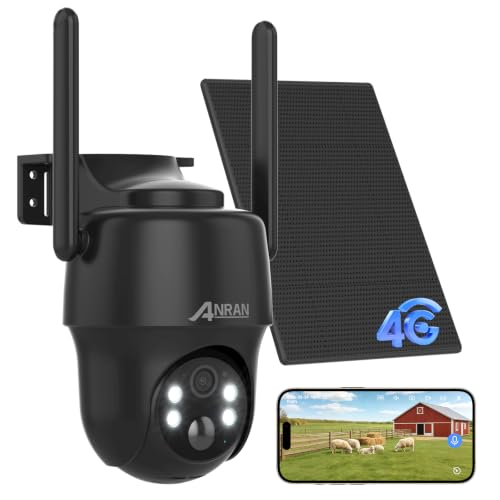
6. ANRAN 4G LTE Solar Camera
Trial-first solar PTZ
- Connection: 4G LTE cellular, no WiFi, built-in SIM
- Terms: 37-day trial, subscription required, as titled
- View: 360-degree wireless PTZ
- Features: Colour night vision, 2-way audio, PIR detection
- Power: Solar powered, off-grid design
ANRAN’s title deserves praise for saying the quiet part in print: a 37-day trial, subscription required. Around that honesty sits a complete off-grid package, 4G LTE with a built-in SIM, solar power, 360-degree PTZ coverage, colour night vision, two-way audio and PIR detection, pitched at farm, barn and RV duty. The trial structure actually suits cellular cameras well, because the only coverage test that matters happens at the buyer’s own barn, and 37 days is long enough to learn the truth.
Weatherproofing claims deserve respect but not worship; a small hood above any camera repays its cost. Metal roofs and silos shadow signals, and a few metres of relocation often outperforms a more expensive camera. Night checks by camera spare both the animals’ rest and the owner’s boots on the worst February paths. Pan-tilt sweep turns one mounting point into a yard-wide watch, from water trough to gate to feed store. A foaling camera earns its keep on the one night a mare chooses, after weeks of uneventful straw and patience.
A camera above a calving pen should be mounted before the season, tested, and then left entirely alone. Two-way talk at a stable door can calm a restless horse with a familiar voice from the farmhouse. A shared family login spreads the watching across the household during lambing’s long rota. A solar panel angled for winter sun keeps a camera alive through the season when nights are longest and checks most valuable. A trail camera at a gate records comings and goings without demanding live attention at all.
GPS tagging on trail images helps place activity across a large property without guesswork. Night checks by camera spare both the animals’ rest and the owner’s boots on the worst February paths. Colour night vision helps distinguish a dark bay horse from shadow, a lame gait from a trick of infrared grey. The free photo plan model suits owners who want pictures of events rather than a continuous live window. Cellular signal at a metal-clad barn can differ wildly between the yard and the far wall, so testing positions matters.
The feature set mirrors the SEHMUA and Reolink formula, solar pan-tilt with colour nights and spoken warnings, which makes the ANRAN a direct rival decided by terms and trial rather than by hardware gaps. PIR detection keeps alerts tied to heat-bearing movement, and two-way audio serves the gate-and-yard conversations these cameras increasingly mediate.
Subscription required means the long-term cost belongs in the purchase decision from day one, and this review keeps it in the first paragraph of the spec story rather than the last. Owners content with a known subscription, who value the trial window, get a fully featured solar sentinel with its economics stated upfront.
Strengths
- 37-day trial lets real coverage decide the purchase
- Built-in SIM with solar 360-degree PTZ coverage
- Subscription terms stated openly in the title
Trade-offs
- Subscription is required after the trial
- Long-term cost exceeds photo-plan alternatives
- Brand’s farm specialisation is shallower than dedicated rivals
Best for: an uncertain-coverage owner seeking a solar PTZ camera with a trial window to prove itself
Not suited for: a subscription-averse landowner seeking a plan-free watch, because this camera’s service requires one
For a trial long enough to test the signal in the actual barn hollow, Check price on Amazon and read the subscription terms before the trial starts.
Comparison table
| Pick | Headline specification | Defining trait |
|---|---|---|
| Barn Owl RangeCam Cellular | Cellular on all U.S. networks | Solar, off-grid farm system |
| SEHMUA 4G LTE Solar Camera | 4G LTE, built-in SIM | 360-degree view, 2K colour night vision |
| Amouu 4G LTE Horse Stable Camera | 4G LTE, SIM not included | 5000mAh battery, HD live view |
| Reolink 2K+ 4G LTE Camera | 4G LTE, SIM included | 2K+ colour night vision, AI detection, solar |
| SPYPOINT Flex-M Twin Cellular | Cellular trail twin, free photo plan | 28MP photos, GPS, 0.4s trigger |
| ANRAN 4G LTE Solar Camera | 4G LTE, built-in SIM, trial | Solar PTZ, colour night vision, subscription required |
How should a landowner choose the best barn cameras without wifi?
Multi-network flexibility earns its premium where carriers divide the land unevenly between fields. Where coverage fails everywhere, accept the verdict early and consider recorded-local alternatives rather than fighting geography. Mount higher than casual reach, angled to cover the approach rather than the sky. Match pan-tilt coverage to the yard’s geometry, counting gates, troughs and doors the sweep must reach. Value two-way talk at gates and stable doors, and discount it for silent pasture corners.
For multiple positions, compare a twin trail pack against two live cameras on total plan cost, not box cost. Choose live view for stables and yards where the moment matters, and photo delivery for territory and records. Tune motion alerts during the first week, or alert fatigue will mute the camera by the second. Consider colour night vision where identifying animals, vehicles or clothing after dark has real consequences. Hold a phone at the exact mounting point first, because coverage there decides the shortlist before features get a vote.
Verify plan renewal and cancellation terms before the camera goes up, not after the first bill. Plan battery and panel maintenance into the farm’s existing rounds, beside fence and water checks. The patience of pasture work contrasts with bridge Cameras for Macro and Landscapes bridge Cameras for Macro and Landscapes, yet both reward owners who scout the location first. Place solar panels for the winter sun’s low arc, not the generous light of installation day. Write the subscription cost beside the purchase cost, since cellular cameras are services wearing hardware.
The right camera is the one whose signal, power and plan all survive the farm’s worst month. Check how many family members can view, since lambing and foaling rotas rarely rest on one phone. Read every listing’s SIM arrangement as a headline: built-in, included, not included and free-plan models create different first months. Keep one camera’s job description narrow; a foaling watch and a gate record are different assignments. Trial periods are coverage instruments; use every day of one before the subscription decision lands.
Coverage, SIMs and the real cost of cellular
Renewal dates belong on the farm calendar beside worming and shearing, because a lapsed plan silences a camera silently. Testing with the household’s own phones gives a first reading, though camera antennas and positions differ. Trial windows should be spent at the real mounting point through real weather, not on a kitchen table. Roaming between networks can rescue a borderline site, a point worth confirming in the listing’s terms. Carrier maps describe districts; a camera experiences a single square metre behind a metal wall.
Multi-network models hedge the bet by choosing among carriers automatically or by SIM flexibility. Alert-only configurations stretch plans dramatically and suit most livestock routines. An included SIM softens setup while leaving the same long-term question of renewal terms. A free photo plan changes the arithmetic entirely for owners whose needs fit its delivery style. Reading terms is unglamorous, and it is also the entire difference between a tool and a subscription surprise.
Cellular barn cameras replace a WiFi problem with a coverage question, and the exchange usually favours the farm. Data consumption follows behaviour: constant live viewing drinks what occasional alerts only sip. The cheapest camera with the wrong plan costs more by spring than the dearer camera with the right one. A built-in SIM trades choice for convenience, landing the owner inside the maker’s plan structure from day one. A camera sold without a SIM hands the choice, and the errand, to an owner who may already hold a preferred carrier.
Power in the field: solar, batteries and seasons
Live viewing is the expensive habit; a camera checked twice daily lives far longer than one streamed for hours. Mounting the panel separately from the camera sometimes rescues a shaded but otherwise perfect viewpoint. Motion-heavy yards wake cameras constantly, and a busy gate can drain what a quiet pasture sips. Cold reduces battery enthusiasm, so mid-winter is the honest season for judging any power system. A panel’s angle and aspect matter as much as its size, particularly under winter’s low sun.
The goal is boring reliability: a system whose power nobody discusses after the first month. Battery capacity figures, where titled, describe storage rather than days, since usage patterns vary too widely for honest conversion. Solar sizing assumes average sun, while farms live through specific weeks of gloom that averages forget. Outbuildings divide into those with power and those where every watt must arrive by panel or by hand. Seasonal repositioning of a panel is normal farm maintenance, like greasing a hinge.
Owners who log battery behaviour through one winter own the knowledge to trust the second. A spare charged battery, rotated on a schedule, remains the low-technology answer that never fails. Cables run to mains power, where available, should be armoured against the yard’s traffic and teeth. Power failure alerts, where offered, deserve enabling, since silence from a camera is ambiguous news. Power planning done in October is wisdom; power planning done during a January foaling is improvisation.
Field notes from the yard
A barn cat will find every camera within a week and perform for it exactly once. Swallows nesting near a camera provide a season of unintended nature footage. The first heavy rain is a rite of passage for both housing and mounting. Neighbours comparing notes at the feed store have become an unofficial coverage map for many districts. A camera’s value compounds quietly, since its archive answers questions nobody thought to ask at the time.
Insurance conversations change tone when a dated, placed image exists. The yard at night, watched in colour, reveals a parallel farm that daylight staff never meet. Seasonal staff and relief milkers benefit from cameras that show routines rather than merely record them. A foaling alarm answered in time is the story owners retell when justifying the whole system. Gates left open announce themselves in the morning’s first frames, before any stock is missed.
The technology succeeds on farms precisely because it asks for no new building and no new network. An owner who checks the camera with the morning coffee has already integrated it into the rounds. Breakdowns announce themselves as silence, which is why a weekly test view belongs in the routine. Every farm has one corner where the signal, the sun and the view align perfectly, and finding it is the installer’s art. The cameras ask little and report faithfully, which is the oldest definition of a good farmhand.
Livestock routines the cameras quietly join
Gates watched over a season produce a plain record that memory alone would argue about. Farms adopt technology that respects their routines, and these cameras succeed by joining them. Sheep at lambing reward the camera that was installed, tested and forgotten weeks earlier. Fox and dog visits at poultry runs follow patterns a trail camera’s archive makes visible. The night yard in colour, rather than infrared grey, tells a truer story at a glance. The archive of an ordinary month becomes evidence when an extraordinary claim is made.
A camera above the feed store settles arguments about what happened and when. Horses read human presence instantly, and a camera’s silent watch disturbs a resting stable less. A shared rota login means the 2 a.m. check belongs to whoever is awake, not whoever lives nearest. A camera’s deterrent value is real but secondary; its witness value is the durable one. The best installation is the one the animals never notice and the owners cannot imagine losing. Equipment leaving a shed at midnight is the alert every owner hopes never to receive.
Seasonal moves, from barn to pasture and back, should be planned into mounting choices. A calving rota shared across a family runs more kindly when the night check begins on a screen. Cameras do not replace stockmanship; they aim it, sending the right person to the right pen. A voice through a stable camera can settle a box-walking horse until someone arrives. Water trough visits logged by a yard camera reveal a sick animal’s changed routine early. Youngstock pens justify their own viewpoint once the main barn camera proves the concept.
The first month with a cellular barn camera
A gate camera’s angle improves after reviewing a week of comings and goings at full size. Alert tuning starts permissively and tightens as the false performers, cats, swallows and tarpaulins, identify themselves. Night pictures deserve review in the first week, while repositioning costs nothing but a ladder climb. Data usage in the first month predicts the year, and plan adjustments made then are calm rather than desperate. A foaling camera installed a month early has already proven its power and plan before the night it matters.
Recording which alerts led to action, and which were theatre, sharpens the second month’s settings. A camera watching water troughs teaches the herd’s daily rhythm within a fortnight. Mounts loosen in wind and curiosity alike, and a first-month tightening round is cheap insurance. The solar panel’s shadow map changes weekly, and a midday check in the first month catches problems early. Family members added to the viewing rota should test their access before the season’s first emergency.
The same appetite for remote certainty that sends owners to cameras That Shoot 240fps cameras That Shoot 240fps for their other projects appears here in working clothes: the right signal, honestly tested, beats the finest specification. Week one belongs to signal, walking the yard with the app open to map the camera’s real conversation with the network. The first month’s lessons, written down, are the manual the manufacturer could not have supplied. Spare batteries and a known ladder location belong in the camera’s own entry in the farm notebook. By the second month the camera should feel less like a gadget and more like a member of the rounds.
Common mistakes
Comparing cameras on purchase cost alone, in a category defined by running cost, inverts the economics. Skipping the trial period’s real-location test wastes the one honest coverage experiment on offer. Ordering any cellular camera before checking signal at the mounting point is the category’s founding error. Ignoring whether a SIM is included turns setup day into an errand day. Reading ‘no WiFi’ as ‘no plan’ surprises buyers at the first renewal, which is why this guide repeats the cellular truth throughout.
Leaving a new camera untested until the first due date arrives gambles a season on an unopened box. Setting motion sensitivity once and never tuning it trains owners to ignore alerts entirely. Streaming live view for hours daily on a modest data plan ends the month in silence. Forgetting renewal dates lets a plan lapse during the exact week the camera was bought for. Judging colour night vision by a showroom clip rather than by the yard’s actual darkness misleads the shortlist.
Assuming one camera covers a whole yard, when its sweep crosses buildings, repeats the fixed-camera mistake in pan-tilt form. Mounting within casual reach invites the interference the camera was installed to record. Placing a camera where the yard’s metal cladding shadows its antenna blames the network for a geometry problem. Mounting a solar panel in summer’s generous light without considering winter’s angle starves cameras in December. Expecting a trail camera’s photo delivery to serve as a live foaling watch mismatches tool and task.
Frequently asked questions
If these cameras need cellular service, in what sense are they ‘without WiFi’?
They never touch a WiFi network: each connects directly to a 4G LTE mobile network, which is precisely what makes them work in barns and pastures beyond router range. The trade is that a SIM and plan, with their own terms, become part of the running cost.
How do I know whether coverage will work at my barn?
Hold a phone on the relevant carrier at the exact mounting point, and favour models with trials or multi-network flexibility where the signal is marginal. Metal cladding and hollows can change the answer within a few metres, so test positions, not just the property.
What are the ongoing costs?
They are set by each camera’s SIM and plan terms in its listing: some include the SIM, one advertises a free photo plan, and ANRAN states openly that a subscription is required after its 37-day trial. Reading those terms before ordering is the single most important step in this category.
Which pick suits foaling or calving watch?
A live-view model: the Amouu is shaped for stables, while the solar pan-tilt cameras from Reolink and SEHMUA cover larger yards. The SPYPOINT twin, excellent for gates and trails, delivers photographs rather than a live picture, so it suits records over real-time watching.
Does solar power really run a camera through winter?
Solar greatly reduces battery visits and can sustain a camera in favourable placements, but short days, shade and heavy live viewing all draw on the battery. Sensible panel placement and alert-led usage, rather than constant streaming, give solar its best chance.
Can one camera watch a whole barnyard?
A 360-degree pan-tilt model can sweep a yard’s key points, trough, gate and doors, from one mounting. Buildings interrupt every sweep, though, so large or divided yards often justify a second camera, which is where the SPYPOINT twin pack’s two positions appeal.
Final recommendation
The cellular truth organises the whole choice: pick the network story first, the power story second and the camera third. Barn Owl’s all-network farm system and Reolink’s complete solar pan-tilt lead the live-view field, SEHMUA and ANRAN press them with built-in SIMs and, in ANRAN’s case, an honest trial, Amouu serves the stable directly, and SPYPOINT’s twin owns the gates and fence lines on a free photo plan.
A buyer who tests signal before ordering has already avoided the commonest failure. The included or excluded SIM is a small line with a large first month attached. Live view and photo delivery are different tools, and matching them to the task matters more than brand. Alert tuning in the first week decides whether the hundredth alert still gets opened. Stables reward immediacy, yards reward sweep, and territory rewards patience.
Solar placement is a decision made once that pays or charges rent all winter. Every camera here was judged against coverage, power and the plain print of its plan. Choose the system whose signal reaches the barn on the worst day, and the rest is features. Farms run on routines, and the camera that joins the existing rounds survives. Subscription terms read early are information; read late, they are grievances.
From the farmhouse kitchen, a February barn glows quietly on a phone screen, animals settled and accounted for, and that small nightly certainty is what every panel, plan and camera in this guide was purchased to deliver.


