What's inside
- Where to Buy These 77-Inch TVs
- Key Takeaways
- Quick Picks
- How the Picks Were Chosen
- Comparison Table
- How Do You Choose a 77-Inch TV?
- Panel Technology at 77 Inches: OLED and QD-OLED
- Motion, Gaming and the Big Screen
- Mounting, Stands and Living With a Very Large Panel
- Sound at 77 Inches: What the Panel Alone Can Do
- Common Mistakes
- FAQ
- Final Recommendation
As an Amazon Associate I earn from qualifying purchases. This post may contain affiliate links at no extra cost to you.
[SITE_DOMAIN] is reader-supported. When you buy through links on our site, we may earn an affiliate commission at no extra cost to you. Prices and availability change; check the Amazon listing for the current details.
Where to Buy These 77-Inch TVs
All six sets carry a live Amazon listing; each line below names the model exactly as its review heading does, because a single letter separates sets with different processors and motion systems.
- Samsung S84F OLED 77 — Samsung S84F OLED 77 on Amazon
- LG 77in OLED evo C4 — LG 77in OLED evo C4 on Amazon
- Samsung 77in S90F OLED — Samsung 77in S90F OLED on Amazon
- Sony 77in BRAVIA XR8B OLED — Sony 77in BRAVIA XR8B OLED on Amazon
- LG 77in OLED evo C5 — LG 77in OLED evo C5 on Amazon
- Sony 77in BRAVIA XR A95L QD-OLED — Sony 77in BRAVIA XR A95L QD-OLED on Amazon
Read the listing once with your own room in mind, confirm the model code matches the heading of the review you read, and check the current terms on the product page rather than trusting any figure quoted second-hand. A 77-inch television is also a freight decision: confirm the delivery arrangement, the box dimensions against your doorway and stairwell, and the return terms before the order is placed, since moving a panel of this size back out of a house is a project in itself.
Seventy-seven inches is where television stops being an appliance and becomes architecture, and the best 77 inch tvs are the sets that justify that promotion. The size sits in a particular sweet spot. It is large enough that a film fills peripheral vision from an ordinary sofa distance, yet it remains a single panel that two careful people can mount, in a class where every serious maker now fields an OLED. All six picks here are 77-inch OLEDs, and that uniformity is itself information: at this diagonal, the market has largely decided that self-lit pixels are the correct technology, and the argument between models is about processing, motion handling, HDR format support and smart platforms rather than about panel fundamentals.
The six divide into three families. Samsung fields the S84F and the S90F, a step-down and step-up pair built on its NQ4 AI processors and Motion Xcelerator motion systems. LG fields the OLED evo C4 from 2024 and the OLED evo C5 from 2025, the two generations of the line that defined this size class for most buyers. Sony fields the BRAVIA XR8B and the flagship BRAVIA XR A95L, the latter a QD-OLED whose listing says so outright. Between them they cover three smart platforms, two distinct OLED panel approaches, refresh figures of 120Hz and 144Hz where the listings state them, and HDR support that ranges from Samsung’s OLED HDR and HDR+ naming to the Dolby Vision support that LG and Sony state in their titles.
One discipline runs through everything that follows. Specifications are quoted only as each listing title states them. Where a title names a figure — the S90F’s Motion Xcelerator 144Hz, the S84F’s Motion Xcelerator 120Hz — the review uses that figure and attributes it to the listing’s own motion language. Where a title stays silent, the spec box says so in plain words rather than borrowing a number from a sibling model or a different size. Brightness is the clearest example: no listing here publishes a peak figure in its title, so this guide makes no brightness claims in numbers at all, and instead talks about what OLED contrast does in a dark room, which is the part of the experience that does not depend on a laboratory number. Readers comparing the wider market will also find the neighbouring classes useful: the static-metadata sets rounded up among 4K HDR10 TVs show what HDR looks like without dynamic metadata, and the dynamic-metadata specialists among 4K TVs With HDR and Dolby Vision go deeper on format support than a size-led guide can.
Room fit deserves a paragraph before any model discussion. A 77-inch 16:9 screen is roughly 1.7 metres wide, and it wants a wall or a stand that can take that width without crowding speakers or furniture against its edges. Seating distance is more forgiving than folklore suggests: 4K resolution at this size resolves fully from around two and a half metres, and many owners sit closer for films and farther for broadcast sport without either feeling wrong. What matters more is light. OLED’s perfect blacks reward a room that can be dimmed, and a 77-inch glossy panel opposite an undressed window will mirror that window back at the audience during dark scenes regardless of which badge the set wears. Decide the wall, the seating and the curtains first; the model choice that follows will be easier and better.
Key Takeaways
- All six picks are 77-inch OLEDs: two Samsung, two LG and two Sony sets, so the decision is about processing, motion and platform rather than panel type.
- The Samsung S90F carries the strongest motion figure in its listing, Motion Xcelerator 144Hz, while the S84F states Motion Xcelerator 120Hz and Pantone Validated colour.
- LG’s C4 and C5 bracket the class’s mainstream: the 2024 C4 with its Magic Remote and Alexa Built-in, the 2025 C5 adding stated Dolby Vision, HDR10 and FILMMAKER Mode.
- Sony’s pair splits by ambition: the XR8B brings Dolby Vision and Atmos with PlayStation 5 features, while the A95L is the QD-OLED flagship of the group.
- Dolby Vision appears in the LG C5 and both Sony listings; Samsung’s titles instead name OLED HDR and HDR+, so format support should be checked pick by pick.
- No listing here states a numeric brightness figure, so this guide compares contrast behaviour and processing rather than invented laboratory numbers.
Quick Picks
| Pick | Badge | Why it is here |
|---|---|---|
| Samsung S84F OLED 77 | The value step into Samsung OLED | NQ4 AI Gen2 processing, OLED HDR, Pantone Validated colour and Motion Xcelerator 120Hz in a 2025 set. |
| LG 77in OLED evo C4 | The proven mainstream OLED | The 2024 evo panel with Magic Remote, AI-powered processing and Alexa Built-in. |
| Samsung 77in S90F OLED | The motion flagship from Samsung | NQ4 Gen3 processor, HDR+, Motion Xcelerator 144Hz and Alexa Built-in for 2025. |
| Sony 77in BRAVIA XR8B OLED | The PlayStation-ready Sony | XR Processor with AI, Dolby Vision and Atmos, and exclusive features for PlayStation 5. |
| LG 77in OLED evo C5 | The format-complete LG | Dolby Vision, HDR10, Dolby Atmos, AI Super Upscaling 4K and FILMMAKER Mode in the 2025 evo line. |
| Sony 77in BRAVIA XR A95L QD-OLED | The flagship of the six | QD-OLED panel, Dolby Vision HDR and Sony’s XR processing with PlayStation 5 gaming features. |
How the Picks Were Chosen
Size came first and admitted no substitutes: every pick is a verified 77-inch listing, because a guide to this class that quietly included a 75- or 83-inch set would fail its only promise. Within the size, the selection maps the actual structure of the market. Three manufacturers dominate 77-inch OLED, and each is represented by two sets at different heights of its range, so the guide can show what stepping up inside one brand actually buys — a faster processor and a higher motion figure at Samsung, a newer generation and fuller format support at LG, a QD-OLED panel at Sony — instead of pretending the six are interchangeable.
Evidence discipline shaped the rest. A feature is attributed to a set only where its listing title states it: the S84F’s Pantone validation, the C5’s FILMMAKER Mode, the XR8B’s PlayStation 5 features, the A95L’s QD-OLED panel technology. Where titles use a manufacturer’s own motion language — Motion Xcelerator 120Hz or 144Hz — the guide quotes that language as the listing’s claim rather than translating it into a native panel claim the title does not make. HDR is handled the same way. Dolby Vision is credited only to the sets whose titles name it; Samsung’s titles name OLED HDR and HDR+ instead, and the reviews keep that distinction visible rather than smoothing it over, because a reader with a shelf of Dolby Vision discs and streams deserves to know exactly which sets state support. Voice control is treated likewise: Alexa Built-in is claimed only for the S90F and the C4, whose titles state it.
Finally, the guide weighs the ownership details that a 77-inch purchase makes unusually important: the smart platform a household will live inside for a decade, the game features a console owner will use weekly, and the film modes a cinema viewer will set once and trust. Readers whose rooms run on voice control will find the dedicated roundup of alexa-Compatible TVs a useful cross-check, since it tests that single feature across sizes rather than treating it as one line in a spec box.
Samsung S84F OLED 77 — The Value Step Into Samsung OLED
Badge: The value step into Samsung OLED
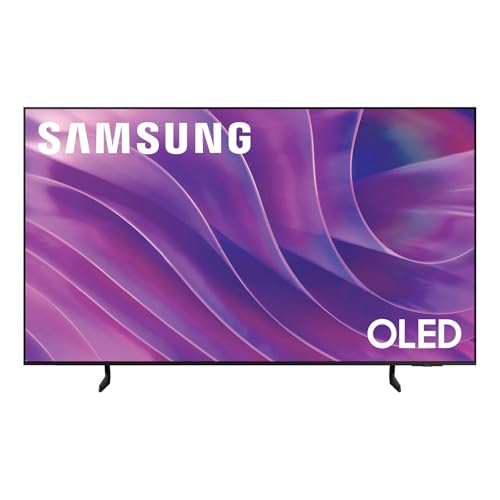
- Size and panel: 77-inch class OLED, 2025 model (77S84F)
- Processor: NQ4 AI Gen2 Processor with 4K AI Upscaling
- HDR: OLED HDR, Pantone Validated colour
- Motion: Motion Xcelerator 120Hz
- Platform: Samsung Vision AI Smart TV
- Dolby Vision: Not stated in the listing title – verify with the manufacturer documentation
The S84F is Samsung’s lower step into 77-inch OLED for 2025, and its listing reads like a deliberate argument that the step down costs less than expected. The NQ4 AI Gen2 Processor drives 4K AI Upscaling, which matters more at 77 inches than at any smaller size: broadcast television, older streaming encodes and game consoles rendering below native resolution all get enlarged across a very large number of pixels, and the quality of that enlargement is the difference between a panel that flatters everything and one that exposes every soft source. Samsung’s AI upscaling lineage is mature, and the Gen2 chip in this set is the same family of silicon thinking that runs the step-up models, tuned a rung lower.
Colour is the second argument. The listing names Pantone Validated status, a certification that the panel reproduces Pantone’s colour library within tolerance. In practice that claim speaks to skin tones and brand colours arriving as their creators intended rather than as the panel’s defaults prefer. Combined with OLED HDR — Samsung’s name for its HDR handling on this panel — the S84F presents its picture case as accuracy plus per-pixel contrast: every pixel lights itself, so a candlelit scene holds true black around the flame instead of the grey halo a backlit panel produces. The listing does not name Dolby Vision, and this review does not award it; Samsung’s sets speak HDR10-family language, and the spec box records the silence honestly.
Motion Xcelerator 120Hz is the motion claim, quoted as the listing states it. Sport and fast games are where 77 inches punishes weak motion handling, because a panning camera sweeps detail across a metre and a half of glass. A 120Hz-class motion system keeps that sweep coherent, and for console play the set presents itself as a credible large-screen partner. Samsung Vision AI is the platform layer, Samsung’s current smart interface with its recommendation and content surfaces. It is a capable, busy interface; households already inside Samsung’s ecosystem will feel at home, while minimalists may spend a first evening pruning rows. None of that changes the core proposition: this is the least elaborate route in this guide to a 2025 Samsung OLED at the full 77 inches, with the processor, colour validation and motion system all named in its own listing.
Strengths
- Pantone Validated colour is stated in the listing, giving the set an accuracy credential its siblings do not claim.
- NQ4 AI Gen2 processing with 4K AI Upscaling suits the mixed-quality sources a 77-inch screen enlarges.
- Motion Xcelerator 120Hz covers sport and console play at the size where motion flaws show most.
Trade-offs
- The listing names OLED HDR rather than Dolby Vision, so dynamic-metadata support goes to rivals in this guide.
- It is the lower Samsung step: the S90F in this same guide carries a Gen3 processor and a higher motion figure.
- Samsung Vision AI’s content-forward home screen will not suit viewers seeking a quiet, apps-only interface.
Best for: a living room seeking Samsung’s OLED picture with Pantone Validated colour and 120Hz-class motion at the lower Samsung step.
Not suited for: a film library seeking stated Dolby Vision support, which this listing does not claim.
For the current terms on this exact 77S84F model, Check price on Amazon on the S84F listing page.

LG 77in OLED evo C4 — The Proven Mainstream OLED
Badge: The proven mainstream OLED
- Size and panel: 77-inch class OLED evo, flat screen (OLED77C4PUA, 2024)
- Processor: 4K Processor, AI-powered
- Remote: Magic Remote included in the listing description
- Voice: Alexa Built-in
- HDR format detail: Not stated in the listing title – verify with the manufacturer documentation
- Motion figure: Not stated in the listing title – verify with the manufacturer documentation
The C4 is the set that defined the mainstream of this size class in 2024, and its listing is refreshingly plain about what it is: a 77-inch OLED evo panel with a 4K processor, AI-powered picture features, the Magic Remote and Alexa Built-in. The evo designation is LG’s brighter, more refined OLED panel line, and at 77 inches the C-series formula — evo glass, a capable processor, a remote that works like an air mouse — is the combination against which every rival in this guide is implicitly measured. A year of ownership reports sits behind this model in a way no 2025 set can match, and that track record is a genuine feature for a purchase of this size and expected lifespan.
The Magic Remote deserves its paragraph. Pointing and clicking through a streaming interface sounds like a novelty until a household has lived with text search on an on-screen keyboard; the pointer turns a chore into a gesture, and the scroll wheel makes long content rows pass quickly. Alexa Built-in is stated in the title, so voice control through Amazon’s assistant is a listed capability of this set rather than an assumption — searches, smart-home commands and playback control can run through the television’s own integration. The listing does not enumerate HDR formats, and the spec box says so; the C4’s reputation in the wider market is not evidence this guide will borrow, because the discipline here is that a set earns claims from its own listing.
As a viewing proposition the C4 is the balanced one: OLED’s perfect blacks, evo panel refinement, a processor that handles upscaling and motion without calling attention to itself, and a platform — LG’s webOS — that keeps apps orderly. Gamers have historically prized this line for its input breadth, though the listing title here does not state gaming figures, so console owners should confirm the port and refresh specifics in the manufacturer documentation before treating it as a gaming purchase. What the listing does support, fully, is the all-rounder case: film nights, broadcast sport, streaming series and voice-controlled convenience in the size class’s most proven package. In a guide of step-ups and flagships, the C4 is the set that asks the least faith from its buyer.
Strengths
- OLED evo panel in the size class’s most established model line, with a full model year of ownership behind it.
- Magic Remote point-and-click control, named in the listing, makes large interfaces genuinely faster to drive.
- Alexa Built-in is stated outright, giving the set a clear voice-control route through Amazon’s assistant.
Trade-offs
- The listing title states no HDR format names and no motion figure, so format sticklers must verify details in the documentation.
- It is the 2024 generation; the C5 in this guide carries the newer panel year and a fuller stated format list.
- webOS advertising rows on the home screen are part of the platform’s current character.
Best for: a main viewing room seeking the established OLED evo formula with Magic Remote control and Alexa Built-in stated in the listing.
Not suited for: a spec-first shortlist seeking HDR formats and motion figures printed in the listing title itself.
Read the full OLED77C4PUA specification on its product page and Check price on Amazon when the C4’s balance looks right.

Samsung 77in S90F OLED — The Motion Flagship From Samsung
Badge: The motion flagship from Samsung
- Size and panel: 77-inch class OLED (77S90F), 2025 model
- Processor: NQ4 Gen3 Processor with Upscaling Pro
- HDR: HDR+
- Motion: Motion Xcelerator 144Hz
- Voice: Alexa Built-in
- Platform: Samsung Vision AI, 4K
The S90F is what the step up from the S84F buys, and its listing itemises the upgrade with unusual clarity: the processor climbs to the NQ4 Gen3 with Upscaling Pro, the HDR naming climbs to HDR+, and the motion figure climbs to Motion Xcelerator 144Hz. Each of those is a real axis of difference at 77 inches. The Gen3 processor is Samsung’s stronger picture brain for 2025, and Upscaling Pro is its more ambitious enlargement engine — relevant every time a 1080p broadcast or an older stream meets a screen this wide. HDR+ is Samsung’s dynamic-metadata format, scene-by-scene tone mapping in the HDR10 family tradition, and its presence in the title gives the S90F a stated dynamic HDR claim of its own kind.
The 144Hz motion figure is the headline for players. Motion Xcelerator 144Hz, as the listing phrases it, speaks to high-refresh gaming from a PC and to exceptionally clean motion in fast content; even for viewers who never connect a gaming rig, a motion system built to that ceiling tends to handle broadcast sport’s pans and tickers with composure. Alexa Built-in is also stated in this title — unlike the S84F’s listing — so the S90F carries a named voice route through Amazon’s assistant alongside Samsung’s own Vision AI platform layer. That combination makes the set the most feature-explicit Samsung in this guide: processor generation, upscaling tier, dynamic HDR naming, motion ceiling and voice support all printed in its own title.
Picture character follows the hardware. OLED blacks anchor the contrast, the Gen3 processor manages colour and detail, and the panel’s maker positions the S90 series as the performance heart of its OLED range — the point where Samsung’s QD-OLED ambitions in other sizes translate into its most complete 77-inch offer here, though this listing does not itself use the QD-OLED name, so neither does this review. For a household choosing inside Samsung’s ecosystem and willing to take the upper step, the S90F is the set whose listing leaves the fewest questions unanswered: nearly every line of its spec box is filled by its own title rather than by a verify-later note, and that completeness is itself a buying argument.
Strengths
- Motion Xcelerator 144Hz is the strongest motion figure stated by any listing in this guide.
- NQ4 Gen3 Processor with Upscaling Pro gives the set Samsung’s higher 2025 processing tier.
- HDR+ and Alexa Built-in are both named in the title, filling the spec box from the listing itself.
Trade-offs
- Dolby Vision is not named in the listing; Samsung’s dynamic-metadata route here is HDR+ instead.
- The step up from the S84F is real money in this class, spent on processing and motion rather than size.
- Vision AI’s recommendation-heavy home screen remains a matter of taste.
Best for: a gaming and sport room seeking Motion Xcelerator 144Hz with Samsung’s Gen3 processing and Alexa Built-in in one 77-inch set.
Not suited for: a Dolby Vision collection seeking that format named in the listing, since this title states HDR+.
Console owners comparing the 144Hz claim against their hardware can Check price on Amazon from the S90F’s own listing.

Sony 77in BRAVIA XR8B OLED — The PlayStation-Ready Sony
Badge: The PlayStation-ready Sony
- Size and panel: 77-inch BRAVIA XR8B OLED, 4K HDR (K-77XR8B)
- Processor: XR Processor with AI Technology
- HDR and audio: Dolby Vision and Dolby Atmos, both stated
- Gaming: Exclusive features for PlayStation 5
- Platform: Smart Google TV
- Motion figure: Not stated in the listing title – verify with the manufacturer documentation
Sony’s XR8B enters the guide carrying the two format names Samsung’s listings omit: Dolby Vision and Dolby Atmos are printed in its title, alongside the XR Processor with AI Technology and exclusive features for the PlayStation 5. That combination sketches the set’s intended owner precisely — a film viewer whose streams and discs carry dynamic metadata, and a console household whose PlayStation sits under the screen. The XR Processor is Sony’s cognitive-intelligence picture line, marketed on how human viewers perceive focal points and colour rather than on raw specification, and whatever one makes of the philosophy, Sony’s processing reputation in motion handling and near-black gradation is the reason its OLEDs anchor guides like this one.
Google TV is the platform, and it brings the deepest app catalogue and the most capable content aggregation of the three platforms in this guide, plus straightforward casting from phones. Dolby Vision support means the large and growing library of dynamically mastered streaming titles renders as mastered; Dolby Atmos naming in the title speaks to the set’s audio decoding ambitions, though at 77 inches any of these sets will eventually meet a soundbar in a serious cinema room, and the Atmos claim is best read as correct handling and passthrough of the format rather than a promise of theatre sound from a slim panel. The PlayStation 5 features are described as exclusive in the listing, which in Sony’s practice means the console and television recognise each other and configure game picture settings cooperatively — the listing does not itemise them, so this review does not either.
Against its stablemate the A95L, the XR8B is the more accessible Sony step: OLED rather than QD-OLED, the same Google TV platform, the same Dolby pairing, the same console relationship. Against the Korean pairs it is the processing-and-formats choice, trading Samsung’s stated motion figures and LG’s remote for Sony’s picture philosophy and the Dolby names in print. The listing leaves the motion figure unstated, which the spec box records; sports devotees comparing numbers will find Samsung’s titles more forthcoming. But for the mixed household — films in Dolby Vision at night, a PlayStation in daily use, Google TV as the family interface — the XR8B’s title makes its case in a single sentence.
Strengths
- Dolby Vision and Dolby Atmos are both stated in the listing, covering the dynamic formats film viewers ask about first.
- Exclusive PlayStation 5 features give the set a defined console relationship no rival title here claims.
- XR Processor with AI Technology brings Sony’s picture-processing approach to a mid-step OLED.
Trade-offs
- The listing states no motion figure, leaving sport and gaming refresh details to the manufacturer documentation.
- It sits below the A95L’s QD-OLED panel in Sony’s own hierarchy within this guide.
- Google TV’s recommendation rows are prominent, which not every household enjoys.
Best for: a PlayStation household seeking Dolby Vision and Atmos stated in the listing with Sony’s XR processing at 77 inches.
Not suited for: a numbers-led comparison seeking a motion figure printed in the title, which this listing leaves unstated.
PlayStation owners can confirm the console features on the K-77XR8B page and Check price on Amazon there.

LG 77in OLED evo C5 — The Format-Complete LG
Badge: The format-complete LG
- Size and panel: 77-inch OLED evo AI 4K (OLED77C5PUA, 2025)
- HDR: Dolby Vision and HDR10, both stated
- Audio: Dolby Atmos stated
- Upscaling: AI Super Upscaling 4K
- Film mode: FILMMAKER Mode stated
- Voice route: Not stated in the listing title – verify with the manufacturer documentation
If the C4’s listing is plain, the C5’s is encyclopaedic. LG’s 2025 evo set names Dolby Vision, HDR10 and Dolby Atmos in its title, adds AI Super Upscaling 4K, and closes with FILMMAKER Mode — the industry-standard picture preset that disables motion smoothing and presents films at their intended frame rate and colour. Read as a whole, the title is a checklist written by someone who knew exactly which questions film viewers ask, and it answers them in the affirmative one by one. Dynamic metadata: yes, in Dolby Vision. The static baseline: yes, HDR10. Object audio decoding: yes, Atmos. The soap-opera effect: off, by name, in FILMMAKER Mode.
AI Super Upscaling 4K is the processing claim, LG’s current-generation enlargement and refinement for the sub-4K sources that still dominate broadcast and much streaming. At 77 inches upscaling quality is not a footnote; it is the difference between a news broadcast that looks clean and one that looks smeared, and LG’s AI-labelled processing generation is the company’s answer. The evo panel continues from the C4 with the newer model year behind it. What the title does not state is equally notable for this guide’s discipline: no voice assistant is named, and no motion figure is printed, so the spec box leaves both to verification rather than assuming the C4’s Alexa line carries over by inheritance.
The C5’s natural rival inside this guide is its own predecessor. A household choosing between the C4 and C5 is choosing between a proven 2024 set whose listing emphasises the remote and voice, and a 2025 set whose listing emphasises formats and film presentation. Neither is a wrong answer; they are different emphases printed in the manufacturers’ own words. Against the wider field, the C5 is the only LG here with Dolby Vision in its title, which makes it the Korean-made choice for the dynamic-metadata library, and its FILMMAKER Mode gives it the clearest stated film-presentation credential of the six. For the cinema-first room that still wants evo OLED and a mainstream badge, the C5 assembles the most complete paper case in the guide.
Strengths
- Dolby Vision, HDR10 and Dolby Atmos are all named in the title — the fullest format statement of any listing here.
- FILMMAKER Mode is stated, giving film presentation a named, smoothing-free preset.
- AI Super Upscaling 4K addresses the sub-4K sources a 77-inch screen enlarges most ruthlessly.
Trade-offs
- The title names no voice assistant, so voice-control routes need verification in the documentation.
- No motion figure is stated in the listing, unlike Samsung’s titles in this guide.
- As the 2025 generation, it carries the newer-model position in LG’s range against the C4’s value.
Best for: a cinema room seeking Dolby Vision, HDR10, Atmos and FILMMAKER Mode all stated in one listing at 77 inches.
Not suited for: a voice-first household seeking a named assistant in the title, which this listing does not print.
Film viewers can read the OLED77C5PUA’s full format list on its page and Check price on Amazon from there.

Sony 77in BRAVIA XR A95L QD-OLED — The Flagship of the Six
Badge: The flagship of the six
- Size and panel: 77-inch QD-OLED, BRAVIA XR A95L series (XR77A95L)
- Resolution and HDR: 4K Ultra HD with Dolby Vision HDR stated
- Gaming: Exclusive gaming features for the PlayStation 5
- Platform: Smart Google TV
- Audio format detail: Not stated in the listing title – verify with the manufacturer documentation
- Motion figure: Not stated in the listing title – verify with the manufacturer documentation
The A95L is the flagship, and it is the only set in this guide whose listing names a panel technology beyond OLED itself: QD-OLED. Quantum-dot OLED marries self-lit pixels to a quantum-dot colour layer, and its calling card is colour volume — saturated colour that holds its intensity in bright highlights where conventional OLED structures wash toward white. In a dark cinema room the difference shows in the scenes other panels flatten: neon signage, sunset gradients, the deep reds and cyans of animated films. Sony pairs that panel with its XR processing and Google TV, and the title adds Dolby Vision HDR and exclusive gaming features for the PlayStation 5, completing a specification that reads as the ceiling of the 77-inch class rather than a step within it.
Flagship ownership is a particular contract. The panel technology that produces those colours is the most demanding in the guide, the set’s positioning at the top of Sony’s range makes it the considered purchase rather than the casual one, and the listing’s own restraint — no motion figure, no audio format named — suggests a product sold on picture quality witnessed rather than on paper statistics. The PlayStation 5 relationship mirrors the XR8B’s, with the console features described as exclusive gaming features in this title. Google TV provides the same broad platform as its stablemate. The honest summary is that the A95L asks its buyer to prioritise the image itself over every secondary consideration, and rewards that priority with the most advanced panel in the room.
Choosing between the two Sonys is therefore a values question. The XR8B states more formats in its title and occupies the sensible step; the A95L states the panel technology that matters most to picture purists and occupies the summit. Choosing between the A95L and the Korean flagships is a philosophy question: Samsung counters with stated motion figures and processing generations, LG with the format checklist and FILMMAKER Mode, Sony here with QD-OLED colour and its processing restraint. There is no specification table that settles that argument, which is precisely why this guide presents the six as a field of genuine alternatives. The A95L is for the room where the picture is the point, the lights go fully down, and the set is expected to remain the best screen in the house for a long time.
Strengths
- QD-OLED panel technology is named in the listing — the only set here stating it — with its colour-volume advantage.
- Dolby Vision HDR is stated, covering dynamic-metadata film and streaming libraries.
- Exclusive PlayStation 5 gaming features continue Sony’s console relationship at the flagship tier.
Trade-offs
- The listing states neither a motion figure nor an audio format, leaving both to the manufacturer documentation.
- Flagship positioning makes it the most considered purchase of the six.
- QD-OLED’s strengths reward dark-room viewing most; a bright, uncontrolled room narrows its advantage.
Best for: a dark cinema room seeking QD-OLED colour volume with Dolby Vision HDR and Sony’s flagship processing.
Not suited for: a bright family room seeking stated motion figures and format lists in the title itself.
Picture-first readers can study the XR77A95L’s listing in full and Check price on Amazon when the flagship case convinces.
Comparison Table
| Model | Panel | HDR stated in title | Motion stated | Platform |
|---|---|---|---|---|
| Samsung S84F OLED 77 | OLED | OLED HDR | Motion Xcelerator 120Hz | Samsung Vision AI |
| LG 77in OLED evo C4 | OLED evo | Not stated in the listing title | Not stated in the listing title | LG smart platform with Magic Remote |
| Samsung 77in S90F OLED | OLED | HDR+ | Motion Xcelerator 144Hz | Samsung Vision AI |
| Sony 77in BRAVIA XR8B OLED | OLED | Dolby Vision | Not stated in the listing title | Google TV |
| LG 77in OLED evo C5 | OLED evo | Dolby Vision, HDR10 | Not stated in the listing title | LG smart platform |
| Sony 77in BRAVIA XR A95L QD-OLED | QD-OLED | Dolby Vision HDR | Not stated in the listing title | Google TV |
Read the table as a map of what each manufacturer chose to print, not as a league table. Samsung prints motion and processing; LG’s C5 prints formats; Sony prints panel technology and the Dolby name. The gaps marked as not stated are gaps in the titles, and the manufacturer documentation is the place to close them before money moves. A household comparing two finalists should read both listings side by side with this table open, checking each stated line against the services, consoles and players already in the room, because the best specification is the one that matches equipment actually owned rather than equipment imagined for a future upgrade.
How Do You Choose a 77-Inch TV?
Start with the room, because at 77 inches the room eliminates more options than the catalogue does. Measure the wall or stand width against a screen roughly 1.7 metres across, walk the delivery route from the street to the seat — doorways, stair turns, lift depth — and note where the windows sit relative to the screen. A set that cannot physically reach its wall, or that mirrors a bright window through every dark scene, fails before its processor matters. Then fix the seating distance honestly: measure where heads actually rest, not where the room plan says they should. Around two and a half to three metres flatters every set here for film; closer seating raises the value of upscaling quality, because enlargement artefacts sit nearer to the eye.
Next, choose the platform your household will actually enjoy living inside. Google TV on the Sonys aggregates content across services and casts easily from phones. Samsung’s Vision AI ties into Samsung’s wider device world. LG’s platform pairs with the Magic Remote’s point-and-click speed on the C4. These interfaces are daily companions for a decade; a household that already runs one ecosystem happily should weight continuity heavily, because the picture differences among these six OLEDs are smaller than the friction of a disliked interface multiplied by ten years of evenings.
Then match the stated strengths to the dominant use. Film-first rooms should read the HDR lines closely: Dolby Vision is stated by the C5, the XR8B and the A95L, while Samsung’s titles state OLED HDR and HDR+ — dynamic metadata exists on both routes, under different names and ecosystems, and a library invested in one format’s titles argues for the sets that name it. Players should weigh Samsung’s printed motion figures and Sony’s PlayStation 5 features. Mixed households should notice which listings answer their questions in print and which leave homework; at this size and commitment level, a title that states what you care about is worth real money.
Finally, plan the whole installation as one purchase: a mount rated for the panel’s weight and VESA pattern, cable runs for the consoles and players the set will serve, and an audio decision — every one of these televisions sounds respectable, and every cinema room eventually benefits from a soundbar or separates, so leave the physical and budgetary room for that step rather than discovering the need after the panel is hung.
Panel Technology at 77 Inches: OLED and QD-OLED
All six sets light each pixel individually, which is why this size class looks the way it does. Per-pixel light control means a starfield is black where space should be black, a night street holds shadow detail beside a lit window, and no backlight halo bleeds around subtitles. The differences among the six live in how their panels produce colour. Conventional OLED structures, including LG’s evo line, build white light and filter it into colour; QD-OLED in the Sony A95L converts blue light through quantum dots into red and green, a route associated with purer, more saturated colour at high brightness. Neither approach is a defect; they are different engineering answers, and their visible signatures — colour volume on the QD-OLED, the evo line’s refinement across two generations here — are best judged in dark scenes with saturated content rather than in showroom brightness contests.
Ownership realities accompany the technology. OLED panels ask for ordinary care: vary content, let the set’s built-in maintenance cycles run, and avoid parking a static bright image for days. Modern sets manage this largely automatically, and for mixed film, sport and gaming diets the practical risk is low. What the technology returns for that small care is the contrast that makes 77 inches feel cinematic rather than merely large — the quality every pick in this guide shares, and the reason the size class has converged on it.
There is also a brightness conversation to have honestly, because it is the one this class’s marketing usually conducts in numbers this guide refuses to invent. No listing here publishes a peak figure, so comparisons must rest on behaviour: OLED’s strength is not raw output across a full white screen but precision — small highlights, a candle flame, a stadium floodlight, rendered at full intensity against true black beside them. In a dimmed room that precision is what the eye reads as brilliance. In a sunlit room, ambient light competes with any panel, and curtains do more for the picture than any specification could. Readers choosing for a bright space should weight the room treatment as part of the purchase and use the manufacturers’ documentation for any model-specific figures rather than expecting a single number to predict the experience.
Motion, Gaming and the Big Screen
Size magnifies motion. A camera pan that crosses a 55-inch screen in a second crosses this one across half a metre more glass, and any judder or smearing in that movement scales with it. That is why the motion lines in these listings matter: Samsung states Motion Xcelerator 120Hz on the S84F and 144Hz on the S90F, figures aimed at sport and high-refresh gaming, while the LG and Sony titles leave motion unstated and their documentation becomes required reading for players comparing refresh support. Console households have a second axis: Sony’s two sets state exclusive PlayStation 5 features, a cooperative relationship between console and television that simplifies game setup. PC players with high-refresh graphics cards will gravitate to the S90F’s printed 144Hz ceiling. Broadcast sport viewers should remember that motion interpolation taste is personal — some viewers love the smoothness, others disable it outside sport — and every set here offers controls; the film sections’ advice about FILMMAKER Mode on the C5 exists precisely because one setting rarely serves both the match and the movie.
Mounting, Stands and Living With a Very Large Panel
Installation is the unglamorous half of a 77-inch purchase, and it deserves planning equal to the model choice. Wall mounting suits most rooms: it frees floor space, sets the screen at a controlled height and removes the wide stand footprint that a panel this size otherwise demands. The mount must be rated for the set’s weight and matched to its VESA pattern, fixed into studs or appropriate masonry anchors, and the wall itself should be checked before the bracket is ordered. Centre the screen at seated eye level rather than above a fireplace mantel; a panel this large mounted too high turns every film into a front-row cinema seat, with the neck ache to match. If the set will stand on furniture instead, measure the stand’s foot span against the cabinet’s depth and width — wide feet near the panel’s edges are common in this class and have embarrassed many a tape measure.
Cabling rewards forethought at this scale. Consoles, players and soundbars should be inventoried before installation so the right number of HDMI runs, an optical or eARC route for audio, and power reach the panel’s location without a visible tangle. In-wall cable channels or a simple raceway keep the installation looking like the room was designed around the screen, which, at 77 inches, it now is. Leave ventilation clearance behind the panel, keep the remote’s line of sight or Bluetooth pairing in mind when placing streaming boxes in cabinets, and photograph the cable layout before the set goes on the wall; future troubleshooting is kinder with a picture. Finally, keep the packaging until the panel has survived its first week. A box of this size is awkward to store and far more awkward to replace if a return becomes necessary.
Sound at 77 Inches: What the Panel Alone Can Do
A screen this large creates an expectation of equally large sound, and honesty helps here: slim panels carry slim speakers, and physics limits what they can move. Every set in this guide handles dialogue, news and casual streaming perfectly respectably, and the format names in the listings — Dolby Atmos on the Sony XR8B and the LG C5 — describe decoding and processing capability, the set’s ability to accept and render object-based audio in a downmixed or virtualised form, rather than a promise of discrete overhead effects from the panel alone. Viewers whose rooms are dedicated to film should treat a soundbar or separates system as the planned second step, connected over eARC so the television’s apps and the console feed the audio system without switching gymnastics. The benefit of choosing a set whose title states its audio formats is that the passthrough conversation starts from known ground: the listing has already told you what the set accepts. For everyone else — sport in the afternoon, series in the evening, news in the morning — the panels’ own audio is a smaller compromise than the size of the screen might suggest, and the upgrade can wait until the room asks for it.
Common Mistakes
The first mistake is buying the diagonal before measuring the room: a 77-inch panel that overwhelms a short wall, blocks a doorway swing or arrives via a staircase it cannot turn has failed regardless of its picture. The second is assuming HDR support from the category rather than the listing — Dolby Vision, HDR+ and OLED HDR are different statements, and this guide’s spec boxes show how unevenly they are distributed even among six premium sets. Check the format names against the services and discs the household actually watches. The third mistake is treating motion language as interchangeable: Motion Xcelerator figures are the manufacturer’s own motion naming, quoted here as listed, and players should confirm native panel behaviour in the documentation before building a gaming setup around a number. The fourth is neglecting audio planning; a slim 77-inch panel’s speakers serve news and casual viewing well, but a cinema room built around one of these sets deserves the soundbar conversation at purchase time, not as an afterthought. The fifth is skipping the delivery plan — box dimensions, two people, and a cleared route are part of the product at this size.
FAQ
Is 77 inches too large for an ordinary living room?
For most rooms with seating between two and a half and four metres from the screen, no. 4K resolution at 77 inches resolves fully at those distances, and the size reads as cinematic rather than excessive once mounted. Rooms with seating closer than two metres, or walls broken by doors and windows, are the exceptions worth measuring carefully.
What separates QD-OLED from the other OLEDs here?
The Sony A95L’s listing names QD-OLED, a panel route that uses quantum dots for colour and is associated with strong colour volume in bright highlights. The other five sets are OLED or OLED evo designs. All six share per-pixel light control and perfect blacks; the QD-OLED’s distinction is colour behaviour, judged best in saturated, bright content.
Which of these TVs state Dolby Vision support?
Three listings name it: the LG C5, the Sony XR8B and the Sony A95L. Samsung’s S84F names OLED HDR and the S90F names HDR+, Samsung’s own HDR language. The C4’s title does not enumerate HDR formats. The spec boxes in each review record exactly what each title states.
Which pick suits PlayStation 5 play?
Both Sony sets state exclusive features for the PlayStation 5 in their titles — the XR8B and the A95L. Samsung’s S90F counters with the guide’s strongest stated motion figure, Motion Xcelerator 144Hz, which PC and console players should weigh alongside Sony’s console integration.
Do any listings state a brightness figure?
No. None of the six titles prints a numeric brightness value, so this guide makes no numeric brightness claims. Panel behaviour is discussed in terms of contrast and colour, and readers comparing laboratory figures should consult the manufacturers’ full documentation for each model.
How long should a 77-inch OLED last?
These are long-term purchases built around panel maintenance features that run automatically. Varied content and the sets’ own refresh cycles keep the panels healthy for mixed viewing diets over many years. The practical lifespan limit is more often the smart platform’s app support than the panel itself.
Should the set be wall-mounted or stand-mounted?
Both work, and the room decides. Wall mounting suits long walls and frees the cabinet for consoles and audio equipment, but it demands proper fixings into studs or masonry and a mount rated for the panel. Stand mounting is simpler and lets the set move between rooms over its life, provided the furniture is wide and deep enough for the feet. Either way, centre the screen at seated eye level and plan cable routes before the set is lifted into place.
Final Recommendation
The six sets divide cleanly once the room’s priorities are named. The LG C5 makes the most complete film case on paper, with Dolby Vision, HDR10, Atmos and FILMMAKER Mode all stated. The Sony A95L owns the panel-technology summit with QD-OLED, and its XR8B sibling brings the same Dolby pairing and PlayStation relationship a step lower. Samsung’s pair owns the printed numbers: the S90F’s 144Hz motion figure and Gen3 processing for players and sport, the S84F’s Pantone Validated colour and 120Hz-class motion at the accessible step. The LG C4 remains the proven all-rounder whose remote and stated Alexa support simplify daily life. Choose by the sentence that describes your evenings — the format library, the console, the match, or the darkened cinema room — and the right badge follows from it. When the curtains close on the first film and seventy-seven inches of perfect black holds the room’s attention in a single shared silence, the size stops being a specification and becomes the reason everyone stays for the credits.