Our Top Picks
 DEWALT 100-Piece FLEX TORQ Drill/Driver Bit Set DWANGFT100SET16.89 x 8.94 x 2.44 inches4.21 poundsCheck on Amazon
 DEWALT DWA2NGFT40IR Impact Ready Flextorq 40-Piece Steel Screwdriver8.75 x 1.74 x 8.75 inches8.75 x 1.74 x 8.75 inches1 poundsCheck on Amazon

What's inside
- Set formats and cases: where daily usability is decided
- Metallurgy and tips: steel, machining and finishes
- Impact-rated versus standard bits
- Drive families and real coverage
- Drill bits inside mixed sets
- Holders and attachments
- The filler audit: counting a set honestly
- Storage and wear
- Check prices on Amazon
- Matching a set to the work you actually do
As an Amazon Associate I earn from qualifying purchases. This post may contain affiliate links at no extra cost to you.
A DeWalt bit set looks simple from the outside: a yellow and black box, rows of silver or dark bits, and a large number printed on the lid. That number tells you very little. Two sets with the same headline count can behave very differently once they live in a truck door pocket, a kitchen drawer, or the top tray of a rolling tool chest. One opens with cold fingers and gives up the right bit at once. The other rattles, spills, and hides the one Torx size you need behind a bar that will not tilt. This guide works through the parts that decide whether a set earns a permanent place in your kit: the case, the steel, the tip geometry, the split between impact-rated and standard lines, the real spread of drive types, the drill bits tucked into mixed sets, the holders and attachments, and the dull but decisive question of how many pieces you will ever touch.
DeWalt sells bit sets to several different buyers at once, and the catalogue reflects that spread. A homeowner hanging curtain rods needs Phillips and slotted bits, a few twist drills, and a magnetic holder that keeps a screw from dropping behind a radiator. A deck builder needs impact-rated Torx and square-drive bits by the handful, because those bits are consumables that wear out under load. A cabinet installer needs short, precise bits for hinge screws, long bits for recessed fixings, and a right-angle attachment for the corner where a drill body will not fit. Reading a set well means matching its contents to that kind of work, rather than treating every included piece as equal value.
Set formats and cases: where daily usability is decided
Compact pocket cases sit at the small end of the range. They hold a short rail of driving bits, sometimes a holder, and little else. The appeal is obvious: the case slips into a jeans pocket, a tool belt pouch, or the glove box, and it goes where the job is instead of staying in the workshop. The cost of that size shows up quickly. Rails are crowded, bits sit close together, and thick fingers struggle to pull a short insert bit free without lifting its neighbours. If you work in gloves, try opening the case and removing a bit while wearing them before you commit, because a case that fights you on a ladder becomes a case left behind in the van.
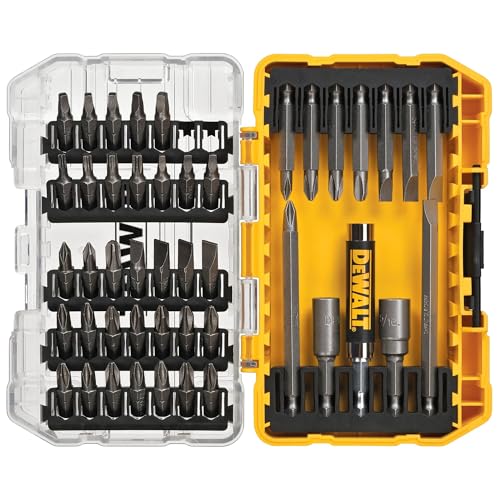
Mid-size ToughCase boxes are the workhorse format in the DeWalt range, and they suit most buyers best. The lid is clear, so you can see at a glance whether a bit is missing or a bar is empty. Inside, bit bars tilt outward once the lid opens, presenting the tips at an angle instead of forcing you to dig them out of a flat row. That tilting action matters more than it sounds. A flat bar holds bits upright and tight, which is secure in transit but slow in use. A tilting bar trades a little of that grip for speed, and on a job with dozens of fixings the seconds saved add up to real time.
Clear lids deserve a moment of their own. Polycarbonate lids let you audit a set without opening it, which helps at the end of a day when you want to know whether everything came home. They also show damage honestly: a cracked hinge or a lid that has gone cloudy from solvent splashes is visible at once. The weakness is that clear plastic scratches, and a heavily scratched lid on a site box can become hard to read in poor light. Latch design varies too. Some cases close with a single central catch, others with two side latches that feel firmer and resist popping open inside a bag full of heavier tools.
Stackable, interlocking systems answer a different problem: several small sets that need to travel and store as one unit. DeWalt cases in this style clip together, so a driving set, a drilling set, and a mixed accessory case can ride as a single block and then separate on the bench. The benefit grows with the number of sets you own. One interlocking case is a curiosity; four of them become a tidy wall or drawer system where each lid stays visible. Check how the clips behave when the cases are full, because a loaded case is heavier than an empty one in the shop, and a clip that feels solid empty may flex once the case carries steel.
Customisable inserts appear in the larger cases, where removable bars and dividers let you rearrange the interior. A carpenter might give the best slots to Torx and square drive and banish slotted bits to a corner. An electrician might reserve space for nut drivers and long hex bits. That freedom is worth having only if the bars stay put after you move them. Loose bars that drift in transit undo the whole point, so look for positive clicks as bars seat, and for moulded markings beside each slot. Size markings printed or moulded next to a bit save guesswork when several Phillips variants sit side by side.
Case size also shapes what a set can hold. Long bits, drive guides, and socket adapters need depth or length that a pocket case cannot offer, so compact sets lean heavily on short insert bits. Mid-size and large cases can carry power bits of two or three inches, which reach recessed screws without an extension. When you compare two sets, lay out what the case forces the maker to include. A shallow case full of short bits may still be the right buy for flat-pack furniture and general repairs, but it will frustrate anyone who regularly drives screws into deep pockets or through thick framing into hidden plates.
Metallurgy and tips: steel, machining and finishes
Most quality driving bits start from S2 tool steel, an alloy chosen for hardness and toughness in roughly equal measure. Hardness alone is not a virtue in a bit. A bit that is too hard becomes brittle, and brittle bits snap at the tip or shatter under an impact driver instead of wearing down gradually. A bit that is too soft twists, rounds over, and starts to cam out of screw heads. S2, properly heat treated, sits between those failures: it resists deformation at the tip while keeping enough give in the body to survive repeated torque. Maker documents for DeWalt bits refer to heat treatment and material grade because those two factors, more than any coating, decide how long a tip keeps its shape.
Tip geometry is where machining earns its keep. A Phillips tip that matches the screw recess fully, with flanks that meet the recess walls along their length, transfers torque without concentrating stress at a few points. CNC machining holds those angles tightly from bit to bit, so a number two Phillips from one end of the bar behaves like the same size from the other end. Poorly formed tips rock in the recess, and that rocking is what chews both the bit and the screw. When you read product literature, language about machined tips and reduced cam-out points to this fit question. Cam-out is the tendency of a Phillips bit to climb out of the recess under torque; better geometry delays it, though it never removes it entirely, because the Phillips profile was shaped in an era when slipping out protected the workpiece.
Black-oxide finishes show up across much of the range. The dark surface is not decoration alone. It offers modest corrosion resistance, cuts glare a little, and helps the bit hold a light film of oil. It will wear at the tip and along the flanks where the bit meets the screw, and that wear is normal rather than a defect. Other finishes appear on specific lines: some bits carry a gold or bronze tone from a different surface treatment, and impact lines often look darker and duller than standard bits. Treat finish as a supporting detail. A good finish on a poorly shaped tip still gives you a poor bit, while a well-shaped tip with a plain finish will drive screws cleanly for a long while.
Torsion zones are the narrow, slightly waisted section found on many impact-rated bits between the tip and the shank. That waist is deliberate. Under peak torque, the waist flexes by a small amount, absorbing the sharpest part of the load spike before it reaches the tip. Think of it as a crumple zone for torque. On a long run of structural screws, that flex can be the difference between a tip that survives the day and one that twists off in the third stud. The trade-off is feel: a flexing bit gives a slightly softer sense of seating, and some users dislike it for delicate work such as small brass screws, where a rigid bit communicates more clearly.
Heat treatment interacts with the torsion design. Makers can harden the tip zone more than the body, keeping the working end crisp while the waist stays springy. Published specifications rarely give full hardness maps, so buyers lean on line positioning and documentation language instead. If a set matters to you for heavy work, favour lines whose documents discuss impact use, flex, and tip fit in concrete terms over lines that lean on vague strength claims. Also remember that bits are wear items. Even the best S2 tip has a finite life measured in hundreds or thousands of screws, and planning to replace high-use sizes is part of owning any set.
One more material point concerns drill-driver bits used in softer metals and plastics. A sharp, well-ground bit in ordinary steel will still wander on smooth surfaces if the point geometry is wrong, which is why later sections return to split points and brad points. For driving bits, surface rust is the more common material failure in damp workshops. A thin coat of oil wiped across a bar after a wet job, and a case stored off a cold concrete floor, will do more for bit life than any premium finish. Steel rewards small habits.
Impact-rated versus standard bits
An impact driver does not turn like a drill. It delivers torque in rapid hammer blows, building force through a series of sharp pulses once resistance rises. That pulsing action drives long screws with a small tool, but it punishes bits. A standard bit, built for the smooth torque of a drill or a hand driver, can survive occasional impact use, yet repeated pulses fatigue the tip, round the flanks, and eventually snap the bit at its narrowest point. Impact-rated bits are built for that punishment: the shank and waist are shaped to flex, the steel and heat treatment favour toughness, and the tip is formed to keep its profile under repeated shock.
The shank tells part of the story. Standard insert bits are short, usually a quarter-inch hex of about an inch long, meant to sit in a magnetic holder. Impact bits often run longer, with a groove that the impact driver’s collet grips directly, plus the flexing waist described earlier. That direct grip matters. A short standard bit rattling in a holder inside an impact driver stacks two loose interfaces together, and each interface wastes energy and adds wobble. Wobble concentrates load on one side of the screw recess, which is how screw heads get chewed on the first day of a deck build.
Picture a month of weekend deck work with standard bits in an impact driver. The first board goes down fine. By the third or fourth session, the Phillips or Torx tips that did the most work show bright, rounded edges. Screws begin to need more downward pressure to stay engaged. One bit snaps flush in a screw head, and now you own a small extraction problem in the middle of a board. None of this is dramatic, but it is steady, avoidable wear. Impact-rated bits in the same month would still wear, because all bits wear, yet they would wear by slowly losing crispness rather than by snapping and rounding early.
DeWalt separates the two families in its documents and packaging, and learning the labels saves money. Lines built for impact use say so plainly, with impact-rated language tied to the bit line rather than to the drill on the box art. Standard accessory sets are described for drill and driver use in general terms. The confusion arises in mixed sets, where a case may include impact-rated driving bits alongside ordinary drill bits and accessories that were never meant for an impact tool. Read mixed sets piece by piece: the rating belongs to the individual bit, not to the case it arrived in. Putting a standard twist drill or a spade bit into an impact driver because the case looked rugged is a common and expensive misunderstanding.
Cost follows the rating. Impact bits cost more per piece, and sets built entirely from them carry fewer pieces for the same money. That trade is usually worth it for anyone who owns an impact driver and uses it weekly. For a household drill that hangs pictures and builds furniture twice a year, standard bits in a tidy case are honest value, and the money saved buys the long bits and holders that compact sets omit. The mistake is not buying standard bits; the mistake is buying them for impact work because the piece count looked generous.
There is also a middle pattern worth naming: many owners keep one impact-rated set for the driver and one standard mixed set for the drill. The two cases divide the work naturally, drill bits stay with the drill, and the high-wear driving sizes live where the torque is harshest. If your budget allows only one case, let your most-used tool decide its rating. A set should match the tool that will spin it most often, not the tool you hope to buy next year.
Drive families and real coverage
Phillips dominates household fasteners in North America, and most sets reflect that with rows of number one, two, and three Phillips bits. Number two does the heavy lifting: drywall screws, most wood screws, machine screws in appliances and brackets. Number one suits smaller electronics and light fixtures, number three appears on larger construction screws and some automotive fasteners. A set with six number two Phillips bits is not padding by default, because that size wears fastest and a fresh spare keeps work moving. Judge duplicates by size. Spares of the size you burn through are sensible; spares of a size you never meet are filler wearing a disguise.
Slotted bits look old-fashioned until you meet painted-over hinge screws, old electrical faceplates, and the flat recesses on older furniture. A slotted bit that is too narrow for the recess will skate and scar the surrounding surface, so a small spread of widths is genuinely useful. Square drive, often called Robertson after its Canadian origin, holds screws beautifully: the tapered square recess grips the bit, resists cam-out, and lets you start a screw one-handed overhead. Decking, cabinet work, and pocket-hole joinery lean on square drive heavily in North America, so a set light on square sizes will feel thin to anyone building with modern wood screws.
Torx, the six-point star profile, has spread from automotive work into construction screws, decking, and structural fasteners. Its straight flanks transfer high torque without the climbing tendency of Phillips, which is why long structural screws so often carry Torx heads. Common sizes cluster in the middle of the range, and a set that jumps from small Torx to large Torx while skipping the middle sizes has a hole exactly where you will stand. Hex bits serve two worlds: hex-socket machine screws in furniture and machinery, and hex-head fasteners driven with nut drivers or socket adapters. Flat-pack furniture alone justifies a decent hex spread, since one missing hex size stops an entire build.
Coverage holes follow predictable patterns. Deep-well sockets rarely appear in bit sets, because sockets belong to a different tool logic, yet buyers often expect a bit set to handle the hex bolts on a bed frame or a bicycle rack. Long bits are the other common gap. Short insert bits cannot reach screws sunk in deep counterbores, inside narrow housings, or behind obstructions, and a holder only partly solves reach because the holder’s wider body may not enter the recess. When a set lists its bit lengths, note them. A case with a handful of two-inch or three-inch power bits in the main sizes covers work that a case of forty short bits cannot touch.
Think about your own fastener population before you shop. Walk the house and the workshop in your head: hinge screws, deck screws, appliance screws, the bolts on the mower, the screws inside the gate latch. Rental properties and older homes throw up odd profiles, including tamper-resistant variants with a pin in the recess, which standard sets seldom include. Security bits exist as their own small sets, and adding one to a main set is cheaper than buying a huge main set hoping it covers them. Coverage is personal. The best set is the one whose spread matches the screws you actually meet, with depth in your top three sizes.
Regional habits matter too. European-made furniture and hardware lean toward Torx and Pozidriv; North American construction leans toward Phillips, square, and Torx; older British hardware may present Pozidriv where a Phillips bit almost fits but rocks and slips. Pozidriv and Phillips look similar at a glance, and forcing one into the other damages both. Few DeWalt sets sold for the North American market emphasise Pozidriv, so buyers surrounded by European cabinetry should check the contents list carefully rather than assuming near-fit is good enough.
Drill bits inside mixed sets
Mixed sets bundle driving bits with drill bits, and the balance between the two families defines what the set really is. Some cases are driving sets with a token row of small twist drills for pilot holes. Others attempt genuine drilling coverage across wood, metal, and masonry-adjacent tasks. Brad-point bits belong to the wood side of that story. Their centre spur scores the wood fibres before the cutting edges lift them, so holes start where you marked them and exit with less tearing than a general-purpose point would leave. For shelf-pin holes, dowel work, and visible joinery, brad points are the right shape, and a mixed set that includes a few earns respect from woodworkers.
Spade bits, also called flat bits, trade finesse for speed and diameter. They bore wide holes for cables and pipes through studs and joists, work that no twist drill of sane size attempts. A spade bit in a mixed set extends the set into rough construction, but check the sizes: one mid-size spade is a gesture, while a small run of spades covers common cable and pipe work. Black-oxide twist drills are the generalists. The dark finish helps with rust and chip flow, the standard point handles wood and thin metal, and the sizes in mixed sets usually run from very small pilot sizes up to about three-eighths of an inch. That ceiling matters. Anyone drilling larger holes in metal needs a dedicated drilling set or individual bits, not a mixed case.
Split points deserve attention because they change how a hole starts. A conventional twist point can walk across a smooth surface before it bites, leaving a scratched arc and a hole slightly off the mark. A split point is ground so the point itself cuts on contact, reducing that wander and often removing the need for a centre punch on metal. In a mixed set aimed at general household work, split-point twist drills are a quiet quality signal. They suggest the maker thought about how holes actually begin, not only about how many diameters fit in the case.
Distinguishing a driving set with garnish from a true drilling set comes down to progression. A real drilling set offers sizes in small, even steps, because drilling often means stepping up gradually or matching a bit to a specific screw, plug, or dowel. A garnish row jumps around: a tiny bit, a mid bit, one large bit, with gaps where common pilot sizes should live. Count the drill bits, list their sizes in order, and ask whether you could drill a pilot, a clearance hole, and a plug hole for the same screw from that row. If the row cannot support one complete task, it is garnish, however shiny the bits look under the lid.
Shank style links drilling back to your tools. Many mixed-set drill bits carry a quarter-inch hex shank so they can swap quickly in a driver or a holder, which is handy for pilot-and-drive work on the same project. Hex-shank drills are usually shorter and less rigid than their round-shank equivalents, so they suit light drilling rather than precision metalwork. Round-shank bits belong in a drill chuck and a different case. Knowing which shank family a mixed set uses tells you whether it will pair with your impact driver for quick pilot holes or whether it expects a proper drill beside it.
Homeowners who also keep workshop charging gear organised will recognise the same buying logic at work in guides such as best 18650 battery chargers, where headline counts matter less than whether the slots and chemistries match what you own. Bit sets reward the same habit: inventory first, purchase second. A mixed set bought to fill a known gap, such as pilot drills plus Torx drivers for a summer of fence repairs, will satisfy far longer than a giant case bought on the hope that size equals readiness.
Holders and attachments
The magnetic bit-tip holder is the hardest-working accessory in most sets. It accepts short insert bits, adds reach, and its magnet holds the screw on the bit while you position it. Magnet strength varies more than packaging admits. A strong magnet keeps a long screw steady as you reach into a cabinet; a weak one drops screws at the worst moment and leaves you fishing behind appliances. Some holders add a sliding sleeve or a retaining ring that grips the screw shaft, which helps with longer fasteners that flop on a magnet alone. When a set lists its holder, treat that line as important rather than as packing material.
Drive guides extend the same idea. A guide has an outer sleeve that slides forward over the screw, steadying it along its length while the bit drives. Long deck screws and drywall screws started in awkward places behave far better with a guide, because the sleeve stops the screw from skating sideways as torque builds. Guides earn their space in sets aimed at construction and fencing. They are less vital for short screws in furniture, where your free hand can steady the work, but even there a guide keeps fingers away from spinning threads.
Right-angle attachments solve geometry problems. Inside a cabinet, between joists, or under a sink, a drill body often cannot align with the screw, and forcing the angle rounds the recess. A compact right-angle head turns the drive through ninety degrees, letting the bit meet the screw squarely in a space a few inches deep. Flexible-shaft attachments take a different route, bending around obstructions to reach fasteners hidden behind panels or inside equipment housings. Flex shafts handle light torque only; asking one to drive structural screws invites a twisted shaft and a spoiled recess. Sets that bundle either attachment add genuine capability, provided the attachments feel solid rather than ornamental.
Socket adapters and nut drivers round out the attachment group. A small adapter turns a driver into a light socket tool for hex-head screws, the kind found on sheet metal, appliances, and outdoor equipment. Nut drivers in common sizes handle the hex heads on lag-type screws and threaded rod nuts at modest torque. None of these replace a socket set, and their torque ceiling is low, but for assembly work they save trips back to the bench. When comparing sets, note whether adapters are included or merely pictured on the box in use with bits from another kit, a packaging trick that still catches buyers.
Workshop readers comparing charging equipment in best aa chargers will know the feeling of a bundle that looks complete until one small adapter turns out to be missing. Bit sets hide the same trap in reverse: the adapter is present, but the bit it serves is not. Lay the contents out as working pairs. Holder plus bits, guide plus long screws in your size, adapter plus the sockets you own. A set whose pieces pair up completely is worth more than a larger set with orphans.
The filler audit: counting a set honestly
Piece count is marketing’s favourite number because it is large, simple, and hard to compare fairly. Makers count every insert bit, every drill, every adapter, and sometimes the case hardware logic stretches further still. An honest count starts by grouping the contents. Put all Phillips together by size, all Torx together by size, and so on through slotted, square, hex, drills, and accessories. Then mark each group with how often you expect to use it in a year. The picture that emerges is the set’s useful coverage, and it rarely matches the number on the lid. A set of seventy pieces might hold thirty you will use weekly, twenty you will use yearly, and twenty that will sit untouched until the case is retired.
Duplicates need a fair hearing before they are dismissed as filler. High-wear sizes deserve spares, as noted with Phillips number two and the common Torx sizes for decking. The audit question is proportion. If half the case repeats two sizes while entire families are missing, the maker padded the count with cheap insurance. Near-identical sizes raise a subtler issue. Slotted bits in widths a fraction apart, or hex bits in sizes split between metric and imperial with heavy overlap, inflate the list while adding little working range. List the sizes in order and look at the steps between them; even steps suggest design, clustered steps suggest padding.
Then there are the pieces a buyer will never touch. Exotic profiles for appliances you do not own, tiny precision sizes in a construction set, drill diameters duplicated across two rows in different finishes: every range has them. Naming them matters because they carry an opportunity cost. Case space and money spent on untouched pieces could have bought longer bits, better holders, or a second case in a stackable system. Readers who have worked through best automatic battery chargers for a vehicle battery will recognise the pattern from that category too, where extra modes on a charger can distract from whether the basic job suits your battery at all.
Comparing two sets fairly takes about ten minutes with a notebook. Write each set’s contents as a grid of families and sizes. Score depth in your three most-used families, breadth across the others, bit lengths, holder and attachment quality, and case format. Ignore the headline count entirely until the grid is done. In many match-ups, the smaller set wins on depth and case design while the larger set wins only on paper. If both sets tie on the grid, the tiebreaker is replacement logic: the set whose worn bits you can replace individually, in the same line and profile, will age better than a set built from odd sizes nobody sells singly.
Price per useful piece is the final audit tool, and it reverses many first impressions. Divide the price by your honest useful count, not the lid count. A modest set where you will use most pieces can easily beat a giant set on that measure, even before case quality enters the argument. Keep the audit sheet after you buy, too. Six months later, mark which bits show wear and which still look new. That record is the best buying guide for your next set, because it describes your work rather than the market’s average buyer.
Storage and wear
Rust starts quietly. A case stored in a damp garage, opened after a wet job, and closed with moisture inside will bloom orange spots on bit flanks within weeks. Prevention is unglamorous: dry bits before the lid closes, store the case off cold floors where condensation gathers, and wipe working bits with a lightly oiled cloth now and then. Silica gel packs tossed into a larger case help in humid climates. If rust does appear, a gentle rub with fine steel wool and oil restores most bits; deep pitting at the tip, though, changes the fit, and a pitted tip should be retired before it damages screw heads.
Keeping a case complete is a habit, not a feature. Empty slots are information: they tell you a bit is in a holder, in another case, or lost under a bench. The clear lid makes the audit quick, so build the audit into the end of a job. Count the bar, note the gaps, and recover strays while you still remember where you worked. Borrowed bits deserve special discipline, because a set lent out casually returns with the most popular sizes missing. If you lend tools, lend a spare set, and keep your main case at home.
Worn Phillips tips cause a particular kind of damage. As the flanks round, the bit rides higher in the recess and concentrates force near the top edges of the screw head. Each slip shaves the recess wider, until even a fresh bit cannot grip and the screw must be extracted rather than driven. Retiring a worn tip early protects every screw it would have met. The signs are visible: bright polished flanks, a tip that rocks in a new screw, a need for heavy downward pressure on screws that used to drive easily. When a size reaches that stage, replace it and keep the old bit only for paint-can duty or other abuse where fit no longer matters.
Rotation extends set life. If your case holds several bits of your most-used size, work through them in turn instead of always pulling the first one. Even wear across spares means no single bit reaches the chewing stage suddenly mid-project. It also spreads the spares across time, so replacements can be bought calmly rather than in a weekend emergency. Owners who maintain vehicle batteries with gear like best 10 amp auto battery chargers tend to understand this rhythm well: small, regular attention prevents the failure that arrives all at once.
Finally, store sets where the work happens. A perfect case in a distant cupboard loses to a decent case in the truck, the kitchen drawer, or the bench top. Match case format to location: pocket cases where space is tight, ToughCase boxes where they will be seen and audited, interlocking stacks where several sets live together. The set you can reach, open with one hand, and trust to be complete is the set that will actually shape your work, long after the headline piece count has been forgotten.
Check prices on Amazon
Live listings for the shortlist in this guide are pulled from Amazon below, so prices and availability are always current at the moment you look.

DEWALT Screwdriver Bit Set, 40 Pcs. Impact Ready, FlexTorq Impact Driver Bit Set with Storage Case (DWA2T40IR)


Matching a set to the work you actually do
Household repair work has a recognisable shape. Most jobs involve a handful of screws, a picture hook or two, a loose hinge, a flat-pack unit, or a curtain rail. The fasteners are modest, the materials are forgiving, and the tool often lives in a drawer rather than a van. For that pattern, a mid-size case with strong Phillips and slotted coverage, a small hex spread for furniture, a magnetic holder, and a modest row of twist drills for pilot holes covers nearly everything. Depth in exotic profiles adds nothing. What matters instead is that the case opens easily at the top of a step ladder and that the holder magnet is strong enough to keep a screw in place while you reach.
Renovation work stretches a set in different directions. Stripping out old fittings brings painted screws, corroded fixings, and profiles chosen by whoever built the room decades ago. Driving work then involves long screws into studs, fixings into masonry-adjacent materials with pre-drilled holes, and repeated changes between drilling a pilot and driving a screw. A renovation buyer benefits from long power bits, a drive guide, spare number two Phillips and mid-size Torx, plus drill bits that step in sensible increments. Impact rating starts to matter here, because renovation days are long and an impact driver often becomes the main tool by lunchtime.
Deck and fence building is the harshest common test. The screws are long, the timber resists, weather makes everything damp, and the same two or three bit sizes do almost all the work for hours at a stretch. In that setting, bit sets should be judged almost like consumable supplies. Look for generous spares in the decking sizes, impact-rated construction, a case that sheds water rather than trapping it, and lids that still close when your hands are cold and dirty. A beautiful spread of tiny precision bits contributes nothing to a fence line. Money spent on depth in the working sizes returns itself in fewer snapped tips and fewer trips indoors.
Cabinet and furniture work rewards precision over power. Hinge screws are small, brass screws snap if bullied, and visible surfaces punish any slip. Short bits with crisp tips, a light touch, and a right-angle attachment for tight carcasses matter more than impact strength. Many cabinet makers prefer to drive delicate screws with a drill on a low clutch setting or even by hand with a bit in a handled holder, because feel prevents damage. A set for this work should include excellent number one and number two Phillips, small square drive for modern cabinet screws, and hex bits that fit cleanly without wobble, since wobble in a hex recess shows up as scuffed chrome on finished hardware.
Automotive and machinery tasks sit at the edge of what bit sets do well. Hex and Torx coverage helps with covers, trim, and light assemblies, and socket adapters handle small hex heads at gentle torque. Beyond that edge lie fasteners that demand real sockets, extensions, and ratchets, and forcing a bit set past its design helps nobody. A wise buyer lets the bit set handle driving and light drilling, and keeps a separate socket set for bolts. Recognising the boundary also protects the bits themselves, because a bit twisted by a seized bolt is a bit lost to ordinary work afterwards.
Bit length, reach and the quiet value of power bits
Insert bits are short by design. Their length suits a holder, keeps them cheap, and lets a case hold many profiles in little space. Their weakness is reach and wobble: each interface between driver, holder, and bit adds a trace of play, and the stack cannot enter narrow recesses. Power bits answer with length. A two-inch, three-inch, or six-inch bit goes straight into the chuck or collet, runs truer, and reaches screws at the bottom of deep housings, inside electrical boxes, and behind plumbing. Sets that include a few long bits in the main sizes quietly outperform larger sets built entirely from inserts, because whole categories of awkward screws become ordinary.
Reach also interacts with screw position in ways catalogues never show. A screw above head height, started one-handed while your other hand holds a bracket, favours a magnetic holder or a guide. A screw inside a narrow channel favours a slim power bit and nothing else. A screw near a finished edge favours a bit that fits perfectly, because any slip travels straight into the visible surface. When you picture your own recurring jobs, picture the position of the screw as much as its profile. Sets are bought by profile, but they succeed or fail by position.
Reading a contents list like a contract
Contents lists reward slow reading. Makers list bits in a marketing order, often starting with the most impressive family, so rewrite the list in your own order before judging it. Group by family, sort sizes, mark lengths, and separate accessories from bits. Then check three things that lists often bury: whether drill bits are counted inside the headline number, whether the holder is a plain magnetic type or a guide, and whether any pictured accessory is actually included. A contents list is a contract about what will be in the box. Reading it as one prevents the small disappointments that make buyers distrust an otherwise decent set.
Photographs deserve the same scepticism. Box art shows bits arranged for beauty, sometimes fanned or doubled for symmetry, and the arrangement can imply duplicates that are not included or hide gaps that are. Trust the written list over the picture, and trust the moulded markings inside the case over both once the set arrives. If a set arrives with contents that differ from its published list, that discrepancy is worth acting on quickly, while return windows remain open and the case is still complete.
Replacements, singles and keeping a line alive
Every set eventually needs fresh bits in its hardest-worked sizes. Lines that sell matching single bits and small refill packs are easier to live with, because the replacement matches the original in profile and length and the case stays coherent. Odd profiles or unusual lengths can strand a set: the case remains, the bar has gaps, and substitutes from another line fit loosely or sit at the wrong height under the lid. Before buying a set you expect to keep for years, check that its main sizes exist as singles. That small check separates a system from a one-off purchase.
Refill discipline also shapes cost over time. Buying a five-pack of your main size when the first bit dulls costs little and arrives before you need it. Waiting until the last bit snaps on a Sunday afternoon costs a project. Experienced owners keep one unopened refill beside the case for exactly this reason. It is a humble habit, and it is the difference between a set that serves for a decade and a set that gets replaced whole, again and again, because one small size ran out.
Safety and control with small bits
Bits are small, sharp, and easy to treat casually, yet they spin at high speed and snap without warning when abused. Eye protection belongs with drilling work in particular, because a shattering bit or a chip of metal leaves the workpiece faster than anyone can blink. Gloves, by contrast, deserve care around rotating tools: a loose glove near a chuck is a hazard of its own, so many workers remove gloves for drilling and keep them for handling timber and fixings. The sensible pattern is protection matched to the moment, not a single rule worn all day.
Control begins with seating. A bit that is not fully seated in a holder or chuck will wobble, and wobble ruins screws and snaps tips. Push the bit home, give it a light tug, and spin the tool briefly in the air to watch for runout before touching the work. On an impact driver, confirm the collet has locked over the groove of the bit rather than resting on it. These checks take seconds and prevent the most common bit failures, which are rarely caused by exotic metallurgy and usually caused by a loose fit nobody noticed.
Pressure and speed complete the picture. Let the tool’s torque do the work, keep the bit aligned with the screw axis, and ease off as the screw seats so the head is not buried or snapped. Drilling follows the same logic: steady feed, cleared chips, and a speed suited to the material. A set of good bits in calm hands will outlast a premium set forced through every task at full trigger. Skill is part of the equipment, and it is the only part that improves free of charge with practice.
What to do with a set that disappoints
Sometimes a set simply misses: the case annoys you, the sizes are wrong, or the bits dull faster than your work allows. The useful response is diagnosis rather than disgust. Identify whether the failure sits in the case, the coverage, or the steel, because each failure has a different remedy. A good set in a bad case can move into a better box or a drawer rail. A strong case with wrong coverage can be rebalanced by swapping bars toward your real sizes. Weak steel has no remedy except replacement of the affected sizes, and learning that early saves months of chewed screws.
Disappointing sets also make excellent secondary kits. The profiles you rarely need at the bench become the ones that live in a car, a rental property, or a relative’s house, where any bit is better than none. Demoting a set beats discarding it, and it keeps your main case lean. Over years, most experienced owners end up with exactly this arrangement without planning it: one trusted set at the centre of the work, and a ring of lesser sets stationed where small jobs appear.
A short word on gifts and shared workshops
Bit sets are frequent gifts, and they land best when the giver thinks about the recipient’s tools rather than the size of the box. A compact impact-rated set suits the relative who recently bought an impact driver and owns almost no bits. A broad mixed case suits a new homeowner whose drawer holds one tired screwdriver. Shared workshops add another wrinkle: common sizes vanish first, so a shared set benefits from depth in Phillips, Torx, and square drive, plus a case with the owner’s name written on it in paint pen. Marking sounds petty until the third identical yellow case appears on the same bench, at which point markings become the only honest way to tell whose bits went home with whom.
Labels help inside families too. A strip of tape naming the borrower and the date, placed on the lid when a set leaves the house, turns arguments into reminders. Workshops that keep a simple sign-out habit lose fewer small tools of every kind, and bits, being the smallest tools most people own, benefit first and most.
A note on how this guide was put together, in plain terms: everything here comes from maker documents, published specifications, retailer contents lists, and our research notes gathered across those sources, not from handling the sets on a bench. As an Amazon Associate we earn from qualifying purchases. That arrangement never changes a contents list, and where documents disagreed with each other we have said what the documents say rather than smoothing the difference away.
Choose the case you will open gladly, count the bits you will truly use, and let the screws in your own home cast the deciding vote.