Our Top Picks



What's inside
- Why a Projector Lens Changes a Headlight
- Headlight Projectors Are Not Home Projectors
- 2.5-Inch vs 3.0-Inch Lenses
- Bi-Xenon Style and Bi-LED Designs
- Bulb Bases and Fitment: H1, H4 and H7
- Shrouds, Angel Eyes and Styling Details
- The Eight Retrofit Projector Kits Compared
- How the Kits Differ at a Glance
- Installation in General Terms
- Choosing the Right Kit for Your Build
- Conclusion
- Check prices on Amazon
- Disclosure
As an Amazon Associate I earn from qualifying purchases. This post may contain affiliate links at no extra cost to you.
A reflector headlight can be bright and still be a poor headlight. That is the problem a retrofit projector is meant to solve. Instead of scattering light from an open bowl, a projector lens gathers the output, controls it with a cutoff shield, and projects it through a focused lens as a defined beam pattern. The result, when the retrofit is chosen well and aimed correctly, is a sharper line between light and dark, more usable light on the road in front of you, and far less stray light thrown upward into the eyes of oncoming drivers. This guide covers headlight retrofit projector lens kits for cars and motorcycles. It is not about video projectors for a living room or classroom, and the distinction matters because the parts, the vocabulary, and the buying decisions are completely different.
Drivers usually start looking at a retrofit for one of three reasons. The first is output that feels weak or uneven, with hot spots close to the bumper and darkness where the beam should reach. The second is glare: a bulb upgrade dropped into a housing that was never designed for it can scatter light everywhere, which is uncomfortable for other road users and inefficient for the driver. The third is appearance. A clean projector lens behind a clear headlight cover, finished with a well-chosen shroud, simply looks more modern and more intentional than an aging reflector bowl. A good retrofit can address all three reasons at once, but only if the lens size, the beam system, and the fitment match the housing you actually have.
The eight kits in this comparison cover the main paths a buyer is likely to take. There are compact 2.5-inch options for tighter housings, larger 3.0-inch options for housings with more room, bi-xenon style kits described as upgrades, bi-LED kits with stated wattage and lumen figures, a long-established mini projector lens for H1 bulb headlights, and kits that add angel eyes, daytime running light and turn signal functions, decorative shroud designs, or a distinctive honeycomb lens look. No single kit is right for every vehicle. The right choice depends on the space inside your headlight, the bulb base your build uses, whether you want a purely functional upgrade or a styling element as well, and how much disassembly work you are prepared to do.
Why a Projector Lens Changes a Headlight
A projector headlight works in a different way from a reflector headlight. In a reflector design, light bounces off a shaped bowl and out onto the road, and the pattern depends heavily on that bowl. In a projector design, the light source sits inside a small housing, a shield creates the cutoff, and a convex lens at the front focuses the beam. That shield is the reason projector beams have the familiar flat-topped pattern with a step in the middle. Below the cutoff line the road is lit; above it, the beam is deliberately held back. Product listings for several kits here use phrases such as focus beam, sharp cutoff line, and no blind oncoming car, and those phrases all point to the same idea: control first, then brightness.
Brightness without control is not an upgrade. A very bright source in the wrong housing can produce foreground glare that makes your own pupils contract, which can actually reduce how well you see farther down the road. A focused projector beam puts the light into a pattern instead of a cloud. That is also why aiming matters so much after a retrofit. A projector with a sharp cutoff makes misalignment obvious: aim it too high and the cutoff sits in other drivers’ eyes; aim it too low and you waste the reach the lens was supposed to give you. The lens does the shaping, but the installer still has to do the pointing.
Most of the kits in this guide are bi-projector designs, meaning a single projector handles both low beam and high beam. In low beam mode the cutoff shield limits the top of the beam. In high beam mode the shield moves or the beam path changes so more light is released above the cutoff. Listings describe this as a hi/lo beam function, and it is a major practical advantage for vehicles that use one housing per side for both beams. Instead of fitting separate optics for each function, one well-aligned projector covers both, and the transition between them is built into the unit.
Headlight Projectors Are Not Home Projectors
Search results mix two unrelated product families, so it is worth clearing this up early. If you arrived here while comparing entertainment gear, our separate coverage of best 4k home projectors belongs to that other category entirely, with screens, throw distances, and room lighting to consider. Likewise, readers researching best 1080 p projectors for a bedroom or office setup are solving a different problem from a driver opening a headlight housing. The same split applies to best 3d projectors for film fans and to best 4000 lumen projectors for bright-room presentations. None of those buying factors apply here. For a headlight retrofit, the questions are housing depth, lens diameter, bulb base, beam cutoff, shroud clearance, wiring for the hi/lo function, and whether the finished beam can be aimed to a clean, legal-looking pattern on a wall before you ever take the car out at night.
2.5-Inch vs 3.0-Inch Lenses
Lens diameter is the first fitment decision, and it is mostly about space. A 2.5-inch projector is the compact option. It is easier to fit into smaller car housings and many motorcycle headlights, leaves more room for a shroud, and generally gives the installer more clearance to work with when the housing is shallow or oddly shaped. Four of the kits here use the 2.5-inch size, which reflects how common that constraint is. If you are opening a housing for the first time, the smaller projector is usually the more forgiving starting point because small positioning errors are easier to correct before the housing is sealed again.
A 3.0-inch projector is the larger option, and four kits here use that size as well. The bigger lens fills larger housings more convincingly, can look more proportionate on bigger vehicles, and is often paired with additional features in these listings, such as angel eyes or dual reflector designs. The trade-off is clearance. A larger projector needs more depth and more width, and the shroud around it needs room too. Measuring before ordering is essential: check the depth from the mounting surface to the inside of the headlight cover, the width available around the reflector area, and whether adjustment hardware will still move freely once the projector is in place. A projector that fits on paper but blocks the aim adjusters is not a fit at all.
Motorcycle owners should be especially careful with size. A single round or compact housing leaves very little spare room, and heat, vibration, and limited wiring space all argue for the simplest installation that achieves the beam you want. Car owners with large modern housings have more freedom, but even there, internal ribs, decorative trims, and dust caps can interfere. In both cases, the lens diameter on the listing is only the starting point for a fitment check, not the whole answer.
Bi-Xenon Style and Bi-LED Designs
Several kits here are described as bi-xenon projector lens upgrades. In retrofit language, that description generally refers to a projector designed around a replaceable bulb platform and a movable cutoff mechanism for hi/lo operation. The appeal of this approach is familiarity and serviceability: the projector is an optical unit, and the bulb is a separate component chosen for the base the projector accepts. The Nilight mini projector in this guide is the clearest example, described specifically for H1 bulb headlights retrofit work.
Other kits are described as bi-LED designs with integrated output figures stated in their titles. The YUFANYA 3.0-inch NHK bi-LED kit, for example, is listed at 120W with 26,000LM and a 6000K white colour, while the 2.5-inch kits from YUFANYA and others are listed at 70W with 20,000LM and 6000K white. Those figures come from the product titles, and they should be read as manufacturer-stated specifications for comparing kits within this guide rather than as independently verified measurements. Colour described as 6000K white is a cool white appearance, which many drivers prefer for its crisp look and clear contrast on road markings and signs.
Choosing between the approaches comes down to how you like to build and maintain a headlight. A bulb-based projector separates the optics from the light source, which some installers prefer. An integrated bi-LED unit simplifies the parts list, which other installers prefer. Either way, the beam pattern still depends on the projector optics and on careful aiming, and either approach still needs secure mounting, tidy wiring, and a housing that is sealed properly afterwards so moisture does not undo your work from the inside.
Bulb Bases and Fitment: H1, H4 and H7
Two kits in this guide name their fitment directly in their titles. The HDYEGIOU 3.0-inch kit with angel eyes and the HGTHXDF 3.0-inch kit with spiral shrouds are both described for H1, H4 and H7 applications across cars and motorcycles. The Nilight mini projector is described for H1 bulb headlights. Those base designations matter because they describe how the light source interfaces with the projector and, in a retrofit, how the assembly relates to the housing you are modifying. Always confirm the base your build requires before ordering, and treat a listing that names your base as a starting point for a fuller check of dimensions and mounting, not as a guarantee for every vehicle that uses that base.
Universal is a word that appears in several of these titles, and it should be read carefully. A universal projector lens means the unit is not moulded for one specific vehicle; it is designed to be adapted into many housings by the installer. That adaptability is the whole appeal of a retrofit, but it also means the work of measuring, trimming, mounting, and aligning belongs to you or to the shop doing the job. Universal describes the design intent, not a promise of a tool-free fit in every headlight ever made.
Shrouds, Angel Eyes and Styling Details
A shroud is the trim piece that surrounds the projector lens and covers the mounting hardware and the gap between the projector and the housing. It is partly cosmetic and partly practical: it gives the finished headlight a clean, factory-like appearance and hides the working parts of the retrofit. The kits here offer several shroud finishes and shapes, including chrome, silver, and black, plus a spiral shroud design on the HGTHXDF kit. Choosing a shroud colour is one of the few purely personal decisions in a retrofit. Chrome and silver tend to blend with bright factory interiors, while black shrouds create a darker, more modified look that many builders prefer.
The HDYEGIOU 3.0-inch kit goes further, adding white and yellow angel eyes with a daytime running light and turn signal light function, according to its title. Angel eyes are the illuminated rings around the projector that act as a visual signature when the main beam is off or alongside it. Integrating a turn signal function into that ring can clean up the front of a vehicle and give the retrofit a feature that is visible in daylight, not just at night. If you choose a kit with extra lighting functions, plan the wiring before you open the housing: each added function needs a correct, secure connection, and the time to think that through is before anything is sealed.
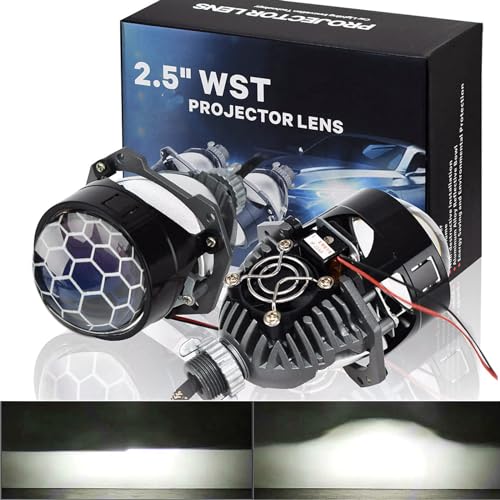
One kit takes a different styling route at the lens itself. The 2.5-inch honeycomb bi projector lens uses a honeycomb-pattern lens appearance that stands out from the smooth, clear lenses on the other kits. Whether that texture suits your build is a matter of taste, but it is a reminder that a retrofit is one of the most visible modifications you can make to the front of a vehicle. The beam still has to come first; styling that you enjoy looking at is a bonus on top of a pattern that works properly on the road.
The Eight Retrofit Projector Kits Compared
Read the individual sections below with your own housing in mind. A compact kit that suits a motorcycle or a small car is not a lesser kit, and a larger feature-rich kit is not automatically the better buy if it crowds your housing. Note which specifications come from each product title: size, beam function, stated output where given, colour where given, shroud finish, and stated fitment. Where a title does not state a figure, this guide does not invent one.
1. YUFANYA 2.5-Inch Bi Projector Lens Kit
This YUFANYA kit is built around a 2.5-inch bi projector lens and is described as a car headlight retrofit kit with a hi/lo beam function. Its title states 70W output, 20,000LM, and a 6000K white colour, together with a focus beam, a sharp cutoff line, and a design intended not to blind oncoming traffic. It is also described as an upgrade bi-xenon projector lens. Taken together, that makes it a representative example of the compact, integrated-output path: a smaller lens for tighter housings, both beam functions in one unit, and manufacturer-stated figures that let you compare it directly with the other 2.5-inch kits in this list.
Choose this direction if your housing space is limited but you still want the full bi-projector arrangement rather than a partial upgrade. The 2.5-inch format is the size most likely to suit smaller cars and many motorcycle housings, subject always to measuring your own unit. As with every kit here, the stated output figures describe the product as listed; the beam you end up with will also depend on mounting solidity and aim. A projector that can move even slightly after installation will not hold the cutoff where you set it, so take the mounting stage seriously and check the pattern on a flat wall before sealing the housing for the final time.
2. Nilight 2.5-Inch Mini Projector Lens for H1 Bulb Headlights
The Nilight entry is the veteran of this comparison. It is a 2.5-inch mini projector lens designed for H1 bulb headlights retrofit work and custom headlamp conversions, supplied with a chrome shroud, and it is the only product in this guide whose title states a warranty: two years. That combination tells you exactly who it is for. If your build is based on an H1 bulb platform and you prefer a projector that works with that bulb format rather than an integrated unit, this is the kit in the list that speaks your language directly.
The mini format suits the same tight housings as the other 2.5-inch options, and the chrome shroud gives a bright, factory-adjacent finish that blends easily with reflector-era headlight interiors. Because the title focuses on the lens, the bulb base, the shroud, and the warranty rather than on integrated output figures, no wattage or lumen figure is stated for it here, and none should be assumed. Judge it on fitment, on the serviceability of a bulb-based approach, and on the reassurance of a stated warranty period, which is a genuinely useful differentiator when you are comparing otherwise similar hardware that will live inside a sealed housing you do not want to reopen.
3. HDYEGIOU 3.0-Inch Bi Projector Lens with Angel Eyes
This HDYEGIOU kit pairs a 3.0-inch bi projector lens with white and yellow angel eyes, black shrouds, and a daytime running light and turn signal light function. It is described as a car headlight retrofit kit for H1, H4 and H7 applications across cars and motorcycles. That is the broadest feature set in this comparison: the largest lens size, a named fitment range, a dark shroud finish, and additional lighting functions built around the projector.
This is the natural shortlist entry for a builder who wants the retrofit to be seen as well as felt. The black shrouds give a deliberately modified look, and the angel eye rings add a daytime signature that plain projector kits do not offer. The extra functions do add wiring work, and the 3.0-inch size demands a housing with real room in it, so this kit rewards a patient installer with a spacious headlight and a clear wiring plan. If your housing is small or you want the simplest possible installation, one of the plainer kits will suit you better. If you have the space and want the full effect, this kit defines that end of the range.
4. YUFANYA 3.0-Inch NHK Bi-LED Projector Lens with Dual Reflector
The second YUFANYA entry steps up to a 3.0-inch NHK bi-LED projector lens with a dual reflector design, described as a headlight retrofit kit for car headlights. Its title states the highest figures in this comparison: 120W and 26,000LM, with a 6000K white colour, a focus beam, and a clear cutoff line. As a reminder, those are manufacturer-stated specifications from the product title, useful for ranking the kits against each other as listed, and they place this unit at the top of the stated-output range covered here.
Pick this direction if you have a larger car housing and want the strongest stated specifications in the group from an integrated bi-LED design. The dual reflector description and the larger lens suggest a build aimed at drivers who prioritise output on paper and have the housing volume to support it. The same cautions apply as everywhere else in a retrofit: stated figures do not aim the beam for you, and a larger projector leaves less margin for measurement mistakes. Confirm depth and width carefully, dry-fit before committing, and plan how the unit will be secured so the cutoff stays exactly where your alignment session puts it.
5. 2.5-Inch Honeycomb Bi Projector Lens Kit
The honeycomb kit uses a 2.5-inch bi projector lens with a distinctive honeycomb lens appearance. Its title describes a car headlight retrofit kit with a hi/lo beam function, stated figures of 70W and 20,000LM, a 6000K colour, a focus beam with a sharp cutoff line, a design intended not to blind oncoming traffic, and positioning as an upgrade bi-xenon projector lens. On stated specifications, it sits alongside the other 70W 2.5-inch kits in this guide; the lens styling is what sets it apart.
That makes the decision here refreshingly simple. If the compact size and the stated figures match your needs, the question is whether the honeycomb look belongs on the front of your vehicle. On a build that already leans into visible detail work, it can be the finishing touch that makes the retrofit look custom rather than merely updated. On a sleeper build that aims to look factory, a smooth lens and a plain shroud will blend in better. Either way, treat it with the same installation discipline: the styling is in the lens face, but the performance still comes from mounting, sealing, and aiming done properly.
6. HGTHXDF 3.0-Inch Projector Lens with Spiral Shrouds
The HGTHXDF kit is a 3.0-inch projector lens supplied with spiral shrouds, described as a universal headlight retrofit kit with hi/low beam for H1, H4 and H7 applications on car and motorcycle headlights. The spiral shroud is its signature: where most shrouds are smooth trim rings, the spiral design turns the surround into a styling feature in its own right. The named fitment range matches the broader of the two fitment descriptions in this guide, which makes it easier to shortlist if your build uses one of those bases.
No wattage or lumen figure is stated in this product’s title, so none is claimed for it here. Judge it instead on its size, its stated fitment, its hi/low function, and its looks. It suits a builder with a larger housing who wants the finished headlight to look deliberately designed, and who is comfortable with the universal retrofit process of measuring, adapting, and aligning. Motorcycle builders considering a 3.0-inch unit should measure with particular care, since the larger lens and a decorative shroud together need more room than the headline diameter alone suggests.
7. 2.5-Inch Projector Lens Kit with Silver Shroud
This kit is described as a 2.5-inch projector lens and car headlight retrofit kit with a hi/lo beam function, stated figures of 70W and 20,000LM, a 6000K colour, a focus beam with a sharp cutoff line, a design intended not to blind oncoming traffic, positioning as an upgrade bi-xenon projector lens, and a silver shroud. In other words, it covers the same core ground as the first kit in this list, with the shroud finish named explicitly as silver.
That finish is the practical reason to choose it. A silver shroud sits between bright chrome and dark black in appearance, and it tends to suit headlights whose interiors mix bright and dark trim. If you have narrowed your choice to the compact integrated kits, small differences like the included shroud are a legitimate deciding factor, because the shroud is what you will actually see every time you look at the front of the vehicle. The fundamentals remain unchanged: confirm the housing has room, mount the unit solidly, wire the hi/lo function correctly, and verify the cutoff on a wall before and after sealing.
8. HDYEGIOU 3.0-Inch Bi Projector Lens with Silver Shrouds
The second HDYEGIOU entry is a 3.0-inch bi projector lens with silver shrouds, described as a universal projector lens for car retrofit with a focus beam, a sharp cutoff line, and hi/low beam. It is the plainer of the two HDYEGIOU kits: no angel eyes are named in its title, and no output figures are stated there either. What it offers is the larger lens size, the bi-projector hi/low arrangement, and a silver shroud finish in a universal retrofit format.
Consider it if you want a 3.0-inch projector without committing to the extra wiring of illuminated rings and signal functions. For many builders that simplicity is the point: fewer connections inside the housing, a cleaner installation, and a finished look that reads as a tidy factory upgrade rather than a showpiece. As a universal lens, it still requires the full retrofit process and honest measurement of your housing. Do that work well and a straightforward kit like this one can be the most satisfying option in the list, because everything about it is focused on the beam itself.
How the Kits Differ at a Glance
Size divides the list cleanly in half. The YUFANYA 2.5-inch kit, the Nilight mini projector, the honeycomb kit, and the silver shroud 2.5-inch kit serve tighter housings. The HDYEGIOU angel eye kit, the YUFANYA NHK bi-LED kit, the HGTHXDF spiral shroud kit, and the HDYEGIOU silver shroud kit serve larger housings. Stated output divides it differently again: three kits state 70W and 20,000LM at 6000K, one states 120W and 26,000LM at 6000K, and the remaining titles state no output figures at all, which is why this guide does not rank those four on numbers that were never published in their titles.
Fitment statements are just as uneven, and that is normal for this category. The Nilight names H1. The HDYEGIOU angel eye kit and the HGTHXDF kit name H1, H4 and H7. The others describe car or car and motorcycle retrofit use in more general terms. Features divide the list a third way: only the angel eye kit names daytime running light and turn signal functions, only the Nilight names a warranty period, and the shroud story ranges from chrome to silver to black to a spiral design. There is no single winner hiding in that matrix. There is only the kit whose size, base, features, and finish line up with your vehicle and your patience for installation work.
Installation in General Terms
A retrofit follows a consistent sequence across vehicles, even though the details vary. The headlight assembly comes off the vehicle, and the lens or cover is separated from the housing, a step that on many assemblies involves softening the original sealant with controlled heat. The reflector area is prepared, the projector is mounted and secured in position, and the shroud is fitted around it. Wiring for the hi/lo function, and for any additional functions such as angel eyes or a turn signal feed, is routed and connected. Before the housing is resealed, the beam is checked; after resealing, it is checked again and aimed properly.
Two stages deserve more time than first-time builders usually give them. The first is the dry fit. Assemble everything loosely, confirm the projector clears the cover, confirm the shroud sits evenly, and confirm the aim adjusters still work through their range. Discovering an interference after the sealant has set means reopening the housing and starting the messy part again. The second is sealing. A housing that is not sealed well can fog from the inside, and moisture will find wiring and reflective surfaces over time. Work cleanly, keep the inside of the cover free of fingerprints and dust, and let the finished assembly sit until the seal has fully set before refitting it.
Aiming is the final and most important step. Park on level ground facing a flat wall, mark the centre height of the projectors, and set the cutoff at the height your local rules and the vehicle’s service information call for. Check that both sides match, that the step in each pattern sits where it should, and that high beam behaves as expected when selected. Local regulations on headlight modification and beam patterns vary, and they are the builder’s responsibility to check. A carefully aimed projector with a clean cutoff is the whole point of this modification; an unaimed one gives the idea a bad name.
If any of that sounds beyond your tools or your confidence, a retrofit is a reasonable job to hand to a reputable lighting or auto electrical shop. Professional installation costs the spontaneity of a weekend project, but it buys experience with opening housings, which is the stage where expensive mistakes happen. Many owners also choose to practise on a spare or salvaged housing first, which is a sensible middle path: the skills are learnable, and the first housing you open should ideally not be the only one your vehicle has.
Choosing the Right Kit for Your Build
Start with the housing, not with the headline figures. Measure the space you have, decide honestly whether a 2.5-inch or a 3.0-inch lens belongs in it, and only then compare the kits that survive that filter. Next, match the fitment language to your build: an H1-based project should look first at the kits that name H1, and an H4 or H7 project at the kits that name those bases. Then decide how you feel about features. Angel eyes with a running light and signal function are genuinely appealing, but only if you are happy wiring them properly; a plain kit you install perfectly will serve you better than a feature-rich kit installed in a hurry.
- Choose a 2.5-inch kit if your housing is compact, your vehicle is a motorcycle, or this is your first retrofit.
- Choose a 3.0-inch kit if your housing is large and you have confirmed depth, width, and adjuster clearance.
- Choose a bulb-based design such as the Nilight if you prefer the H1 platform and value its stated two-year warranty.
- Choose a kit with stated integrated output figures if comparing published specifications is how you like to decide.
- Choose angel eyes or a spiral or honeycomb design if the finished appearance matters as much as the beam.
- Choose the plainest kit that fits if reliability and a simple installation matter most to you.
Whichever direction you take, buy for the vehicle in your driveway rather than for a photograph of someone else’s build. Housings that look similar from outside can differ inside, model years change details, and previous repairs can alter what you find when the assembly comes apart. A tape measure, a careful dry fit, and a wall to aim against will do more for your result than any single specification on any listing in this guide.
Conclusion
The best retrofit projector is the one that fits your housing, matches your bulb base, and gets aimed with care after a clean installation. The compact kits here, led by the YUFANYA 2.5-inch and the honeycomb design on identical stated figures, the Nilight mini projector with its H1 focus and stated warranty, and the silver shroud 2.5-inch kit, cover the smaller end of the market thoroughly. The 3.0-inch kits, from the feature-rich HDYEGIOU angel eye unit and the high stated output of the YUFANYA NHK bi-LED to the spiral-styled HGTHXDF and the straightforward HDYEGIOU silver shroud lens, cover the larger end with a real range of characters. Decide by space first, fitment second, and features third, and the shortlist will usually narrow itself to one obvious answer for your build.
Done well, a projector retrofit is one of the most satisfying upgrades in lighting: a defined cutoff, a focused beam, less stray light for everyone else on the road, and a front end that looks like it was designed that way from the start. Take your time, measure twice, and let the finished beam pattern, checked patiently against a wall at night, be the judge of the work.
Check prices on Amazon
Live listings for the shortlist in this guide are pulled from Amazon below, so prices and availability are always current at the moment you look.


Disclosure
As an Amazon Associate we earn from qualifying purchases. The recommendations in this guide are based on published manufacturer specifications and on research into product documentation and listing information. They are not based on personal use of these kits, on bench evaluation, or on any form of in-person assessment, and no product in this guide was installed or operated by us in preparing it. Specifications quoted here are limited to information stated in the product titles and widely established facts about how projector headlights work, and manufacturer-stated figures may differ from results in any individual installation. Always confirm fitment, local regulations, and installation requirements for your own vehicle before buying or modifying a headlight assembly.