What's inside
- Where to Buy These Projectors
- Key Takeaways
- Quick Picks at a Glance
- How the Picks Were Chosen
- The Six Home Projectors for a 120-Inch Screen in Detail
- Side-by-Side Comparison
- How Much Brightness Does a 120-Inch Screen Actually Need?
- Throw Distance and Room Geometry at 120 Inches
- Screens Are Accessories: Choosing the Surface a 120-Inch Image Deserves
- Sound for a Picture This Big
- Making a Big Image Work Outdoors
- Brightness Standards, Translated Into Plain Language
- Common Mistakes to Avoid
- Frequently Asked Questions
- Final Recommendation
As an Amazon Associate I earn from qualifying purchases. This post may contain affiliate links at no extra cost to you.
[SITE_DOMAIN] is reader-supported. When you buy through links on our site, we may earn an affiliate commission at no extra cost to you. Prices and availability change; check the Amazon listing for the current details.
Where to Buy These Projectors
Native 1080P Projector with Screen — View on Amazon
Aurzen Roku TV D1R Smart Outdoor Projector — See the listing
Smart Outdoor Projector with WiFi and Bluetooth (4K Support) — Open the product page
Outdoor Projector 4K VIDAA — Check the Amazon page
Daylight 5000 ANSI Outdoor Projector — View this model
HAPPRUN 2000 ANSI Projector — See it on Amazon
Choosing the best home projectors for 120 inch screen use is really an exercise in matching light to area, because a 120-inch diagonal spreads any projector output across four times the surface of a 60-inch image. Brightness that feels generous on a bedroom wall can look washed and tired at this span, while modest projectors in dark rooms can look magnificent. The six projectors compared here approach that arithmetic from different directions: bundled screens, smart platforms, published ISO and ANSI figures, daylight-class claims and size headroom up to a stated 300 inches.
One boundary is drawn before anything else: projector screens are accessories, never picks. One model below includes a screen in its box, and that is noted as a convenience, but every pick is a projector judged on its own imaging, connectivity and setup merits. Screen choice gets its own discussion later in the guide, because at 120 inches the surface matters enormously, yet it remains supporting equipment for the six machines that actually make the picture.
Specifications here are reported exactly as the listing titles print them, including headline ANSI and ISO figures that represent manufacturer framing rather than independent laboratory measurement. Where a title is silent, the spec box says so. That discipline matters doubly in this class, where numbers are loudest and standards loosest, and a careful reader deserves to know which claims are printed promises and which are verified facts.
Finally, a note on expectations for the class as a whole. These are accessible, convenience-led projectors rather than laboratory instruments, and their titles speak the dialect of their segment, full of headline claims and platform badges. Read them with the translation habits this guide practices, and they become genuinely informative; read them as engineering documents, and they will mislead you while technically saying very little that is false in any single sentence they contain at all.
Key Takeaways
- At 120 inches, brightness per unit area decides satisfaction more than any other single factor.
- Published figures here range from 920 ISO on the VIDAA model to a 5000 ANSI daylight claim; all are manufacturer figures as printed.
- Only the first pick states native 1080P in its title; 4K support or decoding elsewhere means signal compatibility.
- Auto focus appears across the group because a 120-inch image is usually a fresh setup, not a fixed install.
- Screens are accessories throughout: one bundle includes one, and no screen is ever a pick in this guide.
Quick Picks at a Glance
| Projector | Headline Specification | Short Verdict |
|---|---|---|
| Native 1080P Projector with Screen | Native 1080P, 5G WiFi, Bluetooth, screen included | The only bundle here with a screen supplied |
| Aurzen Roku TV D1R Smart Outdoor Projector | Roku TV built in, 1080P FHD, auto focus and keystone | The streaming-native pick for home and outdoor movies |
| Smart Outdoor Projector with WiFi and Bluetooth (4K Support) | Built-in apps, 4K support, dual speaker Dolby Audio | App-driven outdoor model with auto focus |
| Outdoor Projector 4K VIDAA | VIDAA, WiFi 6, 920 ISO, 40W Dolby, HDR10 | The platform-rich pick with a stated brightness basis |
| Daylight 5000 ANSI Outdoor Projector | 5000 ANSI, 80W Dolby Audio, HDR10+, auto focus | The bright-room and daytime contender |
| HAPPRUN 2000 ANSI Projector | 2000 ANSI, 4K decoding, auto focus, up to 300-inch display | The mid-brightness all-rounder with huge size headroom |
How the Picks Were Chosen
The selection deliberately spans the ways real households reach 120 inches. There is a bundle for the first-timer, a Roku machine for the streaming household, an app-driven outdoor model for events, a VIDAA model with a published ISO figure, a daylight-class claimant for bright rooms and a mid-brightness all-rounder with size headroom. A list of six near-identical projectors would be tidier and far less useful, because the rooms these machines enter have almost nothing in common beyond the diagonal.
Each model also had to plausibly serve the target size. Projectors whose titles framed them around much smaller displays without the brightness or focus range to stretch were set aside, while models stating maximum displays well beyond 120 inches, or brightness classes suited to large spans, were favored. The target diagonal acted as a filter first and a headline second, which is the correct order for a size-specific guide.
Finally, claims were sorted into what a title states, what it implies and what it leaves for the listing to prove. Native resolution, signal support and decoding are three different promises, and the reviews keep them separate even when marketing would prefer them blurred. A reader who finishes this guide should be able to interrogate any projector title in this class and hear exactly what it is and is not saying.
Placement precision at large sizes is explored further in the guide to projectors With Lens Shift and Wi-Fi.
The Six Home Projectors for a 120-Inch Screen in Detail
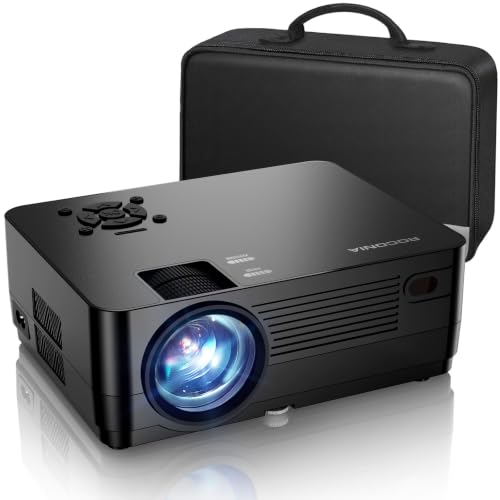
1. Native 1080P Projector with Screen
Native 1080p bundle with a screen included in the box
- Resolution: Native 1080P, full HD
- Connectivity: 5G WiFi and Bluetooth
- Screen: Projector screen included per the title
- Display reference: 100-inch display mentioned in the title
- Compatibility: Phone, laptop and TV stick
This projector opens the comparison with an unusual advantage for a 120-inch conversation: its title states native 1080P resolution and tells you a projector screen is included in the box. A bundled screen is an accessory rather than part of the projector, and this guide treats it that way, but for a first big-image setup the value of starting with a matched, flat surface instead of a wrinkled wall should not be underestimated. Add 5G WiFi and Bluetooth from the title and the package reads as a complete first cinema corner rather than a bare engine.
Native resolution is the specification that matters most at 120 inches, because a big diagonal magnifies whatever the panel actually resolves. A native 1080P image carries real detail across that span for film content, with seating distance doing the rest of the work: sit at a sensible distance for the diagonal and the picture holds together handsomely. Move a sofa too close to any 1080p image at this size and individual structure starts to announce itself, which is a seating decision, not a defect in the machine.
The title references a 100-inch display while this guide targets 120 inches, and that gap deserves a straight sentence. Projectors focus across a range of sizes, and a model presented around 100 inches will generally focus larger, but brightness per unit area falls as the same light spreads across a bigger image. Plan the 120-inch version of this setup for evening viewing in a dimmable room, where the trade is gentle, rather than for a bright afternoon in front of open windows.
Connectivity is thoroughly modern for the class: dual-band wireless for streaming sources, Bluetooth for an external speaker, and stated compatibility with phones, laptops and TV sticks. That last point matters at 120 inches more than anywhere, because a big image deserves a good source. Feed this projector a high-quality stream or a disc player rather than a compressed phone mirror, and the diagonal rewards the better signal with visibly cleaner texture in faces, foliage and film grain.
As the bundle of the group, it also carries the bundle caveat. The included screen gets you started immediately and flat, which is its real gift, while dedicated screen materials discussed later in this guide remain the upgrade path when the room becomes permanent. Judge the projector on its native panel and its connectivity, treat the screen as a welcome head start, and this first pick makes a coherent, low-friction case for itself.
Set the bundled screen up before judging the projector at all. A flat, tensioned surface transforms focus uniformity and perceived sharpness at 120 inches, and many first impressions of budget projection are really impressions of a wavy wall. Give the machine its intended surface for one full film, then decide what you think of it.
Strengths
- Native 1080P panel keeps detail honest at large diagonals
- A screen is included, solving the first-setup surface problem
- 5G WiFi, Bluetooth and wide source compatibility simplify hookup
Trade-offs
- Title frames the display around 100 inches, below this guide target size
- No brightness figure is published in the listing title
- Bundled screen is a starting surface, not a dedicated-room material
Best for: a first 120-inch setup seeking native 1080p, wireless streaming and a screen in the same box
Not suited for: a bright daytime room seeking a verified lumen figure, because the title publishes no brightness number
First-time big-screen planners can check the bundle contents and current listing details for this native 1080p model, then Check price on Amazon.

2. Aurzen Roku TV D1R Smart Outdoor Projector
Roku TV built in, with auto focus for indoor and garden use
- Smart platform: Roku TV built in, all top apps per the title
- Connectivity: WiFi and Bluetooth
- Setup aids: Auto focus and auto keystone, zoom
- Audio: Dolby Audio as printed in the title (spelled DoIby in the listing)
- Resolution: 1080P FHD
The Aurzen D1R builds its case on the two things that decide whether a big-screen habit actually forms: instant content and painless setup. Roku TV is built in with the major applications on board, so the projector wakes up already knowing where your films live, and auto focus with auto keystone means the 120-inch rectangle sharpens and squares itself while you find the remote for the sound. For a household that projects in the living room on Friday and the garden on Saturday, that friction-free rhythm is the product.
A 1080P FHD panel at 120 inches sits in the sensible middle of this guide. The diagonal is ambitious for the class, and the honest way to enjoy it is with seating placed for the size, lights lowered and a decent surface. Roku streaming quality is generally strong, and the platform interface stays responsive in a way that anonymous smart systems often do not after a year of updates, which matters when the projector is the family streaming device and not an occasional toy.
The outdoor positioning in the title deserves respect rather than skepticism. Portable projectors with automatic setup genuinely shine outside, where every session is a fresh installation on uneven ground and nobody wants to focus by hand in the dark. A 120-inch garden image for a summer film night is a different, more forgiving brief than a permanent theater: brightness against a dark sky, a white screen or wall, and friends who came for the occasion as much as the cinematography. The D1R is specified for exactly that joy.
Dolby Audio branding and the portable form suggest sound was considered, though at 120 inches any internal speaker is working against physics and a Bluetooth soundbar or outdoor speaker remains the upgrade that transforms film night. Bluetooth is present for exactly that pairing. Treat the internal audio as capable for casual viewing and speech, and budget the external speaker into the big-screen plan from the start rather than discovering the gap during a quiet dialogue scene.
Against the rest of this group, the Aurzen trades raw published brightness, which its title does not state, for platform quality and automation. That is a defensible trade for its audience. A projector that sets itself up and opens the right application in seconds gets used weekly; a brighter machine that fights its owner gets used monthly. At 120 inches, usage is the specification that compounds.
Outside, anchor the screen before the film, not during it. A 120-inch surface catches evening breeze like a sail, and a gently moving image edge distracts far more than a modest diagonal would. The D1R auto focus will forgive many sins, but a stable screen is the one courtesy it cannot provide for itself.
Strengths
- Roku TV built in provides a mature, updated streaming platform
- Auto focus and auto keystone make every setup nearly effortless
- Portable design serves living room and garden with equal ease
Trade-offs
- No brightness figure is published in the listing title
- 1080P at 120 inches asks for sensible seating distance
- Internal audio benefits from a Bluetooth speaker at this diagonal
Best for: a streaming household seeking Roku built in and automatic setup for 120-inch film nights indoors and outdoors
Not suited for: a permanent theater seeking a published brightness specification, because the title leaves output unstated
Streaming-first households can review the D1R Roku specification and portability details on the product page, then Check price on Amazon.

3. Smart Outdoor Projector with WiFi and Bluetooth (4K Support)
Built-in apps with 4K support and dual speakers
- Audio: Dolby Audio with dual speaker as printed (spelled DoIby in the listing)
- Setup aids: Auto focus
- Named apps: YouTube and Prime Video named in the title
- Signal support: 4K support with built-in apps
- Connectivity: WiFi and Bluetooth
This smart outdoor projector leads with built-in applications and 4K support, and that wording needs one careful unpacking before anything else. Support for a 4K signal means the projector accepts and displays 4K sources gracefully; it is not a claim of a native 4K panel, and the title does not publish a native resolution figure. Judged on what it actually promises, an app-driven machine with auto focus and dual speakers, it is a coherent outdoor and casual home option for big images without a rack of equipment.
Built-in applications change the logistics of a 120-inch night completely. There is no stick to power, no phone to mirror and no laptop to balance: the projector connects over WiFi, opens YouTube or Prime Video as named in the title, and the evening starts. For garden screenings, holiday rentals and spontaneous big-match setups, that self-containment is worth more than a specification rivals win on paper, because the best projector at an event is the one already playing when guests arrive.
Auto focus earns its keep in exactly these improvised venues. A projector on a garden table or a borrowed stand never sits perfectly square, and automatic focus at least guarantees the image is sharp while keystone decisions are made. At 120 inches, focus errors multiply across the span, so an owner who repositions often will feel this feature every single session rather than only on installation day.
Dual speakers with Dolby Audio branding put more emphasis on sound than most of this group manages, and at outdoor volumes that emphasis is rational. Gardens eat sound; there are no walls to return it, and dialogue competes with distance and evening air. A dual-speaker arrangement still will not rival a dedicated outdoor speaker over Bluetooth, but it raises the floor for the casual sessions where nobody wants to set up extra kit, which is most of them.
The honest limitations belong in the open: no native resolution and no brightness figure appear in the title, so a buyer planning a permanent 120-inch theater should verify both at the listing and weigh the app convenience accordingly. As an event and outdoor machine that occasionally fills a big wall indoors, the proposition is much stronger, and it is on that brief, not a theater brief, that this projector should be judged.
Carry a small spirit of preparation outdoors: a extension lead rated for the garden, a stable table and a screen fixing kit turn this projector convenience into an actual event. The machine handles focus and applications; the venue remains your department, and five minutes of venue care is what guests remember as effortlessness.
Strengths
- Built-in apps remove sticks and laptops from setup entirely
- Auto focus suits projectors that move between venues
- Dual speakers raise the sound floor for outdoor sessions
Trade-offs
- 4K support is signal compatibility, not a native 4K panel claim
- Native resolution is not stated in the listing title
- No brightness figure is published for judging bright rooms
Best for: an event-driven household seeking built-in apps and auto focus for a 120-inch image wherever the evening happens
Not suited for: a permanent theater seeking a verified native resolution in the title, because this listing does not publish one
Event hosts comparing app-driven models can read the full feature list for this outdoor projector on its page, then Check price on Amazon.

4. Outdoor Projector 4K VIDAA
VIDAA live TV platform with WiFi 6 and a published ISO figure
- Connectivity: WiFi 6 and Bluetooth, Netflix compatible
- Picture extras: HDR10, AI voice control, auto focus
- Smart platform: VIDAA live TV
- Brightness: 920 ISO as printed in the title
- Audio: 40W Dolby as printed in the title
The VIDAA outdoor projector distinguishes itself in this group by publishing a brightness basis, 920 ISO lumens in the title, alongside a fully named smart platform. VIDAA brings live TV and the major streaming services into the projector itself, Netflix compatibility is stated outright, and WiFi 6 with Bluetooth covers the modern connection set. For a 120-inch buyer tired of titles that publish nothing, a stated figure and a named platform are a refreshing change of posture, even at a brightness level that clearly targets evening use.
Nine hundred and twenty ISO lumens at 120 inches defines the viewing contract precisely: this is a dusk-and-darkness machine. As the same light spreads across a large diagonal, image brightness per area falls, so the VIDAA model will reward the buyer who projects after sunset, controls the room lights and uses a proper screen. Inside that contract it can be genuinely satisfying; outside it, at noon in a bright conservatory, no honest review should pretend otherwise, and the stated figure at least lets you plan with real numbers.
The 40W Dolby audio claim is the boldest sound statement in this comparison, and it reflects the outdoor brief again. A garden or a large room swallows projector audio, and a serious internal system reduces the occasions when an external speaker is mandatory. Paired with AI voice control for hands-full setup moments, the package reads as a machine designed by people who watched users fumble with remotes in the dark and decided to fix the whole experience rather than one specification.
HDR10 support and auto focus round out a specification that keeps returning to the same theme: fewer barriers between arrival and film. Auto focus sharpens the big image after every move, the platform supplies the content, voice control handles the adjustments and the audio carries the room. At 120 inches, where setup friction scales with size, that integration is a legitimate form of performance, distinct from panel statistics and just as real in lived experience.
The comparison it invites is with the brighter machines below it in this list. If your 120-inch plan involves any ambient light at all, the daylight-oriented models will serve you better, and their titles say so loudly. If your plan is a dark garden, a blacked-out room and an evening audience, the VIDAA model integrated approach has a charm the brighter, dumber machines cannot copy, and the choice becomes about the kind of night you actually host.
WiFi 6 only helps if the garden or far wall receives a real signal. Test streaming at the projection spot with a phone before film night, and if the signal fades, a mesh node or a downloaded film removes the risk entirely. Big-screen evenings fail on networks more often than on projectors.
Strengths
- Publishes a 920 ISO brightness figure for honest planning
- VIDAA platform with Netflix compatibility and WiFi 6 built in
- 40W Dolby audio claim leads this group for internal sound
Trade-offs
- 920 ISO output targets dark viewing at 120 inches
- Platform experience depends on the VIDAA ecosystem
- Large-diagonal HDR still limited by the modest brightness basis
Best for: an evening garden cinema seeking a stated brightness figure, a full smart platform and strong internal audio
Not suited for: a daytime 120-inch room seeking high output, because 920 ISO lumens is an evening specification by design
Evening hosts can confirm the VIDAA platform and audio details for this model directly on the listing, then Check price on Amazon.

5. Daylight 5000 ANSI Outdoor Projector
Daylight-class output with a rotating stand and HDR10+
- Picture extras: HDR10+, auto focus, Netflix, WiFi and Bluetooth
- Brightness: 5000 ANSI as printed in the title
- Signal: 4K as printed in the title
- Audio: 80W Dolby Audio
- Stand: Removable foldable 360-degree rotatable stand
Every group has a specification extrovert, and here it is the Daylight model, whose title stacks a 5000 ANSI brightness claim, 80W Dolby Audio, HDR10+, auto focus and a removable foldable stand that rotates a full circle. Numbers in this class of listing should be read as the manufacturer framing rather than laboratory measurement, and this guide reports them exactly as printed without endorsing a measurement standard. Even discounted with that caution, the intent is unmistakable: this is the 120-inch candidate for rooms and gardens where darkness is not guaranteed.
Brightness is the currency a 120-inch image spends fastest. Doubling diagonal quadruples area, so a screen that looks punchy at 80 inches can look tired at 120 from the same projector. A daylight-class claim speaks directly to that arithmetic, promising headroom for larger spans, lighter rooms and the long summer evenings when a garden screening starts before the sky fully darkens. For households whose viewing refuses to schedule itself around sunset, that headroom is the entire purchase argument.
The rotating, foldable stand is more than a novelty at this size. A 120-inch image needs the projector aimed with some precision, and a stand that rotates through a full circle and folds away solves the two recurring portable problems, aiming and storage, in one piece of hardware. Ceiling projection for a bedroom, a wall in the lounge, a screen in the garden: the stand makes the machine a genuine multi-room citizen rather than a fixed installation with ambitions.
HDR10+ support on a bright chassis is an interesting pairing, because dynamic metadata earns its keep when a projector has highlight headroom to spend. Combined with auto focus after every repositioning and Netflix, WiFi and Bluetooth for sourcing, the Daylight model asks very little of its owner beyond a surface and a power socket. The 80W audio claim, again as printed, suggests film sound was treated as a headline feature rather than an afterthought, rare in any projector class.
The cautions are the mirror of the claims. Treat headline ANSI figures in this segment as comparative framing, verify the native resolution at the listing since the title leads with a 4K signal claim, and remember that brightness cannot repeal the physics of a sunlit white wall. Judged as the high-output, high-convenience candidate for imperfect light, though, this is the model in the group that volunteers for the hardest rooms, and that volunteering has real value.
With a rotating stand, mark your proven positions. A small pencil line for the lounge wall, the garden screen and the bedroom ceiling turns each new setup into a repeat performance, and the auto focus finishes what your marks begin. Convenience compounds when a household bothers to record it.
Strengths
- Daylight-class 5000 ANSI claim targets bright rooms and big spans
- Rotating foldable stand solves aiming and storage together
- HDR10+, auto focus and full streaming connectivity built in
Trade-offs
- Headline brightness is a manufacturer claim, not a verified measurement
- Native resolution needs confirming at the listing
- Maximum output at 120 inches still bows to direct sunlight on the screen
Best for: a bright living space seeking daylight-class output, a rotating stand and HDR10+ for a 120-inch image in imperfect light
Not suited for: a blacked-out theater seeking verified laboratory figures, because this listing leads with manufacturer headline claims
Bright-room planners can study the Daylight model stand design and full claim set on the product page, then Check price on Amazon.

6. HAPPRUN 2000 ANSI Projector
Published ANSI figure with a 300-inch maximum display claim
- Brightness: 2000 ANSI as printed in the title
- Signal: 4K decoding
- Maximum display: 300-inch display as printed in the title
- Setup aids: Auto focus
- Connectivity: WiFi and Bluetooth, phone, TV stick, PC and PS5 compatible
The HAPPRUN entry publishes the middle path of this group: a 2000 ANSI brightness figure, 4K decoding, auto focus and a maximum display claim of 300 inches, which places 120 inches comfortably inside its stated envelope rather than at the edge of it. That positioning is the review in miniature. A projector loafing at 120 inches inside a 300-inch ceiling has focus and brightness headroom for the job, and headroom is what separates a relaxed big image from a strained one on the second hour of a film.
Two thousand ANSI lumens, read as the manufacturer published figure, suits the classic 120-inch compromise: a dimmable living room, evening viewing, a proper screen and an audience that came for films and matches rather than a light show. It is not a daylight specification and this guide will not dress it as one. It is, however, a substantial step beyond the sub-1000-lumen class for large diagonals, and at 120 inches that step is exactly where perceived quality turns a corner.
4K decoding deserves the same plain language used elsewhere in this guide: the projector accepts and decodes 4K sources, which keeps modern streaming and console signals fully compatible, while the title does not claim a native 4K panel. Console compatibility is stated outright, including the PS5, and with auto focus handling setup, a games night at 120 inches becomes a realistic weekly event rather than a special production. Sports titles and racing games gain the most from the diagonal; strategy menus gain the least and still look fine.
Portability threads through the whole proposition. The title frames the machine for indoor and outdoor use, compatible with phones, sticks and PCs, which makes it the group natural second-room and garden projector as well as a main-room candidate. A household can start it at 120 inches in the lounge, carry it out for a summer screening at whatever size the garden wall allows, and never change a setting more complicated than focus, which the machine handles itself.
In the final accounting, the HAPPRUN is the balanced ticket: published figures instead of silence, size headroom instead of strain, and no single headline claim asked to carry the whole case. Buyers who distrust both the silent titles and the loudest ones will recognize the temperament. At 120 inches, balance is not a compromise; it is the specification that survives contact with real rooms.
Use the size headroom intelligently: at 120 inches you can afford to run a calmer picture mode for films, trading a little peak output for better color and quieter fans, because the machine is not straining at its ceiling. Headroom spent on refinement is headroom well spent.
Strengths
- 2000 ANSI published figure gives 120-inch planning a real basis
- 300-inch maximum display claim leaves generous size headroom
- Auto focus and broad device compatibility simplify mixed use
Trade-offs
- 4K decoding is signal handling, not a native 4K panel
- Output targets dimmed rooms rather than daylight viewing
- Headline figures are manufacturer claims, as across this class
Best for: a dimmable living room seeking a published brightness figure and comfortable headroom above the 120-inch target
Not suited for: a sunlit room seeking daylight performance, because the 2000 ANSI class is an evening specification
Balanced-spec readers can compare the HAPPRUN published figures against the rest of this group on its listing, then Check price on Amazon.
Side-by-Side Comparison
| Projector | Imaging and Resolution | Brightness From the Title | Defining Extra |
|---|---|---|---|
| Native 1080P Projector with Screen | Native 1080P | Not stated in the title | Screen included in the box |
| Aurzen Roku TV D1R Smart Outdoor Projector | 1080P FHD | Not stated in the title | Roku TV built in |
| Smart Outdoor Projector with WiFi and Bluetooth (4K Support) | Native figure not stated | Not stated in the title | Built-in apps, dual speakers |
| Outdoor Projector 4K VIDAA | HDR10, figure not stated | 920 ISO | VIDAA platform, 40W Dolby |
| Daylight 5000 ANSI Outdoor Projector | 4K as printed | 5000 ANSI | Rotating foldable stand, HDR10+ |
| HAPPRUN 2000 ANSI Projector | 4K decoding | 2000 ANSI | 300-inch maximum display claim |
How Much Brightness Does a 120-Inch Screen Actually Need?
Work from your worst viewing hour, not your best. A room that hosts films only after dark can thrive at the modest end of this group, especially with a proper screen and curtains, while a room that hosts Sunday afternoon sport at 120 inches needs the daylight-class end of the range or a smaller ambition. Brightness requirements are set by the brightest session you genuinely care about, and honesty about that session is worth more than any lumen figure printed anywhere.
Viewers planning long film sessions at this size may also value the technology guide to projectors Without a Color Wheel.
Then respect the area law. Every step up in diagonal spreads the same light thinner, so the move from 100 to 120 inches costs more brightness than intuition suggests, and the move to 150 costs dramatically more. If a projector sits at the edge of its comfort at 100 inches in your light, it is not a 120-inch projector in your light, whatever its focus range allows. Size and brightness are one decision wearing two hats.
Surface choice multiplies or wastes whatever brightness you bought. A smooth matte screen returns light evenly to the seating, a white wall returns most of it with texture and tint, and a wrinkled sheet returns a geography lesson. At 120 inches the screen is the cheapest brightness upgrade available, frequently worth more than stepping up a model tier, which is why this guide discusses screens seriously while never confusing them with the projectors themselves.
Finish with the seating plan. A 120-inch image wants viewers far enough back to take it in without head movement, and room depth sometimes vetoes the diagonal before brightness does. Measure the seating distance your room actually offers, and if it argues for 100 inches, take the hint gracefully: a slightly smaller image at the right distance looks bigger in experience than a huge one you sit inside of.
One last consideration is who operates the system. A household where one enthusiast runs every session can exploit any model here, while a household where grandparents, children and guests all start film night needs the automatic setup and familiar platform of the Roku or app-driven models. At 120 inches, a projector that everyone can operate gets operated, and the best specification in this entire guide might be a film starting without a phone call to the person who set it up.
Throw Distance and Room Geometry at 120 Inches
Throw distance is the silent partner of every big-screen plan. Each projector fills 120 inches from a specific distance range set by its lens, and the title pages in this class rarely publish the ratio, so the manufacturer documentation for your chosen model is the authority. Measure from the screen wall to the spot the projector can realistically live, on a stand, shelf or mount, and confirm that distance sits inside the model working range before the order, not after the unboxing.
Zoom range, where fitted, buys forgiveness. A projector with optical zoom can fine-tune the image to the screen from a fixed position, while a fixed-lens portable must be moved physically until the rectangle fits, which is why the stand and auto-focus designs in this group matter. In rented rooms and multi-use spaces, that physical shuffling is normal and acceptable; in a permanent installation, it is worth paying to avoid.
Ceiling height and screen position complete the geometry. A 120-inch 16:9 image stands roughly a metre and a half tall before the frame, and it needs wall height for the image plus clearance above the floor that keeps seated heads out of the light path. Sketch the wall with real measurements, mark the screen, the projector and the seating, and let the drawing catch the impossibilities that enthusiasm politely ignores.
Screens Are Accessories: Choosing the Surface a 120-Inch Image Deserves
Because screens are accessories rather than picks, this section treats them as the supporting equipment they are, and the first job is flatness. At 120 inches, any wave or wrinkle becomes a visible distortion that focus cannot cure, so a fixed frame screen in a permanent room or a properly tensioned portable screen elsewhere earns its place ahead of exotic materials. The bundled screen with the first pick in this guide is valuable precisely because it starts a household on a flat surface from day one.
Material comes second. Matte white remains the reference for dark and dim rooms, spreading light evenly and keeping color honest for every model here. Gray materials trade peak brightness for perceived contrast where some ambient light survives, a trade the mid-brightness models appreciate. Ambient-light-rejecting surfaces serve bright rooms at the cost of viewing angle, which matters when a 120-inch image is watched by a sofa full of people rather than one centered viewer.
Viewers planning long film sessions at this size may also value the technology guide to projectors Without a Color Wheel.
Size the screen to the room and the projector together, and buy the screen for the diagonal you measured, not the diagonal you daydream about. A screen slightly smaller than the maximum image, with the projector zoomed to fill it exactly, looks intentional and crisp; an oversized screen with a small image floating in it looks like a compromise every night. The black border is not decoration either: it sharpens perceived contrast at the image edge in a way viewers feel immediately.
Sound for a Picture This Big
A 120-inch image exposes small sound mercilessly. Dialogue that felt adequate on a television becomes thin when faces are a metre tall, and every model in this group benefits from an external speaker plan, whether that is a soundbar under the screen, a Bluetooth speaker for the garden or a full system in a permanent room. The internal audio claims here, from dual speakers to the 40W and 80W figures printed in titles, set the floor for casual viewing rather than the ceiling for film night.
Placement of sound matters as much as its size. Voices should appear to come from the screen, so a speaker near the image beats a louder one behind the seating every time. Bluetooth pairing makes that easy for the portable models in this group, and the small latency of a wireless link is invisible in film content for most viewers, while a wired connection remains the reference where the installation allows it.
Outdoors, plan for the air. Sound dissipates without walls, neighbors exist, and late-night volume is a social decision as much as a technical one. A modest speaker close to the audience at moderate volume beats a powerful one far away at high volume for clarity and diplomacy alike, and headphones over Bluetooth solve the midnight screening entirely. The picture is the public part of a garden cinema; the sound is the part the street hears.
Making a Big Image Work Outdoors
Outdoor projection at 120 inches succeeds on timing. The first session should start at dusk rather than dark, letting the audience settle while the sky does the dimming, and the projector classes here divide cleanly by that schedule: modest-output models need full darkness, while the daylight-class claimant can start earlier and hold the image as evening arrives. A rehearsal the night before, at the same hour, tells you which class your venue truly needs.
Power and network are the unglamorous logistics. A safe outdoor-rated extension, a streaming signal tested at the exact spot or a film downloaded in advance, and a screen anchored against the breeze cover almost every failure an outdoor night can produce. The projectors in this group handle focus and applications automatically; everything else on that list belongs to the host, and hosts who handle it are remembered for effortless evenings.
Dew is the final guest. As temperature falls, moisture settles on lenses and electronics, so bring the projector in promptly after the credits and let it warm to room temperature before storage. A machine treated that way will serve many summers; one left out overnight under a cooling sky accumulates the kind of internal damp that shortens electronic lives quietly and completely.
Brightness Standards, Translated Into Plain Language
The figures in this group arrive wearing three different measurement costumes, and a buyer deserves the translation. ANSI lumens are the long-standing American standard for projector output, ISO lumens follow the international method, and LED or marketing lumens follow no standard at all. Figures gathered under different methods are cousins, not twins, and the honest use of any of them is sorting projectors into brightness classes rather than declaring a winner by arithmetic across methods.
That is why this guide keeps repeating a small, unfashionable sentence: these are manufacturer figures as printed in the titles. The sentence is not a dismissal. A stated 920 ISO figure still tells you the VIDAA model was engineered and positioned for evening use, and a daylight-class claim still tells you where its maker aimed it. Claims communicate intent reliably even when they cannot be treated as laboratory results, and intent matched to your room is most of what a purchase needs.
The practical test, when a return window allows it, is your own wall at your own viewing hour with your own content. One evening of that evidence outweighs any cross-standard calculation, and it is the test every recommendation in this guide is ultimately pointing you toward. Buy the class, verify in the room, and keep the machine that passes in the conditions you actually live in.
Common Mistakes to Avoid
The classic 120-inch mistake is buying the diagonal before measuring the room. Seating distance, wall height and throw range veto more big-screen plans than price ever does, and they veto them after delivery if nobody measured beforehand. Ten minutes with a tape measure and a sketch is the cheapest insurance in this entire category, and skipping it is the one error no projector feature can rescue.
Second, do not confuse signal support with native resolution. A title that says 4K support or 4K decoding is promising compatibility, and a buyer expecting a native 4K panel from those words has been misled by vocabulary rather than by any statement the manufacturer actually made. The reviews above separate the claims carefully; bring the same care to any listing you read after this guide.
Third, headline brightness figures in this class are manufacturer framing, and comparing a 5000 ANSI claim against a 920 ISO figure as if they were laboratory results on one scale produces confident nonsense. Use the figures to sort machines into evening, dim-room and daylight classes, verify at the listing, and judge within class rather than across measurement dialects.
Finally, do not let the screen be an afterthought bought with whatever budget remains. At 120 inches the surface is half the perceived quality, and a flat, correctly sized screen under a mid-range projector will outperform a flagship thrown at a wrinkled wall every night of the year. Accessories are not picks in this guide, but they are absolutely part of the purchase.
There is also a social mistake unique to big diagonals: unveiling the system with the wrong first film. Choose an opening title with strong cinematography, a familiar story and sound your setup handles confidently, because the first night writes the household verdict on the whole project. A murky, compression-battered stream as the premiere has talked more families out of projection than any hardware limitation in this guide.
Frequently Asked Questions
How far back should seating be from a 120-inch screen?
As a working guide, seating that places viewers roughly one and a half times the screen width away gives an immersive but comfortable field of view for film. Closer seating increases immersion and reveals panel structure on 1080p sources; farther seating calms both. Let your room depth and your tolerance for visible texture settle the final position.
Can a 1080p projector really fill 120 inches?
Yes, and most of this group is built on exactly that proposition. Native 1080p at sensible seating distances looks convincingly detailed with film content at this diagonal. What 1080p cannot survive is seating placed for a much smaller screen, so the diagonal and the sofa position must be planned together.
What does 4K support mean if the panel is not 4K?
It means the projector accepts a 4K signal and displays it scaled to its native resolution, preserving compatibility with modern sources. The picture benefits from the cleaner source, but the displayed detail is the panel own. Titles that claim decoding or support are making the compatibility promise, and the reviews above read them that way.
Is a screen really necessary, or will a wall do?
A smooth, pale, truly flat wall can serve surprisingly well, and many households start there. A dedicated screen wins on flatness, border contrast and predictable color, and at 120 inches those advantages stop being subtle. Treat the wall as the trial and the screen as the commitment when the habit proves itself.
Which of these suits a bright room best?
The daylight-class model with the 5000 ANSI claim is the volunteer for bright spaces, with the HAPPRUN 2000 ANSI figure as the dim-room middle path. Every figure here is a manufacturer claim as printed, so verify at the listing and, where possible, judge the class rather than the exact number.
Can these projectors work on a bedroom ceiling?
Models with rotating stands and auto focus make ceiling projection genuinely practical, and a 120-inch ceiling image is a memorable novelty. For regular viewing, neck comfort argues for a wall or screen at a natural eye line, with ceiling sessions kept as the occasional treat they excel at.
Why does this guide never pick a screen?
Because the assignment is projectors, and screens are accessories that serve them. A screen cannot be ranked against a projector meaningfully, and mixing the two categories produces the confused shortlists this guide exists to replace. Choose the projector first, then give it the surface it deserves.
Should I size the screen at exactly 120 inches or leave margin?
Buy the screen at the size your seating and wall support best, and let the projector zoom settle the final fit. A screen bought for an honest 120 inches and filled exactly looks deliberate; a larger screen bought for a someday upgrade usually hosts a slightly lost image for years. Margin belongs in brightness headroom, not in unused screen area.
Final Recommendation
It is worth saying plainly what separates the satisfied owners in this category from the disappointed ones, because it is rarely the model. Satisfied owners measured first, chose a brightness class for their real light, gave the projector a flat surface and seated everyone at the distance the diagonal asks for. Disappointed owners bought a headline, skipped the tape measure and judged the result against a photograph of someone else theater. The six machines above are all capable of delight inside their briefs, and the brief, in the end, is yours to write honestly.
Match the machine to the night you actually host and this group resolves itself. The bundle with the included screen is the gentlest start, the Roku model the streaming household default, the app-driven outdoor unit the event specialist, the VIDAA model the integrated evening package with a published figure, the daylight claimant the bright-room answer and the HAPPRUN the balanced middle with headroom to spare. Each is the right 120-inch projector for a different definition of movie night, and none is the right one for all of them.
Whichever you choose, spend the first session on geometry and surface before judging picture quality: square the image physically, focus at the center, seat the audience at the planned distance and watch a familiar film rather than a demo. A 120-inch image set up with that care delivers the scale that makes people gasp quietly when the titles end, and that gasp, not any specification, is what this entire category is for.
At 120 inches the room becomes part of the cast, and the projector that respects your light, your wall and your seating distance will always out-act the one that merely shouted the largest number.