Our Top Picks


What's inside
- Why indoor reception is its own discipline
- The bands an indoor scanner antenna must cover
- Desktop telescopic antennas
- Back-of-set antennas that plug straight onto the receiver
- Window-mounted and glass-friendly designs
- Indoor discone, ground-plane, and novelty shapes
- Connectors, adapters, and the unglamorous details that decide compatibility
- Matching the antenna to a desktop scanner at home
- Matching the antenna to a handheld scanner used indoors
- Placement method: a patient routine for any indoor antenna
- Dealing with household interference
- What to check in published specifications
- Special situations worth planning for
- Care, safety, and staying on the right side of the rules
- Choosing among the main indoor antenna styles
- How the seasons, weather, and neighbours change indoor results
- When an indoor antenna is not enough, and what remains possible
- Check prices on Amazon
- Questions listeners ask before buying
As an Amazon Associate I earn from qualifying purchases. This post may contain affiliate links at no extra cost to you.
A quick note before the comparisons begin: some links in this guide are affiliate links, which means this publication may receive a small commission if you buy through them, while the amount you pay stays exactly the same.
An indoor scanner antenna exists because of a constraint, not because of a preference. Renters cannot drill through a roof, apartment dwellers face building rules, many houses have metal siding or foil-backed insulation that punishes any signal trying to enter, and plenty of listeners simply want a receiver on a desk rather than a mast in a yard. The antenna that lives inside has to work within walls, windows, furniture, and human habits, and it has to do so across an unusually wide span of radio spectrum. A police dispatch channel, a fire department talkgroup, a railroad frequency, an aviation transmission, and a weather broadcast may all sit hundreds of megahertz apart, yet one modest indoor antenna is expected to hear something useful from each of them.
That breadth is what separates scanner antennas from most other receiving antennas. A television antenna covers a defined set of broadcast bands. A router antenna covers two or three wireless networking bands. A scanner antenna, by contrast, is asked to remain civilised from the low VHF range near 30 megahertz through UHF public safety allocations and up into the 800 megahertz region where many trunked systems operate, with some listeners also pursuing signals near 900 megahertz or beyond. No single indoor whip performs brilliantly across that entire span, so choosing well means deciding which bands matter most in your area, then matching element style, placement, and connection hardware to those priorities.
This guide compares indoor scanner antennas using published manufacturer specifications, stated frequency coverage, connector and mounting details released by makers, and recurring themes in owner feedback. It does not claim laboratory measurements, and it does not rank products by numeric scores. Instead it explains how desktop telescopic whips, back-of-set antennas, window-mounted designs, and compact indoor discone or ground-plane styles behave inside real rooms, so you can judge which compromises fit your listening habits.
Why indoor reception is its own discipline
Radio waves do not pass through a house the way light passes through a window. Building materials absorb, reflect, and scatter them, and the effect grows harsher as frequency rises. A VHF signal with a wavelength measured in metres can bend around obstacles and penetrate timber framing with modest loss. An 800 megahertz signal, with a wavelength under forty centimetres, is far more easily blocked by a body, a bookcase, a refrigerator, or a metallised window coating. Inside a building, the same antenna can therefore feel generous on low bands and strangely deaf on higher ones, even though nothing about the antenna itself changed between the two transmissions.
Reflections complicate the picture further. Indoors, a signal rarely arrives by one clean path. It bounces off appliances, ductwork, radiators, and reinforced concrete, arriving at the antenna as several delayed copies that sometimes reinforce and sometimes cancel. Moving an indoor antenna by half a metre can transform a garbled transmission into a clear one, not because the new spot is magically superior, but because the pattern of reflections differs there. Experienced indoor listeners treat placement as a variable to explore patiently rather than a decision made once beside the receiver.
Noise is the third indoor problem. Modern homes are dense with switching power supplies, LED lighting drivers, USB chargers, computers, and networking gear, all of which radiate small amounts of radio-frequency interference. An antenna placed beside a monitor or a cheap wall adapter may hear that local hash more strongly than the distant dispatcher you actually want. Raising the antenna, moving it toward a window, and separating it from electronics often improves the ratio of wanted signal to household noise more than any change of antenna model could achieve on its own.
The bands an indoor scanner antenna must cover
VHF low band and the long wavelength problem
The lowest scanner frequencies, roughly from 30 to 50 megahertz, still carry some highway patrol, rural fire, business, and military traffic in certain regions, although many services have migrated upward. Wavelengths here run from about six to ten metres, so a resonant quarter-wave element would need to be well over a metre and a half long. Indoor antennas for this range are therefore always electrical compromises: telescopic whips extended to their full length, loaded designs that fold electrical length into a shorter physical form, or simple long wires draped along a wall. Expect modest performance, value strong local signals, and remember that a low-band antenna which fits a desk will never behave like a full-size outdoor installation.
VHF high band, where indoor whips feel at home
Between roughly 118 and 174 megahertz sit aviation voice, amateur radio repeaters, marine channels near the coast, weather broadcasts, railroad operations, and a large share of rural public safety traffic. Wavelengths of around two metres make quarter-wave elements of roughly forty to fifty centimetres practical, which is why so many desktop telescopic antennas feel most confident here. A whip adjusted near the middle of this range, placed high in a room and kept vertical, often delivers satisfying results on weather radio and local repeaters without any additional hardware. For many listeners, this band alone justifies owning a decent indoor antenna.
UHF, air band extensions, and the 800 megahertz challenge
From about 380 to 512 megahertz, UHF allocations carry urban public safety, business radio, amateur repeaters, and federal traffic, while the 700 and 800 megahertz ranges host many modern trunked public safety networks built around digital voice. Shorter wavelengths mean shorter elements, which sounds convenient, yet these frequencies suffer most from building attenuation and from the human body absorbing energy when a handheld scanner is carried close. Indoor antennas aimed at these bands benefit enormously from window placement and from height, because a few metres of elevation can clear neighbouring rooftops, parked vehicles, and interior walls that would otherwise sit directly in the signal path.
Some listeners also monitor the 900 megahertz region, utility telemetry, or the 1.2 gigahertz amateur allocation, and a minority chase satellite weather imagery or aviation data broadcasts higher still. Published coverage claims on indoor antennas sometimes stretch impressively wide, but a printed range only says the antenna will accept energy there; it says nothing about efficiency. Reading owner feedback with that distinction in mind prevents disappointment, because an antenna can be technically wideband and practically mediocre at the edges of its stated range.
Desktop telescopic antennas
The telescopic whip on a small base is the archetypal indoor scanner antenna. Its sections slide to change the electrical length, letting the listener favour one band over another, and its base usually connects through a short length of coaxial cable to the receiver on the desk. Because the whip can be raised well above the desktop surface, it escapes some of the clutter and noise at desk level, and because it can be repositioned in seconds, it suits the experimental placement style that indoor listening rewards.
Telescopic designs divide into centre-loaded and plain whips. A plain whip is simply a conductor whose length you set; it behaves predictably and favours whichever band its current length approximates. A centre-loaded whip places a coil partway up the element, which can broaden useful coverage or improve behaviour on a second band without demanding full physical length. Manufacturer descriptions usually state which bands a loading coil targets, and owner reports tend to confirm that loaded whips feel more forgiving when left at one setting, while plain whips reward listeners who actually adjust them for each band they monitor.
Build details matter more than marketing language here. Sections should slide with firm, even resistance and stay where they are set rather than collapsing under their own weight. The hinge or swivel at the base, if fitted, should lock positively, because a whip that slowly leans during the evening changes its polarisation and its relationship to surrounding reflections. Bases vary from lightweight plastic feet, which suit a tidy desk, to heavier weighted or magnetic designs intended for a metal surface; a magnetic base on a filing cabinet or a steel shelf can use that surface as a partial ground plane and sometimes performs noticeably better than the same whip standing on bare wood.
The honest weakness of a desktop telescopic is low-band reach. Even fully extended, most examples remain short for frequencies below 50 megahertz, and their makers generally present them as VHF-high, UHF, and 800 megahertz tools. If your local agencies still operate low-band systems, treat a desktop whip as a companion for the higher bands rather than a complete answer, and consider the wire and window options discussed later for the long wavelengths.
Back-of-set antennas that plug straight onto the receiver
Back-of-set antennas attach directly to the antenna socket on top of a desktop scanner or into the connector of a handheld unit, with no cable in between. Their appeal is immediacy: nothing to route, nothing to knock over, and no extra purchase beyond the antenna itself. For a handheld scanner carried from room to room, a compact back-of-set whip preserves the portability that makes handheld listening enjoyable, and for a desktop receiver in a strong-signal neighbourhood, it may be all the antenna the location requires.
The trade-offs follow from geometry. An antenna mounted directly on the receiver sits exactly where the receiver sits, which is often low, surrounded by other electronics, and close to the operator’s body. On a handheld unit, your hand and torso absorb and detune higher-frequency energy, so published performance figures gathered on a bench rarely match what happens in a coat pocket. On a desktop unit, the receiver’s own metal chassis becomes part of the antenna system, which can help or hinder depending on size and orientation. Owner feedback consistently suggests that back-of-set whips shine for strong local signals and casual monitoring, while distant or weak trunked systems usually demand a separated antenna placed higher and clearer of obstructions.
Within this family, flexible rubberised whips and rigid telescopic whips behave differently. A flexible whip tolerates knocks, travel bags, and crowded shelves, and its fixed length is usually chosen as a compromise favouring the most popular public safety bands. A rigid telescopic back-of-set whip can be tuned by length for a favourite band and often outperforms a flexible whip of similar size on VHF-high, but it is easier to bend, easier to snap at the base, and more awkward when the scanner moves between rooms. Connector strain is the quiet long-term issue for both styles: a long whip acts as a lever on the socket, so supporting the receiver and avoiding side loads protects the radio as much as the antenna.
Understanding gain claims without being misled
Manufacturers sometimes publish gain figures for indoor scanner antennas, and those numbers deserve calm scepticism. Gain describes how an antenna concentrates energy in certain directions compared with a reference, not how much signal it creates from nothing. A small indoor whip with a spectacular gain claim for a single band may simply be narrow in its useful pattern, while a modest figure attached to broad, honest coverage may serve a scanner listener far better. Because scanners roam across bands, consistency usually beats a peak number, and because indoor reflections scramble arrival directions, directional advantage outdoors rarely translates neatly to a living room.
Owner reports offer a useful corrective. When many independent listeners describe the same antenna as lively on UHF and sleepy on low band, that pattern is worth more than a decimal point in a specification table. When reports conflict wildly, placement differences usually explain the disagreement, which is another reminder that indoor antennas are systems of antenna, room, and location combined, rather than products whose performance travels unchanged from house to house.
Window-mounted and glass-friendly designs
A window is often the best radio location inside a home. Glass itself, when it is plain and uncoated, passes radio energy with relatively little loss, the window line usually offers height, and the antenna placed there sits away from the electronic clutter gathered around desks and entertainment centres. Window-mounted scanner antennas exploit all three advantages using suction cups, adhesive pads, or slim elements designed to run vertically along a frame or pane.
Modern glazing introduces a caveat that surprises many buyers. Low-emissivity coatings, metallic tints, and some security films contain thin conductive layers that attenuate radio signals, sometimes severely at UHF and 800 megahertz. A window antenna pressed against coated glass may perform worse than the same antenna on an interior wall, because the coating behaves like a partial shield. Owner feedback from apartments with recent energy-efficient windows mentions this effect repeatedly. A simple comparison helps: listen to a known weak signal with the antenna at the window, then on a nearby wall, and keep whichever position the receiver clearly prefers, regardless of what intuition suggested beforehand.
Suction-cup dipoles and slim vertical elements sold for indoor scanner use often include several metres of thin coaxial cable, which grants freedom to place the receiver where you sit rather than where the window is. That freedom is valuable, yet the cable itself becomes part of the design discussion later in this guide, because long runs of very thin cable lose a meaningful share of higher-frequency signal before it ever reaches the scanner. A window antenna with a moderate cable in good condition usually beats a theoretically superior antenna stranded at the end of an excessively long, lossy lead.
Direction also changes at a window. An antenna there hears the outside world through one main face of the building, so stations on the window side enjoy a clearer path while stations behind the building must diffract or reflect their way in. For listeners whose target systems cluster in one direction, perhaps a county seat or a city centre visible from that side of the home, this bias is a gift. For listeners surrounded by systems in every direction, a central room position may give more even, if slightly weaker, coverage.
Indoor discone, ground-plane, and novelty shapes
Compact indoor discone antennas borrow the silhouette of their rooftop relatives: a horizontal disc above a cone of sloping elements, producing genuinely wide frequency coverage in a footprint that can sit on a shelf or in an attic corner. Their published ranges often span from VHF into the upper UHF region with unusual evenness, which suits scanners that roam widely. The compromises are size, appearance, and cost relative to a simple whip, plus a pattern that still cannot repeal building attenuation. In an attic, however, a small discone can be the closest an indoor listener gets to an outdoor result, because roof timbers and shingles generally obstruct less than brick walls and metallised insulation.
Simple ground-plane designs, built around a vertical element with several sloping radials, appear in both commercial and home-built forms. Radials give the vertical element something to work against, improving consistency compared with a whip relying on a receiver chassis or a random metal surface. Indoor versions aimed at a chosen band, cut for VHF-high or for UHF, can outperform wideband whips within that band, which makes them attractive to listeners who care mainly about one service. Their limitation is the mirror image of their strength: outside the design band, performance falls away, and a scanner used for broad exploration will notice the gaps.
Novelty and disguised antennas, shaped like picture frames, plants, or flat panels, solve a household diplomacy problem rather than a radio problem. A flat panel behind a picture or a slim element hidden along a curtain edge may keep a shared living space peaceful while still hearing strong local traffic. Published specifications for such products tend to be vague, and owner feedback suggests performance similar to other small indoor elements: adequate for nearby signals, limited for weak ones. Judge them as lifestyle purchases with radio benefits, not as engineering breakthroughs.
Connectors, adapters, and the unglamorous details that decide compatibility
Most desktop scanners present a BNC socket, a bayonet connector valued for quick changes and solid contact, while many handheld scanners use an SMA connector, threaded and compact, in either standard or reverse polarity variants depending on the radio family. Indoor antennas are sold with one connector or the other, and adapters bridge the remainder. Each adapter adds a small loss and a potential point of looseness, so the cleanest setup uses an antenna whose native connector matches the receiver, with adapters reserved for occasional swaps rather than permanent residence in the signal path.
Adapters also introduce a mechanical question. A heavy antenna or a stiff cable hung from a small SMA socket through a tall adapter stack places real leverage on the receiver. A short flexible jumper between antenna cable and handheld scanner relieves that strain and lets the radio lie flat while the antenna stands elsewhere. Desktop receivers tolerate more abuse, yet even there a right-angle BNC adapter can save a rear socket from a cable pulling sideways off a shelf edge.
When comparing antennas, confirm three published details before anything else: the connector fitted as standard, whether an adapter is included or merely available, and the cable length supplied. Listings that blur these points generate a large share of disappointed owner feedback, because an otherwise suitable antenna that arrives with the wrong fitting or a cable too short to reach the window feels like a failed purchase even though its radio performance was never the problem. Readers comparing home networking gear face a similar lesson in matching hardware to the room, as explored in best long range routers, where headline range means little until placement and construction enter the discussion.
Cable loss, length, and why shorter usually wins indoors
Coaxial cable consumes signal, and the consumption rises with frequency and with length. The thin, flexible cable bundled with many indoor antennas is chosen for convenience and easy routing around furniture, but its loss per metre at 800 megahertz can be several times that of thicker cable types. In practice, a five-metre run of very thin cable may surrender a noticeable portion of a weak trunked signal, while the same run matters far less on a booming VHF weather broadcast. This is why experienced indoor listeners place the antenna as close to the receiver as placement quality allows, rather than pursuing a distant window with a long thin lead and losing the advantage in transit.
Where a longer run is unavoidable, upgrading the cable to a lower-loss type of moderate thickness, keeping connectors clean and firmly seated, and avoiding tight bends or crushed sections under furniture all protect the signal you worked to capture. Avoid coiling spare cable beside the receiver, because a neat coil can act as an inductor and sits in the noisiest part of the room. If a signal improves when you touch the cable, the cable shield or a connector is participating in reception, which usually signals a grounding or connection issue worth correcting rather than a mysterious property of your hand.
Matching the antenna to a desktop scanner at home
A desktop or base scanner lives a settled life. It occupies a shelf or desk corner, draws mains power, and often runs for hours, scanning banks of channels while the household moves around it. That stability favours a separated antenna: a telescopic on a base, a window element, or a small discone in the attic, connected by a cable short enough to preserve higher-band signals. The receiver can stay where its speaker and controls are convenient while the antenna occupies the electrically better location, and that division of labour is the single largest advantage desktop ownership offers over a handheld unit.
Speaker location and antenna location occasionally conflict. A scanner placed for clear audio beside a computer monitor may sit in a pocket of interference, and lengthening the audio path with an extension speaker or a small external speaker lets the receiver move without sacrificing intelligibility. Owner feedback from home offices mentions this trick often, because the radio can then perch on a high shelf near the antenna while its sound reaches the desk. The same separation principle guides whole-home networking decisions in best wifi boosters and extenders, where the box that serves users best is rarely the box left beside the equipment that feeds it.
Desktop listeners who follow one trunked system for hours benefit from stability more than from ultimate reach. An antenna that hears the control channel reliably at modest strength, without dropouts as people move through the room, serves better than a more sensitive arrangement that flutters with every passing body. In practice that means favouring a position with margin above the minimum usable signal, even if another position occasionally shows a higher peak, because digital voice systems fail abruptly when signal quality dips below their decoding threshold.
Matching the antenna to a handheld scanner used indoors
A handheld scanner indoors leads a double life. It may sit on a kitchen counter during breakfast, ride to a home office for the workday, and end the evening beside an armchair. Its antenna must therefore be judged in motion as well as at rest. The stock flexible whip supplied with many handhelds is a reasonable all-round compromise, and replacing it with a longer aftermarket whip tuned toward your busiest bands can transform VHF-high and UHF reception while making the radio top-heavy and less pocket-friendly.
Band-specific handheld whips deserve attention because their makers publish honest, narrow intentions. A whip described as optimised for the 800 megahertz public safety range will usually disappoint on aviation or low VHF, and that is not a defect; it is the price of its specialisation. Listeners whose local police and fire services live on a regional trunked network often accept that price happily. Listeners who roam from rail yards to air shows should keep a general-purpose whip fitted and treat specialised whips as occasion wear, swapped on for the services they favour.
When a handheld scanner spends most of its indoor life in one room, a hybrid routine works well: the flexible whip for wandering, plus a desktop or window antenna with a short jumper cable waiting at the favourite chair or desk. Plugging in on arrival gives the little receiver the ears of a base station, and unplugging restores its freedom. This routine appears frequently in owner feedback from apartment listeners, who describe it as the closest they can get to an outdoor antenna without breaking a lease or annoying a landlord.
Polarisation, orientation, and the vertical habit
Nearly all land-mobile and public safety transmissions are vertically polarised, which means the receiving antenna should also stand vertical to meet them efficiently. A whip tilted at a casual angle, draped along a shelf, or left horizontal on a windowsill can lose a large share of an already weak signal purely through polarisation mismatch. Telescopic hinges tempt listeners to angle the element toward the window or away from a lampshade, and small tilts are harmless, but a habit of keeping indoor scanner antennas upright, like candles rather than fishing rods, quietly improves results across every band.
Handheld use complicates the rule because people naturally tilt a radio to read its screen. Raising the scanner to a shelf when following an incident, rather than holding it at reading angle for an hour, keeps the whip vertical and removes your body from the immediate antenna environment. Several owner reports describe weak-signal improvements from nothing more glamorous than standing the radio upright on a bookcase and stepping back, a reminder that the operator is part of the antenna system whether invited or not.
Placement method: a patient routine for any indoor antenna
- Choose three or four known signals spanning your favourite bands, including one weak transmission that is only sometimes readable.
- Place the antenna at each candidate position in turn: desk height, top of a bookcase, window frame, and an interior wall away from electronics.
- At each position, note which of the reference signals are clear, which are marginal, and which vanish, using the same receiver settings throughout.
- Rotate or shift the antenna by small steps at the most promising position, because reflections create narrow peaks and nulls indoors.
- Live with the winning position for several days before judging it, since weather, foliage, and neighbouring activity all nudge indoor results.
This routine sounds laborious, yet most listeners complete a first pass in under an hour, and the written notes prevent the common trap of remembering only the last position tried. The weak reference signal does the real work: strong local channels sound fine almost anywhere, so they reveal nothing, while a marginal transmission acts as a sensitive instrument that registers every placement change. Repeating the comparison after moving furniture, adding a large appliance, or changing windows is worthwhile, because the room the antenna lives in has changed even if the antenna has not.
Height deserves special emphasis because it is the cheapest performance available indoors. Signals at UHF and 800 megahertz travel largely by line of sight, and raising an antenna from desk level to the top of a tall bookcase can clear chair backs, occupants, and neighbouring clutter in one move. In multi-storey homes, an upstairs room almost always outperforms a basement den for higher bands, while in single-storey flats the window end of a room usually beats the corridor end. Attics, where building rules allow access, combine height with relatively radio-transparent roofing materials and are the indoor location most often praised in owner feedback.
Dealing with household interference
Interference hunting begins with listening. A scanner that crackles, buzzes, or shows phantom activity on quiet channels near certain appliances is reporting local noise, and the cure is distance or elimination rather than a different antenna. Switch off suspect devices one at a time: LED bulbs, phone chargers, laptop power bricks, older plasma or budget LED televisions, and networking switches are frequent offenders named in owner discussions. If the noise vanishes with a device, replace its power supply, move it to another circuit, or move the antenna, in whichever order your household tolerates.
Ferrite chokes clipped onto power leads and receiver cables can suppress some conducted noise, and they are inexpensive enough to experiment with, but they are seasoning rather than the meal. The main course is separation: every metre between antenna and noise source helps, and a window position often achieves separation automatically by leaving the desk cluster behind. Listeners building a tidy listening corner sometimes borrow layout ideas from networking guides such as best routers with wifi 6, because radios of every kind prefer breathing room away from power bricks and heat.
Broadband noise that blankets whole bands usually originates close by, while a single harsh carrier on one frequency may come from a neighbour’s equipment or a nearby transmitter overloading the receiver. Overload is a different disease from weak reception: a very strong local signal can desensitise a scanner across many channels, making distant stations seem absent. If an indoor antenna upgrade makes reception worse in a strong-signal neighbourhood, especially near broadcast transmitters, the receiver may be drowning rather than starving, and a smaller antenna or an attenuator setting can paradoxically restore the missing channels.
What to check in published specifications
Specification sheets for indoor scanner antennas vary wildly in completeness, so a disciplined reading order helps. Start with stated frequency coverage, then look for any qualification about which bands the design emphasises, because a range printed without emphasis is a claim of compatibility rather than of equal performance. Next, confirm the connector, the cable type and length if a cable is included, the extended and collapsed dimensions of telescopic models, and the mounting hardware supplied. Weight and base style matter for renters who cannot fix anything permanently, while attic-bound buyers should check temperature tolerance and materials, because roof spaces swing between cold and fierce heat across a year.
Impedance is reassuringly uniform: scanner antennas and receivers are built around fifty ohms, so mismatches in ordinary consumer setups are rare and usually trace back to damaged connectors rather than design. More informative is any published detail about construction, such as stainless elements versus plated brass, sealed loading coils versus exposed windings, or strain relief where cable meets base. Owner feedback tends to punish antennas whose coils crack, whose telescopic sections loosen within months, or whose suction cups surrender on warm glass, long before it criticises their electrical design.
Warranty and parts support form the final specification worth reading. Telescopic whips live a life of adjustment, and a maker who sells replacement sections or honours a straightforward warranty is acknowledging that reality. For window models, the availability of spare adhesive pads or cups decides whether the antenna survives a house move. None of this appears in frequency tables, yet it shapes the cost of ownership more than a fractional difference in claimed coverage.
Reading owner feedback without being swept along
Owner reports on indoor antennas are unusually location-dependent, so patterns matter more than verdicts. A report that names the bands used, the floor of the building, the direction faced, and the receiver model carries real information. A report that says only that an antenna is brilliant or useless, with no context, tells you about a mood rather than a product. Gather reports that resemble your own housing: apartment listeners should weight apartment experiences, because a detached house with timber walls is a different radio environment from a concrete tower block, however similar the two antennas on the shelf may look.
Certain themes recur so reliably that they can be treated as established. Window positions help higher bands. Thin bundled cables disappoint on long runs. Telescopic sections need occasional gentle cleaning to keep sliding smoothly. Magnetic bases behave better on substantial steel than on thin or painted metal. Stock handheld whips are rarely terrible and rarely wonderful. When a new product attracts feedback contradicting several of these themes at once, curiosity is warranted, but so is patience until reports from varied housing types accumulate.
Special situations worth planning for
Metal-clad buildings, including homes with steel siding, metal roofs, or foil-faced insulation, can behave like partial shields, and indoor antennas inside them often perform as though the whole house were a screened room. The window becomes not merely helpful but essential, and in stubborn cases an antenna placed in a window opening, a conservatory, or a less shielded extension is the only indoor arrangement that hears distant systems. Listeners in such buildings sometimes monitor security cameras and other household radios from the same favoured corner, a clustering habit also visible among readers of best 10 security ip cameras, where construction materials dictate equipment placement just as firmly.
Student housing and shared houses add a social dimension. An antenna must survive communal shelves, curious housemates, and the occasional party, so robust flexible whips and discreet window elements outlast delicate telescopic arrangements. Listening through headphones keeps the peace, and a compact setup that packs away quickly suits rooms that double as guest space. Budget in these settings is usually tight, which argues for one versatile antenna chosen carefully rather than a drawer of specialised experiments.
Emergency preparedness motivates another group of indoor listeners, who want a scanner that works when weather closes in and outdoor antennas may be damaged or unreachable. For them, an indoor antenna paired with battery power for the receiver is a resilience choice: the antenna lives safely inside, draws nothing, and keeps local emergency traffic audible during storms. A telescopic whip stored extended life is less of a concern here than instant readiness, so simple, sturdy designs with few adjustments earn their place.
Rural listeners face distance rather than shielding. Their signals travel far, arrive weak, and reward every decibel of antenna placement and cable discipline. An attic discone or a high window whip may still fall short of a rooftop installation, yet the gap between a careless desk position and a considered attic position is often the gap between silence and a working county channel. Urban listeners face the opposite geometry: signals are strong, numerous, and tangled with interference, so their indoor antennas succeed by being adequate and well placed rather than by being large.
Care, safety, and staying on the right side of the rules
Indoor antennas need little maintenance, but the little matters. Dust and oxidation on telescopic sections raise resistance and make adjustment gritty; wiping sections with a dry cloth and working them through their travel occasionally keeps them smooth. BNC connectors appreciate a visual check for bent centre pins, and SMA threads should be started by hand to avoid cross-threading the receiver socket. Cables routed across floors invite tripping and crushing, so run them along walls or behind furniture, and keep them away from heater vents that age insulation prematurely.
Electrical safety indoors is mostly common sense. An indoor antenna is not a lightning path the way a rooftop mast can be, which is one of its quiet advantages, but any cable that leaves the building envelope changes that assessment and deserves proper grounding practice and local code attention. Within the room, keep antennas clear of mains wiring repairs, avoid improvised mounts above beds or baths, and remember that a tall telescopic whip near a ceiling fan is an accident arranging itself. Building rules in rented homes may restrict window attachments visible from outside, so choosing a discreet element or an interior wall position can prevent a dispute that has nothing to do with radio.
Listening rules vary by country and sometimes by service, and they govern what you may receive, repeat, or act upon. Scanner ownership is broadly lawful in many places, while disclosing or profiting from certain intercepted communications is restricted in several jurisdictions, and encrypted or protected services are off limits to ordinary receivers regardless of antenna quality. A responsible guide notes the boundary plainly: buy the antenna for lawful monitoring of open transmissions, check the regulations where you live, and let no equipment purchase be mistaken for permission to listen where listening is not allowed.
Choosing among the main indoor antenna styles
- Pick a desktop telescopic whip when you want adjustable, all-round coverage for VHF-high, UHF, and 800 megahertz from a settled listening position.
- Pick a back-of-set whip when portability and simplicity matter most and your target signals are local and reasonably strong.
- Pick a window-mounted element when higher bands disappoint at the desk and your glazing is plain enough to pass radio energy.
- Pick a compact discone when an attic or high shelf is available and broad, even coverage matters more than tidy appearance.
- Pick a band-specific ground-plane or specialised whip when one service dominates your listening and you accept weaker results elsewhere.
Notice what this shortlist does not do: it does not crown a universal winner, because indoor radio refuses to supply one. The best indoor scanner antenna for a third-floor flat facing a city trunked network is a different object from the best choice for a timber house following rural VHF fire traffic, even if both listeners own identical receivers. Your bands, your building, and your habits form the specification; the catalogue merely offers ways to meet it.
Budget thinking follows the same logic. Money spent on a sturdier telescopic mechanism, a better cable, or a mount that achieves a genuinely higher position usually returns more than money spent pursuing exotic coverage claims. A modest antenna in an excellent position routinely outperforms a premium antenna in a poor one, which is the most repeated lesson in owner feedback across every style covered here. Spend first on placement, second on build quality, and only then on specification flourishes.
How the seasons, weather, and neighbours change indoor results
Indoor reception is not a fixed property of an address. Leaves on trees between your window and a distant transmitter absorb and scatter higher-frequency energy, so a system that sounded comfortable in winter may fray at the edges in late spring when foliage is dense and wet. Rain itself matters less at scanner frequencies than folklore suggests, yet wet walls, soaked roofing, and saturated ground all subtly alter how signals arrive, and a marginal channel can drift in and out across a stormy evening without anything in your room changing at all.
Temperature inversions produce the opposite surprise. On certain calm nights, distant stations that never normally reach your area appear with startling clarity, sometimes interfering with the local services you actually follow. New listeners occasionally credit a recent antenna purchase for this gift, or blame the same purchase when the effect vanishes the following week. Published specifications cannot describe these episodes, because they belong to the atmosphere rather than the equipment, and owner feedback written during an unusual week should be read with that calendar in mind.
Neighbours reshape the radio map too. A new metal fence, an extension with foil-backed boards, a parked van outside your window, or a freshly installed rooftop array next door can each nudge a marginal signal in either direction. So can changes inside your own building that seem unrelated to radio: a larger television, a mirrored wardrobe door, or a replacement refrigerator all move reflective metal into new positions. When reception shifts mysteriously, reviewing what physically changed nearby often explains more than swapping antennas in frustration.
Electrical neighbours matter as much as physical ones. A faulty street light, a solar installation with a noisy inverter, or a hobbyist power supply on your street can raise the background level across whole bands at certain hours. Clues include noise that follows a daily schedule, interference that peaks with sunshine on a rooftop array nearby, or hash that arrives only when a particular business is open. An indoor antenna cannot filter out a neighbourhood, but recognising an external source stops you from blaming, returning, or replacing equipment that was never at fault.
Keeping a simple listening log
A notebook, paper or digital, turns vague impressions into evidence. Record the date, the antenna position, the channels followed, and a plain-language note on clarity for each, especially for one or two marginal services that act as barometers. Over a month, patterns emerge that memory alone would blur: the evening when a trunked site always weakens, the window position that survives bad weather, the charger that poisons a band whenever it runs. Those patterns guide purchases far better than a single enthusiastic afternoon, because they describe your building and your spectrum rather than somebody else’s.
The log also disciplines antenna comparisons. When two indoor antennas are candidates for the same desk, alternating them across several days, at the same position and on the same reference channels, separates genuine differences from daily fluctuation. Owner communities that share logs in this structured way produce the most trustworthy feedback available to indoor listeners, and their conclusions tend to be modest, specific, and repeatable, which is exactly what a buyer needs.
When an indoor antenna is not enough, and what remains possible
Honesty requires a boundary. Some addresses sit in valleys, behind hills, inside heavily shielded towers, or simply far from every transmitter of interest, and at those addresses no indoor antenna of any style will conjure reliable reception from nothing. Recognising that boundary early saves money. If a borrowed antenna at your best window hears nothing of a target system across several days and varied conditions, the limitation is geography and construction, not shopping, and further purchases within the indoor category will mostly rearrange the disappointment.
Within the boundary, though, several legitimate avenues remain. A balcony position, where rules permit, often behaves like a different world from the room behind it. A loft or attic arrangement, already praised here, is the strongest card most indoor listeners hold. Feeding a receiver from an antenna in the least shielded room of the home, even if that is a spare bedroom rather than the main living space, and relaying audio to where you sit, respects both physics and comfort. Remote listening over a home network, using a receiver placed for radio rather than for company, has become a quiet habit among apartment enthusiasts for precisely this reason.
Finally, remember that services migrate. Agencies move from conventional channels to trunked networks, from VHF to 800 megahertz, and occasionally in the other direction, and each migration redraws the map your antenna must serve. An indoor antenna chosen for honest breadth, placed with care, and connected cleanly adapts to those migrations better than a narrow specialist bought for yesterday’s allocations. Reviewing your local band plan once a year, alongside your listening log, keeps the antenna, the receiver, and the spectrum in step with one another.
Check prices on Amazon
Live listings for the shortlist in this guide are pulled from Amazon below, so prices and availability are always current at the moment you look.

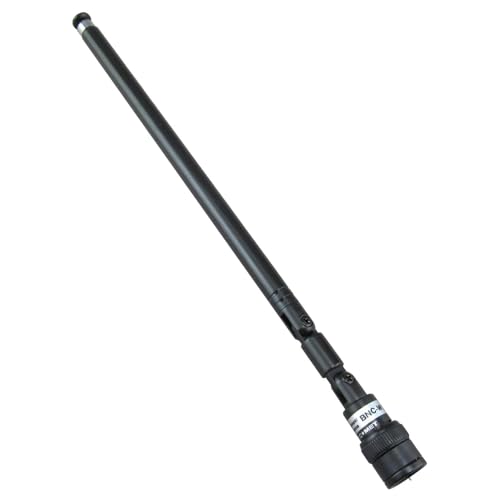
Taurus Desktop 25-2000 Mhz Scanner Antenna


Questions listeners ask before buying
Will an indoor antenna hear a trunked system from inside an apartment?
Often, yes, provided a site of that system is within reasonable range and the antenna can see toward it from a window or a high position. Digital trunked networks either decode or they do not, so the practical answer emerges quickly once the antenna is placed: if the control channel holds steadily through an evening of household movement, the arrangement works. If decoding flickers as people cross the room, more height, a clearer window, or a shorter cable run is the next step rather than a different brand of whip.
Does extending a telescopic whip fully always help?
No. Full extension favours lower frequencies, and on UHF or 800 megahertz a fully extended whip may be several wavelengths long with an awkward pattern, while a shorter setting sits closer to an efficient length for those bands. Makers often publish suggested lengths per band, and following those marks is a better habit than treating maximum extension as maximum performance. Listeners who monitor several bands usually settle on a compromise length and accept it, adjusting only when a favourite weak channel needs coaxing.
Can one indoor antenna serve two scanners?
A passive splitter can divide one antenna between two receivers, but it also divides the signal, costing each receiver a share that weak stations may not spare. For strong local services the arrangement is convenient; for marginal listening it undermines the very signals that justified the antenna. A multicoupler with amplification designed for receiver use avoids much of that loss, yet adds cost and another powered device. Most indoor listeners simply move one receiver or fit each scanner with its own modest antenna.
One last habit separates satisfied indoor listeners from frustrated ones: they change a single variable at a time. Swapping the antenna, moving the receiver, fitting a new cable, and altering settings in one restless evening produces a result nobody can interpret, because any improvement or decline could belong to any of the changes. Patience is unglamorous, yet a methodical afternoon with one antenna, one notebook, and four reference channels teaches more about a room than a month of random swapping, and that knowledge stays useful long after any particular antenna has been replaced.
However your listening corner finally takes shape, the indoor antenna that earns its keep is the one matched to your bands, raised as high as the room allows, kept clear of household noise, and connected with the shortest honest cable run you can arrange.