Our Top Picks


What's inside
- Start with the signal that actually exists outdoors
- Donor antennas for boosters: yagi versus log-periodic
- Panel antennas and the MIMO router path
- Bands, aggregation, and reading published compatibility
- Cable loss at cellular frequencies: the quiet budget-killer
- Finding towers and setting an azimuth that holds
- Booster placement, isolation, and household coverage
- Power, weatherproofing, and lightning protection
- Troubleshooting weak results without buying anything
- How the two architectures age as networks evolve
- A decision sequence for rural buyers
- Signal metrics decoded: strength, quality, and speed are different things
- Grid parabolics and other long-reach options
- Working with carriers, neighbors, and shared towers
- Case patterns from owner accounts
- Seasonal and daily rhythms of a rural sector
- What to do when one bar is all there is
- Antenna gain figures in this category, read skeptically
- Indoor distribution after the router: finishing the job
- Costs, honestly itemized
- Questions rural readers ask most often
- A note on expectations for speed
- Reading a datasheet like an installer
- The survey, revisited as the cheapest upgrade
- Mounting structures: poles, roofs, and repurposed towers
- Check prices on Amazon
- When to call the carrier before buying anything
As an Amazon Associate I earn from qualifying purchases. This post may contain affiliate links at no extra cost to you.
Full disclosure, stated plainly at the top: this guide contains affiliate links, and when a reader buys through one of them, this site may receive a commission that helps fund its coverage, while the amount that reader pays remains exactly what it would have been otherwise. The comparisons below draw on manufacturer documentation, publicly published network and regulatory data, and patterns that repeat across owner reports, and no carrier or hardware brand has reviewed or approved a word of it.
Rural internet frustration has a distinctive texture. The phone shows a bar or two on the porch, enough to tease, yet the laptop indoors cannot hold a video call, the school portal times out, and a software update becomes an overnight gamble. That gap between a signal that technically exists and a connection that practically works is where outdoor cellular antennas live. They do not invent coverage. They collect the weak energy already passing over a property, concentrate it, and deliver it to equipment that can use it.
Two system architectures dominate the rural market, and confusing them is the most common beginner mistake. In the first, an outdoor donor antenna feeds a signal booster, which rebroadcasts an amplified copy of the carrier’s signal inside the home for ordinary phones. In the second, external antennas connect directly to a cellular router, which converts the carrier connection into household Wi-Fi and Ethernet. The antennas look similar on a shelf, yet their band requirements, cable tolerances, and placement rules differ enough that choosing the architecture comes before choosing any hardware.
Start with the signal that actually exists outdoors
Every successful rural installation begins with a survey, not a purchase. Signal conditions indoors mislead, because walls, metal roofing, low-emissivity window coatings, and even foil-backed insulation strip away decibels before a phone ever sees the wave. Conditions on the roof or at the top of a pole are the honest baseline. Published guidance from booster and router makers alike urges measuring at the proposed antenna location, ideally at the proposed height, because a few vertical meters frequently matter more than any specification on a box.
Phones themselves can serve as rough instruments. Field-test screens buried in phone settings report reference signal measurements in negative decibel-milliwatts, and while the exact menus vary by maker, the numbers give a far truer picture than bars. Readings taken at several spots around a property, at different times of day, reveal both the best mounting position and the direction from which the usable signal arrives. Owner accounts repeat this lesson with feeling: the household that surveys first rarely returns hardware, while the household that guesses often returns everything.
Expectations should be calibrated to those readings. A measurable outdoor signal, even a weak one, is workable raw material for a directional antenna and a booster or router. A location where no carrier signal registers outdoors at any height is a different problem entirely, one that antennas cannot solve and that points toward satellite service or a fixed wireless provider with a nearer tower. Honest surveying protects rural buyers from spending real money on physics that was never available.
Donor antennas for boosters: yagi versus log-periodic
The classic rural donor is a yagi: a boom of elements tuned to concentrate gain along one bearing, exactly the geometry a single distant tower calls for. Manufacturer datasheets for cellular yagis list gain by band, because these antennas must cover the several frequency ranges modern carriers use, and gain at the lowest band, where rural coverage usually lives, is typically the figure that decides success. A narrow beam is an asset here. It pulls energy from the tower’s direction while declining interference and noise from elsewhere.
Log-periodic dipole arrays, usually shortened to LPDA in catalogs, take the opposite trade. Their gain at any single frequency is lower than a comparable yagi’s peak, but they hold that gain evenly across an enormous span of frequencies, which suits households unsure which bands their carrier uses locally, or served by different carriers in different directions at similar bearings. Their wider beam also forgives imprecise aiming, a kindness that first-time installers consistently praise in feedback.
Choosing between them is therefore a question about knowledge. A household that has surveyed, identified the serving tower, and confirmed the bands in use can exploit a yagi’s extra reach. A household working from incomplete information, or sharing a booster among family members on different carriers, often fares better with the log-periodic’s breadth. Published radiation patterns from reputable makers make the trade visible: one tall, narrow spike of gain versus a lower, broader plateau.
What booster kits add around the donor
A booster system is more than its outdoor antenna. The amplifier unit carries published gain and output power figures, plus the noise figure that bounds how cleanly it can lift a weak signal. The indoor antenna, panel or dome, distributes the boosted signal, and the separation between indoor and outdoor antennas determines whether the system can use its full gain or must throttle back to avoid oscillation, the feedback loop in which the booster hears its own output and protects itself by reducing power. Installation guides treat that separation, measured in distance and building materials, as the central design constraint, and experienced installers plan the whole layout around it.
Panel antennas and the MIMO router path
Cellular routers take a different approach: instead of rebroadcasting the carrier signal, they terminate it, and their performance leans heavily on MIMO, the use of multiple antennas to carry parallel data streams and to exploit reflections rather than merely endure them. Most such routers ship with small indoor paddle antennas and provide external connectors for owners whose signal needs help. Replacing those paddles with outdoor panels is the single most popular rural router upgrade described in owner forums.
Panel antennas suit this role elegantly. A flat panel concentrates gain across a moderately wide beam, mounts flush against a wall or pole, and presents a tidy profile to wind and neighbors. Cross-polarized designs house two elements at opposing angles inside one enclosure, feeding the router’s two antenna ports from a single mounting job and preserving the polarization diversity MIMO depends on. Datasheets list gain per band for each port, and the low-band figures again matter most for distance work, even though mid-band performance decides everyday speed where both are available.
Some router owners go further, mounting two panels separated in space, or choosing a pair of directional antennas aimed with slight angular diversity. Published MIMO guidance explains why: the streams must arrive decorrelated, differing enough in path or polarization that the receiver can separate them. Two antennas bolted side by side on the same short bracket, fed by identical paths, squander much of the benefit, a subtlety that separates satisfying installations from expensive disappointments. Households comparing router hardware itself often start from roundups such as best 4g routers before thinking about antennas at all.
Connector and cable compatibility on routers
Router antenna ports commonly use small threaded connectors that differ from the larger fittings on booster hardware, and adapter cables bridging the two worlds introduce loss and fragility at exactly the wrong place. Checking the router maker’s published connector specification, and the antenna maker’s termination options, prevents the familiar unboxing-day discovery that nothing quite screws into anything else. Where adapters are unavoidable, keeping them indoors and weather-protected preserves both signal and sanity.
Bands, aggregation, and reading published compatibility
Carriers deliver rural service across a patchwork of frequency bands with distinct personalities. Low-band signals travel farthest and penetrate buildings and foliage best, which is why they anchor most rural coverage, but they carry narrower channels and therefore modest peak speeds. Mid-band signals offer far more capacity where they reach, yet they attenuate faster over distance and struggle through terrain. Any given tower may radiate several bands at once, and a phone or router chooses among them moment by moment according to rules the user rarely sees.
Antenna compatibility is consequently a band question before it is a brand question. A donor antenna whose published range omits the low band serving a particular valley is the wrong antenna for that valley regardless of its headline gain. Carrier aggregation complicates the arithmetic further: routers and boosters that can combine two bands simultaneously need antennas performing respectably on both, which pushes many rural buyers toward wideband designs even when a single-band yagi posts a prettier peak number.
Regulatory and carrier documents published for booster users add another layer. Boosters in many jurisdictions must be registered with the carrier, must carry proper certification, and must shut down if they cause network interference. Those rules are not bureaucratic decoration; a misbehaving booster degrades service for every neighbor sharing the tower, and rural towers are shared by definition. Router-based setups sidestep booster registration because they are the endpoint rather than a repeater, one reason some households prefer them, though they require their own data plan arrangements through the carrier. Readers untangling plan and hardware questions frequently consult best routers with sim card slot alongside antenna guidance.
Cable loss at cellular frequencies: the quiet budget-killer
If one technical topic separates successful rural installations from frustrating ones, it is feedline loss. Cable attenuation grows with frequency, and cellular bands sit far above broadcast television frequencies, so cable runs that would be harmless for a TV antenna can consume a rural cellular system’s entire margin. Published attenuation tables make the stakes concrete: at the upper bands in common use, a long run of thin, inexpensive cable can discard most of the signal the antenna worked to gather, delivering the tuner-equivalent of a whisper.
Cable grades differ enormously. Thin, flexible types intended for short indoor jumpers post loss figures several times higher per meter than the stiff, thick low-loss types designed for tower work. The practical rule in manufacturer installation literature is consistent: use the shortest run the building allows, in the lowest-loss cable the budget tolerates, and place the booster or router to serve that geometry rather than the furniture. Every connector and adapter adds its own small toll, so a tidy two-connection path beats an elegant chain of adapters every time.
Frequency dependence shapes strategy in a subtler way. A cable run that a household finds acceptable for low-band service may quietly strangle the mid-band carrier that would have doubled its speeds, producing the puzzling report that an installation improved reliability but not throughput. Planning the cable for the highest band the household hopes to use, rather than the lowest it can survive on, protects the upgrade path. Where distance is unavoidable, some installations move the router into a weatherproof enclosure near the antenna and run network cable, which shrugs off distance, down to the house instead.
Finding towers and setting an azimuth that holds
Rural folklore often misidentifies the serving tower. The nearest visible tower may belong to another carrier, host no cellular equipment at all, or carry the right carrier on a sector aimed elsewhere. Public tower registration databases list structures and their owners, crowd-sourced coverage maps accumulate user-reported cell identities and locations, and carrier coverage maps, while optimistic, at least indicate which network claims the valley. Cross-referencing two or three of these published sources usually identifies the true target within a shortlist of candidates.
Distance interacts with antenna choice in a way worth stating plainly. Within a few kilometers of a tower, almost any outdoor antenna, aimed approximately, transforms service. At the far fringe, where towers sit fifteen or more kilometers away behind terrain, the installation becomes a genuine engineering exercise in which gain, height, cable discipline, and precise aiming each contribute irreplaceably. Households at that range also benefit most from the narrowest beams, because a wide pattern spends its sensitivity on empty landscape while the tower occupies a sliver of horizon.
Aiming itself is iterative. The installer rotates the donor in small increments while a helper watches signal readings reported by the booster, router, or a phone in field-test mode, hunting for the bearing that maximizes the quality metrics rather than raw strength alone. Signal quality measures, which reflect interference as well as power, often peak a few degrees away from the strength peak, and that offset bearing delivers faster, steadier data in practice. Marking and recording the final bearing, as with any directional antenna, converts future troubleshooting from guesswork into comparison. General background on reaching distant infrastructure appears in roundups like best long range routers, which some readers use to sanity-check their expectations.
Height, terrain, and the fresnel zone again
Cellular wavelengths are far shorter than broadcast FM wavelengths, which shrinks the fresnel zone but multiplies the obstacles that intrude into it. A tree line that an FM signal crosses with mild complaint can block a mid-band cellular path outright. Raising the donor above local clutter remains the cheapest gain in the entire system, and published propagation guidance treats height as the first variable to exhaust before buying a larger antenna. Seasonal foliage then revises the answer twice a year, which is why experienced rural installers evaluate a site in leaf, when possible, rather than trusting a bare-branch January survey.
Booster placement, isolation, and household coverage
Where the boosted signal lands indoors matters as much as how much of it exists. A booster amplifier placed centrally, with its indoor antenna covering the rooms where people actually sit, outperforms a stronger amplifier exiled to a utility closet at the building’s edge. Building materials edit coverage ruthlessly: masonry and metal lath absorb, open timber frames forgive, and a single brick chimney can shadow an entire room. Walking the house with a phone while the system runs reveals the true coverage map within minutes.
Isolation between the donor and the indoor antenna deserves a second visit, because it caps everything else. Manufacturers publish minimum separation guidance, often expressed in vertical distance, horizontal distance, or intervening structure. Exceeding the minimum is free performance; falling short forces the amplifier to reduce gain automatically, and the household pays for specifications it never gets to use. Rooftop donor placement above the indoor antenna’s floor is the classic arrangement precisely because vertical separation plus roof structure buys isolation cheaply.
Multi-story and sprawling single-story homes sometimes need a second indoor antenna fed through a splitter, accepting the published splitter loss as the cost of even coverage. Feedback from ranch-style households is consistent on this point: they would rather have moderate signal in every room than a spectacular signal in one room and a dead zone in the bedroom. Planning the indoor distribution with the same care as the outdoor collection is what separates a system from a gadget.
Power, weatherproofing, and lightning protection
Outdoor cellular hardware lives in weather that indoor electronics never meet. Enclosures carry published ingress ratings, connectors need sealing against driven rain, and cable jackets must be rated for ultraviolet exposure if they are to survive summers on a sunlit mast. Drip loops at entry points, downward-facing connector orientations, and self-amalgamating tape over junctions are unglamorous techniques that decide whether an installation works in its third year or only its third month.
Lightning protection follows the same principles published for any rooftop antenna system. A coaxial surge arrestor at the building entry, bonded to the grounding electrode system, diverts induced surges before they reach the booster or router. The mast itself should bond to ground with a substantial conductor. Direct strikes exceed what consumer protection can promise, and honest documentation says so, but nearby-strike surges are common enough in thunderstorm country that skipping protection is a false economy measured in replacement electronics.
Power continuity rounds out the rural picture. Boosters and routers draw modest power, and a small uninterruptible supply carries a system through the brief outages that rural feeders deliver regularly, keeping phones connected during exactly the weather events when they matter most. Farms with standby generators should still protect the electronics from transfer-switch transients. None of this equipment is exotic; it is the standard defensive layering that published installation guides recommend and that hurried installations omit.
Troubleshooting weak results without buying anything
Disappointing first results usually trace to a short list of culprits, and working through them in order costs an afternoon rather than another order. Aiming error leads the list, especially when the donor was pointed at the most visible tower rather than the serving one. Cable and connector faults follow closely: a kinked run, a connector assembled with a stray braid strand shorting the dielectric, or an unsealed junction that admitted water can each consume the margin the antenna provided. The third culprit is band mismatch, discovered by confirming which bands the serving tower actually radiates and comparing them against the antenna’s published range.
Booster-specific disappointments add oscillation and placement to the list. An amplifier reporting reduced gain is often protecting itself from feedback, and the remedy is separation or shielding between antennas, not a stronger amplifier. Router-specific disappointments add configuration: external antenna ports must sometimes be enabled in settings, aggregation depends on what the tower offers rather than what the router supports, and a router locked to a distant band by an enthusiastic manual setting can underperform its own automatic behavior.
Time of day confounds diagnosis. A rural sector serving a highway or a school swells and relaxes on a schedule, so an installation evaluated only at a quiet dawn may look heroic and then sag at the evening peak, while one adjusted during the peak may be needlessly conservative. Evaluating across a full day, and judging the system by its busy-hour behavior, gives the honest grade. Owners who keep a small log of readings by hour and bearing consistently reach good results faster than owners who rely on impressions, because the log turns arguments into data.
How the two architectures age as networks evolve
Carrier networks are mid-transition, with older generations being retired and spectrum refarmed toward newer standards. Published carrier announcements describe these timelines in general terms, and they matter to antenna buyers because an antenna is a decade-scale purchase while a booster or router is a mid-life one. A wideband donor antenna bought today will very likely serve whatever band plan the local tower adopts next; a narrowband booster amplifier certified for yesterday’s configuration may not. This asymmetry argues for generosity in the antenna’s frequency coverage and skepticism toward deeply discounted previous-generation electronics.
The router path carries its own evolution questions, since aggregation combinations and supported bands live in the router’s radio rather than in the antenna. Households that separate the durable parts of the system, antennas, mounts, and quality cable, from the replaceable electronics make future upgrades cheap: unbolt one box, bolt on its successor, keep the sky hardware. That separation is the strongest structural argument for investing in the antenna side without hesitation while buying electronics at the level the household actually needs today.
Fixed wireless offerings from the carriers themselves complicate the landscape further, since a provider-supplied gateway with a proprietary antenna arrangement may outperform a bring-your-own setup where the provider has optimized for it, or underperform where its indoor placement is constrained. Published availability checkers settle whether that option even exists at an address. Readers weighing whole-property networking sometimes extend the survey to the yard and outbuildings with material like best long range outdoor wifi extenders, since a strong router indoors still leaves the barn to fend for itself.
A decision sequence for rural buyers
- Survey outdoor signal at mounting height, in several spots, before purchasing anything.
- Identify the serving tower and the bands it radiates from published databases and coverage data.
- Choose the architecture first: booster for household phones, or router antennas for a data-centric setup.
- Match the antenna’s published band coverage and gain profile to the bands that actually serve the property.
- Budget cable loss from attenuation tables at the highest band of interest, using the real run length.
- Plan donor and indoor antenna separation before choosing amplifier power.
- Include entry surge protection, mast bonding, and weather sealing in the initial parts list.
Notice the sequence’s discipline: information first, architecture second, hardware last. Rural connectivity marketing prefers the reverse order, leading with a product and letting the property’s facts trail behind. The households reporting durable success in this category almost universally describe some version of the survey-led sequence, even when they arrived at it after an initial mistake taught them its value.
It is equally worth stating what no antenna purchase delivers. It cannot create a signal where none reaches the property, cannot force a tower to offer capacity it lacks at the evening peak, and cannot substitute for a data plan whose terms fit the household’s usage. Within those honest limits, though, a well-chosen outdoor antenna is among the highest-leverage purchases a rural household can make, because it improves every device, every call, and every session that passes through the system, every hour of every day, without asking for attention in return.
Signal metrics decoded: strength, quality, and speed are different things
Three numbers govern every conversation in this category, and rural buyers benefit from keeping them separate. Received power describes how much energy arrives, full stop. Signal quality ratios describe how cleanly that energy stands out from interference and noise, and they predict stability better than power alone. Throughput, the speed a household actually experiences, emerges from both of those plus the tower’s available capacity, the channel width on the band in use, and how many neighbors are drawing from the same sector at the same moment.
This separation explains the category’s most confusing reports. An installation can raise received power dramatically while barely moving speed, because the household was capacity-limited rather than signal-limited. Another can show modest power yet deliver fluid video calls, because its quality metrics are excellent on an uncongested band. Manufacturer literature for better equipment reports both power and quality at the router or booster interface, and installers who watch both while aiming consistently find the bearing that serves real usage rather than the bearing that flatters a single number.
Upload performance deserves its own sentence in every rural evaluation, because it is the direction that fails first. The tower’s transmitter dwarfs the power any household device can return, so the path back to the tower is the fragile one, and it is precisely the direction an outdoor antenna strengthens most. Video calls, cloud backups, security camera uploads, and remote-desktop sessions all live or die on that return path, which is why rural users so often describe a good antenna as fixing their calls before it impresses their download measurements.
Grid parabolics and other long-reach options
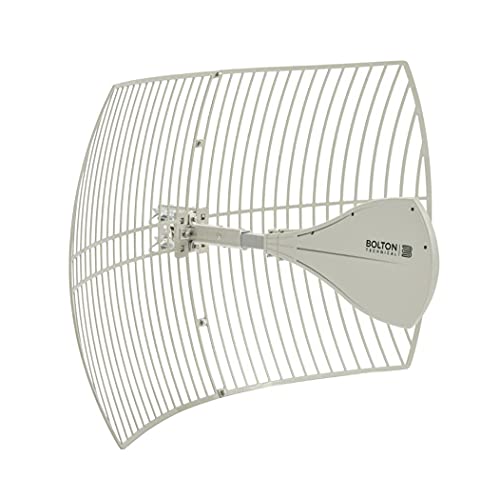
At the extreme edge of coverage, some households turn to grid parabolic antennas, whose curved reflector concentrates energy into a very tight beam with high published gain at mid and upper bands. Their open grid construction sheds wind surprisingly well for their size, and their long focal arms demand careful assembly and rigid mounting. They suit the router architecture and technically confident owners chasing a specific distant tower on a specific band, and they punish casual installation with narrow-beam aiming difficulty that can consume a weekend.
Below that extreme, the familiar ranking holds: yagis for known single-tower situations, log-periodics for uncertain or multi-carrier ones, panels for tidy MIMO router work. Specialty omnidirectional outdoor antennas serve a genuine niche for properties roughly equidistant from several moderate towers, where direction is unknowable or the household roams its service among carriers, though their lack of gain makes them fringe tools of last resort rather than first choice.
Vehicle-derived equipment occasionally tempts farm households, since trucks and recreational vehicles use compact boosters of their own. Published specifications reveal the mismatch quickly: mobile systems are designed around a few meters of cable and a metal roof as ground plane, with coverage areas measured in arm’s lengths. A farmhouse is a larger, more demanding environment, and equipment sized for a cab will disappoint in a kitchen no matter how favorable its mobile reviews read.
Working with carriers, neighbors, and shared towers
Rural towers are communal infrastructure in a way urban sites are not. A handful of sectors may carry an entire valley’s calls, school traffic, and emergency communications, which lends booster registration and interference discipline a civic dimension. Published carrier guidance frames registration as a quick administrative step, and households that complete it gain a support channel if network changes ever affect their service. Unregistered or misconfigured equipment that degrades a shared sector tends to be found, and the resulting conversations are less pleasant than the registration form.
Neighbors are also an underused information source. In thinly settled country, someone within a few kilometers has usually already solved, or failed to solve, the identical problem against the identical tower. Their experience with a particular bearing, band, or contractor transfers directly in a way that national reviews never can. More than a few successful installations began as fence-line conversations, and more than a few doomed purchases were prevented by one.
Local installers occupy a similar niche. Rural areas often support a small trade of satellite and antenna professionals whose mental maps of tower locations, terrain quirks, and carrier behavior constitute genuine expertise. Their published rates, weighed against a household’s ladder confidence and diagnostic patience, are sometimes the most rational line item in the whole project, particularly for tower or tall-pole mounting where the work itself carries risk.
Case patterns from owner accounts
Certain story shapes recur across owner reports often enough to function as guidance. In the first, a household blames its router for evening failures, replaces it twice, and finally discovers through a borrowed signal meter that the donor antenna, installed by a previous owner, points at a tower the carrier vacated years earlier. Ten minutes of re-aiming outperforms two generations of new electronics. The moral is uncomfortable and valuable: in a system, the unfashionable component is frequently the guilty one.
In the second pattern, a family achieves excellent readings at installation in late autumn and watches them decay through spring, concluding the hardware failed. The actual culprit is foliage along the path plus a wet season’s worth of water in an unsealed connector, two ordinary processes arriving together. Resealing the junction and raising the donor by a single mast section restores the original performance, and the household’s log, kept since installation, is what lets them prove the change is environmental rather than electronic.
The third pattern is happier. A remote worker facing a move back to the city spends one weekend on survey, band identification, and careful cable work, and ends with a connection stable enough to make the move unnecessary. Such accounts rarely credit a particular product. They credit the sequence: measured first, matched bands second, disciplined installation third. Products were interchangeable in their telling; method was not.
Seasonal and daily rhythms of a rural sector
A rural connection breathes. Agricultural seasons load the network with machinery telemetry and seasonal labor, school terms shift daytime demand, tourist weekends swell valleys that are quiet all week, and harvest festivals can briefly turn a sleepy sector into a stadium. An antenna system sized with a little headroom, evaluated at the busy hour rather than the flattering one, absorbs these rhythms without drama. One sized exactly to a quiet-morning measurement will generate complaints on a schedule its owner could have predicted from the county calendar.
Weather writes smaller, faster rhythms on top. Rain attenuates higher bands modestly along long paths, wet foliage deepens the losses described earlier, and temperature inversions occasionally deliver a distant co-channel tower’s interference as an unwelcome guest. None of these phenomena indicate defective equipment, and chasing them with replacement hardware is a known rural expense trap. The correct response to a weather-correlated dip is a log entry and patience; the correct response to a permanent step-change is investigation, because towers get reconfigured and trees, eventually, fall down.
What to do when one bar is all there is
Some properties sit at the ragged edge where an outdoor survey finds a signal too weak for confident promises yet too present to dismiss. The honest playbook for that edge starts with maximum height and the highest-gain antenna the structure can carry, aimed with unusual care at the verified serving tower, connected by the shortest, lowest-loss cable run achievable. It continues with expectations set by the busy-hour evaluation rather than the installation-day celebration, and it holds satellite service in reserve as the comparison that keeps the project honest.
It also recognizes a truth the industry understates: incremental improvements compound. A household that gains a stable connection for messaging, email, and voice first has changed its daily life more than the raw speed figures suggest, because reliability, not bandwidth, is what rural users are usually starving for. Video can buffer; a dropped call with a clinic cannot. Prioritizing the applications that matter, and judging the system against them, keeps a fringe installation’s genuine victories in view.
Antenna gain figures in this category, read skeptically
Cellular antennas carry the same dual-scale confusion found elsewhere in radio, with gain quoted against either an isotropic reference or a dipole reference depending on the maker’s habit. The numerical gap between the scales is fixed and known, so a careful shopper converts everything to one scale before ranking products. Listings that state a gain figure without naming its reference, or that quote a single heroic number for an antenna covering many bands, should be read as marketing rather than engineering, because genuine wideband antennas post different figures for different ranges and say so in their tables.
Peak gain also tends to occur at the highest frequencies a wideband antenna covers, which are precisely the frequencies least likely to carry a distant rural signal. The figure that matters is the gain at the lowest band serving the property, and it is routinely several decibels below the headline. Manufacturers who publish full band-by-band tables make this comparison possible; manufacturers who publish only a maximum make it impossible, and that difference in transparency predicts a great deal about the documentation quality a buyer will meet during installation.
Beamwidth figures deserve the same scrutiny. A donor antenna boasting very high gain necessarily listens through a narrow window, which is excellent for a surveyed, fixed tower and miserable for any situation involving uncertainty. Published horizontal and vertical beamwidths let a buyer judge whether a property’s aiming tolerance, mast sway, and survey confidence suit the antenna’s temperament. Matching temperament to circumstance is most of what antenna selection actually is.
Indoor distribution after the router: finishing the job
Router-based households sometimes celebrate a strong carrier connection and then wonder why the far bedroom still struggles, having relocated their bottleneck from the WAN side to the living room. The router’s position now matters the way the donor’s position mattered outdoors: centrally, elevated, away from metal masses and masonry chimneys. Published Wi-Fi guidance on placement is extensive and consistent, and a household that applied survey discipline outdoors usually finds the indoor version familiar.
Outbuildings extend the question. Barns, workshops, and guest cottages each tempt a household toward repeaters and long wireless hops of varying wisdom, when a buried or aerial network cable, or a purpose-built point-to-point link, would settle the matter permanently. The antenna project often becomes the moment a property upgrades its whole approach to connectivity, replacing accumulated improvisation with a small, deliberate network. That broader tidiness, owners report, is frequently worth as much daily satisfaction as the carrier signal improvement that prompted it.
Costs, honestly itemized
A rural antenna project has more line items than its headline product. Mounting poles or a tower section, the cable run in a suitable grade, connectors and sealing materials, surge protection and grounding hardware, and possibly a day of professional labor all belong in the estimate from the start. Itemized honestly, the project still compares favorably with the alternatives available to most rural addresses, particularly against the accumulated cost of repeated inadequate fixes, premium hotspot plans pressed into household service, or a vehicle commute undertaken purely to find bandwidth.
The economics also favor doing the durable parts generously. Cable, mounts, and antennas sized with headroom serve through at least one change of electronics, while savings taken on those same parts tax the system every day it operates. Conversely, electronics bought at the top of the range age against network transitions that no purchase can outrun. Spend on the sky, economize modestly on the box, and keep the receipts and readings together: that allocation, repeated across owner accounts, is the closest thing this category has to a consensus.
Questions rural readers ask most often
Can one system serve phones and a router together?
Households regularly want both: boosted signal for ordinary handsets and a router fed by external antennas. The two architectures can coexist on one property, sharing a mast but not a feedline, since a booster’s donor and a router’s antennas serve different electronics with different band and gain priorities. Splitting one donor’s output between a booster and a router is occasionally proposed in forums and generally disappoints both, because the splitter loss and the conflicting requirements eat the margin each system needed. Two modest, purpose-matched antennas outperform one heroic shared one in nearly every account of the experiment.
Will an antenna help during an outage or emergency?
An antenna improves access to whatever the network is radiating; it cannot substitute for a tower that has lost power or backhaul. Rural towers often carry battery backup measured in hours, and generators at more important sites, so a household system with its own small battery supply frequently stays connected through the early, most chaotic phase of a storm’s aftermath, which is when families most need it. Beyond that window, communications resilience becomes a question of satellite messengers and stored supplies rather than antennas, and prudent rural households plan in those layers without confusing them.
How often does the installation need attention?
Far less than newcomers fear. A well-sealed, well-grounded installation typically asks for a visual inspection each year, a check of the recorded signal readings each season, and connector renewal on a multi-year horizon or after any known surge event. Readings that drift slowly suggest foliage or a degrading junction; readings that change overnight suggest the network itself changed, which carrier announcements and neighbor comparisons usually confirm. The log kept since installation day is what turns each of those judgments from speculation into recognition.
A note on expectations for speed
Marketing in this category loves a speed figure, and rural reality loves humbling one. The throughput a household experiences is the minimum of several limits: the signal the antenna delivers, the channel width on the band in use, the aggregation the tower and device agree on, and the sector’s remaining capacity at that hour. An antenna project addresses the first limit completely and the others not at all. Judged against the limit it actually governs, a good installation is transformative; judged against a fiber connection in a city apartment, it will always look modest. Rural households, in the main, judge correctly: they compare against their own yesterday, and by that measure the improvement is the difference between apologizing for their address and forgetting it.
Stability deserves promotion to a headline metric in its own right. A connection that holds a modest speed without dropping supports work, school, and care; a connection that spikes brilliantly and collapses hourly supports none of them. Antenna work, uniquely among rural internet interventions, buys stability first, because it attacks the physical fragility of the link rather than negotiating with its paperwork. That is the property owners praise once the novelty fades, and it is why so many of them, asked years later, describe the installation less as an upgrade than as a repair to the house itself.
Reading a datasheet like an installer
A competent datasheet tells a story in a specific order, and learning to read it in that order saves money. Begin with the frequency ranges and confirm that every band the serving tower uses appears, with gain stated for each rather than summarized. Move to the radiation pattern and beamwidth, and picture the property’s actual aiming situation inside those angles. Continue to the mechanical page: dimensions, weight, mounting hardware, and the wind figures that the pole or mast must respect. Finish with the electrical details installers quietly live by, connector type, impedance, and the voltage standing wave ratio that hints at how cleanly the antenna hands energy to the cable.
Two absences on a datasheet speak loudly. The first is any mention of test conditions or measurement method for the gain claims; serious manufacturers anchor their numbers to a stated method, while casual ones float theirs in a void. The second is a pattern plot. A maker unwilling to show the shape of an antenna’s pickup is asking buyers to purchase a silhouette, and in a category where shape is performance, that reluctance is itself information. Installation manuals extend the same tell: dimensioned drawings, torque guidance, and sealing instructions correlate strongly with hardware that behaves as promised.
Certification marks and carrier documentation complete the picture for booster components, where regulatory compliance is not optional decoration. Published approval listings can be checked independently, and a booster absent from them should be absent from the shopping list regardless of its specifications or its price. The router path shifts the compliance burden to the router’s own radio approvals, which established makers document thoroughly. In both architectures, paperwork is not the enemy of performance; it is one of its more reliable predictors.
The survey, revisited as the cheapest upgrade
Everything in this guide eventually returns to the survey, because the survey is where rural installations are actually decided. A household that knows its outdoor readings at three candidate mounting points, the verified bearing and bands of its serving tower, and the cable distance from each candidate point to the equipment location can predict its results with embarrassing accuracy before spending anything. A household missing those facts is gambling, and the hardware industry is structured to sell gamblers a second and third attempt.
Fortunately the survey asks for nothing exotic: a phone with access to its field-test readings, a ladder or a tall pole for temporary elevation, a compass application corrected for declination, and an hour at two different times of day. Temporary mounting, with the antenna clamped and its cable run loosely through a window, converts prediction into measurement and is the worst-kept secret of professional installers, who rarely commit a hole to a wall before the temporary version has proven the concept. Rural buyers who imitate that patience describe the permanent installation, when it comes, as almost anticlimactic, which is exactly what good infrastructure work feels like.
Mounting structures: poles, roofs, and repurposed towers
The structure holding the donor antenna quietly determines both its height and its lifespan. A galvanized pole set in concrete beside the house suits many properties, keeps the installer off the roof entirely, and allows the whole antenna to be lowered for service by loosening a single pivot arrangement. Roof mounts borrow the building’s existing altitude and work well where the roofline already clears surrounding trees, though every penetration demands proper flashing, and the household trades easy servicing for a shorter cable run. Gable brackets occupy the middle ground, lifting a short mast above the peak while keeping fasteners in accessible framing.
Repurposed structures tempt rural owners productively. Retired television towers, windmill frames, and grain legs already stand on many properties, engineered for exactly the loads an antenna imposes, and a sound one offers height no new pole can match at comparable cost. Soundness is the operative word: decades of corrosion at the base, missing braces, and unknown footing depth argue for a careful inspection, ideally by someone who climbs professionally, before any antenna inherits the structure. A tower that passes inspection is an asset; one that merely looks upright from the driveway is a hypothesis.
Whatever carries the antenna, sway belongs in the plan. Narrow-beam donors on flexible mounts wander off bearing in gusts, and the household experiences the wander as mysterious evening dropouts that correlate with wind rather than with network load. Stiffer mounting, sensible height rather than maximal height, and guy wires where the structure invites them convert that flutter into a non-event. Owners who log readings alongside weather quickly learn whether their installation has a sway problem, which is one more argument for the logbook this guide keeps recommending.
Check prices on Amazon
Live listings for the shortlist in this guide are pulled from Amazon below, so prices and availability are always current at the moment you look.

WeBoost Single-Band Yagi Antenna – with N-Female Connector – Pole or Wall Mount


When to call the carrier before buying anything
A surprising number of rural connectivity stories change direction after one phone call. Carrier support can confirm which bands a specific tower radiates, whether a closer site is scheduled for activation, and whether the household’s current plan even permits the hotspot or router usage being contemplated. Published coverage maps are marketing documents; a support conversation, while hardly engineering data, sometimes surfaces a planned upgrade that makes waiting wiser than building, or a plan restriction that would have stranded new hardware on arrival.
The call also establishes the account facts a booster registration will need, smoothing that later step. Households that treat the carrier as an adversary miss this value; households that treat the carrier as one information source among several, to be cross-checked against databases and their own survey, extract what the call is worth without surrendering judgment to it.
One more household reality deserves acknowledgment: rural properties often host more than a residence. A tenant cottage, a parent’s smaller house across the yard, or a farm office in the barn may each need service, and a single well-sited system can sometimes feed several buildings through the indoor distribution and network decisions described earlier. Planning for those secondary buildings during the original survey costs a few extra readings; retrofitting for them later costs another installation. The properties that age best with their connectivity are the ones whose owners drew the whole map, buildings and all, before the first pole went into the ground, and that habit of drawing the whole map is, in the end, the real subject of every section above.
Documentation closes the loop on the whole project. Recording the final bearing, the cable type and length, the readings by band at the finished height, and the dates of any later adjustments takes ten minutes on installation day and saves hours in every future year. Households pass houses to children, sell them to strangers, and hire help who never met the original installer; a single page of notes in a drawer near the router is the difference between a system that can be maintained by whoever comes next and one that must be rediscovered from first principles at the worst possible moment.
Done patiently and in the right order, a rural antenna installation fades into the background of a household’s life, which is the highest compliment infrastructure can earn: the calls simply connect, the classes simply stream, the barn cameras simply answer, and the hardware on the roof becomes as unremarkable as the well pump or the mailbox, noticed only on the rare day it asks for attention.