Our Top Picks


What's inside
- The Botanical line: flowers that never ask for water
- Architecture: skylines and landmarks with a long, low footprint
- Art and Icons: when a set becomes a picture, and when it stays a model
- Choosing by room: desk, shelves, living room and bedroom
- Measure the shelf before the box arrives
- Dust, sunlight and the slow aging of plastic
- The build itself: piece counts, evenings and company
- Buying for someone else, buying for yourself
- Check prices on Amazon
- A note on sources, and our disclosure
As an Amazon Associate I earn from qualifying purchases. This post may contain affiliate links at no extra cost to you.
Somewhere in the last decade, the brick quietly changed address. It moved out of the toy box and the childhood bedroom, and it took up residence on living room shelves, office desks and hallway consoles, in homes where nobody under twenty has lived for years. Visitors no longer ask why an adult owns building sets; they ask where the orchid came from, and then lean closer when the answer turns out to be plastic bricks. That double take is the whole phenomenon in miniature: a set succeeds as decor when a guest reads it first as an object and only later as a construction toy.
The shift was not an accident of nostalgia, though nostalgia helped. The makers of these sets began designing for the shelf rather than the play mat: muted color palettes instead of primary brights, display stands and name plaques included in the box, box art that looks at home in a design shop, and subjects drawn from adult visual culture, meaning flowers, skylines, classic cars, famous paintings and mid-century objects. At the same time, the buyers changed. Adults with disposable income and small apartments wanted objects that carried a story, and a model you built yourself over three evenings carries a different story than one you simply unboxed.
Decor criteria differ from toy criteria in ways that matter before money changes hands. A toy is judged on play value: swooshability, opening doors, figures, features that survive a six-year-old. A decor set is judged on silhouette, color harmony with a room, footprint on a shelf, and how it behaves under lamplight at a distance of two meters. Fine detail still counts, but it counts as texture rather than as play features. Stability counts more, because a display model gets dusted, nudged and occasionally relocated, and nobody wants to rebuild a tower because a sleeve brushed it in March.
Price per piece, the old collector metric, also bends under decor logic. A set with fewer, larger elements may fill a shelf more gracefully than a dense set with twice the count, and a set that includes a stand, a vase-friendly shape or wall-mounting hardware saves a second purchase later. What you are really buying is a finished composition: height, width, color weight and negative space, delivered as a few hundred or a few thousand interlocking parts.
This guide walks the main adult display families, matches them to rooms and shelves, and covers the practical side of living with plastic decor: measuring before buying, keeping dust and sunlight from aging the bricks, choosing between a solitary build and a shared one, and giving these sets as gifts without the usual pitfalls. The aim is a shelf that looks intentional, not a storage problem with good lighting.
The adult turn also changed how these sets are sold and shelved in shops. Boxes carry age marks aimed squarely at grown-ups, display photography shows the finished model in a styled room rather than in a child’s hands, and many sets now arrive in packaging handsome enough that buyers keep it as part of the object’s record. None of that marketing would survive contact with a weak product, though. What sustains the category is that the finished models genuinely hold a room. A brick bouquet on a dining table starts conversations that a purchased ornament rarely does, because guests sense the hours inside it.
There is a sustainability footnote that buyers mention often. A decor object built from a material that can be disassembled, rebuilt, resold or handed down behaves differently from a resin ornament destined for landfill the moment taste changes. Bricks hold their clutch for decades, so a set bought for one apartment’s shelf can be rebuilt in the next home, lent to a sibling, or broken down into a child’s inheritance of parts without losing its nature. Decor that can change its mind is a genuinely modern idea, and it softens the guilt that sometimes follows buying beautiful, useless things.
It also helps that the hobby scales gracefully with commitment. A single small succulent tray can be a one-evening experiment. A wall of mosaics or a skyline run can grow one set a year for a decade, each addition chosen against the collection already in place. Rooms evolve the same way, and decor that can evolve in step, piece by piece and shelf by shelf, fits real life better than a single grand purchase that must be right forever.
The Botanical line: flowers that never ask for water
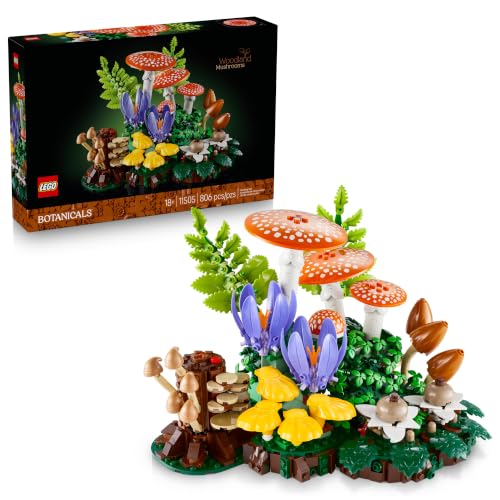
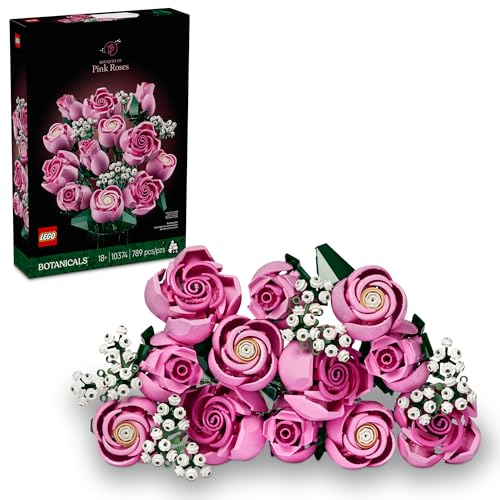
The Botanical family is the gateway for most adult buyers, and its appeal starts with a small domestic miracle: a bouquet that holds its peak indefinitely. Bouquet sets mix stems of roses, snapdragons, poppies, lavender and greenery, each flower built from dozens of small elements in petal shapes that borrow parts from unexpected corners of the brick catalog. Arranged in a real vase, a finished bouquet reads at room distance as stylized flowers rather than as a toy, which is exactly the register decor wants: clearly crafted, not pretending to be alive, but harmonious with living plants nearby.
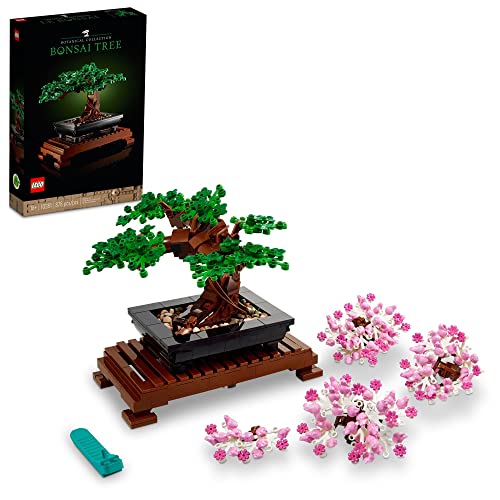
The orchid is the line’s quiet masterpiece and its most common desk resident. Its design copies the real plant’s habits: arching stems, blooms that graduate in size, roots spilling over a pot that is itself part of the build. Because the pot is included, the orchid arrives decor-complete, needing no vase hunt, and its soft pink or white palette sits comfortably beside monitors, paperwork and coffee cups. The bonsai takes the opposite approach to customization: it ships with green foliage and a second set of pink blossom elements, so the owner can swap the canopy with the seasons or mix the two for a less formal look. Few display objects at any price invite that kind of seasonal editing.
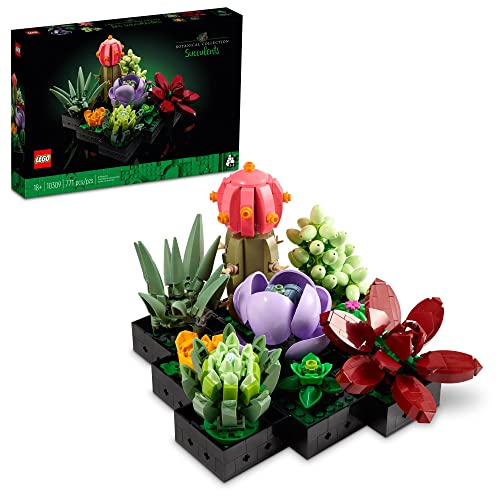
Succulent sets solve a different room problem. Real succulents die in the low-light corners where people most want a hint of green: interior bathrooms, north-facing shelves, windowless hallways. A tray of brick succulents, each plantlet in its own small pot and the pots arranged in a grid or grouped loose, delivers the geometry of the real thing with none of the quiet guilt. They also travel well between rooms, since there is no soil to spill and no drainage to protect furniture, and they tolerate the warm, dry air above radiators that murders their living counterparts.
The no-watering advantage is usually told as a joke, but it has a serious side for offices and second homes. A desk plant that survives a three-week holiday untouched, a reception arrangement that never needs a rota, flowers for a hay-fever household that cannot keep the real thing indoors: these are genuine use cases, and they explain why botanical sets keep escaping the hobby shelf and turning up in workplaces. For styling, our research keeps returning to one rule: give botanical builds the same respect as real plants. One arrangement per surface, room to breathe, and a vase or pot with some visual weight, because the bricks are light and a flimsy container makes the whole composition look temporary.
Styling botanical builds is a small art of its own. Mixed bouquets look best when arranged with the same looseness a florist aims for: tallest stems at the back, faces turned at slightly different angles, one or two stems trimmed shorter by removing a link so the eye travels. The sets permit that editing because stems are modular, and owners who treat the bouquet as a living arrangement, reworking it every few months, report that it stays fresh to their own eyes far longer than a static model does. A heavy ceramic vase suits the visual weight; a tall glass vase shows off the stem construction for guests who enjoy the trick.
Seasonal rotation extends the idea. A household can keep blossom elements on the bonsai through spring, run green through summer, and bring out a bouquet with warmer colors for autumn, storing the off-duty elements in a labeled bag inside a drawer. That tiny ritual, ten minutes twice a year, gives one shelf a changing calendar, which is something expensive decor rarely offers. It also spreads the build’s value across the year instead of concentrating it in the first admiring week.
Architecture: skylines and landmarks with a long, low footprint
Architecture sets trade height for length. A city skyline model strings a dozen or more miniature landmarks along a base, each building simplified to its essential massing and one or two signature details, with a printed name tile anchoring the composition. The result is a panoramic strip, wider than it is tall by a factor of three or four, and that proportion decides where it can live. Skylines belong on long, low surfaces: the top of a bookcase run, a sideboard, a window sill deep enough to be safe, or the shelf above a desk where a wide, calm horizon does not compete with the work below.
Single-landmark sets behave differently. A great pyramid, a famous tower, a castle or a cathedral is a freestanding sculpture with a footprint closer to a square, and it asks for clearance on all sides so the silhouette can be read in the round. These are the sets that reward a corner position or a spot at the end of a shelf, where a visitor’s eye lands naturally. Their part counts run higher for their size than skylines, because the shaping is denser: slopes, arches and texture work consume elements quickly, and the finished object feels correspondingly substantial in the hand when it is moved for cleaning.
Scale consistency is the collector’s quiet obsession in this line. Skylines share a rough common scale with each other, so Paris can sit beside London and New York on one long shelf without visual argument, while the landmark models each follow their own scale and mix less peacefully. A shelf of skylines becomes a travel diary for people who collect places they have lived or loved, and that personal geography is a large part of the line’s staying power. Few other decor objects let a renter carry a decade of addresses in a single moving box.
Color discipline helps architecture earn its place in adult rooms. The palettes lean on white, tan, light gray and sand tones with restrained accents, so a skyline reads as a neutral band across a shelf rather than as a toy explosion. In a room with strong colors, that neutrality is a rest for the eye; in a minimalist room, the tiny variations in facade texture supply the interest. Builders who plan to light a shelf should note that pale bricks show shadows beautifully under a warm strip light, which can turn a simple skyline into the room’s evening focal point.
Lighting can make or undo an architecture display. A skyline lit only from a ceiling light looks flat, because every miniature facade receives the same wash. A low, warm source from one side, a picture light above a shelf, or the spill from a nearby table lamp rakes across the tiny cornices and towers and gives the strip a dusk-in-the-city depth that doubles its presence. Builders sometimes add a simple backdrop: a dark painted shelf back or a strip of matte board behind a pale skyline, which throws the silhouette forward the way a mount sets off a print.
Landmark models reward a plinth more than skylines do. A low wooden block, a thick art book or a purpose-made stand lifts a pyramid or a tower out of the shelf’s general population and signals that this object is the exhibit. Height from a plinth must be counted in the shelf measurements, of course, and the later section on measuring takes that up. The principle to carry forward is that architecture sets are compositions of horizontal calm; everything in their presentation should protect that calm rather than crowd it.
Buyers comparing cities often ask which skyline to start with, and the honest answer has nothing to do with piece counts. Start with the city that means something: the birthplace, the honeymoon, the year abroad, the place a parent always described. A skyline of a stranger’s city is a handsome object; a skyline of your city is a shelf autobiography, and guests will ask about it in a way they never ask about a merely handsome object. Collections that begin with meaning tend to grow with meaning, one deliberate city at a time, rather than by completing a checklist.
Art and Icons: when a set becomes a picture, and when it stays a model
The Art line flattens the brick into a mosaic. Thousands of small round tiles in a tight color grid build up a famous painting, a portrait or a graphic pattern inside a frame that hangs on a wall like any other picture. From across the room the image resolves; up close it dissolves into dots, and that two-distance behavior is precisely how pointillist and pixel art behave, so the medium flatters the subjects chosen. Wall sets free shelf space entirely, which makes them the default recommendation for small flats, and a group of two or three frames can carry a whole wall with a coherence that random prints rarely achieve.
Icons sets occupy the neighboring territory: three-dimensional tributes to objects with cultural weight. A typewriter in mint green with keys that move. A Stratocaster-style guitar with a small amplifier, displayed on a stand. A vintage camera, a retro game console with a television showing a game level, a globe that actually spins on its axis. These are models, not pictures, and the distinction guides placement. A picture wants a wall and viewing distance. A model wants a surface, a slight angle to the room, and enough elbow room that its moving or openable features can be demonstrated to a guest without clearing a path first.
The test our research applies is simple. If the set’s meaning survives being seen only from the front, at a distance, it is a picture and belongs on a wall. If its meaning depends on walking around it, opening it, or watching a mechanism work, it is a model and belongs on furniture. Confusing the two produces the two classic disappointments of this hobby: a beautiful mechanism entombed behind other objects on a high shelf, and a flat mosaic propped on a sideboard where nobody ever stands far enough back to see it resolve.
Both families share one decor advantage over traditional ornaments: provenance you can talk about. A framed mosaic you dotted into place over six evenings, a typewriter whose carriage you assembled linkage by linkage, carries a making story that guests genuinely ask about. That story is part of the object’s presence in the room, and it is why these sets so often survive redecoration purges that send anonymous ornaments to the charity shop. Decor that you made is decor with tenure.
Sound is a forgotten feature of the Art line: many mosaic sets were designed to be built while listening, with the makers publishing companion playlists and ambient tracks matched to each subject, from gallery hush to ocean noise. That detail sounds like marketing until a builder tries it and discovers the session has a shape, an opening and a close, like a film. It underlines the larger truth of the adult lines, which is that the hours of building are not a toll paid before the decor arrives; they are half the product, and the shelf piece is the souvenir.
Icons sets also carry a licensing of memory that pure ornaments cannot copy. The typewriter recalls a grandparent’s desk even to buyers whose grandparents typed nothing; the retro console recalls a specific childhood carpet and a specific Saturday. Displaying such an object is a way of keeping a biography visible without framing a single photograph. Guests respond to that, and rooms furnished with two or three well-chosen Icons tend to feel personal in a way that rooms furnished entirely from a catalog, however tasteful, do not.
Color planning ties the Art and Icons families to the rest of a room. A mosaic in saturated primaries will dominate a pale wall and should be allowed to, with neighboring frames kept quiet or removed entirely. A pastel botanical scene can share a wall with photographs without a fight. Vehicle models in strong colors, a red guitar or a yellow cab, behave like accent cushions: one per sightline is exuberance, three is a theme park. Builders who fall for several loud pieces can rotate them seasonally, which returns to the museum habit described later and keeps any single room from shouting.
Choosing by room: desk, shelves, living room and bedroom
The desk and home office
A desk tolerates small footprints and rewards objects that behave well in peripheral vision during video calls. The orchid and the smaller succulent groupings lead the recommendations here, joined by compact Icons subjects like a bonsai or a miniature globe. Desk sets should stay below monitor height so they read as background rather than competition, and they should avoid sprawling bases that eat mouse space. One more desk virtue deserves mention: a brick model gives the eyes a near, textured object to rest on between screen sessions, and builders frequently report that a half-finished build beside the keyboard is the rare hobby that survives a working week, a few bags at a time. Readers furnishing a shared workspace for two should also weigh the surface itself, and best 2 person desks gathers the sizing questions that matter when two chairs, two monitors and one calm shelf have to coexist.
Bookshelves and media units
Shelves are the natural habitat of this hobby, and the trick is rhythm. A run of books interrupted by one skyline, a vertical stack broken by a small botanical, a landmark holding the end of a row like a bookend with opinions: that alternation keeps a shelving unit looking curated rather than stored. Leave air around each model. A set pressed tight between book spines disappears, while the same set with a hand’s width of clearance on both sides becomes a pause in the rhythm that the eye enjoys. Media units add a caution about vibration: subwoofers and enthusiastic film nights can walk light models toward a shelf edge over weeks, so heavier landmark builds or a discreet museum gel pad under the base earn their keep there.
The living room
Living rooms take the statement pieces: the large landmark, the classic car on its display stand, the framed Art mosaic over the sofa. Scale is the governing rule, because a small set on a large wall or a long sideboard reads as clutter while the same set in a tighter room reads as a jewel. Cars deserve a specific note. Vehicle Icons in display trim, with clean lines and no play features deployed, sit happily beside coffee-table books and ceramics, and their color often becomes the accent that a neutral sofa scheme was missing. Anyone pairing a display shelf with evening film sessions may also be speccing the room’s sound and screen, where best projectors for movie watching covers the projector side of that project.
The bedroom
Bedrooms ask for calm palettes and quiet subjects. Botanical sets in white, blush and sage suit bedside tables and dresser tops, and skylines of personally meaningful cities work above a headboard shelf where their low profile cannot loom. Avoid the busiest Art mosaics and the most mechanical Icons here; a bedroom object should lower the heart rate, not invite inspection at midnight. Soft lighting flatters pale bricks, and a small set on a nightstand is often the first thing a guest room gets complimented on, which makes the spare bedroom an honorable posting for a second botanical build.
Children and pets redraw the room map in ways catalogs ignore. A shelf at toddler altitude is a toy shelf whatever lives on it, and a cat regards every model as a climbing proposal. Households with either should promote display sets to heights that require a chair to reach, or accept the household’s true favorites, the succulents and the mosaics, which survive curiosity best: succulents because each plantlet is small and rebuildable in minutes, mosaics because a wall at picture height is beneath feline ambition and above toddler reach. Planning for the household you have, rather than the showroom you imagine, is the difference between a collection and a casualty list.
Renters face one more room constraint: walls. Landlords who forbid picture hooks push decor toward shelves, which favors models over mosaics, though modern removable hanging strips rated for frames have quietly solved the mosaic problem in most rentals. A frame hung on strips should still be checked after the first warm week, when adhesives soften, and the model itself is light enough that a fall usually costs pride rather than pieces. Owners, by contrast, can plan a permanent gallery wall and let Art sets anchor it for years.
Measure the shelf before the box arrives
Most decor disappointment is a tape-measure problem wearing a disguise. Product pages list a finished model’s height, width and depth, and those three numbers must be compared against the shelf as it actually is, not as memory flatters it. Depth is the measurement buyers skip. Domestic bookcases commonly offer less usable depth than a large landmark model needs once its base is counted, and a model that overhangs the front edge looks anxious and lives dangerously. Leave a margin behind the model as well, because cables, skirting and the slight bow of real shelves all eat into the nominal figure.
Height between shelves is the second trap. Adjustable shelving spoils owners into assuming every gap can grow, yet many units have one fixed shelf, often the middle one, and that fixed gap decides where tall pieces may live. The bonsai complicates height in a charming way: its canopy spreads wider than its pot and its total height includes a stand in some configurations, so measure the canopy diameter as a fourth dimension and allow headroom for the day you swap in the blossom elements, which sit slightly differently. Bouquets in vases are taller than the brick count suggests, because vase height and stem length stack; measure the arrangement you intend, not the flowers alone.
Leave vertical breathing room above any display. A model whose top nearly touches the shelf above looks wedged even when it technically fits, and dusting becomes a knuckle-scraping negotiation. A clearance roughly equal to the height of a hand lets light fall across the model and keeps the composition airy. Width deserves the same generosity: skylines in particular want empty shelf continuing a little past both ends, like a margin on a page, and a skyline trimmed exactly to its shelf looks cropped rather than placed.
Renters and frequent movers should also weigh the base. Long bases can be lifted in one piece if the model is handled from underneath with both hands, which makes skylines surprisingly portable. Tall, top-heavy builds travel worst and may need partial disassembly for a move, a fact worth knowing before a landmark becomes the centerpiece of a room you will leave in a year. A photograph of each finished model, taken on its shelf before packing, doubles as a rebuilding map and as a record of the arrangement that worked.
Weight belongs in the measuring conversation too. A long shelf loaded with books already works hard; adding a dense landmark at its middle can bow a thin shelf over a season, which tilts models almost imperceptibly until a door or a car rolls a millimeter and a guest notices before you do. Place heavy builds nearer the shelf’s supports, spread the load, and check older shelving with a straight edge once a year. Glass shelves deserve special respect: confirm their rating before a large set moves in, and use the model’s base to spread its footprint rather than letting small feet concentrate the load.
Finally, measure the route, not just the destination. A wide mosaic frame that fits its wall may not fit the turn in a narrow stairwell, and a completed landmark is far more fragile than the same set in its box. Builders in small flats learn to assemble near the display spot, carry models on a tray or a baking sheet for stability, and keep two hands under every base. The journey from table to shelf is the most dangerous meter in a model’s life, and it deserves the same planning as the purchase.
Hallways and landings, the forgotten rooms, deserve a closing word in this tour. A narrow console with a single skyline, a landing shelf with one landmark under a small lamp: these transitional spaces are where guests pause, and a well-placed model turns a corridor into a gallery beat. Because hallways are passage rather than destination, choose sturdy, low builds there and keep the fragile, tall pieces for rooms where people sit and objects are safe from passing shoulders and carried laundry baskets.
Entryways carry a practical bonus. A small, cheerful build near the door, a tiny botanical on the key table, sets the tone of the home before a word is spoken, and it gives residents a small daily pleasure at the exact threshold where days begin and end. Decor writers call such spots vignettes; builders just call them the reason the little set by the door will be the last one they ever part with.
Dust, sunlight and the slow aging of plastic
Dust is the tax on all open display, and brick models collect it with unusual efficiency because studs and tile joints give particles a thousand tiny ledges. The good news is that the maintenance kit is cheap and gentle. A soft makeup brush or a wide, natural-bristle paintbrush sweeps dust out of crevices without scratching, and short bursts of canned air handle the deep texture of foliage and facade work. Hold air cans upright and at a distance, since a tilted can spits propellant that can spot surfaces. Work from the top of the model downward, over a table rather than a carpet, and the weekly two-minute version of this ritual prevents the monthly twenty-minute version.
Acrylic display cases change the equation for prized pieces. A clear case over a car, a landmark or a helmet-style build cuts dusting to an occasional wipe of the case itself, and it adds a museum formality that some rooms love. Cases cost shelf depth, trap a little heat in direct sun, and can make a casual shelf feel like a shop counter if overused, so most collectors case only the few pieces they would genuinely grieve over. Measure for a case with the same care as for the model, and remember that a case needs clearance to be lifted off, not merely to sit in place.
Sunlight is the slower, crueler enemy. Ultraviolet light yellows white and light-gray bricks and fades bright colors unevenly, so a model half in a sunbeam ages into a two-tone object over a couple of summers. South and west windows are the danger zones. The remedies are placement first and chemistry never: move the model out of direct sun, rotate pieces a quarter turn each season so any gentle change stays even, and reserve window sills for sets in colors that forgive light. Bleaching potions and retro-brightening recipes circulate among collectors, but they risk brittle plastic and uneven results, and our research treats prevention as the only respectable strategy.
Handling leaves its own marks. Skin oils dull glossy tiles over time, so move display pieces with clean, dry hands and by their bases. Smokers’ households and homes with wood stoves will find that a case earns its price faster, since airborne residue settles into brick texture and resists dry brushing. A model that has gone truly grimy can be washed: lukewarm water, a drop of mild soap, a soft brush, then a long air dry with pieces spread on a towel, electronics-free display sets only, and never heat to speed the drying.
Humidity and household dust conspire in kitchens and bathrooms, the two rooms where brick decor is most often doubted. Steam alone does the plastic no harm, but steam plus cooking grease makes a film that dry brushing smears rather than lifts, so kitchen displays belong far from the hob and under a case if they are loved. Bathroom succulents, by contrast, thrive as decor precisely because the room’s moisture cannot hurt them, and a monthly rinse under a tap keeps them brighter than any plant that would actually enjoy the climate. Choose the room for the model’s tolerance, not only for the room’s need of decoration.
Collectors with several open displays sometimes adopt a rotation borrowed from museums: most pieces out, a few rested in a cupboard, swapped with the seasons. Resting a model in darkness halts light aging entirely and makes its return feel like a new acquisition. The habit costs nothing but a shelf in a closet, and it doubles the apparent size of a collection across a year. It also gives each piece a cleaning and a completeness check twice annually, which is how small losses get noticed while the missing element can still be found in a sofa.
One measurement habit separates veterans from first-time buyers: they measure with the shelf dressed, not empty. Books lean, neighboring objects claim their centimeters, and a shelf that looks generous when bare can be honest only when its current residents are in place. Photograph the shelf, mark the candidate gap with painter’s tape at the model’s listed dimensions, and live with the tape outline for two days. If the outline still looks right on the second evening, the set will too. If it nags at you, believe the tape; it just saved a return, a rebuild and a small grudge against an innocent model.
Doorways of the digital kind matter as well. Augmented previews and room-planning tools from retailers can project a rough sense of scale onto a phone photograph of your shelf, and while their rendering is crude, they catch the gross errors: the tower that dwarfs the bookcase, the skyline that vanishes on a long sideboard. Use them as a sanity check after the tape measure, never instead of it, because a tape cannot be fooled by a wide-angle lens.
The build itself: piece counts, evenings and company
Piece count predicts time only loosely, and the decor lines prove it. A thousand small mosaic tiles can vanish in two long evenings because each step is a single dot placed by color, while a six-hundred-piece landmark with layered internal structure can occupy four evenings of genuine concentration. As a rough household rule, relaxed builders place a few hundred pieces an hour on structural sets and rather more on mosaic work, but the honest metric is the evening, not the hour: most adult sets are designed, bagged and numbered to divide gracefully into sessions, with a natural stopping point every forty minutes or so.
Repetition varies by family and decides who enjoys what. Botanical sets repeat by nature: a bouquet may ask for the same petal assembly a dozen times, and many builders find that rhythm meditative, the brick equivalent of knitting rows. Architecture repeats at the level of windows and facade bays, broken by the pleasure of each landmark resolving into recognition. Art sets are repetition in its purest form, redeemed by the image surfacing gradually under your hands. Icons sets repeat least; their mechanisms and one-off assemblies keep surprising the builder, which is why they suit people who get bored by rows of identical steps. Choosing a line is partly choosing a flavor of repetition you personally find soothing.
Building alone and building together produce different objects, or at least different memories attached to identical objects. Solo building is a decompression ritual: music on, phone in another room, a bag at a time, and a shelf piece that forever recalls a particular quiet week. Shared building splits naturally in these sets because numbered bags and parallel sub-assemblies let two people work side by side; couples often divide a bouquet by flower type, and a parent building a skyline with a teenager gets conversation that a screen rarely delivers. Many Art sets even include multiple instruction paths so two builders can complete separate quadrants and join them at the end.
Practical habits protect the pleasure. Sort each bag into a shallow tray rather than a pile, keep the box lid as a parts corral, and stop for the night at a bag boundary instead of mid-wall, because returning to a half-layer is where pieces go missing and tempers go thin. Builders furnishing a compact corner for both building and working might compare best 70 dollar corner desks for a surface that fits a tray, a lamp and a finished model in a small footprint, and those who build with a film or a match on in the background often end up improving the room’s audio with something from best 100 200 dollar desktop speakers.
Difficulty deserves a frank paragraph, because adult branding can mislead in both directions. A set aimed at grown-ups is not automatically complex; some botanical builds are gentle introductions that a patient twelve-year-old could finish, and their calm is the point. Conversely, a large landmark or a mechanism-rich Icons set can humble an experienced builder with Technic internals hidden under pretty walls. Instruction books grade the journey honestly if you sample them: look at a late page before buying, count the pieces added per step, and judge whether that density reads as pleasure or as homework to you personally.
Sorting strategy quietly decides whether big builds feel serene or chaotic. Some builders open one bag at a time and hunt within it, which keeps the table clean and the pace slow. Others empty several bags into sorted trays by color and shape, front-loading an hour of organization for days of fluent building. Neither camp is wrong, but a first-time buyer of a large set should know that the hunt is part of the time budget, and that a muffin tin, a cutlery tray or a set of shallow bowls is the cheapest quality-of-life upgrade in the entire hobby.
Workspace for building is the last unglamorous topic, and it decides whether a big set is a pleasure or a spill waiting for a date. A tray with a raised lip, a lamp that throws light without glare on glossy tiles, and a chair you can sit in for an hour will carry a builder further than any accessory sold for the hobby. Builders with cats will add one more item: a cover for the work-in-progress, because an unfinished wall section left overnight is an invitation no self-respecting cat declines. A tea towel works. A closed door works better.
Music, podcasts and long phone calls are the traditional companions of the build, and the decor lines suit them because so much of the work is pattern rather than problem-solving. Builders often anchor a set to whatever they heard while making it, and years later the model recalls the album as faithfully as the shelf it stands on. That layering of memory is unbuyable, and it is the deepest reason these objects hold their places in adult rooms long after trendier ornaments have been quietly rehomed.
Buying for someone else, buying for yourself
As gifts, these sets carry one unbeatable virtue: they announce thought. A botanical set for a colleague leaving a job, a skyline of the city where a couple met, a guitar for the friend who never stopped playing: each choice shows the giver noticed something. The risks are duplication and scale. Enthusiasts may already own the obvious flagship of a line, so a discreet question to a household member beats a heroic guess, and a gift that needs a shelf the recipient does not have is a burden wearing a bow. When in doubt, the orchid and the bonsai are the diplomats of the range: compact, neutral, self-contained, and welcome in nearly any room described in this guide.
Check the box like a grocer checks eggs. Seals should be intact and untampered, the box corners reasonably crisp if the set is a gift, and the weight should feel consistent with a full set rather than a raided one. Opened or returned sets are not automatically bad purchases for yourself, since bricks are nearly indestructible and a discount for a crushed corner can be excellent value, but verify the bag count against the inventory at the front or back of the instruction book before building, when a missing bag is a solvable problem rather than a heartbreak at step four hundred.
Completeness checks deserve ten calm minutes. Count the sealed bags, confirm the instruction book and any sticker sheet are present, and glance at special elements: printed name tiles, large baseplates, frame parts for Art sets, the stand pieces for cars. Makers run replacement services for missing elements and will mail a small envelope of parts when a bag genuinely falls short, a policy that has saved many birthdays. For a gift, slip a note inside the card mentioning that help exists; it turns a potential defect from a verdict on your present into a minor errand.
Keep the box and the book. Flattened boxes store easily behind a wardrobe, and instruction books shelve beside novels, yet together they anchor the set’s long-term value and its second life. A displayed model with its box, book and any spare elements bagged is a complete object that can be sold, traded or handed down as a set rather than as loose plastic by weight. Even owners who never sell anything benefit: the book is the rebuild manual after a move, a fall or an enthusiastic child, and the box art is the quickest record of what the finished model should look like from its best angle.
Buying for yourself, the final filter is the photograph test. Picture the finished set on the exact shelf, in the exact light, among the exact neighbors it will have. If the picture pleases you, the build will too, because the building evenings are a bonus on top of an object you already want to live with. If the picture needs excuses, wait. The catalog renews itself constantly, and the right composition for your room is a matter of patience, not of settling.
Retirement is the shadow side of this market, and it affects buying strategy more than newcomers expect. Adult display sets are produced for a season or a few years and then withdrawn, after which prices on the secondary market often climb for the popular subjects. That pattern tempts buyers into speculation, which this guide discourages for decor purchases: a set bought to be looked at earns its keep daily, while a set bought to appreciate earns anxiety. The practical lesson is narrower. If a current set clearly belongs on your shelf, buy it while it is a normal retail product rather than a collectible, and let the future price be a pleasant surprise rather than a plan.
Second-hand buying follows from that. A pre-owned display set, complete with book and box, can be the wisest purchase in the whole category, since bricks survive their first owner easily. Inspect photographs for sun damage by comparing white elements against the box art, ask whether the set was displayed near a window or in a smoking household, and confirm that printed tiles and stickers are present and well applied, because those are the elements that carry a model’s face. A set that was built once and shelved is usually a better buy than a set described as never opened at a dreamer’s price.
For gifts, timing matters in one more way: give the set when the recipient has evenings to enjoy it. A build delivered in the busiest week of someone’s year can sit in its box until the gesture cools, while the same set arriving before a holiday or a quiet month becomes the project that season is remembered by. Some givers pair the box with a small tray or a promise to build the first bag together, and that pairing often matters more than the size of the set itself.
One gift scenario deserves its own caution: the surprise build for a shared home. Partners generally love the finished object and occasionally resent the shelf it annexed, so a set destined for a communal room is best chosen together, or at least sized against a shelf both people agree is available. The solo study and the personal desk forgive unilateral purchases; the living room runs on diplomacy. Many couples solve this by making the big living-room build a joint project from the start, which converts a negotiation into an anniversary with instructions.
Gift wrapping a large set is its own small logistics problem, since the boxes are broad, flat and eager to tear paper at the corners. A reusable fabric wrap or a plain box one size up solves it neatly, and a card taped to the top survives better than one tucked under a ribbon. If the set is being posted rather than handed over, double-box it: retail packaging was designed for shelves and pallets, not for the tender mercies of a courier van in December.
Check prices on Amazon
Live listings for the shortlist in this guide are pulled from Amazon below, so prices and availability are always current at the moment you look.




A note on sources, and our disclosure
This site takes part in affiliate programs, and the arrangement is stated plainly here rather than in fine print elsewhere. As an Amazon Associate we earn from qualifying purchases. When a reader follows a link from this guide to a retailer and buys something, the retailer may pay this site a commission; the price on the reader’s receipt does not change because of it. That income supports the research time behind guides like this one, and the recommendations above were ordered by room fit, shelf practicality and build character, not by any retailer’s wishes.
The factual ground for this guide is documentary. Dimensions, piece counts, included elements and line descriptions come from the manufacturer’s published product information and instruction material, cross-checked against retailer listings and collector references where figures are commonly quoted. Nothing in these pages claims that a set was assembled at this office or scored by a panel; where the guide offers judgment, it offers it as judgment, grounded in our research into how these sets are sized, built and displayed in real homes. Product ranges change, sets retire, and dimensions for a specific set should always be confirmed on the maker’s own page before a shelf is promised to it.
A house fills with objects one decision at a time, and the shelves that strangers photograph are rarely the expensive ones; they are the ones where every object looks chosen, so build the set that belongs in your room’s story, set it down, and let it start collecting compliments instead of dust.