Our Top Picks
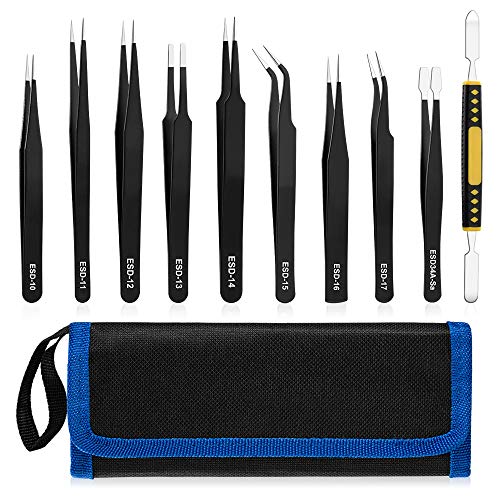
 Antonki 12-in-1 Precision Metal Tweezers Set with Leather12 Piece Set5.4 x 0.7 x 0.4 inchesCheck on Amazon


What's inside
- Electronics tweezers are not cosmetic or medical tweezers
- The tip shapes inside a set, and the work each one owns
- Materials: stainless grades, carbon steel, titanium and ceramic
- ESD: the invisible reason ratings exist
- Tip closure, clamping force and the one-minute inspection
- What a sensible set actually contains
- Choosing by the work: phones, laptops, watches and hobby soldering
- Care: keeping points true and clean
- Check prices on Amazon
- Disclosure and how this guide was put together
As an Amazon Associate I earn from qualifying purchases. This post may contain affiliate links at no extra cost to you.
Ask a repair technician to empty a tool roll onto the bench and one item always lands near the middle: a pair of fine tweezers, usually several. Soldering irons get the glory and multimeters get the budget, yet the tool that actually touches the work most often is the humble tweezer. Every resistor lifted, every connector reseated, every stray strand of wire pulled clear of a solder bridge passes between two narrow points of steel. On a busy bench the tweezers are picked up and set down hundreds of times in a single session, more often than the iron in many rework jobs, because modern boards are mostly about placing, holding, nudging and retrieving rather than melting joints.
A single cheap pair bought on impulse rarely survives that workload gracefully. Bargain tweezers tend to share the same faults: tips that meet at one corner and gap at the other, arms that flex sideways under modest pressure, edges sharp enough to slice a fingertip or score a solder mask, and a finish that starts flaking the first time flux cleaner touches it. Each flaw sounds minor in a product photo. On a real board, a misaligned tip turns a simple pickup into a small catapult, and the component you needed is suddenly on the floor, in the carpet, or lost inside the device you were trying to save.
A proper set solves a different problem than a single pair. Boards do not present one kind of task. A phone mainboard crowds parts so tightly that only a needle-fine point can enter the gap, while a laptop board asks for a wider blade that can lift a shield can or hold a ribbon connector steady. A set puts several tip geometries in one case, each ground for a family of jobs, and it does so with consistent steel and consistent alignment from pair to pair. When one shape becomes familiar in the hand, the others feel like relatives rather than strangers, and that consistency shortens the fumbling that beginners mistake for clumsiness.
There is also the matter of wear. Tweezers are consumables in slow motion. Tips bend when they meet a dropped phone or a careless drawer, edges dull after months of scraping flux residue, and springs lose their snap. A set bought with a spare of the most-used shape keeps a repair moving on a Friday evening when no supplier can help you. Buying the set is really buying continuity: the right shape, in working order, within reach, every time the board demands it.
This guide walks through what separates a bench-worthy set from a drawer of bent metal. It covers tip shapes and the jobs each one owns, the steels and ceramics those tips are made from, the static-electricity ratings that protect delicate silicon, and the simple checks any buyer can run in the first minute of ownership. Nothing here depends on brand loyalty. The same reasoning applies to a modest kit for a hobby drawer and to the pricier sets that professional shops reorder by the dozen.
Consider how a repair actually unfolds and the tweezer count becomes obvious. A board arrives, screws come out with a driver, and then the driver goes back to its stand for the rest of the job. The iron wakes up for a few minutes at a time. The tweezers, by contrast, lift the shield, hold the cable, steady the connector, present the new part, adjust its rotation by a degree, retrieve the screw that rolled under the board, and fish out the sliver of solder that bridged two pins. They are the continuity between every other tool’s brief appearances. A bench can forgive a mediocre screwdriver because screws are patient; it cannot forgive a mediocre tweezer because components are not.
Skill interacts with tool quality in a way beginners rarely hear. A newcomer with a warped pair assumes the fault lies in their hands, practices harder, and builds compensating habits: squeezing too firmly, approaching parts at odd angles, hunting launched capacitors across the floor. Hand that same person a true pair and the supposed clumsiness evaporates within an afternoon, because the tool finally reports honestly what the fingers are doing. Experienced technicians know this, which is why they lend good tweezers to trainees and keep the bent ones for prying battery connectors and other honorable rough work.
Electronics tweezers are not cosmetic or medical tweezers
All tweezers pinch, but the family resemblance ends there. Cosmetic tweezers are built for hair: a slanted or pointed tip, a firm spring, and enough closing force to grip something anchored in skin. Their tips are comparatively thick because a hair is forgiving cargo, and their makers polish the outside for the bathroom shelf rather than grinding the inside faces for precision contact. Medical tweezers, often called forceps in that world, answer to a different master again. They are designed to be sterilized in autoclaves, to hold tissue or dressings without slipping, and many carry teeth or serrations that would be destructive on a circuit board.
Electronics work reverses those priorities. The cargo is rigid, tiny and fragile: a ceramic capacitor the size of a grain of sand cracks if the grip lands wrong, and a gold-plated contact finger bends if the tip closes with real force. What matters is how fine the point is, how exactly the two points meet, and how little pressure the job needs. Good electronics tips taper to a fraction of a millimeter, meet along a short flat or a precise point, and close with a spring light enough that the user feels the part seat rather than crushing past it. Serrations, so helpful in surgery, would chew component markings and slip on hard ceramic bodies, so bench tweezers keep their inner faces smooth or very finely finished.
Alignment is the second dividing line. A cosmetic pair can be a half millimeter off and still pull a hair. An electronics pair that is half a millimeter off will roll a small resistor instead of lifting it, because the part pivots on the one tip that touched first. Makers of serious bench tweezers grind and match tips as a pair, then check them against light: hold the closed tips up to a lamp and a good pair shows no bright wedge leaking through. That single quality step explains much of the price gap between a checkout-aisle pair and a bench pair.
Material expectations differ too. Bathroom tweezers may be plated mystery metal that rusts in a steamy cabinet. Bench tweezers face isopropyl alcohol, flux removers, occasional contact with a hot iron, and the mild acids in rosin residue, so they are normally solid stainless steel or a purpose-chosen alloy rather than a coating over something soft. Finally there is static. A cosmetic or medical tool carries no electrostatic rating at all, because hair and bandages do not die from a spark. On a bench, as a later section explains, an unrated tool can carry a charge straight into a gate oxide layer that never forgives it. Electronics tweezers are therefore sold with documented surface behavior, and that paperwork is part of the product.
The tip shapes inside a set, and the work each one owns
Straight fine tips for general SMD handling
The straight fine pair is the default hand on most benches, the one that lives outside the case while the others wait inside. Its points run parallel to the arms, taper evenly, and meet in a small, crisp contact patch. That geometry suits the everyday grammar of surface-mount work: sliding in from the side to grip a resistor by its end terminations, feeding a jumper wire through a crowded channel, or plucking a hot component away the moment its joints let go. Because the tips point where your fingers point, aim is intuitive, and beginners usually start here before they trust the stranger shapes.
A typical scene: a phone board with a failed capacitor sitting between two taller neighbors. The straight pair enters from above, closes on the part body with the lightest squeeze, and lifts straight up once the iron has freed both ends. No sideways sweep, no contact with the neighbors, no drama. The same pair then holds a replacement steady against its pads while the first joint is tacked, which is the moment alignment earns its keep, because a part held crooked gets soldered crooked.
Curved tips for reaching under and around
Curved tweezers bend the last stretch of each arm so the points approach the board at an angle while your hand stays higher and clear. That bend buys two things. First, sight lines: with straight tips your knuckles often eclipse the very component you are placing, while a curve drops the working point below your fingers so the part stays visible under magnification. Second, access: many parts sit in the shadow of a tall electrolytic capacitor, a shield wall or a connector housing, and a curved point can hook under an edge that a straight point can only push against.
Picture seating a small IC where one row of pins hides beneath the lip of a metal shield. The curved pair cradles the package from the sides, tips curling slightly under the body, and lowers it the final millimeter without your hand tilting into the shield. Curved tips also shine when threading flexible cables behind brackets, or when lifting a part that must come out at an angle because a socket wall blocks a vertical path. The trade-off is a slightly less direct sense of force, which is why most technicians keep curved pairs for placement and retrieval rather than for stubborn, high-pressure grips.
Wide flat tips for lifting ICs and holding connectors
Wide flat tips look almost like tiny spatulas, and they behave like them. Their broad faces spread closing pressure across a large area, which is exactly what a quad flat package or a delicate connector wants. A narrow point concentrates force and can dent a plastic package or crack a corner; a flat blade cradles the whole side of the chip, so the lift rises evenly and no single pin row takes the strain. Sets aimed at board-level repair nearly always include one wide pair for this reason.
Connector work is the other home of the flat pair. Board-to-board connectors and ZIF sockets punish pointy tools: a fine tip slips off the housing, digs into a contact, or pries where it should only hold. The flat pair can grip a connector body across its width while the other hand works the latch, or hold a ribbon cable flat and square while it slides home. Anyone who has watched a fine tip skate across a connector and scar the housing learns to reach for the wide pair first, and to keep it near the front of the case.
Ultra-fine needle tips for 0402 parts and hair-thin wire
The smallest common imperial SMD size, 0402, measures about a millimeter long, and the metric 0402 is smaller still. At that scale a merely fine tip looks like a fence post. Ultra-fine needle tips taper to points that can enter the gap between adjacent pads, separate two strands of magnet wire, or nudge a single solder ball back into formation. They are the specialists of the set, brought out for the jobs where everything else is simply too wide to fit.
They are also the most fragile members of the family. A needle point that can split a bundle of fine wire can also bend when it meets the edge of a bench or gets used, wrongly, to pry a stuck shield. Experienced hands treat the ultra-fine pair as a precision instrument rather than a lever: grip is feather-light, lifts are vertical, and the pair goes back into its protective cap the moment the tiny work ends. A set that includes this shape alongside sturdier siblings lets each tool stay inside the force range it was ground for, and that division of labor is the quiet argument for owning a set at all.
One more shape question hides inside many sets: tip length relative to the taper. Two straight pairs can share a silhouette in a catalog photo yet behave differently at the board, because one grinds its taper over a long, gradual run and the other keeps thick arms until a short, abrupt point. The long taper slips between tall neighbors and flexes a little, forgiving small errors in squeeze pressure. The short taper feels rigid and exact, preferred by technicians who place parts against a hard stop or work on densely packed RF sections where any springiness reads as vagueness. Neither is better in the abstract; they suit different hands and different boards, which is why better sets describe tip dimensions rather than relying on adjectives like precision or professional.
There is also a handedness to curved pairs that listings rarely mention. Most curves bend in the plane of the arms, so the points drop below the grip line, and that suits everyone. A smaller family bends slightly sideways as well, letting the points approach a part from the left or the right while the wrist stays neutral. Watch and phone specialists who work through a microscope for hours value that sideways offset, because a neutral wrist at hour four is worth more than a clever feature at minute four. If a set includes an offset pair, treat it as a comfort tool for long sessions rather than a gimmick.
Finally, consider what the shapes share: the last millimeter decides everything. A set whose four shapes all close perfectly will outperform a larger set whose points were ground carelessly, every single day. Shape variety earns its keep only after alignment is proven, so the inspection routine described later in this guide applies to every pair in the case, not just the flagship straight pair that product photos love to feature.
Materials: stainless grades, carbon steel, titanium and ceramic
Most bench tweezers are stainless steel, but the grade number printed in a listing carries real information. Type 304 is the workhorse: decent hardness, strong corrosion resistance, and a spring temper that survives years of flexing. Type 316 adds molybdenum, which improves resistance to chlorides and some cleaning chemistries; shops that wash boards often, or coastal workshops fighting salty air, notice the difference as fewer rust freckles at the tip after a humid season. Both grades are mildly magnetic at most, and in practice usually described as low-magnetic rather than truly non-magnetic, a distinction that matters when a tiny steel screw or a magnetized component is involved.
Carbon steel sits at the harder, cheaper end of the catalog. It takes a keener edge and a finer point than soft stainless, which is why some precision pairs still use it, but it rusts eagerly and often wears a black or nickel coating for protection. Once that coating chips at the tip, corrosion follows, and a pitted tip grips unevenly. Carbon pairs also tend to be fully magnetic, so they will happily collect every loose screw on the bench and can tug at small steel parts you meant to place, not attract. For occasional hobby use in a dry room they can be fine; for daily bench duty they ask for more care than most people give.
Titanium answers a specific set of complaints. It is far lighter than steel, completely non-magnetic, and shrugs off both heat and most bench solvents. Solder does not wet titanium easily, so a tip that brushes a molten joint comes away clean instead of carrying a blob that glues it to the next part. The compromises are price and feel: titanium is less stiff, so long thin arms can feel springy, and its points do not hold a needle edge as long as hardened steel. Technicians who work long shifts often keep one titanium pair for the weight alone, because grams matter when the tool is in your fingers for six hours.
Ceramic tips occupy the far end of the bench. Fitted to metal or composite handles, ceramic points are electrical insulators, immune to solder heat at any temperature a hand tool will meet, and indifferent to flux removers and board washes. That makes them the safe choice around live circuits and the clean choice for optics-adjacent work. Their weakness is brittleness: drop a ceramic pair on tile and the point may chip or snap outright, and no amount of careful filing restores the original profile. A set rarely consists of ceramic alone; more often one ceramic pair rides along as the specialist for hot, live or chemically messy jobs.
Heat behavior deserves a sentence of its own. Any tweezer tip will occasionally touch a joint at soldering temperature. Stainless tolerates brief contact without softening, titanium and ceramic barely notice, and plated carbon steel suffers most because heat accelerates coating failure. Solvent behavior runs the other way: solid metals of every kind handle alcohol and commercial flux removers well, while painted or plastic-coated handles are the weak link, softening or peeling after repeated soaking. When a listing is vague about material, that vagueness itself is information, and our research treats unnamed alloys as a reason to keep looking.
Hardness numbers give shoppers one more honest comparison. Makers who publish a Rockwell figure for their tips are telling you how the point will age: harder tips resist the slow rounding that comes from a thousand pickups, while softer tips trade that longevity for toughness against bending. A point can be hard and still snap if it is thin, so hardness should be read alongside tip thickness rather than as a standalone score. When two sets look identical on paper, the one that publishes hardness, grade and magnetic behavior is usually the one whose maker expects scrutiny.
Antimagnetic claims deserve the same scrutiny. True antimagnetic alloys exist, developed for watchmaking and laboratory work, and they cost noticeably more than ordinary stainless. Some listings borrow the vocabulary for steel that is merely less magnetic than carbon steel. The practical bench check is simple and costs nothing: a genuinely antimagnetic pair will not lift a steel sewing pin or a small screw from the mat, while a mildly magnetic pair picks it up reluctantly and a carbon pair snatches it. Knowing which behavior you own matters more than the label, because a mildly magnetic pair is perfectly serviceable as long as nobody uses it to sort micro screws.
Handles and coatings complete the material story. Some pairs are bare metal from point to heel, which makes them easy to clean and impossible to peel. Others carry a dissipative polymer coat over the grip area, which adds comfort and the static behavior discussed next, at the price of a surface that solvents and heat can eventually damage. A third family uses replaceable tips on a shared handle, common with ceramic points, so a chipped point becomes a small spare-part purchase rather than a whole new tool. Each arrangement is defensible; the mistake is buying one while imagining another.
ESD: the invisible reason ratings exist
Static electricity is a bench hazard precisely because it is unfelt at the levels that do damage. A person walking across a dry room can carry thousands of volts, yet the discharge only stings when it climbs far higher than the threshold that injures electronics. A MOSFET gate is insulated from its channel by an oxide layer measured in atoms; a modest spark punches through that layer and the transistor is altered forever. Sometimes the part dies on the spot. Worse, sometimes it limps onward weakened, passes a quick power-on check, and fails in the customer’s hands a month later, which is why experienced shops treat static discipline as warranty protection rather than superstition.
Integrated circuits share the vulnerability in different degrees. Logic parts with exposed inputs, RF front ends, and bare sensor dies sit near the fragile end; beefier power parts with internal protection tolerate more abuse. The trouble is that a repairer rarely knows which board hides a delicate input one pad away from the joint being reworked. A tool that is safe for every part removes the need to guess, and that is the real product being sold when a tweezer carries an electrostatic-discharge rating.
Makers mark compliant tools in a few recognizable ways. Look for the letters ESD in the product name, the international hand-in-triangle protective symbol stamped or printed on the handle, or wording that describes the tool as dissipative or static-safe. Coated handles in matte black are a common visual cue, since the coating is often the dissipative element, but color alone proves nothing; plenty of plain black paint insulates perfectly. The honest signal is a published surface-resistance figure, which leads to the numbers themselves.
Surface resistance describes how willingly charge bleeds away instead of jumping. Conductive materials sit at the low end and dump charge fast, insulators sit at the high end and hold charge until it arcs, and dissipative materials occupy the middle band, commonly quoted between one million and one billion ohms per square for bench tools and worksurfaces. That middle band is the sweet spot for tweezers: charge drains off in a calm trickle rather than a spark, and the tool never becomes a charged object waiting for a victim. When a set publishes a range in that band for its coating or its full-metal body treatment, the claim can be compared across brands; when it publishes nothing, the ESD label is decoration.
Tools are only one link in the chain. A dissipative tweezer in the hand of a person standing on carpet, wearing a fleece, with no wrist strap, still delivers the person’s charge to the board. The habits that complete the picture are unglamorous: a grounded mat under the work, a wrist strap worn and actually plugged in, boards handled by their edges, and humidity kept from desert levels in winter. Sets sold for professional benches assume that environment; hobbyists working without a mat can still cut risk sharply by touching a grounded metal object before picking up a board and by choosing dissipative tools over bare insulators. Readers setting up a first home bench often pair that discipline with a look at charging gear for the batteries their test instruments eat, and best aa chargers is a reasonable place to compare options for keeping those cells ready.
Damage from static often hides behind a confusing symptom pattern. A board that took a discharge may boot, pass a quick function check, and then misbehave only when warm, or only on one channel, or only after a week of ordinary use. That ambiguity is why repairers who skip static precautions also tend to distrust their own diagnoses later: every intermittent fault could be a part they wounded themselves. A dissipative tool habit removes an entire category of doubt from the bench, and that mental clarity is worth as much as the silicon it saves.
Season and clothing change the risk more than most people expect. Heated indoor air in winter dries out fast, synthetic fleece and wool sweaters generate charge generously, and soft-soled shoes on carpet complete the generator. Summer humidity bleeds charge away quietly, which is why some benches seem cursed in January and blessed in July. A rated tweezer behaves the same in every season, and pairing it with a habit of touching the grounded mat before reaching for a board covers the months when the air itself is working against you.
One caution about coatings: the dissipative layer on a coated pair is a working surface, not paint. Solvent soaks, abrasive cleaning and years of grip wear can thin it, and a tool that was compliant when new may drift out of its published band with age. Shops with formal compliance needs measure their tools on a schedule. Home benches can take the simpler lesson: treat coated pairs gently, keep them out of solvent baths, and let full-metal dissipative designs carry the rough work when both kinds are in the case.
Tip closure, clamping force and the one-minute inspection
Specifications end where the hand begins, and tweezers reward a buyer who inspects them on arrival. The first check takes five seconds: close the tips slowly against a bright background and watch how they meet. The points should arrive together, touch along their intended contact zone, and show no sliver of light and no sideways offset. A pair that crosses like scissors or lands tip-to-side will spend its life rotating parts instead of holding them, and no break-in period fixes geometry that was ground wrong at the factory.
The hair check comes next. Pluck a single hair, or use a fine thread, and grip it near the very points with the gentlest squeeze that closes the tips. A well-matched pair holds the hair against a light tug without sawing through it. This sounds like a party trick, yet it maps directly onto bench reality: the same delicate, even contact is what keeps a strand of 0.1 mm magnet wire from slipping while you tin its end. If the hair slides out no matter how carefully you close, the inner faces are not meeting as a team.
Then the live-fire version: pick up the smallest loose component you own, ideally an 0402 or 0603 part, ten times in a row. Count the launches. A sound pair should hold the part through a short carry and a gentle set-down every time, without demanding a white-knuckle squeeze. Parts that squirt out sideways point to tips that meet at a single corner; parts that rotate as you lift point to a twist between the arms. One launch in ten might be your technique. Four launches in ten is the tool confessing.
Spring character matters over hours, not seconds. Squeeze the pair fully closed fifty times and notice where the effort lives. Good arms flex along their length and return with a smooth, even resistance; poor arms hinge near one spot and feel notchy. During long sessions, a spring that is too strong tires the small muscles between thumb and forefinger and quietly degrades placement accuracy, while a spring that is too weak lets parts drift at the exact moment the iron arrives. There is no universal right answer, but the middle path suits most hands: firm enough that the grip feels deliberate, light enough that the fiftieth placement is as controlled as the first.
Finish the inspection with the edges. Run a fingertip lightly along the outside of the closed tips. You are feeling for burrs and knife edges left by cheap stamping. Burrs scratch solder mask, snag gloves, and nick the insulation of fine wire. Quality pairs arrive with edges broken just enough to be safe while the working faces stay crisp. If a new set fails two or more of these checks, return it while the window is open; tweezers do not improve with age, they only decline more slowly when they start out right.
Grip width is the quiet half of clamping comfort. Arms that sit too close together force the fingers into a pinched posture, while arms spaced widely suit larger hands and gloves. Many quality pairs let the user adjust the resting gap slightly by gently setting the arms, though that is a once-at-setup task rather than a daily habit, and it should be done before judging the spring. If several people share one bench, a set whose pairs share a similar resting width keeps muscle memory portable from one technician to the next.
Sound is an underrated diagnostic. Close a good pair slowly and it makes almost no noise until the faces meet with a soft tick. Gritty scraping sounds during the squeeze suggest rough inner faces or debris from manufacturing that was never cleaned out. A quick rinse, a dry, and a second listen will tell you whether the noise was dirt or geometry. Geometry does not wash off, so a pair that still scrapes after cleaning belongs in the return box alongside the pairs that failed the light check.
Weight rounds out the inspection. Heavier is not better and lighter is not cheaper by definition; what matters is balance. A pair that carries its mass near the grip feels calm during slow placements, while a tip-heavy pair wants to nod forward and demands constant correction. Roll each pair slowly between your fingers and notice where it wants to settle. The pairs that settle neutrally are the ones that will feel invisible during the long, magnified work where attention is scarcest.
Left-handed users and users with smaller hands should run one extra check that listings never mention: symmetry of effort. Most tweezers are symmetric tools, yet the comfort of the squeeze depends on where the arms’ widest point falls relative to the fingertips. A pair that feels balanced in a large right hand can feel tip-heavy in a small left one, not because the tool changed but because the contact points did. Rotating the pair and repeating the pickup drill with the other hand, when the work allows it, reveals whether a set serves the whole bench crew or only its most average member. Teams that share tools learn quickly that one person’s favorite pair is another person’s daily annoyance, and a set with two lengths of the straight shape quietly solves that argument too.
It is also worth checking how a pair behaves when the part is wet with flux or the board is warm. Grip that feels secure on a dry, room-temperature component can turn skating-rink slippery once residue enters the equation. A quick rehearsal with a scrap board and a dab of flux tells the truth before a customer’s device does. Pairs whose inner faces carry the faintest matte texture tend to hold their manners in those conditions, while mirror-polished faces, however beautiful in photographs, sometimes need a cleaning wipe between placements to stay predictable.
What a sensible set actually contains
Count the shapes before you count the pieces. A balanced starter set covers the four geometries described earlier: one straight fine pair, one curved pair, one wide flat pair, and one ultra-fine pair. Many kits add a fifth and sixth member, often a reverse-action pair that stays closed on its own and opens when squeezed, which holds a part without constant finger pressure during long alignment work. Beyond six, sets tend to repeat shapes in slightly different lengths, which helps a busy shop equip several benches but adds little for a single user.
Length deserves a thought. Longer tweezers, around the length of a hand from wrist to fingertip, reach deep into a chassis without dragging knuckles across tall parts, but they amplify hand tremor at the point. Shorter pairs feel steadier for board-level SMD work under a microscope. A set that mixes one longer pair among standard lengths quietly covers both worlds, and it is a detail worth scanning a contents list for.
Storage is not packaging fluff; it is tip insurance. The best arrangements give each pair its own slot in a roll, a fitted case, or individual tubes, so steel never rattles against steel in a drawer. Loose bundles tied with an elastic band guarantee that the finest point in the set will eventually meet the hardest object in the drawer. A case that also keeps the set closed and flat on the bench, rather than in a toolbox across the room, raises the odds that the right shape gets used instead of whichever pair happens to be out.
Tip protectors, the small caps or sleeves that slide over closed points, look like the first thing a buyer would throw away. Keep them. Most bent tips happen off the board: in drawers, in transit, in the moment a pair slides off the bench edge. A cap turns a fall into a non-event and keeps needle points from punching through case fabric. If a set ships without protectors, short lengths of soft tubing from a craft store do the same job for pennies.
The spare question resolves differently than most buyers expect. Duplicates of the shape you use hourly are worth more than exotic shapes you use yearly. For most benches that means a second straight fine pair, because it is the one that will be mid-repair when its tip meets the floor. A spare lets the damaged pair wait for a careful straightening session instead of forcing a rushed fix or a repair performed with the wrong geometry. When a kit offers a choice, choose depth in the workhorse shape over breadth at the margins.
Charging and power gear crowds the same benches, and readers who maintain a fleet of flashlights, meters and cordless drivers for repair work may also want to compare best 18650 battery chargers for the cylindrical cells those tools share. Likewise, anyone building a compact travel kit for field repairs often ends up weighing compact power bricks, and best 65 watt usb c chargers collects the considerations for that class of adapter.
Labeling sounds trivial until two pairs look alike at a glance. Straight fine and ultra-fine pairs, in particular, are easy to confuse when both wear their caps, and grabbing the fragile one for a stubborn job is how needle points die young. Better cases print the shape name beside each slot; where they do not, a small dot of paint or a strip of tape on the heel of each pair creates a code your fingers learn within a week. Shops with several benches often engrave or tag pairs by station, because a set that wanders becomes a set that vanishes.
Travel and field work change the arithmetic of a set. A technician who repairs point-of-sale terminals or industrial controllers on site needs the same four shapes in a roll that survives a tool bag, plus the spare straight pair, because a bent tip at a customer site cannot be swapped from a drawer. Roll-up fabric cases beat rigid boxes in bags, since they flex instead of cracking, and individual tip caps stop being optional when the whole kit rides in a vehicle. Home benches can favor the rigid case that stands open like a small bookcase; the contents are identical, only the armor differs.
Choosing by the work: phones, laptops, watches and hobby soldering
Phone repair
Phones compress everything. Shields sit a hair above the parts you need, connectors stack in layers, and screws differ by fractions of a millimeter within the same device. The straight fine pair does most lifts, the curved pair earns its place whenever a flex cable must be coaxed from under a bracket, and the ultra-fine pair handles the tiniest capacitors near the baseband section. Magnetic behavior matters here more than anywhere: a strongly magnetic pair will collect the very screws you just organized, so low-magnetic stainless or titanium is the calmer choice. Short-to-medium lengths suit phone work because the field of action is small and usually viewed through magnification.
Laptop and larger board repair
Laptop boards spread out, and their parts grow with them. Larger inductors, chunky MOSFETs, full-size connectors and long shield cans shift the balance toward the wide flat pair, which lifts big packages without tilting them into neighboring parts. Longer straight pairs help reach across a wide board without leaning over hot sections, and the extra leverage of a firmer spring is welcome when a connector housing needs a confident grip. ESD discipline also scales up here, because a laptop board concentrates expensive silicon in one place and a single careless discharge can turn a charging-port repair into a board replacement.
Electronic watches, clocks and scale models
Horology and modeling share a taste for the minute and the easily lost. Watch work involves gears, springs and screws that make 0402 parts look chunky, and it prizes non-magnetic tools above almost everything, because a magnetized tweezer can drag a hairspring out of truth. Ultra-fine and curved pairs dominate, often in titanium or antimagnetic alloys, and the grip is the lightest of any discipline in this guide. Model builders borrow the same tools for photo-etched parts, tiny decals and rigging wire, where a flat pair holds a miniature railing flat while adhesive sets. In both worlds the bench is unhurried and the parts are irreplaceable, so tip condition is checked before every session, not after something goes wrong.
DIY soldering and electronics hobbies
The hobby bench is the most forgiving and the most varied: through-hole kits one weekend, a drone rebuild the next, a keyboard build after that. A four-shape set in 304 stainless covers nearly all of it, and the reverse-action pair becomes a quiet hero when a component must be held in a through-hole while both joints are soldered from the other side. Hobbyists also drop tools more often, because the bench doubles as a desk, so a case with real slots matters. For readers who draw their own enclosures or design panels on a pen display at the same desk, best drawing display tablets that don t need a computer covers screens that work without a tethered PC, a natural companion purchase for a maker corner.
Shared benches add one more selection factor: cleanability between users and jobs. A pair that moves from a leaded-solder repair to a food-adjacent appliance control, or from a dusty industrial board to a clean phone, should wash up completely without trapping grime in serrations or under peeling coats. Smooth faces and solid metal win that contest easily. This is also why many professional sets avoid fabric-wrapped or foam-dipped handles, however comfortable they feel in the first minute of a showroom visit.
Budget, handled honestly, sorts buyers into two camps. Occasional users who open a device twice a year can accept a modest stainless set and the small risk that one pair arrives imperfect, provided they run the arrival checks and use the return window without sentimentality. Weekly repairers should buy the best-aligned set they can justify, because their cost is measured in hours and lost components rather than in the difference between two listings. Both camps lose money the same way: by buying a giant set of mediocre pairs when a compact set of true ones was within reach.
Care: keeping points true and clean
Most tweezer deaths are falls. A pair knocked off the bench lands on its points with the full enthusiasm of gravity, and the finer the point, the more likely it bends. Build one habit and you prevent most of it: tweezers rest on the mat, never on the bench edge, and they travel in their case rather than in a pocket or a loose tray. When a fall does bend a tip, inspect before you fix. Close the pair against light and see whether one arm moved or both did. Gentle correction with smooth-jaw pliers, working in small steps and checking against the light after each, can rescue a modest bend in a sturdy pair.
Flux is the daily enemy rather than the dramatic one. Rosin and no-clean residues bake onto warm tips and dry into a varnish that makes parts stick when they should release and slip when they should hold. A wipe on a damp cellulose sponge or a pass with alcohol on a lint-free swab after a session keeps the faces honest. Dried, stubborn residue responds to a soak of the tips only, never the whole tool if the handles carry a coating, followed by a careful wipe along the grain of the metal. Avoid scraping tips with a blade; every scratch becomes a future grip problem.
Sharpening and dressing have limits. A fine stone or a sheet of very fine abrasive on a flat surface can restore a dulled edge on a straight or flat pair: close the tips, draw them across the abrasive a few times with even pressure, and check the meeting against light. Needle points and ceramic tips do not forgive this treatment; a needle point that has been stoned usually ends up shorter and blunter than a new pair, and ceramic cannot be dressed at home at all. Replace instead when the hair check fails after cleaning, when a crack appears near the tip, when one arm has been bent and straightened twice, or when corrosion pits the contact faces. A tweezer is a measuring instrument for your fingers, and like any instrument it should be retired when it starts lying to you.
Storage closes the loop. Caps on, slots filled, case shut, and the set stored dry. A drop of light oil on carbon steel pairs before long storage prevents the freckles that become pits. Once a season, run the one-minute inspection from the earlier section on every pair in the case; it takes less time than one lost component hunt on the floor, and it turns surprise failures into planned replacements.
One last storage distinction separates home benches from production lines. In a drawer at home, the enemy is other tools; on a production line, the enemy is pace, and pairs are swapped mid-shift without ceremony. Home users can therefore favor cases that protect a personal set beautifully, while small repair shops do better with open trays that make a missing pair obvious at a glance. Either way, the seasonal inspection stays the same, and a pair that fails it should leave the rotation immediately rather than drifting back into service because it was somebody’s favorite.
Retirement, handled early, is cheaper than retirement handled late. A worn pair demoted to opening battery doors, lifting labels and other rough errands still earns its drawer space, and marking the heel with a dot of paint keeps it from wandering back into precision service by mistake. The set as a whole, though, should always contain at least one pair you trust completely for the smallest part on your most valuable board; the day no pair in the case earns that trust is the day the set has quietly expired, whatever its purchase date says.
Check prices on Amazon
Live listings for the shortlist in this guide are pulled from Amazon below, so prices and availability are always current at the moment you look.




Disclosure and how this guide was put together
As an Amazon Associate we earn from qualifying purchases. Links from this page to a retailer may pay this site a small commission when a reader buys, and that commission arrives at no added cost to the buyer. It funds the time spent reading spec sheets and standards documents, and it never changes which shapes, materials or ratings this guide recommends, because the recommendations follow the physics of the bench rather than the contents of any catalog.
Everything stated here rests on published manufacturer documentation, material data sheets for the alloys discussed, and publicly available electrostatic-discharge standards and guidance. We did not invent specifications, and where makers disagree about a grade or a rating band, the guide describes the range rather than crowning a winner. Readers should confirm the exact figures for a specific set on its maker’s own documentation before relying on them for a professional compliance requirement.
Good tweezers disappear in the hand, and that is the whole point: when the tool stops announcing itself, your attention lands where it belongs, on a millimeter of board and the small part that decides whether a dead device wakes up again.