Our Top Picks



What's inside
- Why the factory antenna is usually the bottleneck
- What counts as a super whip in this category
- Antenna length and the portability trade-off
- The Nagoya NA-771 pattern: long flexible whip
- The Signal Stick pattern: light wire whip thinking
- The Abbree tactical pattern: folding tape antennas
- The Diamond SRH77CA pattern: established premium whip
- Dual-band performance on 2 metres and 70 centimetres
- Connectors: SMA female, SMA male, and BNC
- Flexibility, durability, and daily abuse
- Counterpoise and the tiger tail concept
- Check prices on Amazon
- Matching a whip to Baofeng, Yaesu, Kenwood, and Anytone radios
As an Amazon Associate I earn from qualifying purchases. This post may contain affiliate links at no extra cost to you.
A handheld radio lives or dies by the antenna screwed onto its top, so this comparison begins with a plain disclosure. This page includes affiliate links, and the site may receive a commission if readers purchase through them, with no extra cost to the reader. All comparisons below draw on manufacturer specifications, published data sheets, and owner reports, not on any claim that the site has handled the products directly. High-performance whip antennas for handheld transceivers, often grouped under the informal label super whips, promise a simple upgrade: unscrew the factory antenna, fit a longer and better engineered radiator, and hear more of the band.
The handheld transceiver, or HT, packs a complete two-way radio into a body that fits one hand, covering the 2 metre band near 144 to 148 megahertz and the 70 centimetre band near 420 to 450 megahertz in most dual-band models. Brands such as Baofeng, Yaesu, Kenwood, and Anytone ship these radios with compact antennas chosen for packaging, durability, and cost rather than maximum reach. Owners quickly learn that the radio electronics usually outperform the stubby radiator supplied in the box. A whip upgrade is therefore the first modification most HT owners consider. It requires no opening of the radio, no soldering, and no change to programming.
Expectations need calibration before any model names enter the discussion. A better whip improves the efficiency with which the radio radiates and receives within line-of-sight limits set by terrain and height. It cannot repeal geography, and a valley floor will still struggle to reach a repeater hidden behind a ridge. What owners report, consistently, is stronger repeater access from familiar spots, cleaner audio at the edges of coverage, and receive performance that finds signals the factory antenna missed. Those gains are worthwhile precisely because HT radios are used at the margins. Nobody upgrades a whip to improve a contact that already sounds perfect.
Readers who carry radios alongside other mobile gear may enjoy our related material filed under best truck bluetooth headsets, where hands-free audio for drivers raises a different set of fit and durability questions. The common thread is that accessories chosen for a vehicle or a belt kit must survive daily handling rather than shelf life. HT antennas live a hard life in door pockets, backpacks, and centre consoles. This guide weighs published electrical performance alongside that physical reality. A whip that performs beautifully but snaps in a month is a poor upgrade by any honest accounting.
Why the factory antenna is usually the bottleneck
Factory antennas for budget and mid-range HT radios are exercises in compromise. Manufacturers must keep the packaged radio compact, protect the antenna connector from the leverage of a long radiator, and meet price targets that leave little room for elaborate antenna engineering. The result is often a short helical or loaded whip whose electrical length is compressed into a few inches of housing. Published data for factory antennas is rarely offered, which itself tells a story. Accessory makers, by contrast, publish gain and band data because performance is their entire sales argument.
Electrically short antennas radiate inefficiently, especially on the 2 metre band where a quarter wavelength measures roughly 19 inches. A factory stub a quarter of that length depends on loading coils and the radio body to complete the system, and much of the transmitter energy warms the loading structure instead of leaving as radio waves. Receive performance suffers in parallel because antenna behavior is reciprocal: a poor radiator is also a poor collector. Owner reports describing a replacement whip as transformative usually reflect how poor the starting point was. The radio did not change; the weakest component did.
The connector and feed point add another quiet limitation. On many HT radios the antenna mounts directly to a socket that also serves as a mechanical anchor, and the radio case plus the operator hand form part of the antenna system. A short factory whip keeps that system small and detuned by every grip change. A longer whip raises the radiating element above the hand and case, which stabilises performance in ordinary use. That geometric benefit appears in owner reports as consistency rather than raw distance. Signals stop fluttering when the operator shifts grip or turns around.
Cost pressure also shapes factory antenna bandwidth. A dual-band radio needs an antenna that behaves acceptably on two bands separated by a factor of three in frequency. Cheap designs achieve this with lossy compromises that are adequate near a strong repeater and inadequate at range. Published specifications for quality replacement whips show deliberate dual-band engineering, with stated gain on each band rather than a single vague claim. Buyers should read factory antenna performance as a baseline to beat, not a standard to respect. The accessory market exists because that baseline is low.
There are exceptions worth acknowledging. Premium HT models from established makers sometimes ship with competent whips that narrow the upgrade gap considerably. Owners of flagship radios report smaller improvements from accessory antennas than owners of entry-level sets. That pattern makes sense: the more the maker invested in the supplied antenna, the less headroom remains. Even so, a longer whip still offers mechanical and geometric advantages for outdoor use. Judging your own starting point honestly prevents both disappointment and unnecessary spending.
What counts as a super whip in this category
The label super whip is marketing language rather than a formal standard, so this guide defines it by measurable traits. A super whip is a replacement HT antenna substantially longer than the factory unit, engineered for the 2 metre and 70 centimetre bands, with published gain figures and a connector matched to common HT radios. Lengths in this class run from roughly 15 inches for flexible whips to well over 30 inches for folding tactical designs measured fully extended. Each design balances that length against flexibility, weight, and the strain placed on the radio socket. The category is defined by intent: maximum portable performance without external antennas or mounts.
Four design families dominate owner discussion and structure the rest of this guide. The Nagoya NA-771 pattern represents the long flexible whip, a slim radiator around 15.6 inches with broad brand recognition. The Signal Stick represents the ultra-light wire whip built from memory metal style elements, sold with an emphasis on durability and simple published data. The Abbree tactical pattern represents the folding tape-measure style antenna that extends dramatically and folds for transport. The Diamond SRH77CA represents the established Japanese accessory tradition, a flexible whip with detailed published specifications and a loyal following among Yaesu and other brand owners.
These families differ in philosophy as much as in dimensions. Flexible whips accept moderate length in exchange for everyday carry comfort. Folding tactical designs chase maximum length and accept bulk, unfolding only when the radio is in active use. Wire whips chase lightness and near indestructibility, accepting a very plain appearance. Premium branded whips chase refinement: smooth connectors, consistent manufacturing, and trustworthy data sheets. None of these philosophies is wrong, and the right choice depends on whether the radio lives on a belt, in a vehicle, or in an emergency kit.
Counterfeit and clone products complicate this category more than most accessory markets. Popular models, especially the NA-771 pattern, are widely copied with inferior materials and invented specifications printed on convincing packaging. Owner reports of a bargain whip performing no better than a factory antenna often trace back to a clone. Buying through reputable dealers and checking maker markings are practical defences mentioned throughout owner communities. Published specifications only mean something when the product in hand is genuinely the product described. This guide therefore treats sourcing as part of antenna selection, not an afterthought.
Price bands in this category stay modest compared with the radios themselves, which encourages experimentation. Owners commonly own two whips: a flexible everyday antenna and a long folding design for field days, events, or emergency use. That two-antenna pattern appears repeatedly in owner reports and club discussions. It reflects the genuine trade between portability and performance that no single design has solved. Readers should plan for their dominant use case first and treat a second whip as an optional later addition.
Antenna length and the portability trade-off
Length is the crudest and most honest performance lever available to a whip designer. On the 2 metre band, a radiator approaching quarter-wave length, roughly 19 inches, radiates far more efficiently than a loaded stub of 4 or 5 inches. The 70 centimetre band needs only about 6.5 inches for a quarter wave, so almost every whip in this guide is electrically generous there. This asymmetry explains a pattern in published data: accessory whips claim their largest improvements on 2 metres. Buyers whose activity centres on 70 centimetre repeaters should expect smaller, though still useful, gains from an upgrade.
Carrying a long whip imposes daily costs that specification sheets never mention. A 15 inch flexible whip on a belt-carried radio catches on seatbelts, door frames, and jacket hems, and it announces itself in every room the wearer enters. A 30-plus inch folding antenna is effectively a two-mode device: compact while folded, conspicuous while deployed. Owners who use radios for event support, search tasks, or outdoor recreation accept these costs because operating time matters more than transit comfort. Owners who carry a radio all day for work often settle on the shortest whip that still improves on the factory unit.
Leverage on the antenna socket is the mechanical side of the length question. A long radiator acts as a lever whenever the radio is dropped, sat on, or knocked against a door frame, and the socket and its internal solder joints absorb that force. Radio makers design sockets for the antennas they supply, not for aftermarket whips twice the length. Owner reports include cracked cases and intermittent antenna connections traced to heavy or rigid long whips. Flexible construction mitigates the risk by bending instead of prying. Buyers fitting a long whip to a lightweight budget radio should weigh socket strain as seriously as gain figures.
Vehicle use redraws the trade-off completely. Inside a metal vehicle cabin, any HT antenna struggles, and a longer whip held near a window can still make the difference between reaching a repeater and hearing only static. Many owners keep a long whip in the vehicle kit even if a shorter antenna serves daily carry. Related planning for vehicle power appears in our guide collected under best car chargers, because a radio used from a vehicle needs charging discipline as much as antenna help. The whip decision and the power decision together define a practical mobile HT setup. Neither compensates for neglect of the other.
Storage and transport deserve a line in any buying plan. Flexible whips coil loosely in a go-bag, wire whips tolerate being bent into a pack, and folding tactical antennas need their folded length accommodated by the bag design. A whip that must travel separately from the radio tends to be left behind, and an antenna left at home delivers no gain at all. Owner wisdom in this category often reduces to a blunt rule: the best whip is the one attached when the radio is needed. Portability is therefore not a soft preference but a performance factor in its own right.
The Nagoya NA-771 pattern: long flexible whip
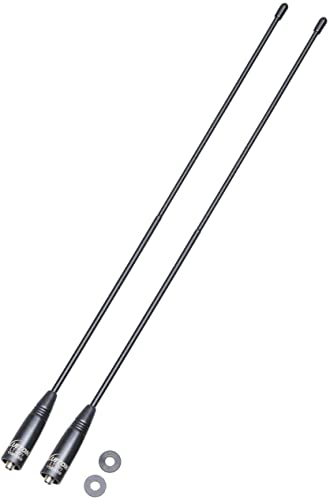
The NA-771 pattern is probably the most widely owned HT whip upgrade in the world, and its published specification explains the appeal. Manufacturer specifications list the genuine NA-771 at about 15.6 inches long, dual-band for 144 and 430 megahertz ranges, with stated gain of 2.15 dBi on VHF and 3.0 dBi on UHF, handling up to 10 watts, and fitted with an SMA female connector in its common version. Those numbers describe a whip roughly three times the length of many factory antennas, with a slim flexible profile. For owners of SMA female socket radios, particularly the large Baofeng fleet, it is the default first upgrade in countless owner discussions.
Real-world reports emphasise receive improvement first. Owners describe repeaters moving from scratchy to full quieting at home desks and walking routes where the factory antenna produced broken audio. Transmit reports from other stations tend to confirm the change, with contacts describing stronger, cleaner signals from the same radio and location. The whip flexibility earns praise for surviving belt carry and backpack transport without visible damage. Its length, however, draws equal comment: the antenna is conspicuous, catches on low branches outdoors, and makes a small radio feel top-heavy. None of that surprises anyone who has seen the dimensions before buying.
Connector variants matter greatly within this pattern. The common version suits radios with SMA male sockets, which means the antenna itself carries the SMA female fitting, a point of confusion covered later in this guide. Buyers must also distinguish the NA-771 from its retractable and gooseneck relatives sold under similar names, which behave differently and publish different data. Clone risk is highest precisely here because demand is highest. Genuine units carry consistent branding and packaging that owner communities have documented in detail. A suspiciously cheap listing with no maker information should be treated as a different, unknown product.
Power handling of 10 watts on the published sheet covers virtually every HT in normal service, since most handhelds transmit at 5 watts or less on high power. A small number of high-power handhelds approach 8 to 10 watts, which still fits the rating but leaves little margin for misuse. The whip is not intended for mobile or base amplifiers, and connecting one would exceed both the rating and common sense. Within handheld service, heat at the antenna base during long transmissions is occasionally reported but rarely described as a failure. Duty cycle discipline belongs to the operator rather than the antenna.
For many buyers the NA-771 pattern is the sensible default against which other whips must justify themselves. It offers documented dual-band gain, huge community experience, and a form factor that works for mixed indoor and outdoor use. Its weaknesses are length in confined spaces and the clone problem in the marketplace. Buyers who verify authenticity and accept the size usually report satisfaction proportional to the modest cost. It is the reference flexible whip for this category, and later sections return to it when comparing connectors and durability.
The Signal Stick pattern: light wire whip thinking
The Signal Stick takes a different engineering path, building the radiator from a super-elastic alloy wire related to the memory metals used in medical and aerospace work. The published concept is simple: a whip around 19 inches in its common dual-band form that can be coiled, bent, and knotted in demonstrations, then spring back straight when released. Maker materials emphasise weight so low that the radio feels almost unchanged in the hand, plus a simple published gain story rather than elaborate claims. The design originated in the amateur community and is sold with an unusually transparent description of its construction. That openness appeals to technically minded buyers.
Durability reports form the core of its reputation. Owners describe sitting on the antenna, closing it in vehicle doors, and stuffing it into overfilled packs without permanent deformation. For radios carried by volunteers at outdoor events, where gear is borrowed, dropped, and rained on, that resilience has practical value beyond any decibel figure. The thin wire profile also reduces socket leverage compared with thicker whips of similar length. A lighter lever arm means less prying force on the radio during the inevitable knocks of field use. Mechanical kindness to the radio is a genuine design achievement here.
Performance expectations should be set by its honest positioning. A plain wire whip of near quarter-wave length on 2 metres will radiate efficiently, and owner reports describe solid repeater access and receive gains over factory antennas. The design does not claim exotic loading or multi-element tricks, so its published story stays close to physics. On 70 centimetres the wire is electrically long, and behavior there follows the published dual-band intent rather than perfection. Buyers seeking the last fraction of UHF refinement may prefer a more elaborately engineered whip. Buyers seeking a whip that simply works after abuse will find the trade attractive.
Practical details distinguish the ownership experience. The wire whip can be coiled for transport in a way no rigid antenna tolerates, which suits emergency kits and travel bags. Its connector options have included SMA and BNC variants, letting buyers match their radio or adopt a quick-release strategy. The plain appearance divides opinion: some owners like the understated look, while others prefer the finished moulding of conventional whips. Tips and end caps matter because a wire end near face height should be properly finished, and maker materials address that point. Small details like that separate a considered product from a length of wire with a connector crimped on.
Community support is an unusual strength of this pattern. The maker has historically engaged directly with amateur buyers, published construction reasoning, and supported charitable amateur initiatives, which owner forums mention with approval. Warranty and replacement experiences reported by owners are generally positive. In a category plagued by anonymous clones, a named maker standing behind a simple product carries weight. The Signal Stick pattern suits buyers who value resilience and transparency over moulded styling. It also suits anyone whose previous whip died by bending, which is a larger group than marketing usually admits.
The Abbree tactical pattern: folding tape antennas
The Abbree tactical pattern borrows its structure from military tape antennas, using a flexible folding element that extends to striking lengths. Common versions publish extended lengths around 28.3 inches and 42.5 inches depending on model, with dual-band coverage for the 144 and 430 megahertz ranges and SMA female fittings aimed at the Baofeng-style fleet. Folded, the element doubles back along the radio into a package that fits a pouch or pack side pocket. The visual effect when extended is dramatic, and owner photographs of these antennas dominate social posts in this category. Drama aside, the electrical idea is straightforward: more length, closer to efficient dimensions on 2 metres.
Reports from field users describe the folding whip as a problem-solver for marginal locations. Event volunteers working in valleys, hikers at trailheads, and operators at the edge of repeater coverage describe contacts completed after unfolding that failed on shorter whips. The gooseneck or folding base lets the element be angled away from the body, which can help when the operator is the largest nearby obstacle. Receive reports follow the same pattern, with weak signals becoming readable once the full length is deployed. These accounts consistently come from stationary or slow-moving use, which suits the format.
The compromises are equally consistent in owner discussion. A fully extended 42 inch class antenna is impractical while walking through woodland, working a crowd, or riding in a vehicle. The folding mechanism and tape element demand a moment of deployment that a fixed whip never asks for. Repeated folding is reported to loosen some joints over time, and the tape can take a set if stored folded under pressure for long periods. Weight and bulk exceed every other family in this guide. Buyers should treat the tactical pattern as a deployable tool rather than an everyday carry antenna.
Published data for this family deserves extra scrutiny because listings vary widely in quality. Some sellers quote gain figures without stating band or reference, and model names repeat across unrelated factories. Buyers should look for a stated length, connector type, band range, and power rating from an identifiable seller, then cross-check against owner reports for that exact listing. The better listings in this family are specific about SMA fitting gender and radio compatibility. Vague listings are a warning sign in a category where a wrong connector makes the product useless on arrival.
Used within its intended pattern, the folding tactical whip fills a real niche. Emergency kits benefit from an antenna that packs flat and deploys long when infrastructure is strained and every contact counts. Field day and portable operators gain a no-cost setup step that improves a handheld station without masts or external antennas. The pattern also appeals to new operators experimenting with how much antenna length matters, because the difference is easy to hear. It is a specialist tool bought for specific outings. Judged as a daily belt antenna it fails; judged as a deployable upgrade it earns its following.
The Diamond SRH77CA pattern: established premium whip
Diamond Antenna is one of the long-established names in amateur accessories, and the SRH77CA is its representative flexible whip for SMA-socket handhelds. Manufacturer specifications list the SRH77CA at about 15 inches long, covering 144 and 430 megahertz, rated to 10 watts, with an SMA fitting intended for the common SMA male radio socket. Diamond publishes its data in the restrained style typical of the brand, and the model has accumulated years of owner reports across Yaesu, Kenwood, Icom, and other radio fleets. Longevity in the catalogue is itself a form of evidence in this fast-moving accessory market. Products that disappoint tend to disappear quietly.
Owner commentary on this pattern centres on consistency and finish. Connectors seat smoothly, the whip flexes without creaking or looseness at the base, and performance from unit to unit is described as uniform. Reports describe clear gains over factory antennas on both bands, with particular praise for receive clarity on 2 metres during handheld outdoor use. The whip length sits in the same class as the NA-771 pattern, so carry compromises are familiar: noticeable on a belt, manageable in a pack, and awkward in tight vehicle cabins. Buyers choosing between the two patterns are usually choosing between brand assurance and price.
Diamond also publishes a wider family of related whips, including BNC variants and models tuned for different band combinations, which helps buyers match unusual radios. That catalogue depth matters for owners of older Kenwood or Icom handhelds whose sockets differ from the current SMA mainstream. Checking the exact model suffix against the radio socket is essential because Diamond naming is precise and similar-looking models differ in fitting. Dealer listings from authorised sources reduce the risk of the counterfeit units that also circulate under this brand. The premium paid over clone pricing buys both the product and the certainty.
Durability reports for the SRH77CA pattern are quietly strong. The whip is described as flexible rather than floppy, returning to straight after the bends of normal carry, with a base construction that resists the wobble cheaper whips develop. Water resistance is that of a typical HT accessory: fine in rain during an outing, not a submersible component. Owners who treat it as a quality tool rather than a disposable accessory report years of service. That service life changes the value calculation even when the purchase price is several times that of a budget whip. Cost per year of reliable use can favor the premium option.
This pattern suits buyers who plan to keep one whip for a long time and want published data from a maker with a reputation to protect. It also suits owners of premium radios who find that a bargain antenna feels out of place on a flagship handheld. Performance differences versus a genuine NA-771 class whip are reported as modest rather than dramatic. The honest summary is that you pay for manufacturing consistency, finish, and trust in the specification. For many experienced operators that is a rational purchase, not a vanity one.
Dual-band performance on 2 metres and 70 centimetres
Published dual-band data needs translating before it can guide a purchase. Makers quote gain in dBi, a figure relative to an isotropic radiator, and the numbers for HT whips typically cluster between about 2 and 3.5 dBi depending on band and design. A gain claim without a band attached is meaningless because every whip in this guide behaves differently at 146 megahertz than at 446 megahertz. Buyers should look for separate VHF and UHF figures, a stated frequency range, and ideally an SWR statement describing the match across each band. Diamond and genuine Nagoya listings generally provide that structure. Anonymous listings often provide a single large number and nothing else.
The physics of the two bands pull design in opposite directions. Two metres rewards length above all, since efficient dimensions are long relative to a handheld body. Seventy centimetres rewards correct phase alignment and match, since even short whips exceed quarter-wave length there and longer designs must manage their pattern carefully. A whip optimised purely for VHF length can show a pattern on UHF with nulls in unhelpful directions, which owner reports occasionally describe as UHF performance that varies with how the radio is held. Dual-band engineering is the art of keeping both behaviors acceptable in one radiator. Published UHF data therefore deserves as much attention as the headline VHF figure.
SWR, or standing wave ratio, describes how well the antenna accepts power from the radio across the band. A whip with low SWR at band centre and acceptable figures at the edges suits repeater use, which clusters in defined sub-bands, and simplex work across the allocation. Most modern HT radios tolerate moderate SWR without damage, though efficiency falls as the match worsens. Owner reports rarely include measured SWR because few handheld owners own an analyser, which makes trustworthy published curves more valuable. Makers who publish SWR information signal confidence in their matching design. Buyers with access to a club analyser often verify a new whip at a club night before trusting it in the field.
Receive performance follows the same published data with one caveat: scanners and wideband receive coverage on many HT radios extend well beyond the amateur bands. A whip tuned for 144 and 430 megahertz will still receive weather, marine, and airband signals, but not with the efficiency its amateur-band figures imply. Owners who monitor public safety or weather channels should not judge a dual-band amateur whip harshly for mediocre results far outside its design range. Conversely, a whip should never be bought for wideband receive claims that its maker never made. Matching the antenna design bands to your actual listening habits is a basic buying discipline.
Our audience often pairs radio upgrades with broader connectivity purchases, and the guide gathered under best am fm radios headsets shows a similar pattern of published specifications needing translation into daily use. In both categories the honest makers state the conditions behind their numbers. For HT whips the practical summary is this: expect the largest, best documented gains on 2 metres, useful but smaller gains on 70 centimetres, and no miracles on either. A whip that moves a marginal repeater from unreadable to comfortable has done everything physics allows at handheld height. Terrain and operator height will still dominate absolute range.
Connectors: SMA female, SMA male, and BNC
Connector confusion causes more failed HT antenna purchases than any electrical misunderstanding. Most current handhelds from Baofeng, Yaesu, and many Anytone models present an SMA male socket on the radio, meaning a threaded barrel with a centre pin, so the antenna must be SMA female with a centre receptacle. Kenwood handhelds traditionally use the opposite arrangement, an SMA female socket on the radio requiring an SMA male antenna. Two antennas can look identical in photographs while carrying opposite fittings. Product titles usually state the antenna fitting, and buyers must match it to the radio socket rather than to the radio brand name alone.
The naming trap catches experienced buyers too, because some listings describe the radio socket while others describe the antenna itself. A listing that says SMA female almost always describes the antenna fitting, which suits the Baofeng and Yaesu pattern. A listing that says for Kenwood usually implies the SMA male antenna variant. Photographs of the connector base, read carefully, resolve most ambiguity: look for a pin or a hole at the centre of the fitting. Owner forums maintain compatibility charts for popular radio and antenna pairings that are worth consulting before ordering. Returns for wrong fittings are common enough that dealers often print warnings in bold type.
BNC offers a different ownership experience built around speed. The bayonet fitting locks with a quarter turn, allowing antenna swaps in seconds without threading, which event operators and experimenters value highly. Some radios, including older models and certain current designs, carry BNC sockets natively. Others adopt BNC through a low-profile adapter left semi-permanently on the radio, after which all antennas are bought in BNC form. That adapter strategy appears often in owner reports from operators who swap between a whip, a vehicle antenna, and a home antenna daily. Each adapter adds a small mechanical and electrical compromise, but the convenience frequently wins.
Connector durability interacts with whip choice in ways buyers overlook. SMA threads are small and can cross-thread when a long whip is fitted carelessly in poor light, while the radio socket itself is rarely user replaceable. BNC fittings tolerate hurried changes better but can develop play after years of swaps. A heavy or rigid whip multiplies the wear on either fitting during drops. Sensible practice includes fitting the antenna by holding the radio steady, threading by hand without tools, and stopping at snug rather than forcing extra rotation. Published torque guidance is rare for HT accessories, so hand judgment rules.
Buyers building a kit around one radio should standardise deliberately. Choose the whip family that matches your socket, or commit to the BNC adapter route and buy every antenna in that fitting. Mixed kits breed the frustration of owning a good antenna that cannot attach on the day it is needed. Spares follow the same logic: a spare whip in the correct fitting is useful, while a bargain whip in the wrong fitting is clutter. Connector literacy is unglamorous, but in this category it is the difference between an upgrade and a return parcel.
Flexibility, durability, and daily abuse
An HT whip lives at the highest point of a radio that gets dropped, sat on, rained on, and shoved into bags, so durability data matters even though makers rarely publish formal ratings. Flexibility is the main survival strategy: a whip that bends deeply without kinking sheds the energy that would snap a rigid radiator or tear a socket loose. The NA-771 and SRH77CA patterns use flexible moulded construction, the Signal Stick pattern uses elastic wire, and the Abbree tape folds by design. Each approach survives a different abuse profile. Buyers should match the flexibility style to the abuse their radio actually receives.
Base construction is where cheap whips usually fail first. The junction between connector and radiator concentrates every bending force, and owner reports of failure almost always describe separation, wobble, or intermittent contact at that point. Better designs reinforce the base with a moulded strain relief that spreads bending over several centimetres. Examining product photographs for a tapered, substantial base is a reasonable proxy when hands-on inspection is impossible. Reviews that mention a whip feeling solid at the base correlate strongly with long service reports. A whip that wobbles when new will not improve with age.
Environmental tolerance separates outdoor tools from desk accessories. Rain during an event, dust on a worksite, and cold mornings that stiffen cheap plastics all test materials that specification sheets ignore. Owner reports from northern climates describe budget whip housings cracking in winter while quality mouldings stay supple. Ultraviolet exposure fades and embrittles antennas left on vehicle dashboards. None of the whips in this guide claims submersible ratings, and the radio itself usually sets the water limit of the combination. Treating the antenna as a weather-exposed component, inspected occasionally, prevents surprise failures.
Repairability is nearly absent from this category, which shifts value toward initial build quality. A broken whip is replaced, not repaired, because the radiator and matching structure are sealed inside moulding or heat-shrink. That reality makes warranty terms and maker responsiveness part of the durability story. The Signal Stick pattern earns mentions for maker support, while established brands offer dealer networks that handle faulty units routinely. Anonymous clone whips offer no such path, so their low price must be weighed against total loss on failure. Durability is therefore partly metallurgy and partly commerce.
Care habits extend whip life regardless of brand. Storing a flexible whip straight or loosely coiled, rather than folded sharply in a pocket, preserves its shape and internal conductor. Removing the whip before packing a radio in checked luggage prevents socket damage in transit. Cleaning grit from connector threads before fitting avoids grinding damage to both antenna and radio. These habits appear in experienced owner advice because each one addresses a failure those owners have personally witnessed. A quality whip plus careless handling still ends as a broken whip.
Counterpoise and the tiger tail concept
Every HT whip works against a counterpoise, whether the owner knows it or not. A quarter-wave style radiator needs something to push against electrically, and on a handheld that role falls to the radio case, internal ground structures, and the operator hand and body. This is why HT antenna performance changes when the radio sits on a metal surface, hangs on a belt, or is held at arm length. The whip is only half the antenna system. Understanding that fact explains many confusing field experiences where the same radio and whip behave differently across a single afternoon.
The tiger tail is the folk remedy for a starved counterpoise: a length of flexible wire, roughly a quarter wavelength for the band in use, attached at the antenna base ground and left to hang down from the radio. For 2 metres that means about 19 inches of wire; for 70 centimetres, about 6.5 inches. The wire gives the antenna system a deliberate second half instead of relying entirely on the radio body and operator. Owner reports describe improved repeater access and more consistent performance when a tiger tail is fitted correctly. The modification costs almost nothing, which explains its enduring popularity in club workshops.
Attachment method matters for both effect and safety. The wire is typically trapped under the antenna connector or clipped to the socket ground so that it connects to the shield side of the feed, never to the centre conductor. A ring terminal sized to the connector makes a tidy, repeatable fitting that survives antenna swaps. The free end should be insulated, and the wire routed so it does not snag during normal handling. Diagrams in club literature show the arrangement clearly, and new builders are usually advised to have an experienced operator check a first attempt. A tiger tail fitted to the wrong contact would short the antenna system and must be avoided.
Expectations should stay measured. A counterpoise wire helps most when the radio is used in the hand at pedestrian height, which is exactly where HT radios spend their working lives. It helps less on a radio already sitting on a large metal surface that serves as a generous ground plane. Dual-band users sometimes fit a 2 metre tail and accept that the UHF behavior is a compromise, since one wire cannot be a quarter wave on both bands. Reports of dramatic transformation are rarer than reports of useful, repeatable improvement. In antenna work, a repeatable small improvement available everywhere is valuable.
The tiger tail also teaches a wider lesson that shapes smart whip buying. Because the radio body is part of the antenna, published whip gain measured on a test fixture cannot capture your exact handheld system. Two operators with the same radio and whip can honestly report different results because their grips, heights, and surroundings differ. That variability is not a scandal; it is the physics of handheld antennas. Buyers should therefore value consistent owner reports across many users over any single spectacular claim. A whip with a broad base of satisfied reports is a safer purchase than a whip with one dramatic testimonial.
Check prices on Amazon
Live listings for the shortlist in this guide are pulled from Amazon below, so prices and availability are always current at the moment you look.


Pro Trucker 102" Inch CB Ham Radio Antenna Stainless Steel Whip

Matching a whip to Baofeng, Yaesu, Kenwood, and Anytone radios
Baofeng owners form the largest audience for whip upgrades because the radios are inexpensive, the factory antennas are widely criticised, and the SMA female antenna requirement is consistent across most models. A genuine NA-771 pattern whip is the community default for the UV-5R family and its successors, with the Abbree folding pattern popular for field kits built around the same radios. Buyers should still confirm the socket on their exact model, because Baofeng has shipped variants and special editions over the years. Published compatibility lists from reputable dealers cover the common models. The upgrade transforms these radios more visibly than any other brand pairing in this guide.
Yaesu handhelds generally use the same SMA arrangement as the Baofeng fleet, so the accessory choice overlaps heavily, but owner expectations differ. Yaesu factory antennas are usually better than budget-brand units, so reported upgrade gains are real but smaller. The Diamond SRH77CA pattern is a frequent Yaesu owner choice, reflecting both socket compatibility and brand culture. Water-resistant Yaesu models add a consideration: an accessory whip may not preserve the sealing arrangement of the factory antenna around the socket. Owners who rely on the radio weather rating should check how the replacement seats against the case. Published radio manuals describe the sealing design that accessories must respect.
Kenwood owners must start from the opposite SMA gender, since Kenwood handhelds traditionally present an SMA female socket and need SMA male antennas. Several makers, including Diamond and Nagoya, publish Kenwood-suitable variants, but listings must be read with unusual care because the mainstream versions will not fit. BNC has a long history in the Kenwood ecosystem through older models, and some Kenwood owners adopt adapters for quick swaps. The performance logic of whip length and flexibility is identical once the fitting matches. Kenwood buyers who internalise the gender rule early avoid the most common disappointment in this entire category.
Anytone has grown a loyal following with DMR handhelds such as the 878 family, and those radios generally follow the SMA pattern used by Baofeng and Yaesu. Digital voice changes the perceived value of an antenna upgrade in an interesting way: a digital signal stays perfectly clear until it falls off a cliff, so a better whip extends the zone of clean audio and shrinks the zone of garbled dropouts. Owner reports from DMR users describe exactly that cliff moving outward after a whip upgrade. Analog users hear gradual improvement, while digital users experience a boundary shift. Both are the same physics wearing different clothes.
Across all four brands, transmit power and duty cycle interact with antenna choice at the margins. A more efficient whip radiates more of the radio output instead of converting it to heat in a lossy loading structure, which is kinder to the radio during long transmissions. High-power handheld variants near 10 watts should be paired with whips whose published rating covers that output, as the NA-771 and SRH77CA data sheets do. Event and emergency use, where transmissions cluster, rewards that headroom. Checking one published number before purchase prevents a mismatch that only appears during the busiest operating day of the year.
Fleet buyers, such as clubs and event organisations standardising on one radio model, gain extra value from standardising the whip as well. A single spare whip type in the kit bag fits every radio, training materials can show one antenna, and performance across the fleet stays uniform. Owner reports from organised groups describe fewer lost contacts after fleet-wide whip upgrades than after individual experimentation. The lesson generalises to families and work crews who share radios. Consistency is a feature that never appears on a specification sheet, yet it shapes real communication reliability.
A buying checklist and a sensible order of decisions
Start the decision with the socket, because no other specification matters if the whip cannot attach to your radio. Confirm whether your handheld presents an SMA male or SMA female socket, or a BNC fitting, using the radio manual or a careful look at the centre contact. Next decide the carry pattern honestly: daily belt use favors a flexible whip near 15 inches, vehicle and desk use tolerates more length, and field kits can exploit folding designs that would annoy a commuter. Then compare published dual-band data from identifiable makers, giving weight to separate VHF and UHF figures and a stated power rating. Finally, choose a seller whose authenticity you trust, since clone products undermine every earlier step.
Budget planning in this category rewards a slightly wider view than the whip price alone. A BNC adapter, a spare whip for a second radio, a ring terminal and wire for a tiger tail, and a small case that protects the kit all belong in the same purchase conversation. Readers organising a home station corner may also be reviewing our material under best wifi boosters and extenders for a different corner of the same room, and the planning habit is identical: accessories and placement decide whether headline hardware delivers. For the HT kit, the whip is the headline item, yet the supporting pieces determine whether it is present, attached, and working on the day that matters.
After purchase, a simple comparison routine helps you learn what your new whip actually changed. Note which repeaters you can reach from fixed spots around your home and regular routes with the factory antenna, then repeat the same circuit with the replacement fitted. Record audio quality in plain words rather than meter readings, because handheld S-meters are crude instruments. Repeat the comparison on both bands, since a whip can delight on 2 metres while merely matching the factory unit on 70 centimetres. That personal record, gathered over a week of ordinary use, is worth more than any single dramatic contact. It also tells you whether a second, longer whip for field use would add anything real.
Common buying mistakes in this category are worth listing plainly because they repeat across owner forums every year. Ordering the wrong SMA gender is the most frequent, followed by buying a clone of a respected model from an anonymous listing and concluding the model itself is poor. Choosing maximum length for a radio carried all day ranks third, with the whip abandoned in a drawer within a month. Ignoring the power rating on a high-output handheld is rarer but more consequential. Every one of these mistakes is preventable with five minutes of specification reading. The category rewards careful buyers out of proportion to the money involved.
Different readers will land on different whips, and that spread is the sign of a healthy category rather than an unclear guide. The operator who walks a dog with a Baofeng on the belt needs flexibility and modest length above all. The volunteer who deploys to a hilltop for event coverage can exploit every inch a folding tape antenna offers. The Yaesu owner who values finish and documented data will find the premium pattern worth its price. The experimenter who bends antennas for fun will love a wire whip that refuses to stay bent. Matching the whip to the life of the radio is the whole decision.
Fit the whip your radio can carry, your socket accepts, and your routine will actually keep attached when the band opens.