Our Top Picks


What's inside
As an Amazon Associate I earn from qualifying purchases. This post may contain affiliate links at no extra cost to you.
Best CO2 Monitors for Small Grow Setups
A small grow setup can change its air faster than almost any other indoor space. A sealed tent under bright lights, filled with fast-growing plants, draws carbon dioxide down during the light period, pulls it back up when the lights go off and the grower opens the door, and swings again every time an exhaust fan kicks in. Without a number on a screen, all of that is invisible. Carbon dioxide has no colour and no smell at the levels found in a grow tent, so the only way to know whether your plants are sitting in depleted air, in a comfortable middle range, or in air that has climbed higher than you intended is to measure it. That is the job this guide is about.
The five products gathered here fall into two clearly different groups, and understanding that split is the most important step in choosing well. Two of them are monitors in the strict sense: they measure carbon dioxide, display the reading, and leave every decision to you. The other three are controllers: they also measure carbon dioxide, but they add switched outlets and relays so they can turn a carbon dioxide regulator or an inline exhaust fan on and off automatically. A monitor tells you what is happening. A controller acts on what is happening. Neither is automatically better. A grower who simply wants to learn how a tent behaves through a full light cycle needs a monitor. A grower who already injects carbon dioxide, or who runs an exhaust fan on a cycle, needs the controller hardware to close the loop.
In this roundup, the two pure monitors are the YOWEXA CO2 Monitor with NDIR Sensor and the SwitchBot CO2 Detector. The three controllers are the Inkbird ICC-510 CO2 Controller, the AC Infinity CO2 Controller, and a CO2 Controller rated from 0 to 5000 PPM with a 15-foot NDIR probe. We compared listings, checked the exact wording of each product title, and organised this guide around what each device actually claims to do. Where a title states a feature, we describe that feature. Where a title is silent, we do not invent a specification to fill the gap. That discipline matters in this category, because small differences in sensor placement, relay logic, and display behaviour decide whether a device suits a compact tent or fights against it.
Small setups also impose their own constraints. Space on the tent wall is limited, power strips are already crowded, humidity runs high, and the distance between the canopy and the sensor may be only a few feet. A controller that makes sense in a large greenhouse can be awkward in a two-by-four tent, while a neat desktop monitor that is perfect for a nursery may need thoughtful placement to read canopy air rather than the air near a door zip. The sections that follow explain how carbon dioxide behaves in a small planted space, how monitors and controllers differ in daily use, what to look for in a sensor, and then walk through each of the five products in turn before covering placement, calibration, and the questions small-scale growers ask most often.
How Carbon Dioxide Works in a Small Grow Setup
Plants build tissue out of light, water, and carbon. The carbon comes from carbon dioxide in the air, taken in through tiny pores on the leaves during photosynthesis. When light is strong and temperature and water are adequate, the rate of photosynthesis can be limited by how much carbon dioxide is available at the leaf surface. Outdoor air contains a baseline level of carbon dioxide that has risen slowly over the past century, and indoor air in an occupied home usually sits somewhat above that baseline because people and pets exhale carbon dioxide as they breathe. A grow tent complicates that simple picture because it is a small, partly sealed volume with a very active biological load inside it.
During the light period, healthy plants in a small tent can draw the carbon dioxide concentration down noticeably, especially if the tent is well sealed and the exhaust fan runs only intermittently. The better the light and the faster the growth, the faster that drawdown can happen. When the lights go off, photosynthesis stops, plants and the microbes in the growing medium respire, and the concentration climbs again. Add a grower opening the tent to water or train plants, a fan cycling to control heat, or a carbon dioxide generator or regulator adding gas, and the level can move through a wide range within a single day. A monitor turns that invisible daily curve into something you can actually manage.
Ventilation is the other half of the equation. An inline exhaust fan does far more than remove heat and humidity: every air exchange replaces tent air with room air, pulling the carbon dioxide level back toward whatever the surrounding room holds. That is helpful when levels have climbed too high, and wasteful when a grower is paying to add carbon dioxide only to have it extracted minutes later. This tension between enrichment and ventilation is exactly why controllers exist. A controller can coordinate the two, favouring the regulator when levels fall and favouring the exhaust fan when levels rise, instead of running both devices on unrelated timers that work against each other.
It is equally important to understand what a carbon dioxide reading is not. It is not a complete picture of plant health. Temperature, humidity, light intensity, root-zone conditions, and nutrient supply all matter at least as much, and a perfect carbon dioxide number cannot rescue a tent that is too hot or a medium that is too wet. Think of the reading as one instrument on a dashboard. Pilots do not fly on one gauge, and growers should not grow on one number. But a dashboard without that gauge leaves a real blind spot, because carbon dioxide is the one major input you cannot estimate by looking at the plants until growth has already slowed.
Small volumes also respond quickly, which cuts both ways. A reading can recover within minutes of opening a door, so a single glance tells you less than a trend. This is why historical displays, trend charts, and alarms feature so prominently in this product category. A monitor that shows where the level has been over the past day teaches you how your tent actually behaves: when the drawdown starts after lights-on, how deep it goes before the fan runs, and how fast levels rebound at night. That pattern knowledge is often worth more than any single precise reading, and it is the foundation for deciding whether you need a controller at all.
Monitor or Controller: The Distinction That Decides Your Purchase
A pure monitor contains a sensor, a display, and usually an alarm. It draws little power, sits on a shelf or hangs on a wall, and reports. It cannot open a regulator, start a fan, or stop either device. If you see a level you dislike on a pure monitor, the response is yours: open a vent, adjust a fan timer, or check a regulator by hand. For many small growers, especially those not adding supplemental carbon dioxide, that is entirely sufficient. Monitoring alone reveals whether a tent is chronically depleted during the light period or whether normal household air and regular ventilation already keep levels in a reasonable band.
A controller contains the same sensing core, then adds switched power. The three controllers in this guide all follow that pattern. The Inkbird and AC Infinity models are described as dual-plug or two-plug systems intended to work with a carbon dioxide regulator on one side and an inline exhaust fan on the other. The 0-to-5000 PPM controller uses a relay arrangement with separate day and night behaviour. In practice, the controller compares its sensor reading with setpoints you choose and energises or cuts the relevant outlet accordingly. Setpoints, hysteresis, and day-night logic are what separate a thoughtful controller from a simple switched plug, because equipment that chatters on and off every minute wears out quickly and produces unstable air.
There are honest trade-offs on both sides. Monitors are simpler, cheaper to run, easier to move between a tent, a nursery, and an office, and they carry no risk of switching the wrong device at the wrong time. Controllers cost more bench space, add cables and plugs to an already busy tent, and demand careful setup: plug a regulator into the exhaust outlet by mistake and the system will do precisely the opposite of what you intended, faithfully and automatically. Automation amplifies both good configuration and bad configuration. That is why the product sections below keep the two groups clearly separated, and why we recommend that first-time buyers decide which group they need before comparing features within it.
One more distinction matters: sensor placement. A pure monitor usually has its sensor built into the display unit, so the display must live where you want to measure. A controller may also integrate the sensor, or it may put the sensor on a separate probe at the end of a cable, as the 0-to-5000 PPM model does with its 15-foot NDIR probe. A probe lets the electronics and display sit outside the tent while the sensing point sits at canopy height inside it. In a humid tent, keeping the main unit outside the wettest air can be a genuine practical advantage, and it also makes the display easier to read without opening the tent and disturbing the very air you are trying to measure.
How to Choose: The Criteria That Actually Matter
NDIR Sensing and Why It Dominates This Category
Most serious indoor carbon dioxide instruments, including the YOWEXA monitor and the probed controller in this guide, use an NDIR sensor. NDIR stands for non-dispersive infrared. The principle is elegant: carbon dioxide absorbs infrared light at a specific wavelength, so by shining infrared light through a small sample chamber and measuring how much of that wavelength is absorbed, the sensor can infer how much carbon dioxide is present. The method is selective for carbon dioxide rather than reacting to a broad mix of gases, which is why it has become the standard approach for indoor air quality and horticultural measurement alike.
For a grower, the practical implications are stability and specificity. An NDIR instrument is measuring carbon dioxide itself, not estimating it from unrelated gases. Like all optical instruments, though, it benefits from sensible handling: keep the sensing openings free of dust and water droplets, avoid blasting the sensor with direct mist from a humidifier, and follow the maker guidance on calibration. When you read listings, treat the explicit mention of an NDIR sensor as a meaningful signal about the class of instrument you are buying, and treat its absence as a question to resolve rather than a detail to overlook.
Measurement Range, Refresh, and Interval
Range tells you the span of concentrations an instrument is designed to report. Only one product in this group states its range in its title: the probed controller, at 0 to 5000 PPM. That span covers everything from fresh outdoor air through enriched grow-room air and well beyond, which suits a device intended to both monitor and control. For the other four products, the titles do not state a range, so we do not assign them one. If range is critical to your use, confirm it on the individual listing before ordering rather than assuming that all carbon dioxide devices share the same span.
Speed of reporting is a separate question from range. The YOWEXA title is unusually specific here, stating a 4-second measure interval and a 1-second LCD refresh, alongside a power-saving mode. In a small tent where opening a door changes the air quickly, a display that refreshes every second feels alive: you can watch the number respond as a fan starts or a door closes. A slower instrument is not necessarily less accurate, but it is less instructive in the moment. For controllers, sensing speed matters in a different way, because the reading drives the relays. Even so, good control logic deliberately avoids reacting to every flicker, so sensor speed and switching speed are not the same thing and should not be confused.
Integrated Sensor Versus Remote Probe
An integrated sensor keeps everything in one box. That is tidy, portable, and ideal for a monitor you may move between a grow tent, a home office, and a nursery, which are exactly the settings named in the YOWEXA title. The cost of that tidiness is that the whole unit, display and all, must sit in the air you want to measure, exposed to tent humidity and light. A remote probe reverses the trade. The 15-foot probe on the 0-to-5000 PPM controller gives real freedom in a small setup: route the cable through a tent port, position the probe near the canopy, and keep the controller body mounted outside where its display and buttons stay dry and reachable.
Neither arrangement is universally superior. In a compact tent, a probe cable is one more thing to route and protect from sharp light hangers and fan intakes. In a larger small room, or a greenhouse bay, integrated units may simply be too far from the plants to represent canopy air. Think about where the leaves actually are, because that is the air that matters. Carbon dioxide can stratify in still air, and a sensor beside a fresh-air intake or directly in an exhaust stream will report the stream, not the canopy.
Relays, Dual Plugs, and Day-Night Logic
If you are buying a controller, the switching arrangement is the heart of the product. A dual-plug or two-plug system, as described for the Inkbird ICC-510 and the AC Infinity controller, is built around a natural pairing: one outlet serves carbon dioxide equipment such as a regulator, and the other serves ventilation equipment such as an inline exhaust fan. The controller’s job is to coordinate them so enrichment and extraction are not fighting. When you set up such a system, label the plugs before you connect anything, and verify each outlet’s behaviour with a lamp or a fan alone before trusting it with a regulator.
Day and night logic, stated in the title of the 0-to-5000 PPM controller as a day and night relay, reflects a basic plant truth: carbon dioxide enrichment is a lights-on activity. Plants are not photosynthesising in the dark, so adding gas at night wastes it, while ventilation at night may still be needed for humidity control. A controller that can behave differently across the two periods matches the biology better than one fixed routine. The related human and plant mode on the same unit, also stated in its title, acknowledges that a greenhouse or grow room is sometimes a workspace for people and sometimes an optimised plant environment, and that the targets appropriate to each are not identical.
History, Trend Displays, and Alarms
A current reading answers one question. A history answers better ones. The YOWEXA monitor offers a 24-hour historical bar chart, which is well matched to the daily rhythm of a grow tent: one full light-dark cycle fits in a single view, so you can compare today’s drawdown with the shape of the whole day at a glance. The probed controller offers an LCD trend display, serving the same instinct in a control context. Trend information is what turns a gadget into a diagnostic tool, because patterns, repeated daily dips, slow overnight climbs, sudden steps when equipment starts, are how you learn what your setup is really doing.
Alarms serve a different purpose. The YOWEXA title lists an over-alarm function, and the probed controller lists an audible alarm. An alarm is a guardrail, not a management strategy. Set sensibly, it warns you when the level has moved outside the band you intended, whether that means enrichment equipment has run away or ventilation has failed. Set carelessly, it becomes noise you learn to ignore. If other people share the space, remember that a carbon dioxide alarm in a home also has a household safety dimension, and follow the guidance supplied with the device rather than treating the alarm as a grow feature alone. Display legibility matters here too: a clear screen you can read at arm’s length, much like the readable panels people look for when comparing guides such as best eye care low blue light monitors, encourages the quick, frequent glances that keep a small grow on track without turning every check into a project.
Power, Portability, and Multi-Room Life
Not every device in a grower’s kit lives permanently in the tent. The SwitchBot detector is described as portable and suitable for the home, car, office, and greenhouse, and it reports temperature and humidity alongside carbon dioxide. A portable multi-purpose meter earns its keep differently from a dedicated controller: it is the instrument you carry to spot-check a second tent, a propagation shelf, a bedroom, or the room the tent exhausts into. Temperature and humidity in the same unit are genuinely useful in that role, because those are the other two numbers you almost always want at the same moment. The YOWEXA unit, with settings named for home, office, nursery, and grow tent use and a Celsius and Fahrenheit switch in its title, sits in a similar broad household category, though its historical chart and fast refresh give it a stronger monitoring flavour for a fixed position.
Consider, finally, how a device fits the wider room. Grow tents usually live in a spare room, garage, or basement alongside other household technology, and the discipline of matching a tool to its space is the same one you would apply when reading about best 32 smart tvs for that room: measure the space, think about viewing distance and glare, and do not buy a feature set sized for a different environment. A controller display you cannot see, or a monitor wedged behind a reservoir, will not be consulted, and an instrument that is not consulted might as well not be there.
Check prices on Amazon
Live listings for the shortlist in this guide are pulled from Amazon below, so prices and availability are always current at the moment you look.

The Five Products in Detail
1. YOWEXA CO2 Monitor with NDIR Sensor: The Dedicated Pure Monitor
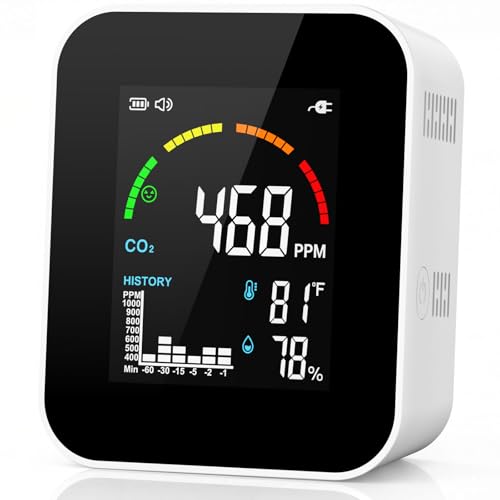
The YOWEXA is one of the two pure monitors in this guide, and it is important to be plain about what that means: it measures and displays, and it does not switch a regulator or a fan. Within that role, its title is the most detail-rich of any product here. It names an NDIR sensor, a 24-hour historical bar chart, a switch between Celsius and Fahrenheit, a power-saving mode, a 4-second measure interval, a 1-second LCD refresh, an over-alarm, and an emoticon indicator, and it lists home, office, nursery, and grow tent among its intended settings. That combination sketches a coherent product: a fixed-position household monitor that happens to be well suited to a small tent.
The historical bar chart is the feature a grower will probably use most. A full day of carbon dioxide behaviour, compressed into bars, makes the light-cycle drawdown and the night-time recovery visible without any app or export. If you are still learning your tent, run the YOWEXA for several days before changing anything else. The chart will show you whether the tent actually depletes during the light period or whether your existing ventilation already holds a steady level, and that evidence should drive any later decision to buy a controller. The fast LCD refresh supports the same learning process in real time: open the tent, watch the number move, close it, and watch the recovery.
The emoticon indicator deserves a fair reading rather than a dismissive one. A simple face that shifts with air quality is not a substitute for the numeric reading, and growers should manage by the number. But in the home, office, and nursery settings the title also names, an at-a-glance indicator lets someone who does not know or care what PPM means notice that a room feels stuffy and ventilate it. In a shared household, that legibility has real value. The over-alarm adds the guardrail described earlier, and the power-saving mode suits a device that may run continuously in a living space. For a small grower who wants measurement first and automation later, if ever, this is the natural starting point in the group.
2. Inkbird ICC-510 CO2 Controller: Dual-Plug Control for Tents and Greenhouses
The Inkbird ICC-510 belongs firmly in the controller group. Its title describes a carbon dioxide controller and meter with a dual-plug arrangement, designed to fit with a carbon dioxide regulator and an inline exhaust fan, and aimed at grow tents, grow rooms, and greenhouses. That is a complete control proposition in one sentence: sense the level, add gas when the logic calls for it, and extract air when the logic calls for that instead, using the two kinds of equipment nearly every enriched small grow already owns.
Inkbird is a name many growers already know from temperature and humidity control, and the appeal of a controller from a familiar control-focused brand is consistency of approach: setpoints, switched outlets, and equipment protection rather than a passive display. We make no claim here about specifications the title does not state, so growers comparing controllers should confirm sensor type, range, and setpoint details on the listing itself. What the title does establish is the intended pairing and the intended environments, and on that basis the ICC-510 is best understood as the automation step for a grower who has already confirmed, ideally with a monitor, that active carbon dioxide management is worthwhile in their tent.
Setup discipline will decide how well any dual-plug controller serves you, and the ICC-510 is no exception. Connect one device at a time, confirm which plug responds under which condition, and only then connect the regulator. Keep the controller’s cables clear of water lines and reservoir spills, and remember that a controller concentrates responsibility: a single mis-set setpoint now drives two pieces of equipment. For a grower comfortable with that responsibility, the dual-plug format is the cleanest route from manual observation to a tent that holds its carbon dioxide routine through the whole light period without constant attention.
3. AC Infinity CO2 Controller: Smart Outlet Control in a Two-Plug System
The AC Infinity CO2 Controller is the second dual-plug controller in the group, described in its title as a smart outlet carbon dioxide monitor with a two-plug system, best fit with carbon dioxide regulators and inline exhaust fans, adjusting carbon dioxide in grow tents, grow rooms, and greenhouses. The word monitor in that title should not blur the category line: with switched outlets for a regulator and a fan, this is a controller that also monitors, not a passive meter. Its job is to adjust, as the title itself puts it, not merely to report.
AC Infinity’s wider reputation in grow environments rests on ventilation, and that context makes the pairing in this title logical. A maker whose ecosystem centres on inline fans approaching carbon dioxide control will naturally treat the exhaust fan as a first-class part of the system rather than an afterthought, and for small tents that is the right instinct, because ventilation is the force most often undoing enrichment. Growers already running an inline fan in this ecosystem should still verify compatibility and ratings on the listing rather than assuming cross-product behaviour, but the intended combination is stated plainly enough to plan around.
Choosing between the two dual-plug controllers in this guide will usually come down to ecosystem, interface preference, and the detailed specifications confirmed on each listing, rather than any difference in basic mission. Both aim at the same pairing, the same environments, and the same outcome. That is a healthy kind of competition: the category has settled on the right architecture for small enriched grows, and the buyer’s task is to pick the implementation that fits their existing equipment and their habits. If your tent already leans heavily on one maker’s fans and controls, consistency of cables, mounts, and menus is a legitimate deciding factor.


