Our Top Picks


What's inside
- What heavy duty actually means
- Load ratings and growing bodies
- Steel frames: strengths and watchpoints
- Wooden frames: timber, mass and maintenance
- Anchoring: the step nobody may skip
- Height, clearance and room to swing
- Seat styles for bigger riders
- Chains, hangers and the small parts that fail first
- Surfacing: what lies beneath flying feet
- Weather resistance and rust management
- Assembly: planning for the big weekend
- Siting the set in a real family garden
- Age and size guidance without guesswork
- Rules, supervision and teaching safe habits
- Maintenance calendar for a decade of service
- Budget tiers in words, not numbers
- Backyard entertainment around the frame
- Common buying mistakes
- What owner reports teach over several seasons
- Accessibility and inclusive play
- Climbing add-ons and combination structures
- Steel versus wood: the decision in one sitting
- Inspecting a display model or delivered kit
- When a public playground standard helps
- Teaching the neighbourhood rules
- Seasonal play patterns and getting full value
- Transport, delivery and the unglamorous logistics
- Repair or replace: judging an ageing frame
- How the choice supports active teenagers
- A buyer’s walkthrough, step by step
- Questions worth asking the seller
- Small gardens and awkward spaces
- The physics corner: why arcs punish weak frames
- Documenting your installation
- Deciding between two finalists
- Closing perspective for parents
- A word on warranties and spare parts
- Check prices on Amazon
- The first ride and what it tells you
As an Amazon Associate I earn from qualifying purchases. This post may contain affiliate links at no extra cost to you.
Links in this article are affiliate links, so a qualifying purchase may fund our editorial work through a commission while your checkout total remains unchanged. Heavy duty swing sets for older kids answer a problem every parent eventually meets: the frame that felt enormous to a five-year-old starts flexing, creaking and looking undersized once riders pass nine or ten. Taller frames, honest load ratings and proper anchoring separate equipment built for that stage from toys designed for gentler years. This guide works through each structural question in the order a careful buyer should ask it.
What heavy duty actually means
The phrase heavy duty appears on boxes of wildly different quality, so ignore the label and search for numbers. A meaningful specification states a maximum weight per swing seat and a total capacity for the frame, because two heavy riders swinging in unison load the structure very differently from one child sitting still. Dynamic force multiplies body weight at the bottom of the arc, which is why ratings carry margins that static thinking underestimates.
Frame gauge matters alongside those figures. Thick-walled steel tubing resists the racking motion that loosens joints over a season, while thin decorative tubing dents at bolt points and flexes visibly under older children. Wooden beams earn their strength through sheer cross-section; a solid six-by-six top beam behaves nothing like a pair of slim boards sandwiched together, however similar they look in photographs.
Hardware tells the same story at smaller scale. Through-bolts with locking nuts hold structural joints far better than short screws driven into end grain. Swing hangers rated for playground duty, with smooth bearings or bushings, outlast the simple hooks supplied with budget frames. When a product page hides these details, that silence usually answers your question.
Load ratings and growing bodies
Older kids are not simply heavier; they swing higher, pump harder and invite friends aboard. A seat rated generously above your child’s current weight buys headroom for growth spurts and the inevitable day three cousins arrive. Manufacturers publish per-seat limits because chains, hangers and the seat itself each become the weakest link at different loads, and exceeding any one of them stresses the rest.
Total frame capacity deserves equal attention. Two riders at the top of their arcs simultaneously can impose forces that a frame rated only by adding seat limits together may not comfortably handle. Look for explicit statements about the whole structure, and treat vague marketing language about accommodating the whole family as a prompt to ask harder questions, not as reassurance.
Age guidance on packaging reflects size assumptions as much as safety. A tall eleven-year-old may exceed the intended rider dimensions of a set nominally approved to age twelve, while a petite thirteen-year-old fits comfortably. Measure your child, compare legroom and head clearance figures, and let physical fit outrank birthday arithmetic.
Steel frames: strengths and watchpoints
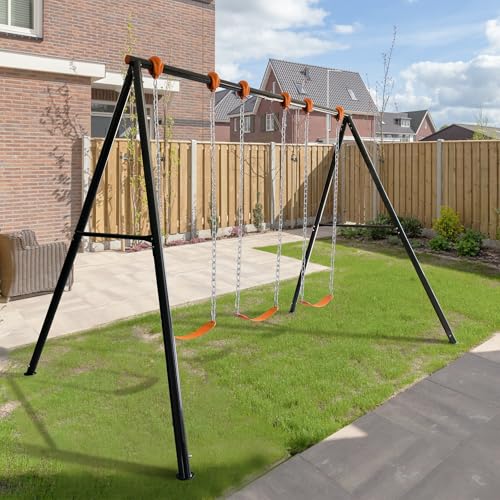
Powder-coated steel dominates the heavy duty category for good reason. It delivers high strength in relatively slim profiles, assembles from repeatable factory parts and can be engineered tall without becoming unwieldy. Quality sets use galvanised or coated tubing that resists corrosion at cut ends and bolt holes, the two places rust loves to begin.
Steel’s weaknesses are manageable but real. Coating chips from stones, mower strikes or chain rub expose bare metal, and rust follows quickly in wet climates unless owners touch up damage promptly. Thin-walled steel also transmits a hollow ringing flex when riders swing aggressively; better designs counter this with triangulated legs, cross braces and wider footprints that spread loads into the ground.
Check weld quality in photographs and owner reports. Continuous, even welds at hanger brackets and leg joints signal careful manufacture, while spattered, partial welds predict early cracking under the repetitive stress older kids generate. A steel frame is a fatigue machine by design; every joint should look like its maker understood that.
Wooden frames: timber, mass and maintenance
Cedar, redwood and pressure-treated pine sets bring natural mass that many parents find reassuring. A heavy timber frame barely notices two big kids swinging, and its broad beams accept lag bolts and brackets with satisfying bite. Gardens also tend to forgive a wooden structure visually, where a tall steel frame announces itself as playground equipment from the street.
The bargain is maintenance. Outdoor timber needs sealing or staining on a cycle dictated by your climate, plus annual checks for splinters, checking cracks and soft spots where moisture lingers near the ground. Insects investigate wooden frames in some regions, and hardware loosens as timber expands and contracts through seasons, so a socket wrench in spring becomes part of ownership.
Quality varies enormously within the category. Naturally rot-resistant cedar heartwood outlasts fast-grown pine that relies entirely on chemical treatment, and pre-drilled, pre-stained kits assemble far more happily than raw lumber projects. Published specifications should name the timber species and beam dimensions; evasiveness about either suggests the wood is the compromise, not the feature.
Anchoring: the step nobody may skip
A tall frame carrying older riders behaves like a sail attached to a lever. Every vigorous swing tries to lift the leeward legs, and an unanchored set can walk across a lawn or, in the worst case, tip. Anchor kits exist precisely because manufacturers know this, and treating them as optional accessories misunderstands the physics entirely.
Ground anchors come in several forms. Auger-style stakes twist deep into soil and suit most lawns, while concrete footings provide the definitive solution for very tall frames or soft, sandy ground. Straps or brackets should connect each leg positively to its anchor, not merely rest nearby. After installation, rock the frame hard yourself before any child rides; movement at the feet means the anchors need deeper purchase or a different method.
Soil conditions change the answer by postcode. Clay holds anchors firmly but heaves with frost, rocky ground defeats augers and demands dug footings, and coastal sand requires longer anchors or concrete. Local hardware knowledge beats generic instructions here, so describe your soil honestly when asking advice rather than assuming the included kit suits every garden on earth.
Height, clearance and room to swing
Frame height decides whether older kids can swing with straight legs and full extension or must tuck awkwardly at the bottom of every pass. Top rails around eight feet or higher give taller riders the geometry they need, and longer chains let seats hang at a comfortable height without shortening the arc. A set your child must crouch to use will be abandoned within a summer, however strong its frame.
Clearance zones matter as much as the frame itself. Safety guidance commonly calls for unobstructed space extending well beyond the swing’s travel in both directions, plus lateral room so riders cannot strike support legs or neighbouring equipment. Fences, trees, washing lines and garden sheds all intrude on real backyards, so measure your available rectangle before admiring any particular model.
Head clearance under the top beam becomes critical when children stand on seats, a behaviour parents may forbid and children will nonetheless attempt. Taller frames reduce the chance of a head meeting the beam during exuberant misuse, though no dimension substitutes for supervision and clear family rules. Design for the child you have, including their appetite for testing boundaries.
Seat styles for bigger riders
The classic belt seat remains the workhorse: a flexible band that cradles the rider, moves with their body and suits the high, rhythmic swinging older kids love. Quality versions use reinforced rubber or polymer with moulded inserts that resist tearing at the chain attachment points. Flat rigid seats, by contrast, punish landings and slide around under lighter riders, though some children prefer them for tricks and dismounts.
Trapeze bars with rings shift the activity from swinging toward gymnastics, building grip and shoulder strength while demanding more from the frame’s lateral stability. Glider seats carrying two riders face-to-face add a social dimension and impose distinctive loads, since both children pump in coordination. Disc and nest seats invite lounging, spinning and group riding, but their wide platforms need generous lateral clearance and chains rated for the combined weights they encourage.
Adaptive and inclusive seats deserve mention for families who need them. High-backed moulded seats with harnesses allow children with limited trunk control to share the same frame as siblings, and reputable makers publish specific ratings for these accessories. Swapping seats seasonally as children grow or interests change is one of the pleasures of a modular frame, provided every accessory matches the hanger spacing and chain standard of the original set.
Chains, hangers and the small parts that fail first
Owner reports across brands converge on one lesson: frames rarely fail before their moving parts do. Chains should be galvanised or coated, with links sized generously for the rated load and no sharp welds at the seat connection. Plastic-dipped chain sections where hands grip prevent pinched fingers and winter-cold metal, a detail children appreciate daily and adults notice only in its absence.
Swing hangers determine how smoothly and quietly the whole apparatus moves. Heavy duty designs use pendulum hangers with nylon bushings or sealed bearings, bolted through the top beam rather than wrapped around it. Eye bolts through timber need large washers to spread load and prevent the nut pulling into softened wood over years of cyclic stress.
Inspect S-hooks and quick links with suspicion. Open hooks can unhook at the slack top of a violent arc, which is why better sets close every connection or use locking carabiner-style links. Whatever the design, a monthly pinch-and-pull check of every connector takes five minutes and catches loosening long before it becomes an incident.
Surfacing: what lies beneath flying feet
Children leave swings in every way imaginable, including mid-flight, so the ground underneath functions as safety equipment. Grass over firm soil, the default in most gardens, compacts into a hardpan by midsummer precisely where feet land and drag. Loose-fill materials such as engineered wood fibre or bark mulch cushion falls far better, provided depth is maintained and borders keep the material from migrating across the lawn.
Rubber mulch and poured rubber surfaces raise the protection level and lower ongoing raking, at higher upfront effort and cost. Interlocking rubber tiles suit smaller zones under a single frame and let owners replace damaged sections individually. Each option has drainage implications; a surface that holds puddles under the swing arc becomes a mud factory that children track indoors with enthusiasm.
Whatever surface you choose, maintain it like you mean it. Loose fill compresses and scatters, tiles lift at edges, and grass dies back to dirt. A spring top-up and a mid-season rake restore most of the cushioning you paid for. The safest frame in the world still lands its riders on whatever you spread beneath it.
Weather resistance and rust management
Outdoor equipment lives a harder life than almost anything else a family buys. Ultraviolet light embrittles plastics and fades coatings, rain hunts every unprotected bolt, and freeze-thaw cycles work water into joints. Heavy duty sets acknowledge this reality with galvanised hardware, capped tube ends that keep rain out of hollow steel, and drainage holes where water would otherwise pool invisibly inside frames.
For steel, a ten-minute autumn inspection with a wire brush and touch-up paint prevents the rust blooms that weaken tubing from the outside in. Pay special attention to ground-contact points and anywhere chains rub their hangers, since friction strips protection exactly where stress concentrates. Stainless or hot-dip galvanised fasteners resist the seized, rusted bolts that make later repairs miserable.
Timber sets ask for a different ritual: reseal on schedule, tighten hardware as boards season, and replace any component showing deep rot rather than hoping it survives another winter. Plastic accessories such as seats and gliders benefit from winter storage indoors in harsh climates, extending their flexible life by seasons. Weather care is unglamorous, repetitive and precisely what separates a ten-year set from a three-year disappointment.
Assembly: planning for the big weekend
Heavy duty sets arrive as serious construction projects. Steel kits typically assemble in a long day with two adults, while substantial timber sets can occupy a full weekend once levelling, squaring and anchoring receive the attention they deserve. Read the entire manual before opening hardware bags, lay parts out in order, and confirm every bracket exists while replacement is still a phone call rather than a crisis.
Site preparation decides the quality of everything built on top of it. Choose the flattest available ground, remove stones and roots from the footprint, and think about drainage after storms. Building on a slope and correcting with one long leg invites rocking and uneven chain wear; a few hours with a spade and level at the start saves years of compensating adjustments.
Torque discipline matters more than enthusiasm. Overtightening bolts into timber crushes fibres and weakens the joint, while undertightened steel connections fret and elongate their holes. Follow the manual’s sequence, leave final tightening until the frame stands square, then recheck every structural bolt after the first week of use, because new assemblies settle under load in predictable ways.
Siting the set in a real family garden
Visibility from the house ranks high for parents of younger older-kids, that in-between stage where independence grows faster than judgement. A set visible from the kitchen window gets used more and supervised more easily than one hidden behind a shed. Consider also the sun’s path: a west-facing swing arc in a hot climate becomes unusable on summer afternoons, while dappled shade keeps seats cool enough to touch.
Neighbours deserve a thought. Tall frames overlook fences, and exuberant riders generate noise at hours that test goodwill. Positioning the set away from a neighbour’s bedroom windows and mentioning the plan before construction day preserves relationships that outlast any single purchase. Some localities regulate play structures near boundaries or above certain heights, so a quick check of local rules prevents expensive repositioning.
Evenings extend play when the garden supports it, and families planning outdoor film nights nearby often browse best outdoor tvs while mapping where screens, seating and the swing’s clearance zone can coexist without anyone’s sightline crossing a flying pair of heels.
Age and size guidance without guesswork
Manufacturers print age ranges because regulators expect them, but your tape measure tells the truth. Seat height should let a rider sit with feet flat enough to mount safely yet hang freely at the arc’s bottom. Chain length adjusts this on most sets, though very tall children eventually need the frame height itself, not just longer chains, to keep geometry sensible.
Weight guidance deserves the same literal respect as the tape measure. Buy for the child your rider will be in three summers, not the one standing in the shop today, because frames are long-lived purchases and growth spurts arrive without consulting your budget. If your ten-year-old already approaches a set’s per-seat limit, that set is effectively already outgrown regardless of its marketing photographs.
Siblings complicate the arithmetic helpfully. A frame serving a teenager and a seven-year-old simultaneously needs stations spaced widely enough that different swing heights and styles never interfere. Mixed-age use also argues for the strongest frame you can accommodate, since the oldest rider sets the structural requirement while the youngest sets the supervision one.
Rules, supervision and teaching safe habits
Equipment carries only part of the safety burden; habits carry the rest. Families do well to agree explicit rules early: one rider per seat, no twisting chains into knots, no walking within the arc of a moving swing, and no jumping from height as a competitive sport. Rules stated before the first ride become the set’s culture rather than a reaction to the first scare.
Teach mounting and dismounting as skills. Younger riders within the older-kid bracket still misjudge stopping, dragging feet through surfacing and wearing trenches at the arc’s low point. Showing them how to slow gradually, wait for near-stillness and step clear sideways prevents most of the minor injuries that never appear in product reviews but fill family memory.
Supervision should evolve rather than vanish. A responsible twelve-year-old hosting friends needs different oversight from a cautious nine-year-old alone, and parents know their own children’s calibration best. Periodic presence also lets adults hear the new creak or notice the loosened bolt that children, focused entirely on altitude records, will never report.
Maintenance calendar for a decade of service
Monthly during the play season, walk the frame with a wrench and a critical eye. Tighten any bolt that yields, spin each hanger to feel for grinding, examine chains link by link where they meet the seat, and confirm anchors still hold their legs firmly against determined rocking. This circuit takes less time than mowing the lawn it stands on.
Each spring, escalate to a full inspection. Sand and treat rust spots on steel, reseal timber where the finish has thinned, replace cracked plastic seats before they fail under a rider, and top up surfacing to its intended depth. Manufacturers often publish torque values and replacement part numbers; a set from a maker who still sells its hangers and seats five years later is a set designed to be maintained rather than replaced.
Winter asks little beyond drainage and storage of removable accessories in cold regions. Clear leaf litter that traps moisture against timber feet, ensure caps still seal tube ends, and note any repairs needed so spring begins with a list rather than a discovery process. Equipment cared for on this rhythm commonly serves a second family after yours outgrows it.
Budget tiers in words, not numbers
Entry-level heavy duty sets concentrate spending on the frame itself: honest steel, two belt swings, anchoring hardware and little else. For many families this is the intelligent purchase, because stations can multiply later as birthdays supply trapeze bars and gliders. What this tier should never economise on is hanger quality or anchor provision, the two systems where failure actually hurts someone.
Mid-tier sets add a third station, better coatings or timber, improved surfacing bundles and accessories such as climbing walls or rope ladders. The structural conversation changes here: every added feature hangs weight and leverage on the same top beam, so verify that total capacity accounts for the fully dressed configuration in the brochure photograph, not merely the base frame.
Premium sets justify themselves through engineering depth: thicker gauges, taller beams, commercial-grade hangers borrowed from public playgrounds and warranties that contemplate a decade outdoors. Families expecting heavy neighbourhood use, or planning to hand the set down through several children, extract real value from that overbuilding. A single child who prefers cycling may not, and honest self-knowledge beats aspirational purchasing.
Backyard entertainment around the frame
A well-sited swing set often anchors a wider outdoor living pattern. Parents reading about best affordable outdoor projectors for dusk film sessions should keep projector throw distances and screen placement outside the swing clearance envelope, because an arc that seems safely distant at noon feels much closer when excited children spill between activities in the dark.
Similarly, households comparing best home projectors for outdoor movies frequently discover that the swing frame’s top beam tempts teenagers as a mounting point, an improvisation worth discouraging firmly since beams are engineered for downward swing loads, not for cantilevered electronics vibrating in evening breezes.
Poolside and patio setups raise their own adjacency questions, and the guidance gathered under best bluetooth outdoor speakers for pool pairs naturally with a simple family rule: music and screens live in the spectating zone, while the swing arc stays a screen-free, full-attention territory for riders and anyone crossing the garden.
Common buying mistakes
The most frequent error is purchasing for the child of last summer. Parents remember a seven-year-old, buy accordingly, and watch a rapidly growing ten-year-old fold himself into a frame he will abandon by spring. Whenever doubt exists between two sizes, the taller, stronger frame almost always proves the wiser long-term decision, provided your garden and anchoring plan can support it.
Second comes ignoring the ground. Families research beams and seats for weeks, then install on sloping, stony soil with the included anchors barely biting. Money spent on surfacing and proper footings protects children more directly than any upgraded accessory, yet it photographs badly and tempts buyers to skip it. Resist that temptation in writing if necessary.
Third, buyers overvalue station count. Five cramped stations on a short beam generate conflicts and lateral collisions, while three generously spaced stations on a long beam get used happily for years. Measure the beam, divide by the stations, and ask whether two broad-shouldered twelve-year-olds could genuinely swing side by side without synchronising like a drill team.
What owner reports teach over several seasons
Long-term owners praise stability above every other virtue. The sets remembered fondly are the ones that never developed a wobble, never shed a part mid-season and never made a parent hover anxiously. Reports repeatedly credit overbuilt frames and conscientious anchoring for that calm, while complaints trace back to undersized hardware, skipped anchors and coatings that surrendered early to weather.
Noise emerges as an underrated theme. Squeaking hangers and rattling joints erode neighbourly patience and parental nerves alike, and they usually announce wear worth addressing anyway. Owners who lubricate bushings on schedule and replace worn hangers promptly describe their sets as background furniture; those who ignore the soundtrack eventually describe a nuisance they wish they had sold.
Resale and hand-me-down stories complete the picture. Quality steel and cedar frames change hands readily because their strength remains visible and their parts remain available. A set that survives your children with its structure intact has delivered value twice: once in play, and again in the driveway of the family who collects it.
Accessibility and inclusive play
Heavy duty frames serve families best when every child in the household can genuinely use them. Wider seats, supportive backs and transfer-friendly seat heights open swinging to children whose mobility differs from their siblings’, and the shared rhythm of side-by-side swinging is a powerful equaliser in family play. Manufacturers serving this need publish detailed dimensional drawings, which deserve the same scrutiny as load tables.
Ground-level design choices help too. A level, firm path to the frame, surfacing that wheelchairs and unsteady feet can cross, and gates in any border edging all determine whether the set functions as shared territory or as equipment some children only watch. Inclusive planning at purchase time costs little; retrofitting goodwill later costs considerably more.
Consulting the child concerned, whenever possible, beats assuming preferences. Some riders love height and speed, others want the gentle arc and a seat that feels like a hug. A modular heavy duty frame accommodates both temperaments across its stations, which is precisely the flexibility families are paying for when they step up from basic sets.
Climbing add-ons and combination structures
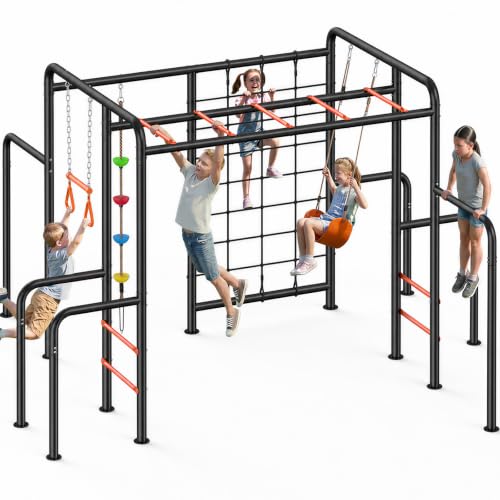
Many heavy duty frames grow climbing walls, rope nets, monkey bars or fireman’s poles, transforming a swing beam into a small training ground. Each addition changes the structure’s load paths. A climbing wall hung from one end adds torsional stress when a heavy child traverses it, while monkey bars demand rigidity along the beam’s whole length because the rider’s weight travels joint by joint.
Evaluate combination sets by their least impressive component rather than their most photogenic. A superb swing beam married to a flimsy ladder with narrow rungs will generate complaints out of proportion to the ladder’s share of the price. Check rung diameter for older children’s hands, spacing for longer legs, and whether climbing surfaces use textured, weather-resistant materials rather than smooth plastic that turns treacherous with morning dew.
Fall zones multiply with every feature. The area beneath monkey bars needs the same surfacing generosity as the swing arc, and the exit path from a slide or pole must not cross a swing’s travel line. Drawing the whole layout on paper, with arcs and landing zones sketched to scale, exposes conflicts invisible in catalogue photography taken on endless lawns.
Steel versus wood: the decision in one sitting
Families torn between materials should interrogate their own habits first. Households that enjoy garden projects and already maintain fences or decking will absorb timber care without resentment, and they gain a structure that ages into the landscape. Households that prefer installing once and inspecting occasionally usually fare better with galvanised steel, whose maintenance asks for a brush and paint rather than a sander and stain.
Climate casts a strong vote. Persistently wet regions punish timber feet and reward steel raised on concrete footings, while arid, high-ultraviolet environments crack wood finishes quickly but also fade powder coatings. Coastal salt air attacks ordinary steel fasteners relentlessly, pushing buyers there toward hot-dip galvanising or cedar with stainless hardware. Let your weather, honestly described, arbitrate the contest.
Neither material rescues a weak design, and neither dooms a strong one. Beam dimensions, joint engineering, hanger quality and anchoring decide real-world performance, with material acting as the personality layered over that skeleton. Buy the engineering first and the material story second, and either path can end in a decade of uneventful swinging.
Inspecting a display model or delivered kit
Where a showroom exists, use it rudely. Sit in the seat yourself if the rating permits, swing gently, and watch the legs for lift and the beam for twist. Listen for creaks that betray loose joints even in a display unit. Pull chains sideways, spin hangers, and examine weld or bolt quality at the brackets where failures historically begin.
For delivered kits, inspect before assembly day. Photograph any transit damage to tubing or timber, count hardware against the packing list, and flex plastic seats for hidden cracks. Discovering a missing hanger bracket while the supplier’s warehouse is still open beats discovering it with four children watching a half-built frame on Saturday afternoon.
Documentation deserves the same attention as parts. A thorough manual with exploded diagrams, torque guidance and a spare-parts list signals a manufacturer expecting to support the product for years. Vague, photocopied instructions covering three different models with one generic drawing predict a frustrating build and an orphaned product when something eventually wears out.
When a public playground standard helps
Some residential sets borrow design cues or components from public playground equipment, where standards contemplate heavier use and wider age ranges. Commercial-grade hangers, for instance, tolerate backyard abuse almost indefinitely. Fully commercial structures, however, bring their own complications: greater heights, professional installation expectations and fall-zone requirements that exceed most gardens.
The sweet spot for ambitious families is often residential framing with selected commercial components at wear points. Upgrading hangers, chains and seats while keeping a home-scale frame delivers most of the durability benefit without turning the garden into a municipal project. Manufacturers and specialist suppliers increasingly sell such upgrade paths explicitly, which simplifies matching parts.
Standards language on packaging should be read precisely. A claim that a set was designed with reference to playground guidelines differs from independent certification, and neither replaces correct installation at home. The finest certified frame installed unanchored on a slope remains a hazard wearing a badge, a distinction worth repeating to any salesperson leaning too hard on logos.
Teaching the neighbourhood rules
A conspicuously sturdy swing set attracts visiting children, which is mostly joy and partly liability management. Agree in advance how many riders the frame hosts, which stations guests may use, and whether your children may enforce the household rules or must fetch an adult. Clear expectations prevent the classic scenario where six visitors improvise a group stunt your frame never contemplated.
Younger visiting children need particular care around equipment sized for older riders. Seat heights, climbing grips and fall distances calibrated for a tall eleven-year-old can defeat a visiting six-year-old completely. Offering the youngest guests alternative garden activities is kinder, and safer, than letting them attempt apparatus built for bodies twice their size.
Insurance and local responsibility rules vary widely, and this guide cannot advise on yours. What holds universally is that documented maintenance, intact surfacing and visible supervision strengthen any family’s position after an accident, while a neglected frame with known faults weakens it. Diligence is both a safety practice and a legal hygiene habit.
Seasonal play patterns and getting full value
Spring releases pent-up energy, and the swing set becomes the garden’s headquarters within days of the weather turning. This is when last autumn’s deferred maintenance announces itself, so complete the inspection circuit before the first enthusiastic weekend rather than during it. Children who help with age-appropriate checks, holding the wrench caddy or testing seat stability, absorb the maintenance culture almost by osmosis.
Summer brings peak loads and peak heat. Metal chains and dark seats can grow uncomfortably hot in direct sun, a problem solved by shade placement, lighter-coloured accessories or simply timing heavy play for mornings and evenings. Hydration breaks double as informal inspection moments; an adult handing out drinks naturally scans the frame, the surfacing and the riders’ behaviour.
Autumn winds test anchors and covers in ways calm months never do. After any serious storm, walk the frame before children resume play: check for lifted anchors, debris in the fall zone, cracked branches overhanging the arc and water pooling where it never pooled before. Winter, finally, is planning season, when worn accessories get replaced at leisure and next year’s layout improvements move from argument to agreement.
Transport, delivery and the unglamorous logistics
Heavy duty sets earn the adjective in the delivery van as well. Timber kits can weigh as much as a small car, arrive on pallets and demand several adults simply to move components to the build site. Confirm delivery terms before ordering: kerbside drop, pallet disposal and access for large vehicles all become your problem the moment the truck leaves.
Measure gates and side passages with the largest component in mind. A one-piece welded steel A-frame that cannot pass the garden gate converts a weekend project into a crane hire or an embarrassing return. Manufacturers publish carton dimensions for exactly this reason, and five minutes with a tape measure protects the entire schedule.
Storage between delivery and assembly also matters. Timber left wrapped in plastic on wet grass sweats and stains, while steel cartons stored outdoors invite the very rust the coating exists to prevent. A garage corner, a dry shed or at minimum a raised, tarped platform keeps components in the condition the factory intended until build day arrives.
Repair or replace: judging an ageing frame
Not every tired set deserves replacement. Surface rust, worn seats, squeaking hangers and depleted surfacing all yield to ordinary maintenance, and a frame whose skeleton remains sound can serve another decade after a weekend of renewal. The economics favour repair strongly when the manufacturer still supplies parts and the timber or tubing shows no structural compromise.
Certain findings end the argument. Deep rust perforating a load-bearing tube, rot hollowing a beam at a bolt line, cracked welds at hanger brackets and elongated bolt holes that no longer hold torque all describe structural failure in progress. Cosmetic optimism has no place here; retire the component or the set, because these defects worsen under exactly the loads older children apply.
Second-hand purchases demand this same inspection with extra scepticism, since the set’s history is unknown and its hardware may include substitutions. A used premium frame in verified condition can be a bargain, while a used budget frame with hidden corrosion is a liability wearing a fresh coat of paint. Inspect in daylight, underneath as well as on top, before money moves.
How the choice supports active teenagers
It surprises some parents that a well-chosen set remains relevant into the teenage years. The swinging itself may fade, but trapeze stations become informal strength training, nest seats turn into outdoor lounging territory, and the frame anchors a social corner of the garden where older children gravitate with friends. Equipment bought generously at age ten often earns this second career automatically.
Teenagers also test equipment in ways specifications anticipate imperfectly: maximum-height swinging, group lounging and inventive misuse. This is the final argument for buying structural margin rather than adequacy. A frame rated comfortably beyond your children’s current statistics absorbs the teenage years without drama, while a frame bought to the exact limit spends those years at its limit.
When teenagers genuinely outgrow the set, its departure can mark the garden’s next chapter rather than a loss. Families frequently convert the levelled, surfaced footprint into seating, a fire pit terrace or a games lawn, inheriting the site’s preparation work. Planning that succession early softens any reluctance about investing properly in the swing years themselves.
A buyer’s walkthrough, step by step
Begin in the garden, not on a website. Measure the level area you can truly dedicate, sketch the swing arcs and fall zones, and note sun, shade, drainage and sightlines from the house. This sketch becomes the filter through which every candidate must pass; a set that fails the footprint test is eliminated no matter how glowing its description sounds.
Next, define the riders with uncomfortable precision. List each regular user’s current weight, height and likely growth over three years, then add the visiting friends who will inevitably appear. Your per-seat target and total frame target come from this list, not from a manufacturer’s suggestion about what children of a certain age usually weigh.
Only now compare products, and compare them on paper. Tabulate beam dimensions, materials, hanger type, anchor method, seat ratings and warranty terms side by side, because marketing pages are designed to be felt rather than compared. Candidates that refuse to disclose a figure reveal something important in the refusal, and your table will show the gap glaringly.
Finally, price the whole project rather than the headline product. Surfacing, anchors or concrete, delivery, assembly help and the first year’s maintenance supplies belong in the same calculation as the frame. Families who budget honestly at this stage finish the project completely; families who budget for the box alone often leave the set unanchored on bare dirt, which quietly negates every careful choice made earlier.
Questions worth asking the seller
Ask what the per-seat rating assumes about dynamic loading, and whether the total frame rating was established with all stations occupied simultaneously. Ask which single component wears out first in normal service, and how much its replacement costs and how long it takes to arrive. Honest manufacturers answer such questions readily because they have heard them from playground professionals for years.
Ask about the coating or treatment process in specific terms: galvanised before or after fabrication, powder coat thickness, timber species and treatment chemical. Ask whether the anchor kit in the box suits clay, sand or only average soil, and what the company recommends when it does not. Each precise answer narrows the distance between brochure promises and your actual garden.
Ask, finally, what the warranty excludes. Weather damage, commercial use and unauthorised modifications commonly void coverage, and knowing the boundaries before purchase prevents bitter surprises. A seller who can discuss exclusions calmly and specifically is usually a seller whose product rarely triggers them.
Small gardens and awkward spaces
Compact gardens need not exclude serious swinging, but they demand honesty about arcs. A single-bay heavy duty frame with one belt seat and one trapeze station fits surprisingly modest footprints while still delivering height and strength. What small gardens cannot safely accommodate is a full multi-station set squeezed in by trimming the fall zones, because physics does not negotiate with landscaping ambitions.
Corner installations tempt many families and deserve extra scrutiny. Swing arcs radiate in two directions, and a corner placement often leaves one direction’s clearance crossing a path or patio. Rotating the frame a few degrees sometimes resolves the conflict elegantly, which is another argument for sketching the layout to scale before committing to post holes.
Shared or rented gardens introduce permission questions that precede all others. Landlords and housing associations may restrict permanent footings, favouring surface anchors and reversible installations. Freestanding frames with broad feet and ballast systems exist for exactly this situation, trading some ultimate stability for removability, and they should be loaded conservatively in recognition of that compromise.
The physics corner: why arcs punish weak frames
A swinging child is a pendulum, and pendulums concentrate force at the bottom of their travel. At that instant the chains pull down and forward with a combined load well beyond the rider’s static weight, and the frame’s legs experience a repeating tug that tries to walk them out of the ground. Height amplifies everything, because a longer pendulum swung to the same angle carries more energy through that bottom point.
Lateral forces arrive when riders swing crookedly, twist or launch sideways from a trapeze, loading the frame in directions its A-frames resist least happily. Cross-bracing, wide footprints and triangulated joints exist to answer these sideways demands. When you see a frame with spindly legs and no bracing carrying a tall beam, you are looking at a structure that has only solved the easy half of the problem.
Fatigue completes the lesson. A weld or bolt hole does not need to fail on the first hard swing; it needs to survive the hundred-thousandth. Heavy duty construction is ultimately fatigue engineering for children, which is why margins that seem excessive in the showroom reveal themselves as simple prudence by the third summer of daily use.
Documenting your installation
Photograph the build at stages: the prepared ground, anchors before burial, frame joints before covers snap on, and the finished set from all four sides. These images help with warranty claims, insurance records and the detective work of diagnosing a creak two years later. Store them with the manual and receipts, ideally digitally as well as in the traditional kitchen drawer.
Record the torque checks and maintenance you perform, even as a simple dated note on the manual’s back page. Should you ever sell or donate the set, that history reassures the next family and demonstrates the care that kept the frame sound. Documentation is the cheapest component in the entire project and the one most often skipped.
Register the product if the manufacturer offers registration, and note the model and batch identifiers somewhere durable. Recalls and safety notices occasionally affect play equipment years after sale, and registered owners hear about them first. A five-minute administrative task quietly extends the manufacturer’s duty of care all the way into your garden.
Deciding between two finalists
When two sets survive every filter, let the tiebreakers be unglamorous. Choose the one with the better hangers, the clearer manual, the longer parts availability and the anchor system that suits your soil, even if its colour is your second favourite. Children will not remember the shade of the powder coating; they will remember whether the set wobbled, squeaked or stood silent and solid.
If the finalists divide along material lines, revisit your maintenance honesty one last time. The family that will genuinely reseal timber should buy timber without guilt, and the family that knows itself better should buy steel without apology. Self-knowledge, applied before purchase, is worth more than any feature comparison because it predicts the set’s condition in year five.
Consider also which set your children can help maintain and eventually help dismantle or pass on. Involving older kids in the inspection routine teaches them that durable things stay durable through attention, a lesson that transfers to bicycles, tools and every machine they will own. The swing set becomes, almost accidentally, a small education in stewardship.
Closing perspective for parents
Strip away the catalogues and the decision reduces to a handful of commitments: buy structural margin your children will grow into, anchor the frame as if storms and teenagers were both scheduled, surface the ground for the falls that will certainly happen, and maintain the result on a rhythm you can actually keep. Every section of this guide expands one of those commitments, and none of them requires perfection, only consistency.
It is also worth remembering what the purchase is really for. Not the photograph on installation day, but the thousand ordinary afternoons when the set simply works: homework abandoned for twenty minutes of altitude, siblings negotiating turns, a parent pushing a rider higher than last week while dinner waits. Equipment that disappears into the background of family life has succeeded completely.
Buy the frame your future, taller children will thank you for, anchor it like you mean it, and the whole garden will feel the difference every single day.
A word on warranties and spare parts
Warranty length on frames can look generous while quietly excluding the components that actually wear out, so read which parts carry which terms. A decade of cover on a steel beam matters less than two seasons of cover on hangers, chains and seats if those smaller parts need replacing first. Ask whether wear items are sold individually at sensible availability, because a set whose manufacturer still lists its original hangers five years later can be maintained indefinitely, while an orphaned design forces improvisation with generic hardware that may not match the original ratings.
Keep every receipt, photograph the model plate or carton label, and store the manual where you can find it during a phone call with customer support. Owners who can quote a part number and purchase date resolve claims in one conversation; owners guessing at a model name from memory often receive the wrong bracket and lose a fortnight of the play season. This administrative dullness, completed once, quietly protects all the money and effort invested elsewhere in the project.
Second owners inherit these questions too, which is why a documented set commands confidence when it changes hands. If you sell or gift the frame, passing along the manual, the maintenance notes and any spare hardware completes the generosity properly. The receiving family starts with knowledge instead of archaeology, and the set’s safe working life extends by exactly the care that documentation makes possible.
Measure twice, anchor once, and let a properly chosen frame carry your children through summers they will describe for the rest of their lives.
Check prices on Amazon
Live listings for the shortlist in this guide are pulled from Amazon below, so prices and availability are always current at the moment you look.



The first ride and what it tells you
Stand back during the inaugural session and simply observe with fresh eyes. Watch whether legs stay planted through the highest arcs, whether chains run true without twisting, and whether riders mount and dismount without awkward stretching or toe-scrabbling. Listen for the sounds a healthy frame makes: a soft rhythmic creak from bushings is ordinary, while metallic clunks, grinding or a leg thumping against its anchor each announce a specific adjustment waiting to happen.
Correct those small findings the same evening, while the details remain vivid and the tools are still out. A quarter-turn on a hanger bolt, one extra twist on an anchor or a handful of surfacing raked back into the landing trench takes minutes now and prevents the slow loosening that turns minor play into genuine wear. Then record what you adjusted in the manual’s margin, because future-you, hearing a new noise next spring, will be grateful for the baseline.
After that first fine-tuning, step aside and let the set belong to the children, secure in the knowledge that its strength was chosen, installed and verified by you.