Our Top Picks



What's inside
- What a backyard agility set really includes
- Weave poles and spacing for learning dogs
- Jump bars, cups and breakaway safety
- Tunnels that invite rather than intimidate
- Pause tables and calm control work
- Matching jump height to your dog
- Materials, weather and muddy paws
- A beginner training path week by week
- Storage, transport and quick setup
- Safety checks before every session
- Choosing for breed, size and temperament
- Handling basics the equipment cannot teach
- Value, warranties and the honest cost of a season
- Seasonal training through a full year
- Common buying mistakes and how to sidestep them
- When a class, club or second opinion helps
- Course design for small, large and awkward gardens
- Check prices on Amazon
- Keeping a simple training log
As an Amazon Associate I earn from qualifying purchases. This post may contain affiliate links at no extra cost to you.
Some links on this page are affiliate links, meaning the site may receive a commission if you buy through them, at no extra cost to you. A dog agility set promises a great deal in a single box: jumps, poles, a tunnel and the cheerful implication that your garden will soon resemble a competition field. Reality is kinder and more ordinary. What you are really buying is a set of invitations for your dog, arranged in plastic, fabric and aluminium, and the quality of those invitations decides whether training becomes a shared game or a weekly argument with collapsing equipment. Our research for this guide compared published specifications, manufacturer data and owner reports across backyard agility kits, from small starter bundles to broad modular courses, so you can judge each obstacle by how a real dog, on real grass, with a real human learning alongside, will actually meet it.
Begin with the dog standing in front of you rather than the course pictured on the packaging. A young, bouncy adolescent needs different challenges from a cautious rescue dog or a senior who still enjoys gentle games. Size matters, confidence matters more, and joints matter most of all. A good set bends around the dog: jump heights that start low, poles that can be spaced generously, a tunnel that can be shortened until it stops looking like a cave. A poor set insists the dog bend around it, with fixed heights, rigid spacing and obstacles that punish the exact mistakes a beginner is guaranteed to make. Everything that follows in this guide flows from that distinction, because agility at home is supposed to build a dog up, and equipment that forgets that purpose has failed before the first run begins.
What a backyard agility set really includes
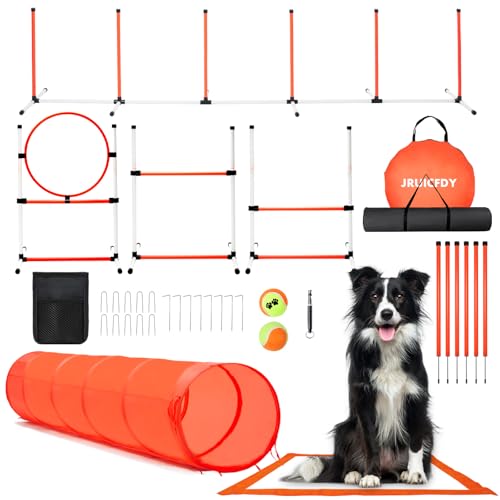
Most home sets gather around four classic obstacles. Weave poles teach rhythm and body awareness as the dog threads a line of uprights. Jumps teach lift, timing and the partnership of handler movement, since a dog reads your shoulders and stride as much as the bar itself. Tunnels teach confidence and independence, asking the dog to leave your side and commit to a dark, brief unknown. A pause table teaches the opposite virtue: stopping, settling and waiting while excitement hums around the edges. Together they form a balanced little curriculum of speed, control, courage and calm. When a set includes all four in sensible proportions, it offers a complete training conversation. When it doubles up on jumps while omitting any way to practise stillness, it is selling excitement and skipping half the education.
Counting pieces requires the same scepticism here as in any kit. A bundle may count every pole segment, connector and ground peg separately, inflating the number while delivering a modest course. Judge instead by finished obstacles: how many complete jumps can be built at once, how many poles stand in the weave line, how long the tunnel runs when fully extended, and whether the pause table is a real platform or a marker mat wearing a grander name. Manufacturer data usually answers these questions somewhere in the specifications, though rarely in the headline. Owner reports answer them differently, by describing what a Saturday setup actually produced on the lawn, and the two sources together give a buyer a far truer picture than either manages alone.
Missing small parts cause a disproportionate share of disappointment in this category. Jump cups, connectors, end caps and anchoring pegs are easy to overlook in a listing and miserable to improvise in a garden. Check whether spare connectors are included, whether replacement parts can be ordered from the manufacturer, and whether the design uses standard pole diameters that a local shop could match in an emergency. A set built from proprietary fittings becomes a countdown the first time a connector cracks in cold weather. A set built generously, with spares in the bag, shrugs off the same accident and keeps the weekend intact. That resilience rarely appears in marketing copy, yet it decides how long the course survives ordinary family life.
Weave poles and spacing for learning dogs
The weave is the obstacle beginners most often set up badly, because a finished weave looks deceptively simple. Competition spacing is a destination, not a starting point. Learning dogs benefit from poles that can be arranged in a gentle channel or a wider spacing first, so the body learns the side-to-side rhythm without the frustration of constant errors. Sets differ in how honestly they support that progression. Some provide bases or guides that hold varied spacing; others fix poles at a single distance and leave the handler to discover, expensively, that their dog needed an easier introduction. Published specifications should state pole count, pole height and spacing plainly. If spacing is missing from the data, treat that absence as a question to resolve before purchase, not a detail to discover on the lawn.
Pole stability shapes the learning experience in ways handlers underestimate. A pole that wobbles or topples when brushed teaches a careful dog to give the whole line a wide, worried berth, while a pole that stands firm but flexes slightly on contact rewards accuracy without frightening the student. Bases behave differently on grass, soil and patio slabs, and spikes that anchor beautifully in a soft lawn may be useless on hard ground. Owner reports from gardeners with clay soil, sandy soil and decking are worth more here than any studio demonstration on perfect turf. Look for comments about poles leaning by the third session, because a weave line that slowly becomes a slalom of drunks teaches crooked habits to everyone involved.
Training method matters as much as hardware, and a responsible guide should say so. Two-by-two training, channel weaves and guide wires are all established approaches with passionate advocates, and each makes different demands of the equipment. What they share is gradualism: the dog succeeds early, succeeds often, and meets difficulty in slices thin enough to digest. Whatever set you choose, plan to reward heavily at the end of the line, keep sessions short enough to end while the dog still wants more, and resist the human urge to drill a mistake into a grievance. Poles are patient teachers only when the handler is one too, and no specification sheet can substitute for that temperament.
Jump bars, cups and breakaway safety
The jump is where safety engineering becomes visible, and the central principle is simple: the bar must fall. A dog that misjudges a stride, catches a bar with a trailing leg or arrives at an awkward angle should meet an obstacle that gives way instantly, not one that trips, tangles or strikes back. Jump cups should hold the bar securely against a breeze yet release it cleanly under a dog’s touch, and the bar itself should be light, smooth and free of splinters or sharp edges. Sets that treat the bar as a rigid hurdle borrowed from human athletics misunderstand the animal entirely. Our research weighted breakaway behaviour heavily, because a single frightening collision can undo weeks of confidence, and because this is the specification most likely to be described honestly by owners who watched it happen in their own gardens.
Height adjustment deserves equal scrutiny. Good designs change height in small, clearly marked steps, with cups or clips that stay put once set and can be moved quickly between dogs. Poor designs offer a few widely spaced notches, forcing handlers to choose between too easy and too ambitious, or rely on friction fittings that creep downward mid-session. Check how the lowest setting behaves, not just the highest. Many pet dogs, puppies in their cautious early introductions, and older dogs enjoying gentle exercise should meet bars set very low or even lying on the ground as a visual exercise. A set whose lowest rung is already a genuine jump has excluded the learners who need it most, whatever its other virtues.
Wings and uprights frame the jump and help a dog read it from a distance, but they also add parts to store, carry and break. In a small garden, simple uprights keep the footprint honest and the setup quick. In a larger space, modest wings give the obstacle presence and help young dogs commit from an angle. Either way, the structure should stand plumb on uneven grass and come apart without tools when the session ends. Connectors that require force will eventually be forced wrongly, usually by a cold handler at dusk, and the resulting crack always seems to happen on the piece no spare exists for. Gentle, forgiving assembly is a safety feature too, because equipment people dread setting up quietly stops being set up at all.
Tunnels that invite rather than intimidate
A tunnel succeeds when a hesitant dog decides, voluntarily, that going through looks like fun. Design choices either support that decision or undermine it. Diameter matters first: a tunnel wide enough for your dog to move without crouching in fear is a tunnel that will be used, while a bargain tube sized for a smaller breed teaches a big dog that obstacles are traps. Length matters second, and adjustability matters most of all, because the classic introduction starts with the tunnel scrunched short enough for the dog to see daylight and a familiar face at the far end. Sets that can be secured at partial length, with straps or ties that hold the shape, support that gentle beginning. Sets that only behave at full extension ask beginners for a leap of faith many dogs sensibly decline.
Material and structure decide whether the tunnel holds its inviting shape. A spiral-supported fabric tunnel should spring open into a round profile and stay there, not sag into a floppy oval that brushes the dog’s back and sides. Interior surfaces should be smooth, without exposed wire ends, and the fabric should tolerate muddy paws and hosing down, because a tunnel lives outdoors and meets weather and enthusiasm in equal measure. Anchoring is part of the same story. Pegs, sandbags or straps keep the tunnel from rolling or travelling when a fast dog hits the entrance at speed, and an unanchored tunnel that shifts mid-run can frighten a dog out of the obstacle for months. Manufacturer data on anchoring is often thin, so owner reports about tunnels migrating across lawns are worth reading with close attention.
Many owners like watching evening practice from the patio, and the guide at best 1080p outdoor security cameras explains garden coverage plainly for households that also want a wider view of the yard. Recorded clips, however you capture them, are quietly one of the best training tools a home handler owns. Watching a run afterwards reveals handling habits invisible in the moment: the shoulder that turned too early, the hand that hovered, the stride that crowded the dog at the entrance. Keep that reviewing spirit kind. The camera is there to educate the human end of the partnership, since the dog, in almost every replay, was responding honestly to signals the handler did not know they were giving.
Pause tables and calm control work
The pause table is the least glamorous obstacle in the box and, for many family dogs, the most valuable. It asks for a full stop in the middle of excitement: jump on, settle, wait, and release only when told. That skill transfers everywhere, to doorways, kerbs, vet waiting rooms and the moment a dropped lead turns a walk interesting. A good table or platform is sturdy, low and surfaced for grip, with edges a dog can read clearly and a structure that does not rock, flex or drum hollowly underfoot. Dogs notice instability instantly and forgive it slowly. Published specifications should include dimensions and a weight capacity, and the platform should suit your dog’s size generously, because a table a dog can barely fit on teaches fidgeting rather than stillness.
Height and surface interact with confidence. A low platform suits beginners and smaller dogs, while a surface that stays grippy when damp suits everyone, since garden training rarely enjoys perfect conditions. Some sets substitute a marked mat or a low hoop for a true table, and those substitutes have their place in early training, where the lesson is position rather than elevation. Just know what you are buying. If the product page calls something a pause table, it should support a dog’s full weight, hold still under shifting paws, and survive being left out in a shower without swelling, peeling or growing slick. Owner reports about surfaces turning treacherous when wet appear often enough in this category to deserve a deliberate search before you commit.
Training the pause rewards a different emotional register from the rest of the course. Keep your voice level, reward the stillness itself rather than only the release, and build duration in seconds so small the dog cannot fail. A dog that learns the table is a place of praise and interesting snacks will offer the behaviour eagerly, and that eagerness lets you practise control at the exact moment arousal peaks after a tunnel or a jump. Handlers sometimes skip this obstacle because it photographs poorly. That is their loss. The calm centre of a course is what makes the fast edges safe, sociable and genuinely fun to run.
Matching jump height to your dog
Jump height should be fitted to the dog like a harness, by measurement rather than guesswork. The usual reference point is the height of the dog at the withers, the ridge between the shoulder blades, and training heights for pet dogs should sit comfortably below the maximum a fit adult could clear. Puppies whose growth plates are still open should not be jumping at height at all; poles on the ground, low bars and flat work build the skills and the partnership without loading young joints. Senior dogs and breeds with long backs or short legs deserve similarly conservative choices. A set with fine-grained adjustment serves all of these cases, which is why our research treated the number and spacing of height settings as a headline specification rather than a footnote.
Build height as a reward for fluency, never as a test of courage. A dog that is running confidently, taking off in stride and landing balanced can be offered a modest increase, one step at a time, across sessions rather than within one excited afternoon. A dog that starts rushing, chipping in extra strides or knocking bars is communicating clearly, and the correct response is to lower the bar and restore success, not to repeat the failure at the same height in hope of a different outcome. Bars knocked occasionally are information; bars knocked repeatedly are a training plan asking to be rewritten. The equipment supports this honesty when height changes take seconds, because a handler who must wrestle clips for five minutes will postpone adjustments the dog needed immediately.
If your training videos and timing apps struggle at the far end of the lawn, best long range outdoor wifi extenders covers the connectivity side of a bigger garden setup in practical, non-technical language. That small convenience connects to a larger principle: home agility flourishes when friction disappears. Equipment that sets up fast, adjusts quickly and stores neatly gets used on ordinary Tuesdays, and ordinary Tuesdays are where dogs actually learn. The spectacular weekend session matters less than the accumulation of short, successful repetitions across a season, each one ending before fatigue or frustration can write the final line of the day’s lesson.
Materials, weather and muddy paws
Backyard equipment lives a harder life than its photographs suggest. Ultraviolet light fades and embrittles plastics, rain finds every unsealed joint, frost makes cheap connectors crack at the exact moment a keen handler pulls the kit out in January, and mud is not an occasional visitor but a resident. Material choices should be read with that biography in mind. UV-stabilised plastics, rust-resistant metal fittings and fabrics that can be hosed clean are the honest markers of a set designed outdoors. Painted steel that chips at the connectors will rust decoratively by autumn. Untreated fabric that absorbs water will grow heavy, musty and eventually uninviting to a dog whose nose works better than yours.
Storage habits decide how much of that weather the set must endure. A kit that lives in a shed between sessions can be made of kinder materials than one expected to stand in the garden all season, and buyers should be honest about which life they are actually offering. Manufacturer guidance on storage is worth following here, particularly for tunnels, whose fabric rewards being dried before packing away. Owner reports tell the complementary story: sets left out permanently fade, stiffen and loosen, whatever the listing implied, while identical sets stored dry stay cheerful for years. The gap between those two outcomes is not the product. It is the routine, and it is entirely within the buyer’s control from the first weekend onward.
Music and spoken cues during relaxed weekend sessions are covered in our roundup behind best bluetooth outdoor speakers for pool, which also suits gardens where people and dogs share the same outdoor space. The mention belongs in a weather section for a practical reason: everything that lives in a garden, from tunnel fabric to the speaker on the patio table, should be chosen for the climate it will actually meet. Buy once for the real conditions, store with modest care, and the whole outdoor setup, canine and human alike, stops being a cycle of replacements and becomes part of the furniture of family summers.
A beginner training path week by week
The first week with a new set should contain almost no course running at all. Let the dog investigate every obstacle at liberty, reward curiosity generously, and teach the tunnel scrunched short and the bar lying on the ground between uprights. Introduce the pause platform as a wonderful place where snacks happen for standing still. End every session while the dog is still asking for more. This restraint feels slow to ambitious handlers and looks, from the outside, like very little training. It is actually the foundation everything else stands on, because a dog that has decided the equipment predicts good things will offer effort later that no amount of coaxing can manufacture.
Weeks two and three can add single obstacles in earnest: a low jump approached from a few strides, weave poles in a wide, forgiving arrangement, a tunnel gradually lengthening as confidence grows. Keep rewards frequent and handling simple, running beside the dog rather than choreographing from a distance. Introduce short sequences of two obstacles only when each element is fluent alone, and let the sequence end at the pause platform often, so excitement reliably resolves into calm. Mistakes in this phase are curriculum, not failure. A knocked bar tells you about height or approach; a refused tunnel tells you about length or anchoring; a broken pause tells you the previous obstacle was more thrilling than your stillness was rewarding. Adjust one variable, then play again.
By the second month, most pet dogs can enjoy a small, flowing course of five or six obstacles at training heights, with the handler learning as much as the dog. This is the stage where video review, a training partner or a local class sharpens progress, because handling is a language and fluency in it is easier to hear from outside your own head. Keep sessions short, vary the order of obstacles so the dog reads your signals rather than memorising a track, and protect one rule absolutely: the game ends the moment either partner is tired, sore or losing heart. Agility taught this way becomes a standing appointment your dog reminds you about, which is the surest sign the path was paced correctly from the very first week.
Storage, transport and quick setup
A course that takes forty minutes to assemble will be assembled rarely, and a course that packs into a single bag will travel to parks, beaches and relatives’ gardens where training becomes adventure. Judge storage by the bag as honestly as by the obstacles. A carrying bag should swallow poles, bars, cups and pegs without a wrestling match, close securely, and survive being dragged across a patio. Pole lengths decide whether the kit fits a car boot or a hallway cupboard, and published dimensions for the packed set matter more than the assembled photographs. Our research noted that owners consistently praise the sets they can deploy in ten minutes, because those are the sets still in weekly use a year after purchase, while grander courses quietly become shed archaeology.
Setup order becomes a small ritual worth learning. Walk the space first and clear stones, toys and anything a landing dog should not meet. Place the tunnel and anchor it while energy is fresh, since it is the bulkiest piece. Set jumps at conservative heights, stand the weave line, and put the pause platform where the sequence should exhale. Check every bar by tapping it from its cups; it should fall cleanly and reseat easily. That two-minute inspection, repeated every session, catches the cracked connector and the creeping height clip before your dog finds them at speed. Equipment checks are not fussiness. They are the handler’s half of the safety bargain, renewed each time the bag opens.
Families who review training clips outside after practice may enjoy best outdoor tvs, since a shaded viewing spot turns short recordings into an easy way to spot handling habits worth adjusting. Whether or not a screen joins the ritual, build the review into the tidy-up rather than skipping both. Pack away while the session’s lessons are fresh, talk through what the dog told you, and note one thing to change next time. A kit stored in good order and a plan stored in a notebook are the twin engines of progress in this hobby, and neither requires talent, only the decision to treat small sessions as worth organising properly.
Safety checks before every session
Ground conditions come first, because dogs land on the garden you have, not the surface in the brochure. Wet grass is slippery, baked summer ground is hard, and frozen or waterlogged patches change stride and landing in ways that invite injury. Walk the running lines yourself, look for holes hidden by grass, ant nests, sharp stones and the forgotten garden tools of other hobbies. In hot weather, train early or late, watch for the heavy panting and wandering attention that signal a dog who needs water and shade, and remember that enthusiasm can outrun physiology in keen young dogs. In cold weather, warm up with walking and easy games, because cold muscles and sudden jumping are poor companions at any age.
The dog’s own condition is the second check, and it should be a hands-on habit rather than a glance. Feel for heat or swelling in legs, check pads for cuts and thorns, notice any stiffness that yesterday did not have, and be willing to downgrade the session to flat games or cancel it entirely. A rest day taken early is a small disappointment; a strained dog is a long one. Collars deserve a thought as well, since loose tags and dangling hardware can catch on equipment, and many handlers prefer a flat collar or running the course without one in a secure garden. None of these checks require veterinary knowledge. They require the same attentiveness you would offer any athlete you loved, scaled to a partner who cannot describe where it hurts.
Children and spectator dogs change the risk picture and should change the plan. A secure boundary, a waiting dog who cannot charge the course mid-run, and young humans briefed to stay clear of landing zones keep the game joyful for everyone. Agility’s social charm is real, and family involvement is one of its pleasures, but speed plus obstacles plus small children requires choreography rather than hope. Assign roles, rotate turns fairly, and let the dog’s session remain the dog’s, with applause from the sidelines rather than company on the course. The memories families describe years later are of exactly this kind of organised fun, where everyone had a part and the dog was unmistakably the star.
Choosing for breed, size and temperament
Breed tendencies are a starting point for choosing a set, never a verdict on an individual dog. Herding breeds often arrive with intensity and a appetite for pattern, which makes weave training joyful and impulse control essential. Terriers bring enthusiasm and opinions, and they reward handlers who keep sessions brisk, varied and clearly rewarded. Sporting breeds tend to love tunnels and open running, while toy breeds need equipment scaled to their stride rather than a standard course they must heroically survive. Giant breeds ask for generous tunnel diameter, sturdy platforms and jump progressions that respect the physics of a large frame landing at speed. Read the specifications through your own dog’s body: stride length, turning circle, weight and confidence, and let those measurements outrank any photograph of a smiling border collie.
Temperament edits the shortlist further. A bold dog needs equipment that channels speed safely, with anchored tunnels and bars that fall without argument. A shy dog needs the opposite emphasis: obstacles that can be made small, short and obviously escapable, so courage grows by choice. For the shy dog, the tunnel’s scrunchable length and the jump’s ground-level starting point are not conveniences but the whole product, and a set lacking them will sit unused while its owner wonders why training stalled. Owner reports from adopters of nervous dogs are especially instructive here, because they describe in detail which introductions worked, how many sessions confidence took, and which designs asked too much too soon.
Multi-dog households should think in terms of range rather than a single fitting. A set that adjusts quickly between a tall youngster and a small senior earns its place twice over, while a fixed course fitted to one dog quietly excludes the other. Separate sessions remain wise even with perfect equipment, since dogs learn at different speeds and waiting dogs need their own management plan. Where two dogs share obstacles, hygiene and wear both accelerate; fabric tunnels meet twice the mud, and connectors live twice the life. Spare parts and washable surfaces, already valuable, become close to essential, and the household that plans for that arithmetic will still be training happily when a less prepared one is shopping for replacements.
Handling basics the equipment cannot teach
New handlers often blame the course for confusion that belongs to their own feet, and discovering this is oddly liberating, because feet can be retrained for free. Dogs read motion before words. A handler who turns early tells the dog to turn early; a handler who slows approaching a tunnel tells the dog the obstacle deserves caution. Consistent cues, a small vocabulary of clear commands and a body that moves with intention will make an ordinary set perform beautifully, while erratic handling can make the finest equipment look broken. Practise your own movement without the dog sometimes, walking sequences and rehearsing turns, so your body stops improvising contradictions at speed.
Reward placement is the quiet engine of good training. Deliver the treat or toy where you want the dog’s attention to travel: ahead at the end of the weave, beyond the tunnel exit, on the pause platform during stillness rather than after the release. Rewards that always come from your pocket pull the dog’s focus backwards to you; rewards placed along the line of travel build independence and flow. Keep rewards small, frequent and genuinely valued by the individual in front of you, because a dog working for a snack it merely tolerates is a dog whose motivation will evaporate the first time a squirrel files a competing offer. These are training truths no manufacturer can package, and they explain why two neighbours with identical sets report entirely different hobbies.
Session length is the last handling fundamental, and the easiest to get wrong with enthusiasm. Five excellent minutes beat twenty deteriorating ones at every stage of learning. Fatigue shows first in small things: a slower sit on the platform, a pole clipped that was clean earlier, a dog who begins sniffing the grass with sudden scholarly interest. Those signals are the curriculum telling you the lesson is complete. End there, on a success, with the game still shining in the dog’s mind, and tomorrow’s session begins with a partner who pulls you toward the bag. Handlers who learn to stop early discover that progress accelerates, which feels paradoxical until you remember that dogs, like people, consolidate learning between sessions rather than during exhaustion.
Value, warranties and the honest cost of a season
Judging value in this category means thinking in seasons rather than in pieces. A modest set used weekly from spring to autumn delivers hundreds of training moments and hours of shared exercise, while an elaborate course assembled twice is expensive regardless of its headline figure. Divide your judgement by expected use, and the arithmetic usually favours the set whose bag you can carry comfortably, whose heights adjust in seconds, and whose parts you can replace individually. Warranty terms reveal how a maker expects its plastics and fabrics to age. A clear, reachable support route and a parts list published openly are worth real money in a category where a single cracked connector can bench an entire obstacle.
Second-hand sets circulate widely in this hobby, and they can be excellent buys with informed inspection. Check connectors for hairline cracks, tunnel fabric for mildew and torn stitching, bars for warping, and platforms for water damage or slick, worn surfaces. Ask why the set is being sold; outgrown starter kits are common and honest, while sets sold after one frightening session deserve questions about what frightened whom. Hygiene argues for a thorough wash of anything a strange dog has mouthed, climbed or tunnelled through. A used set that passes inspection stretches a training budget wonderfully, freeing resources for the things that genuinely improve a season, like a local class, better footwear for the handler, or a second tunnel to extend sequences.
Accessories deserve a sceptical paragraph of their own. Cooling mats, target plates, treat pouches and training cones all have honest uses, and none of them rescue a poorly chosen core set. Buy the course first, train for a month, and let the gaps announce themselves. Perhaps your handling would improve with a target for teaching contacts and pauses. Perhaps your dog’s enthusiasm for the tunnel justifies a second, longer one. Those are purchases with evidence behind them. The bundle of accessories bought in advance, by contrast, usually becomes a drawer of might-have-beens, because nobody can predict a specific dog’s education before it begins. Restraint at the start is not frugality for its own sake; it is how a household ends up owning exactly the equipment its own training actually uses.
Seasonal training through a full year
Spring is the natural opening of the agility year, with softer ground, longer evenings and dogs frisky after winter. It is also the season of mud, sudden showers and grass that grows faster than your mowing schedule, so anchor tunnels well and expect to rinse fabric often. Use spring to rebuild foundations after any winter break, returning to low heights and short sequences even with an experienced dog, because fitness and timing both need reassembly. The patience of a gentle restart prevents the early-season strain that can steal the whole summer, and dogs read the easy early sessions as a promise that the game remains kind.
Summer rewards the organised and punishes the careless. Heat is the governing fact: train in the cool edges of the day, keep water closer than the next obstacle, shorten sessions without apology, and watch light-coloured dogs and flat-faced breeds with extra care. Surfaces change too, as ground hardens and grass thins, making landing checks part of every setup. Summer is also social season, when gardens fill with visitors and training becomes demonstration, so protect the dog’s working time from becoming a performance for guests. A dog that learns the course is where focus lives, despite an audience, has learned a lesson worth more than any sequence.
Autumn and winter sort the devoted from the fair-weather handlers, and both are respectable categories. Wet leaves make surfaces treacherous, early darkness compresses training into weekends, and cold plastics deserve gentle handling during assembly. Shorter, foundation-focused sessions suit the season: platform work, ground poles, handling drills at walking pace and tunnel games kept brief and well anchored against wind. Some households move a reduced kit under cover, into a garage or large shed cleared for the purpose, and find winter training becomes a cosy ritual rather than a test of endurance. Others rest the course entirely and return in spring to a dog who remembers everything. Either rhythm is legitimate. What matters is that the equipment, stored dry and checked before its return, is ready when the partnership is.
Common buying mistakes and how to sidestep them
The commonest mistake in this category is buying the course in the photograph rather than the course in the specifications. Studio images hide packed size, omit anchoring details and show every obstacle at its most flattering extension, while the facts that predict a happy season sit in dimension tables and parts lists. Tunnel diameter, pole count and spacing, height increments, platform size and packed weight are dry reading, and they are the only reading that survives contact with a real lawn. A second mistake is buying for the dog you hope to have in a year rather than the dog learning today. Equipment should fit the beginner standing in the garden now, with room to grow, instead of demanding a future athlete justify the purchase in advance.
Oversizing ambition is the third trap, and it catches kind people. A full course bought before the first lesson often overwhelms dog and handler alike, turning what should be play into an syllabus with furniture. Many successful home trainers begin with a tunnel, one jump and a platform, learn the grammar of handling on that small vocabulary, and add weaves once the partnership is fluent enough to enjoy their difficulty. A set that can grow by modules suits that path elegantly, which is why expandability deserves a place in your comparison even if you never expand. Growth by choice, at the speed of learning, beats growth by bundle, at the speed of a checkout page.
Reading owner feedback well is a skill this guide has leaned on throughout, and it deserves a direct summary. Favour reports that describe months of use over first-week enthusiasm, because plastics, fabrics and connectors reveal themselves slowly. Look for patterns rather than anecdotes: repeated mentions of a tunnel rolling, a clip creeping or a platform slick in dew are the crowd quietly performing long-term research on your behalf. Note the size of dog in each report, since a set praised by owners of small terriers may be honestly unsuited to a young retriever. And weigh negative comments about setup time heavily, because they predict the single most common cause of failure in this hobby, which is not breakage or weather but a course that slowly stops being worth assembling.
When a class, club or second opinion helps
Home equipment and outside guidance are partners, not rivals. A beginner class teaches safety habits and handling language faster than solitary discovery, and an instructor’s eye catches the crouched shoulder or late cue that a handler cannot see in themselves. Local clubs often let newcomers try full-size equipment before buying anything, which converts guesswork about tunnel diameter and jump construction into experience. Even a single session with a knowledgeable trainer, booked after a month of home play, can reorganise a household’s training for the better, because the advice lands on real habits rather than hypothetical ones.
There are also moments when the right advisor is a veterinarian rather than a trainer. A dog that begins refusing jumps it once loved, knocking bars it used to clear, or hesitating at the tunnel entrance may be reporting pain in the only language available. Limping is the obvious signal, but reluctance is often the earlier one, and honouring it promptly protects both the dog’s body and its trust in the game. Breed-specific joint concerns, weight management and age-related changes all belong in that conversation. Agility is a means to a healthier, happier dog; the moment it stops serving that end, the correct move is to pause the course and ask a professional why.
Course design for small, large and awkward gardens
Garden shape should steer course layout more than any diagram in an instruction booklet. A long, narrow plot suits a flowing line: tunnel near one end, a jump in the middle distance, weaves along the fence where the ground runs straightest, and the pause platform where the dog naturally slows near the house. A square garden invites a gentle loop, with obstacles angled so the dog is rarely running directly at a fence or a flowerbed. Slopes deserve respect in both directions; jumping uphill shortens stride, jumping downhill lengthens landing, and a thoughtful handler places jumps across a slope or on the flattest ground available rather than asking a dog to solve physics at speed.
Surfaces inside one garden can vary more than buyers expect. A patio edge, a worn patch by the gate and a shaded corner that stays damp all change grip within a single sequence, and dogs notice each transition even when handlers do not. Walk your planned lines at training pace and feel them through your own shoes, then adjust obstacle positions so take-off and landing zones sit on the most honest ground you own. Where a perfect spot does not exist, shorten the sequence rather than accepting a poor landing. A course of four obstacles on good ground teaches more, and risks less, than seven obstacles arranged wherever they happened to fit on delivery day.
Neighbours and boundaries form the final design constraint, and a courteous course accounts for both. Keep fast lines away from fences shared with reactive dogs, orient tunnel exits toward open space rather than a boundary, and remember that evening barking travels further than afternoon barking in still air. None of this diminishes the training; it simply locates the fun where it can continue undisturbed for seasons. Gardens are shared ecosystems of households, wildlife and weather, and the agility course that respects its setting becomes a settled feature of outdoor life instead of a recurring negotiation with everyone within earshot.
Check prices on Amazon
Live listings for the shortlist in this guide are pulled from Amazon below, so prices and availability are always current at the moment you look.


Keeping a simple training log
A notebook, or a plain notes file on a phone, multiplies the value of every session by preserving what memory cheerfully edits. Record the date, the obstacles used, the heights and spacing chosen, one success worth repeating and one difficulty worth shrinking next time. Note the dog’s energy, the weather and anything unusual, because patterns hide in those details: the weave that always falters on wet grass, the jump that improves after a rest day, the tunnel enthusiasm that dips in high heat. Five lines after each session are enough. The point of the habit is practical rather than ceremonial; written notes stop a handler from re-teaching solved lessons and starts building deliberately on the dog’s actual education.
Review the log monthly and let it steer purchases, session plans and expectations with evidence instead of mood. If the platform work has been flawless for weeks, duration can grow. If bars fall whenever a particular approach angle appears, the log will show the pattern before frustration names it a character flaw in the dog. When the season ends, those pages become the restart plan for the next one, recording exactly where fluency paused and which introductions need repeating gently. Handlers who keep logs consistently describe the same discovery: progress was steadier than it felt on the difficult days, and the dog had been communicating clearly all along, in a handwriting the log finally taught them to read.
Photographs of the course, taken from the same corner of the garden a few times each season, add something words cannot: a visual record of how the layout evolved and how the dog’s confidence changed its posture at each obstacle. Compare a spring picture with an autumn one and you may notice the tunnel approached at a trot in one and at a joyful gallop in the other, or a weave entry that has straightened as rhythm settled into the body. Keep those images with the log rather than scattering them through a camera roll, because together they form the season’s honest biography, and biographies are what guide good decisions when a new puppy, a new garden or a new year asks the partnership to begin again.
One last habit separates households that train for years from those that drift away by midsummer: protecting the ritual from perfectionism. Some sessions will be rained on, some will be interrupted by deliveries, neighbours and escaped footballs, and some will simply feel flat for reasons nobody can name. Let those days be short and kind rather than cancelled in disappointment, because a dog does not measure a season by its finest afternoon. The partnership is built from returning, bag in hand, to a course that was chosen thoughtfully and set up with care, on ordinary days when nothing remarkable is expected and something quietly good usually happens anyway.
Invite the dog to vote on every plan you make, and then honour the result without negotiation. A turned head, a offered sit, a sudden interest in the gate are all ballots cast in plain sight, and the handler who reads them honestly will adjust heights, shorten sequences or end the session with the partnership intact. Equipment can be replaced in a weekend; trust, once spent carelessly, takes a whole season of patience to earn back again.
Bring water for the handler too, and a chair for the pauses between turns, because a comfortable human makes calmer decisions, gives clearer cues and stays out in the garden long enough for the dog to enjoy the unhurried second session that so often turns into the day’s best work.
So the buying decision resolves into a handful of durable questions. Does the bar fall kindly, does the tunnel invite and anchor, do the poles support a gentle education, does the platform hold still and grip, and can one person set the whole conversation up in minutes and pack it away dry? Answer those well and the specific brand of plastic matters far less than the season of short, joyful sessions the equipment makes possible. The best backyard course is the one your dog finishes smiling, tail loose and breathing easy, ready to wander back inside for water and rest.