Our Top Picks
 Casio Men's AE-1500WH-5AVCF Digital Sports WatchStandard4.29 x 3.43 x 2.76 inches0.37 poundsCheck on Amazon


What's inside
- A Glow That Owes Nothing to Sunlight, Chargers, or Buttons
- How Tritium Tubes Actually Produce Light
- Brightness Expectations and Colour Choices
- Case Size, Thickness, and Wrist Reality
- Movements: Quartz Reliability and Mechanical Character
- Water Resistance and the Language of Ratings
- Straps and Bracelets for Night Duty and Daily Wear
- Styles Within the Tritium Family
- Reading a Listing Like a Watchmaker’s Customer
- Second Hand Buying and the Question of Tube Age
- Caring for a Tritium Watch Across the Years
- Who Benefits Most From Constant Illumination
- Comparing Tritium With Other Illumination Approaches
- Sizing the Tube Layout to Your Actual Nights
- Gift Buying and First Tritium Purchases
- Safety, Regulations, and Sensible Handling
- How Price Bands Map to Features in This Category
- Matching a Watch to Your Wrist and Wardrobe
- Questions Worth Asking Before Any Purchase
- Dial Design Details That Separate Thoughtful From Ordinary
- Seasonal and Occupational Edge Cases
- Long Term Value and the Idea of a Decade Watch
- A Shortlist Method You Can Finish in One Evening
- Verdict: Steady Light for People Who Live Part of Life in the Dark
- Check prices on Amazon
- One Last Consideration: How You Will Feel About It in Year Five
As an Amazon Associate I earn from qualifying purchases. This post may contain affiliate links at no extra cost to you.
A Glow That Owes Nothing to Sunlight, Chargers, or Buttons
Most luminous watches borrow light and repay it briefly. Their painted markers soak up sunshine or lamplight, shine with early evening enthusiasm, then fade toward illegibility sometime after midnight, precisely when a traveller in a tent, a nurse on a night shift, or a pilot crossing time zones might want a quiet glance at the hour. Tritium illumination follows a different philosophy entirely. Tiny sealed glass tubes containing a radioactive hydrogen isotope sit on the dial and hands, and the electrons they emit excite a phosphor coating inside each tube, producing a continuous, self powered glow that asks for no charging ritual and no exposure to light beforehand.
The result is less dramatic at dusk than a freshly charged conventional dial, and that honesty is part of the appeal. Tritium does not flare; it persists. Hour after hour, in a darkened cabin, a cave tour, a fishing boat before dawn, or a bedroom during a power cut, the markers present the same calm readability they offered at sunset. Owners describe the experience as closer to instrument lighting than to a novelty effect, and people whose work or hobbies regularly unfold in darkness often become quietly devoted to the technology once they have lived with that steadiness.
This guide explains how the tubes work, how brightness evolves across years, and which case sizes, movements, and strap choices suit different wrists and routines. It draws on manufacturer specifications and recurring themes in owner feedback rather than laboratory claims, and it treats categories instead of crowning one universal winner, because a slim dress leaning piece and a chunky dive instrument can both be excellent while serving entirely different lives. Listings change configurations and availability, so confirm the exact variant described on product pages before deciding.
Before going further, a straightforward note about how this site operates: certain links here may earn a small commission from the retailer if a reader later buys something, and that possibility plays no part in which styles receive criticism or praise in the sections ahead. Nothing in this article carries a fixed price, because tritium models span wide bands depending on movement, case material, and tube layout, and quoting a figure that expires within weeks would help nobody plan a considered purchase. Think instead in terms of cost spread across a decade or more of nightly service.
How Tritium Tubes Actually Produce Light
Each tube begins as a minute glass capsule, its inner wall coated with phosphor and its interior filled with tritium gas before being sealed. Tritium is an isotope of hydrogen whose atoms slowly decay, releasing low energy electrons. Those electrons strike the phosphor, which converts the energy into visible light, most often green, though orange, blue, yellow, and white variants appear on various dials. Green dominates because human vision perceives it efficiently at low intensities, making it appear brightest for a given amount of activity.
The radioactivity involved frightens some shoppers until they examine the physics. The electrons emitted cannot penetrate the glass tube, let alone human skin, and the watches are regulated consumer products in the markets where they are sold. A broken tube in a damaged watch is a reason to follow the maker’s service guidance, not a scenario for panic, and intact tubes present no exposure pathway during ordinary wear, swimming, or sleep. Regulatory markings on case backs in several countries confirm compliance with those standards, which is one reason established makers print them prominently.
Tritium has a half life of roughly twelve years, meaning the glow dims gradually along that curve rather than switching off on a birthday. A watch that begins life vivid will still read clearly after a decade, just more softly, and many owners report useful legibility well beyond the point where the tubes reach half their original output. Eventually tube replacement becomes a service decision, handled by the manufacturer or a specialist, and the prospect of that future cost belongs in any honest total ownership calculation, particularly for buyers considering older second hand examples whose tubes have already spent much of their luminous life.
Brightness Expectations and Colour Choices
Shoppers arriving from modern luminous paints sometimes misjudge tritium during the first evening. Under a shop light or a bright kitchen, the tubes look modest, even underwhelming, because ambient illumination overwhelms their gentle output. Judge them instead where they are meant to work: a fully dark room after your eyes have adjusted. There the relationship reverses, painted dials having surrendered hours earlier while the tubes continue their level presentation, and the absence of any need to wave the watch under a lamp becomes the luxury you paid for.
Tube arrangements differ in generosity. Some dials place tubes on every hour marker and both main hands, others economise with tubes at cardinal points and a small beacon on the bezel or second hand. More tubes generally mean easier orientation in darkness, particularly for telling which hand is which at a sleepy glance. A tube on the second hand sounds minor until you want to confirm in the dark that the watch is still running, and bezel markers matter for divers timing an ascent or cooks timing an interval without switching on a light.
Colour mixing is partly aesthetics, partly function. Many makers render the twelve o’clock marker in a contrasting hue so orientation is instant, a convention borrowed from instrument design. Blue tubes look sophisticated and slightly dimmer to most eyes, orange reads warmly and distinctly, and green remains the pragmatic champion for outright visibility. Choosing a colour for looks alone is perfectly legitimate in a dress leaning piece, while anyone depending on the watch during night work should let perception, not fashion, lead the decision.
Case Size, Thickness, and Wrist Reality
Diameter numbers dominate watch listings, yet lug to lug distance decides whether a case truly fits a wrist, because that measurement governs overhang at the edges where discomfort and snagging begin. A compact case with long lugs can wear larger than a broader case with short, curved ones. Thickness interacts with shirt cuffs, jacket sleeves, and the simple question of whether the watch slides under a cuff or announces itself by catching on every layer you own. Tritium models skew toward tool watch proportions, so slimmer wrists should pay particular attention to these subtler dimensions rather than chasing diameter alone.
Case materials set weight, character, and maintenance needs. Stainless steel remains the default for good reason, balancing corrosion resistance, repairability, and a familiar heft that many owners find reassuring. Titanium cuts weight dramatically and suits people who wear a watch through physical work or sport, though it scratches more visibly and carries a greyer tone. Resin and polymer cases appear on field oriented models, shrugging off impacts that would dent metal, while carbon composites occupy a middle path of lightness and toughness at higher cost.
Finishing influences how a watch ages in public. Brushed surfaces hide the small scuffs of daily life, polished flanks catch light elegantly but confess every contact with a door frame, and coated cases in black or sand tones look tactical until the coating itself begins to wear at the edges. None of these choices is objectively superior; they are wagers about your environment. Someone working at a desk in formal clothing lives a different abrasion life from a mechanic, a climbing instructor, or a parent whose watch meets playground equipment daily.
Movements: Quartz Reliability and Mechanical Character
Quartz movements power most tritium watches sold today, and the pairing makes practical sense. A battery driven calibre keeps time within seconds per month, tolerates shocks that would trouble delicate mechanical gearing, and allows slimmer cases because no rotor needs room to swing. Battery changes every few years interrupt the ownership story briefly, and each opening of the case back is an occasion to renew seals if water resistance matters to you. For shift workers, travellers, and anyone who sets a watch once and expects obedience, quartz is the rational default.
Automatic mechanical movements attract a different temperament. Their sweeping seconds motion, absence of battery anxiety, and traditional craftsmanship give ownership a ritual quality that specifications cannot capture. The compromises are equally real: accuracy measured in seconds per day rather than per month, service intervals that cost meaningful money, and sensitivity to magnetism and hard knocks. Tritium tubes on a mechanical dial create a pleasing union of old and modern illumination philosophies, and collectors often seek exactly that combination, accepting the upkeep as part of the hobby’s texture.
Solar and other charging systems rarely pair with tritium, because the technology’s whole premise is independence from light gathering. Hand wound movements appear occasionally in heritage styled pieces. Whatever the calibre, check the manufacturer’s stated accuracy, service guidance, and warranty length on the listing and documentation, and consider whether a local watchmaker can handle routine work or whether the watch must travel to a distant service centre for every intervention. Ownership convenience over ten years outweighs a small specification advantage enjoyed for ten minutes.
Water Resistance and the Language of Ratings
Depth figures on dials describe static laboratory pressure, not a licence to descend to that exact depth while moving, and the industry has confused generations of buyers with this convention. For tritium watches bought for swimming, snorkelling, or diving, look beyond the headline number toward screw down crowns, case construction, and whether the maker describes the model as a genuine dive instrument with a unidirectional bezel and standards compliance. A modest rating suits rain, hand washing, and showering for most field and everyday models, while regular immersion deserves a more serious specification and disciplined seal maintenance.
Bezels deserve their own scrutiny. A rotating timing bezel with a tritium marker at its zero point extends the illumination story beyond the dial, letting elapsed time be read in darkness without electronics. Ratcheting quality varies from crisp and authoritative to loose and vague, and owner feedback mentions bezel feel frequently because it is one of the few mechanical interactions a quartz watch still offers. Bidirectional bezels appear on pilot styled models for different timing conventions, so match the bezel logic to your intended use rather than assuming all rotating rings behave alike.
Crystals protect the tubes and dial beneath them. Sapphire resists scratching superbly and appears on mid range and premium models, mineral glass occupies the middle ground, and acrylic, now uncommon, offers warm vintage character and easy polishing at the cost of frequent scuffs. Anti reflective treatment improves dial legibility in bright conditions, which matters more than newcomers expect for a watch bought for darkness: you will read it in daylight thousands of times for every midnight glance, and a glare prone crystal becomes a daily irritation regardless of how beautifully the tubes perform at three in the morning.
Straps and Bracelets for Night Duty and Daily Wear
The strap decides comfort more intimately than any other component, because it is the part actually touching skin through heat, cold, sweat, and swelling across a long day. Metal bracelets distribute weight, rinse clean after dirty work, and suit watches that move between outdoor tasks and evening settings, though they add grams and can rattle softly if end links fit poorly. Checking bracelet articulation, clasp security, and micro adjustment range matters for anyone whose wrist size fluctuates between a cold morning commute and a warm afternoon outdoors.
Rubber and silicone straps excel around water, shrug off sunscreen and insect repellent better than leather, and flex comfortably during sport. Their weaknesses are aesthetic formality and, on cheaper examples, a tendency to attract dust or tear at the spring bar holes after heavy use. Nylon pass through straps bring a field heritage, dry quickly after rain, and add a layer of security because the watch head remains attached even if one spring bar fails, a small reassurance valued by people working over water or rough ground. Leather, meanwhile, belongs on the dress leaning end of the tritium spectrum, where it softens the instrument character into something that sits happily beside a blazer, provided it stays away from swimming pools.
Readers comparing illuminated dials with connected features sometimes ask how these traditional pieces relate to modern wearables, and the discussion in best android smartwatches fitness clarifies that contrast: a smartwatch offers notifications and health tracking behind a screen that sleeps, while a tritium watch offers one job performed continuously without menus, updates, or a nightly charging cable. Neither invalidates the other, and plenty of owners rotate between them depending on whether the day calls for data or for dependable simplicity.
Styles Within the Tritium Family
Dive Watches With Instrument Intent
Dive styling dominates the category, bringing bold markers, generous tube layouts, rotating bezels, and cases built for immersion. Even buyers who never descend below a swimming pool surface benefit from the overbuilt sealing and legibility, and the aesthetic has become a general shorthand for ruggedness. Watch for legible minute tracks, a distinctly shaped hour hand, and a bezel marker that remains visible in darkness, because those details separate a thoughtful dive instrument from a fashion piece merely wearing a diver costume.
Field Watches Rooted in Military Practicality
Field models favour restraint: smaller cases, matte finishes, twenty four hour markings on some dials, and straps chosen for mud rather than boardrooms. Their tritium tubes often sit in simpler arrangements, prioritising the main hands and primary markers. This is the natural home for people who camp, hike, hunt, or work outdoors and want a watch that tolerates being knocked against rock, gateposts, and vehicle doors without complaint or conspicuous expense. The style also slips under outdoor clothing layers more easily than a large diver, which matters during winter layering.
Pilot and Aviation Influenced Designs
Aviation pieces emphasise instant dial comprehension, large numerals, and sometimes dual time functions for crossing zones. A second time zone hand carrying its own small tube is a genuinely useful night feature for travellers who land after dark and want home time without waking a phone. Cases tend toward moderate diameters with highly legible, uncluttered dials, and straps often echo cockpit heritage in stitched leather or robust nylon, though water resistance on pilot models is frequently modest, reflecting a design brief written for altitude rather than depth.
Dress Leaning and Everyday Minimal Pieces
Not every tritium buyer wants tactical theatre. Slimmer models place discreet tubes on baton markers, keep branding quiet, and pair polished cases with leather, producing a watch that reads as conventional elegance until the lights drop. These pieces suit professionals whose night needs are modest but real: checking time during a theatre performance, a late train, or a child’s bedroom visit without flooding the room with phone light. Tube counts are lower and brightness correspondingly gentler, which most owners of this style consider a feature rather than a compromise.
Reading a Listing Like a Watchmaker’s Customer
Specifications on product pages reward slow reading. Confirm whether the tubes cover the second hand and bezel if those details matter to you, because photographs taken under studio lighting can make painted elements look like tubes and vice versa. Check which colour sits at twelve o’clock, whether the movement is quartz or automatic, and what the lug width is, since that single measurement determines your future strap options. Warranty terms and return policies deserve the same attention as dial photography, particularly for international orders where returning a watch involves customs paperwork and patience.
Photographs deserve scepticism of a friendly kind. Lume shots are frequently long exposures that flatter any illumination system, making weak tubes look theatrical and honest tubes look supernatural. Seek images or owner accounts describing ordinary darkness after eye adjustment, and pay attention to comments from people who have owned the watch through at least one full year, including a battery change or a strap replacement. Those longitudinal remarks reveal clasp wear, coating durability, and whether the initial glow impressions survived familiarity.
Counterfeit and grey market concerns are legitimate in this category. Tritium products are regulated, and reputable sellers provide clear provenance, documentation, and warranty support. An implausibly cheap listing for a model that elsewhere commands a serious price should prompt questions about authenticity, tube age, and service history rather than celebration. Buying through established channels costs more for reasons that become visible the first time you need help, and a watch intended to serve for fifteen years is a poor place to gamble on an unverifiable origin.
Second Hand Buying and the Question of Tube Age
Pre owned tritium watches offer an entry into discontinued designs and premium makers at gentler cost, but they introduce a variable new purchases avoid: elapsed luminous life. A watch manufactured a decade ago may keep superb time and wear beautifully while its tubes have already travelled halfway down their decay curve. Sellers should be asked for production year or purchase documentation, and buyers should calibrate expectations accordingly, remembering that dimmer does not mean dead, merely softer, and many decade old examples remain perfectly readable in genuine darkness.
Inspection priorities for used pieces include crystal scratches, bezel action, crown threading, strap condition, and evidence of moisture having visited the dial, such as fogging marks or degraded printing. Service history matters more than cosmetic perfection, because a recently serviced movement with fresh seals offers years of calm ownership, while a shiny watch with unknown internals may present a bill shortly after arrival. Factor a professional service into the true cost of any older mechanical example and the comparison with a new quartz model becomes more honest.
Tube replacement feasibility varies by maker. Some manufacturers support their back catalogue generously, others have discontinued parts for older references, and independent specialists fill some gaps at varying cost. If you fall for a vintage piece whose glow has faded beyond usefulness, research that restoration path before buying rather than assuming it exists. Collectors sometimes accept faded tubes as patina, a philosophy that suits a display cabinet better than a night fisherman’s wrist, so be clear with yourself about which relationship you are buying.
Caring for a Tritium Watch Across the Years
Daily care is undemanding. Rinse salt and grit away after sea use, keep the watch away from strong magnets where possible, and store it in a dry place rather than a steamy bathroom cabinet. Quartz models should have batteries replaced promptly when they stop, because an exhausted cell left inside for years can leak and damage the movement, converting a trivial service into an expensive rescue. Choosing a reputable watchmaker for that job, rather than the cheapest kiosk, also protects case backs from the scratches that hurried tools leave behind.
Water resistance is a condition, not a permanent property. Gaskets age, crowns take knocks, and a watch that swam safely for five summers can admit moisture in the sixth after a seal quietly perishes. Owners who swim regularly should have seals inspected and pressure checked periodically, especially after any battery change or case opening. Those who never immerse the watch can relax that schedule but should still treat a crown left unscrewed, where fitted, as an invitation to dust and damp that no dial illumination can fix.
Straps age faster than watch heads and deserve scheduled attention. Nylon can be washed, leather benefits from rest days between wearings, rubber should be inspected for cracking near the holes, and bracelet screws or pins occasionally loosen under vibration. Replacing a tired strap transforms the feel of an older watch for modest cost and prevents the genuine disaster of a worn strap failing over hard ground or open water. Keep the removed original hardware stored safely if you ever plan to resell, because completeness influences collector interest.
Who Benefits Most From Constant Illumination
Night shift professionals form the most obvious audience: healthcare workers checking time without disturbing patients, security staff on dark rounds, warehouse and transport crews whose schedules ignore sunrise. For them the watch is equipment, and its value is measured in hundreds of small moments where a glance replaced a button press, a phone screen, or a guess. The same logic serves parents of infants, who learn quickly that any light source brighter than necessary can convert a sleepy feeding into a fully awake household negotiation.
Outdoor devotees form the second natural constituency. Campers reading the hour before an alpine start, anglers launching before dawn, sailors on night watches, and hunters waiting in cold darkness all share a need for information without white light that ruins night vision and announces their presence. Outdoor audio and camp equipment get discussed elsewhere on this site, including in best bluetooth outdoor speakers for pool, but few camp gadgets demonstrate their worth as repeatedly, night after night, as a dial that simply remains readable until morning.
Travellers occupy a third niche. Red eye flights, unfamiliar hotel rooms, overnight trains, and jet lagged awakenings at unfamiliar hours all reward a watch that answers instantly in the dark. There is also a quieter demographic: people who simply dislike charging things. A household already managing phones, earbuds, laptops, and perhaps a smartwatch may find deep relief in one object that asks for nothing for years at a time, and that emotional simplicity, difficult to quantify, appears again and again in owner accounts of why a tritium piece became their default daily wear.
Music and entertainment habits at home occasionally enter the conversation too, since late evening listeners checking the time during a film or a gaming session prefer a wrist glance to a bright phone unlock; the audio focused readers among you may enjoy best gaming headsets with microphone for the other half of that after dark setup. The pattern across all these audiences is identical: the watch serves moments when reaching for a brighter, busier device would be disproportionate to the simple question being asked.
Comparing Tritium With Other Illumination Approaches
Conventional photoluminescent paint remains the most common rival, and in its modern high grade forms it performs impressively after a strong charge, sometimes outshining tubes for the first hour of darkness. Its weakness is arithmetic: brightness falls continuously, and by the small hours a painted dial that dazzled at bedtime may require close squinting. Tritium reverses the profile, starting modestly and holding its level, so the fair comparison is not peak brightness at ten in the evening but legibility at four in the morning, which is where purchasing decisions for night use should be settled.
Electroluminescent backlights and tiny lamps solve darkness with a button press, delivering even, bright illumination across the whole dial for a few seconds. They work well and appear on respected instrument watches, yet they demand a free hand, consume battery each time, and produce a burst of light that can feel excessive in a sleeping compartment or a darkened ward. Owners who check the time many times per night often prefer passive tubes for the same reason libraries prefer reading lamps to camera flashes: the information arrives without an event.
Smartwatch screens outgun everything for brightness, colour, and information density, and they can display complications no mechanical dial will ever match. Their costs are charging discipline, software lifecycles measured in a handful of years, and screens that sleep precisely to conserve the battery that their ambition consumes. A tritium watch makes the opposite wager, offering almost no information beyond time and date while guaranteeing that this narrow service continues uninterrupted for a decade. Many wrists, sensibly, want both wagers on different days.
Sizing the Tube Layout to Your Actual Nights
Marketing photographs emphasise maximal tube arrays, with markers, hands, bezels, and sometimes numerals all glowing in coordinated colours. Abundance helps orientation, but it is not free: elaborate layouts raise prices, can crowd a dial’s daylight appearance, and may overwhelm a smaller case design. A minimalist arrangement covering the hands and quarter hours already answers the basic question of what time it is, provided hand shapes differ enough to distinguish at a glance. Sleepy cognition is poor cognition, so clarity of hand differentiation matters more than raw tube count for most people.
Consider also how you actually read time in darkness. Some people orient by the twelve o’clock marker and work around, others read hand angles almost subconsciously after years with analogue dials, and beginners benefit from numbered markers that remove all ambiguity. Matching layout to habit is a personal fitting exercise similar to choosing a keyboard layout, and it explains why two owners can disagree completely about the same dial, one calling it perfectly legible and the other finding it confusing at a glance.
Date windows introduce a small dilemma, because few are illuminated. A traveller waking in a dark hotel may learn the hour instantly yet still need a phone for the date, which slightly dents the independence story. Some designs answer with larger date apertures and strong contrast for daylight use, accepting darkness as a limitation. If knowing the date at night genuinely matters to your work, verify whether any candidate addresses it, rather than discovering the omission during your first night shift with a new purchase.
Gift Buying and First Tritium Purchases
A tritium watch makes a distinctive gift for graduates entering night work, service members, medical trainees, new parents, and outdoor enthusiasts, because it combines daily utility with a story most recipients have never encountered. Gift buyers should favour versatile case sizes, neutral colours, and straps that suit varied settings, avoiding extreme tactical styling unless the recipient’s taste is known. Including a note explaining that the glow needs no charging often delights recipients who would otherwise wait in vain for the tubes to charge under a lamp.
For a first personal purchase, restraint is wise. A mid sized quartz field or dive model from an established maker teaches you your preferences about size, tube colour, and strap material at a sane commitment level. After a year of wear you will know whether you crave a mechanical movement, a slimmer dress piece, or a more elaborate dial, and the first watch will either remain a beloved workhorse or sell onward with its story intact. Starting at the extravagant end risks discovering a simple sizing mismatch after spending collector money.
Warranty registration and documentation should be handled immediately, however the watch was acquired. Photograph the paperwork, store the serial details with your household records, and keep the presentation box if storage space allows, since complete sets retain value and simplify any future service conversation. These administrative minutes are unglamorous, yet they distinguish an heirloom grade purchase from a gadget that happens to tell the time.
Safety, Regulations, and Sensible Handling
Because tritium is a regulated material, watches are manufactured to limits set for consumer products, and the tubes are engineered as sealed components. Normal wear, including swimming and sleeping with the watch on, sits comfortably within the intended use those standards assume. The sensible precautions are simple: do not attempt to open the case yourself, have battery changes and servicing performed by professionals who handle the components properly, and if a severe impact ever shatters the crystal and damages tubes, stop wearing the piece and contact the manufacturer for guidance on repair and disposal.
Travel rules occasionally surprise owners. Tritium watches are common, lawful personal items in most jurisdictions, but regulations for importing, selling, or disposing of them vary, and commercial quantities attract scrutiny that a single worn watch does not. Anyone relocating internationally with a collection should check local requirements rather than assuming uniformity. Disposal at end of life should follow the maker’s or local authority’s guidance for products containing such materials, rather than ordinary household rubbish, a small responsibility that accompanies the technology’s long service.
Children’s use deserves a plain word. A sturdy tritium watch is not a toy, and while an older child wearing one under normal circumstances is a question for parental judgement and local rules, handing a damaged piece with a cracked crystal to a young child would be careless. Treat the watch with the same ordinary respect afforded to any precision instrument containing sealed technical components, and it will repay that respect with years of uneventful reliability.
How Price Bands Map to Features in This Category
Without quoting figures that would expire, it is still possible to describe what each broad tier typically buys. Entry level tritium watches usually pair quartz movements with resin or basic steel cases, mineral crystals, and simpler tube layouts, delivering the core glow experience honestly while economising on finishing and bracelet quality. For many buyers this tier is not a compromise at all, because the essential promise, constant legibility, is fully present, and the savings can fund a second strap or a future service.
The middle band is where specifications converge most attractively: sapphire crystals appear, cases gain refined brushing and better bezels, bracelets acquire solid links and milled clasps, and tube layouts become more thoughtful. Mechanical movements begin to enter at the upper reaches of this territory. Shoppers who intend one watch to serve for a decade often find their natural home here, since the durability and serviceability improvements are tangible while the pricing has not yet begun charging for prestige alone.
Premium and collector tiers purchase heritage, finishing executed to a higher standard, in house or elaborately decorated movements, and limited production stories. The glow itself does not become dramatically better, because physics sets the ceiling, so the additional money is honestly buying craft, materials, and identity rather than night performance. Recognising that distinction protects buyers from disappointment and lets enthusiasts spend joyfully on exactly what they value, with eyes open about which part of the experience the extra cost improves.
Matching a Watch to Your Wrist and Wardrobe
Try before buying whenever geography permits, because wrist fit is stubbornly personal and photographs lie about scale with complete sincerity. A case that looks balanced on a large wrist in a listing image may dominate a smaller wrist entirely, and thickness that seems trivial in a specification table can feel like a doorknob beneath a fitted cuff. If trying is impossible, compare lug to lug measurements against a watch you already own and like, since that number predicts fit more faithfully than diameter headlines.
Wardrobe compatibility deserves the same realism. A neon accented tactical piece may clash with the formal clothing you wear five days a week, while a polished dress model will look lost and vulnerable on a building site. Most people need the watch to succeed in their dominant environment first and merely survive the secondary one. Strap swapping extends versatility considerably: the same steel field watch reads as weekend equipment on nylon and as respectable office wear on leather, which is why standard lug widths and quick release spring bars are quietly valuable features.
Skin sensitivity occasionally decides materials for the owner. Nickel content in some steels irritates a minority of wearers, titanium is often kinder in those cases, and a nylon strap can act as a barrier layer beneath a case that otherwise causes discomfort. If you have known reactions to metals, investigate case back materials specifically, because that is the surface in continuous contact, and a beautiful watch that itches will spend its life in a drawer regardless of how magnificently it glows.
Questions Worth Asking Before Any Purchase
- Which dial elements carry tubes: every marker, selected markers, both main hands, the second hand, the bezel?
- What colour marks twelve o’clock, and will that contrast help me orient instantly in complete darkness?
- Is the movement quartz or mechanical, what accuracy does the maker state, and where would servicing take place?
- What are the case diameter, lug to lug distance, thickness, and lug width, and how do they compare with a watch I already wear comfortably?
- Which crystal material is fitted, and does the water resistance match how often this watch will actually be immersed?
- When was this example manufactured, a question that matters most for discounted old stock and every pre owned purchase?
- What warranty and return terms apply through this particular seller, and are they documented rather than merely promised?
Working through those questions converts a browsing session driven by photographs into a purchase grounded in fit, function, and ownership reality. Households researching several technology purchases at once sometimes arrive here from unrelated guides such as best android tablets for kids, and the discipline transfers surprisingly well: define the job honestly, measure the physical fit, and let your own nights, wrists, and routines outrank any generic ranking, including the impressions offered in guides like this one.
Dial Design Details That Separate Thoughtful From Ordinary
Beyond tubes and movements, small design decisions accumulate into the character you will live with daily. Hand length should reach its corresponding track without overshooting into clutter, and counterweighted second hands move with a visual calm that stubby ones lack. Printed minute tracks, applied indices, and the depth created by a chapter ring all influence whether a dial feels crafted or merely assembled. None of these details photographs as dramatically as a lume shot, yet they are what your eyes meet in daylight, which is most of your shared life with the watch.
Typography carries surprising weight. Numerals drawn in a clear, slightly technical typeface support the instrument promise, while decorative fonts can undermine legibility and date a design quickly. Branding restraint is another quiet virtue: a dial crowded with model names, depth claims, and slogans leaves less room for the information the watch exists to present. Makers confident in their product tend to print less, and buyers who expect a decade of wear should favour that confidence over launch year excitement.
Lume colour coordination in daylight is easy to overlook. Tubes have a pale, sometimes slightly green or off white appearance under normal light, and on a stark white dress dial they can look faintly clinical, while on a matte black field dial they blend into the design as neat rectangular markers. Viewing ordinary daylight photographs, not only darkness shots, prevents surprise when the watch arrives and spends its first week looking different from the glowing portrait that persuaded you.
Seasonal and Occupational Edge Cases
Winter challenges watches through layers rather than cold alone. A thick case worn under ski gloves and tight jacket cuffs can become genuinely uncomfortable, and repeatedly pulling a cuff back to check time in a storm is nobody’s favourite ritual. Slimmer field models or wearing the watch over a base layer cuff are practical adaptations. Extreme cold itself rarely troubles quartz or mechanical movements rated for normal consumer ranges, though battery performance and lubricant behaviour at severe temperatures are worth checking for expedition use in polar or high altitude environments.
Hot, humid work presents the opposite trial. Sweat accelerates strap deterioration, corrodes cheap spring bars, and makes a heavy steel bracelet slide around a slick wrist. Ventilated rubber, nylon that can be rinsed each evening, and cases without sharp crown guards digging into a flexed wrist all earn their keep in tropical or summer labour conditions. Owners in such climates often rotate two straps across the week so each dries fully, a humble habit that doubles strap life and improves comfort noticeably.
Certain occupations impose rules no buying guide can override. Medical settings may require watches that tolerate constant sanitising or may ban wrist items in some clinical areas, food production imposes its own hygiene logic, and electrical or magnetic environments can argue for specific movement types. Checking workplace policy before purchase is unglamorous diligence, and discovering a prohibition after buying a watch for that exact job is an avoidable disappointment that a two minute conversation with a supervisor prevents.
Long Term Value and the Idea of a Decade Watch
Cost per wear reframes the entire category kindly. A watch worn daily for ten years, through thousands of nights, reduces even a substantial purchase to a modest figure per day of service, while a cheap piece abandoned after a year because its clasp failed or its glow disappointed becomes expensive by the same arithmetic. This is not an argument for buying beyond your means; it is an argument for aligning spending with expected years of genuine use and for valuing serviceability, standard parts, and maker stability over novelty.
Emotional durability matters alongside the mechanical kind. Designs rooted in military, dive, or aviation traditions have remained recognisable for generations because their forms follow function, and that stability protects an owner from the itch that fashion driven designs provoke each season. A watch bought as a decade companion should be chosen slightly conservatively, in colours and proportions that will still please you when your wardrobe and circumstances have changed around it. The glow will soften gradually across those years, and many owners find that this slow dimming becomes part of the object’s biography rather than a flaw, a visible record of shared time.
Resale considerations, for those who care, reward complete documentation, original straps, and honest condition. Limited editions occasionally appreciate, but buying with that hope is speculation wearing a hobby’s clothing, and the safer assumption is that value lies in use. A watch that has served through night shifts, crossings, storms, and ordinary Tuesdays has already repaid its owner in the currency it was designed to mint: certainty in the dark, delivered without fuss, thousands of times in succession.
A Shortlist Method You Can Finish in One Evening
Begin by naming the single environment where darkness reading matters most in your life, and let that environment dictate style family, water resistance, and strap before aesthetics enter the discussion. A night nurse, a sailor, and a camper will write three different briefs from the same catalogue, and each brief eliminates most listings immediately, which is exactly what a good brief should do. Next impose your physical limits: the largest lug to lug distance your wrist wears gracefully, the thickest case your cuffs tolerate, and the strap materials your skin and climate allow.
With those filters standing, compare the survivors on tube layout, movement type, crystal, and warranty, in that order, because that sequence mirrors how the watch will actually perform across a decade. Read owner remarks filtered for longevity rather than first impressions, and give particular weight to anyone describing the watch after a battery change, a strap failure, or a summer of swimming, since those episodes reveal the ownership texture that specification tables politely omit. If two candidates remain tied, choose the one whose maker offers clearer service pathways in your country, because future maintenance is a certainty while marginal dial preferences tend to fade.
Finally, sleep on the decision, literally if possible. Tritium purchases reward patience, since the product’s entire appeal is long horizon steadiness rather than novelty, and a choice that still pleases you after a night of not buying it is likely to please you across years of wearing it. Check the chosen listing once more for variant accuracy, tube colours, and return terms, then commit without continuing to browse, because endless comparison after a sound decision manufactures dissatisfaction that the watch itself never caused.
Verdict: Steady Light for People Who Live Part of Life in the Dark
The best tritium watch for you is the one whose tubes cover the information you actually read at night, whose case your wrist forgets during the day, and whose maker will still answer for it when a battery, a gasket, or eventually the tubes themselves need attention. Dive instruments serve the water minded and the knock prone, field models serve walkers and workers who value restraint, pilot designs serve travellers juggling zones, and the quieter dress leaning pieces serve anyone who wants the secret advantage of constant legibility without announcing it across a room.
Spend according to years, not according to launch excitement. Quartz delivers the purest form of the promise for most people, mechanical movements add craft and ritual for those who knowingly accept their upkeep, and every tier from honest entry level to collector grade can honour the central bargain if the fundamentals of fit, sealing, and tube layout are right. Ignore long exposure photography, distrust any listing that will not state its movement and crystal plainly, and remember that this technology’s magic is deliberately undramatic.
Somewhere tonight a nurse will glance down between rounds, a sailor will check the watch change without a torch, and a parent will learn that it is almost dawn without waking the house, each of them reading a small constellation that never asked to be charged; choose the watch that puts that constellation on your wrist in the shape your life requires, and it will keep its quiet promise long after brighter gadgets have been replaced, forgotten, and left blinking in a drawer.
Check prices on Amazon
Live listings for the shortlist in this guide are pulled from Amazon below, so prices and availability are always current at the moment you look.


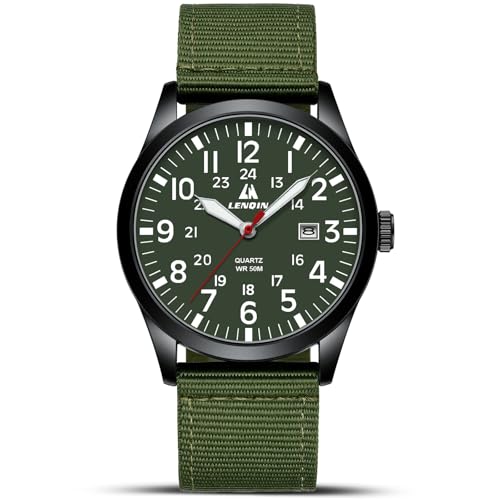
GOLDEN HOUR Men's Nylon Slip-Thru Strap Watch with Military Time Easy Read Dial Glowing Hands in Black



One Last Consideration: How You Will Feel About It in Year Five
Specifications describe the watch on the day it arrives, but ownership is lived in year five, when the strap has softened to your wrist, the case carries small bright scars from door frames and seatbelt buckles, and the tubes burn a little gentler than they did in the first winter. By then the questions that mattered at purchase will have changed completely. Nobody in year five discusses unboxing. They discuss whether the clasp still closes with the same reassuring click, whether the maker answered an email about a gasket, and whether the dial still greets them clearly during the particular darkness their life keeps returning to.
That is why this guide has returned so often to service pathways, standard lug widths, replaceable straps, and honest tube layouts rather than chasing novelty features with short half lives of their own. A watch chosen on those durable grounds tends to age alongside its owner instead of against him, becoming less like a product and more like a habit, the object reached for automatically on a nightstand in a strange city or a tent pitched far from any streetlight.
So make the careful choice, wear it through ordinary weeks as well as adventures, and let familiarity do the judging that photographs cannot; when a winter morning five years from now finds you checking the hour in a cold, dark kitchen and smiling at how naturally your eyes find those small steady markers, you will know the constellation on your wrist was chosen well.
There is a small ritual worth performing during the first week of ownership: wear the watch through one complete ordinary night at home, notice how you read it each time you wake, and adjust the strap by a single hole or micro adjustment if the fit that seemed perfect at noon feels different at midnight, because wrists change subtly across a day and a watch intended for darkness should be fitted for darkness. Settle that detail early, store the paperwork somewhere sensible, and then stop evaluating the purchase altogether, since the whole point of a steady glowing dial is that it quietly removes one recurring question from your nights and replaces it, year after year, with a glance so brief and dependable that you will eventually forget it ever required a decision at all.