What's inside
- Key Takeaways
- Quick Picks
- How We Chose These Picks
- Which six-inch Android phones deserve your money?
- How do the six compare side by side?
- Why does width matter more than screen size in this class?
- How should you choose between the three camera philosophies here?
- What mistakes do six-inch buyers keep making?
- How do the displays really differ once the diagonal is identical?
- How much performance do you actually get at this size?
- What does a full day do to each battery in this class?
- How do you set up a six-inch phone for true one-handed use?
- How do you buy renewed in this class without inheriting problems?
- How long will each phone stay worth owning?
- Which accessories actually earn their place at this size?
- What separates a good six-inch phone from a great one after a year?
- A note on gaming, since this class gets asked about it constantly
- What about privacy and security features at this size?
- Final Recommendation
- Frequently Asked Questions
- Related Guides
As an Amazon Associate I earn from qualifying purchases. This post may contain affiliate links at no extra cost to you.
widgetverdict.com is reader-supported. When you buy through links on our site, we may earn an affiliate commission.
Where to buy: all six phones below are listed on Amazon under the names used in their headings; the compact class attracts many renewed listings, so check the condition grade, the seller’s battery note and the return window before comparing headline prices.
The best 6 inch android phones are, quietly, the phones the industry actually settled on. While flagships ballooned toward seven inches and miniatures shrank into niches, the 6.1-inch class kept the original smartphone promise: a screen large enough for maps, documents and photographs, in a body that one hand can still govern. Every maker in this guide fields an entry, and the class is competitive enough that there is no lazy default. Samsung brings the complete flagship, Google brings the camera and the calendar, ASUS brings the grip, Sony brings the battery, and two value models bring the prices down without surrendering the size. This roundup compares them on the things that separate phones of identical screen acreage: body width, camera honesty, update support and how each one behaves at the end of a long day.
A note on the label before the rankings: screens in this class measure between 5.9 and 6.2 inches diagonally, which the market rounds to the six-inch shelf. What unites them is not the diagonal but the body — heights between roughly 146 and 155 millimetres, widths a thumb can cross, weights under 200 grams. If you are cross-shopping against a 6.5-inch phone that calls itself compact, measure its width and let the millimetres settle the argument.
Key Takeaways
- The Galaxy S23 is the most complete phone in the six-inch class: flagship cameras with a real zoom, universal carrier support and years of updates.
- Pixel 8 owners get the finest stills camera and support until 2030; the Pixel 8a delivers most of that experience for notably less money.
- The Zenfone 10’s 68.1mm width makes it the one-handed champion, and its gimbal camera is a genuine differentiator for video.
- Sony’s Xperia 10 V trades speed for a two-day battery and the lightest body in the class.
- The Pixel 7a is the budget doorway into the size, with wireless charging and Google’s camera processing at a low renewed price.
- Within one screen size, width and update calendars separate the phones far more than processors do.
Quick Picks
| Pick | Badge | Why it earns its place |
|---|---|---|
| Samsung Galaxy S23 | Best overall six-incher | The complete flagship recipe — zoom camera, bright screen, long support — in the class’s tidiest body. |
| Google Pixel 8 | Best camera | Google’s processing turns a strong sensor into the most reliable stills camera at this size. |
| Google Pixel 8a | Best value | Same chip and seven-year promise as the Pixel 8, wrapped in a tougher, cheaper shell. |
| ASUS Zenfone 10 | Best one-handed grip | The narrowest body in the class plus a gimbal camera and a headphone jack. |
| Sony Xperia 10 V | Best battery life | Two days per charge, 159 grams, card storage — the endurance specialist. |
| Google Pixel 7a | Best budget entry | Wireless charging and a 90Hz screen at the lowest renewed cost in the class. |
How We Chose These Picks
Eligibility began with the tape measure: bodies had to stay under 156mm tall and 73mm wide, with screens between 5.9 and 6.2 inches. That filter admits the genuine six-inch class and excludes the 6.4-inch phones that borrow its reputation. Ranking then weighed four things in order: camera capability across daylight and low light, the length and reliability of the maker’s update commitment, battery behaviour matched against charging speed, and the quality of the hand feel — width, edge shape, back texture and weight distribution judged together rather than as isolated numbers.
Availability closed the list. Each pick needed a current Amazon listing verified in this site’s pool, unlocked or in an honestly labelled carrier variant, so that a reader can act on the recommendation the same day. Models with strong reviews but no dependable listing were left out; a buying guide that recommends unobtainable phones is a museum catalogue, not a guide.
Which six-inch Android phones deserve your money?

Samsung Galaxy S23 — Best overall six-incher
The S23 wins this class the way decathletes win: not by topping every event, but by having no event where it embarrasses itself. Its body — 146.3mm tall, 70.9mm wide, 7.6mm thin, 168 grams — is the class benchmark, with flat aluminium rails that locate precisely in the fingers and IP68 sealing that the value picks below cannot match. Gorilla Glass Victus 2 front and back has aged well in the renewed market, so graded units tend to arrive looking honest.
The 6.1-inch AMOLED runs at 120Hz and peaks at 1,750 nits, which keeps maps and messages readable under a summer sky. Samsung’s colour tuning leans vivid without tipping into caricature, and the in-display fingerprint reader is quick enough to stop being a thought. Stereo speakers, often mediocre at this size, are genuinely good here — dialogue stays clear at kitchen distances, and music has more body than the thin frame promises.
Photography is the S23’s loudest claim on your money. The 50-megapixel main camera with optical stabilisation handles the everyday with warm consistency; the 12-megapixel ultrawide covers interiors; and the 10-megapixel 3x telephoto — the only true zoom in this guide — changes what a compact phone can bring home from a school hall or a stadium seat. Video is excellent, stabilised and detailed at 4K. Night work is strong, a half-step behind the Pixel 8’s processing wizardry and ahead of everything else here.
The Snapdragon 8 Gen 2 in the listed US version is the class’s best all-round chip: fast, cool-headed in ordinary work, and paired with full US 5G including mmWave. The 3,900mAh battery is the one specification that reads modestly, and it behaves that way — a confident day, not a lazy weekend — with 25W wired and 15W wireless charging that are adequate rather than exciting. Samsung’s commitment runs to Android 17 and security patches into 2028, which for a renewed purchase is a long, bankable future. Put together, this is the six-inch phone to buy when you do not want to think about phones again for years.
- Body: 146.3 × 70.9 × 7.6 mm, 168 g, IP68
- Screen: 6.1-inch AMOLED, 120Hz, 1,750-nit peak
- Chip: Snapdragon 8 Gen 2, 8GB RAM, 128GB on listed version
- Cameras: 50MP main with OIS, 12MP ultrawide, 10MP 3x telephoto
- Battery: 3,900mAh, 25W wired, 15W wireless; support into 2028
Strengths
- Only true telephoto in the class.
- Brightest complete package of screen, sealing and speakers.
- Works on every major US carrier.
Trade-offs
- Battery sized for a day, not two.
- Charging speeds are mid-pack.
- No expandable storage.
Best for: buyers wanting one compact flagship with no weak department.
Not suited for: two-day battery hunters or card-storage loyalists.

Google Pixel 8 — Best camera
Google builds its six-inch entry around a single conviction: the best camera is the one that gets the shot without being asked twice. The Pixel 8’s 50-megapixel main sensor is fine hardware; the processing behind it is the product. Faces keep their texture, mixed lighting resolves into balance instead of mud, and night photographs hold skies black and streetlights contained. For parents, travellers and anyone whose camera roll is their diary, that reliability outweighs spec-sheet gaps elsewhere.
The body measures 150.5 by 70.8 millimetres and 187 grams, with every corner softened into a pebble curve that hides its height in the palm. The 6.2-inch Actua OLED is the brightest here at 2,000 nits peak and refreshes at 120Hz, though the polished glass back is slippery enough that a slim case should be considered part of the purchase price. Inside, the Tensor G3 runs Google’s intelligent features — call screening, live translation, transcription, photo unblur — with an ease that makes rival assistants feel like homework, while conceding raw gaming power and some weak-signal efficiency to the Snapdragon phones.
The second camera is a 12-megapixel ultrawide that doubles as a macro lens; there is no telephoto, and zoom relies on sensor cropping that stays clean to roughly 2x. Battery capacity of 4,575mAh delivers the strongest flagship endurance in this guide, and charging runs at 27W wired. The headline, though, is the calendar: seven years of operating-system and security updates from launch, reaching 2030, which means a renewed Pixel 8 bought today will out-support most phones launched next year. In a class where several rivals ask you to accept two or three years, that promise is close to a cheat code.
- Dimensions: 150.5 × 70.8 × 8.9 mm, 187 g
- Display: 6.2-inch Actua OLED, 120Hz, 2,000-nit peak
- Chip: Tensor G3, full US 5G including mmWave
- Cameras: 50MP main, 12MP ultrawide with macro focus
- Battery: 4,575mAh, 27W wired; updates until 2030
Strengths
- Most reliable stills camera in the class.
- Seven-year update support, unmatched here.
- Smart features that reduce daily friction.
Trade-offs
- No optical zoom for distant subjects.
- Heavy for its size; slippery without a case.
- Tensor trails Snapdragon in sustained gaming.
Best for: photographers and long-term keepers who value software intelligence.
Not suited for: zoom-dependent shooters or competitive gamers.

Google Pixel 8a — Best value
The 8a asks a sharp question: if the chip, the camera philosophy and the seven-year calendar are the same as the flagship’s, what exactly does the extra money buy? Materials and margins, mostly. The 8a’s body is matte plastic instead of polished glass, its bezels are thicker, its water resistance is IP67 rather than IP68, and its charging is slower. Everything a spec sheet calls secondary. Everything a hand calls primary — grip, screen, speed, photographs — survives the discount remarkably intact, and the matte back actually out-grips the flagship it undercuts.
At 152.0 by 72.7 millimetres it is the largest body in this guide, though the 6.1-inch Actua OLED inside it refreshes at 120Hz and reaches the same 2,000-nit peak as the Pixel 8. The Tensor G3 keeps call screening, transcription and photo tools at flagship fluency. The 64-megapixel main camera, processed Google’s way, produces stills that embarrass phones costing far more, and the 13-megapixel ultrawide is a fair companion. Battery capacity of 4,492mAh lasts the day with headroom; 18W wired and 7.5W wireless charging are the class’s slowest, demanding overnight habits rather than opportunistic top-ups.
For families, the 8a has become the default first smartphone recommendation for good reason: it is inexpensive renewed, supported until 2031, repairable through a wide network, and honest about its compromises. For adults, it is the value pick of the six-inch class — the phone that spends your money on the years ahead instead of the finish on the back.
- Body: 152.0 × 72.7 × 8.9 mm, 188 g, matte plastic
- Screen: 6.1-inch Actua OLED, 120Hz, 2,000-nit peak
- Chip: Tensor G3, same as the Pixel 8
- Cameras: 64MP main, 13MP ultrawide
- Battery: 4,492mAh; seven years of updates from launch
Strengths
- Flagship intelligence and longevity at a value price.
- Camera quality far beyond its tier.
- Grippy, drop-forgiving body.
Trade-offs
- Largest and joint-heaviest body here.
- Slowest charging in the class.
- Chunky bezels date the design.
Best for: value hunters, families and anyone buying years of support on a budget.
Not suited for: buyers chasing the smallest grip or fastest charging.

ASUS Zenfone 10 — Best one-handed grip
ASUS is the only maker here that designed its six-inch entry grip-first. The Zenfone 10’s screen measures 5.9 inches, and the body around it — 146.5mm tall and just 68.1mm wide — is the narrowest in the class by a margin your fingers will register within seconds. The textured polymer back refuses to slide, the side-mounted fingerprint reader doubles as a notification gesture surface, and the whole phone can be operated, genuinely operated, with one hand on a moving train. In a class defined by one-handed promises, this is the one that keeps them completely.
Performance refuses to play the small-phone discount: the Snapdragon 8 Gen 2 matches the S23’s speed, backed by generous RAM on the listed 256GB international version. The AMOLED panel refreshes at up to 144Hz, the smoothest here, and the 4,300mAh battery — large for the footprint — converts the smaller screen into full-day-plus endurance with 30W wired and 15W wireless charging. A 3.5mm headphone jack survives, which in 2025 reads almost as a manifesto.
The camera story centres on the 50-megapixel main sensor’s six-axis gimbal stabilisation, which produces walking footage with a steadiness software alone cannot imitate, and low-light stills that stay sharp at forgiving shutter speeds. A 13-megapixel ultrawide assists; there is no zoom lens. ASUS’s software support — two major upgrades, four years of patches — is the class’s shortest flagship calendar, and the international model targets GSM networks. Grip absolutists on T-Mobile or AT&T will forgive both. Everyone else should read those two sentences twice before ordering.
- Dimensions: 146.5 × 68.1 × 9.4 mm, 172 g
- Display: 5.9-inch AMOLED, up to 144Hz
- Chip: Snapdragon 8 Gen 2, ample RAM on listed version
- Cameras: 50MP gimbal main, 13MP ultrawide
- Battery: 4,300mAh, 30W wired; headphone jack fitted
Strengths
- Narrowest, grippiest body in the class.
- Gimbal video stabilisation is unique here.
- Strong battery for a compact flagship.
Trade-offs
- Shortest flagship update commitment.
- No telephoto camera.
- GSM-oriented listing; not a Verizon phone.
Best for: one-handed purists and walking-video shooters on GSM carriers.
Not suited for: Verizon customers or five-year keepers.

Sony Xperia 10 V — Best battery life
Sony’s entry interprets the six-inch brief through a taller lens — literally. The 6.1-inch OLED is stretched to a 21:9 ratio inside a body 155mm tall but only 68mm wide and 159 grams light, so it grips like the Zenfone while showing more lines of text than anything else here. For readers, that shape is a feature no benchmark captures: articles, documents and message threads all flow further per glance, and split-screen apps stack naturally in the tall frame.
Sony specced this phone for stamina rather than speed, pairing a frugal Snapdragon 695 with a 5,000mAh battery, and the result owns the class’s endurance crown — two days of ordinary use is a planning assumption, not a hope. The compromises ride along openly: a 60Hz screen in a 120Hz class, performance that caps out at everyday workloads and light games, and no wireless charging. Cameras — a stabilised 48-megapixel main, an 8-megapixel 2x telephoto and an 8-megapixel ultrawide — handle daylight with Sony’s characteristic restraint and fall behind the Pixels after dark.
What keeps the Xperia in this guide, beyond stamina, is respect for older habits: a microSD slot for the library you already own, a headphone jack for the earphones already in your drawer, and IP65/68 sealing that outclasses its price. Support is shorter than the leaders’, and the listed GSM model belongs on T-Mobile or AT&T. As a light, narrow, long-running reading and listening machine, nothing else in the class does its particular job.
- Body: 155 × 68 × 8.3 mm, 159 g — lightest here
- Screen: 6.1-inch 21:9 OLED, 60Hz
- Chip: Snapdragon 695, efficiency-tuned
- Cameras: 48MP main with OIS, 8MP 2x telephoto, 8MP ultrawide
- Battery: 5,000mAh; microSD slot and headphone jack
Strengths
- Two-day battery life, unmatched in the class.
- Lightest and joint-narrowest body.
- Expandable storage and wired audio.
Trade-offs
- 60Hz screen and midrange pace.
- No wireless charging.
- Shorter support; GSM listing only.
Best for: readers, listeners and travellers who charge twice a week, not nightly.
Not suited for: gamers or buyers wanting flagship speed and long patch support.
Google Pixel 7a — Best budget entry
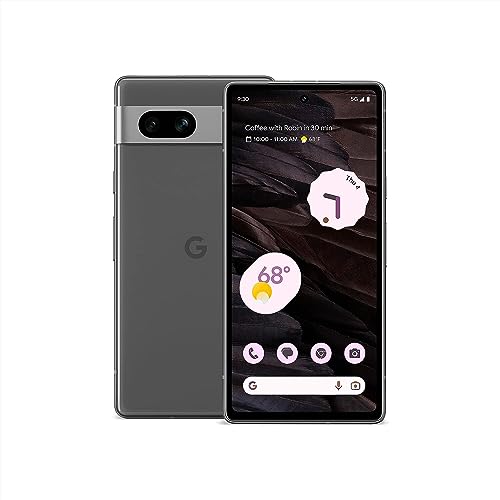
The Pixel 7a is the previous generation’s value champion, and the renewed market has turned it into the cheapest respectable doorway into the six-inch class. Its 6.1-inch OLED refreshes at 90Hz — a step below the 120Hz leaders, a leap above the 60Hz panels still sold at its price — and the body, 152mm tall and 72.9mm wide, wears a matte frame and plastic back that shrug off the knocks of daily work. At 193.5 grams it is the heaviest phone here, a fact wrists notice on long calls, though the balance is even enough that it rarely feels clumsy.
Google’s Tensor G2 keeps the experience recognisably Pixel: call screening, magic eraser, live transcription and a 64-megapixel main camera whose processing delivers low-light results that still embarrass newer budget rivals. A 13-megapixel ultrawide supports it. The 4,385mAh battery lasts a typical day, charging at 18W wired — but the 7a’s party trick at this price is wireless charging, a feature budget phones routinely skip and desk workers genuinely use. IP67 sealing adds further insurance.
The honest caveat is the calendar. Google promised the 7a three years of OS updates and five of security patches from its 2023 launch, so its remaining runway is the shortest in this guide. Buyers who rotate phones every couple of years will never feel that limit; buyers shopping for a five-year companion should step up to the 8a and its seven-year horizon. As a two-to-three-year phone at today’s renewed prices, the 7a remains very easy to recommend.
- Dimensions: 152.0 × 72.9 × 9.0 mm, 193.5 g
- Display: 6.1-inch OLED, 90Hz
- Chip: Tensor G2
- Cameras: 64MP main, 13MP ultrawide
- Battery: 4,385mAh, 18W wired plus wireless charging
Strengths
- Lowest entry price into the class.
- Wireless charging at a budget tier.
- Google camera processing for low light.
Trade-offs
- Shortest remaining update runway here.
- Heaviest body in the guide.
- 90Hz screen trails the 120Hz leaders.
Best for: budget buyers wanting a genuine Pixel experience for two to three years.
Not suited for: long-term keepers — the 8a’s calendar is the better buy for them.
How do the six compare side by side?
| Model | Screen | Width | Battery | Standout trait |
|---|---|---|---|---|
| Galaxy S23 | 6.1″ 120Hz | 70.9mm | 3,900mAh | Telephoto camera, complete flagship |
| Pixel 8 | 6.2″ 120Hz | 70.8mm | 4,575mAh | Best stills, support to 2030 |
| Pixel 8a | 6.1″ 120Hz | 72.7mm | 4,492mAh | Value with seven-year support |
| Zenfone 10 | 5.9″ 144Hz | 68.1mm | 4,300mAh | Narrowest grip, gimbal camera |
| Xperia 10 V | 6.1″ 21:9 | 68.0mm | 5,000mAh | Two-day battery, 159 g |
| Pixel 7a | 6.1″ 90Hz | 72.9mm | 4,385mAh | Budget Pixel with wireless charging |
Why does width matter more than screen size in this class?
Every phone in this guide advertises roughly the same diagonal, yet they feel like three different classes in the hand, and width is the reason. A thumb anchored at the bottom corner sweeps an arc; on a 68mm body that arc covers the whole keyboard and most of the screen, while on a 73mm body the far column of keys and the top corner become two-handed territory. Five millimetres of width is the difference between a phone you operate and a phone you handle. That is why the comparison table above sorts by width alongside screen size, and why your first shop test should be typing a full sentence — capitals, punctuation and all — with one thumb.
Weight distribution is width’s quiet partner. A top-heavy phone feels larger than its dimensions because it levers against your little finger all day; a balanced one disappears. The Pixel pair carry their camera hardware high and feel denser than the numbers suggest, while the Xperia’s lightness flatters its tall frame. None of this appears on a spec sheet, and all of it appears within a week of ownership.
How should you choose between the three camera philosophies here?
Samsung sells versatility: three lenses, three focal lengths, and a processing style that flatters food, faces and sunsets with warm confidence. Google sells certainty: two lenses, but processing that rescues the shots other phones lose — the dim restaurant, the backlit portrait, the child who moved. Sony sells honesty: restrained colours and files that reward editing, at the cost of low-light sparkle. ASUS sells motion: the gimbal makes video its first language and stills its second.
Match the philosophy to your camera roll. Scroll through your last hundred photographs and count how many are distant subjects, dim interiors, moving children or posed landscapes. Distant subjects point to the S23’s zoom. Dim interiors point to the Pixels. Moving subjects point to the Zenfone. Landscapes forgive everything and let price decide. Your own archive is a better buying guide than any reviewer’s gallery, because it describes the photographer you actually are.
What mistakes do six-inch buyers keep making?
Assuming all 6.1-inch phones feel the same
They share a diagonal and nothing else that matters to a hand. Widths in this guide span 68 to nearly 73 millimetres, weights span 159 to 193 grams, and those spreads are the difference between one-handed ease and daily juggling. Compare bodies, not diagonals.
Paying flagship money for a two-year calendar
A premium phone whose updates end soon is a depreciating asset wearing a flagship badge. Read the support commitment for the exact model — the table of virtues in this guide lists them per pick — and let a short calendar discount your offer accordingly.
Ignoring renewed grading language
Excellent, very good and acceptable are not poetry; they are promises about screens and battery health that vary by seller. Buy the grade you would accept on your worst day, test the phone hard inside the return window, and treat a vague listing as a no.
Buying the case after the first drop
Glass backs dominate this class, and two of the six are slippery by design. Order the slim case and screen protector with the phone. A week of caseless confidence is the most expensive week in compact ownership.
How do the displays really differ once the diagonal is identical?
Brightness separates first. The Pixel pair peak at 2,000 nits, the S23 at 1,750, and both figures translate into maps that stay readable at a sunny bus stop without the hand-shading ritual. The Zenfone’s panel is a touch dimmer outdoors but compensates with the class’s highest refresh rate, 144Hz, which makes scrolling and game motion visibly smoother than the 120Hz standard the Samsung and Google flagships share. The 7a’s 90Hz sits in between, and the Xperia’s 60Hz panel is the one display here that feels a generation old the moment you flick a long page — though its 21:9 shape returns more text per screen than any rival.
Colour philosophy divides the class as cameras do. Samsung tunes for appetite: saturated, warm, instantly appealing, with a natural mode available for those who prefer accuracy. Google tunes for fidelity and keeps skin tones honest. Sony stays closest to a reference monitor, which video editors appreciate and casual viewers sometimes call dull. None of these panels will disappoint; they simply flatter different content. If your phone is your newspaper, prioritise the Xperia’s shape and the Zenfone’s sharpness. If it is your cinema, prioritise the S23’s brightness and speakers. If it is both, the Pixel 8 splits the difference with the brightest screen of all.
Durability of the glass deserves a line, because six-inch phones live in pockets with keys. The S23’s Victus 2 and the Pixels’ Victus coverings resist the micro-scratching that clouds cheaper glass, which matters doubly on renewed units: a flagship screen that has survived two years gracefully is worth more than a budget screen that has not. Fit a tempered protector on day one regardless; at this size, protectors are cheap, precisely cut, and invisible in use.
How much performance do you actually get at this size?
Two chips define the class’s fast lane. The Snapdragon 8 Gen 2 in the S23 and Zenfone 10 remains a genuinely flagship processor: games hold high settings, photo processing is instant, and the phones stay composed under the kind of multitasking — navigation dictating over music while messages arrive — that exposes weaker silicon. Google’s Tensor G3 answers with intelligence rather than force, trading benchmark crowns for transcription, translation and camera computation that feel like the future arriving early. In daily, non-gaming work the two are effectively tied, and anyone who tells you otherwise is selling something.
The second lane is honest midrange. Tensor G2 in the 7a keeps the Pixel experience fluid for communication and photography, with gaming as its ceiling. The Xperia’s Snapdragon 695 is the deliberate slowcoach: it never pretends to chase frames, and in return it barely warms, barely sips, and handles the reading-messaging-listening workload indefinitely without a stutter. The mistake is not buying a slower chip; it is buying one while expecting the faster lane’s hobbies. Match the processor to your games list and the question answers itself.
Memory and storage follow the same pattern. The listed flagships carry 8GB of RAM or more and 128–256GB of storage, which is ample for app collections and photo libraries backed by cloud storage. Only the Xperia offers a card slot for those who keep media locally. If your current phone’s storage screen shows a library north of 100GB, budget the cloud migration into your purchase or pick the Xperia and carry the card over.
What does a full day do to each battery in this class?
Start at dawn with all six at full charge and the class sorts itself by evening. The Xperia finishes with half its tank in reserve, because its chip and screen sip while its cell is the largest. The Pixel 8 and Zenfone 10 end a mixed day — messages, an hour of maps, photography, an evening of reading — with a comfortable margin. The 8a lands close behind them. The S23 ends the same day lower, in the teens, still upright but glad of the bedside charger. The 7a mirrors it a year further down the battery-age curve.
Push the day harder and the order holds while the margins shrink. A navigation-heavy road day with the screen lit for hours is the compact class’s sternest test: the Xperia shrugs, the Pixels and Zenfone ask for a car charger by afternoon, and the S23 wants one by lunch. This is not a defect in any single phone; it is the physics of small bodies and big radios. The practical responses are boring and effective — a car charger, a desk pad, a slim power bank in the bag — and they cost less than the regret of buying a larger phone you never wanted.
Charging speeds decide how forgiving those habits must be. The Zenfone’s 30W and the Pixel 8’s 27W restore a useful charge during a coffee stop. Samsung’s 25W is adequate. The 8a and 7a at 18W, and the 8a’s 7.5W wireless, demand overnight planning. The Xperia omits wireless charging entirely, which desk workers should weigh honestly against its two-day stamina: a phone charged twice a week by cable inconveniences you less than a phone charged nightly by pad, but only if your routine suits it.
How do you set up a six-inch phone for true one-handed use?
The class promises one-handed operation; settings deliver it. Begin by shrinking the interface’s ambitions: enable one-handed mode on whichever phone you chose and learn its gesture until it is reflex. Move the six apps you open hourly into the bottom two home-screen rows, and exile everything else to the app drawer, where a search finds it faster than a thumb-stretch ever did. Widgets that inform — weather, calendar, headlines — belong at the top, where eyes go and thumbs need not.
Keyboards repay five minutes of attention. Reduce the keyboard height slightly, turn on swipe typing for long words, and let voice dictation handle messages longer than a sentence; on the Pixel models especially, dictation accuracy has reached the point where typing a paragraph feels like the eccentric choice. Notification handling completes the setup: Samsung’s edge gestures, the Zenfone’s fingerprint-swipe, and Android’s universal double-tap tricks all exist to keep the shade within reach. Configure them on day one, because a phone that requires two hands after a month of ownership was configured by default, not by you.
Accessories finish the job. A slim case with textured sides adds grip without width; a finger ring moves the phone’s balance point into your hand’s control; and a car mount removes the most dangerous one-handed task of all. Judge the setup after a week of commuting rather than an evening on the sofa — the train, the shopping bag and the school run are the examiners this class was built to pass.
How do you buy renewed in this class without inheriting problems?
Four of these six phones reach most buyers through renewed channels, and the grade on the listing is a contract worth reading like one. Prefer sellers who state a minimum battery-health percentage in writing, because compact batteries have no reserve to hide behind: a unit at 85 percent health has lost the equivalent of half a day of the S23’s margin. Check the cosmetic grade against your own tolerance honestly — screen scratches are forever, back-panel marks vanish under the case you should be buying anyway.
During the return window, run the phone like an examiner. Photograph a white wall and a dark room to expose sensor and screen faults. Make calls from your weakest-signal rooms. Charge it fully and use it hard for a day to see the battery’s real behaviour rather than its reported one. Register the device, run every pending update, and confirm the model number in settings matches the listing’s promise — US and international variants share names and differ in bands. A phone that passes that week will almost certainly serve for years; one that fails has cost you nothing but postage.
Warranty separates the serious renewed sellers from the hopeful. Amazon’s renewed programme and established refurbishers back their units for months; anonymous marketplace sellers back theirs with adjectives. In a class where the newest model is two generations old, that backing is part of the product, and paying slightly more for it is rarely a mistake.
How long will each phone stay worth owning?
Read the calendars as the products’ true expiry dates. The Pixel 8 and 8a, supported to 2030 and 2031 respectively, are the class’s long-distance runners — a renewed 8a today has more supported future than most phones that will be announced next spring. The S23 follows with patches into 2028. The 7a’s runway is the shortest of the Google pair’s family, ending years sooner, which its price reflects. ASUS offers four years of security patches from the Zenfone 10’s launch; Sony’s midrange calendar is shorter still. None of these phones will physically wear out before its calendar does, which is precisely why the calendar deserves the weight this guide gives it.
Battery ageing is the second clock, and it is serviceable: every model here has replacement batteries available through manufacturer or independent repair networks, and a fresh cell at year three restores a compact phone to something close to youth. Budget that single repair into a keeper’s total cost and the flagship picks’ economics improve further. The phones to avoid are not the old ones — they are the ones whose software ends before their second battery would.
Which accessories actually earn their place at this size?
The six-inch class sells a promise — a phone that disappears into a pocket and a hand — and accessories should be audited against it. A slim case with raised screen edges protects the glass while adding under two millimetres in each direction; a rugged case protects better and spends the promise. Choose by your drop history, not your optimism. Tempered glass protectors are model-specific and worth fitting on day one, because every screen here is expensive relative to the phone’s renewed value.
Charging gear divides by standard. All six phones drink from USB-C, and a single 30W Power Delivery brick serves every one of them at or near its best speed, which simplifies the travel kit to one brick and one cable. Wireless pads suit the Samsung, ASUS and Google models; the Xperia sits them out. A car mount sized for the class’s widths adjusts across all six bodies, and a short cable for the car prevents the navigation battery drain described earlier. Earbuds are the last decision: the Zenfone and Xperia take your wired pair directly, the rest ask for USB-C or Bluetooth — a small, daily convenience worth weighing if you listen for hours.
What separates a good six-inch phone from a great one after a year?
Time edits every review. At month twelve, the specifications that filled the launch coverage — chip generations, refresh rates — have faded into the background hum of a phone that simply works, and three qualities remain in the foreground. The first is battery honesty: whether the phone still ends your actual day upright, which is why this guide weighted endurance and replaceable cells so heavily. The second is software freshness: whether security patches still arrive and apps still assume your phone matters, which is the calendar argument in another costume. The third is physical survival: whether the screen is unmarked, the ports are tight and the back is uncracked, which is where sealing ratings and glass quality quietly repay their cost.
Judged on those three year-later qualities, the class ranks itself cleanly. The Pixel pair lead on software, the Xperia leads on battery, the S23 leads on physical completeness, and the Zenfone leads on the grip that made you buy it — which, a year on, is still the quality its owners mention first. Pick the quality your future self will thank you for, because that self, not the unboxing one, owns most of the phone’s life.
A note on gaming, since this class gets asked about it constantly
Compact phones carry a reputation for gaming weakness that the current class only half deserves. The Snapdragon models — S23 and Zenfone 10 — run demanding titles at high settings with stable frame rates for session-length play; their limit is thermal, arriving after extended sessions as warmth and gentle throttling rather than collapse. The Tensor phones play popular titles well at moderate settings and heat sooner. The 7a is a casual-gaming phone, and the Xperia is honest about not being one at all. Cooling accessories exist, but a buyer whose primary use is marathon gaming should honestly shop the large gaming class instead; a six-inch phone asked to be a console will spend its life disappointing two masters.
For the way most people actually game — twenty minutes on a train, a puzzle over coffee, a few races in the evening — every phone in this guide except the Xperia is more than sufficient, and the Zenfone’s combination of speed, grip and 144Hz screen makes it the sleeper pick of the class for exactly that pattern.
What about privacy and security features at this size?
All six phones unlock biometrically — face, fingerprint or both — and all support the platform protections modern Android assumes: per-app permissions, approximate location, a privacy dashboard and automatic permission reset for apps you stop using. The meaningful differences are about time, not features. A phone still receiving patches is a phone whose protections are current; a phone past its calendar is running yesterday’s defences against tomorrow’s threats. That is the security argument underneath this guide’s repeated attention to update windows, and it applies with special force to phones holding banking, health and work accounts — which is to say, nearly all of them.
Two habits multiply whatever protection your phone ships with. Keep the automatic updates on, including the small security ones that arrive without fanfare, and audit your app list twice a year for things you no longer open. Compact phones encourage a leaner app library by temperament; let that instinct run, and the attack surface shrinks with the screen.
Final Recommendation
For most buyers the Galaxy S23 is the six-inch class done completely — buy it and stop reading comparison tables. Choose the Pixel 8 when the camera and the 2030 calendar speak loudest, the Pixel 8a when they must speak at a lower price, and the Pixel 7a when the budget is firm and the horizon is short. Take the Zenfone 10 for the grip and the gimbal, and the Xperia 10 V when battery life and lightness outrank speed. Six phones, one screen size, six genuinely different answers — measure your hand, read your camera roll, and the right one identifies itself.
Frequently Asked Questions
Is 6.1 inches big enough for video and games?
For one viewer, comfortably: modern 6.1-inch panels are bright, sharp and high-refresh, and most games are designed around this size. For sharing video with a second person or split-screen multitasking all day, a larger phone earns its bulk — but that is a different search from this one.
Which of these has the best battery life?
The Xperia 10 V, by a wide margin, thanks to its 5,000mAh cell and efficient processor — expect two ordinary days. Among the flagships, the Pixel 8 and Zenfone 10 lead, while the S23 is a solid one-day phone.
Which six-inch phone works on Verizon?
The US-version Galaxy S23, Pixel 8, Pixel 8a and Pixel 7a all support Verizon. The Zenfone 10 and Xperia 10 V listings here are GSM models aimed at T-Mobile and AT&T.
Is the Pixel 8a too big to count as a six-inch phone?
Its screen is 6.1 inches, squarely in class; its body is the largest here at 152 by 72.7 millimetres. If your hands are small, handle one before ordering — the Zenfone 10 shows how much narrower the same class can feel.
Do any of these phones have a headphone jack?
Yes — the Zenfone 10 and the Xperia 10 V both keep the 3.5mm jack. The Samsung and Google models are USB-C or Bluetooth only for audio.
Which is the best choice for a first smartphone?
The Pixel 8a: inexpensive renewed, supported for years, with a forgiving body and software that actively reduces spam and confusion. The Pixel 7a undercuts it further if the shorter support window is acceptable.
Which of these is best for small hands specifically?
The Zenfone 10, and it is not close: at 68.1mm wide with a textured back, it is the only phone here a small hand can wrap rather than balance. The Xperia 10 V matches its width but adds height, and the Galaxy S23 is the narrowest of the mainstream flagships after those two.
Do all six support 5G?
Yes — every pick here is a 5G phone. The US-version Samsung and Google models cover the major American networks comprehensively, while the Zenfone 10 and Xperia 10 V listings are GSM-oriented, so check your carrier against the listing before ordering.
Which phone here is best for an older parent?
The Pixel 8a: its software screens spam calls before the phone rings, its interface can be simplified with large text, its body forgives drops, and its seven-year support means a child will not be re-buying it soon. Set it up with their accounts and a simple home screen before handing it over.
Is a six-inch phone big enough for reading books?
For novels and articles, yes — the tall screens here show plenty of lines, and the Xperia’s shape is built for exactly that. For PDFs, comics and anything designed as a fixed page, a tablet remains the honest tool; a six-inch phone will have you pinching and panning.
What is the cheapest way into this class?
A renewed Pixel 7a through the listing in this guide. You accept the shortest update runway in the class and the heaviest body, and in exchange you get Google’s camera and wireless charging at the lowest price here — a fair trade for a two-to-three-year horizon.
Can these phones replace a separate camera for family events?
The S23 and Pixel 8 can, for the way families actually photograph: birthdays, school events, holidays. Their main cameras are excellent and their processing forgives bad light. The S23’s zoom adds the stage-and-playing-field shots that defeat the others. For weddings you are being paid to shoot, bring a camera; for everything else, these two suffice.
How do I transfer everything from my old phone?
Both Samsung and Google include cable transfer tools that clone apps, photos, messages and settings during setup. Run the transfer plugged into power, then sign into banking and health apps individually, since those verify new devices deliberately. Keep the old phone for a fortnight as a fallback for forgotten authenticators.
Which pick handles hot weather and outdoor work best?
The Xperia 10 V: its efficient chip generates little heat, its battery outlasts a shift, and its light body rides in a work pocket unnoticed. The S23 is the runner-up for its sealing and screen brightness. Whichever you choose, a case matters more on a site than in an office.
Do these phones support eSIM?
The Samsung and Google models here support eSIM alongside a physical nano-SIM on their US versions, which suits travellers who add local data plans. The Zenfone 10 and Xperia 10 V rely on physical SIMs in the listed versions — the Xperia takes two, plus its memory card.
Which of these should a student buy?
The Pixel 8a for most: it survives drops, its camera handles social life, call screening silences the spam that targets students, and its support window covers a whole degree and beyond. If the budget is tighter and the course is shorter, the 7a covers two to three years honourably.
How important is the refresh rate, really?
It is the difference you feel rather than see in screenshots: scrolling stays legible, animations feel liquid, and the phone seems faster than its processor. Once you have lived with 120Hz, 60Hz feels like wading. That is why the Xperia’s 60Hz panel is listed as a genuine trade-off despite its other virtues.
Can I use one of these as a hotspot all day?
You can, and the battery table predicts the experience: the Xperia will, the Pixels and Zenfone will with a top-up, and the S23 will want a cable by mid-afternoon. Hotspot duty is radio-heavy work; if it is your job’s core, carry the charger regardless of the phone you choose.
Which phone here will still feel fast in three years?
The Snapdragon pair — Galaxy S23 and Zenfone 10 — start with the most performance headroom, and the Pixel 8’s support calendar keeps its software optimised the longest. The Xperia was never chasing speed and will feel in three years exactly what it feels like today, which its owners count as a virtue.
Do I need 256GB, or is 128GB enough?
For a cloud-backed photo library and a normal app collection, 128GB is enough. If you store music, films or a decade of photographs locally, take 256GB where offered — or the Xperia, whose card slot makes the question disappear.
What should I check first when a renewed unit arrives?
The model number in settings, against the listing — variants share names and differ in bands and storage. Then the battery’s behaviour across one hard day, the cameras against a white wall and a dark room, and every pending software update. Do all of it inside the return window, while the answers still cost nothing.
Is the Zenfone 10’s 5.9-inch screen noticeably smaller than 6.1?
Barely, in area; noticeably, in grip. The tenth-of-an-inch differences in diagonal are marketing weather, while the Zenfone’s 68.1mm width is a climate your hand lives in. Judge it by holding, not by the decimal.
Which of these is easiest to sell on when I upgrade?
The Galaxy S23 and Pixel 8 hold the deepest secondhand demand, because their names, support windows and repair networks reassure the next buyer. Keep the box, the cable and a record of any battery replacement; in the renewed market, documentation is worth money.
How do I decide between the Pixel 8 and the Galaxy S23 in one minute?
Ask which you photograph more: near things in bad light, or far things in any light. Near and dim belongs to the Pixel’s processing; far belongs to the Samsung’s zoom lens, and no software setting on either phone fully covers the other’s ground. If the answer is genuinely both, take the S23 for the lens and accept its slightly less magical processing — hardware outlives software tricks, because tricks get copied and lenses do not.
What is the single best test before the return window closes?
Live one ordinary day entirely on the new phone — commute, work, photographs, evening — and write down the battery percentage at bedtime and the one moment the size annoyed you. If the percentage is healthy and the annoyance is trivial, keep it; the data from your own day outweighs every table in this guide.
Related Guides
Measure the class by body height in the best 146mm android phones, revisit the classics in the best 5.2 inch phones android roundup, or go smaller still with the best 4 inch android phones.