What's inside
- Key Takeaways
- Quick Picks
- How We Chose These Picks
- Which compact phones actually serve T-Mobile properly?
- How do the six compare side by side?
- Which tempting compacts are missing T-Mobile bands, and what happens if you buy one anyway?
- How do you check coverage and bands for your own addresses?
- What mistakes do T-Mobile compact buyers keep making?
- How do you activate and set up a compact on T-Mobile, step by step?
- What should you do when signal disappoints anyway?
- How do hotspots, travel and roaming behave on these picks?
- How do the prepaid brands change the calculation?
- Which of these phones will still be patched when your plan renews?
- What does living with each pick feel like on this network?
- How should families split these picks across several lines?
- A brief history of why this network rewards band literacy
- What should you keep from your old carrier when you switch?
- One last comparison: the two philosophies in this guide
- Final Recommendation
- Frequently Asked Questions
- Related Guides
As an Amazon Associate I earn from qualifying purchases. This post may contain affiliate links at no extra cost to you.
widgetverdict.com is reader-supported. When you buy through links on our site, we may earn an affiliate commission.
Where to buy: every pick below is sold unlocked on Amazon under the name in its heading, ready for a T-Mobile SIM or eSIM; confirm the model is the US version where the heading says so, because carrier band support lives in the variant, not the brand name.
Finding the best 5 inch android cell phones for tmobile means solving two puzzles at once, and the order matters. The first puzzle is size: no current phone carries a true 5-inch screen, so the honest hunting ground is the modern compact class — 5.9 to 6.2-inch screens in bodies a hand can still run one-handed. The second puzzle is the network. T-Mobile’s coverage rests heavily on bands other carriers treat as optional, above all the 600MHz low band (LTE band 12 and 5G band n71) that carries signal into rural counties and through concrete, and the mid-band n41 that delivers the network’s famous 5G speeds in cities. A compact phone missing n71 will feel broken on T-Mobile outside the suburbs no matter how good its camera is. Every main pick in this guide is a US-market model with the full T-Mobile band set, verified against the maker’s specifications; the tempting international compacts that lack those bands are discussed separately, with their caveats in plain sight, and none of them is ranked as a pick.
That discipline removes some famous names and keeps six phones that a T-Mobile customer — or a Mint, Tello, Metro or Google Fi customer riding the same network — can activate, carry into the countryside and keep patched for years. They span the useful range: two Google value models, two Samsung flagships in compact form, Google’s camera flagship, and Sony’s narrow battery specialist, which earns its place because its listed GSM variant does support T-Mobile’s network properly for calls, texts and LTE data where its bands reach.
Key Takeaways
- Band n71 (600MHz) is the single most important T-Mobile specification: it is the difference between coverage and a dead zone across rural America.
- Every ranked pick here is a US-version phone with n71 and n41 support, so activation on T-Mobile or its prepaid brands is painless.
- The Pixel 8a is the value champion for this network — full bands, seven years of updates, and Wi-Fi calling that works out of the box.
- The Galaxy S23 is the premium compact answer, with the strongest radio package and a real zoom camera.
- International compact models often lack n71 entirely; they are covered below as caveated mentions, never as ranked picks.
- eSIM support on the Samsung and Google picks makes switching to T-Mobile a software errand rather than a postage wait.
Quick Picks
| Pick | Badge | Why it earns its place |
|---|---|---|
| Google Pixel 8a | Best value on T-Mobile | Full band support, seven-year updates and flawless Wi-Fi calling at a renewed midrange price. |
| Samsung Galaxy S23 | Best premium compact | The complete flagship with the strongest T-Mobile radio set and a true telephoto camera. |
| Google Pixel 8 | Best camera for the network | Google’s finest stills, full n71 and n41, and support running to 2030. |
| Samsung Galaxy S22 | Budget flagship route | Same band completeness as the S23 at a lower renewed cost, with a smaller battery as the trade. |
| Google Pixel 7a | Cheapest full-band option | Wireless charging and complete T-Mobile support at the lowest price in this guide. |
| Sony Xperia 10 V | Narrow battery specialist | Two-day stamina and a 68mm grip; check its band list against your area before choosing it. |
How We Chose These Picks
Network fitness was the gate, and it was absolute. A phone needed T-Mobile’s core LTE bands plus 5G n71 and n41 in its US specification to be ranked at all; models whose listings could not confirm that support were demoted to the caveat section regardless of their other charms. Size came second: bodies under 156mm tall and 73mm wide, the modern translation of the 5-inch brief. Software support, camera quality and battery behaviour then ordered the survivors, with Wi-Fi calling reliability and eSIM support counted as genuine T-Mobile virtues rather than footnotes.
Every ranked pick is available through a verified Amazon listing in this site’s pool, unlocked, so a T-Mobile SIM or eSIM transfer is the only step between the box and the network. Where a pick also exists in an international variant with weaker bands, the pick section names the US version explicitly, because buying the wrong twin is the most common and most preventable failure in carrier-specific shopping.
Which compact phones actually serve T-Mobile properly?

Google Pixel 8a — Best value on T-Mobile
The Pixel 8a is what happens when a value phone refuses to cut the network corners. Its US specification carries T-Mobile’s full working set — low-band 600MHz for reach, mid-band n41 for city 5G speed — and it behaves on the network exactly like Google’s flagships: Wi-Fi calling provisions instantly, visual voicemail works in the dialer, and eSIM activation on T-Mobile takes minutes through the carrier’s app. For customers on Mint Mobile or Tello, which resell T-Mobile capacity, the same completeness applies, because an MVNO inherits the bands of its host whether the phone supports them or not — and this one does.
The body is the largest in this guide at 152.0 by 72.7 millimetres, wrapped in matte plastic that grips securely and forgives the drops of daily work. The 6.1-inch Actua OLED refreshes at 120Hz and peaks at 2,000 nits, so coverage maps and messages stay readable in the bright conditions where you most need signal information. Tensor G3 performance matches the Pixel 8, including call screening, which on a network famous for spam-call volume is less a feature than a public service.
Photography from the 64-megapixel main camera, processed Google’s way, leads the value tier by a distance that still surprises: night shots hold together, faces keep their tones, and the 13-megapixel ultrawide covers group interiors. The 4,492mAh battery lasts a full day with margin, though 18W wired and 7.5W wireless charging are slow — plan the overnight dock and forget it. Seven years of updates from launch, reaching 2031, complete the case: this is the compact T-Mobile phone to buy when the budget is real and the horizon is long.
- Body: 152.0 × 72.7 × 8.9 mm, 188 g, matte plastic
- Network: full T-Mobile set including 5G n71 and n41, eSIM plus nano-SIM
- Screen: 6.1-inch Actua OLED, 120Hz, 2,000-nit peak
- Cameras: 64MP main, 13MP ultrawide, Google processing
- Battery: 4,492mAh; updates promised for seven years
Strengths
- Complete T-Mobile bands with zero activation drama.
- Longest support life per pound in this guide.
- Camera and spam screening punch above the price.
Trade-offs
- Largest body among the picks.
- Slow charging by flagship standards.
- Plastic build feels practical, not premium.
Best for: T-Mobile, Mint and Tello customers wanting flagship network behaviour at a midrange cost.
Not suited for: buyers chasing the smallest possible grip or fastest top-ups.

Samsung Galaxy S23 — Best premium compact
The US-version Galaxy S23 carries the most complete radio package in this guide: every T-Mobile LTE band that matters, n71 for the countryside, n41 for the city’s fast 5G, and mmWave for the stadium districts where T-Mobile deploys it. Signal behaviour is correspondingly boring in the best way — the phone holds fringe coverage on rural highways where lesser band sets have already surrendered, and its Wi-Fi calling handover is clean. If your T-Mobile life includes both a downtown office and a family farm, this is the compact built for the whole map.
The rest of the phone is the familiar flagship completeness: a 146.3mm body of aluminium and Victus 2 glass, a 6.1-inch AMOLED at 120Hz peaking at 1,750 nits, and the Snapdragon 8 Gen 2 keeping everything fluid. The camera trio — 50-megapixel main with stabilisation, 12-megapixel ultrawide, true 3x telephoto — is the strongest photographic kit in this guide, and Samsung’s software support runs to Android 17 with patches into 2028. eSIM and physical SIM both work, so porting a number to T-Mobile can happen the evening the phone arrives.
Battery capacity of 3,900mAh delivers a solid day; heavy hotspot users — a real T-Mobile demographic, given the network’s generous hotspot plans — should expect a mid-afternoon top-up and will find 25W wired charging adequate rather than thrilling. Wireless charging at 15W covers desk duty. None of that dents the central verdict: as a premium compact that treats T-Mobile’s network as a first-class citizen, the S23 has no equal in this line-up.
- Dimensions: 146.3 × 70.9 × 7.6 mm, 168 g, IP68
- Network: full T-Mobile LTE and 5G including n71, n41 and mmWave
- Display: 6.1-inch AMOLED, 120Hz, 1,750-nit peak
- Cameras: 50MP main with OIS, 12MP ultrawide, 10MP 3x telephoto
- Battery: 3,900mAh, 25W wired, 15W wireless; support into 2028
Strengths
- Most complete T-Mobile radio support here.
- Telephoto camera no rival in the guide matches.
- Compact flagship body with full sealing.
Trade-offs
- Hotspot-heavy days need a top-up.
- Charging is adequate, not fast.
- No microSD slot for local libraries.
Best for: T-Mobile customers who split life between city speed and rural coverage.
Not suited for: all-day hotspot users away from power, or card-storage loyalists.

Google Pixel 8 — Best camera for the network
Google’s flagship compact matches the S23 band for band on T-Mobile — n71, n41, mmWave, the full LTE set — and then wins the photography argument outright. The 50-megapixel main camera’s processing produces the most dependable stills in this guide: the dim bar, the backlit doorway, the school play from row nine all come home looking like the moment felt. A 12-megapixel ultrawide with macro focus supports it; zoom beyond 2x is cropping and should be planned around.
The body, 150.5 by 70.8 millimetres and 187 grams, rounds its corners into a pebble that hides its height, though the polished glass back wants a slim case. The 6.2-inch Actua OLED peaks at 2,000 nits, the brightest here. Tensor G3 powers the intelligent layer — call screening that strangles spam, transcription that turns voicemail into reading, translation that works in conversation — and concedes sustained gaming pace to the Snapdragon phones. The 4,575mAh battery is the strongest among the flagships here, and seven years of updates to 2030 is the longest promise on the page.
On the network specifically, the Pixel 8 is the phone T-Mobile’s own support pages seem to have been written around: eSIM transfers are painless, Wi-Fi calling is native, and carrier settings update through Google’s own channel without waiting for a carrier build. For a photographer on T-Mobile who keeps phones long enough for support to matter, this is the guide’s most complete answer after the S23 — and ahead of it whenever the camera leads.
- Body: 150.5 × 70.8 × 8.9 mm, 187 g
- Network: full T-Mobile 5G with n71, n41 and mmWave; eSIM supported
- Screen: 6.2-inch Actua OLED, 120Hz, 2,000-nit peak
- Cameras: 50MP main, 12MP ultrawide with macro
- Battery: 4,575mAh; seven years of updates
Strengths
- Finest stills camera in the guide.
- Complete bands plus the longest support calendar.
- Strongest flagship battery here.
Trade-offs
- No optical zoom lens.
- Heavy and slippery without a case.
- Tensor chip trails Snapdragon for gaming.
Best for: T-Mobile photographers planning a long ownership.
Not suited for: zoom-first shooters or buyers wanting the lightest compact.

Samsung Galaxy S22 — Budget flagship route
The S22 brings the same T-Mobile completeness as its successor — the full LTE set, n71, n41 and mmWave in its US version — at a renewed price that undercuts the S23 meaningfully. For a customer whose old phone just died and whose budget has opinions, that band completeness is the whole argument: cheap phones that skim the band list are the false economy of carrier shopping, stranding their owners in exactly the rural and indoor places where a phone matters most. The S22 skimps on none of it.
The familiar silhouette — 146.0 by 70.6 millimetres, 167 grams — carries a 6.1-inch 120Hz AMOLED peaking at 1,300 nits and the same three-lens camera layout as the S23: 50-megapixel main, 12-megapixel ultrawide, 10-megapixel 3x telephoto. Daylight photography is close to the newer phone; night photography is a step behind. The Snapdragon 8 Gen 1 is quick and thirsty in equal measure, and the 3,700mAh battery is this guide’s smallest: a day for ordinary use, a plan for heavy use. Support runs to Android 16 with patches into 2027.
Buy it as the budget flagship it is — three good years of full-network service at a midrange price — and its compromises read as arithmetic rather than flaws. Buy it expecting S23 stamina and you will spend the ownership annoyed at a phone that told you the truth in its specifications.
- Size: 146.0 × 70.6 × 7.6 mm, 167 g
- Network: US version with n71, n41 and mmWave for T-Mobile
- Screen: 6.1-inch AMOLED, 120Hz, 1,300-nit peak
- Cameras: 50MP main, 12MP ultrawide, 10MP 3x telephoto
- Battery: 3,700mAh; support into 2027
Strengths
- Full T-Mobile bands at the lowest flagship price here.
- Real zoom camera included.
- Lightest Samsung in the guide.
Trade-offs
- Smallest battery in the line-up.
- Chip efficiency trails the S23.
- Support horizon ends sooner.
Best for: T-Mobile customers replacing a dead phone on a firm budget.
Not suited for: heavy users far from chargers, or buyers wanting support past 2027.
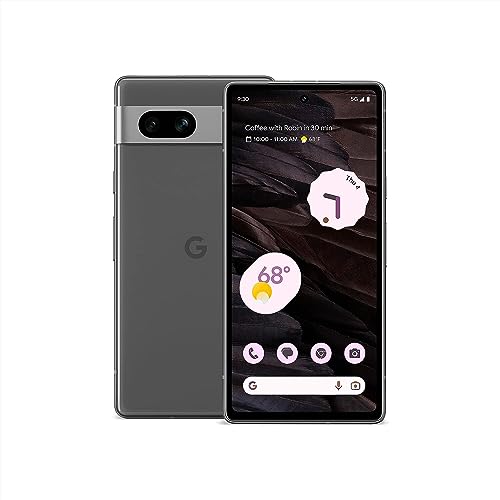
Google Pixel 7a — Cheapest full-band option
The Pixel 7a closes the price ladder without closing the band list: its US model carries n71 and n41 alongside the full LTE set, activates on T-Mobile and its prepaid brands without drama, and adds wireless charging that budget phones almost never include. At 152.0 by 72.9 millimetres and 193.5 grams it is the bulkiest pick here, but the matte frame grips well and the 6.1-inch 90Hz OLED remains a pleasant window.
Tensor G2 performance keeps the Pixel experience intact — call screening, transcription, and a 64-megapixel main camera whose low-light processing still embarrasses newer budget hardware. The 4,385mAh battery covers a day; charging is 18W wired plus the wireless convenience noted above. The calendar is the caveat to read twice: three years of OS updates and five of security patches from a 2023 launch make this a two-to-three-year phone from today. At its renewed price, that is a fair and honest trade — provided you buy it with that horizon in mind rather than discovering it later.
- Body: 152.0 × 72.9 × 9.0 mm, 193.5 g
- Network: full T-Mobile support including n71 and n41
- Display: 6.1-inch OLED, 90Hz
- Cameras: 64MP main, 13MP ultrawide
- Battery: 4,385mAh, 18W wired plus wireless charging
Strengths
- Cheapest complete-band phone in the guide.
- Wireless charging at a budget price.
- Google camera quality for low light.
Trade-offs
- Shortest remaining support runway.
- Heaviest pick here.
- 90Hz screen trails the leaders.
Best for: prepaid T-Mobile customers wanting maximum network for minimum spend.
Not suited for: buyers planning to keep a phone beyond three years.

Sony Xperia 10 V — Narrow battery specialist
Sony’s Xperia 10 V is the one pick where this guide asks you to do a final band check yourself, and the reason is geography rather than doubt. The listed XQ-DC72 is a GSM-unlocked model whose LTE bands serve T-Mobile customers well in cities and suburbs, and it will activate and behave on the network. Its 5G band set, however, is not the full US arrangement — the deep-rural n71 layer is where its coverage can thin compared with the five US-version picks above. Urban and suburban T-Mobile users will rarely notice; road-trippers should choose a Samsung or Pixel instead. That is the honest shape of this pick, stated before its virtues.
The virtues are considerable. At 155 by 68 millimetres and 159 grams, it is the narrowest and lightest phone here, with a 21:9 screen that shows more of every thread and document. The 5,000mAh battery, sipping through an efficiency chip, lasts two ordinary days — the only pick that lets a T-Mobile customer forget the charger for a weekend. A microSD slot and headphone jack survive. Cameras are daylight-honest and low-light-modest, the screen refreshes at 60Hz, and wireless charging is absent. As a light, narrow, long-running phone for a city-based T-Mobile life, it earns its place with its caveat attached.
- Dimensions: 155 × 68 × 8.3 mm, 159 g
- Network: GSM-unlocked, T-Mobile-friendly LTE; 5G set is not the full US layout
- Display: 6.1-inch 21:9 OLED, 60Hz
- Cameras: 48MP main with OIS, 8MP 2x telephoto, 8MP ultrawide
- Battery: 5,000mAh; microSD and headphone jack fitted
Strengths
- Two-day battery and the lightest body here.
- Narrowest grip in the guide.
- Card storage and wired audio retained.
Trade-offs
- Rural 5G coverage cannot match the US-version picks.
- No wireless charging; 60Hz screen.
- Midrange performance ceiling.
Best for: city and suburban T-Mobile users who prize stamina and grip.
Not suited for: rural drivers who live on low-band coverage, or gamers.
How do the six compare side by side?
| Model | Screen | T-Mobile 5G | Battery | Standout trait |
|---|---|---|---|---|
| Pixel 8a | 6.1″ 120Hz | n71 + n41 | 4,492mAh | Value with seven-year support |
| Galaxy S23 | 6.1″ 120Hz | n71 + n41 + mmWave | 3,900mAh | Complete flagship, zoom camera |
| Pixel 8 | 6.2″ 120Hz | n71 + n41 + mmWave | 4,575mAh | Best stills, support to 2030 |
| Galaxy S22 | 6.1″ 120Hz | n71 + n41 + mmWave | 3,700mAh | Full bands at a budget flagship price |
| Pixel 7a | 6.1″ 90Hz | n71 + n41 | 4,385mAh | Cheapest full-band Pixel |
| Xperia 10 V | 6.1″ 21:9 | Partial — check your area | 5,000mAh | Two-day life, 159 g, card slot |
Which tempting compacts are missing T-Mobile bands, and what happens if you buy one anyway?
The compact market’s most desirable imports illustrate the trap. ASUS’s Zenfone line is beloved by small-phone fans, but the international Zenfone 10 listed in many marketplaces omits band n71 and parts of the US LTE set; on T-Mobile it will shine in a city centre and fade on the interstate, and Wi-Fi calling provisioning can be unreliable on non-US firmware. Xiaomi’s compact-adjacent models and various global Samsung A-series variants repeat the pattern with different missing pieces. None of them is a bad phone. All of them are the wrong phone for a network whose rural backbone they cannot hear.
What actually happens to buyers who ignore this is a slow disappointment rather than a dramatic failure: activation succeeds, the city works, and then the dead zones multiply — the relative’s farm, the warehouse interior, the stretch of highway where the map freezes. Returns follow, usually outside the easy window. The five US-version picks ranked above exist to prevent exactly that story, and the Xperia’s partial status is labelled for the same reason. Carrier shopping rewards the unglamorous virtue of reading a band list before a camera review.
How do you check coverage and bands for your own addresses?
Start with the places, not the map’s colours. T-Mobile’s coverage checker accepts addresses; run your home, your workplace and the one rural address you visit most — a parent’s house, a cabin, a job site — and read the 5G and LTE layers separately. Then match the phone: n71 support matters most for the rural address, n41 for the urban ones, band 12 LTE for building penetration everywhere. If the checker promises low-band 5G at the farm and your phone lacks n71, the promise was made to a different handset.
Prepaid customers should repeat the exercise with extra care, because Mint, Tello and Metro customers receive the same towers but sometimes different roaming arrangements. The phones do not change; the safety net does. A full-band phone on a prepaid plan is the closest thing this market offers to a guarantee, which is why the Pixel 8a — complete bands, long support, sane price — leads this guide for the prepaid crowd specifically.
What mistakes do T-Mobile compact buyers keep making?
Buying the international twin of a US phone
Same name, same looks, different radios. The international variant of a compact flagship can lack n71, mmWave or key LTE bands while saving a small amount of money. Always confirm the model number and the words US Version or the carrier band list in the listing before paying.
Judging the network by a city-centre speed test
n41 makes spectacular screenshots downtown and says nothing about the county road. T-Mobile ownership is decided at the fringe — indoors, rural, moving — which is precisely where low-band support earns its keep.
Skipping Wi-Fi calling setup
Every pick here supports it, but it must be switched on and the emergency address registered before it rescues a basement or a concrete office. Set it up on day one, test it in aeroplane mode with Wi-Fi on, and forget it until the day it matters.
Assuming prepaid means second-class bands
The bands live in the phone, not the plan. A full-band Pixel on Mint hears everything a full-band Pixel on a postpaid plan hears. The savings of prepaid are real; there is no reason to compound them with a deaf handset.
How do you activate and set up a compact on T-Mobile, step by step?
Begin before the box arrives: gather your T-Mobile account credentials, and if you are porting a number, the account number and transfer PIN from your old carrier — ports stall on paperwork far more often than on technology. When the phone lands, charge it past half, connect to Wi-Fi, and run the system update checker before moving any accounts across; carrier settings and security patches both ride those early updates, and a phone configured on day-one software occasionally needs its network settings reset later.
For eSIM activation on the Samsung and Google picks, open T-Mobile’s app or website, follow the bring-your-own-device path, and scan or enter the phone’s EID when prompted; the line usually provisions within minutes. For a physical SIM, power the phone off, seat the nano-SIM, and restart — the network should register automatically, with data roaming settings worth a glance if you travel near borders. Then enable Wi-Fi calling in the phone settings, register your emergency address as the setup insists, and place one test call in aeroplane mode with Wi-Fi connected. That single test proves the feature you will want most in a basement, a hospital or a concrete office.
Finish with the unglamorous checks. Send and receive a picture message, because MMS failures hide bad APN settings that ordinary browsing never reveals. Confirm visual voicemail appears in the dialer on the Pixels and Samsung’s voicemail app behaves on the Galaxies. Walk to your home’s weakest-signal room and make a call there. Every one of those tests is free inside the return window and expensive outside it, which is the whole philosophy of carrier-specific buying: verify the marriage while annulment is still easy.
What should you do when signal disappoints anyway?
Even a full-band phone meets buildings and valleys it cannot conquer, and the responses have an order. First, Wi-Fi calling, already set up, quietly routes around the problem wherever wireless internet exists. Second, check the phone is actually using its low bands: a restart after travelling between regions occasionally leaves a handset camped on a weaker layer, and toggling aeroplane mode forces a fresh, smarter attachment. Third, remove the case for one test call — a minority of thick or metallic cases measurably dull reception at fringe range, and it is better to learn that at home than on a roadside.
If a specific address remains dead on every device, the honest answer is infrastructure rather than shopping: a carrier signal booster registered with T-Mobile, or a home internet gateway strategy, will do what no handset can. What you should not do is buy a different compact phone hoping its antennas defy physics. Within the laws of radio, the five US picks here already extract what the network offers; the Xperia’s thinner 5G set is the only ranked exception, and it was labelled as such before you bought it.
How do hotspots, travel and roaming behave on these picks?
T-Mobile sells more hotspot-inclusive plans than its rivals, and compact owners use them — a laptop tethered through a phone on a train is the modern office. All six picks support hotspot duty; the differences are stamina and heat. The Xperia’s big battery makes it the marathon tether, the Pixel 8 follows, and the S22 and S23 will want a cable by mid-afternoon of continuous sharing. Thermals follow the same order in reverse: small bodies shed heat slowly, so a phone propped open, out of its case, on a hard surface will out-tether one cooking in a bag pocket.
International travel is where T-Mobile’s plans already shine — many include data and texting across a long country list — and the phone’s job is simply to support the local bands at the destination, which the US Samsung and Google models do broadly. The Xperia’s global GSM heritage also travels well for LTE. Before departure, download the carrier app, confirm your plan’s roaming terms in writing, and save offline maps for arrival cities; roaming data works, but it works at the plan’s stated speeds, and a downloaded map never throttles.
Domestic roaming deserves one sentence of calm: in the shrinking areas where T-Mobile partners with regional carriers, a full-band US phone roams exactly as designed, while an international variant may not be recognised by the partner’s systems at all — one more quiet dividend of buying the version built for the network you pay for.
How do the prepaid brands change the calculation?
Mint, Tello, Metro and Google Fi all ride T-Mobile’s towers, but they are not the same product wearing different logos. Mint sells months in bulk and rewards the organised; Tello lets you build a small plan around small usage; Metro adds physical shops and family bundles; Fi brings Google’s international data strengths and per-gigabyte honesty for light users. The phone requirements, however, are identical across all of them: full T-Mobile bands, working Wi-Fi calling, and — for Fi especially — a model the service fully supports, which the Pixel line defines by birth.
Two prepaid-specific traps deserve naming. First, promotional pricing on carrier-locked phones from the big brands looks tempting until you read the unlock policy; every pick in this guide is sold unlocked, so your plan-hopping freedom survives the purchase. Second, some prepaid activations quietly require the phone’s IMEI to pass a compatibility checker, and US-version flagships sail through those checks while international variants bounce off them. Run your chosen model’s checker on the prepaid brand’s website before ordering if you want belt and braces; it takes two minutes and uses only the model name and variant.
For a household running three or four lines on prepaid, the arithmetic of this guide scales kindly: Pixel 8a units for the adults who keep phones longest, a 7a for the teenager whose horizon is a school year or two, and one shared understanding that nobody buys an import special again. Coverage complaints in such households almost always trace back to the one phone that skipped the band list.
Which of these phones will still be patched when your plan renews?
Carrier contracts and prepaid cycles end; software calendars decide whether the phone notices. The Pixel 8a and Pixel 8 carry support to 2031 and 2030, outliving any plan you can sign today several times over. The S23 reaches into 2028, the S22 into 2027, and the 7a’s security window closes soonest of the ranked picks. Sony’s calendar for the Xperia is the shortest here, which compounds its band caveat for long-term buyers: it is a phone for a defined chapter, not a decade.
Patches matter on a carrier phone for a specific reason beyond general security: network technology itself moves. As T-Mobile refarms spectrum and retires legacy layers, updated radio software keeps older phones attached gracefully, while an unpatched phone can lose polish it once had. Buying the long calendar is therefore not just about apps and banking safety; it is about the phone continuing to hear the network it was bought for.
What does living with each pick feel like on this network?
Numbers describe bands; days describe phones. The Pixel 8a’s day is uneventful in the way customers pray for: spam screened before it rings, photographs that flatter the family group chat, a battery that ends the evening with something left, and a network connection that never becomes a topic. The S23’s day adds ceremony — the zoom catching the recital from the back, the screen outshining the noon sun — at the price of a battery that asks to be fed nightly without exception. The Pixel 8’s day resembles the 8a’s with the volume of quality raised everywhere except the bill.
The S22’s day is the S23’s with a shorter fuse, best suited to lives organised around desks and docks. The 7a’s day is the budget traveller’s: everything works, nothing dazzles, and the wireless charger by the bed becomes a beloved ritual. The Xperia’s day is the long one — two sunrises per charge, a phone light enough to forget in a shirt pocket, and a standing reminder to check the map before a rural weekend. None of these days includes the sentence “my phone could not get signal”, which, on this particular network, is the review that matters.
How should families split these picks across several lines?
Households rarely need six different answers; they need two, assigned by horizon. The keeper lines — parents, the relative whose phone is also the family camera — deserve the long calendars: Pixel 8a or 8, or the S23 where the zoom will be used weekly. The shorter-horizon lines — a teenager’s first phone, a grandparent who mainly calls, a spare for the car — are served honestly by the 7a or S22, whose remaining support matches the likely life of the assignment. Mixing this way keeps every line on full bands, which is the household rule that prevents the one chronically complaining phone at every gathering.
One shared accessory budget completes the plan: a multi-port charger where everyone already gathers, spare cables in the car, and cases bought with the phones rather than after the first cracked corner. Carrier life is logistics as much as technology, and the families who treat it that way stop thinking about phones entirely — which is the actual product T-Mobile sells and these six handsets deliver.
A brief history of why this network rewards band literacy
T-Mobile built its modern reputation by buying the spectrum its rivals undervalued. The 600MHz licences it acquired and rolled out as band 12 LTE and then n71 5G were unfashionable low frequencies — slow by the standards of city mid-band, but capable of crossing counties and concrete. Customers who bought phones fluent in those bands watched their coverage transform as the rollout spread; customers whose imported handsets could not hear 600MHz watched nothing change at all. The same spectrum story continues today with n41, the former Sprint mid-band that now delivers the network’s headline speeds in metropolitan areas.
That history explains this guide’s stubbornness. On a carrier whose identity is written in specific frequencies, a phone is not compatible or incompatible in general — it is fluent or deaf in particular bands, and the difference shows up at the addresses where you most need a phone to work. The six picks here are fluent. Buy fluency, and the rest of the comparison — cameras, calendars, grips — becomes the pleasant part of the decision.
What should you keep from your old carrier when you switch?
Switching networks with a new phone tempts a clean break, but three things should travel with you deliberately. Your number, obviously, ported rather than replaced, because a decade of contacts, banks and doctors hold the old digits. Your photographs and messages, transferred by cable during setup before the old SIM goes quiet. And your two-factor authentications, which deserve a checklist of their own: banking, email, work systems and health portals each re-registered on the new device while the old one still works beside it. Do those three things in that order and the switch becomes an afternoon rather than a week of small emergencies.
Keep the old phone, wiped of nothing yet, for a fortnight after the port completes. Numbers occasionally take days to propagate through every system that texts them, and the drawer phone is your witness during that window. After it, factory-reset it, remove it from your carrier account, and let it become the household spare or the trade-in it was always going to be.
One last comparison: the two philosophies in this guide
Samsung and Google answer the T-Mobile compact question with different temperaments. Samsung builds the complete object — zoom lens, bright screen, every band including the exotic ones, sold in every shop on earth — and asks flagship money for the completeness. Google builds the complete service — screening, transcription, translation, a camera that thinks — inside plainer hardware, and asks less for it while promising to maintain it longer. Sony, the third temperament, builds for endurance and grip and accepts the network caveat this guide has repeated honestly.
There is no wrong temperament here, only mismatched ones. Buy the object if you keep phones until they break and photograph at a distance. Buy the service if your frustrations are spam, voicemail and software expiry. Buy the endurance if your life is measured in days between sockets. The network, for once, does not care which you choose — provided the band list was honoured first, which is the sentence this entire guide exists to make unforgettable.
Final Recommendation
On T-Mobile, buy the band list first and the phone second. The Pixel 8a is the guide’s default answer — complete coverage, seven years of support, a camera beyond its price — and the Galaxy S23 is the upgrade when you want the flagship body and the zoom. The Pixel 8 serves photographers who keep phones longest, the S22 serves budgets that still refuse coverage compromises, and the 7a serves the shortest horizons at the lowest cost. Keep the Xperia 10 V for city life where its stamina and grip shine. Whichever you choose, let n71 be the line you never cross: on this network, it is the difference between a compact phone and a compact disappointment.
Frequently Asked Questions
What is band n71 and why does it matter so much?
n71 is T-Mobile’s 600MHz 5G layer. Low frequencies travel far and penetrate buildings, so n71 carries the network across rural counties and into concrete interiors where mid-band signals fade. A compact phone without it will feel fine in a city and lost outside one.
Do these phones work on Mint Mobile and Tello?
Yes. Mint and Tello resell T-Mobile network access, so any phone with full T-Mobile band support — every ranked pick here — works on them with the same coverage behaviour. The Xperia’s partial 5G caveat applies equally on the prepaid brands.
Can I bring my number to T-Mobile with one of these phones?
Yes. The Samsung and Google picks support eSIM, so a number port can complete through T-Mobile’s app or website the day the phone arrives; a physical nano-SIM works just as well. Keep your old carrier’s account number and PIN handy for the port.
Is there a true 5-inch phone that works on T-Mobile?
Not a current one. The 5-inch screen belonged to an earlier generation whose band sets predate T-Mobile’s modern network. The compacts in this guide are the honest modern translation: 5.9 to 6.2-inch screens in one-hand bodies with complete contemporary bands.
Does Wi-Fi calling work on all six picks?
On the US-version Samsung and Google models, yes, natively and reliably. The Xperia’s GSM build generally supports it on T-Mobile as well, but confirm during your return window with a test call in aeroplane mode, since provisioning on international firmware can vary.
Which pick is best for rural T-Mobile coverage?
Any of the five US-version picks, with the Galaxy S23 and Pixel 8 leading on overall radio quality. Avoid the Xperia for a rural-primary life, and avoid international variants of any model — n71 is the specification your coverage depends on.
How can I tell whether a listing is the US version before I pay?
Look for three things together: the words US Version or the carrier band list printed in the listing, a model number matching the US variant on the maker’s support pages, and a seller who answers the band question directly when asked. Any listing that hides all three is asking you to gamble, and the stakes are your rural coverage.
My current phone shows 5G in town but nothing at my parents’ rural home. Will these fix that?
If your current phone lacks n71, very likely yes — that is precisely the layer rural T-Mobile runs on. The five US-version picks all carry it. If your current phone already has n71 and still fails there, the address may sit beyond the network’s present reach, and the fix is a booster or Wi-Fi calling at the house rather than another handset.
Is 5G necessary, or is LTE enough on T-Mobile now?
LTE still carries a great deal of T-Mobile’s traffic and every pick here handles it fully. But the network’s investment flows to 5G, and low-band 5G in particular reaches places LTE reaches weakly. Buying a phone without n71 today means declining the layer your coverage will increasingly depend on.
Which pick is best for a delivery or rideshare driver on T-Mobile?
The Pixel 8 for its battery, bright screen and full bands, with the Xperia as the stamina alternative for city-based work. Drivers live on maps and fringe signal simultaneously; whichever you choose, budget for a car charger and a mount as part of the phone.
Do I lose anything by buying unlocked instead of from a T-Mobile shop?
You lose instalment billing and in-store setup help, and you gain an unlocked phone, no carrier bloatware on the Google models, and the freedom to move plans. Every network feature discussed in this guide — Wi-Fi calling, visual voicemail, hotspot — works on the unlocked US versions listed.
What is the first thing to check when a renewed unit arrives?
The model number in settings, matched against the US variant you intended to buy, followed by one call from your weakest-signal room and one picture message sent and received. Those three checks, done inside the return window, catch the variant mix-ups and radio faults that account for nearly every bad outcome in carrier-specific buying.
Can I use one of these phones as my only internet at home?
Through hotspot, many T-Mobile customers do, and the battery ranking in this guide predicts the experience: the Xperia and Pixel 8 endure it best, the Galaxies want a permanent cable, which in a fixed home setup is no hardship at all. Check your plan’s hotspot allowance before cancelling anything.
Does a case affect T-Mobile reception?
Slim plastic and silicone cases, no. Thick metal-accented or wallet designs can dull fringe reception slightly, which matters exactly where n71 is doing heroic work. If you live at the coverage edge, choose the slim case and keep the phone’s antennas as free as its designers left them.
Should seniors on T-Mobile choose differently?
The Pixel 8a again: its call screening removes the scam calls that target older customers, its display settings allow genuinely large text, and its support window means a family member sets it up once and rarely revisits it. Pair it with a simple home screen and a case with a grip texture.
What happens to my coverage when T-Mobile retires older network layers?
Phones with current software and complete modern bands absorb those transitions quietly — the network steers them to the surviving layers. Phones past their update window or missing bands feel each retirement as a small coverage loss. It is one more reason this guide weights support calendars and band completeness above launch-day glamour.
Is the Galaxy S23 worth the premium over the Pixel 8a on this network?
For the zoom camera, the brighter build quality and mmWave, yes — if you will use them. For coverage itself, no: both phones hear the same essential bands, and the 8a’s longer support window arguably serves a T-Mobile customer better across a long ownership. Let photography and finish decide, not signal anxiety.
Can I test T-Mobile coverage before committing to a phone?
Yes — the carrier periodically offers trial programmes through eSIM on compatible phones, and a prepaid SIM for a month is the low-tech equivalent. Test at your real addresses, including indoors, before porting a number you have held for years.
How long does a number port to T-Mobile usually take?
With the correct account number and transfer PIN, most ports complete within hours; landline-origin numbers can take days. Your old service keeps working until the port lands, so schedule the switch on a quiet day and keep both phones charged until the new one rings with your old number.
Which pick has the best reception in fringe areas, honestly?
Among full-band phones, differences are small and situational; the S23 and Pixel 8 have the strongest overall radio implementations here, but no ranked pick will transform a dead address into a covered one. Judge fringe performance by the band list first and by booster or Wi-Fi solutions second.
Do I need a new SIM for 5G on T-Mobile?
Older SIMs occasionally limit newer network features; if your SIM predates the 5G era, ask T-Mobile for a current one or switch to eSIM on the Samsung and Google picks, which removes the question entirely.
Which pick should a student on a family plan choose?
The Pixel 8a, for reasons that compound across a degree: its support window outlasts the course, its call screening silences the spam that floods student numbers, its camera handles social documentation without a second device, and its price leaves budget for the laptop that actually decides grades. If the family plan is prepaid, every one of those arguments survives intact, because the bands and features live in the phone rather than the plan tier.
What if I live in a city but travel rurally every weekend?
Then you are the exact reader the n71 rule was written for. Choose any of the five US-version picks, weight the S23 and Pixel 8 for their radio quality, and ignore every international bargain the internet shows you on Friday night. Your weekday self will never know the difference; your weekend self will know nothing else.
How do I keep a child’s line safe on one of these phones?
Set up the device with a supervised Google account before the SIM goes in, enable Family Link limits, and use the carrier’s family controls for content filtering at the network layer. The Pixel models’ call screening adds a third wall against unknown callers. Agree the charging place, the case rule and the lost-phone steps — Find My Device stays on — before the first school day, not after the first scare.
Is it worth waiting for next year’s compact models before switching?
Rarely, on a carrier-driven purchase. Bands change slowly, the current US compacts already speak T-Mobile’s full language, and a dead or deaf phone today costs more in missed coverage than a future model will repay in novelty. Switch when the present phone fails the band list or the battery, not when the calendar turns.
What single setting should every T-Mobile compact owner change first?
Turn on Wi-Fi calling and register the emergency address, then make one test call in aeroplane mode. It takes three minutes, it costs nothing, and it converts every building with wireless internet — offices, hospitals, basements, hotels abroad — into covered territory for the life of the phone.
What should I do on the first evening with the new phone?
Run every pending system update, enable Wi-Fi calling, send one picture message, and place one call from the room in your home with the weakest signal. Then transfer your accounts at leisure over the following days. A phone proven on its first evening rarely surprises you later; a phone left unproven keeps its secrets until the return window has closed and the secrets have become yours.
Is there any reason to choose the S22 over the 7a at similar renewed prices?
Yes: the zoom camera, the brighter screen and the lighter body all belong to the Samsung, while the Pixel counters with wireless charging and Google’s cleaner software. Their calendars end within sight of each other. Photographers take the S22; desk workers who live on a charging pad take the 7a.
Related Guides
Size up the wider compact class in the best 6 inch android phones, go smaller with the best 4 inch android phones, or compare bodies precisely in the best 146mm android phones.