What's inside
As an Amazon Associate I earn from qualifying purchases. This post may contain affiliate links at no extra cost to you.
A studio monitor is not a speaker for enjoying music, it is a tool for judging it, and the difference matters more in a small studio than anywhere else, because a speaker that flatters a mix will hide the problems that a listener on another system will hear immediately, while a speaker that tells the truth will expose a muddy low end, a harsh vocal or a buried guitar before the track leaves the room. The best small studio monitors for a studio are compact nearfield speakers with a flat frequency response, a tight low end that does not excite the room, and a stereo image that stays stable at close range, and this guide covers six models that professional and home studios use as their main reference, from the three-inch Genelec that fits on a broadcast desk to the seven-inch KRK that anchors a project studio.
The word nearfield is the key to understanding a small studio monitor, because it means the speaker is designed to be listened to at arm's length, with the direct sound from the speaker reaching the ear before the reflections off the walls, which is the only way to hear a mix honestly in a room that has not been treated. A large monitor in a small room fails because the listener sits too close for the woofer and tweeter to blend, and because the extra bass excites room modes that smear the low end, while a compact monitor with a five-inch woofer or smaller blends its drivers at a metre, produces less low-end energy for the room to fight with, and keeps the stereo image precise. The monitors in this guide are all nearfield designs, and they are all meant to sit on a desk or a stand at arm's length, not across the room.
A studio monitor also needs controls that a hi-fi speaker does not, because every studio is different and the speaker has to adapt to the desk, the wall and the corner it sits in. The monitors in this guide have boundary switches, low-frequency trims, high-frequency trims or digital room correction, and those controls are not decoration: they are the difference between a monitor that sounds right in a specific room and a monitor that sounds right only in the factory. A buyer who sets the controls once, with a familiar reference track and a headphone check, will get more from a modest monitor than a buyer who buys an expensive monitor and leaves the controls flat in a difficult room.
The six monitors in this guide span the small-studio range, from the ultra-compact Genelec 8010A that suits a broadcast desk and a mobile rig to the KRK Rokit 7 G4 that suits a project studio with a little more space, and each one is judged on the same things: flatness, low-end control, stereo imaging, and the ability to keep its balance at the low volumes a studio uses for most of its work. A three-inch monitor is the right choice for a desk that is also used for video editing or broadcasting, a five-inch monitor is the right choice for a dedicated mix position, and a seven-inch monitor is the right choice when the room is large enough to handle the extra bass, and the buying guide at the end explains how to choose between them and how to set them up so the room stops getting in the way of the mix.
Quick picks: best small studio monitors for studio
| # | Product | Where to buy |
|---|---|---|
| 1 | Genelec 8010A | Check on Amazon |
| 2 | Neumann KH 80 DSP | Check on Amazon |
| 3 | Adam Audio A4V | Check on Amazon |
| 4 | Focal Alpha 50 Evo | Check on Amazon |
| 5 | KRK Rokit 7 G4 | Check on Amazon |
| 6 | Mackie MR524 | Check on Amazon |
Quick Comparison
| Product | Key Specs | Best For |
|---|---|---|
| Genelec 8010A | 3-inch woofer, 3/4-inch tweeter, 50 W, compact aluminium | Best ultra-compact studio monitor |
| Neumann KH 80 DSP | 4-inch woofer, 1-inch tweeter, 120 W, DSP room correction | Best small studio monitor for accuracy |
| Adam Audio A4V | 4-inch woofer, X-ART ribbon tweeter, 110 W, DSP | Best small studio monitor for detail |
| Focal Alpha 50 Evo | 5-inch Slatefiber woofer, 1-inch tweeter, 65 W | Best small studio monitor for dynamics |
| KRK Rokit 7 G4 | 7-inch Kevlar woofer, 1-inch tweeter, 145 W, DSP | Best larger small-studio monitor |
| Mackie MR524 | 5.25-inch woofer, 1-inch tweeter, 50 W, acoustic tuning | Best budget small studio monitor |

Genelec 8010A
The Genelec 8010A is the best ultra-compact studio monitor in this guide, and it is the monitor that broadcasters, video editors and travelling engineers reach for when the desk is small and the work has to be right, because Genelec built the 8010A as a genuine professional reference in a cabinet barely larger than a paperback, with a three-inch woofer, a three-quarter-inch tweeter and fifty watts of bi-amplified power in a die-cast aluminium enclosure that is rigid enough to keep resonances out of the sound. The 8010A is the monitor for a studio where space is the limiting factor and accuracy is not negotiable.
The sound is remarkably honest for a speaker of this size, with a midrange that is clear and uncoloured, a high end that is smooth and extended, and a low end that is tight and controlled rather than extended, which is the right trade in a small room where a bigger woofer would only excite room modes. The 8010A has a flat response that makes it easy to judge the balance of a mix, and the directivity control waveguide keeps the stereo image stable at close range, which matters on a broadcast desk where the listener sits a metre from the speakers. At low volume the 8010A keeps its balance, and a mix made quietly on these monitors translates well to headphones and larger systems, which is the real test of a reference monitor.
The practical details are built for professional use. The 8010A has a balanced XLR input, a volume control on the back, and bass and treble tilt controls that let the speaker be tuned to the desk and the room, plus an Iso-Pod stand that angles the monitor toward the listener and isolates it from the desk. The aluminium cabinet is tough enough to survive travel, and the monitor is small and light enough to fit in a bag with a laptop and an interface, which makes it the standard choice for a mobile rig. The 8010A is also available in a white finish, and it pairs with the Genelec 7040A subwoofer for a full-range system when the room can handle it.
The trade-offs are that a three-inch woofer cannot produce deep bass, so the 8010A needs a headphone check or a subwoofer for the lowest octave, and the maximum volume is modest, so it suits nearfield work at a desk rather than filling a room. The monitor is more expensive than other three-inch models, and the bass tilt controls are small and fiddly. But as an ultra-compact professional monitor, the 8010A has no real rival, and it fits a broadcaster who needs an honest reference on a small desk, a video editor who needs accurate dialogue, and an engineer who needs a monitor that can travel.
Check price on Amazon: Genelec 8010A

Neumann KH 80 DSP
The Neumann KH 80 DSP is the best small studio monitor for accuracy in this guide, and it is the monitor that buyers choose when the mix has to be right and the room is small, because Neumann built the KH 80 around a four-inch woofer, a one-inch tweeter and a digital signal processor that corrects the response of the speaker itself and, with the optional measurement microphone, corrects the response of the room as well. The KH 80 is a monitor that takes accuracy seriously, with a flat frequency response, a precisely controlled dispersion pattern, and a low end that is tight and honest rather than extended, and it is the smallest monitor in the Neumann KH range, which is the range that professional studios use as a reference.
The sound is the most accurate in this guide, with a midrange that is exceptionally clear, a high end that is smooth and detailed, and a stereo image that is precise and stable at close range, thanks to the mathematically modelled dispersion waveguide that keeps the direct sound consistent across the listening position. The DSP is the feature that sets the KH 80 apart: it corrects the response of the drivers, it provides a boundary switch and low-frequency trim, and with the Neumann measurement system it can measure the room and apply a correction that tames the worst of the room modes, which is a genuine advantage in a small studio where the room is the biggest problem. At low volume the KH 80 is at its best, with a balance that holds together quietly, which is how most studio work happens.
The practical details are professional through and through. The KH 80 has balanced XLR inputs, a volume control on the back, and a compact cabinet that sits well on a desk stand or an isolation pad, with the tweeter at ear height once the stand is in place. The monitor is built to a high standard, with a cabinet that is rigid and well damped, and the DSP settings are adjusted with a small app or a switch on the back, which is straightforward once the manual has been read. The KH 80 is the monitor that a studio buys when the work has to be right the first time, and it is the smallest Neumann that can honestly be called a main monitor.
The trade-offs are the price, which is higher than any other monitor in this guide, and the fact that the room correction needs an optional microphone and software, which adds to the cost. The four-inch woofer does not produce deep bass, so the lowest octave still needs a headphone check, and the monitor is best used at arm's length, where its precision is an advantage. But as a small studio monitor for accuracy, the KH 80 DSP is the benchmark, and it fits a mixing engineer who needs a reference that can be trusted, a mastering engineer with a small room, and anyone who wants the most accurate small monitor available.
Check price on Amazon: Neumann KH 80 DSP
Adam Audio A4V
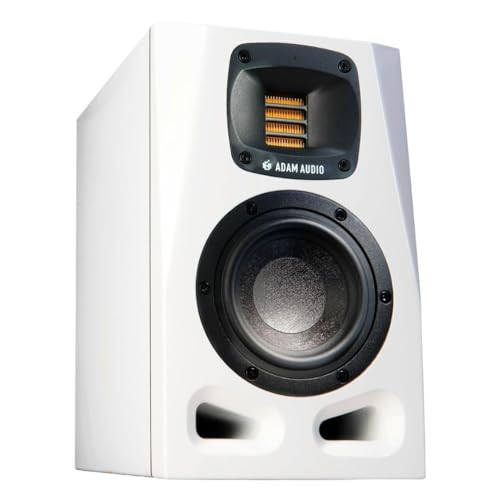
The Adam Audio A4V is the best small studio monitor for detail in this guide, and it is the monitor that buyers choose when the top end of a mix is the priority, because Adam built the A4V around the X-ART ribbon tweeter, a folded-ribbon design that moves air faster and more precisely than a conventional dome, and the result is a high end that is open, detailed and extended, with a sense of air around cymbals, strings and vocals that a dome tweeter struggles to match. The four-inch woofer is driven alongside the ribbon tweeter by a hundred and ten watts of bi-amplified power, and the combination is a monitor that sounds fast and articulate in a small studio.
The sound is the most detailed in this guide, with a high end that reveals reverb tails, sibilance and the fine texture of an acoustic instrument, which makes the A4V especially useful for mixing vocals, acoustic music and anything where the top octave matters. The low end is tight and controlled, with a rear port that needs a little space behind the monitor, and the DSP on the back provides voicing options, a low-frequency extension setting and a high-frequency trim, which let the speaker be tuned to the desk and the room. The stereo image is precise, with the ribbon tweeter keeping the soundstage wide and stable at close range, and the monitor sounds balanced at low volume, which is how most studio work happens.
The practical details are strong for a small studio. The A4V has balanced XLR and unbalanced RCA inputs, so it connects to an interface or directly to a computer, and the volume control is on the back with a clear scale. The cabinet is compact for a four-inch monitor, with a bevelled front baffle that reduces diffraction, and the monitor is light enough for a desktop isolation pad. The ribbon tweeter is protected by a grille, and the build quality is solid, with a finish that looks professional on a desk. The A4V is also the smallest monitor in the Adam A series, which is the range that professional studios use as a reference.
The trade-offs are that the rear port means the A4V needs more space behind it than a front-ported monitor, so it suits a desk that can sit away from the wall, and the ribbon tweeter can sound a little forward in a bright, untreated room. The four-inch woofer does not reach deep bass, so the lowest octave still needs a headphone check. But as a small studio monitor for detailed work, the A4V is excellent, and it fits a producer who mixes vocals and acoustic instruments, an engineer who needs to hear the top end clearly, and anyone who wants a ribbon tweeter in a compact monitor.
Check price on Amazon: Adam Audio A4V

Focal Alpha 50 Evo
The Focal Alpha 50 Evo is the best small studio monitor for dynamics in this guide, and it is the monitor that buyers choose when the music has to hit hard, because Focal built the Alpha 50 Evo around a five-inch Slatefiber woofer, a composite cone made from recycled carbon fibre and thermoplastic polymer, which is light and rigid enough to start and stop quickly, and the result is a monitor with a punchy, dynamic low end and a midrange that is clear and present. The one-inch aluminium inverted dome tweeter is driven alongside the woofer by sixty-five watts, and the combination is a monitor that sounds alive and engaging in a small studio.
The sound is the most dynamic in this guide, with a low end that is tight and punchy rather than bloated, a midrange that keeps vocals and guitars forward and clear, and a high end that is detailed without being harsh, thanks to the inverted dome tweeter that disperses the sound widely and keeps the stereo image stable. The Alpha 50 Evo has a front-firing laminar port that keeps the bass output away from the wall, which matters in a small room, and a low-frequency trim on the back that lets the bass be adjusted for a desk or a wall position. At low volume the Alpha 50 Evo keeps its punch, and at higher volume it stays clean, which makes it a good choice for a studio that needs to check a mix loudly as well as quietly.
The practical details suit a small studio. The Alpha 50 Evo has balanced XLR and TRS inputs plus an unbalanced RCA input, so it connects to an interface, a mixer or a computer, and the volume control is on the front, which is a real convenience. The cabinet is compact for a five-inch monitor, with a front port and a solid build, and the monitor sits well on an isolation pad with the tweeter at ear height. The Slatefiber woofer is a distinctive feature, and the monitor looks as good as it sounds, with a finish that suits a professional desk.
The trade-offs are that the Alpha 50 Evo is a little more coloured than the Neumann or the Yamaha, with a low end that is punchy rather than flat, so a buyer who wants a ruthlessly flat monitor may prefer a drier speaker, and the five-inch woofer does not reach the deepest bass. The monitor is also a little heavier than some rivals. But as a small studio monitor for dynamic music, the Alpha 50 Evo is excellent, and it fits a producer who works with drums, bass and electronic music, an engineer who needs a monitor that stays punchy at low volume, and anyone who wants a monitor that makes music feel alive.
Check price on Amazon: Focal Alpha 50 Evo
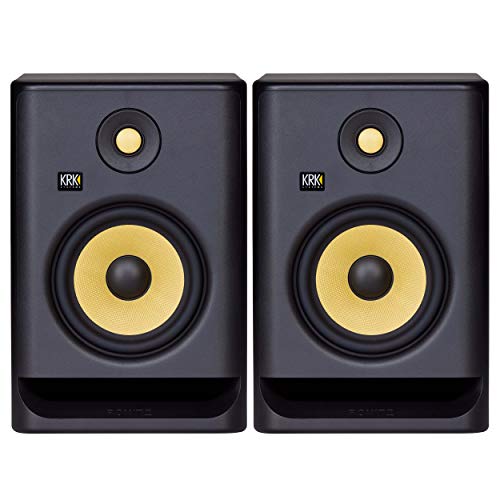
KRK Rokit 7 G4
The KRK Rokit 7 G4 is the best larger small-studio monitor in this guide, and it is the monitor to choose when the room is big enough for a seven-inch woofer and the music needs more low end than a five-inch monitor can give, because KRK built the Rokit 7 G4 with a seven-inch Kevlar woofer, a one-inch silk dome tweeter and a hundred and forty-five watts of bi-amplified power, plus the same DSP room tuning that makes the Rokit 5 G4 so useful in a small room. The Rokit 7 G4 is the monitor for a project studio that has outgrown a five-inch speaker but still needs the control and the honesty of a nearfield design.
The sound is the fullest in this guide, with a low end that reaches lower than any five-inch monitor, a midrange that keeps vocals and guitars clear, and a high end that is smooth and detailed without fatigue. The seven-inch woofer gives the Rokit 7 G4 a physical presence that a smaller monitor cannot match, which matters for electronic music, hip hop and anything with a deep bass line, and the front-firing bass port keeps the port output away from the wall, so the extra bass stays clean even when the monitor sits close to the wall. The DSP provides twenty-five room-tuning presets that let the low end be dialled down when the speaker sits against a wall, which is essential in a small room, because a seven-inch woofer in a small space needs that control.
The practical details are strong for a project studio. The Rokit 7 G4 has balanced XLR and TRS inputs plus an unbalanced RCA input, a volume control on the back, and a compact cabinet for a seven-inch monitor, with a curved front baffle that reduces diffraction and keeps the stereo image stable. The monitor is heavier than a five-inch model, so it needs a solid stand or a sturdy desk, and the DSP is adjusted with a small LCD on the back, which is straightforward once the manual has been read. The Rokit 7 G4 is the monitor that a studio buys when it wants more low end without moving to a large midfield speaker.
The trade-offs are that a seven-inch woofer produces more low-end energy than a five-inch monitor, so the Rokit 7 G4 needs a room that is large enough to handle it, and in a very small bedroom it can excite room modes that a five-inch monitor would not. The monitor is also larger and heavier, and it needs more desk space. But as a larger small-studio monitor, the Rokit 7 G4 is the best in this guide, and it fits a project studio with a dedicated room, a producer who works with bass-heavy music, and anyone who has outgrown a five-inch monitor and needs more low end.
Check price on Amazon: KRK Rokit 7 G4

Mackie MR524
The Mackie MR524 is the best budget small studio monitor in this guide, and it is the monitor to choose when the budget is tight and the studio still needs an honest reference, because Mackie built the MR524 as a genuine nearfield monitor in a five-and-a-quarter-inch package, with a polypropylene woofer, a one-inch silk dome tweeter and fifty watts of bi-amplified power, plus acoustic tuning controls that larger monitors in this class often skip. The MR524 is the monitor for a first studio, a student desk and a bedroom producer who needs to hear the mix honestly without spending a fortune.
The sound is surprisingly honest for the price, with a midrange that keeps vocals and dialogue clear, a high end that is smooth and detailed, and a low end that is tight rather than boomy, which is the right choice in a small room. The acoustic tuning controls on the back are the feature that sets the MR524 apart from other budget monitors: a high-frequency trim and a low-frequency trim let the speaker be tuned to the desk and the room, and the low trim is especially useful when the monitor sits on a desk, because it trims the bass build-up that a desk surface causes. At low volume the MR524 keeps its balance, which matters in a bedroom where the neighbours are close and the listening level is modest.
The practical details are excellent for a small desk. The MR524 has balanced XLR and TRS inputs plus an unbalanced RCA input, so it connects to an interface, a mixer or a computer, and the volume control is on the front, which is a real convenience. The cabinet is compact for a five-and-a-quarter-inch monitor, with a front port that keeps the bass output away from the wall, and the monitor sits well on an isolation pad with the tweeter at ear height. The pair is inexpensive, which makes it the easiest way into honest monitoring for a first studio, and the build quality is solid for the class.
The trade-offs are that the MR524 does not reach the deepest bass, so the lowest octave needs a headphone check, and the maximum volume is modest, so it suits nearfield listening at a desk rather than filling a room. The low end rolls off earlier than a seven-inch monitor, and the monitor is best used at arm's length, where its size is an advantage. But as a budget small studio monitor, the MR524 is the best value in this guide, and it fits a student with a bedroom desk, a podcaster who needs clear speech, and anyone building a first studio on a tight budget.
Check price on Amazon: Mackie MR524
Buying Guide
Buy a monitor, not a speaker
A studio monitor and a hi-fi speaker are built for opposite jobs, and the difference is the flat response: a hi-fi speaker is designed to make music sound pleasant, with a boosted low end and a sweetened top end, while a studio monitor is designed to make music sound honest, with a flat response that exposes a muddy low end, a harsh vocal or a buried guitar. A buyer who mixes on a hi-fi speaker will make a mix that sounds good on that speaker and wrong everywhere else, while a buyer who mixes on a flat monitor will make a mix that translates. Check the frequency response graph before buying, and choose the flattest monitor the budget allows, because flatness is the feature that matters most.
Match the monitor to the room size
A three-inch monitor suits a broadcast desk and a tiny bedroom, a five-inch monitor suits a dedicated mix position in a spare room, and a seven-inch monitor suits a project studio with a room large enough to handle the extra bass. A monitor that is too large for the room will excite room modes and make the low end sound louder than it is, while a monitor that is too small for the room will run out of volume and bass before the mix can be judged. Measure the room, measure the listening distance, and choose the smallest monitor that reaches the bass the music needs, because a small monitor in a small room is more honest than a large monitor in the same space.
Use the tuning controls and the DSP
Every monitor in this guide has a low-frequency trim, a boundary switch or a DSP preset, and those controls exist because no studio is the same as any other, so a monitor that sounds flat in the factory will sound bass-heavy on a desk against a wall. Start with the controls flat, play a familiar reference track, and if the bass sounds bloated, trim the low end one step at a time until the track sounds right, then check the same track on headphones to confirm the change. The DSP in the Neumann and the KRK models goes further, with presets that compensate for a wall, a corner or a desk, and a buyer who uses them will get more from a modest monitor than a buyer who buys an expensive monitor and leaves the controls flat.
Place the monitors in a triangle, tweeters at ear height
The monitors and the listening position should form an equilateral triangle, with the tweeters at ear height and the monitors angled inward so they point at the ears, because that geometry puts the listener in the sweet spot where the stereo image is widest and most stable. In a small studio the triangle will be small, often no more than a metre on each side, and that is fine, because nearfield monitors are designed to be listened to at close range. Put the monitors on isolation pads or stands so the desk does not vibrate, keep them away from the corners where bass builds up, and avoid placing one monitor in a corner and the other in free space, because an asymmetric placement makes the stereo image lopsided.
Treat the room before upgrading the monitors
A modest monitor in a treated room will outperform an expensive monitor in a bare room, because the room is the biggest source of error in a small studio, with reflections off bare walls smearing the stereo image and bass build-up in the corners making the low end sound louder than it is. A few panels of acoustic treatment on the wall behind the monitors and on the first reflection points will improve the sound more than a monitor upgrade, and a rug, a bookshelf and a curtain will help as well. Treat the room first, then judge the monitors, because a buyer who upgrades the monitors before treating the room is paying to hear the room more clearly, not to hear the mix more clearly.
Listen quietly, and check the mix elsewhere
A small studio sounds best at low volume, because quiet listening excites the room modes less, reduces the reflections off the walls, and lets the ear hear the balance of the mix without fatigue, and most professional mixers do the bulk of their work quietly for exactly that reason. Once a mix sounds right on the monitors, check it on headphones, in a car and on a phone speaker, because each of those systems exposes a different part of the mix, and a mix that survives all three is a mix that is genuinely finished. The monitors are a tool for judgement, not a system for enjoyment, and the discipline of checking elsewhere is what makes a small-studio mix translate.
Frequently Asked Questions
What is the difference between a studio monitor and a normal speaker?
A studio monitor is built to be flat and honest, with a frequency response that adds nothing and hides nothing, so a mix made on a monitor translates to other systems, while a normal speaker is built to sound pleasant, with a boosted low end and a sweetened top end that flatters the music but hides its problems. A buyer who mixes on a normal speaker will make a mix that sounds good on that speaker and wrong everywhere else, which is why a studio needs a monitor, not a speaker, for mixing.
What size studio monitor do I need for a small studio?
A five-inch monitor is the best size for most small studios, because it produces enough bass to judge a mix without producing so much low-end energy that the room modes take over, and a three-inch monitor is the right choice when the desk is very small or the room is a bedroom. A seven-inch monitor suits a larger project studio with a room that can handle the extra bass. Choose the smallest monitor that reaches the bass the music needs, and check the lowest octave on headphones.
Do I need a subwoofer with small studio monitors?
In most cases no, because a subwoofer adds more low-end energy to a space that already has too much of it, and the result is usually boomier and harder to judge, not better. A five-inch monitor reaches low enough for most music, and the lowest octave can be checked on headphones, which is a more reliable way to judge sub-bass in a small room. A subwoofer only makes sense once the monitors are placed well, the room has some treatment, and the subwoofer can be positioned and level-matched carefully.
How should I place studio monitors in a small room?
The monitors and the listening position should form an equilateral triangle, with the tweeters at ear height and the monitors angled inward so they point at the ears. Put the monitors on isolation pads or stands, keep them away from the corners where bass builds up, and pull them at least a few inches away from the wall behind them. Avoid placing one monitor in a corner and the other in free space, because an asymmetric placement makes the stereo image lopsided.
Why does my mix sound different on headphones?
A mix sounds different on headphones because headphones remove the room entirely, so the bass is tighter and the stereo image is wider, while monitors in a small room add reflections and bass build-up that colour the sound. The remedy is to mix at low volume, use the tuning controls on the monitors, place them in a proper triangle, and treat the room, then check the mix on both systems before calling it finished. A mix that sounds right on both monitors and headphones is a mix that translates.
Conclusion
The best small studio monitor is the one that tells the truth about a mix in the room it actually sits in, and in this guide the Neumann KH 80 DSP is the most accurate choice, while the Genelec 8010A is the best ultra-compact professional monitor, the Adam A4V is the most detailed in the highs, the Focal Alpha 50 Evo is the most dynamic, the KRK Rokit 7 G4 is the best when the room can handle a seven-inch woofer, and the Mackie MR524 is the best budget entry into honest monitoring. Choose a five-inch monitor for a dedicated mix position, a three-inch monitor for a tiny desk, place the pair in a triangle with the tweeters at ear height, use the tuning controls on the back, treat the room before upgrading the speakers, and check every mix on headphones before calling it done.