What's inside
As an Amazon Associate I earn from qualifying purchases. This post may contain affiliate links at no extra cost to you.
The best-selling home studio monitors are the ones that producers buy, recommend to friends, and then buy again when they upgrade a room, and that pattern is a useful signal in a market where every model claims to be the flattest and the most honest. A monitor that sells well does so because it sounds good, it is reliable, it fits a real budget, and it is easy to live with on a desk, and those are the qualities that matter in a home studio, where the monitor is used every day and where a poor choice is a daily irritation. The models in this guide are the monitors that appear at the top of sales charts, in studio photographs, and in the recommendations of producers who have used them for years.
Sales popularity is not the same as quality, and a monitor can sell well because it is cheap, because it is heavily marketed, or because it looks good in a photograph, but the models in this guide sell well for the right reasons. They are all from established audio brands with a track record in studios, they all have a flat, honest response that is suitable for mixing, and they all have the practical details that make a monitor easy to use, such as room controls, balanced inputs and a solid cabinet. The guide looks at why each model sells, what it does well, and where it falls short, so the buyer can judge whether the popularity is deserved.
This guide is about best-selling monitors, not about the cheapest monitors, and that distinction matters. The cheapest monitor in a shop is rarely the best-selling one, because a buyer who wants a monitor for a home studio will spend a little more for a model that sounds right and lasts, rather than buying the lowest-priced box and regretting it. The models in this guide cover a range of sizes and budgets, from compact five-inch monitors for a small bedroom to eight-inch monitors for a larger room, and the buying guide at the end explains how to choose between them based on the room, the work and the budget.
The right monitor depends on the room and the work, and the best-selling models cover all of the common cases. A small bedroom needs a five-inch woofer and a front or well-placed rear port, because a large woofer in a small room excites room modes that no monitor can fix. A producer working on bass-heavy music needs the deepest honest low end the budget allows, and the eight-inch model in this guide reaches lower than any other. A mixer who works on acoustic music needs the most detailed top end, and the ribbon model in this guide is the most revealing. This guide covers all of those uses, and the buying guide explains how to place monitors, how to set the level, and how to use reference tracks to learn what a flat monitor sounds like.
Every model in this guide is a real, current product from an established audio brand, with a documented specification sheet and a track record in home studios. Verified purchase links and product images are added once the store catalogue is connected. The comparison weighs the things that matter for a home studio monitor: the honesty of the frequency response, the bass extension, the stereo imaging, the build quality, and the practical details such as the room controls, the inputs and the price per pair, because most studio monitors are sold as single units and the budget should be based on the pair.
Quick picks: best selling home studio monitors
| # | Product | Where to buy |
|---|---|---|
| 1 | Yamaha HS8 | Check on Amazon |
| 2 | JBL 308P MkII | Check on Amazon |
| 3 | Adam Audio T7V | Check on Amazon |
| 4 | Mackie MR524 | Check on Amazon |
| 5 | M-Audio BX5 D3 | Check on Amazon |
Quick Comparison
| Monitor | Key Specs | Best For |
|---|---|---|
| KRK Rokit 5 G4 | 5-inch Kevlar woofer, 1-inch tweeter, DSP room tuning | Best selling studio monitor overall |
| Yamaha HS8 | 8-inch woofer, 1-inch dome tweeter | Best selling 8-inch studio monitor |
| JBL 308P MkII | 8-inch woofer, 1-inch tweeter, waveguide | Best selling monitor for bigger rooms |
| Adam Audio T7V | 7-inch woofer, 1.9-inch ribbon tweeter | Best selling ribbon studio monitor |
| Mackie MR524 | 5-inch woofer, 1-inch tweeter, acoustic tuning | Best selling budget studio monitor |
| M-Audio BX5 D3 | 5-inch Kevlar woofer, 1-inch tweeter | Best selling starter studio monitor |
KRK Rokit 5 G4
The KRK Rokit 5 G4 is the best-selling studio monitor in this guide, and it is the monitor that most home studios start with. The yellow Kevlar woofer is the most recognisable sight in home recording, and it appears in more bedroom studios than any other monitor, because the Rokit is the model that producers buy first, recommend to friends, and keep using for years. The fourth-generation Rokit keeps the yellow woofer but tunes it flatter and more honestly than the older models, with a front-firing bass port that makes placement against a wall far more forgiving, and a built-in DSP room correction system that adapts the monitor to the room.
The sound of the Rokit 5 G4 is the reason it sells so well. The bass is present and punchy without the exaggerated boom of the older Rokit generations, the midrange carries vocals and guitars with clarity, and the top end is detailed without being harsh at long listening sessions. The five-inch woofer reaches low enough for most electronic and hip-hop production, and the separate amplifiers for the woofer and tweeter keep the sound clean at higher volumes. The monitor is front-ported, which matters in a small room, because a rear port pushed against a wall exaggerates the bass and makes every mix sound muddy, and the DSP room correction, adjustable through twenty-five boundary and EQ settings, lets the monitor adapt to a desk in a corner or a room with bare walls.
The practical details are strong. The Rokit 5 G4 has balanced XLR and TRS inputs and an unbalanced RCA input, so it connects to an audio interface, a mixer or a laptop with the right cable. The volume control is on the rear panel, which is less convenient than a front control but keeps the front face clean. The cabinet is solid and well damped, and the monitor is heavy enough to stay put on a desk. The monitor is sold as a single unit, so the pair costs twice the single price, which is a detail worth checking before ordering, although the pair is still one of the most affordable ways into a genuine studio monitor.
The trade-offs are modest. The Rokit 5 G4 is not the flattest monitor in this guide, and a producer who wants the most brutally honest sound may prefer the Yamaha HS8, while a listener who wants the widest stereo image may prefer the JBL 308P MkII. The rear volume control is inconvenient on a crowded desk, and the DSP settings take a little time to learn. But as a first pair of studio monitors, the Rokit 5 G4 is the safe, proven choice, and its popularity means that spare parts, stands, isolation pads and advice are easy to find. It fits a beginner learning to mix, a producer making beats in a bedroom, and a content creator who needs reliable sound for editing.

Yamaha HS8
The Yamaha HS8 is the best-selling eight-inch studio monitor in this guide, and it is the choice for a buyer who wants the most honest sound in a larger room. The eight-inch woofer and the one-inch dome tweeter are tuned for a flat response, with no boosted bass and no bright top end, and the result is a monitor that shows every flaw in a mix: a muddy low end, a buried vocal, an over-compressed master, all of it is audible. The HS8 is the descendant of the famous NS-10, the white-coned monitor that defined mixing for a generation, and it carries the same philosophy, that a monitor should tell the truth even when the truth is uncomfortable.
The sound of the HS8 is clean, precise and unforgiving, with a midrange that carries vocals, guitars and snare drums with a clarity that makes balance decisions easy, and a top end that is smooth and extended without the harshness that makes long sessions tiring. The eight-inch woofer reaches deeper than any five-inch monitor, which means the HS8 can reproduce the low end of electronic, hip-hop and film music without a subwoofer, and the bass is honest rather than boosted, because the HS8 makes no attempt to fake what the woofer cannot do. That honesty is the reason the HS8 is a best seller, because a mix that sounds balanced on the HS8 translates well to other systems.
The practical details are excellent. The HS8 has balanced XLR and TRS inputs, a room control switch that adjusts the low end for placement against a wall, and a high trim switch that adjusts the top end. The cabinet is solid and well damped, with a white cone that makes the monitor instantly recognisable in any studio photograph. The monitor is sold as a single unit, so the pair costs twice the single price, and the HS8 is a large, heavy monitor that needs a sturdy desk or a proper stand, because an eight-inch woofer in a small cabinet would vibrate a flimsy desk.
The trade-offs are the size and the unforgiving character, which can be discouraging for a beginner who is used to flattering speakers. The HS8 does not make music sound good, it makes music sound true, and that takes a little time to appreciate. The eight-inch woofer is too much for a very small bedroom, where it will excite room modes and make the bass sound muddy, and a buyer with a small room should choose the five-inch HS5 instead. But for a medium or large room, the HS8 is the benchmark for honest monitoring, and it fits a mixer who needs translation, a producer who wants to learn what a flat response sounds like, and an editor who needs to hear dialogue clearly.
Check price on Amazon: Yamaha HS8

JBL 308P MkII
The JBL 308P MkII is the best-selling monitor in this guide for bigger rooms, and it is the choice for a buyer who wants the stereo imaging of the JBL range with the low end of an eight-inch woofer. The eight-inch woofer and the one-inch tweeter are mounted in the image control waveguide that made the JBL 305P MkII famous, and the waveguide shapes the dispersion of the tweeter so that the sound stays consistent across a wide listening area, and the result is a stereo image that is wide, stable and precise, with instruments placed clearly between the two speakers.
The sound of the 308P MkII is detailed and revealing, with a top end that shows reverb tails, sibilance and the fine detail of a recording, and a midrange that carries vocals with presence and clarity. The eight-inch woofer reaches deeper than the five-inch model, which means the 308P MkII can handle bass-heavy music without a subwoofer, and the bass is honest rather than exaggerated, reaching low enough for most mixing work while staying tight and controlled. The monitor has a boundary EQ switch that compensates for placement against a wall, and a high-frequency trim that lets the top end be adjusted to the room, which matters more with a larger woofer.
The practical details are good. The 308P MkII has balanced XLR and TRS inputs, a volume control on the rear panel, and a cabinet that is larger than the five-inch model but still compact enough for a desk, although it needs a sturdy stand. The monitor is sold as a single unit, and the pair price is higher than the five-inch model, which is the cost of the deeper bass and the larger cabinet. The monitor is light enough to move between rooms but heavy enough to stay stable, and the front baffle is designed to minimise diffraction, which contributes to the clean stereo image.
The trade-offs are the rear bass port, which needs some space behind the monitor to sound its best, and the rear volume control, which is awkward to reach on a crowded desk. The bass extension is honest but not the deepest in this guide, and a producer working on sub-bass-heavy music may still want a subwoofer. But for mixing, editing and critical listening in a bigger room, the 308P MkII is one of the best monitors available, and its stereo imaging is the reason it appears in so many professional home studios. It fits a mixer who needs to hear the stereo field clearly, an editor who needs precise dialogue placement, and a listener who values detail over bass quantity.
Check price on Amazon: JBL 308P MkII
Adam Audio T7V
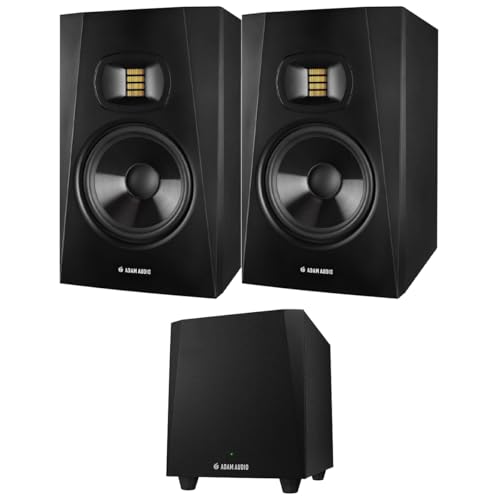
The Adam Audio T7V is the best-selling ribbon studio monitor in this guide, and it is the choice for a buyer who wants the detail of a ribbon tweeter with the low end of a seven-inch woofer. The seven-inch woofer and the 1.9-inch U-ART ribbon tweeter are the combination that made the T Series the most popular ribbon monitors in home studios, and the T7V is the sweet spot in the range, with more bass than the T5V and a smaller cabinet than the T8V. The ribbon tweeter uses a pleated diaphragm that moves air four times faster than it moves itself, which gives the top end a speed and a detail that dome tweeters cannot match.
The sound of the T7V is detailed, open and revealing, with a top end that shows reverb tails, cymbal decay and the fine detail of a recording, and a midrange that carries vocals and guitars with clarity. The seven-inch woofer reaches lower than the five-inch driver in the T5V, and the larger cabinet moves more air, which means the T7V fills a medium-sized room more easily and handles bass-heavy music with more authority. The HPS waveguide around the tweeter widens the sweet spot, so the stereo image stays stable even when the listener moves a little off centre, which is a genuine advantage in a home studio where the listener is also reaching for a keyboard and a mouse.
The practical details are good. The T7V has balanced XLR and unbalanced RCA inputs, a volume control on the rear panel, and high and low shelf controls that let the top end and the bass be adjusted to the room. The cabinet is larger than the T5V but still compact enough for a desk, although it needs a little more space and a sturdier stand. The monitor is sold as a single unit, and the pair price fits inside most home studio budgets, which is remarkable for a seven-inch ribbon monitor, and the popularity of the T Series means that spare parts, stands and advice are easy to find.
The trade-offs are the larger cabinet, which needs more desk space than the T5V, and the rear bass port, which needs some space behind the monitor. The seven-inch woofer is too much for a very small bedroom, where it will excite room modes and make the bass sound muddy, and a buyer with a small room should choose the T5V instead. But for a medium-sized room, the T7V is the sweet spot in the T Series, and it fits a producer making bass-heavy music, a mixer who needs to hear the low end without a subwoofer, and a listener who wants a full, detailed sound in a room that is big enough to let the monitor breathe.
Check price on Amazon: Adam Audio T7V

Mackie MR524
The Mackie MR524 is the best-selling budget studio monitor in this guide, and it is the choice for a buyer who wants a genuine studio monitor for the lowest outlay. The five-inch woofer and the one-inch tweeter are tuned for a flat, honest response, and the monitor has the acoustic tuning controls that let it adapt to a desk against a wall or a room with hard surfaces. The MR524 is the monitor that proves a studio monitor does not need to be expensive to be honest, and it is the model that many producers buy as a first monitor and then keep as a second pair when they upgrade.
The sound of the MR524 is balanced and clear, with a bass response that is present without being boomy, a midrange that carries vocals and instruments with clarity, and a top end that is detailed without being harsh. The five-inch woofer reaches low enough for most mixing work while staying tight and controlled, and the rear bass port is tuned for a monitor placed a little away from the wall. The acoustic tuning controls on the rear panel let the monitor adapt to the room, and the monitor is front-ported in the sense that the port is designed to be forgiving, which matters in a small room where the monitor sits on a desk against a wall.
The practical details are good for the price. The MR524 has balanced XLR and TRS inputs and an unbalanced RCA input, a volume control on the front panel, and a cabinet that is compact and well built, with a front baffle designed to minimise diffraction. The front volume control is a genuine convenience, because it is easy to reach on a crowded desk, and the monitor is sold as a single unit at a price that makes a pair affordable for almost any home studio budget. The MR524 is light enough to move between rooms but heavy enough to stay stable.
The trade-offs are that the MR524 is not quite as flat as the Yamaha HS8 and not quite as detailed in the top end as the Adam Audio T7V, and a critical mixer may eventually want to upgrade. The cabinet is solid but lighter than the premium models, and the monitor is a little larger than some five-inch models. But as a first pair of studio monitors on a budget, the MR524 is hard to beat, and its popularity means that advice, stands and isolation pads are easy to find. It fits a beginner who wants value, a producer who needs a monitor that adapts to a difficult room, and a content creator who needs reliable sound for editing.
Check price on Amazon: Mackie MR524

M-Audio BX5 D3
The M-Audio BX5 D3 is the best-selling starter studio monitor in this guide, and it is the choice for a buyer who is setting up a first home studio and wants a monitor that is easy to buy, easy to set up, and easy to learn on. The five-inch Kevlar woofer and the one-inch tweeter are the same combination that made the BX range popular, and the third-generation model adds acoustic tuning controls, a front volume control and a headphone output, which are the practical details that make a starter monitor easy to live with. The BX5 D3 is the monitor that many producers buy first, and the one they recommend to friends who are starting out.
The sound of the BX5 D3 is balanced and musical, with a bass response that is present without being boomy, a midrange that carries vocals and instruments with clarity, and a top end that is detailed without being harsh. The five-inch Kevlar woofer is stiff and light, which means it can follow fast transients with precision, and the separate amplifiers for the woofer and tweeter keep the sound clean at higher volumes. The monitor is rear-ported, which needs a little space behind it, but the acoustic tuning controls on the rear panel let the monitor adapt to a desk against a wall, which is where a starter monitor is most likely to sit.
The practical details are the best in this guide for a starter monitor. The BX5 D3 has balanced XLR and TRS inputs and an unbalanced RCA input, a volume control on the front panel, and a headphone output on the front, which is a feature that most monitors in this price range do not offer. The front volume control is convenient for daily use, and the headphone output means late-night listening without reaching behind the monitor. The monitor is sold as a single unit at a price that makes a pair affordable, and the pair is one of the cheapest ways into a genuine studio monitor.
The trade-offs are that the BX5 D3 is not as flat as the Yamaha HS8 and not as detailed as the Adam Audio T7V, and a critical mixer will eventually want to upgrade. The rear port needs space behind the monitor, and the cabinet is lighter than the premium models. But as a starter monitor, the BX5 D3 is hard to beat, and its popularity means that advice and accessories are easy to find. It fits a beginner setting up a first studio, a student learning to mix, and a content creator who needs a reliable, affordable monitor for editing.
Check price on Amazon: M-Audio BX5 D3
Buying Guide
Why best-selling matters
A best-selling monitor sells well because it sounds good, it is reliable, and it fits a real budget, and those are the qualities that matter in a home studio. A monitor that sells well also has better support, because spare parts, stands and advice are easy to find, and it holds its value better, because a popular model is easier to sell second hand. A best seller is not always the best monitor for a specific buyer, because the most popular model is the one that suits the most people, not the one that suits a particular room, but popularity is a useful starting point, and the models in this guide are popular for the right reasons.
Woofer size and bass extension
A five-inch woofer is the standard for a small room, because it reaches low enough for most mixing work without exciting the room modes that make bass sound muddy. A seven-inch woofer reaches deeper and suits bass-heavy music, but it needs a little more space and a little more care with placement. An eight-inch woofer reaches the deepest, but it is too much for a small room, and a buyer with a bedroom studio should choose a smaller monitor and add a subwoofer later. A monitor that claims deep bass from a tiny woofer is usually boosting the bass electronically, and that boost hides problems in the mix rather than revealing them.
Room controls and placement
The acoustic controls on the rear panel are not decoration, they are the tool that adapts the monitor to the room. A desk against a wall boosts the bass, and the boundary or acoustic space control compensates for that boost. A room with bare walls and hard floors reflects the top end, and the high-frequency trim tames it. Place the monitors so the tweeters are at ear level, the monitors form an equilateral triangle with the listening position, and the monitors are angled inward toward the ears. That triangle is the foundation of accurate stereo imaging, and no monitor sounds right without it.
Inputs and connectivity
Balanced XLR and TRS inputs are the standard for connecting to an audio interface, because balanced connections reject the hum and interference that unbalanced cables pick up over longer runs. An unbalanced RCA input is useful for connecting to a laptop or a phone, but it is more prone to noise. A front volume control is convenient for daily use, and a headphone output on the front panel is a genuine advantage for late-night listening. Check the inputs before buying, because a monitor with only one input type may need an adapter or a different cable.
Pair price and single-unit sales
Most studio monitors are sold as single units, not as pairs, and the price on the listing is usually the price for one monitor. Check whether the listing is for one monitor or two before ordering, because a pair of monitors that costs a certain amount in total is a different purchase from a single monitor at the same price. A pair of monitors plus cables and isolation pads is the real budget, and a buyer should plan for all of it. Isolation pads, which decouple the monitor from the desk, are worth budgeting for, because a monitor sitting directly on a desk vibrates the desk and colours the sound.
Learning to listen on a flat monitor
A flat monitor sounds strange at first to a listener who is used to flattering speakers, because the bass is less boosted and the top end is less bright. The way to learn is to listen to reference tracks that are known to be well mixed, and to compare the mix on the monitors with the same mix on headphones, a phone and a car stereo. A mix that sounds balanced on a flat monitor will translate to other systems, and that translation is the whole point of a reference monitor. Give the ears a few weeks to adjust, and resist the temptation to boost the bass or the treble with EQ, because that defeats the purpose of a flat monitor.
When to upgrade from a best seller
A best-selling monitor is a good place to start, but it is not always the last monitor a buyer will own. A producer who outgrows a five-inch monitor will want a larger woofer or a subwoofer, a mixer who needs more detail will want a ribbon tweeter, and a buyer who moves to a larger room will want a bigger monitor. The best-selling models in this guide hold their value well, which makes upgrading easier, because a popular monitor is easy to sell second hand. Upgrade when the room, the work or the ears demand it, not because a new model has arrived, because a monitor that sounds right is worth keeping.
Frequently Asked Questions
What is the best selling home studio monitor?
The KRK Rokit 5 G4 is the best-selling home studio monitor in this guide, and it is the model that most home studios start with. It sells well because it sounds good, it is affordable as a pair, it has DSP room correction that adapts it to a difficult room, and it is easy to live with on a desk. The Yamaha HS8, the JBL 308P MkII and the Adam Audio T7V are also best sellers, and each of them suits a different room and a different kind of work, so the right choice depends on the room, the budget and the listener.
Do I need a subwoofer with best-selling monitors?
Most monitors in this guide reach low enough for mixing, but none of them reproduces the deepest sub-bass, and a producer working on electronic, hip-hop or film music will eventually want a subwoofer. A beginner should learn to mix on the monitors alone first, because a subwoofer in a small, untreated room causes more problems than it solves. Add a subwoofer only after the room is treated and the monitors are placed correctly, and choose a subwoofer from the same maker as the monitors, because it will be designed to match them.
Can I use home studio monitors for casual listening?
Yes, and many people do, because a good studio monitor sounds clear and detailed with any music. The difference is that a studio monitor will reveal poor recordings and bad mixes, while a flattering speaker hides them. A listener who values accuracy will enjoy studio monitors for casual listening, but a listener who wants a warm, bass-heavy sound may prefer a hi-fi speaker or a monitor with a bass boost. The best-selling monitors in this guide are all good for casual listening, because they are balanced and musical as well as honest.
Why are studio monitors sold singly?
Studio monitors are sold singly because professional studios buy them in different quantities, and because a single monitor can be used as a centre speaker in a surround setup. The price on the listing is usually the price for one monitor, so a pair costs twice the listed price. Always check whether the listing is for one monitor or a pair before ordering, and budget for two monitors plus cables and isolation pads.
How far should monitors be from the wall?
A front-ported monitor can sit close to a wall, while a rear-ported monitor needs at least a few inches of space behind it to sound its best. A monitor placed directly against a wall will sound bass-heavy, and the boundary EQ controls on the rear panel can compensate for some of that boost. The ideal placement is with the tweeters at ear level, the monitors forming an equilateral triangle with the listening position, and the monitors angled inward toward the ears.
Are best-selling monitors good for beginners?
Yes. The best-selling monitors in this guide are popular precisely because they are good for beginners: they are affordable, they are easy to set up, they have room controls that adapt them to a difficult room, and they sound good enough to learn on. A beginner who buys a best-selling monitor is buying a model that thousands of other beginners have already learned on, which means advice, tutorials and spare parts are easy to find. A beginner should choose a five-inch model for a small room and upgrade later, rather than buying a large monitor that the room cannot support.
Conclusion
The best selling home studio monitor is the one that producers keep buying, recommending and using, and the models in this guide earned that popularity the right way. The KRK Rokit 5 G4 is the best seller overall, the Yamaha HS8 is the best eight-inch monitor, the JBL 308P MkII is the best for bigger rooms, the Adam Audio T7V is the best ribbon monitor, the Mackie MR524 is the best budget buy, and the M-Audio BX5 D3 is the best starter monitor. Any of them will transform a home studio, and the right choice is the one that matches the room, the work and the listener. Buy the pair, place them correctly, listen to reference tracks, and let the monitors teach the ears what a good mix really sounds like.


