What's inside
- Key Takeaways
- Quick Picks
- How did we choose these picks?
- What does the seven-channel bed actually give you?
- Which flagship completes your room?
- How do the six compare side by side?
- What does a complete dome do to a familiar film?
- How should the flagship decision be made when two philosophies tie?
- What should you verify before buying at flagship level?
- How do you set up a flagship system so the dome actually forms?
- What does the subwoofer do at this level that cheaper ones cannot?
- How does gaming at flagship level change the picture?
- What will ownership feel like in year three?
- What mistakes do flagship buyers keep making?
- Final Recommendation
- Frequently Asked Questions
- Related Guides
As an Amazon Associate I earn from qualifying purchases. This post may contain affiliate links at no extra cost to you.
widgetverdict.com is reader-supported. When you buy through links on our site, we may earn an affiliate commission.
Where to buy: the flagship systems below are listed on Amazon in several configurations, so read the contents line of the listing you choose with unusual care — one of our six is sold as a bundle with its subwoofer and a protection plan included, and its section below explains exactly what that bundle contains before you spend anything.
Start with the truth this guide is built on: the best 7 1 soundbars, as a pure category, barely exist. A traditional 7.1 layout means seven ear-level channels and a subwoofer, arranged around the room as separate speakers — and soundbar makers, given the same ambition, almost universally spend those channels differently. They add height. The systems that answer to this search are therefore Atmos flagships wearing configurations like 7.1.2, 7.1.4, 9.1.4 and 11.1.4, in which the seven-channel bed survives — front trio, side surrounds, rear surrounds — and up-firing or virtual height channels are layered above it. Anyone who tells you otherwise is rounding, and at these prices rounding is a form of lying.
So this guide does the honest thing: it gathers the six systems that deliver what a 7.1 shopper actually wants — a complete surround bed with a speaker’s answer for every direction, plus the height dimension modern soundtracks assume — and it prints each one’s true configuration in its heading, its spec box and the comparison table. One is a genuine 7.1.2 at the core of a bundle. One is a 7.1.4 with detachable rear speakers that carry height drivers. Two exceed the brief entirely, at 9.1.5 and 11.1.4. And two are single bars from Sonos that build their wide, high fields virtually, labelled with the same plainness.
What unites them is intent: these are the systems for viewers who have stopped asking whether surround is worth it and started asking how complete it can be without a receiver and a weekend of wiring. Dialogue, bass, height, rear truth — at this level nothing is supposed to be a compromise, and the analysis below holds each system to that standard rather than to the gentler ones applied elsewhere in our coverage.
Key Takeaways
- Pure 7.1 soundbars are a rounding fiction; the real class is Atmos flagships from 7.1.2 upward.
- The Samsung Q990D, at 11.1.4, is the most complete soundbar system in this guide.
- The Sony HT-A7000 listing here is a bundle: bar, SA-SW5 wireless subwoofer and a protection plan.
- The JBL Bar 1000’s detachable rears carry height drivers for a true 7.1.4 field.
- The Sonos Arc Ultra builds a 9.1.4 presentation from a single bar, virtually.
- Every configuration in this guide is printed exactly as the maker specifies it.
Quick Picks
| Pick | Badge | Why it earns its place |
|---|---|---|
| Samsung HW-Q990D | Best overall flagship | An 11.1.4 system with wireless rears that carry height drivers of their own. |
| Sony HT-A7000 bundle | Best 7.1.2 core system | The A7000 bar with the SA-SW5 subwoofer and a protection plan in one listing. |
| JBL Bar 1000 | Best detachable-rear flagship | A 7.1.4 field whose battery rears dock back onto the bar. |
| LG S95QR | Best for large rooms | A 9.1.5 system with six real height channels across bar and rears. |
| Sonos Arc Ultra | Best single-bar flagship | A 9.1.4 presentation rendered virtually from one cabinet. |
| Sonos Arc | Best established ecosystem bar | The original 5.1.2 Arc, outclassed on paper and still formidable in a Sonos home. |
How did we choose these picks?
The entrance requirement was a complete surround bed: any system here had to answer for the front, the sides and the rear, by physical speakers or by processing honest enough to name itself. Beyond that, we judged as flagship buyers judge — on the totality. Height performance with real Atmos material, centre-channel authority under reference-level mixes, subwoofer integration at both extremes of volume, calibration quality, and the maturity of the platform the system will live inside for a decade.
Configuration honesty was policed as strictly here as anywhere in our coverage, because this is the price level where creative arithmetic flourishes. A channel exists, for this guide’s purposes, when the maker provides a discrete signal path for it — a driver, or a virtual channel the maker itself specifies as part of the system’s rated configuration. The numbers in the headings are the makers’ own rated figures, and where a system’s field is substantially virtual, as with the Sonos pair, the analysis says so in its opening lines rather than in a footnote.
We also required each system to justify its flagship status on television, not only on film. A system that renders a blockbuster magnificently but makes the evening news sound like a broadcast from a hangar has failed the room it will live in. The six below all keep their composure at conversational scale, which is rarer at this level than the brochures suggest.
What does the seven-channel bed actually give you?
Resolution of movement. A 5.1 system places surround effects in two broad zones, left-rear and right-rear; a seven-channel bed adds the side positions, so a sound travelling around the room — a vehicle circling, a crowd’s reaction rippling, weather crossing the space — moves through four stations instead of teleporting between two. The difference is not loudness or even envelopment, which 5.1 already provides. It is the smoothness of the world’s motion, and once heard on material mixed for it, the two-zone version sounds like a slideshow of the same journey.
Height then completes the architecture, and here the class divides by method. The Samsung, LG and JBL systems place real up-firing drivers in their rear speakers as well as their bars, so height effects exist behind the listener too — rain that surrounds at ceiling level, an aircraft that crosses the whole dome. The Sony builds its height from the front with formidable processing. The Sonos pair synthesise their fields entirely. Each method has a ceiling of conviction, and the analysis below grades them against reference Atmos material rather than against each other’s marketing.
The buyer’s question at this level is therefore not whether to go beyond 5.1 — the search that brought you here has answered that — but which completeness philosophy fits the room: physical speakers everywhere, at the price of objects and sockets; or a single bar’s virtual dome, at the price of ultimate conviction in the largest spaces. Both philosophies are represented here by their finest current examples, and neither is treated as the other’s poor relation.
Which flagship completes your room?

Samsung HW-Q990D — Best overall flagship
The Q990D is the system against which the phrase soundbar system stops sounding like a contradiction. Its rated configuration is 11.1.4: a wide bar carrying the front and side bed, a substantial wireless subwoofer, and two wireless rear speakers that each add surround and up-firing height channels, so the rear of the room is served at ear level and above it simultaneously. No direction a soundtrack can point is left to implication. Effects do not suggest themselves from behind; they occur there, at height, with the same authority as the front.
What elevates it above a channel-count trophy is composure. Samsung’s room adaptation and its processing maturity keep the centre channel sovereign inside mixes that would swamp lesser systems, and the subwoofer integrates with a discipline that lets dialogue scenes play at low volume without the field collapsing. Samsung television owners gain the speaker-sharing harmony, but the system needs no garnish: fed reference Atmos material in a cooperative room, it produces the most complete dome any soundbar package currently assembles without a receiver.
The obligations are proportional: rear speakers with sockets to find, a ceiling worth bouncing sound from, and a household ready to host a flagship’s worth of hardware. There is also the simple question of need — a small room will never let this system unfold. For the room that can, the Q990D is not merely this guide’s recommendation; it is the current definition of how far the soundbar idea reaches, and every other pick below is a variation in philosophy from its completeness.
Ownership at this level has a particular texture worth reporting: the system stops being upgraded, tweaked or discussed, because there is nothing left in the soundtrack it cannot reproduce. Households describe a strange calm descending on the hobby — the forums lose their urgency, the settings freeze, and the equipment’s entire personality becomes its reliability. That calm is, in the end, what the flagship money buys, and the Q990D delivers more of it than anything else with a soundbar’s name.
- Rated configuration: 11.1.4 — the fullest layout in this guide
- Rear speakers: wireless, each with an up-firing height driver
- Subwoofer: wireless, flagship scale
- Room handling: automatic adaptation plus Samsung television harmony
Strengths
- Height exists behind the listener, not only in front.
- Centre authority survives reference-level mixes.
- The most complete dome available without a receiver.
Trade-offs
- Demands rear sockets and a cooperative ceiling.
- Overwhelms small rooms by design.
- Flagship commitment in boxes and budget.
Best for: dedicated viewing rooms ready for the complete Atmos dome. Not suited for: small spaces or households allergic to rear speakers.

Sony HT-A7000 bundle — Best 7.1.2 core system
Read this listing the way its own title asks you to: it is a bundle. The package pairs Sony’s HT-A7000 soundbar — a 7.1.2 bar with built-in subwoofer drivers, up-firing height speakers and beam tweeters that widen its front image — with the SA-SW5, Sony’s substantial wireless subwoofer, and a protection plan covering the purchase. That composition matters, because the A7000 on its own is a front-stage instrument; it is the SA-SW5 in this bundle that gives the system its full low-frequency foundation, and the protection plan that rounds the listing into the form in which it is sold here.
Judged as the bundle delivers it, the system is formidable. The A7000’s front presentation is the widest and most precise available from a single bar in this guide — Sony’s spatial mapping builds a sound field with genuine lateral reach, and its centre work is reference-grade for dialogue. The SA-SW5 supplies the depth the bar’s internal drivers cannot, and the combination handles film mixes with an authority that embarrasses the notion that a bar is a compromise. Optional Sony rear speakers can join later to complete the surround bed physically, converting this bundle into the foundation of a full Sony theatre over time.
The honest boundaries follow from its architecture. As bundled, the surround and rear impression is substantially the bar’s processing rather than physical rear speakers — superb processing, graded as such in its section — and buyers wanting rear truth on day one should look to the Samsung or the JBL. The bundle’s protection plan is a value question each household must price for itself. What is not in question is the front of the room: no system here presents it better.
Music through the bundle deserves its sentence: the A7000’s width and the SA-SW5’s foundation combine into the most convincing stereo illusion in this guide, the kind that makes a household use the television system as its main listening room. Sony’s heritage in both cinema and music is audible in that dual citizenship, and for buyers whose flagship must serve concerts as faithfully as films, this bundle’s claim strengthens beyond its channel count.
- Rated configuration: 7.1.2 from the bar, as the core of this bundle
- Bundle contents: HT-A7000 bar, SA-SW5 wireless subwoofer, protection plan
- Bass: SA-SW5 wireless subwoofer included in this listing
- Expansion: Sony wireless rear speakers can join later
Strengths
- Finest front stage of any single bar here.
- Bundle includes the subwoofer the bar deserves.
- Reference-grade dialogue clarity.
Trade-offs
- Rear field is processing until rears are added.
- Protection plan’s value varies by household.
- Completing the system costs further.
Best for: viewers who prize the front stage and plan to grow the system. Not suited for: buyers needing physical rears in the first purchase.
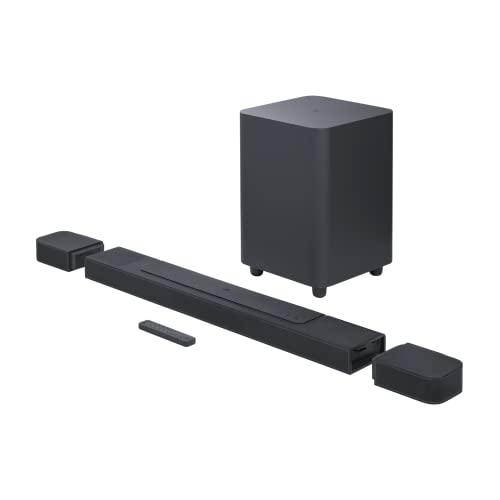
JBL Bar 1000 — Best detachable-rear flagship
The Bar 1000 takes the detachable idea from its smaller sibling and builds a flagship on it: a true 7.1.4 system whose rear speakers — complete with up-firing height drivers, so the rear height channels are physical — detach from the bar’s ends and run on batteries wherever the room wants them. The main bar carries the front bed and its own height drivers, a wireless subwoofer supplies the foundation, and the whole field assembles in the time it takes to walk two small speakers to the back of the sofa.
The significance for this class is that completeness no longer requires permanence. A room can host a 7.1.4 dome on film night and contain a single tidy bar on Tuesday; renters can own a flagship without installing one; and the rears’ improvised positions are forgiven by a calibration routine that listens for wherever they landed. When docked, the system remains a formidable front-only bar, so the household is never punished on the evenings the ritual is skipped.
The battery discipline is the standing caveat, as it is throughout JBL’s detachable line: the rears must start charged for the longest sessions, and their compact size caps their individual authority even as their placement sells the field. There is also a philosophical question each household answers for itself — whether a flagship should be furniture or an event. For rooms with two lives, the Bar 1000 is the only answer in this guide, and it is a genuinely excellent one.
The Bar 1000 also reframes what flagship ownership feels like day to day. Instead of a room permanently arranged around audio, the household gets a room that becomes a cinema — a transformation with a beginning and an end, like drawing curtains. Families with children report the docking ritual becoming part of the film-night liturgy the children themselves perform, which is either a charming detail or the entire point, depending on the household.
- Rated configuration: 7.1.4 with physical rear height drivers
- Rear speakers: detachable, battery-powered, dock to recharge
- Subwoofer: wireless, full-size
- Calibration: automatic, adapts to improvised rear positions
Strengths
- A complete 7.1.4 dome with no rear sockets or cables.
- Rear height channels are real drivers, not processing.
- Bar alone remains formidable on ordinary evenings.
Trade-offs
- Battery endurance must be managed for marathons.
- Compact rears limit individual rear weight.
- The dome exists only when the ritual is performed.
Best for: multipurpose rooms and renters wanting flagship completeness. Not suited for: households wanting permanently installed rears.

LG S95QR — Best for large rooms
The S95QR’s rated 9.1.5 configuration contains a number no other system here can match: five height channels. The bar itself carries a centre height channel among its up-firing array, and its wireless rear speakers add height drivers of their own, so the Atmos dome is built from six physical height sources in total, spread front and back. In a large room — the natural habitat of this class — that architecture tells. Height effects do not merely appear; they travel, crossing the ceiling from screen to sofa with their position intact.
LG’s calibration, measured from the listening seat, marshals the whole population with unusual competence, and the centre channel’s clarity survives the spectacle around it, which is the test that separates flagship systems from flagship demonstrations. The wireless subwoofer is scaled for big spaces, and the rears, being wireless, can be placed at the distances a large room’s geometry actually wants rather than where a cable would have permitted.
Its demands are the flagship standard set: sockets for the rears, a ceiling worthy of the array, and a room large enough that its capabilities read as proportion rather than excess. In a modest space the Q990D’s completeness or the Arc Ultra’s simplicity will serve better. In the big room — the converted space, the open-plan great room with a serious screen — the S95QR is the system that fills the volume honestly, and its five height channels stop being a statistic and become the weather of every film.
There is a scale honesty to the S95QR that buyers should mirror in their own assessment: it will not pretend a small room is a cinema, and it does not dim its capabilities to flatter one. Its centre height channel, the feature rivals most often omit, pays its way in large spaces by keeping dialogue at the screen’s altitude while the dome moves above it — a small architectural decision that owners notice every time a voice stays put inside a storm.
- Rated configuration: 9.1.5, with five height channels
- Rear speakers: wireless, each carrying an up-firing driver
- Centre provision: dedicated centre plus centre height channel
- Calibration: measured from the listening position
Strengths
- Height effects travel across the whole ceiling.
- Scales to large rooms without strain.
- Centre clarity holds inside the spectacle.
Trade-offs
- Needs a big room to justify its architecture.
- Rears require sockets and real estate.
- App experience trails the hardware.
Best for: large rooms and viewers who want height everywhere. Not suited for: modest spaces where its scale becomes excess.

Sonos Arc Ultra — Best single-bar flagship
The Arc Ultra is the virtual philosophy executed at its highest current level: a single bar rated at 9.1.4, building its entire dome — wide front, surrounds, height — from one cabinet using an array of precisely aimed drivers and Sonos’s most advanced processing, including a redesigned bass architecture that gives the bar improbable low-end authority for its size. There are no rear speakers, no subwoofer and no cables beyond power and the television connection, and yet a well-shaped room receives a sound field that earlier generations of single bars could not credibly claim.
Its dialogue story deserves the emphasis this guide gives every centre: the Ultra’s speech enhancement and centre focus are the finest Sonos has produced, and in the evening register — series, news, a film at family volume — it is a superb television instrument. The Sonos platform adds the ecosystem virtues: multi-room music, an app of genuine polish, and a growth path via the company’s subwoofers and rear speakers for households that later decide the dome should become physical.
The boundaries are those of all virtual systems, stated at flagship scale. The field’s conviction depends on the room’s walls and ceiling to reflect from; in a vast or open space the dome thins where the physical systems keep building. And a single cabinet, however ingenious, cannot place a driver behind your head. Buyers are choosing between the most elegant object in this guide and the most complete fields — a legitimate choice, provided it is made with both descriptions in view, as they are here.
The Ultra also suits the household whose listening is split between the screen and the room itself — podcasts while cooking, music through the evening, the news at breakfast — because the Sonos platform treats the bar as a citizen of the house’s whole audio life rather than as the television’s servant. A flagship that only wakes for films is a specialist; the Ultra is a generalist with a flagship’s ceiling, and for many homes that breadth outlasts the dome’s last degree of conviction.
- Rated configuration: 9.1.4, rendered virtually from one bar
- Bass: redesigned internal architecture; Sonos subwoofers can join
- Platform: Sonos multi-room with app control
- Speech tools: the strongest dialogue enhancement Sonos offers
Strengths
- A flagship dome with zero additional boxes.
- Dialogue polish leads the single-bar field.
- Ecosystem and app are the most mature here.
Trade-offs
- Virtual field depends heavily on room shape.
- No physical rear presence at any setting.
- Completing it physically exits this purchase entirely.
Best for: design-led rooms and Sonos households wanting flagship sound simply. Not suited for: very large or open rooms needing physical speakers.

Sonos Arc — Best established ecosystem bar
The original Arc closes this guide as the class’s elder statesman, and its presence requires the same honesty as everything above: its rated configuration is 5.1.2, which places it below the seven-channel brief on paper. It earns its place on two grounds. First, within Sonos households it remains a complete, mature Atmos bar whose virtual field and dialogue work are proven across years of evenings rather than a launch season. Second, it is the reference point that makes the Ultra’s advance measurable — and the system many readers of this guide already own, deciding whether to climb.
As a television instrument it remains deeply capable: a wide, composed front, speech that sits forward without strain, and the full Sonos platform beneath it. Paired with the company’s subwoofer and rear speakers — the route many owners have already taken — it forms a physical system whose whole exceeds its bar-only rating, which is precisely the ecosystem argument at its most persuasive. Judged bar-alone against this guide’s flagships, it is outgunned in channels and in height conviction, and its section says so without flinching.
The verdict for new buyers is therefore conditional in a way this guide rarely permits itself: entering the Sonos world fresh at this level, the Ultra is the rational flagship; already living in that world, with the Arc at its centre and its companions around it, the case for replacement is weaker than the specifications shout. Completeness is a property of systems, not of bars, and the Arc’s system, fully grown, still honours the intent behind this search.
There is also a market reality in the Arc’s favour: a mature product with years of firmware refinement behind it behaves like it. Its handshakes are practised, its app is finished, its failure modes are known and mostly solved. Flagship buyers pay for performance, but they live with behaviour, and the Arc’s behaviour — in Sonos homes that have grown around it — is the most thoroughly house-trained in this guide.
- Rated configuration: 5.1.2 as a bar — stated plainly
- Field: virtual Atmos from a single cabinet
- Platform: Sonos multi-room, subwoofer and rears available
- Standing: the established reference of the Sonos line
Strengths
- Proven, mature performance across years of use.
- Full Sonos ecosystem growth path.
- Composed dialogue and front stage.
Trade-offs
- Below the seven-channel brief as a bar alone.
- Height conviction trails the newer flagships.
- Full system requires the ecosystem additions.
Best for: Sonos households with an established system around it. Not suited for: fresh flagship buyers, who should take the Ultra.
How do the six compare side by side?
| Pick | Rated channels | Rear speakers | Height method | Philosophy |
|---|---|---|---|---|
| Samsung HW-Q990D | 11.1.4 | Wireless, with height drivers | Physical, front and rear | Total completeness |
| Sony HT-A7000 bundle | 7.1.2 | Processing; add-ons possible | Up-firing in bar | Front-stage supremacy, bundled sub |
| JBL Bar 1000 | 7.1.4 | Detachable, battery, with height drivers | Physical, front and rear | Completeness without permanence |
| LG S95QR | 9.1.5 | Wireless, with height drivers | Five height channels | Scale for large rooms |
| Sonos Arc Ultra | 9.1.4 | Virtual | Virtual | One-bar flagship |
| Sonos Arc | 5.1.2 | Virtual; ecosystem rears possible | Virtual | Established ecosystem core |
Read the rated-channels column as the guide’s founding honesty made visible: six systems, six different numbers, one shared intent. The shopper who understands why the numbers differ understands the category better than most of its marketing does.
What does a complete dome do to a familiar film?
It reveals the mix’s third act. Viewers who know a favourite film by heart — who can recite its dialogue and hum its score — discover, inside a complete system, a layer of the soundtrack that was always present and never reproduced: the room tone of the fictional space, the weather system of the scene, the off-screen life continuing at the edges. The film does not change. The household’s access to it completes, and the sensation is closer to restoration than to upgrade, like seeing a painting cleaned.
Height is the dimension that startles, but the seven-channel bed is the one that convinces. A circling helicopter impresses once; a market scene whose bustle surrounds the conversation at ear level, with the sky of the scene open above it, convinces nightly, because it resembles how the world actually sounds from inside it. Flagship systems earn their keep in that resemblance — not in the demo scenes their makers loop, but in the ordinary spatial truth of well-recorded places.
The honest shadow is expectation. A complete dome raises the standard by which all other listening is judged, and households report their other rooms — and the cinema itself, on an off night — sounding thinner by comparison. That is not an argument against completeness. It is a warning that the flagship purchase is a one-way door, and that the households who walk through it happily are the ones who knew the door was one-way before they paid.
How should the flagship decision be made when two philosophies tie?
By the room’s future, not its present. A physical system — Samsung, LG, JBL — commits the room to speakers and rewards it with a field that does not depend on reflection; a virtual flagship commits the household to an ecosystem and rewards it with simplicity and portability between rooms and homes. Households that expect to move, renovate or re-purpose the room within the system’s life should weight the virtual and detachable answers heavily. Households building a settled cinema should weight the installed ones.
By the household’s other screens, too. A Sonos home experiences the Arc Ultra as an upgrade to a system it already speaks; a Samsung home gains its harmony from the Q990D; a house with no allegiances is free to choose on the sound alone, which is the happiest position and the one this guide’s ranking assumes. Allegiance is not a weakness in the decision — it is information about where the friction will live for the next decade.
And by the ceiling, always by the ceiling, because it is the one participant in the purchase that cannot be upgraded, returned or argued with. Measure it, photograph it, be honest about its beams and its slopes, and let it veto what it must. The systems that remain after the ceiling’s veto are the real shortlist, and among them, at this level, there are no wrong answers — only answers fitted to different rooms.
What should you verify before buying at flagship level?
Your ceiling and your rear wall, in that order, because they decide which philosophy is even available to you. Physical height — whether from a bar or from rear speakers — needs a flat, reflective ceiling at a sane height; a vaulted or beamed room taxes every system here and taxes the virtual ones twice. The rear wall decides the speaker question: sockets and surfaces for the Samsung or LG, open floor for the JBL’s improvisation, or nothing at all, which is the Sonos pair’s entire proposition.
Then verify the listing itself, a flagship habit worth forming. One of this guide’s six is a bundle whose value lives in its contents; others are sold in bar-only and full-system forms under near-identical names. The contents line, read slowly, is the difference between the system reviewed here and a fraction of it. Finally, measure your room against the systems’ scale with a tape rather than optimism: flagship bars are wide, flagship subwoofers are furniture, and a system that dominates a small room visually will dominate it sonically in ways no setting fully civilises.
How do you set up a flagship system so the dome actually forms?
Geometry before electronics. Place the rears symmetrically where the format wants them — sides and rear in their stations for the seven-channel bed — at seated ear height, angled to the listening position, and give the bar a clear line to the ceiling with nothing overhanging its up-firing drivers. Run the system’s calibration from the main seat, all of it, including any microphone routine the maker provides; flagship processing is only as honest as the measurements it is fed, and skipping the routine to save ten minutes is the most expensive saving in home audio.
Verify with the right evidence: an Atmos scene with genuine overhead movement, a dialogue scene at evening volume, and a pan that circles the room. The dome should feel continuous — no hole above the sofa, no rear speaker performing solo. Adjust levels by subtraction where a channel announces itself, set the subwoofer against a baritone voice rather than an explosion, and then leave the geometry alone for a week of real viewing. Flagship systems reward a single careful installation with years of invisibility; they punish perpetual adjustment by never letting the household forget the equipment exists.
What does the subwoofer do at this level that cheaper ones cannot?
It disappears — downward. A flagship subwoofer’s gift is not volume but extension and control: the ability to reproduce the lowest octave of a mix as pressure the room feels rather than as a note the ear locates, while stopping and starting with a precision that keeps dialogue’s foundation clean. In the systems here with separate subwoofers, that quality is what lets a whispered scene and an earthquake share an evening without the owner touching a control. The sub is the dome’s floor, and a floor should be felt, never watched.
Placement remains destiny even at this level. A flagship subwoofer corner-loaded by default will excite the same room modes as a cheap one, and the calibration routines here — good as they are — can only discipline what placement permits. The standing advice of this guide applies with flagship force: place by the baritone test, keep the sub in the room’s front half, and let the system’s measurement finish the argument. Owners who do this once, properly, describe their bass the way they describe their roof — by never mentioning it.
Households in attached housing should take the counterintuitive comfort this level offers: a controlled flagship subwoofer, working within its ease, usually disturbs the neighbours less than a strained smaller one at the same perceived loudness. Extension is not aggression. The systems here can be enjoyed at civilised hours in civilised housing, provided their owners resist the demonstration instinct — and a flagship that can whisper is worth more, nightly, than one that can only roar.
How does gaming at flagship level change the picture?
Games are where the seven-channel bed stops being a refinement and becomes information. A player inside a complete dome hears the world’s geometry — footsteps resolving through side and rear stations, weather arriving from the correct quarter of the sky — with a precision that two-zone surround approximates and stereo merely narrates. Story titles gain cinema’s atmosphere; competitive titles gain the practical advantage of located sound, delivered by physical speakers in the Samsung, LG and JBL systems with no processing interpretation in between.
The chain discipline matters as much as the speakers: console or PC into the television, eARC onward, game mode governing latency at the set. Every system here honours that wired path. What flagship money adds for gamers is headroom — the dome does not strain at the chaotic peaks games produce — and the centre channel’s protection of the dialogue that modern story games mix like films. A household where the screen serves both premieres and playthroughs will find the flagship tier is the first level at which neither use feels like the other’s compromise.
What will ownership feel like in year three?
Quiet, if the purchase was right — and at this level, quiet is the luxury being sold. The system will have survived television changes, furniture changes and at least one redecoration; its calibration will have been re-run a handful of times; its settings will have frozen into the household’s defaults so completely that new guests will assume the room simply sounds like that. Flagship equipment’s final trick is to be mistaken for architecture.
The maintenance ledger is short and worth writing down once: keep the up-firing drivers’ paths unobstructed when furniture migrates, re-run calibration after any change to the room’s soft furnishings, keep the detachable rears’ batteries exercised if the JBL is yours, and let firmware arrive. None of it resembles the receiver era’s rituals. The systems here were designed for households that want the result of a cinema without adopting its upkeep as a hobby, and year three is where that design brief proves itself.
And the value question resolves itself by then. A flagship divided by a decade of evenings is not an extravagance; it is one of the cheaper seats in the house. The households that regret flagship purchases are, in our experience, almost never the ones that bought too much system — they are the ones that bought the right system for a room they did not have. Hence this guide’s refrain, offered one final time: the ceiling, the rear wall, the seats. Measure those, and the flagship chooses itself.
What mistakes do flagship buyers keep making?
- Believing the category label. Pure 7.1 bars barely exist; the real systems are Atmos configurations, and their true numbers are printed in this guide.
- Buying a bundle without reading its contents. The Sony listing’s value is its subwoofer and plan; skimming past them misunderstands the purchase.
- Installing flagship scale in a small room. Completeness needs volume to unfold in; excess hardware in a small space is clutter, not cinema.
- Skipping calibration. A flagship’s processing is a measuring instrument; unmeasured, it is guessing at flagship prices.
- Judging on height demos alone. The centre channel still carries most of every film; a dome with mumbling at its heart is a failed dome.
- Ignoring the ceiling. Every height method here answers to architecture; a hostile ceiling should redirect the whole purchase.
A closing observation for the reader who arrived via the search that named this guide. You came looking for a number — seven point one — and the honest answer turned out to be a family of larger, stranger numbers, each attached to a philosophy. That is not a bait-and-switch; it is the category telling the truth about itself at last. The makers stopped building plain 7.1 bars because height was worth more than purity, and the systems above are what their ambition produced. Judge them by the printed configurations, install them by the room’s evidence, and the number you started with will have led you, by an honest detour, to the system you actually meant.
One more consideration belongs to households choosing between the two Samsung-and-LG style flagships and the world of the traditional receiver. A component system can still exceed these bars at the summit — larger speakers, more placement freedom, endless upgrade paths — at the cost of the receiver, the wiring and the weekend. The soundbar flagships exist for the household that has priced that weekend honestly and declined it. Nothing in this guide pretends the trade does not exist; everything in it testifies that the trade, for most rooms, has become remarkably cheap to make.
Final Recommendation
Crown the Samsung HW-Q990D. It is the most complete soundbar system in this guide and, for a room that can host it, the fullest answer the category currently gives: a surround bed with no direction left to implication, height in front and behind, and a centre that rules the dome it sits in. Choose the LG S95QR when the room is larger still and height should travel the whole ceiling, the JBL Bar 1000 when completeness must be able to pack itself away, and the Sony bundle when the front stage matters most and the system will grow. The Sonos Arc Ultra is the flagship for rooms that will host exactly one beautiful object, and the original Arc remains the honourable core of an established Sonos home. The label said 7.1; what these systems actually deliver is the whole sky — pick the one whose sky fits your ceiling.
Frequently Asked Questions
Does a true 7.1 soundbar exist?
Essentially no, and this guide opens with that fact rather than burying it. Makers given seven channels of ambition add height channels instead, producing the 7.1.2 and 7.1.4 systems above, or exceed the bed entirely. A listing claiming a plain 7.1 bar deserves the scepticism this guide applies throughout: read the rated configuration, not the headline.
What exactly is in the Sony bundle?
Three things: the HT-A7000 soundbar itself, Sony’s SA-SW5 subwoofer in wireless form, and cover for the purchase. The subwoofer’s inclusion is the substantive point — it gives the 7.1.2 bar the low-frequency foundation its internal drivers cannot provide alone — and the bundle should be priced and judged as the package it is.
Is 11.1.4 meaningfully better than 7.1.4?
In a suitable room, yes, in the specific currency of smoothness and rear height. The Q990D’s extra channels fill the side and rear field more completely and place height behind the listener with more authority. In a small room the difference compresses toward irrelevance, which is why this guide keeps returning the decision to the room rather than to the arithmetic.
Can a single bar really produce a 9.1.4 field?
It can produce a rated 9.1.4 presentation virtually, as the Arc Ultra does, and in a cooperative room the effect is genuinely enveloping. It cannot place physical sound behind you, and in large or open spaces the field thins. The honest phrasing is Sonos’s own configuration delivered by processing — impressive, room-dependent, and different in kind from the physical systems here.
Do these systems still need a good television?
They need an eARC-equipped one to receive full-quality Atmos from the set’s apps and connected devices. The picture itself is your own affair, but the audio path is part of the system you are buying, and a flagship bar fed through a bottlenecked output is a flagship under house arrest.
Should I build with separate speakers instead?
If the room is dedicated, the wiring is welcome and the hobby itself appeals, a receiver system remains the summit — this guide has never claimed otherwise. The flagships here are for the household that wants the summit’s view from a chairlift: nearly the altitude, none of the climbing. Knowing which traveller you are is the real first decision, and it is a decision about your life, not about audio.
For the chairlift travellers — most of the readers who will ever open this guide — the six systems above represent the current top of the lift line, and the differences among them are differences of room and philosophy rather than of worthiness. That is a pleasant place for a category to have reached: the argument is no longer about whether a soundbar can be a flagship, but about which flagship your ceiling, your walls and your household were built for.
Answer those three witnesses honestly — ceiling, walls, household — and then buy without a backward glance at the numbers game that brought you here. The dome, once formed over your own seats, has a way of making the arithmetic that described it feel very far away, which is exactly where arithmetic belongs: in the guide, not in the evening.
And if the evening is the argument, let the first one be a film the household already loves, played at the volume the household actually uses, in the seats it actually occupies. A flagship that cannot transform the familiar has no business promising the spectacular — and every system in this guide was chosen because it transforms the familiar first, and lets the spectacular look after itself.
That is the standard this guide leaves you with, and it is deliberately unglamorous: not the tallest specification, not the longest channel count, but the familiar made complete. The six systems above all meet it in their different dialects. Choose the dialect your room speaks, and the category’s founding fiction — the missing plain 7.1 bar — will never trouble your evenings again.
Trouble, in fact, is the one thing a well-chosen flagship abolishes: the trouble of wondering whether the soundtrack holds more than your room is giving you. It does not, once one of these systems is installed and measured — and that certainty, nightly renewed, is the true product at the top of this market.
Buy it, install it with the patience the setup section prescribes, and then spend the saved wondering on the films themselves. That reallocation of attention — from the equipment to the art it serves — is the final measure of every system in this guide, and the one by which, years from now, you will know the flagship money was spent on the right sky.
The sky, in the end, is personal: it is the shape of your ceiling, the spread of your seats, the films your household returns to. Six systems above can build it. One of them was built for your version — and the preceding pages, read with your room in mind, have already named it.
Trust that naming. Then dim the lights, start the film you know by heart, and listen for the moment the room disappears — the moment every flagship in this guide was engineered, channel by honestly counted channel, to deliver.
When that moment arrives — and with the right system in the right room, it arrives in the first scene — the search that began with a rounded number ends where it should: not with a specification, but with a room that has stopped asking for anything.
Can a flagship soundbar system work with a projector instead of a television?
Yes, and in a dedicated viewing room it is often the neatest way to run one. The bar still needs the same audio feed a television would give it: HDMI eARC or ARC where the projector offers it, or optical as a fallback. Where the projector has no eARC, several systems in this guide — the Samsung, the Sony and the JBL among them — carry full HDMI inputs of their own, so a streamer, console or disc player can feed the bar first and pass its picture onward to the projector untouched. That routing matters, because an optical-only connection caps the stream at lossy Dolby Digital and quietly demotes the height layer these systems exist to provide; if your projector cannot return eARC, feed the bar directly rather than accepting the thinner format.
Placement follows the screen, not the set. The bar sits below the projected image, close to the centre of the front wall, and the up-firing drivers still need a reasonably flat ceiling between bar and seats to bounce their channels from — most projector rooms oblige. Run the system’s room calibration only after the screen, seating and any acoustic treatment are final, because the screen wall changes how the front stage reflects, and a calibration captured before the room is finished will be politely wrong for the room you actually watch in.
One more placement note belongs here, because projector rooms tempt a mistake television rooms cannot make: hiding the bar behind an acoustically transparent screen. A few screens are woven to pass sound with little loss, and a bar behind one keeps the front wall visually clean — but the up-firing height drivers must never sit behind fabric, since their whole job is to throw sound at the ceiling, and a screen in the way muffles exactly the channels you paid flagship money for. Keep the bar below the screen’s lower edge, in open air, and let only its silhouette disappear into the dark.
Related Guides
Step down to the best 100 watts soundbars for small rooms for the complete mid-tier picture, examine the cable question in the best 2 channel stereo sound cards for music, or revisit the foundations in the best 5.1 sound cards for speaker setups.


