What's inside
- Key Takeaways
- Quick Picks
- How Did We Choose These Component Sets?
- Where Should the Tweeters Go, and Why Does It Matter So Much?
- How Do the Six Sets Compare?
- What Does an External Crossover Actually Buy You?
- How Do You Install a Component Set Without Regretting It?
- What Mistakes Do First-Time Component Buyers Make?
- How Is This Guide Different From the Coaxial Guide?
- Why Does Time Alignment Matter More in a Component System?
- Should You Bi-Amplify a Component Set, or Run It Passively?
- How Should Tweeters Be Aimed Once Their Position Is Chosen?
- What Should Go in the Rear Doors Once the Front Stage Is Components?
- How Does a Subwoofer Complete a Component Front Stage?
- Which Specification Differences Between Sets Are Real, and Which Are Theatre?
- How Long Does a Component Installation Really Take?
- What Changes After a Week of Living With the System?
- Why Do Component Sets Reveal Recording Quality So Ruthlessly?
- Can a Component Set Work in a Car With a Premium Factory System?
- What Is the Sensible Upgrade Path After a Component Front Stage?
- How Do You Choose Between the Focal’s Resolution and the Hertz’s Warmth?
- What Should You Keep From the Installation for the Next Car?
- One Last Distinction: Component Sets and the Listeners They Suit
- Final Recommendation
- Frequently Asked Questions
- Related Guides
As an Amazon Associate I earn from qualifying purchases. This post may contain affiliate links at no extra cost to you.
widgetverdict.com is reader-supported. When you buy through links on our site, we may earn an affiliate commission.
Before the picks, a definition worth policing: four of the six sets below — Focal, Hertz, JBL and CT Sounds — link to verified listings, and every one of them is a genuine component system: a woofer for the door, a separate tweeter you mount where ears can benefit from it, and an external crossover network that divides the music between them. The JL Audio C1-650 is covered without a link for the reason stated in its section, and one further set is discussed as prose-only context. If a listing you meet elsewhere calls itself a component set but the tweeter is fixed in the woofer’s centre, it is a coaxial wearing this keyword’s clothes, and it belongs in the companion guide, not in your shortlist here.
The case for the best 6 5 component speakers rests on a single geometric fact: a car door is a terrible place to put a tweeter. Tweeters radiate the frequencies that locate sound — the ones that tell your brain where a voice is standing — and a door buries them at ankle height, firing across the footwells. A coaxial accepts that burial as the price of simplicity. A component set refuses it. By separating the tweeter from the woofer and giving you a length of wire and a choice, it lets the high frequencies move up the door, into the sail panel at the mirror’s base, or onto the A-pillar, while the woofer stays below doing the heavy midbass work. Between those two freed drivers sits the format’s second advantage: an external crossover, a small network of real components that divides the signal with steeper slopes and finer tailoring than any capacitor hidden inside a coaxial can manage.
That freedom is also the format’s price, and this guide will not hide it. A component installation is a project: doors apart, tweeters mounted, crossovers hidden, more wiring to route and protect. The four linked sets below divide the territory by philosophy. Focal builds the audiophile’s entry point, all resolution and air. Hertz builds the efficient Italian all-rounder that flatters factory-adjacent power. JBL builds the high-output Club set for systems that will be amplified. CT Sounds builds the value insurgent, a three-way flagship at a two-way price of admission. Choose by the system you actually own and the Saturday you actually have.
Key Takeaways
- A component set separates tweeter from woofer and adds an external crossover; the tweeter’s freedom to move upward is the entire point of the format.
- Expect a higher, more believable soundstage than any coaxial can produce from the same door, because the locating frequencies now leave from near ear level.
- External crossovers divide the signal more precisely, often with tweeter level adjustment, so the handover between drivers can be tuned to the cabin.
- Installation is genuinely more work: tweeter mounting, crossover placement and extra wiring runs are part of the purchase, not an afterthought.
- The linked four split by philosophy — Focal for resolution, Hertz for efficiency, JBL Club for amplified output, CT Sounds for three-way value.
- Amplification is not required, but component sets reveal their full advantage on clean power; the Hertz is the pick that asks for least.
Quick Picks
| Pick | Badge | Why it earns its place |
|---|---|---|
| Focal ASE 165 | Best for resolution | The Auditor-series entry to Focal’s house sound: inverted-dome tweeter, fine detail, unmistakable staging. |
| Hertz K 165 Uno | Best on modest power | An efficient Uno-series set with a neodymium tweeter that wakes up on head-unit-adjacent power. |
| JBL Club 64C | Best for amplified builds | Club-series components with strong sensitivity, a low impedance trick and output headroom to grow into. |
| CT Sounds Meso 6.5 | Best three-way value | A flagship three-way set — woofer, midrange, tweeter — at a price the two-way establishment notices. |
| JL Audio C1-650 | Prose-only benchmark | The smooth, honest C1 set, covered without a link because the clean listing for this size was not there to verify. |
| Alpine S2-S65C | Prose-only alternative | The S-series component route through dealers and installers, noted for buyers in that channel. |
How Did We Choose These Component Sets?
By grading the three parts separately before grading the whole. The tweeter came first, because it carries the format’s promise: its material, its mounting hardware and its dispersion decide whether the stage actually rises. The crossover came second — its slope, its build and whether it offers tweeter level adjustment, because a set whose tweeter cannot be trimmed to a bright cabin is a set half-finished. The woofer came third, judged on the door virtues: cone material, basket depth, and sensitivity honest enough to describe the power in real cars. Sets that spent their budget in that order ranked above sets that spent it on cosmetics, and every linked set here can explain, part by part, where its money went.
We also drew the format’s border strictly, in both directions. Products with fixed central tweeters were excluded as coaxials, however premium; and raw driver pairs with no crossover network were excluded as unfinished systems, however audiophile their branding, because a first-time component buyer deserves a set whose designer already solved the division of labour. What remains is the format as it should be sold: complete, matched and ready to install as a system.
Where Should the Tweeters Go, and Why Does It Matter So Much?
Three addresses compete. The sail panel — the small triangle at the front of the window, by the mirror — is the classic: near ear height, angled naturally toward the listeners, and usually hollow enough to accept a flush mount. The A-pillar aims higher and wider, giving the broadest stage at the cost of the most involved trim work and, in cars with pillar airbags, a hard safety boundary that rules the location out entirely for many owners — check your car’s manual before falling in love with it. The top of the door card is the compromise: less trim surgery, a meaningful lift over the woofer’s ankle address, and a short wire run. Surface mounting on an angled pod is the reversible audition for all three: tape the tweeters in place, live with each position for a week of real driving, and let the stage you hear — not the photograph you imagine — choose the permanent home. That audition is the component format’s hidden gift; no other speaker purchase lets you rehearse its acoustics before committing the trim.

Focal ASE 165 — Best for resolution
Focal’s Auditor series is the French maker’s invitation tier, and the ASE 165 carries the family’s signature where it counts: an inverted-dome tweeter. The inversion is not styling. A conventional dome pushes sound from its centre outward; Focal’s inverted dome, driven around its edge, behaves more like a tiny woofer in its control of the radiating surface, and the audible result is the house sound that built the brand — treble with air and fine grain, cymbals that shimmer in layers, and a soundstage whose edges stay defined when the music gets busy. The woofer’s polypropylene cone and the set’s external crossover, with tweeter level adjustment, complete a system tuned for listeners who hear detail as a feature rather than as a warning.
In the car, the ASE 165 rewards placement care more than any set here: give its tweeters the sail panels and a fair angle, and voices stand on the dashboard with a specificity that makes coaxial owners quiet. It asks for two things in return. Clean power flatters it — a modest amplifier turns its composure up a full grade — and bright cabins must use the crossover’s tweeter trim rather than the head unit’s treble, which is the blunt instrument by comparison. Owners cross-shopping purely on sensitivity numbers will find louder sets below; owners cross-shopping on what a violin section sounds like at the end of a long drive have found their pick.
- Layout: two-way components in the 6.5-inch door size
- Tweeter: inverted dome, Focal Auditor design
- Crossover: external, with tweeter level adjustment
- Woofer: polypropylene cone
- Character: resolution, air, precise staging
Strengths
- The finest treble detail and stage definition in this guide.
- Crossover trim lets the tweeter be tuned to the cabin properly.
- A genuine entry into a flagship maker’s design philosophy.
Trade-offs
- Reveals poor recordings and noisy amplifiers without mercy.
- Needs placement care to earn its staging advantage.
- Premium pricing within the linked field.
Best for: detail-first listeners building a considered front stage. Not suited for: rough-and-ready installs on noisy factory amplification.

Hertz K 165 Uno — Best on modest power
Hertz built the Uno series around a problem the industry prefers to ignore: most component sets are bought for cars whose amplification is a head unit, and most component sets sound half-asleep on one. The K 165 answers with efficiency as a design creed. Its tweeter is a PEI dome on a neodymium magnet — small, light and eager — and the woofer’s pressed-pulp cone with its water-repellent treatment keeps moving mass low and sensitivity high, with published figures that place it among the most efficient sets in this guide. The crossover is an honest, compact network with the tweeter’s filter integrated thoughtfully, sized to hide in a door without a wrestling match.
The result is the component set for the real world of unamplified cars: the stage rises, the detail arrives, and the volume knob stays where it always was. Hertz’s voicing helps the cause — a touch of warmth in the midrange, a treble that informs without the Focal’s forensic glare — making the K 165 the easiest set here to live with across a whole library, from compressed streams to good recordings. Its ceiling is real: feed it serious power and ask for serious volume and the JBL below keeps its composure longer. But for the buyer whose amplifier budget is zero and whose Saturday is one, the Uno is the set that respects both constraints while still delivering the format’s essential miracle, tweeters at ear level.
- Layout: 6.5-inch component pair, two-way
- Tweeter: PEI dome, neodymium magnet
- Woofer: pressed-pulp cone, water-repellent treatment
- Design brief: high sensitivity for modest power
- Character: warm, eager, forgiving
Strengths
- The most convincing component sound here without an amplifier.
- Compact crossover and hardware ease the installation.
- Forgiving voicing suits mixed libraries and factory sources.
Trade-offs
- Ultimate output and headroom trail the amplified picks.
- Treble detail is a step behind the Focal’s resolution.
- The efficiency brief means lighter bass authority at the woofer.
Best for: head-unit systems that want the component stage without the amplifier bill. Not suited for: high-volume amplified builds.

JBL Club 64C — Best for amplified builds
The Club 64C is JBL’s answer for the owner whose system has, or will have, an amplifier — and it brings a trick the spec sheet states plainly: a nominal impedance on the low side, which draws more power from a given amplifier voltage and converts it into sensitivity that reads impressively and behaves impressively in the car. The woofer’s polypropylene cone and the set’s external crossover are built to Club-series touring standards, and the tweeter is an edge-driven silk dome whose smoothness at volume is the set’s quiet glory: the 64C can play loudly without the treble turning into a siren, which is precisely the failure mode of lesser sets on real power.
Treat the low impedance as a specification to verify rather than a slogan: most modern amplifiers and head units tolerate it happily, but an elderly head unit driving all channels hard deserves a check of its ratings before this set is asked to party. Within that single caution, the Club is the growth pick of the guide — satisfying on a head unit today by virtue of its sensitivity, and properly unleashed by an amplifier tomorrow, with a crossover that keeps the two drivers’ handover tidy at both power levels. If your build has stages, this is the set that does not need replacing at stage two.
- Layout: component set with a 6.5-inch woofer, two-way
- Tweeter: edge-driven silk dome
- Impedance: low nominal rating — verify amplifier compatibility
- Crossover: external network
- Character: smooth at volume, ready to be amplified
Strengths
- High sensitivity now, high headroom later — a genuine two-stage pick.
- Silk-dome composure holds at volumes that harden rivals.
- Club-series build suits daily-driver durability.
Trade-offs
- Low impedance demands a compatibility glance at older head units.
- Its value is partly locked until amplification arrives.
- Installation is a full component job, tweeters and crossovers included.
Best for: staged builds and amplified systems that play loud cleanly. Not suited for: owners who want the whole answer on factory power alone — the Hertz argues better there.
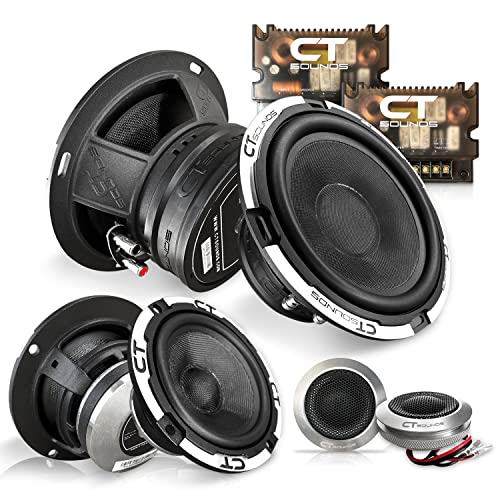
CT Sounds Meso 6.5 — Best three-way value
The Meso 6.5 is the insurgent entry: a three-way component set — woofer, dedicated midrange driver and silk-dome tweeter, with a substantial external crossover network — sold by CT Sounds at a level where the establishment offers two-way sets. The third driver is the argument. In the door-and-sail layout most cars allow, the woofer’s top and the tweeter’s bottom leave a region where dispersion narrows and voices can thin; a small midrange, mounted with or near the tweeter, covers that region with authority, and the Meso’s vocal solidity is the first thing listeners notice. The crossover is correspondingly serious, a real network rather than a token, with the build weight to match — check your hiding places before it arrives.
CT Sounds’ direct, enthusiast-channel character cuts both ways: the value is undeniable, the specification ambition is real, and the set’s appetite for power is equally real — the Meso wakes properly on an amplifier and merely visits on a head unit. Installation is the fullest job in this guide, with three drivers to place per side and a crossover that needs a dry, secure home. For the builder who measures a system by what it contains and what it does rather than by the badge’s age, the Meso is the most interesting box in the roundup, and for voice-heavy listeners with amplification, possibly the best.
- Configuration: 6.5-inch three-way component set
- Drivers: woofer, midrange and silk-dome tweeter
- Crossover: full external network, generously built
- Design brief: flagship content at an insurgent price
- Character: vocal solidity, scale, ambition
Strengths
- The only three-way architecture among the linked picks.
- Midrange presence that flatters voices and acoustic music.
- Component content per unit of money leads the guide.
Trade-offs
- Wants an amplifier to show its real ability.
- The largest crossover and the most installation work here.
- Brand support runs through enthusiast channels rather than dealer networks.
Best for: amplified builders who value architecture over badges. Not suited for: minimal-installation, factory-power simplicity.
JL Audio C1-650 — Prose-only benchmark
The C1-650 is JL Audio’s entry component set, and its virtues are the company’s virtues in miniature: a mineral-filled polypropylene woofer, a silk-dome tweeter, an external crossover designed with unusual care for the tier, and a voicing so honest that it has become the set installers recommend to customers they like. Nothing about it shouts. Its stage is wide and calm, its treble is the kind that survives a six-hour drive, and its measured behaviour makes it the easiest set in this class to integrate with processing later. If this guide ranked on refinement per decibel of hype, the C1 would be embarrassing the field.
It is prose-only for a listing reason we state exactly: for this 6.5-inch size, we could not verify a clean listing — the name’s marketplace trail runs through the 6×9 variant and third-party offers we would not send a reader to with confidence. The buying advice follows from that. Through a JL Audio dealer or a reputable installer, the C1-650 is a first-rank choice and its warranty and support are part of its value. Through a marketplace listing of uncertain contents, it is a gamble wearing a good name. We would rather lose the link than blur that distinction, and readers who buy it through the proper channel will understand the set’s reputation within one album.
- Layout: two-way component system, 6.5-inch class
- Tweeter: silk dome
- Woofer: mineral-filled polypropylene cone
- Channel: dealers and installers recommended
- Status: prose-only — no clean verifiable listing for this size
Strengths
- Refined, fatigue-free voicing of installer-benchmark quality.
- Crossover design and integration behaviour lead its tier.
- Dealer channel brings warranty and setup support.
Trade-offs
- No verified link from this guide; buying takes a channel decision.
- Calm character understates itself in quick auditions.
- Premium-tier pricing through authorised channels.
Best for: listeners who buy through dealers and value refinement. Not suited for: one-click marketplace shoppers.
Alpine S2-S65C — Prose-only alternative
Alpine’s S-series component set is the other name a dealer will put on the counter, and it earns its mention here as the prose-only alternative for buyers shopping through installers: a second-generation S-series design with a glass-fibre-reinforced cone, a silk dome tweeter and the tidy, system-minded engineering of a company that also makes the head units and processors these sets so often partner with. Its particular strength is integration — in an Alpine-centred system, the S2 set’s behaviour with the brand’s processing is a known quantity, and installers lean on that predictability. It sits outside this guide’s verified pool, so it carries no link; judged purely as hardware it is a legitimate rival to the linked two-ways, a shade more neutral than the Hertz and a shade less forensic than the Focal, and buyers whose local shop stocks it should audition it against both with confidence.
- Layout: 6.5-inch two-way set with separate drivers
- Tweeter: silk dome
- Woofer: glass-fibre-reinforced cone
- Channel: dealers and installers
- Status: prose-only — outside this guide’s verified pool
Strengths
- Predictable, neutral voicing that integrates easily.
- Natural partner for Alpine head units and processors.
- Installer familiarity is widespread.
Trade-offs
- No verified link from this guide.
- Less distinctive character than the Focal or Hertz.
- Dealer stock and terms differ from shop to shop.
Best for: Alpine-system owners buying through a shop. Not suited for: readers who want this guide’s verified route.
How Do the Six Sets Compare?
| Set | Ways | Tweeter | Power personality |
|---|---|---|---|
| Focal ASE 165 | 2-way | Inverted dome | Rewards clean amplification |
| Hertz K 165 Uno | 2-way | PEI dome, neodymium | Best on modest power |
| JBL Club 64C | 2-way | Silk dome | Amplified builds, low impedance |
| CT Sounds Meso 6.5 | 3-way | Silk dome + midrange | Wants an amplifier |
| JL Audio C1-650 | 2-way | Silk dome | Refined all-rounder (prose-only) |
| Alpine S2-S65C | 2-way | Silk dome | Neutral dealer-channel pick (prose-only) |
Sort by your amplifier before your taste. No amplifier and none planned: the Hertz stands alone at the top of the honest list. An amplifier present or firmly budgeted: the Focal for resolution, the JBL for output growth, the Meso for architecture. Buying through a dealer regardless: the JL and Alpine enter as equals of the linked sets, separated from them only by this guide’s linking rules.
What Does an External Crossover Actually Buy You?
Precision at the handover. The crossover’s job is to send low frequencies to the woofer and high frequencies to the tweeter while keeping each driver out of the region where it misbehaves — the tweeter out of the bass that would destroy it, the woofer out of the top octave where its cone breaks up. An external network does this with steeper slopes than a coaxial’s inline capacitor, so the transition is cleaner and each driver works a narrower, happier range. It also adds the format’s most useful control: tweeter level adjustment, typically a switch or jumper offering the dome’s output in a few steps, which lets the installer balance the tweeter against its chosen position — a sail-panel tweeter near glass needs a different allowance than a door-top tweeter — instead of accepting one compromise for every car. Finally, the external box can be mounted where it stays dry and reachable, and its settings can be revisited after a week of listening without removing a speaker. That revisiting, unglamorous as it sounds, is where good component systems become great ones.
How Do You Install a Component Set Without Regretting It?
In stages, with the irreversible steps last. Mount the woofers as you would any door speaker — adaptor, seal, deadening behind — and route their wiring through the door’s loom protection rather than alongside it. Place the crossovers in a dry, accessible home: inside the door only if the cavity’s dry side is certain, otherwise at the kick panel or under the dash, with their adjustment switches reachable for the tweeter-trim session you will hold in a week. Run the tweeter wires with slack, surface-mount the tweeters on their angled pods, and audition positions with tape before any trim is cut or drilled — sail, door top, pillar where legal and safe — driving real routes at real volume, because a stage that charms in the driveway can nag on the motorway. Verify polarity across all four drivers per side with a mono voice recording before final fitting, and only then commit the tweeters to their permanent mounts. The format rewards this patience disproportionately: an hour of rehearsal is the difference between a stage and a pair of speakers.
What Mistakes Do First-Time Component Buyers Make?
Mounting the tweeters where they photograph best rather than where they sound best leads the list — the audition ritual exists because the two addresses are often different. Second is burying the crossovers somewhere unreachable, then living forever with a tweeter level chosen in haste. Third is mixing the format’s halves across brands — one maker’s woofers with another’s tweeters and a third’s crossover — which discards the matched engineering that justifies a set’s existence. Fourth is skipping the door work: a component woofer in an unsealed, undeadened door is a precision instrument in a drum, and its midbass will be judged by the door’s behaviour rather than its own. Fifth is judging the system in the first hour, before tweeter positions are auditioned and levels trimmed; component sets are the one car-audio purchase whose manual might honestly say “some assembly of the sound itself is required.”
How Is This Guide Different From the Coaxial Guide?
Deliberately, and in one sentence: nothing here has its tweeter in its woofer. The companion guide covers the coaxial format — central tweeters, inline crossovers, two-wire simplicity — and argues its case honestly for the majority of daily drivers. This guide covers the format that separates the drivers, and the two share no picks, no paragraphs and no conclusions, because the formats answer different questions. If your reading of both leaves you undecided, the deciding factors are installation appetite and tweeter ambition: a free Saturday and a wish to hear the stage at windscreen height point here; a free hour and a wish for the car to simply sound right point there. Neither answer is a compromise — they are the two honest shapes of a 6.5-inch upgrade.
Why Does Time Alignment Matter More in a Component System?
Because the format deliberately separates drivers that the ear expects to hear as one. The woofer sits low and forward in the door; the tweeter sits high and often a few centimetres nearer or farther; and the driver’s seat is much closer to one side’s pair than the other’s. Sound from each driver therefore arrives at the ear at slightly different times, and through the crossover region — where both drivers play the same notes — those small differences smear the image the format was bought to sharpen. Component crossovers are designed with the typical geometry in mind, which handles the woofer-to-tweeter relationship within a side. The side-to-side relationship belongs to the listener’s position, and that is what time alignment in a head unit or processor corrects, delaying the nearer side by fractions of a millisecond until the stage centres itself. Owners without processing still get most of the format’s benefit — height and clarity need no delay — but the first taste of alignment is the moment many component owners understand what the fuss was about: the singer stops leaning toward the nearer door and stands, finally, in the middle of the windscreen.
Should You Bi-Amplify a Component Set, or Run It Passively?
Passively, for almost everyone, and the format’s designers agree with you — the external crossover in the box is engineered to be fed by one amplifier channel per side and to divide the result properly. Bi-amplification, where separate channels drive woofer and tweeter with the crossover bypassed or supplemented by electronic filtering, is a real technique with real gains in control, but it moves the system’s most delicate decision — the handover — from the set’s designer to the installer, and it demands measurement equipment and experience to land where the passive network already sits. The sensible growth path runs the other way: install passively, live with the system, and let any later processing take the form of time alignment and equalisation applied to the whole side, which refine the designer’s work instead of replacing it. The exception is the competition-grade build with a processor per driver, which is a wonderful hobby and a different article.
How Should Tweeters Be Aimed Once Their Position Is Chosen?
Start on-axis toward the opposite listener’s shoulder — the classic cross-firing arrangement — because tweeters beam their top octave and a dome aimed at the far seat tends to balance the near seat’s proximity advantage. Then experiment in small rotations, because cabins differ in glass angle and dash shape, and the difference between a stage that floats and one that merely sits high can be a few degrees of toe. Listen for two things while adjusting: the centre image’s stability as you move your head naturally, and the treble’s behaviour on sibilant voices, which announce excessive on-axis energy before any instrument does. Change one side at a time and keep the other as your reference, or you will chase a moving target around the cabin. When the aim is right, the tweeters disappear as sources — you hear a stage, not two domes — and that disappearance, not any measurement, is the format’s finishing line.
What Should Go in the Rear Doors Once the Front Stage Is Components?
Less than your instincts suggest. The front stage is where the system’s money and attention now live, and the rears’ job narrows to ambience and passenger courtesy. A coaxial pair from the same family as the front set is the tidy answer — one voicing throughout the cabin, no second crossover population to hide — and the fader should favour the front enough that rear output supports the stage rather than pulling it backwards. Some component owners go further and run rears quietly or not at all for critical listening, restoring them for passengers; neither choice is a betrayal of the format. What the rears should not become is a second front stage bought before the first one is finished: tweeters in the rear pillars create a second, competing image that the front listeners hear as confusion. Sequence the build the way the seats are used — fronts, then bass, then rears — and each stage will be audible as an improvement rather than as a rearrangement.
How Does a Subwoofer Complete a Component Front Stage?
By taking the one job the door woofers do worst and returning their composure. A 6.5-inch woofer in a door can produce genuine midbass, but the bottom octave asks it for excursion that taxes the same cone that must stay precise through the midrange. High-passing the component woofers at a sensible point and handing everything below to a subwoofer cleans the midrange audibly — voices steady, guitars separate — while the sub, placed and levelled with restraint, supplies the foundation the stage stands on. The crossover between sub and doors then becomes the system’s second handover to tune, with the same rules as the first: set it by measurement or patient listening, prefer the setting where the bass seems to come from the stage rather than from the boot, and resist the level that impresses passengers for one song. A component stage with disciplined bass support is the configuration most of this guide’s readers are actually building toward, whether they say so at the start or not.
Which Specification Differences Between Sets Are Real, and Which Are Theatre?
Sensitivity is real, with the cross-brand measurement caveat this batch of guides keeps repeating. Crossover slope and tweeter attenuation options are real, and visible in the hardware if you open the box. Cone and dome materials are real but second-order — they describe tendencies, not verdicts, and a well-engineered polypropylene set will outplay a poorly engineered exotic one every day of the week. Peak power figures are theatre, printed for the shelf. Frequency response ranges without tolerances are theatre with a programme. The most honest specification is the one few buyers read: the set’s recommended amplifier range, which tells you the power the designer actually imagined, and which sorts this guide’s picks — the Hertz content at the modest end, the Meso asking for the full orchestra — more truthfully than any headline number. Read the sheet for vetoes and for that recommendation, then let character decide.
How Long Does a Component Installation Really Take?
Budget a full day for a first installation done properly, and distrust any estimate that omits the rehearsal. The woofers and door work consume the morning; the crossovers and their wiring, the early afternoon; the tweeter audition — tape, pods, real roads, real music — is an hour that feels optional and is not. Owners who compress the job into an afternoon usually skip exactly the stages that distinguish this format: positions get guessed, crossovers get buried wherever they first fit, levels get set in the driveway and never revisited. The second car goes faster, because the judgement is reusable even when the trim is not. If the day is not available, the professional route or the coaxial format are the honest alternatives — a component set installed hastily is a coaxial’s simplicity spent without a coaxial’s forgiveness, which is the worst bargain in this guide.
What Changes After a Week of Living With the System?
The tweeter trim session, which this guide has mentioned twice because it matters twice. A week of real listening accumulates the evidence a driveway session cannot: the recording that always sounds bright, the podcast voice that sits slightly left, the motorway volume at which the stage either holds or frays. Return to the crossovers with that evidence, adjust one variable — tweeter level first, aim second — and live another few days before judging again. Owners also discover their true fader preference in this week, and often their true tone settings, which tend toward flat as the system earns trust. This slow finishing is not a defect of the format but its final feature: the system is tuned, in the end, to one cabin and one pair of ears, which is a specification no factory can ship.
Why Do Component Sets Reveal Recording Quality So Ruthlessly?
Because they remove the two veils that factory systems hide behind. The first veil is position: a tweeter at ankle height, firing across a footwell, blurs the fine detail that distinguishes a good recording from a loud one, so everything sounds equally mediocre and nothing offends. The second veil is the crossover: a minimal network smears the handover region where much of music’s texture lives. Lift both veils — tweeter at ear level, handover handled precisely — and the system’s honesty extends to everything upstream: a well-recorded album gains air and separation, while a compressed stream loses its last excuses. Listeners new to the format sometimes describe the first week as the speakers being “bright” or “harsh,” when the accurate description is that the speakers have stopped lying on the recording’s behalf. The remedy is not to re-veil the system but to feed it better and to set the tweeter trim with the library you actually own — which is why this guide’s Focal section warns, with respect, that resolution is a commitment.
Can a Component Set Work in a Car With a Premium Factory System?
Yes, but the factory system’s processing must be invited into the plan. Premium factory setups often equalise aggressively for their own speakers and sometimes sum or filter channels in ways that assume the factory drivers are present; replacing the drivers while keeping that processing can produce a result worse than either system alone, through no fault of the new set. The established routes are to tap the signal before the factory processing where the architecture allows, to use integration processors designed to correct factory curves, or to accept the installer’s judgement about which factory channels to use. This is the one scenario in this guide where professional assessment is close to mandatory, and it is also where component sets shine brightest once integrated, because the factory locations in such cars — sail panels and pillars included — were often designed for exactly this format before the cost accountants chose the drivers.
What Is the Sensible Upgrade Path After a Component Front Stage?
In the order the ears will notice: amplification if the set was bought ahead of it, because the Focal, JBL and Meso all keep composure in reserve; then bass, via the high-pass and subwoofer discipline of the earlier section; then processing, meaning time alignment and measured equalisation applied to a system whose positions and levels are already right; then the rear doors, in the supporting role already described. Notice what is not on the list — replacing the component set. A well-chosen set, properly installed, is the stable centre of the system for years, and the upgrades orbit it. That stability is the format’s final economic argument: the coaxial path often ends in a second purchase when ambition grows, while the component path, bought once with its crossover and its rehearsed tweeters, simply accumulates better company.
How Do You Choose Between the Focal’s Resolution and the Hertz’s Warmth?
By auditioning with your own library’s extremes rather than with demonstration tracks. Take the brightest recording you love and the dullest one you cannot abandon. Through the Focal, the bright recording will show you everything it contains, for better and occasionally for worse, while the dull one stays honest; through the Hertz, the bright recording softens into listenability and the dull one gains a warmth that may be exactly the kindness it needed. Neither outcome is a defect — they are the two temperaments this class offers at its best, and your library, not a reviewer’s, holds the casting vote. The same method arbitrates the rest of the field: the JBL splits the difference with composure at volume, the Meso votes with its midrange, and the prose-only pair wait for the dealer-room audition where this test is easiest to run honestly, with your own music, at your own volume, in a chair that lets you close your eyes.
What Should You Keep From the Installation for the Next Car?
The knowledge, the hardware habits, and possibly the set itself. Component sets migrate well: the 6.5-inch pattern fits an enormous share of doors, sail panels accept tweeters in car after car, and a set you have already tuned by ear once is faster to tune the second time. Keep the crossover settings noted, the tweeter pods and hardware bagged together, and the factory speakers you removed — they go back into the old car in an afternoon, restoring it for sale while your stage moves with you. This portability quietly changes the format’s economics over a decade: a coaxial pair bought for one car is a purchase, while a component set carried through two or three cars becomes infrastructure, and its cost per year of raised stages and honest treble falls below almost everything else in the system. Buy the set you would be willing to uninstall, and you will probably never need to argue with the choice.
One Last Distinction: Component Sets and the Listeners They Suit
Everything in this guide reduces to a temperament match. The component format suits listeners who notice where sound is coming from — who have caught themselves turning toward a voice in a film, who hear a stage as a place — because it is the only door format that treats location as a variable under your control. It suits owners who keep cars long enough for a day’s installation to amortise into years, and who enjoy the finishing work of trims and rehearsals rather than enduring it. It suits least the owner who wants the improvement invisible, instant and finished by lunch; that owner is honestly served by the companion guide, and this one loses nothing by saying so. Formats are not ranks. They are answers, and the component answer, for the listener it fits, is the one that turns a car from a place where music happens to be playing into a place where music is happening.
Final Recommendation
Choose by power and by patience. The Hertz K 165 Uno is the set for the unamplified majority, delivering the raised stage without demanding a second purchase. Add an amplifier and the field opens: the Focal ASE 165 for listeners who chase resolution, the JBL Club 64C for output with manners, and the CT Sounds Meso for the builder who wants three-way architecture and voices that stand in the room. Buy through a dealer and the JL Audio C1-650 and Alpine S2-S65C deserve their auditions alongside. Whichever set you choose, spend the rehearsal hour on tweeter positions and revisit the crossover trim after a week — because a component system is not bought, it is composed, and the moment a voice you have heard a hundred times stands up off the dashboard and takes its place in the windscreen, you will understand that the extra wires were never the cost of this format. They were the whole point of it — the wires, the rehearsals, the trim clips lined up on the workbench in order, the week-later trim session with a notebook on the passenger seat, all of it adding up to the one thing no specification sheet can promise and every set in this guide, honestly installed, delivers: a front stage that finally sounds like it was placed by someone who knew where your ears would be, because it was — by you, in your own car, on your own roads, with your own music as the only specification that ever really mattered, and with the patience to move a tweeter half an inch and hear the whole stage agree that the half inch was the address it had been waiting for all along. Keep the tape measure in the glovebox for a month afterwards; component owners develop a habit of noticing stages in other people’s cars, and it is kinder to measure than to mention, at least until they ask why your ordinary door speakers sound like the windscreen is singing, at which point you may tell them the truth — that the speakers are not ordinary any more, that their tweeters moved house, and that the whole transformation cost one Saturday, two skinned knuckles and a new respect for where sound decides to live when someone finally gives it a choice of addresses and the patience to pick the right one by ear rather than by catalogue photograph, in the only listening room whose acoustics will ever be asked to judge the result — yours, at your speed, on your roads, with the windows exactly as you like them and the volume where it belongs, which is wherever the music sounds honest and alive.
Frequently Asked Questions
Can I install just the woofers now and the tweeters later?
You can physically, but you should not listen that way for long: the set is designed as a system, and woofers alone leave the top of the range missing while the crossover sits in its box. If the installation must be staged, do it within the same weekend, and treat the tweeterless interval as a workshop state, not a listening state.
Do component sets need an amplifier to be worth it?
Not categorically — the Hertz in this guide was designed for exactly that question — but amplification is the format’s natural partner, and the Focal, JBL and CT Sounds sets all keep a grade of composure in reserve that only clean power releases. Buy the set that matches the power you have, or the power you are certain is coming.
Where do I put the crossover if my doors get wet inside?
Outside the door’s wet zone: the kick panel, under the dash, or another dry cavity, with wiring run through the door loom. A crossover is a small box of components and connections that deserves a dry life, and the extra wire is cheaper than a corroded network.
Can the tweeters go in the A-pillars if my car has airbags there?
Only if the car’s manufacturer allows it and the mounting cannot interfere with the airbag’s deployment path — for many cars that is a firm no. The sail panel delivers most of the pillar’s benefit without the conflict, and no soundstage is worth a safety argument. Check the manual, not a forum.
Is a three-way component set always better than a two-way?
No. A three-way adds a driver to cover the midrange with better dispersion, which helps in many layouts, but it adds crossover complexity, installation work and power appetite too. The best two-ways here outperform an indifferent three-way; the Meso earns its place by being a good three-way, not merely a three-way.
Are component tweeters fragile compared with coaxial ones?
They are protected by the same crossover logic and built to similar standards; their vulnerability is installation, not delicacy. A tweeter wired without its crossover — connected directly to a full-range signal during a hurried test — can be damaged by bass it was never meant to see. Wire through the network from the first test tone, and the dome will outlive the car.
Can I use the factory tweeter locations my car already has?
Often, and it is the neatest outcome when the factory pods accept the new domes or their cups. Many cars with factory tweeters in sails or pillars use standard-ish apertures, and component sets include flush and surface hardware precisely for this migration. Measure the aperture before assuming, and keep the factory grilles where they fit — the stealth result is worth the restraint.
Related Guides
Read alongside our 6.5-inch coaxial speaker guide, which argues the other format’s case with its own distinct picks, the 3.5-inch dash speaker guide for the cars whose stages combine both sizes, and our dual-subwoofer home cinema explainer if the car’s new clarity has started a conversation about the living room. The budget Bluetooth speaker roundup covers the workshop accompaniment for installation day.


