What's inside
- Key Takeaways
- Quick Picks
- How We Chose These Picks
- Why Does an Oval Speaker Make More Bass?
- Which 6×9 Speakers Deserve Your Rear Deck?
- How Should You Power and Tune a 6×9 System?
- What About 6x9s in Doors, Trucks and Side Panels?
- How Long Do Deck Speakers Last, and What Kills Them?
- What Should the Front Stage Be, If the Deck Is This Good?
- Which Brand Character Fits the Rest of Your System?
- How Do the Six 6x9s Compare?
- How Do You Install 6x9s on a Rear Deck Without the Rattles?
- What Mistakes Do 6×9 Buyers Keep Making?
- Should You Buy 6x9s or a Small Subwoofer Instead?
- Final Recommendation
- Frequently Asked Questions
- Related Guides
As an Amazon Associate I earn from qualifying purchases. This post may contain affiliate links at no extra cost to you.
widgetverdict.com is reader-supported. When you buy through links on our site, we may earn an affiliate commission.
Where to buy: All six of these oval sets carry checked Amazon listings, linked in the table, the reviews and the comparison. Every one is a genuine 6×9 oval — no round speaker in a costume — and the reviews state plainly which locations each suits, because a 6×9 that thrives on a rear deck is not always the one to bury in a door.
The best 6×9 speakers hold a special place in car audio because physics is on their side. An oval 6×9 cone has substantially more area than a 6.5-inch round driver, and cone area is what moves air; mounted on a rear deck with a boot’s worth of volume behind it, a good 6×9 produces the kind of midbass weight that smaller speakers strain for and subwoofers are bought to supply. For decades this format was the default answer to “make my car sound bigger,” fitted to the rear shelves of sedans on every continent, and the format’s survivors in today’s catalogues are the refined descendants of that era — three-way and four-way coaxials with proper tweeters, real crossovers in the better models, and voicing intended for listeners, not just loudness contests.
This guide reviews six current 6x9s from the five brands that still take the format seriously: Kicker, Rockford Fosgate twice over, JBL, Infinity and Pioneer. They divide by intention more than by price. Some are factory-power friends built to wake up a standard head unit; some are amplifier-ready designs whose composure only appears with real power behind them; one is the value pick, one the detail pick, one the smoothness pick. We will also cover the installation realities that decide whether a 6×9 sings or disappoints — deck sealing, boot volume, the infamous rattle hunt — because in this format the mounting surface is half the instrument.
Key Takeaways
- A 6×9’s cone area advantage is real: on a sealed rear deck it delivers midbass weight no 6.5 can match without a subwoofer.
- Kicker’s DSC6930 is the factory-power default — efficient, lively and built for head-unit swaps.
- Rockford’s Punch P1694 is the sound-quality ceiling here, a four-way that rewards an amplifier; the Prime R169X3 is its honest budget sibling.
- JBL’s Club 964M is the efficiency specialist, with high sensitivity that makes standard head units sound stronger than they are.
- Infinity’s REF-9633IX is the smooth, detailed choice; Pioneer’s TS-A6971F is the balanced four-way all-rounder.
- Deck sealing and rattle control decide the outcome as much as the speaker — budget an hour for the mounting surface, not just the swap.
- Replace 6x9s in pairs and flatten the factory tone settings afterwards; both habits protect the upgrade from sounding worse than the worn originals.
Quick Picks
| Pick | Badge | Why it earns its place |
|---|---|---|
| Kicker DSC6930 | Best factory upgrade | The head-unit-friendly 6×9: efficient three-way voicing that turns a tired rear deck into the system’s foundation. |
| Rockford Fosgate P1694 | Best sound quality | Punch-series four-way with the control and refinement to justify an amplifier behind it. |
| Rockford Fosgate R169X3 | Best value | Prime-series three-way honesty: correct, smooth and priced for owners replacing blown factory ovals. |
| JBL Club 964M | Best on head-unit power | High sensitivity wrings genuine loudness and clarity from standard factory electronics. |
| Infinity REF-9633IX | Best detail and smoothness | Reference-series manners with an oversized-feeling woofer and a tweeter that never shouts. |
| Pioneer TS-A6971F | Best balanced four-way | A-Series composure across the range — the 6×9 for listeners who want everything done evenly. |
How We Chose These Picks
The 6×9 market splits into serious speakers and novelty products with chrome trim and fantasy wattage figures, so the first filter was manufacturer credibility: every pick comes from a brand with published specifications, a real support network and a history in this format. The second filter was role coverage. A useful guide to this size needs a factory-power default, a value option, an amplifier-grade flagship and distinct voicings for different ears, because 6×9 buyers range from sedan owners replacing a rattling deck pair to enthusiasts building a no-subwoofer system around the format’s bass. The six below cover those roles without overlap pretending to be variety.
Third, we weighted deck behaviour. A 6×9’s natural home is a rear shelf working into a boot, an effectively large, leaky enclosure, and speakers voiced for that duty differ from door designs: they need cone control at low frequencies without an enclosure’s air spring to help, and surrounds and spiders built for excursion. Each pick was assessed for that environment first and for door duty second, and the reviews say so where a pick’s talents point one way or the other. Finally, every linked pick was verified against our pool with the manufacturer’s own listing as the reference — no exceptions, no borrowed specifications.
We also deliberately excluded the format’s novelty fringe: the illuminated, chrome-flashed 6x9s sold on wattage claims no standard supports. They exist in large numbers and they are the reason the format’s name is sometimes mud in enthusiast circles. The six speakers here are what the format looks like when serious manufacturers engineer it, and the gap between the two groups is larger in this size than in almost any other we cover — which is precisely why a curated list earns its keep here.
Why Does an Oval Speaker Make More Bass?
Geometry, mostly. Bass output at a given excursion is a function of how much air the cone moves, and air moved is cone area multiplied by travel. The 6×9 oval packs the area of a noticeably larger round driver into a shelf-friendly shape, which is why the format conquered rear decks in the first place: manufacturers could give family sedans real low-frequency weight without the depth and packaging problems of an eight-inch round. Add the boot behind the deck — a large volume that lets the cone move freely at low frequencies — and a pair of 6x9s becomes the closest thing to a subwoofer that fits in a parcel shelf.
The same geometry explains the format’s limits. An oval cone is harder to keep rigid than a round one, and at high excursions a poorly engineered 6×9 flexes in ways that colour the midrange; the better picks here use stiffened cones and substantial surrounds precisely to manage that. The format also beams its upper midrange more narrowly than a small round driver, which is why every serious 6×9 is a multi-way design: the woofer’s job ends early, and a midrange or supertweeter arrangement carries the range where directionality would otherwise leave off-axis listeners — which in a car is everyone — in a dull zone. When you see a 6×9 with a single whizzer cone or one tiny tweeter, you are looking at the format done cheaply; the six below all take the multi-way obligation seriously, in three-way or four-way form.
Placement completes the physics. On a rear deck, 6x9s fire upward into glass that reflects their output into the cabin — one reason deck systems sound spacious — while the front occupants hear them as foundation and fill rather than as a located source. In front doors, where some trucks and older vehicles fit them, the same speaker becomes a primary source and its midrange behaviour matters far more. Keep that distinction in mind through the reviews: a pick praised for deck duty is being praised for weight and smoothness at a distance, which is a different talent from door duty’s demand for midrange precision at close range.
It is also worth retiring a myth here: that the oval shape is inherently a compromise, a round speaker’s poor relation. The shape is a packaging solution, and within it the engineering variables — cone stiffness, motor control, crossover quality, tweeter design — matter exactly as much as they do in round drivers. A great 6×9 is a great speaker that happens to be oval, and a poor one is poor for the usual reasons. The format’s long service in millions of cars has produced both kinds in abundance; this guide exists to sort one from the other.
Which 6×9 Speakers Deserve Your Rear Deck?
Read the six reviews as answers to six different owners. The Kicker serves the factory-power majority, the Punch serves the amplifier builder, the Prime serves the budget, the JBL serves the weak head unit, the Infinity serves the detail listener, and the Pioneer serves the owner who wants balance above all. None of them is the wrong speaker; each is the wrong speaker for somebody else’s car.
One reading tip before the details: notice how often the verdicts turn on the source rather than the speaker. That is the honest shape of this category. The hardware differences among six competent 6x9s are real but second-order compared with the difference between a factory head unit and clean amplification, or between a sealed deck and a leaking one. Use the reviews to shortlist by role, then use the installation and tuning sections to make whichever pair you chose perform at its ceiling — that sequence is worth more than agonising between adjacent picks.

Kicker DSC6930 — Best factory upgrade
The DSC6930 is Kicker’s DS-series formula applied to the big oval: a three-way coaxial with a polypropylene cone, a midrange and tweeter arrangement that keeps vocals present from the back seat’s output, and an efficiency-first design brief aimed squarely at factory head units. On a standard system it does the thing 6×9 buyers actually want — it makes the car sound substantially bigger. The cone area delivers the promised midbass foundation, Kicker’s lively voicing keeps the presentation awake despite the deck’s distance from the front seats, and the whole swap asks nothing of the car’s electronics. For the sedan owner whose factory ovals have started to buzz and flap, this is the replacement that feels like an upgrade rather than a repair.
Its class limits are the DS series’ usual ones. The materials are honest rather than exotic, the crossover work is simple, and on strong amplifier power at high volume the DSC6930 reaches a composure ceiling that the Punch P1694 sails through. It is also voiced on the lively side of neutral, which flatters factory systems but can stack with an already bright aftermarket head unit. Within its intended job — head-unit power, deck mounting, everyday listening — those are the right compromises, and Kicker’s long history with this exact product brief shows in how few owners find anything to complain about once the deck stops rattling.
- Format: 6×9-inch (160x230mm) three-way coaxial, pair
- Impedance: 4 ohm
- Design brief: efficiency for factory head units
- Best location: rear deck; also suits large door openings
Strengths
- Genuine midbass foundation from factory power — the 6×9 promise, delivered simply.
- Lively voicing keeps deck output present without turning the fader into a crutch.
- Straightforward install with no amplification or crossover demands.
Trade-offs
- Composure ceiling arrives on strong amplifiers where Punch-class rivals continue.
- Forward voicing can compound a bright aftermarket head unit.
- Simple crossover work leaves the last refinement of multi-way tuning unrealised.
Best for: factory-system owners who want their rear deck to become the system’s foundation in one swap. Not suited for: amplified builds chasing high-volume refinement.
Rockford Fosgate P1694 — Best sound quality
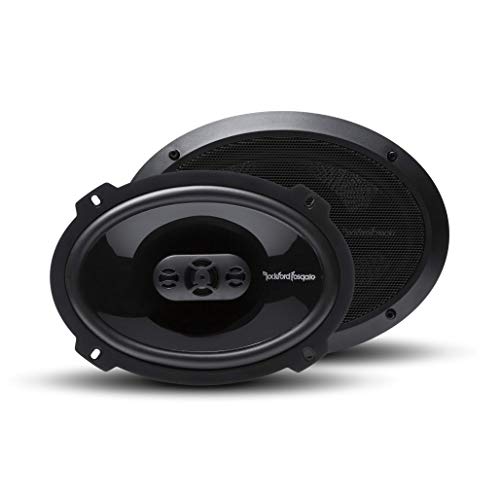
The P1694 is the 6×9 for owners who think of the format as a serious speaker rather than a legacy one. As a Punch-series four-way, it splits the spectrum four ways — woofer, midrange, tweeter and supertweeter duties — which lets each driver work in its comfort zone and gives the big oval a top-end extension and midrange order that three-way rivals approximate. The woofer’s mineral-filled cone and Rockford’s motor control keep the deck’s bass taut where lesser 6x9s turn boomy, and the whole presentation has the Punch character: composed at volume, detailed without aggression, and clearly engineered by people who expected an amplifier to be involved.
That expectation is the caveat. On a base factory head unit the P1694 sounds good but restrained, its advantages compressed by the source’s limits; owners planning to stay on factory power will hear more life from the DSC6930 or the JBL below. Give the Punch clean power, though, and the ranking inverts — it is the pick that scales. It is also the most demanding of a clean installation: a four-way of this output on a flimsy, rattling deck advertises every loose trim piece in the boot. Buy it as the centrepiece of a deliberate no-subwoofer build, treat the deck properly, and it will justify both decisions.
- Format: 6×9 four-way coaxial from the Punch series
- Cone: mineral-filled polypropylene
- Design brief: amplifier-grade control and extension
- Best location: treated rear deck in a deliberate build
Strengths
- Four-way architecture delivers the class’s most ordered midrange and extended top end.
- Woofer control keeps deck bass taut instead of boomy at real volumes.
- Scales with amplifier power better than any other pick here.
Trade-offs
- Factory head units compress its advantages; it wants clean power.
- Output exposes rattles — the deck needs treatment to match.
- Premium of the mainstream picks, priced like the flagship it is.
Best for: enthusiasts building a serious deck system, ideally amplified, without a subwoofer. Not suited for: casual factory replacements, where its talents go largely unheard.
Rockford Fosgate R169X3 — Best value
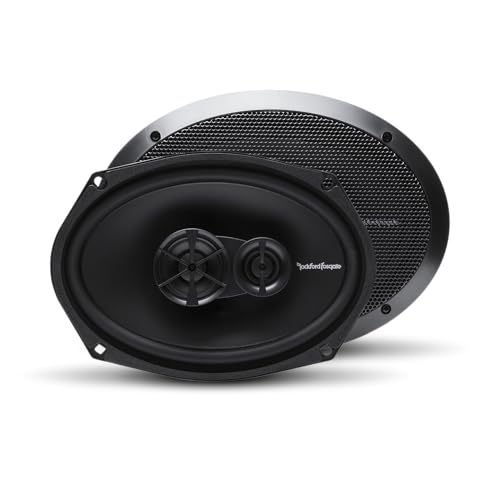
Every format needs its honest budget speaker, and the R169X3 fills that role for 6x9s the way Prime fills it everywhere in Rockford’s catalogue. It is a three-way design with a vacuum-formed polypropylene cone and a silk dome tweeter — the latter a genuinely civilised touch at this level, sparing budget buyers the piezo harshness that gives cheap 6x9s their reputation. Voicing is relaxed and forgiving, which suits both the worn factory systems it usually joins and the older recordings and radio sources that dominate many of the cars it lands in. Nothing about it pretends to be premium, and everything about it works.
Set against its Punch sibling, the Prime gives up extension at both ends, some midrange order, and a good deal of high-volume composure — the expected toll. Set against the Kicker DSC6930, its closest rival in spirit, the trade is character: the Rockford is smoother and calmer, the Kicker livelier and more present, and the better choice depends on whether your system needs waking up or settling down. For owners replacing sun-rotted factory ovals in a car that simply needs to sound whole again, the R169X3 is frequently the smartest money in this guide, and its modesty is a feature: it will not demand an amplifier, a treated deck or a listener’s full attention to justify itself.
- Format: 6×9 three-way coaxial, Prime series
- Tweeter: silk dome — unusual refinement at this level
- Cone: vacuum-formed polypropylene
- Design brief: honest replacement value
Strengths
- Silk dome tweeter avoids the harshness budget 6x9s are known for.
- Forgiving voicing flatters worn factory systems and everyday sources.
- Asks nothing of the car: no amplifier, no treatment, no fuss.
Trade-offs
- Gives up extension and composure to the Punch four-way at volume.
- Relaxed presentation can feel plain beside the Kicker’s energy.
- Built plainly, in materials and in appearance.
Best for: budget replacements that need to sound smooth and whole rather than spectacular. Not suited for: listeners building toward amplification and high output.
JBL Club 964M — Best on head-unit power
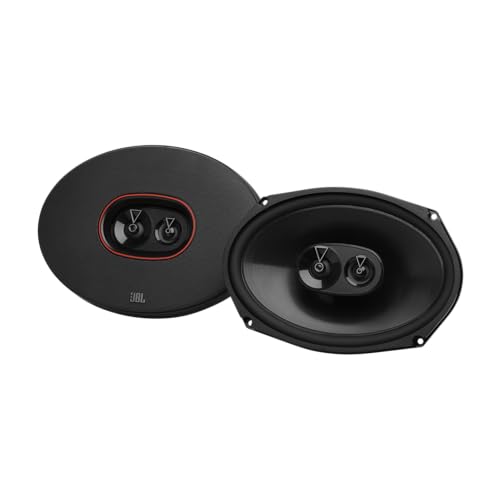
JBL publishes the number that matters for this pick right in its listing: sensitivity of 93dB, alongside an honest 85 watts RMS power rating for this three-way Club-series 6×9. Sensitivity is the specification that decides how a speaker behaves on the modest output of a factory head unit, and the 964M is engineered around it — this is a speaker designed to be driven by the electronics cars actually have. The result is a deck pair that plays with an ease and clarity that make owners suspect the head unit was also changed. JBL’s Club voicing adds its customary presence through the vocal range, so the rear fill supports the front stage instead of merely rumbling behind it.
The Club’s honesty about power cuts both ways: its ratings describe a speaker for head units and modest amplification, not a high-output build, and owners planning serious amplifier power should be shopping the Punch. Its presentation is also distinctly JBL — articulate and forward through the mids — which pairs beautifully with dull factory front speakers and less sympathetically with an already assertive front stage. As the specialist answer to the commonest 6×9 situation, though — a standard car, a standard head unit, a tired deck — the 964M is arguably the most precisely aimed product in this guide, and its published figures let you verify that aim yourself.
- Format: 6×9 (152x230mm) three-way, Club series
- Power rating: 85W RMS per its listing
- Sensitivity: 93dB per its listing — the head-unit specialist’s key figure
- Design brief: maximum clarity from standard electronics
Strengths
- High sensitivity extracts loudness and clarity factory systems rarely achieve.
- Published, honest ratings make system matching straightforward.
- Vocal presence turns rear fill into a real contribution to the front stage.
Trade-offs
- Not the pick for high-power amplifier builds; its brief is standard electronics.
- Forward midrange can double up with an already assertive front stage.
- Bass weight is tidy rather than the deepest here at modest volumes.
Best for: standard cars on factory head units that need the deck to genuinely perform. Not suited for: high-output amplified systems, where the Punch’s headroom matters more.

Infinity REF-9633IX — Best detail and smoothness
Infinity’s Reference series occupies the thoughtful middle of the market, and the 9633IX three-way shows why it has loyalists. Its woofer uses Infinity’s Plus One philosophy — a cone with more effective area than its nominal size suggests — which in a 6×9 means bass and midbass with an ease that belies the driver’s mounting dimensions, while the edge-driven textile dome tweeter produces the smooth, extended top end that has defined the brand’s car speakers for years. The combination is a deck speaker of unusual refinement: detailed enough to reveal the front stage’s shortcomings, smooth enough to listen to for a full day’s drive, and voiced with a neutrality that suits listeners who distrust excitement as a design goal.
That neutrality defines its ideal buyer and its limits in one stroke. Owners who want the deck to thrill — the Kicker’s liveliness, the Punch’s authority — may find the Infinity correct to a fault, and its composure at moderate volumes can mask the fact that it, too, appreciates clean power when the road gets loud. It is also the pick most likely to start an argument for upgrading the front speakers next, since a rear stage this revealing reframes what the whole system could be. As a 6×9 bought on its own merits, though, the REF-9633IX is the connoisseur’s value: flagship manners without flagship pricing theatre, in the format where manners are rarest.
- Format: 6×9 three-way, Reference series
- Woofer: Plus One cone design for greater effective area
- Tweeter: edge-driven textile dome
- Design brief: neutral detail and long-distance smoothness
Strengths
- Textile dome treble is detailed yet fatigue-free over long drives.
- Oversized-feeling woofer area gives midbass unusual ease and weight.
- Neutral voicing integrates with almost any front stage without argument.
Trade-offs
- Correctness can read as restraint to listeners who want excitement.
- Revealing nature may expose a weak front stage you then feel obliged to fix.
- Appreciates clean power at high volume more than its manners suggest.
Best for: detail-minded listeners building a balanced, listenable system around the rear deck. Not suited for: buyers who want the deck to dominate with sheer presence.

Pioneer TS-A6971F — Best balanced four-way
Pioneer’s A-Series has spent decades as the default recommendation for owners who want a known quantity, and the TS-A6971F four-way shows the line’s priorities clearly: balance, consistency and an install that behaves. Its four-way layout divides the spectrum finely, its woofer cone uses Pioneer’s carbon-and-mica reinforced construction for stiffness without weight, and the voicing is the most even-handed in this guide — no region spotlit, no region neglected. In a family sedan that plays everything from podcasts to playlists, that evenness is not a consolation prize; it is the correct engineering answer, and it is why Pioneer sells so many of these to people who never read speaker reviews.
The trade for balance is a certain lack of a headline act. The TS-A6971F is not the most efficient here, not the most refined, not the bassiest; it is the pick with the fewest weaknesses rather than the most strengths, which makes it easy to underrate in a comparison and easy to live with for years. Its published maximum power figure is generous in the way of the industry, so match it by RMS thinking and sensitivity rather than the headline number. For owners who want one recommendation that offends no listener and no genre — the shared car, the mixed household, the system built for everyone — Pioneer’s four-way is the guide’s peace treaty, and peace treaties have their own kind of value.
- Format: 6×9 four-way coaxial, A-Series Plus
- Cone: carbon and mica reinforced construction
- Design brief: even-handed balance across the spectrum
- Best location: rear deck of shared, everyday cars
Strengths
- The most even voicing here — every genre and listener treated fairly.
- Stiff, light cone construction keeps the midrange clean at deck distances.
- Predictable, well-documented install from the market’s most familiar line.
Trade-offs
- No single headline talent to match the specialists around it.
- Headline power figure flatters; judge it by real-world behaviour instead.
- Balanced character can feel unexciting to listeners chasing a signature sound.
Best for: shared cars and mixed listening, where even-handedness beats specialisation. Not suited for: buyers who want one dramatic strength — bass, detail or loudness — above all.
How Should You Power and Tune a 6×9 System?
Start with the fader, because it is free and because most 6×9 disappointment is a balance problem wearing a hardware costume. With the system playing familiar music, sit in the driver’s seat and bias the fader forward until the deck speakers become a foundation you feel more than a source you can point to — typically a few steps forward of centre. Rear passengers lose a little dominance and gain a more coherent presentation; the driver gains a soundstage that sits on the dashboard where recordings put it. Only after that balance is set does it make sense to judge whether the speakers themselves need help, and owners are routinely surprised how much of the “thin” or “boomy” verdict was the fader’s doing.
Equalisation comes next, with a light hand. Deck 6x9s working into a boot often need no bass boost at all — the format’s cone area and the boot’s volume do that work — and the factory loudness contours and bass enhancements designed to compensate for feeble original speakers should be switched off before any other judgement is made. A small treble adjustment can compensate for a deck’s distance and the glass’s reflections, but resist carving the midrange: the multi-way designs in this guide were voiced by their manufacturers, and heavy-handed equalisation usually fixes a problem the installation created. If the system sounds wrong with flat tone controls and a sensible fader, the fault is mechanical — seal, polarity, rattles — not electronic.
Amplification, when it comes, should be bought for cleanliness rather than spectacle. A compact four-channel amplifier driving the front stage and the deck pair transforms the Punch P1694’s composure and tidies every other pick at volume, because what it really supplies is headroom: the ability to reproduce peaks without the clipping that makes systems sound strained. Set gains conservatively with the head unit’s volume at its clean maximum, high-pass the deck pair only if a subwoofer joins later, and leave them full-range in a no-subwoofer build — filtering the format’s bass away defeats the reason it was chosen. Owners who follow that sequence — balance, flat tone, then clean power if needed — consistently end with systems that sound a class above their parts.
Source quality deserves a sentence in an era of compressed streams and ageing Bluetooth links. A revealing deck pair like the Infinity will faithfully reproduce whatever the source sends, including its flaws, and owners sometimes mistake that honesty for a speaker fault. Before blaming hardware, audition a known-good recording through a wired connection; if the system suddenly sounds right, the speakers were never the problem and the fix costs nothing at all.
What About 6x9s in Doors, Trucks and Side Panels?
Not every 6×9 lives on a sedan’s deck. Full-size trucks have fitted them in doors, older SUVs carry them in rear side panels, and some vehicles put them in rear doors — and the change of location changes the brief. In a door, the speaker sits close to a listener and works as a primary source, so midrange clarity and tweeter behaviour matter the way they do in any front-stage speaker; the Pioneer’s balance and the Infinity’s smoothness translate well, while a deck-tuned liveliness can overwhelm at close range. Door mounting also brings the format’s depth into play against window mechanisms, and its weight against door hinges and trim designed for smaller drivers, so check both before assuming a deck favourite belongs in a door.
Side panels in SUVs and wagons split the difference: the speaker fires across a cargo space rather than into a sealed boot, gaining less low-frequency support than a deck provides and needing the cone control to compensate. The Punch P1694’s disciplined woofer is the natural pick in that environment, since an under-controlled 6×9 in a large, hollow panel can sound cavernous. Whatever the location, the constants of this format travel with it: seal the mounting, respect polarity, and remember that a large cone is an efficient rattle detector mounted wherever the vehicle is loosest.
One more location note, because it decides real purchases: some vehicles carry 6x9s in both deck and rear doors, or a 6×9 deck pair behind a front stage of modest round speakers. In those layouts the temptation is to make the big ovals the system’s stars, but the staging logic of every guide in this series still applies — the front seats hear the front stage as the performance and the 6x9s as its foundation. Spend first where ears point, and let the format do the job its physics suits: weight, warmth and scale underneath a front stage that handles the detail.
How Long Do Deck Speakers Last, and What Kills Them?
A rear deck is the harshest neighbourhood in car audio: the speakers sit under glass in direct sun, enduring temperature extremes no door speaker faces, while their cones and surrounds bake through summers and freeze through winters. Ultraviolet and heat are what kill factory 6x9s — foam surrounds crumble, cones grow brittle, and the first symptom is usually a buzzing on bass notes as the surround’s edge lets go. Every pick in this guide uses modern synthetic surrounds and cones chosen for that environment, which is one reason a quality replacement typically outlasts the original it replaces: the materials science of the wear parts has genuinely improved since many of these cars were built.
Owners can tilt the odds further with two habits. Where the car allows it, a sunshade or tint on the rear glass reduces the thermal punishment meaningfully over years. And volume discipline matters more on a deck than anywhere, because a speaker working into a boot’s free air has no enclosure pressure to limit its excursion — sustained, distorted loudness from an underpowered head unit is mechanically harder on a deck 6×9 than clean power at the same loudness. The practical translation: if you regularly listen loud, the amplifier that seems like an indulgence is partly a longevity purchase for the speakers themselves.
Diagnose ageing honestly before replacing, though. A rattle that appears on bass notes may be the deck, the trim or the boot’s contents rather than the speaker, and the tests are free: press gently on trim while music plays, empty the boot and listen again, and inspect the surround with a torch for cracking. Replace speakers for faults that are actually theirs — a torn surround, a scraping voice coil, a dead tweeter — and you may find the old pair has years left once the shelf around it is quiet. When the fault is the speaker’s, the six above are the current answers; when it is not, you have saved a purchase and fixed the real problem.
What Should the Front Stage Be, If the Deck Is This Good?
A question this guide provokes deliberately: if 6x9s are so capable, why not build the whole system around them? Because location outranks hardware. The front stage determines imaging, clarity and the perceived position of every instrument, and it does so from doors or dash positions near the listeners. A car with modest front speakers and excellent deck 6x9s sounds like a concert heard from the corridor; a car with an excellent front stage and modest deck fill sounds like the concert. The 6x9s’ role is to give that front performance weight and scale, and within that role they are close to irreplaceable — no front door speaker of sane size supplies the same foundation.
Practically, pair the deck with a front stage one tier of ambition above it. Component speakers in the front doors, or the best coaxials the location takes, matched in general character to the deck pair — a lively Kicker deck behind a lively front, the Infinity’s neutrality behind a neutral front — produce systems that sound designed rather than accumulated. Brand matching is the easy route to that coherence, and every brand in this guide sells front speakers voiced to sit with its 6x9s. Owners building in stages should therefore buy the deck pair from the brand whose front stage they intend to finish with; it is the one piece of forward planning this format genuinely rewards.
Which Brand Character Fits the Rest of Your System?
Because deck speakers work as part of a system, brand character is a legitimate selection tool rather than marketing fog, and the five families here have recognisable house sounds worth matching to your front stage and your taste. Kicker’s is energy: present midrange, eager treble, a sense of occasion that flatters factory systems and popular music. Rockford Fosgate splits by series — Prime relaxes, Punch disciplines — but both share a full-bodied midrange foundation. JBL is articulation: voices and details pushed a step forward, engineered around sensitivity and clarity. Infinity is refinement: neutral, smooth, detail without insistence. Pioneer is balance: nothing emphasised, nothing missing, the diplomat of the group.
None of these characters is a quality ranking, and treating them as one is how buyers end up with a technically excellent speaker they simply do not enjoy. The useful question is what your system currently lacks. A dull, muffled factory system needs Kicker’s or JBL’s wake-up call. A bright, shouty one needs Infinity’s or Prime’s composure. A system that is already good but thin needs Punch weight; one that is good but opinionated needs Pioneer’s neutrality. Read the reviews above through that lens — what does my car need more of, and what does it already have too much of — and the six-way choice usually collapses to one or two names without any agonising.
Genre is the tiebreaker when two picks remain. Bass-led electronic and hip-hop listening rewards the Punch’s control and the Kicker’s foundation; vocal, acoustic and jazz listening rewards the Infinity’s smoothness and the JBL’s articulation; the mixed family diet rewards the Pioneer’s evenness; and the owner who mostly hears radio and podcasts should weight tweeter smoothness and midrange clarity — Prime, Infinity — over every bass consideration, because speech lives in the midrange and a deck that renders it cleanly at distance is doing its most valuable work.
How Do the Six 6x9s Compare?
| Pick | Ways | Power it suits | Character | Choose it when |
|---|---|---|---|---|
| Kicker DSC6930 | 3-way | Factory head unit | Lively, foundational | The deck must become the system’s base, simply |
| Rockford P1694 | 4-way | Amplifier preferred | Controlled, refined | You are building a serious no-subwoofer system |
| Rockford R169X3 | 3-way | Factory head unit | Smooth, relaxed | Budget and smoothness lead the brief |
| JBL Club 964M | 3-way | Factory head unit | Efficient, articulate | Your head unit is weak and must sound stronger |
| Infinity REF-9633IX | 3-way | Head unit or amplifier | Neutral, detailed | Long-distance smoothness and detail matter most |
| Pioneer TS-A6971F | 4-way | Head unit or amplifier | Even, balanced | One speaker must please everyone in the car |
How Do You Install 6x9s on a Rear Deck Without the Rattles?
Rear deck work begins from the boot, not the cabin, on most sedans: fold the seats or climb in with a light, find the factory speaker’s fasteners and connector, and note how the deck’s trim and the speaker’s gasket were arranged before disturbing them. The deck itself is the enclosure’s front wall, and its stiffness decides your bass quality — a thin, drummy parcel shelf flexes with the woofer and colours everything. While the speakers are out, add deadening to the shelf’s flat areas, replace any perished foam gasket with fresh material, and check the boot’s contents for the classic rattle sources: loose tools, the spare wheel’s hardware, trim panels resting against the deck’s underside. A 6×9 playing into a boot full of sympathetic vibrations will be blamed for all of them.
Mounting deserves the same even-handed torque discipline as a door speaker, with an addition specific to decks: confirm the new speaker’s magnet and frame clear the boot’s torsion bars for the boot lid, a collision that has ended more than one install at the final centimetre. Test the boot lid’s travel before the trim returns. Wiring on decks is usually accessible and forgiving, but observe polarity scrupulously — a reversed pair on a wide deck cancels bass across the whole cabin, and the symptom, a big speaker sounding oddly thin, sends owners shopping for amplifiers they do not need. Finish by listening from the driver’s seat with the boot loaded as it normally travels; an empty boot is a different acoustic space from your real one, and the final level balance should be set for the car as used.
Two deck-specific details separate tidy installs from frustrating ones. First, the grille: many factory decks carry the grille in the trim panel rather than on the speaker, and the new speaker’s tweeter protrusion must clear it — a four-way’s taller tweeter stack meeting a flat factory grille is a classic final-minute discovery, so dry-fit the trim before final torque. Second, the vapour and dust seal above the boot: decks often separate the cabin from a dusty boot with nothing but the speaker and its gasket, so a leaky install admits dust and road noise along with cancelling bass. The gasket is doing three jobs on a deck — acoustic seal, dust seal and rattle prevention — which is why this guide keeps insisting on it.
What Mistakes Do 6×9 Buyers Keep Making?
The first is shopping by maximum wattage, a figure with no standard behind it, printed largest precisely on the products with least else to say. Judge by brand credibility, sensitivity and RMS ratings where published, as the JBL in this guide allows. The second is expecting door speakers’ behaviour from a deck: owners fit 6x9s, leave the fader centred and the rears at full level, and then complain the soundstage sits behind them. Deck 6x9s are foundation and fill for front listeners; run them a few steps down and the system stages correctly while keeping its weight. The third is ignoring the deck itself — no gasket, no deadening, loose trim — and attributing the resulting rattles and thinness to the speakers.
Fourth, mismatching power ambitions to the pick: a Punch P1694 on a wheezing factory unit disappoints its owner, while a Prime R169X3 on a strong amplifier disappoints differently, and both disappointments were avoidable at the ordering stage by reading the roles in this guide. Fifth, forgetting that many factory 6×9 systems — particularly older premium ones — used low-impedance speakers or dedicated amplification channels with equalisation shaped for the originals. Check what came out of your deck before assuming a standard 4-ohm replacement is a like-for-like electrical swap. The format is forgiving, but it is not magic, and the cars that take it reward owners who look before they leap.
Sixth, replacing only one side. Deck speakers age as a pair under the same sun, and a fresh speaker beside a perished one gives you a lopsided stage and a second install within the year; the format is sold in pairs because it should be fitted in pairs. Seventh, chasing the rattle after reassembly instead of before it: every loose object in the boot should be found while the trim is off and the old speakers are still playing, because that is when your hands are already there. Ten minutes of prevention in the boot is worth an hour of diagnosis from the driver’s seat later.
Should You Buy 6x9s or a Small Subwoofer Instead?
It is the fork in the road for every sedan owner with a tired system, and the honest answer depends on what is actually broken. If your factory 6x9s are worn, buzzing or dead, replacement speakers are not an alternative to a subwoofer — they are a repair that also upgrades, and no subwoofer makes a rattling deck speaker sound acceptable. Start there. If your existing speakers are healthy and your complaint is purely missing low bass, the comparison becomes real: a small powered subwoofer reaches lower and louder in the bottom octave than any 6×9 pair, while the 6×9 upgrade improves everything — midbass, clarity, detail, volume composure — across the whole range rather than only beneath it.
Budget and complexity argue for the speakers first in most cases. A 6×9 swap uses factory wiring, factory locations and an afternoon; a subwoofer adds power wiring through the firewall, a signal tap, an enclosure in the boot and a tuning session. Owners who do the speakers first frequently discover the system no longer needs the subwoofer for their listening, particularly with the Punch or Kicker pairs on a sealed deck. Owners who still want more have lost nothing: the upgraded 6x9s remain the system’s midbass foundation, and the subwoofer, when it arrives, can be crossed over low and worked gently because the deck is no longer straining to be one.
The exception is the bass-first listener in a car whose speakers are already competent. If your system is a modern one with healthy speakers and your music lives in the bottom octave, a subwoofer is the honest purchase and a 6×9 swap will feel like a detour. Know which listener you are, and this decision — like most in this guide — makes itself.
Final Recommendation
Most owners should buy the Kicker DSC6930: it fulfils the 6×9 promise — real foundation from a factory system — with the least fuss and the liveliest result. Buy the JBL Club 964M instead if your head unit is notably weak, since its sensitivity is purpose-built for exactly that problem, and the Rockford R169X3 if the budget is firm and your taste runs smooth. Build around the Punch P1694 when an amplifier and a treated deck are part of the plan, choose the Infinity REF-9633IX for detail that never fatigues, and take the Pioneer TS-A6971F when the car belongs to everyone and the speaker must please them all. Whichever pair earns your deck, seal it, deaden the shelf and set the fader with intent — a 6×9 installed carelessly is just a big hole in a shelf, while a 6×9 installed properly is the reason this format has outlived every prediction of its death.
And if you are replacing speakers that have served since the car was new, take a moment to appreciate what the format has done: it carried the sound of family motoring for half a century, in the harshest seat in the car, asking for nothing but a shelf and a signal. The six pairs above are its current custodians, and any of them, fitted with the care this guide describes, will still be doing that job faithfully long after the head unit around them has been replaced twice over.
Frequently Asked Questions
Can 6×9 speakers replace a subwoofer?
Partly. A sealed, well-driven pair on a rear deck produces satisfying midbass and the sense of weight most listeners actually miss, which is why the Punch P1694 anchors no-subwoofer builds in this guide. True low bass — the bottom octave a subwoofer exists for — remains beyond any deck speaker’s reach, so bass-heavy listeners will still want the dedicated driver eventually.
Are 6x9s only for rear decks?
No. They appear in the front doors of some trucks and older vehicles and in rear doors and side panels elsewhere. Deck duty rewards weight and smoothness; door duty, where the speaker becomes a primary source near the listener, rewards midrange precision — which is why this guide notes location suitability per pick.
Three-way or four-way: which is better?
Neither, inherently. A four-way divides the spectrum more finely and can sound more ordered and extended, as the Punch and Pioneer show; a good three-way with a quality tweeter, like the Infinity, can be smoother than a mediocre four-way. Judge the specific speaker, not the count.
Do I need an amplifier for 6×9 speakers?
No. The Kicker, JBL, Prime and Pioneer picks are all designed to perform on factory head units, and sensitivity matters more than power ratings at that level. Amplification specifically rewards the Punch P1694’s control and raises every pick’s composure at high volume, but it is an upgrade, not an entry fee.
Why do my new 6x9s sound thinner than the old ones?
Check polarity first — one reversed speaker cancels bass across the cabin. Then check the seal: a missing or perished gasket leaks the rear wave forward with the same thinning effect. Both faults are installation issues with free fixes, and both are far more common than a genuinely bass-light speaker.
How do I stop the rear deck itself from rattling?
Work through it in order: empty the boot and listen again, add deadening to the shelf’s broad flat areas while the speakers are out, renew the speaker gaskets, and check the trim panel and third brake light housing for looseness. Most deck rattles are one of those four, and all are cheaper to fix during the speaker install than after it.
My car has 6x9s in the deck and the doors. Should both pairs match?
Matching helps tonal consistency, and every brand here sells both roles coherently, but the door pair works as a primary source and deserves the larger share of budget and the more midrange-capable model. A common sensible pattern is the balanced or detailed pick in the doors and the foundational pick — Kicker or Punch — on the deck.
Will these fit my car’s 6×9 openings?
The 6×9 format is well standardised, but mounting depth and the boot-lid torsion bars behind some decks are the real constraints. Measure the factory speaker’s depth, confirm clearance with the boot mechanism, and compare against the manufacturer’s stated dimensions before ordering.
Related Guides
Ford and Mazda owners whose doors take the other classic oval should continue to Best 6×8 Car Speakers for Ford and Mazda Doors. If your front doors are the smaller round format, Best 6 Inch Car Door Speakers That Actually Fit explains that size honestly, and its component companion is Best 6 Inch Component Speakers for Tight Doors.


