What's inside
- Key Takeaways
- Quick Picks
- How We Chose These Picks
- Why Did Ford Commit to Such an Odd Size?
- What Is the Relationship Between 6×8 and 5×7 Speakers?
- Which 6×8 Speakers Should Ford and Mazda Owners Buy?
- How Should You Tune the System After a 6×8 Swap?
- What About the Rear Locations in Ford and Mazda Vehicles?
- How Well Do These Speakers Survive Truck Life?
- What Should You Look For in a 6×8 Speaker, Beyond the Badge?
- What Changes in a Mustang or a Small Mazda Cabin?
- How Do the Six 6×8 Picks Compare?
- How Do You Fit 6x8s in Ford Doors Without Surprises?
- What Mistakes Do Ford and Mazda Owners Make With This Size?
- What Wiring and Hardware Should You Have Before the Door Comes Apart?
- Should You Convert a 6×8 Hole to 6.5 With an Adapter Plate?
- How Do You Know the Install Is Right When You Hear It?
- Final Recommendation
- Frequently Asked Questions
- Related Guides
As an Amazon Associate I earn from qualifying purchases. This post may contain affiliate links at no extra cost to you.
widgetverdict.com is reader-supported. When you buy through links on our site, we may earn an affiliate commission.
Where to buy: Each of the six sets here carries a checked Amazon listing and is linked throughout. Five are coaxials for direct factory replacement; the sixth, Kicker’s KS component system, is a genuine 6×8 component set and is labelled as such wherever it appears — it is the upgrade path, not a drop-in swap.
The best 6×8 car speakers exist because Ford decided, across several decades and millions of vehicles, that its doors and rear quarters would take an oval slightly different from everyone else’s. The 6×8 — closely related to the 5×7, with which it shares mounting DNA — became the factory size for the F-Series trucks, the Mustang, the Explorer and a long roll of Ford, Lincoln, Mercury and Mazda vehicles built on shared platforms. If you own one, you already know the peculiar frustration of the size: every general speaker guide talks about 6.5s and 6x9s, while your door waits for an oval the mainstream barely acknowledges. This guide is written for that door.
Six current 6x8s make the cut, and they divide the way the vehicles divide. Most Ford and Mazda owners need a coaxial that bolts in, seals properly and wakes up a factory head unit — Kicker, Pioneer, Infinity and Skar each answer that need with a different character. Owners building a real system get two further options: Rockford’s Punch three-way for amplified composure, and Kicker’s KS component system, a true 6×8 component set that raises the tweeter out of the door and turns a truck’s front stage into something worth tuning. We will cover the fitment checks that matter in Ford doors — depth against window regulators, the 5×7 question, factory premium-system wiring — because in this size, the install details are where purchases succeed or fail.
Key Takeaways
- The 6×8 is Ford and Mazda’s house size: F-Series, Mustang, Explorer and many platform siblings use it in doors and rear locations.
- Kicker’s 46CSC684 is the factory-upgrade default — a CS-series two-way that bolts in and livens a stock system.
- Pioneer’s TS-A6880F four-way is the balanced all-rounder; Infinity’s REF-8632CFX is the smooth, detailed alternative.
- Rockford’s Punch P1683 is the amplified build’s coaxial, and Kicker’s KS 51KSS6804 is a genuine 6×8 component system for a proper front stage.
- Skar’s TX68 is the value-and-output pick for owners who play loud on a budget.
- Many 6×8 speakers also mount in 5×7 openings, but verify the specific model’s flange and your vehicle’s actual cutout before relying on it.
- Keep the factory wiring intact with harness adapters — polarity stays foolproof, terminals stay dry, and the next owner inherits a clean door.
Quick Picks
| Pick | Badge | Why it earns its place |
|---|---|---|
| Kicker 46CSC684 | Best factory upgrade | CS-series two-way with the lively voicing and easy fit that Ford factory systems need most. |
| Pioneer TS-A6880F | Best all-rounder | A four-way A-Series with even manners across every genre and listener. |
| Infinity REF-8632CFX | Best detail and smoothness | Reference-series refinement for owners who listen closely and drive far. |
| Rockford Fosgate P1683 | Best for amplified systems | Punch three-way control that stays composed when real power arrives. |
| Kicker 51KSS6804 | Best component upgrade | A true 6×8 component system — separate one-inch tweeters and crossovers for a real front stage. |
| Skar Audio TX68 | Best value output | Elite-series two-way with a loud, durable brief at an entry price. |
How We Chose These Picks
Fitment honesty came first, as it must in a size defined by one manufacturer’s ecosystem: every pick is a manufacturer-listed 6×8, verified against our pool from its own listing, with no 5×7-only or 6×9 products borrowed to fill the table. Second, we mapped the picks to the actual Ford and Mazda fleet — the truck owner replacing door speakers on a work vehicle, the Mustang owner who listens hard, the family Explorer that needs to sound whole again — and required the list to serve each of them distinctly. Third, we insisted on one genuine component system, because the 6×8 world is unusually lucky here: unlike the 6.75 class, this size has a current KS-series component offering, and front-stage builders in Fords deserve to know it exists.
We also weighted documentation and support. Ford fitments span decades of model years with mid-cycle changes, and the brands here publish the dimensional data — mounting depth, cutout, flange — that lets an owner verify a fit before ordering rather than after. Speakers from manufacturers who treat the size as an afterthought, with vague dimensions and no support trail, were passed over even when their specifications looked lively. In a niche size, the paper trail is part of the product.
A final criterion was honesty of role. This size attracts a fringe of oversized-wattage novelty products aimed at truck owners, and we excluded it wholesale: every pick here is a speaker its manufacturer will document, support and stand behind, sold on engineering rather than on a number printed in a flame font. The list is shorter for that discipline, and considerably more useful.
Why Did Ford Commit to Such an Odd Size?
The 6×8’s story is the 5×7’s story continued. Ford adopted the smaller oval for door packaging reasons generations ago — an oval delivers more cone area than a round speaker of the same width, and door real estate is governed by width: window regulators, intrusion beams and latch hardware all compete for the same vertical space. The 6×8 stretches that idea, adding length for cone area while keeping the width a door can swallow. When Ford and Mazda shared platforms extensively, the size crossed to Mazda’s trucks and SUVs as well, which is why a B-Series pickup and an F-150 can share a speaker recommendation despite wearing different badges.
For owners, the legacy cuts both ways. The fleet is enormous, so the aftermarket supports the size properly — every pick here is a current, engineered product rather than a clearance curiosity. But the size is also a Ford-ecosystem island: advice, brackets and harnesses are vehicle-specific in a way 6.5 advice never is, and the premium factory systems in higher-trim Fords complicate swaps with low-impedance drivers and outboard amplifiers. Treat this guide’s fitment checks as part of the purchase, and the island is a comfortable place; skip them, and the returns process teaches the same lessons more expensively.
What Is the Relationship Between 6×8 and 5×7 Speakers?
Close enough to cause endless confusion, different enough to matter. The two sizes share a family resemblance and, in many vehicles, an interchangeable mounting footprint: a large share of speakers sold as 6×8 are designed with flanges and hole patterns that also accommodate 5×7 openings, and manufacturers frequently list both sizes against one product. That is a statement about mounting, not about the openings being identical — a true 6×8 cutout is longer, and a speaker that mounts in a 5×7 hole may still need its full flange room checked against trim and door structure.
The practical procedure is boring and reliable: pull one factory speaker, measure the cutout’s length and width and the screw pattern, and compare all three against the candidate’s published dimensions. If your vehicle is one of the many listed under both sizes by different databases, the physical speaker in your hand settles the argument in a way no database can. Every pick in this guide is a listed 6×8; where a model’s documentation also confirms 5×7 mounting, that is a bonus for cross-shopping households, not a reason to skip the tape measure.
Which 6×8 Speakers Should Ford and Mazda Owners Buy?
The five coaxials below are interchangeable in fit and distinct in character; the component system at the end plays a different sport entirely. Read for the match between a pick’s character and your vehicle’s current system — a dull factory radio and a premium amplified one need opposite things from the same door.

Kicker 46CSC684 — Best factory upgrade
Kicker’s CS series is the company’s sweet spot for factory replacement, and the 46CSC684 brings that formula to the Ford oval: a two-way coaxial with a polypropylene cone, a balanced-dome tweeter voiced for presence, and a published peak figure of 225 watts that matters less than the design’s real brief — efficiency and durability in a door that will be driven by whatever the factory fitted. In an F-150 with the standard radio, the swap produces the classic CS result: voices step forward, the top end gains the sparkle the factory speakers never had, and the midbass firms up because a proper flange seals a hole that the tired original had stopped sealing years ago.
Within this list the CSC684 is the recommendation we would hand to the largest number of owners, and its limitations are the honest ones of its class. The tweeter sits in the door where Ford put the speaker, so imaging stays low; the two-way layout asks one tweeter to cover everything above the woofer, which it does energetically rather than exquisitely. Owners planning amplification and attentive listening have two upgrade paths inside this very guide — the Punch coaxial for composure, the KS components for a stage — and the CS’s job is to make sure everyone else never needs them. For a truck that works for a living, that is exactly the right job description.
- Format: 6×8 two-way coaxial, CS series
- Peak power: 225 watts per its listing
- Design brief: factory replacement with lively voicing
- Typical home: F-Series and Explorer front doors on standard radios
Strengths
- Lively, efficient voicing extracts the most from standard Ford head units.
- Proper 6×8 flange restores the door seal tired factory speakers lose.
- CS-series durability suits work trucks and daily drivers alike.
Trade-offs
- Door-height tweeter keeps imaging low, as with every coaxial here.
- Two-way simplicity leaves the finest treble detail to the Infinity and KS picks.
- Energetic top end can stack with a bright aftermarket head unit.
Best for: the mainstream Ford or Mazda owner replacing factory door speakers on a standard system. Not suited for: front-stage builders, who should jump straight to the KS components below.

Pioneer TS-A6880F — Best all-rounder
Pioneer’s A-Series four-way in this size, the TS-A6880F, is the diplomat of the list: a speaker engineered to be good at everything a family vehicle asks, with a four-way driver complement that divides the spectrum finely and a woofer built around Pioneer’s reinforced cone construction. Its sound is the A-Series signature — even, unforced, with no frequency showing off — and in the Explorer-and-school-run context where many of these will live, that evenness across podcasts, playlists and radio is worth more than any specialist talent. Installation is equally diplomatic: Pioneer documents its dimensions thoroughly, the mounting pattern suits the Ford fleet broadly, and the speaker behaves on factory power without sulking.
The all-rounder’s tax is the absence of a headline. The Pioneer is not the liveliest (Kicker), the smoothest (Infinity) or the loudest (Skar); an owner chasing one of those qualities specifically should buy the specialist. What the TS-A6880F offers instead is the lowest chance of regret in the guide — the speaker least likely to clash with any source, genre or listener sharing the vehicle. Households with one car and several drivers have a way of valuing exactly that, and Pioneer’s decades in this exact size mean the ownership experience behind the product is deep and well documented.
- Format: 6×8 four-way coaxial, A-Series
- Driver layout: woofer plus midrange and tweeter complement
- Design brief: even balance for everyday vehicles
- Typical home: family SUVs and sedans on mixed listening
Strengths
- Four-way layout keeps every part of the spectrum orderly and covered.
- Even voicing pleases every listener and genre sharing the vehicle.
- Thorough published dimensions make Ford fitment checks painless.
Trade-offs
- No single standout talent for owners chasing one specific quality.
- Balanced character can seem plain beside the Kicker’s energy.
- Four-way complexity buys little on a worn, noisy factory system.
Best for: shared family vehicles needing one speaker that treats all content fairly. Not suited for: specialists who know exactly which single quality they are buying.
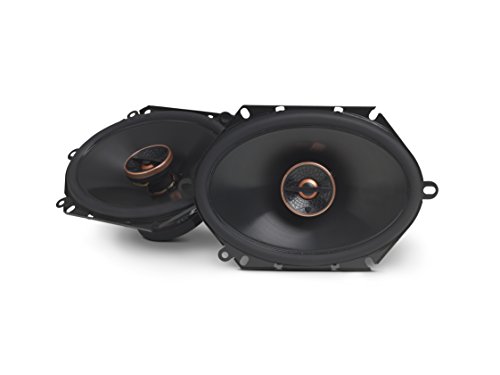
Infinity REF-8632CFX — Best detail and smoothness
The REF-8632CFX brings Infinity’s Reference-series values to the Ford oval: an edge-driven textile dome tweeter with the smooth, extended character that defines the brand, and a woofer built to the series’ Plus One philosophy for effective cone area beyond the nominal dimensions. In a Mustang or a well-trimmed Explorer — cabins quiet enough to hear it — the result is the most refined coaxial listen in this guide: treble with air but no edge, midrange with genuine texture, and a neutrality that lets the recording rather than the speaker set the mood. Long-distance drivers in particular should audition this character first, because fatigue-free treble is the quality that matters at hour four.
Refinement has its prerequisites. The Infinity reveals source quality faithfully, so a noisy base radio or low-bitrate streaming will be presented as-is; and its composure at moderate volumes can disguise how well it responds to clean power when the road demands more. It is also the coaxial here most likely to make an owner dissatisfied with the rest of a tired system, since a front stage this honest reframes the rear fill and the head unit as the next projects. Buy it as the anchor of a system you are content to improve around, and it is the connoisseur’s value in this size; buy it hoping it will disguise a poor source, and it will politely decline.
- Format: 6×8 two-way coaxial, Reference series
- Tweeter: edge-driven textile dome
- Woofer: Plus One design philosophy for greater effective area
- Typical home: quieter cabins and attentive listeners
Strengths
- Smooth, extended treble that stays fatigue-free on long drives.
- Neutral, textured midrange flatters voices and acoustic music.
- Reference-series build and voicing at a mid-market position.
Trade-offs
- Reveals poor sources rather than flattering them.
- Composure can feel restrained to listeners who want Kicker energy.
- May expose the rest of an ageing system as the next necessary upgrade.
Best for: attentive listeners in quieter Ford and Mazda cabins who value refinement. Not suited for: masking a noisy factory radio or chasing maximum excitement.
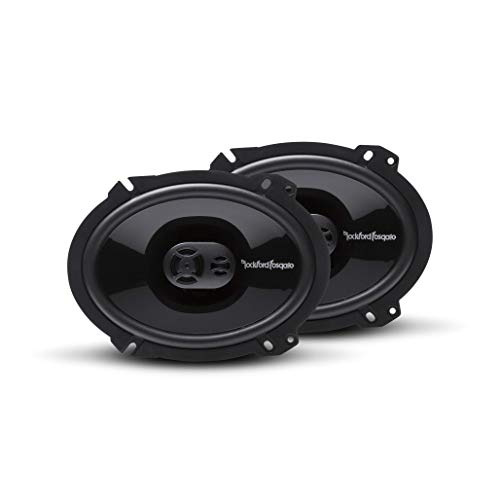
Rockford Fosgate P1683 — Best for amplified systems
The P1683 is the Punch series’ answer in this size, a three-way coaxial whose design brief assumes the owner takes sound seriously enough to feed it properly. Its mineral-filled cone and Rockford’s motor design give the woofer a discipline that matters most at the volumes factory systems cannot reach: midbass stays taut in a big truck door, the three-way split keeps the midrange ordered, and the whole presentation holds together when an amplifier leans on it. In an F-150 with a compact amplifier and treated doors, the P1683 is the coaxial ceiling of this guide — the point beyond which the only step up is the component architecture of the KS system.
As with every Punch product in this batch of guides, the caveat is appetite: on a base factory head unit the P1683 performs competently but within itself, and owners staying on factory power will hear more immediate life from the Kicker CS at lower cost. The three-way layout also places its tweeter and midrange in the door’s factory position, so no coaxial staging miracles occur — the Punch spends its budget on control and composure, not imaging. Judge it as what it is: the serious driver’s coaxial for this size, bought deliberately alongside the power that unlocks it.
- Format: 6×8 three-way coaxial, Punch series
- Cone: mineral-filled polypropylene
- Design brief: control and composure under amplification
- Typical home: amplified truck doors and deliberate builds
Strengths
- Woofer discipline keeps big-door midbass taut at real volumes.
- Three-way layout orders the midrange better than two-way rivals under power.
- Scales with amplification further than any other coaxial here.
Trade-offs
- Factory head units leave much of its ability untapped.
- Imaging remains door-bound, as with all coaxials in this list.
- Premium positioning only justifies itself in a deliberate build.
Best for: amplified Ford truck builds wanting coaxial simplicity with serious control. Not suited for: standard-radio owners, who will pay for headroom they never use.

Kicker 51KSS6804 — Best component upgrade
Let the classification be unmistakable: the 51KSS6804 is a component system, not a coaxial. Its 6×8 woofer mounts in the Ford door, its one-inch tweeter mounts separately — sail panel, pillar or dash corner — and an external crossover network divides the signal between them. That architecture is why it headlines the upgrade path in this guide: raising the tweeter to ear height transforms a truck’s soundstage from a murmur at the door handles into a presentation across the windscreen, and no coaxial, however refined, can follow it there. Kicker’s KS series engineering — the finer tweeter, the proper crossover, the woofer built for amplified duty — makes this the most capable front-stage hardware that fits a 6×8 door without adapters or fabrication.
The costs are the component costs, stated plainly: an installation measured in hours rather than minutes, tweeter locations to choose and prepare, crossovers to mount dry and secure, and a system whose advantages assume at least a good head unit and ideally an amplifier. Against the Punch coaxial, the KS trades drop-in simplicity for staging and tuneability; against the CS coaxial, it trades nearly everything casual for capability. Owners whose Fords are keepers and whose listening is attentive should consider this the destination product of the size class — the one the other five are, in a sense, alternatives to — while owners who need the truck back together by lunch should buy the CSC684 without a moment’s regret.
- Format: 6×8 component system, KS series — separate woofer and tweeter
- Tweeter: 1-inch, separate housings for sail, pillar or dash mounting
- Crossover: external network included
- Typical home: keeper trucks and Mustangs with deliberate front stages
Strengths
- Separate tweeter lifts the soundstage to windscreen height — beyond any coaxial’s reach.
- KS-series components give the size class its highest performance ceiling.
- Native 6×8 woofer keeps the factory door seal without brackets.
Trade-offs
- Installation is a project: tweeter mounting, crossover placement, wiring runs.
- Advantages assume decent electronics; wasted on a neglected base system.
- Most expensive route in this guide by a clear margin.
Best for: committed Ford and Mazda owners building a real front stage in a 6×8 door. Not suited for: quick factory replacements or vehicles being sold soon.

Skar Audio TX68 — Best value output
Skar Audio built its following on output per unit of money, and the TX68 applies that formula to the Ford oval: a two-way from the company’s Elite TX series, rated at 200 watts in its listing, with a ferrite-driven woofer and a tweeter chosen for durability and projection. In the contexts Skar owners actually inhabit — trucks that play loud, windows down, systems that grow amplifier-first — the TX68 delivers volume and toughness with an honesty about its brief that more pretentious budget speakers lack. It is the pick for the owner whose factory speakers died and whose replacement brief reads “louder, tougher, now.”
The trade-offs are the mirror of the Infinity’s. The TX68’s presentation prioritises projection over refinement, so fine treble texture and midrange nuance sit below the detail picks here, and its voicing will not flatter quiet, attentive listening the way the Reference series does. Skar’s support and documentation, while adequate, are thinner than the legacy brands’. None of that dents its role: as the value-and-output answer in a size where budget options are often grim, the TX68 is a legitimate tool for a specific job, and owners who buy it for that job tend to keep it happily.
- Format: 6×8 two-way coaxial, TX Elite series
- Power figure: 200 watts per its listing
- Design brief: output and durability at an entry price
- Typical home: loud-playing trucks and budget builds
Strengths
- Strong output capability for the money — the loud Ford door on a budget.
- Durable construction suits hard-used trucks and open windows.
- Straightforward two-way install with no special demands.
Trade-offs
- Projection over refinement: fine detail trails the Infinity and Pioneer.
- Documentation and support trail the legacy manufacturers.
- Voicing serves loud listening better than quiet, close listening.
Best for: budget-conscious owners who play loud and value toughness over texture. Not suited for: detail-first listeners in quiet cabins.
How Should You Tune the System After a 6×8 Swap?
Ford’s factory head units give you more processing than most owners realise, and nearly all of it was tuned for the speakers you just removed. Begin the first drive with tone controls flat and any sound enhancement, occupant-mode or DSP setting in its neutral position; several Ford systems offer driver-focused and all-seats modes that reshape the stage substantially, and the mode that flattered the factory speakers may actively fight the new ones. Live with the flat baseline for a few days of ordinary listening. The clarity you gained will recalibrate your expectations, and the adjustments you still want afterwards will be smaller and more accurate than anything chosen in the first excited hour.
Speed-compensated volume deserves a specific decision. It raises output with road speed, which in a truck means it raises output precisely when the cabin is noisiest and the speakers are working hardest; with efficient replacements like the Kicker CS or the Skar, the compensation curve calibrated for feeble factory drivers can overshoot, pushing the new speakers into harshness at highway pace. Try it at its lowest setting or off, and let your own hand on the volume control be the judge for a week. Similarly, if your system offers a rear-seat or fade preset, set the balance for where listeners actually sit — in most trucks that is the front row, and a front-biased balance with the rears as fill stages better than the democratic default.
If an amplifier joins later, set its gains with the head unit’s processing already flattened, and re-check the speed-compensation afterwards, since the two volume systems multiply each other. Owners who sequence the work this way — hardware, flat baseline, patience, then small corrections — consistently report that the final settings are surprisingly modest. That modesty is the signature of a system whose problems were mechanical and have been fixed, leaving the electronics with little to apologise for.
What About the Rear Locations in Ford and Mazda Vehicles?
The 6×8 appears in rear doors, rear quarters and cab corners across the Ford range, and those locations deserve the same size honesty as the fronts — with a different spending logic. Rear speakers in a truck or SUV serve passengers and provide fill; the front stage carries the music. A sensible pattern across the fleet is to put the best pair in front — the KS components for builders, the CS or Infinity coaxials for everyone else — and a competent coaxial behind, with the Pioneer and Skar both suiting rear duty well. Matching the brand front and rear keeps the tonal family consistent as sounds move around the cabin, which matters most in SUVs where rear passengers sit close to their speakers.
Extended-cab and crew-cab trucks add a wrinkle: rear doors in some configurations are shallow, and the rear location may take a different size entirely from the front. Measure each location independently rather than assuming a vehicle is 6×8 throughout — Ford’s own fitment history includes mixed-size systems, and a four-speaker order placed on an assumption is a return waiting to happen. Where the rear is a smaller size, buy that size’s honest equivalent from the same brand family and spend the savings on the front pair, where your ears live.
How Well Do These Speakers Survive Truck Life?
A working truck’s door is a hostile posting: dust on every opening, moisture from wet weather gear, vibration from rough roads and temperature swings from dawn frost to cab heat. The picks in this guide use synthetic cones and surrounds rather than paper and foam precisely because those materials tolerate that life, and the differences among them are of degree rather than kind. Owners in genuinely harsh service — farm, site and fleet trucks — should weight the simpler, tougher builds (the CS Kicker, the Skar) over the finest-voiced ones, not because the Infinity or the KS are fragile, but because a speaker’s tweeter and crossover are additional things for a hard environment to reach.
Two installation habits extend any door speaker’s life in a truck. Keep the door’s drain holes clear so the cavity dries as designed, and ensure the vapour barrier goes back intact after the install; a torn barrier invites the moisture that corrodes terminals over years. And when a door speaker does eventually fail in a working vehicle, diagnose before replacing the pair: a corroded connector or a chafed wire in the boot mimics a dead driver faithfully, and the fix is a fraction of a speaker’s cost. The fleet logic of this whole size class is longevity through simplicity, and the owners who get a decade from a set are the ones who installed it dry, sealed and strain-relieved the first time.
What Should You Look For in a 6×8 Speaker, Beyond the Badge?
Sensitivity first, for the same reason it leads every factory-replacement guide in this series: most 6x8s will live on head-unit power, and a speaker that plays clearly on modest output beats a power-hungry design in that life every day. Where manufacturers publish sensitivity, compare it; where they do not, the design brief tells the story — CS, A-Series and TX products are built for factory systems, Punch and KS products are built with amplification in mind, and buying across that line in either direction wastes money. Power ratings, by contrast, should be read as ceilings for amplifier matching, with peak figures treated as marketing weather rather than climate.
Cone and surround materials decide longevity and midrange character together. Polypropylene in its plain, mineral-filled and reinforced forms covers this entire list because it is the rational door material: immune to humidity, consistent across temperature, and stiff enough when engineered well. The differences you hear among these picks come less from the cone’s brochure name than from the motor and crossover engineering behind it — which is why two polypropylene speakers can sound like different generations. Tweeters divide by temperament as they do everywhere: balanced domes for energy, textile domes for smoothness, and the KS’s larger dome for body. Choose the temperament that corrects your cabin’s existing bias rather than amplifying it.
Mounting depth and flange design are the specifications owners skip and regret. Ford doors vary more across the fleet’s decades than any single database captures, and the difference between a speaker that clears the window regulator and one that kisses it is a few millimetres of published depth. Read the dimensions, measure the door, and treat any seller who cannot supply dimensions as a risk you do not need in a niche size. Finally, weigh the crossover question even among coaxials: the better designs voice their tweeter circuit deliberately rather than hanging a capacitor on it, and the midrange smoothness that results is audible in every one of the top picks here.
What Changes in a Mustang or a Small Mazda Cabin?
Most of this guide’s advice is calibrated to trucks and SUVs because that is where most 6x8s live, but the size’s sports-car and compact applications rewrite two assumptions. A Mustang’s cabin is small, its listeners sit close to the doors, and its exhaust note sets a noise floor that favours efficiency at cruise and composure when the engine is working. In that environment the Infinity’s refinement is audible at closer range, the Skar’s projection is less necessary, and the KS component system’s staging is at its most dramatic — a small cabin with tweeters at the pillars images like a listening room compared with a truck’s wide cab.
Small Mazda cabins from the shared-platform years add a fitment caution instead: their doors are shallower than the Ford trucks the same speakers are marketed for, and depth checks stop being a formality. Measure with the window down, and favour the shallower coaxials if the clearance is marginal. The reward for the care is outsized — a small, light cabin needs little power to fill, so even the factory-replacement picks produce a completeness that truck owners need amplification to reach. Size of cabin, like size of speaker, is a variable to design around rather than a fate to accept.
How Do the Six 6×8 Picks Compare?
| Pick | Type | Power it suits | Character | Choose it when |
|---|---|---|---|---|
| Kicker 46CSC684 | Coaxial 2-way | Factory head unit | Lively | You want the default Ford door upgrade |
| Pioneer TS-A6880F | Coaxial 4-way | Head unit or amplifier | Even | The vehicle is shared and content is mixed |
| Infinity REF-8632CFX | Coaxial 2-way | Head unit or amplifier | Smooth, detailed | Refinement and long drives lead the brief |
| Rockford P1683 | Coaxial 3-way | Amplifier preferred | Controlled | Your build has real power and wants composure |
| Kicker 51KSS6804 | Component | Amplifier preferred | Staged, premium | You want a true front stage in a 6×8 door |
| Skar TX68 | Coaxial 2-way | Head unit or amplifier | Loud, tough | Budget and output outrank refinement |
How Do You Fit 6x8s in Ford Doors Without Surprises?
Ford doors reward a specific checklist. First, depth: truck doors are generous, but Mustang and smaller Mazda doors place window regulators close behind the speaker, so compare the candidate’s mounting depth against the space with the window fully down — fully down, not halfway, because that is where the glass travels on the day you forget. Second, the factory connector: many Fords use a plug harness, and the inexpensive adapter that mates it to standard terminals preserves the factory wiring and your resale value. Third, the premium-system question: higher-trim Fords with branded factory audio sometimes drive the door speakers from a separate amplifier at low impedance, and in those vehicles a speaker swap is an electrical decision, not just a mechanical one — identify your trim’s system before ordering, using the factory speaker’s own markings as evidence.
The mechanical work itself follows the discipline of every door install in this series: photograph before disconnecting, test-fit before wiring, gasket the flange, torque evenly, and listen before the trim returns. Ford door cards of the relevant eras use a mix of screws and lift-off hooks rather than pure clips on many models, so consult a model-specific panel guide rather than forcing a card that moves differently than you expect. For the KS component system, add the tweeter rehearsal — temporary mounting, a listening session, then the permanent fix — and route its leads through the factory door boot, which on Fords is roomy enough to accept them without drama.
What Mistakes Do Ford and Mazda Owners Make With This Size?
The first is ordering a 5×7 or a 6×9 on a database’s say-so. The 6×8’s neighbours both fail differently — one rattles in an oversized hole, the other does not fit at all — and the tape measure on the factory speaker settles every argument before money moves. The second is assuming all factory Ford systems are electrically identical: the base radio’s 4-ohm door speakers and a premium system’s amplified low-impedance drivers look similar through a grille and behave nothing alike. The third is skipping the seal on a door whose factory speaker used a foam gasket that has long since turned to dust; the new speaker inherits the leak and gets blamed for the thinness.
Fourth, component buyers mounting the KS tweeters in the first available spot — low on the door beside the woofer — and concluding that components are overrated. The tweeter’s height is the product; mount it where it can do its work. Fifth, judging any of these speakers with the factory sound processing still engaged: Ford’s factory equalisation and speed-compensated volume were tuned around the original drivers, and flattening the tone controls after a swap is the step that separates “no better than before” from the improvement the hardware actually delivered.
Sixth, the mixed-fleet assumption: ordering four identical speakers for a vehicle whose front and rear locations differ, a mistake Ford’s own mixed-size systems invite. Measure every location you intend to fill. Seventh, overtightening mounting screws into ageing door steel or plastic spacers until the flange warps or the mount cracks — snug and sealed is the goal, and a warped flange leaks exactly like a missing gasket. The theme running through all seven is that this size rewards verification over assumption at every step, which is another way of saying it rewards the owners Ford built it for: people who keep vehicles long enough to know them.
What Wiring and Hardware Should You Have Before the Door Comes Apart?
Ford’s speaker connectors changed across the decades this size spans, so the first purchase is information: identify your model year’s connector style, then buy the matching harness adapters, which convert the factory plug to standard terminals without cutting a single wire. The adapters cost little, preserve the vehicle’s wiring integrity for the next owner, and — not trivially — make polarity foolproof, since the adapter’s terminals are keyed to the speaker’s. Owners who cut and splice instead inherit two risks: a reversed pair that cancels bass, and connections that corrode in a door’s humidity over the following years. Solder or quality crimps with heat-shrink mitigate the second risk; nothing mitigates the first except testing, which adapters make unnecessary.
Hardware beyond the speakers themselves is short but decisive: foam gasket material for the flange seal, a handful of replacement door clips in your model’s style because some always break, and — for trucks with high door speakers — a step stool and patience rather than a lean across the sill that ends with a scratched card. Component buyers add tweeter mounting hardware and cable ties for the crossover leads. Gather it all before the first panel comes off; a Ford door dismantled on a driveway while a clip is in the post is a small misery this hobby inflicts only on the unprepared.
One more preparation separates smooth installs from archaeological ones: find your model’s door-panel procedure before touching it. The fleet’s panel retention mixes screws, hooks and clips in proportions that vary by model and year, and the correct release sequence is documented in owner forums and service guides for every common Ford and Mazda. Five minutes of reading replaces the pry-and-pray method that cracks twenty-year-old plastic, and on vehicles of the age many 6x8s serve, the plastic’s fragility is a bigger installation risk than anything electrical.
Should You Convert a 6×8 Hole to 6.5 With an Adapter Plate?
It is the question every Ford owner eventually asks, because adapter plates exist and the 6.5 market is vastly larger: why not convert and shop the mainstream? The honest answer is that conversion is legitimate and usually unnecessary. A rigid plate, properly sealed, lets a 6.5 speaker work in a 6×8 opening without the air-gap penalty, and it opens the door to component systems and voicings the native size lacks. For an owner with a specific 6.5 system in mind — a particular Morel, Focal or JL set, say — the plate is a rational toll, paid once, for access to that sound.
For everyone else, native speakers win on arithmetic. The plate adds cost, a fitment variable and a potential rattle source to gain access to a catalogue whose mainstream entries are not better than this guide’s natives — they are merely more numerous. The 6×8 class is unusually well served: it has factory replacements at every temperament, an amplified coaxial, and a genuine KS component system, which between them cover the needs of nearly every Ford and Mazda on the road. Conversion solves a scarcity problem this size does not actually have, unlike the 6.75 class where the bracket route earns its place. Convert for a specific speaker you have chosen on merit, not for the abstract idea that more choice is better.
If you do convert, hold the installation to the standard the native speakers meet by design: plate rigid enough not to flex under the speaker’s mounting torque, gasket on both faces, and a depth recheck, since the plate moves the speaker outward and changes both window clearance and grille clearance. A conversion done to that standard is sonically invisible; one done casually reintroduces every fault this guide has catalogued, wearing a mainstream speaker as a disguise.
How Do You Know the Install Is Right When You Hear It?
Evaluation deserves a method, because first impressions after a speaker swap are unreliable — everything sounds different, and different is easily mistaken for better. Use three familiar recordings: one vocal-led track you know intimately, one with genuine low bass, and one dense, busy mix. On the vocal track, the test is placement and tone: the voice should sit steadily in front of you, intelligible at low volume, free of the honk that signals a midrange problem or the sizzle that signals a tweeter being asked too much. On the bass track, listen for definition rather than quantity — individual notes with starts and stops, no boom that lingers into the next bar, and no buzz from the door at the loudest passage you actually use.
The busy mix tests composure: at your real cruising volume, can you still follow an individual instrument, or does the presentation smear into a wall? Coaxials in this guide will smear sooner than the KS components — that is the honest physics of one mounting point — but none should collapse at sane levels on their intended power. Finish with a quiet test that catches what music hides: pause the source at volume and listen for hiss, alternator whine or rattles, then drive over rough pavement with the system off. A door that is silent when the music is silent was assembled correctly; a door that comments on the road has a clip, a loom or a crossover asking for attention, and it is kinder to answer on the day than in a month.
Give the finished system a week before final judgement. Your ears recalibrate, the novelty fades, and the settings that survive a week of commutes are the true ones. Owners who follow that discipline rarely reopen their doors; owners who tune frantically on day one often chase their own first impressions in circles. The speakers were chosen carefully — let them, and yourself, settle.
Final Recommendation
Hand most Ford and Mazda owners the Kicker 46CSC684 and the job is done well: it fits, it seals, it livens the factory system, and it asks nothing else of the vehicle. Choose the Pioneer TS-A6880F when the car is shared and evenness is the priority, the Infinity REF-8632CFX when your listening is attentive and your cabin quiet enough to honour it, and the Skar TX68 when the brief is loud and the budget is firm. Build with the Rockford P1683 when amplification is real, and graduate to the Kicker 51KSS6804 component system when the vehicle is a keeper and the front stage is the point — it is the finest hardware this odd, loyal size offers, and a well-kept Ford with a staged front end is a reminder that factory fitments, respected rather than fought, can carry a system a very long way.
Whichever you choose, do the unglamorous parts with care — measure the hole, gasket the flange, keep the factory wiring intact, flatten the tone controls — because in this size more than most, the difference between a speaker that disappoints and the same speaker delighting its owner is almost never the speaker. It is the twenty minutes of verification and sealing around it, and those twenty minutes are the cheapest performance in car audio.
Frequently Asked Questions
Which vehicles use 6×8 speakers?
Primarily Ford products — F-Series trucks, Mustang, Explorer and many other Ford, Lincoln and Mercury models across several decades — plus Mazda vehicles from the platform-sharing era, including the B-Series trucks. Fitment varies by year and location in the vehicle, so verify against your own car rather than a general list.
Can a 6×8 speaker fit a 5×7 opening?
Often, yes: many 6×8 models are designed with mounting compatibility for 5×7 openings, and manufacturers list both sizes against them. But flange room and cutout length still need checking against your specific door — measure the factory speaker and compare published dimensions before relying on the overlap.
Do I need an amplifier for 6×8 speakers?
No. The Kicker CS, Pioneer, Infinity and Skar picks all perform on factory head units. Amplification specifically rewards the Punch P1683 and the KS component system, whose control and staging were designed for it, but it is an upgrade path rather than a requirement.
My Ford has the premium factory audio system. Can I still swap speakers?
Usually, but check the electrical details first: premium systems may use low-impedance door speakers driven by a separate amplifier, and a standard 4-ohm replacement will play more quietly and may interact with factory equalisation. Read the markings on the factory speaker and research your trim’s system before ordering.
Is the Kicker KS system really a component set in this size?
Yes — the 51KSS6804 is a genuine 6×8 component system with a separate one-inch tweeter and an external crossover, which makes it unusual: most sizes in Ford’s ecosystem are coaxial-only in practice. It needs tweeter mounting and crossover placement, and in return delivers staging no coaxial in this guide can match.
Are 6×8 speakers being discontinued?
No — the fleet they serve is too large and too long-lived. Every major brand in this guide lists current 6×8 models, including a current component system, and the size’s support follows the trucks and cars that use it, which remain on the road in the millions. Buy current product with confidence, and keep the receipt with the vehicle’s papers as you would for any long-lived part.
How long should a 6×8 swap take in a Ford door?
A coaxial pair is typically a one-to-two-hour job for a careful first-timer, with the second door faster than the first once the panel procedure is learned. The KS component system, with tweeter mounting and crossover placement, deserves half a day. Add time rather than force clips if your vehicle is older — aged plastic is the commonest cause of install damage in this fleet.
Can I mix brands between front and rear doors?
Yes, with a small caution: keep the characters compatible — a smooth Infinity front with a smooth Prime rear ages better than a lively front fighting a relaxed rear for the cabin’s tonal identity. When in doubt, the same brand’s family voicing is the safe route, and every brand in this guide offers a coherent front-rear pairing.
Why do my new door speakers sound thin?
The usual suspects are a missing flange seal, one speaker wired in reverse polarity, or factory tone processing still compensating for the old drivers. Check the gasket, pop-test the polarity, flatten the tone controls — in that order — before concluding the speakers are at fault.
Related Guides
If your other doors take the smaller round format, Best 6 Inch Car Door Speakers That Actually Fit is the honest guide to that size, and Best 6 Inch Component Speakers for Tight Doors covers its component systems. Readers leaving the car for the desk will find the same evidence-first approach in Best 1TB SSDs: NVMe Picks for Speed and Value.


