What's inside
- Where to Buy
- Key Takeaways
- Quick Picks
- How We Chose These Picks
- Comparison Table
- How to Choose an Affordable Camera for a YouTube Channel
- Is a Mirrorless Kit Worth It for a First Channel?
- Why Do Budget Camcorders Claim Such Large Megapixel Numbers?
- What Else Should a First Channel Budget for Beyond the Camera?
- Common Mistakes When Buying a Cheap YouTube Camera
- Final Recommendation
- Frequently Asked Questions
- Related Guides
As an Amazon Associate I earn from qualifying purchases. This post may contain affiliate links at no extra cost to you.
[SITE_DOMAIN] is reader-supported. When you buy through links on our site, we may earn an affiliate commission.
Where to Buy
Each of the six cameras below is sold on Amazon under its own listing, and the listing page is where its current cost should be checked, because affordable cameras move in and out of promotion more often than any other class. The Canon EOS R50 kit is the one listing here whose contents change the maths most — a lens is in the box — so read its configuration line before comparing its figure with body-only offers. The Sony ZV-1F in white is a fixed-lens compact, which makes its page a quick verify. Canon’s EOS R50 V is sold body-only, so its headline figure is the start of a purchase, not the whole of it, and the listing is where that distinction is spelled out. Three camcorder-style budget cameras follow: the ZYDIIE 4K camcorder with a card, remote and two batteries in its title, the rotating-lens 4K vlogging camera that lists a tripod and 16GB card, and the 5K camcorder whose title adds a microphone to its kit. For those three, the Amazon page is effectively the only product documentation in existence, so give it a slower read than feels necessary.
The search for the best affordable youtube cameras runs into a vocabulary problem before it reaches a product problem. Affordable can mean a complete mirrorless kit from a major brand, bought once and used for a decade, or it can mean a camcorder-shaped device whose entire kit costs less than a single brand-name lens — and both meanings are honestly represented in this guide. What separates the picks is not effort or intention but verifiability. The Canon and Sony titles can be checked against manufacturer documentation down to the sensor size. The three camcorder titles make claims — 64MP, 75MP, 5K — that no published standard confirms, and this guide prints them as listing claims every time they appear.
That split is not a reason to dismiss the budget half. A creator publishing their first thirty videos needs a camera that starts quickly, frames them reliably and survives being knocked off a stack of books, and the camcorders below answer those needs at a price that leaves money for lighting, which improves footage more than any sensor upgrade at this level. But the split does decide how each review is written. The branded cameras are assessed on documented hardware. The camcorders are assessed on what their boxes verifiably contain — screens that rotate, cards and batteries included, a microphone in one case — with their headline numbers held at arm’s length.
One structural fact deserves stating before the reviews, because it shapes the whole table. Only one pick here arrives as a complete interchangeable-lens system in the box: the Canon EOS R50 with its 18-45mm kit lens. The EOS R50 V shares the mirrorless mount but is sold body-only, so its affordability depends on a lens you buy separately. Everything else is a fixed-lens device. That is the real fork in this guide — not Canon against Sony, not 4K against 5K claims — but whether your channel’s future involves buying lenses at all.
Key Takeaways
- The Canon EOS R50 kit is the only pick that includes an interchangeable lens in the box: the RF-S 18-45mm F4.5-6.3 IS STM.
- The EOS R50 V is a body-only mirrorless camera, so its true starting cost includes a lens its title does not bundle.
- The Sony ZV-1F states a 1-inch sensor and a 20mm lens in its title — the most complete fixed-lens specification in this set.
- All three budget camcorders make unverified megapixel and resolution claims; all three include a memory card, and two include two batteries.
- Only the 5K camcorder names a microphone in its title among the budget three, and it also claims webcam use.
Quick Picks
| Pick | Badge | Why it earns a place |
|---|---|---|
| Canon EOS R50 18-45mm Kit | Complete system in a box | 24.2MP APS-C sensor, 4K video and a kit zoom lens included. |
| Sony ZV-1F White | Fixed-lens simplicity | 1-inch sensor, 4K video and a 20mm lens for vlogging and streaming. |
| Canon EOS R50 V | Body-only growth path | 24.2MP APS-C body aimed at vlogging and live streaming, lens chosen separately. |
| ZYDIIE 4K Camcorder | Fullest budget kit | Listing claims UHD video with a rotating touchscreen, remote, card and two batteries. |
| 4K Vlogging Camera with Rotating Lens | Rotating-lens experiment | Listing claims PDAF autofocus and face tracking with a tripod and card included. |
| 5K Video Camera Camcorder | Microphone included | Listing claims 5K video with a rotatable touchscreen, microphone, card and two batteries. |
How We Chose These Picks
Affordability was measured against the whole first month of ownership, not the headline figure. A camera that needs a lens, a card and a second battery before its first upload is affordable in a different sense from one that films out of the box, so the selection deliberately mixes both kinds and the reviews keep the distinction visible. Kits and bundles were credited only for contents their titles actually name — a lens, a card, batteries, a remote, a tripod, a microphone — never for accessories a shopper might assume are standard.
The second filter was documentation. Two Canons and a Sony anchor the guide because their titles state sensor sizes, megapixel counts and lens details that manufacturer documentation can confirm, giving an affordable-camera buyer at least three options whose specifications are facts rather than marketing. Around that anchor, three camcorders were admitted for the opposite reason: they are what a large share of real first-time buyers actually purchase, and a guide that ignored them would leave those readers to evaluate unverified claims alone, without a framework for doing it.
Framing hardware came third. Every pick offers the solo shooter a way to see the shot: flip or rotating screens on the camcorders, the vlogging orientation of the Sony and the two Canon bodies. A cheap camera that cannot show you your own framing is not cheap at any price, because its footage tax is paid in reshoots. Screen rotation angles, where titles state them — 270 degrees on two camcorders, a 330-degree rotating lens on the third — are reported exactly as printed.
Finally, each pick had to imply a different channel. The R50 kit serves the creator ready to build a system. The ZV-1F serves the creator who never wants to think about lenses. The R50 V serves the creator who already owns, or deliberately wants to choose, a lens. The three camcorders serve the creator whose budget is real and whose first need is simply to begin. A guide where all six picks answered the same reader would be a worse guide, however tidy it looked. Readers should therefore expect the reviews to disagree with each other in emphasis: what counts as a virtue in the system cameras counts as overhead in the appliances, and the verdicts are written from inside each pick’s own logic rather than from a single league table.

Canon EOS R50 18-45mm Kit — Complete system in a box
This is the pick that makes the word affordable mean something grown-up. The title describes a mirrorless camera with a 24.2-megapixel APS-C CMOS sensor, 4K video, and the RF-S 18-45mm F4.5-6.3 IS STM lens included as a kit. That last clause is the whole argument. An APS-C sensor is the largest imaging area in this guide by a wide margin, and it arrives with a zoom lens in the box, ready to film the day it lands. For a YouTube creator, that combination — big documented sensor, real interchangeable mount, lens included — is the point where a camera stops being a starter device and becomes the foundation of a channel’s next five years.
The kit lens deserves an honest paragraph rather than a dismissive one. Kit zooms are routinely mocked by enthusiasts, yet the 18-45mm range covers the shots a YouTube channel actually uses: a wide establishing frame of the room, a natural mid-range for pieces to camera, a modest reach for product details. Its aperture range, printed in the title as F4.5-6.3, tells the truth about its character — this is a lens for lit rooms and daylight, not for moody darkness — and a creator who films under even basic lighting will find it entirely serviceable while learning what a second, more specialised lens should be.
Canon’s title also names the audiences plainly: vlogging, content creation, photography. That breadth matters for the affordable buyer, because a camera that only vlogged would be a narrower tool than a household often needs. The same body that records a tutorial on Tuesday photographs a family event on Saturday, and every still it takes teaches its owner composition lessons that return to the channel as better thumbnails. The title does not state a flip-screen design or a microphone arrangement, so those details sit in the spec box as documentation questions rather than assumed answers — Canon publishes them, and the listing page links the way.
Who it suits is the creator who can stretch to the top of this guide’s range and intends the stretch to be the last one for years. Buy it if you want your second purchase to be a lens chosen from knowledge, not a replacement camera chosen from regret. It does not suit the buyer whose total budget must also cover lights, a microphone and a tripod from the same envelope — the camcorders below exist for that arithmetic — nor anyone who wants to film from a jacket pocket. If the system route is yours, the R50 kit’s page is where to confirm the exact kit configuration before ordering.
- Sensor: 24.2-megapixel CMOS, APS-C
- Video: 4K
- Lens included: RF-S 18-45mm F4.5-6.3 IS STM kit lens
- Stated uses: vlogging, content creation, photography
- Screen design: Not stated in the listing title — verify with the manufacturer documentation
- Microphone arrangement: Not stated in the listing title — verify with the manufacturer documentation
- Memory card included: Not stated in the listing title — verify with the manufacturer documentation
Strengths
- The APS-C sensor is the largest documented imaging area in this guide.
- A zoom lens is in the box, so the camera films complete on arrival.
- The interchangeable mount turns later upgrades into lens purchases, not camera replacements.
Trade-offs
- The kit lens aperture range suits lit rooms better than dark, moody sets.
- Screen and microphone details are absent from the title and need documentation.
- It is the largest commitment here, in size as well as in system terms.
Best for: creators ready to build on an APS-C system whose lens already sits in the box. Not suited for: a total production budget that must fit inside this one purchase, because lights and audio gear would have nothing left to draw from.
There is a patience dividend to this camera that cheaper picks cannot offer. Because the mount and sensor are a platform rather than a dead end, every skill its owner learns compounds: the framing instincts, the exposure judgement, the lighting habits all transfer to whatever lens joins the kit next year. Affordable cameras are often bought twice — once cheaply, once properly. The R50 kit is the argument for skipping the first of those purchases when the budget can possibly bear it, and its presence at the top of this guide is a standing reminder to price the second purchase before celebrating the first.

Sony ZV-1F in White — Fixed-lens simplicity
The ZV-1F’s title is a small masterpiece of saying enough. It states a 1-inch sensor, 4K video and a 20mm lens, and names its territories: vlogging, streaming and social media. In one line, a buyer learns the sensor class, the recording class, the exact lens focal length and the intended jobs. Among fixed-lens cameras at this level, that completeness is rare, and it makes the white ZV-1F the easiest pick in this guide to evaluate without leaving the page. The 20mm lens figure in particular is the kind of detail budget listings usually hide, and its presence here is a sign of a manufacturer willing to be specific.
A fixed 20mm lens is a deliberate creative decision, and beginners should understand what they are accepting. Twenty millimetres is wide: it takes in the vlogger, the room behind them and the context of the scene, which is exactly the grammar of vlogging and exactly wrong for filming a subject across a hall. There is no zoom to reach for, so the camera teaches its owner to move, to place, to compose with feet and furniture. Many creators find that discipline liberating — one lens, one look, a recognisable visual signature across every video — and the wide field forgives handheld wobble better than a longer lens would.
The white finish is not a trivial detail either. A white camera reads differently on a desk and in a hand: it looks like a lifestyle object rather than a piece of broadcast equipment, which matters to creators whose channels are built around kitchens, desks and bright rooms, and whose audiences respond to a lighter visual tone. It will also show scuffs and grime more honestly than black, which is a fair trade to name. The title’s stated uses — vlogging, streaming, social media — describe a camera meant to live in that bright, quick, publish-daily world.
Who it suits is the creator who wants a documented sensor, a known lens and no decisions left over. It is the anti-system camera: nothing to mount, nothing to upgrade, nothing to research at midnight. Its limits are the fixed lens itself — no reach, ever — and the title’s silence on microphone hardware and screen mechanics, both of which Sony documents elsewhere but neither of which this listing prints. If a single focal length sounds like freedom rather than a fence, the ZV-1F’s listing will confirm its current configuration in a minute’s reading.
- Sensor: 1-inch
- Video: 4K
- Lens: fixed 20mm
- Stated uses: vlogging, streaming, social media
- Finish: white
- Microphone arrangement: Not stated in the listing title — verify with the manufacturer documentation
- Screen design: Not stated in the listing title — verify with the manufacturer documentation
Strengths
- The title states sensor class, video class and exact lens focal length — full marks for specificity.
- The wide 20mm lens suits arm’s-length vlogging and forgives handheld movement.
- Streaming is a named use, matching creators who broadcast as well as record.
Trade-offs
- The fixed lens offers no zoom reach for distant subjects, by design and forever.
- Microphone and screen details are not printed in this title.
- The white finish shows wear more visibly than a black body would.
Best for: creators who want one wide lens, a documented 1-inch sensor and zero accessory decisions. Not suited for: filming subjects at a distance — a stage, a playing field, wildlife — because the fixed 20mm lens provides no reach at all.
Consider, too, what the fixed lens does to a channel’s look over a year. Every video shares the same field of view, the same perspective, the same relationship between face and room. Audiences come to recognise that consistency the way they recognise a voice, and beginners often underestimate how much of a channel’s identity is simply showing up in the same visual grammar every week. The ZV-1F enforces that grammar by design. Creators who chafe at sameness will outgrow it; creators who thrive on routine will find it has quietly branded their channel for them.
Canon EOS R50 V — Body-only growth path
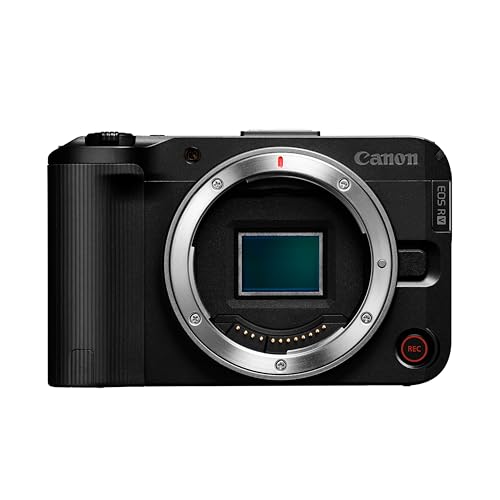
The R50 V is the R50’s more specialised sibling, and its title makes the specialisation plain: a mirrorless body with an APS-C sensor and 24.2 megapixels, aimed squarely at vlogging and live streaming, with fast autofocus named among its claims. It is also, and this must be read twice, a body-only listing. No lens is in this box. The affordability question therefore changes shape: this is the cheapest way into Canon’s current creator body only for a buyer who already owns a compatible lens or has deliberately budgeted for one, and the most misleading bargain in the guide for a buyer who has not noticed the words body only.
Judged on its own terms, the body makes a strong case. It shares the APS-C sensor class and megapixel figure of the kit above, which means the image foundation — the part that cannot be upgraded later — is identical in kind. Fast autofocus, named in the title, is the feature a solo vlogger leans on hardest: the camera holds a face while its owner gestures, leans, holds products toward the lens. A body designed for vlogging and live streaming also signals where Canon spent its attention — on the creator’s workflow rather than the photographer’s — and for a channel-first buyer that focus is worth more than a longer feature list aimed elsewhere.
The title contains one phrase that needs careful handling: it pairs the body-only designation with a mention of an ultra-wide zoom. Read plainly, the listing is describing the kind of lens this body is meant to partner — the vlogging use case is a wide one — rather than including that lens in a box it explicitly calls body-only. This guide treats the box as body-only, full stop, and the spec box below records the lens as not included. A buyer who wants certainty should read the listing’s contents line at purchase time, because with body-only offers the contents line is the entire contract.
Who it suits is the deliberate builder: the creator who already has a lens from another Canon body, or who wants one specific lens and resents paying for a kit zoom they would shelve. For that buyer, the R50 V is arguably the smartest money in this guide — flagship-class sensor territory, creator-focused design, no redundant glass. For everyone else, the kit above is the honest comparison, priced as a whole. If you are the deliberate builder, open the R50 V’s page and price it alongside the exact lens you intend to mount, as a pair.
- Sensor: APS-C, 24.2 megapixels
- Video: aimed at vlogging and live streaming per the title
- Focus: fast autofocus named in the title
- Configuration: body only — no lens included
- Lens included: none; the title’s ultra-wide zoom wording describes the intended pairing, not a bundled lens
- Screen design: Not stated in the listing title — verify with the manufacturer documentation
- Microphone arrangement: Not stated in the listing title — verify with the manufacturer documentation
Strengths
- APS-C, 24.2-megapixel foundation matches the kit camera’s imaging class.
- Fast autofocus is named in the title — the solo vlogger’s most-used system.
- No kit lens charge for buyers who already own the glass they want.
Trade-offs
- Body-only means the camera cannot film anything until a lens is bought.
- The true starting cost is body plus lens, which can exceed the kit above.
- Screen and microphone details require Canon documentation to confirm.
Best for: creators who already own a compatible lens or want to choose one specific lens from the start. Not suited for: filming that must start the day the box arrives with nothing further to buy, because this box contains no lens at all.
The body-only route also teaches a useful shopping habit that transfers to every later upgrade: price the working system, never the component. A body, a lens, a card and a spare battery are one purchase wearing four price tags, and the creator who learns to add them honestly at this level will never be ambushed by a bargain again. The R50 V rewards that honesty richly — it is a serious creator body at the friendly end of Canon’s range — but it punishes the skimming reader, and the difference between those two experiences is thirty seconds spent reading the words body only.
ZYDIIE 4K Camcorder — Fullest budget kit
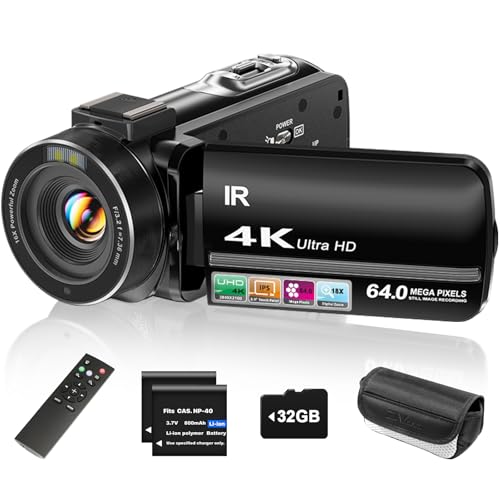
The ZYDIIE is a camcorder in the classic mould — a body shaped to be held in one hand for long stretches — and its title assembles the most complete budget kit in this guide: a 3-inch IPS touchscreen that rotates 270 degrees, night vision, a remote control, a 32GB card and two batteries. The listing claims UHD 4K video and a 64MP figure, with an 18x digital zoom, and those numbers are printed here as what they are: claims by an unbranded listing, unverified against any published standard. The kit contents, by contrast, are physical and checkable the moment the box opens.
Judge this camera by the session it enables. The rotating touchscreen frames the solo shooter. The remote control starts and stops recording from the presenter’s chair, which sounds minor until you have walked around a tripod forty times in an evening. Two batteries cover a long filming day with a swap rather than a tether. The included card means the camera records within minutes of unboxing. Night vision — an infrared mode, by the conventions of this class — opens novelty footage: garden wildlife, camping trips, the after-dark segments that lifestyle channels love. None of these virtues requires believing the megapixel claim, and that is exactly how a budget camera should be bought.
The 18x zoom is labelled digital in the title itself, and that honesty deserves noting even as it limits the feature: digital zoom crops the image, so its far end trades detail for reach. Used gently, for framing rather than magnification, it is a convenience. Leaning on it for quality footage of distant subjects will disappoint, and the disappointment will be blamed on the camera when it belongs to the physics of cropping. The same realism applies to the headline resolution: film a test piece in your first days, watch it on a television, and let your own eyes grade the claim.
Who it suits is the beginner whose budget is firm and whose filming is varied — family events, hobby documentation, a first channel shot in real rooms under real light. The kit completeness means the spending genuinely stops at this purchase, which for many households is the entire point. It does not suit a creator building toward monetised, television-watched production, because nothing in its documentation can be verified, nor anyone who needs a named microphone — the title names none. If the kit-first bargain matches your situation, the ZYDIIE’s page will confirm the current bundle contents.
- Video: the listing claims UHD 4K recording
- Stills: the listing claims a 64MP figure
- Zoom: 18x digital zoom, as labelled in the title
- Screen: 3-inch IPS touchscreen, 270-degree rotation
- Extras in title: night vision, remote control
- Included: 32GB card, 2 batteries
- Microphone arrangement: Not stated in the listing title — verify with the manufacturer documentation
- Sensor: Not stated in the listing title — verify with the manufacturer documentation
Strengths
- The most complete box in the budget half: card, two batteries and a remote are all included.
- The 270-degree rotating touchscreen covers self-framing and high or low angles.
- The title honestly labels its zoom as digital rather than implying optical reach.
Trade-offs
- The 4K and 64MP figures are unverified listing claims.
- Digital zoom crops the image, so distant subjects lose detail quickly.
- No microphone is named, so voice recording quality is an open question to test.
Best for: budget-bound beginners who want one purchase to cover camera, storage, power and remote control. Not suited for: creators who need a documented sensor and microphone specification for client-facing work, because this listing publishes neither.
A word about the camcorder shape itself, which younger buyers sometimes read as old-fashioned. The elongated body exists because filming is a duration, not a moment: a grip that fills the palm, controls under the thumb, a screen that swings out to the side. For long recordings — a school concert, a workshop session, a full match from the sideline — this shape is kinder than a compact’s pinch grip. The ZYDIIE’s shape is a feature, and beginners who film events rather than clips may find it the most comfortable tool in this entire guide, whatever the badge on its box claims.

4K Vlogging Camera with Rotating Lens — Rotating-lens experiment
This unbranded pocket camera takes the rotating-lens route to self-filming: its title describes a lens that turns through 330 degrees, so the optics swing to face the vlogger while a 1.72-inch touchscreen stays in the hand. The listing claims a 75MP figure, PDAF autofocus and face tracking, and includes a tripod and a 16GB card in the box, with WiFi for moving clips to a phone. As with its budget siblings, every performance number here is a listing claim; the rotating lens, the small screen, the tripod and the card are the verifiable substance of the offer.
The claims deserve one specific examination, because PDAF — phase-detection autofocus — is a term with a precise technical meaning that serious manufacturers print when their hardware implements it. An unbranded listing printing the same term is borrowing credibility it has not documented, and the face-tracking claim sits in the same position. The mature way to buy this camera is to treat both claims as features to audition: film a friend walking toward the lens, film yourself turning side to side, and watch whether faces hold focus or drift. Your footage, reviewed in the return window, is the only specification sheet this camera will ever have.
What is genuinely attractive here is the form. A pocket camera whose lens rotates can sit on a table and film its owner without a flip screen unfolded, can shoot forward for scenery and backward for commentary with a twist, and disappears into a bag corner afterward. The included tripod, small as it surely is, covers the static shots. WiFi sharing suits a Shorts-first workflow where the phone is the editing suite. For a creator whose channel is vertical, quick and daily, the shape of this tool matches the shape of the work better than a traditional camcorder would.
Who it suits is the short-form experimenter with a small budget and realistic expectations: someone who will test the claims promptly, publish to phone-first platforms, and treat the camera as a season’s tuition. The small 1.72-inch screen is the clearest physical limit — framing checks at arm’s length will be squinted, not studied — and no sensor, microphone or stabilisation information appears in the title at all. Creators filming long-form for television audiences should stay with the documented half of this guide. If the rotating experiment appeals, read its page closely for the current kit list before deciding.
- Video and stills: the listing claims 4K video and a 75MP figure
- Lens: 330-degree rotating lens
- Focus claims: PDAF autofocus and face tracking, as claimed in the title
- Screen: 1.72-inch touch screen
- Sharing: WiFi named in the title
- Included: tripod and 16GB card
- Sensor: Not stated in the listing title — verify with the manufacturer documentation
- Stabilization: Not stated in the listing title — verify with the manufacturer documentation
Strengths
- The rotating lens frames the vlogger without unfolding a screen.
- Tripod and card are included, so static shots are possible from the first day.
- WiFi sharing fits a phone-edited, short-form publishing rhythm.
Trade-offs
- The PDAF and face-tracking claims are undocumented and must be tested, not trusted.
- The 1.72-inch screen is small for judging framing or focus at arm’s length.
- No sensor or microphone information is published in the title.
Best for: short-form creators who want the rotating-lens form and will audition its claims during the return window. Not suited for: creators who need to check fine focus on the camera’s own screen, because a 1.72-inch display cannot show it reliably.
There is a broader lesson folded into this little camera, and it is worth stating for every budget buyer reading this guide. Marketing vocabulary migrates downward: terms invented for flagship hardware appear on unbranded listings within a season or two, emptied of the engineering that made them meaningful. The defence is not cynicism — some budget claims turn out to be partly true — but sequence. Believe the box contents first, the physical design second, your own test footage third, and the borrowed vocabulary last of all. A buyer who grades claims in that order will rarely be fooled, by this camera or by any of its successors.

5K Video Camera Camcorder — Microphone included
The boldest title in this guide belongs to its last pick: an unbranded camcorder claiming 5K video and a 64MP figure, with a 3-inch touchscreen rotating 270 degrees, infrared night vision, a 16X zoom, WiFi, webcam capability, a 32GB card, two batteries and — the detail that earns this camera its place — a microphone included in the kit. Every number in that sentence is a listing claim, and the 5K badge in particular outruns what the camera class usually delivers; but a budget kit that thinks about audio at all is rarer than one that thinks about resolution, and this one thought about audio.
That microphone matters because it addresses the failure mode that actually ends young channels. Viewers forgive soft footage on a phone screen; they do not forgive dialogue they must strain to hear. A kit microphone, however modest, lifts the voice off the camera body, away from handling noise and finger taps, and signals that the person filming understands the hierarchy of what audiences judge. If this camera’s claimed resolution turns out to be optimistic, its owner still owns a more watchable channel than the owner of a sharper camera recording through a distant built-in capsule. That is a strange sentence to write in a camera guide, and it is also true.
The rest of the kit follows the generous pattern of its budget siblings: the rotating touchscreen for self-framing, two batteries for a full day, a card so the first recording needs no further shopping, night vision for after-dark novelty, webcam capability for the creator whose channel includes live sessions. The 16X zoom’s type is not specified in the title, so it should be assumed digital — a cropping convenience — until the listing page or your own tests say otherwise. The HD wording in the title, sitting alongside the 5K claim, is a reminder that unbranded titles are assembled for search engines as much as for readers.
Who it suits is the beginner who wants the fullest possible kit — camera, microphone, power, storage, webcam option — at the budget end, and who will spend the first week testing claims rather than repeating them. It does not suit a buyer who needs any figure in the title to be contractually true, because none of them is documented, nor a creator whose work will be judged on a cinema screen. Bought as a complete, audio-aware starter kit with unverified badges, it is a defensible first step; its page carries the contents list to confirm at checkout.
- Video: the listing claims 5K recording
- Stills: the listing claims a 64MP figure
- Screen: 3-inch touchscreen, 270-degree rotation
- Zoom: 16X figure stated in the title, type not specified there
- Extras in title: IR night vision, WiFi, webcam use
- Included: microphone, 32GB card, 2 batteries
- Sensor: Not stated in the listing title — verify with the manufacturer documentation
- Stabilization: Not stated in the listing title — verify with the manufacturer documentation
Strengths
- A microphone is included — the only budget pick here whose kit addresses audio directly.
- Card and two batteries complete the kit, and webcam use is claimed for live sessions.
- The 270-degree rotating touchscreen handles self-framing and awkward angles alike.
Trade-offs
- The 5K and 64MP figures are unverified claims from an unbranded listing.
- The zoom type is unstated, so plan on digital cropping behaviour.
- No sensor documentation exists to predict low-light performance.
Best for: beginners who want camera, microphone, storage and power in one budget box. Not suited for: a purchase that requires the headline resolution to be a guaranteed specification, because this listing documents nothing behind its 5K claim.
End this review with the test that decides whether this camera stays. Film a two-minute piece to camera in your real filming room, once with the kit microphone and once without, then a walking clip at dusk, then a zoomed clip of a sign across the street. Watch all four on a television. That half hour tells you more than any specification debate: whether the voice is clear, whether the dusk footage holds together, whether the zoom is a tool or a trap. Cameras at this level should be auditioned, not believed — and a camera that passes its audition has earned its price, whatever its badge says.
Comparison Table
| Camera | Sensor (per title) | Video claim | Lens situation | Included extras (per title) |
|---|---|---|---|---|
| Canon EOS R50 Kit | 24.2MP APS-C CMOS | 4K | RF-S 18-45mm kit lens included | Not stated in the listing title |
| Sony ZV-1F White | 1-inch | 4K | Fixed 20mm | Not stated in the listing title |
| Canon EOS R50 V | 24.2MP APS-C | Vlogging and streaming body | Body only, no lens | Not stated in the listing title |
| ZYDIIE Camcorder | Not stated in the listing title | Listing claims UHD 4K, 64MP | 18x digital zoom | 32GB card, 2 batteries, remote |
| Rotating-Lens Camera | Not stated in the listing title | Listing claims 4K, 75MP | 330-degree rotating lens | Tripod, 16GB card |
| 5K Camcorder | Not stated in the listing title | Listing claims 5K, 64MP | 16X zoom, type unstated | Microphone, 32GB card, 2 batteries |
How to Choose an Affordable Camera for a YouTube Channel
Start by deciding whether you are buying a system or an appliance. A system — the R50 kit, or the R50 V plus a lens — costs more at the door and less across the years, because growth arrives as lenses and accessories rather than replacement cameras. An appliance — the ZV-1F and the three camcorders — costs less at the door and asks nothing further, but its ceiling is fixed on the day it arrives. Channels with a three-year ambition lean system; channels testing whether filming is enjoyable at all lean appliance, and should not be shamed for it.
Second, audit what is actually in the box before comparing any two figures. The budget camcorders include cards and batteries that the branded cameras’ titles do not promise, and the R50 V includes no lens at all. A comparison that ignores box contents will crown the wrong winner with great confidence. Write the full kit list for each candidate — body, lens, card, batteries, microphone — price the missing pieces, and only then compare totals. It takes ten minutes and it is the single most valuable habit this guide can teach.
Third, weigh documentation as a feature. A stated sensor size and a stated lens focal length — the ZV-1F’s quiet virtues — are worth money because they remove uncertainty, and uncertainty is what makes beginners return cameras and abandon channels. Unverified claims are not worthless, but they should be priced as lottery tickets: pleasant if they pay out, never the foundation of the plan. If your temperament hates gambles, the documented half of the table is your half, even at the higher figure.
Fourth, think about the second camera angle before you need it. Channels grow toward multi-angle filming — a wide shot and a close shot, a presenter and a product — and the affordable camera you buy today is very likely to become the second angle when a better camera arrives. That afterlife favours cameras with clean, honest output over cameras with aggressive processing, and it is one more reason the documented picks hold their value in a kit long after they stop being the main camera. A camcorder that served a first season honourably and then covered the wide shot for three more years was never a wasted purchase.
Last, leave money for light. At this end of the market, a modest lamp improves footage more than the difference between any two cameras here, because every sensor in this guide — documented or not — performs better when fed. A budget split that gives the camera everything and the lighting nothing produces dim, noisy videos from excellent hardware. The affordable camera is the one that leaves the channel enough to be lit.
Is a Mirrorless Kit Worth It for a First Channel?
For a creator who already knows they will film weekly for years, yes — and the reason is not image quality alone. The R50 kit’s APS-C sensor and interchangeable mount create options that compound: a brighter lens for evening filming, a wider lens for small rooms, a longer lens for events, each bought when a real video demands it. The camera becomes the stable centre of a growing kit rather than a ceiling the channel bumps into at month eight. That compounding is what the extra money buys, and creators with a settled commitment get full value from it.
For a creator still discovering whether they enjoy filming, the same kit can be a beautifully engineered mistake. Enjoyment is the fuel of the first hundred videos, and it is tested just as well by a camcorder that costs a fraction as much. The honest sequence for the undecided is to begin with the appliance, publish until the habit is proven, and then buy the system with the authority of experience — knowing exactly which lens, which sensor behaviour, which handling traits the channel actually needs. Bought in that order, neither purchase is wasted: the camcorder becomes the second angle, the travel spare, the camera lent to a friend without anxiety.
Why Do Budget Camcorders Claim Such Large Megapixel Numbers?
Because megapixels are the easiest number to inflate and the hardest for a buyer to check. A stills megapixel figure can describe the sensor, an interpolated upscale of the sensor’s output, or a maximum file size the software will produce — and unbranded listings rarely say which. The figure then does marketing work entirely out of proportion to its meaning, because video, the thing a YouTube camera is actually for, uses only a fraction of any sensor’s pixels anyway. A claimed 64MP or 75MP stills number tells you nearly nothing about the 4K or 5K video beside it in the same title.
The defence is to grade budget cameras on evidence you can generate yourself. Record in your worst room light and your best. Photograph a detailed subject — a bookshelf, a patterned fabric — and examine the edges at full size. Compare the result with your phone, which is the honest benchmark every budget camera must beat to justify existing. If the camcorder’s footage pleases you more than the phone’s, it has a job. If not, no megapixel figure, however large, should argue you out of what your own screen showed you.
What Else Should a First Channel Budget for Beyond the Camera?
Light comes first, and it is not close. Every camera in this guide, from the APS-C Canons to the humblest camcorder, produces visibly better footage when the subject is lit deliberately rather than by whatever a ceiling bulb provides. A single adjustable lamp, placed to the side of the camera and softened by distance or a diffuser, lifts skin tones, steadies exposure and lets autofocus stop hunting in dim rooms. Beginners routinely discover that a cheap camera under good light outperforms an expensive camera under bad light, and the discovery usually arrives one purchase too late. Reserve part of the budget for light before the camera box is even opened.
Sound comes second, and the guide’s own table shows why. Only one budget kit here includes a microphone, and none of the branded titles names its microphone arrangement, which means most buyers in this category are relying on whatever capsule sits in the camera body. Filming close to the camera, in a soft-furnished room, with background noise sources switched off, costs nothing and recovers much of the gap. When money allows one audio purchase, a small microphone that can sit nearer the speaker than the camera does will change how professional a channel feels more than any resolution step on any listing in this guide.
The unglamorous remainder is support and storage: a tripod that does not wobble when the floor is walked on, a card large enough that a filming day never ends in deletion decisions, and somewhere for footage to live that is not the same card it was shot on. None of these items photographs well for an unboxing video. All of them decide whether filming feels like a craft or a series of small emergencies. The affordable camera, properly understood, is the one whose purchase leaves room for this supporting cast — which is why this guide keeps returning to the total kit, and why the cheapest headline in the table is so rarely the cheapest channel.
Common Mistakes When Buying a Cheap YouTube Camera
Comparing headline prices instead of complete kits. A body-only camera and a camcorder with card, batteries and microphone included are not priced in the same currency. Total the working kit before ranking anything.
Treating a megapixel claim as a quality grade. On unbranded listings the number is a claim about a file, not a promise about an image. Your own test footage outranks it.
Forgetting that body-only means no lens. It is the most expensive misreading in this category. If the box has no lens, the camera films nothing until more money is spent.
Spending the lighting budget on the camera. Every camera here looks better under a decent lamp. A channel filmed in gloom with a premium body loses to a lit channel filmed on a camcorder.
Judging test footage on the camera’s own screen. Small screens flatter everything. Watch your first recordings on the largest display you own before the return window closes.
Final Recommendation
Buy the Canon EOS R50 kit if your budget can reach it and your commitment is real: it is the only complete, documented, interchangeable-lens system in this guide, and it will still be the centre of your kit in five years. Buy the Sony ZV-1F if you want documented quality without a system — a known sensor, a known lens, nothing left to decide. Treat the R50 V as the connoisseur’s route into the same Canon foundation, priced honestly as body plus the lens you choose. Below them, the three camcorders are beginnings, not bargains to be believed: the ZYDIIE for its complete kit, the rotating-lens camera for short-form experimenters, the 5K camcorder for the beginner wise enough to value its included microphone.
Affordability, in the end, is not the smallest number on a listing — it is the purchase you do not have to repeat, so choose the camera whose cost you understand completely, and let your first fifty videos be cheap in every way except honesty.
Frequently Asked Questions
Which is the cheapest way to start filming for YouTube here?
The three camcorders are the budget end of the guide, and all three include a memory card, so the spending stops at the purchase. The 5K camcorder adds a microphone to its kit, and the ZYDIIE adds a remote control and two batteries.
Does the Canon EOS R50 V come with a lens?
No. Its listing is body-only. The ultra-wide zoom wording in its title describes the pairing the body is designed for, not a lens in the box, so budget for a lens alongside the body.
Should I believe a 75MP claim on a budget camcorder?
Treat it as an unverified listing claim. Megapixel figures on unbranded cameras can describe interpolated output rather than sensor resolution. Film test footage and judge the image itself, on a large screen, during the return window.
Is the Sony ZV-1F’s fixed lens a problem?
Only if your filming needs reach. The 20mm lens stated in its title is wide and well matched to arm’s-length vlogging, streaming and social media. Filming distant subjects is simply not what this camera is for.
Can these budget camcorders really record the resolutions they claim?
The claims are printed by their listings and confirmed by no published documentation. Some may record files at the stated size with less actual detail than the number implies. That is why this guide weighs their verified contents — screens, cards, batteries, microphone — more heavily than their badges.
Related Guides
Readers still settling the shape of their first setup will find the wider view in our guide to beginner vlogging cameras, where ease of first-month use leads the argument. Those who have decided Canon is their system should continue to our roundup of Canon cameras for vlogging, which follows the mount from compacts to mirrorless bodies.


