What's inside
- Key Takeaways
- Quick Picks
- How We Chose These Picks
- Comparison Table
- How to Choose Your First Canon Mirrorless Camera
- Do Beginners Need Full Frame, or Is APS-C the Smarter Start?
- Which Kit Lens Should a Beginner Grow Beyond First?
- How Much Video Should a First Camera Really Offer?
- What Should the First Three Months With a New Camera Look Like?
- When Does a Second Lens Beat a Second Body?
- Should a Beginner Buy One Versatile Zoom or Start Collecting Primes?
- Common Mistakes When Buying a First Mirrorless Camera
- Final Recommendation
- Frequently Asked Questions
- Related Guides
As an Amazon Associate I earn from qualifying purchases. This post may contain affiliate links at no extra cost to you.
[SITE_DOMAIN] is reader-supported. When you buy through links on our site, we may earn an affiliate commission.
Where to buy — five of the six Canon bodies below carry Amazon links in their headings and in the Quick Picks table, each pointing at the exact kit described in its review. The sixth, the EOS R8, is discussed without a link because no listing for it was verified for this guide, so read its section as orientation rather than a shopping shortcut.
Choosing among the best canon mirrorless cameras for beginners feels harder than it should, because Canon’s RF lineup now stacks several friendly bodies within a narrow band of shapes and sensors. The R100, R50, R50 V, EOS RP and R10 all promise an easy first step, yet they suit different hands, different subjects and different appetites for video. This guide separates them by what each kit actually contains, what its listing title confirms, and which beginner each body quietly serves best.
One clarification before the picks: everything here is a genuine mirrorless camera in Canon’s RF system. Older Canon names still circulate in beginner conversations, and the Rebel T7 is the classic example — a capable DSLR, but a DSLR all the same, with an optical viewfinder and a mirror box. It does not appear among the picks because this guide covers mirrorless bodies only, and mixing the two families confuses lens shopping later.
Beginners also deserve honesty about lenses. Every APS-C body below uses Canon’s RF-S kit zooms, while the EOS RP and the prose-only R8 sit in the full-frame RF family. Lenses, more than bodies, decide how long a first camera stays satisfying, so each review names the glass in the box and flags where a kit runs out of reach or light.
Key Takeaways
- The EOS R100 kit is the simplest entry: a 24.1 megapixel APS-C sensor, an 18-45mm zoom and 4K video in one box.
- The EOS R50 adds a creator-friendly tilt toward vlogging while keeping the same approachable kit-zoom formula.
- The EOS R50 V is a body-only, video-leaning variant, so its budget must include a first lens bought separately.
- The EOS RP is the lone full-frame kit among the linked picks, pairing an RF 24-105mm zoom with a compact travel body.
- The EOS R10 two-lens bundle solves reach on day one, adding a 75-300mm telephoto beside the 18-150mm standard zoom.
- The EOS R8 appears prose-only as a step-up reference, with no link and no listing-derived specifications claimed for it.
Quick Picks
| Pick | Badge | Why it made the cut |
|---|---|---|
| Canon EOS R100 with RF-S 18-45mm Kit | Gentlest first step | A complete APS-C kit with 4K video and wireless sharing for a brand-new owner. |
| Canon EOS R50 with RF-S 18-45mm Kit | Creator-leaning all-rounder | The same friendly zoom pairing, framed by Canon for vlogging and content work. |
| Canon EOS R50 V Body | Video-first body only | Fast autofocus and a streaming-ready brief, sold without a lens in the box. |
| Canon EOS RP with RF 24-105mm Kit | Compact full-frame route | A full-frame sensor and a versatile travel zoom in a notably small body. |
| Canon EOS R10 Two-Lens Bundle | Reach included from day one | Standard and telephoto zooms, a memory card and a bag in a single bundle. |
| Canon EOS R8 | Prose-only step-up reference | A higher rung on the RF ladder, covered here without a verified listing link. |
How We Chose These Picks
Beginner cameras fail in predictable ways: menus that punish curiosity, kits that demand a second purchase before the first outing, and video modes so buried that owners never touch them. Selection therefore started with completeness. A pick had to make sense as a first purchase standing alone, or — in the R50 V’s body-only case — declare that incompleteness plainly so its true starting cost stays visible.
Sensor and mount came next. APS-C bodies dominate this guide because the format keeps kits small and lenses attainable, and Canon’s RF-S 18-45mm zoom appears in two of the linked kits for exactly that reason. The EOS RP earned its place as the counter-argument: a full-frame body whose compact shape suits a beginner who already knows that portraits and travel, shot in dim light, will dominate their photography.
Video counted, but with restraint. Four of the five linked listings state 4K video in their titles, and that fact matters for family films and first vlogs; still, no pick was promoted on video claims its title does not make. Where a title stays silent about a specification a beginner might assume, the spec box inside that review says so directly instead of borrowing numbers from a sibling model.
Size and weight were weighed as photographic features, not conveniences. A camera left behind takes no pictures at all, and beginners — who have not yet built the carrying habits of committed photographers — abandon heavy kits fastest. That is why the RP’s compact full-frame claim matters as much as its sensor, and why the APS-C kits’ small zooms are a virtue rather than a compromise. Judge each pick partly by whether you can picture it slung over your shoulder on an ordinary Tuesday, because ordinary Tuesdays are where a photography habit is actually built.
Finally, growth room decided the ordering. A first camera should forgive a year of learning and then reward a second year with a better lens, an external microphone habit, or a move into manual exposure. Each review therefore ends by naming the ceiling its pick will eventually show, because a beginner camera bought honestly includes knowing when it will stop being enough.

Canon EOS R100 with RF-S 18-45mm Lens Kit — Gentlest first step
The R100 is Canon’s answer to a very specific person: someone upgrading from a phone who wants a real camera to feel like an appliance before it feels like a hobby. Its listing describes a 24.1 megapixel CMOS sensor in APS-C size, the RF-S 18-45mm F4.5-6.3 IS STM zoom in the box, 4K video, and Wi-Fi with Bluetooth for moving pictures to a phone. Nothing in that recipe asks a new owner to study before the first family gathering.
That simplicity is a genuine feature rather than a compromise to apologise for. A beginner’s first hundred photographs are usually ruined by hesitation, not by missing specifications, and a body that keeps its controls sparse encourages the habit that actually improves pictures: carrying the camera along. The kit zoom covers the wide-to-portrait span where everyday photography lives, from a kitchen birthday to a posed shot by a window.
Sharing deserves its own mention because it decides whether a first camera survives contact with real life. The title confirms Wi-Fi and Bluetooth, which in practice means the photograph taken at lunch can reach a phone before dessert without a cable or a card reader. Beginners who see their images quickly shoot more; beginners who must schedule a transfer session quietly revert to the phone in their pocket.
Growth, when it comes, runs through the RF mount. The same body that starts with the kit zoom can later accept brighter RF-S and RF lenses, so the R100 works as an inexpensive way to learn whether photography sticks before serious glass money follows. Treat it as a first chapter with a real upgrade path rather than a dead end.
The honest ceiling is light. An F4.5-6.3 kit zoom asks the sensor to work harder indoors and after sunset, and a beginner who falls in love with evening street scenes or dim restaurants will feel that limit within a year. That is a fine trade at this level — the lesson arrives attached to a camera that cost little and taught much — but it should be known before purchase, not discovered during a holiday.
- Sensor: 24.1 megapixel CMOS, APS-C
- Kit lens: RF-S 18-45mm F4.5-6.3 IS STM
- Video: 4K, as stated in the listing title
- Connectivity: Wi-Fi and Bluetooth
- Intended audience per title: beginner photographers and creators
Strengths
- Complete kit: body, zoom, sensor and sharing all settled in one purchase
- 24.1 megapixel APS-C files leave real room to crop and print
- Wireless transfer keeps the phone-sharing habit painless
Trade-offs
- Slow F4.5-6.3 maximum aperture limits dim-room photography
- Single kit zoom means telephoto subjects stay out of reach
- Entry positioning means fewer enthusiast controls to grow into
Best for: a first-time camera owner seeking a complete APS-C kit that shoots stills and 4K video straight out of the box
Not suited for: evening and indoor photography built around the slow kit zoom’s F4.5-6.3 aperture range alone
Ownership of the R100 also teaches a quieter lesson about accessories: almost none are needed. A spare card, a simple bag and the charger habits of a phone owner cover the first season entirely. Money that other systems demand immediately for grips, cages or adapters can stay in the lens fund, which is exactly where a beginner’s second hundred pounds or dollars does the most photographic good.
Before ordering the R100, glance at the listing’s kit contents one more time and confirm the RF-S 18-45mm zoom is the lens bundled, since that single detail is what makes this pick a camera rather than a body awaiting further spending.

Canon EOS R50 with RF-S 18-45mm Lens Kit — Creator-leaning all-rounder
Canon’s title for the R50 kit names its audience without embarrassment: vlogging, content creation and photography, in that order’s neighbourhood. Under that framing sits a 24.2 megapixel APS-C CMOS sensor, the same RF-S 18-45mm F4.5-6.3 IS STM zoom as its R100 sibling, and 4K video. The recipe reads like the R100’s, yet the intent differs — this is the beginner body Canon expects to spend part of its life facing its owner.
That creator tilt changes how a beginner should judge it. A camera bought for family stills alone can hide its screen and video modes; a camera bought partly for talking-to-camera work lives or dies by how naturally it supports filming oneself. The R50’s positioning promises that orientation, and buyers whose plans include a first YouTube channel, product clips for a small shop, or regular video messages to family abroad will feel the difference in daily use.
For stills, the fundamentals mirror the friendlier end of the RF range: a 24.2 megapixel APS-C sensor is ample for prints, crops and social sharing, and the kit zoom’s range covers the establishing view and the closer portrait without a lens swap. A beginner can spend a full first year inside that zoom range and emerge with a genuine sense of which focal lengths their eye prefers — knowledge worth more than any single specification.
The R50 also suits the learner who suspects photography will become a system rather than a souvenir. RF-S and RF lenses, Canon’s flash ecosystem and a large second-hand market all stand behind the mount, so money spent on a brighter prime later is money kept. Among the linked APS-C kits here, this is the one whose listing most clearly anticipates that second and third purchase.
Its limits echo its sibling’s. The kit zoom’s aperture range keeps low-light work dependent on higher sensitivity settings, and a shooter set on wildlife or school sports will find 45mm at the long end simply too short. Neither flaw is hidden; both are the normal price of a compact starter zoom, and both can be cured later by glass rather than by replacing the body.
- Sensor: 24.2 megapixel CMOS, APS-C
- Kit lens: RF-S 18-45mm F4.5-6.3 IS STM
- Video: 4K, as stated in the listing title
- Stated roles: vlogging, content creation and photography
- Finish: black, per the listing title
Strengths
- Creator-first positioning suits beginners who film themselves regularly
- 24.2 megapixel APS-C sensor matches the guide’s larger kits for stills
- RF mount gives the clearest lens upgrade path in this beginner group
Trade-offs
- Kit zoom tops out at 45mm, short for sports and wildlife subjects
- F4.5-6.3 aperture range asks for care in dark interiors
- Video ambitions beyond the basics will eventually want a wider lens
Best for: a beginner seeking one body that splits its time between family stills and first vlogging attempts
Not suited for: distant-subject photography, where the kit zoom’s 45mm long end runs out of magnification
One habit separates R50 owners who thrive from those who stall: filming short, finished pieces instead of endless test clips. The body’s creator framing rewards completion — a two-minute recipe video, a product demonstration for a market stall, a grandparent interview — because editing real footage exposes exactly which skill to practise next. Stills shooters on the same body benefit too, since video discipline sharpens composition everywhere.
If the R50 is your pick, use the product page to verify the black finish and the exact 18-45mm kit pairing before checkout, because Canon sells this body in several configurations and the listing linked here is the one this review describes.
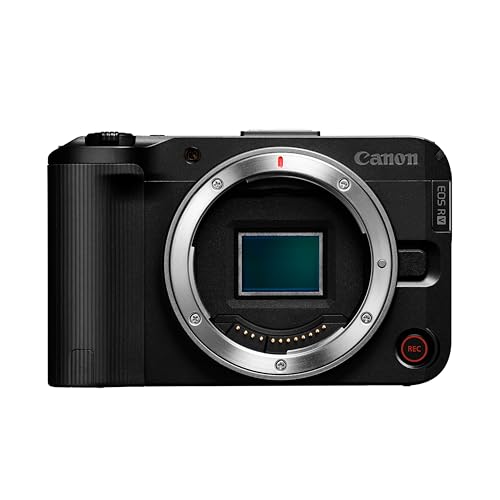
Canon EOS R50 V Body — Video-first body only
The R50 V rearranges the beginner equation: the money goes into the body, and the lens becomes a separate decision. Canon’s title describes an APS-C sensor of 24.2 megapixels, fast autofocus, and a design brief aimed squarely at vlogging and live streaming, sold as body only. Read that last phrase twice. A first-time buyer who unboxes this camera without ordering glass owns a sophisticated paperweight until a lens arrives.
Handled knowingly, body-only is a liberation rather than a trap. The standard kit zoom is the lens many creators replace first anyway, because filming yourself at arm’s length demands a wider view than 18mm on APS-C comfortably gives. Starting with the R50 V lets that first lens be chosen for the actual job — a wide zoom for a desk setup, a bright prime for a presenter who films in one room — instead of inherited from a bundle.
The title’s mention of an ultra-wide zoom orientation reinforces the streaming intent, even though the body-only box itself contains no lens; treat that phrase as a description of the shooting style the camera courts, not as glass included. What the listing does promise directly is fast autofocus, which for a solo presenter means focus that holds on a face while hands gesture, products lift toward the lens, and the performer moves between a chair and a whiteboard.
Live streaming adds a second audience for this body: the beginner whose camera doubles as a webcam-class device for lessons, gaming streams or remote work presentations. A dedicated mirrorless body in that role delivers a visibly different image from a laptop camera, and the R50 V’s stated purpose puts it at the front of this guide for that job.
Stills remain part of the package — 24.2 megapixels is the same resolution class as the R50 kit — so the R50 V is not a video-only appliance. It is better understood as the choice for a beginner whose filming plans are concrete enough to name, and whose stills can ride along on whichever lens the video work required.
- Sensor: APS-C, 24.2 megapixels
- Configuration: body only — no lens included in this listing
- Autofocus: described as fast in the listing title
- Stated roles: vlogging and live streaming for content creators
- Video resolution: Not stated in the listing title — verify with the manufacturer documentation
Strengths
- Body-only pricing leaves the lens budget free for a purpose-chosen first lens
- Fast autofocus serves solo presenters who cannot monitor focus manually
- Streaming and vlogging intent is explicit rather than implied
Trade-offs
- No lens in the box, so the true starting cost is body plus glass
- Video resolution is not stated in the title and must be confirmed in documentation
- Creator orientation may overwhelm a stills-only beginner with unused modes
Best for: an aspiring streamer seeking a body designed around vlogging, with a separate lens purchase already planned
Not suited for: an all-in-one first purchase, since the body-only box contains no lens for day-one shooting
Desk streamers should think about the R50 V as furniture as much as camera: it will live on a small tripod or mount beside a monitor, aimed at a chair, lit by whatever serves the room. That permanent readiness is the real product. A camera that must be fetched, assembled and framed before every session gets used weekly; one already waiting gets used daily, and daily use is what turns a beginner into a presenter.
Anyone choosing the R50 V should open the listing beside a lens shortlist and price the pair together, because the meaningful figure for this pick is the combined cost of body and first glass, not the body figure alone.

Canon EOS RP with RF 24-105mm Lens Kit — Compact full-frame route
The EOS RP breaks this guide’s APS-C pattern. Its listing pairs a full-frame interchangeable-lens body with the RF 24-105mm F4-7.1 IS STM zoom, and describes the combination as compact and lightweight for travelling and vlogging. For a beginner, full frame is less about prestige than about two practical gifts: gentler behaviour in dim light and shallower depth of field for portraits, both arriving in a body that does not punish a day of sightseeing.
Sensor size also changes the lens conversation. The 24-105mm zoom on a full-frame body covers a genuinely useful span — wide enough for a street scene or a hotel room, long enough for a portrait with separation or a detail across a market square. A travelling beginner can leave home with this single lens and return with a varied album, which is precisely the promise the title’s travel framing makes.
Notice what the title does not state: a megapixel count. Many beginners shop by that number, and its absence here is a useful discipline. The spec box below records the omission plainly rather than filling it from memory of the model’s launch coverage. What the listing confirms — full-frame format, the named kit zoom, the compact build — is enough to place the RP in this guide; finer figures belong to Canon’s documentation.
Who should consider skipping the APS-C queue entirely? The beginner who already knows their subjects: a partner’s portraits, a child’s first theatre performances, cafés and old towns on evening walks. Those scenes reward the larger sensor immediately, and the RP’s modest body keeps the full-frame experiment from feeling like a professional commitment.
The counterweight is the ecosystem’s price of admission over time. Full-frame RF lenses generally cost more than their RF-S counterparts, and a beginner who later craves several primes will feel that difference. The kit zoom delays the issue gracefully — it may be the only lens a travel photographer needs for years — but the RP is the one pick here whose future glass bill deserves a clear-eyed forecast.
- Sensor: full-frame (megapixel count not stated in the listing title)
- Kit lens: RF 24-105mm F4-7.1 IS STM
- Build: described as compact and lightweight in the title
- Stated roles: travelling and vlogging
- Resolution detail: Not stated in the listing title — verify with the manufacturer documentation
Strengths
- Full-frame sensor in the most travel-friendly body shape in this guide
- 24-105mm kit zoom covers wide scenes through portrait distances alone
- Direct entry into the full-frame RF lens family from the first purchase
Trade-offs
- Megapixel count absent from the title, so spec shoppers must check documentation
- F4-7.1 kit zoom is slow at its long end despite the larger sensor
- Future full-frame lenses typically cost more than RF-S equivalents
Best for: a travel-minded beginner seeking full-frame portraits and evening scenes from a compact single-lens kit
Not suited for: a tight long-term lens budget, since full-frame RF glass carries higher prices than the RF-S range
Portraiture is where the RP quietly justifies itself to a beginner household. The full-frame sensor behind a 24-105mm zoom lets a new photographer stand back, zoom toward the longer end and watch a cluttered living-room background soften into something gentle — an effect smaller formats work harder to produce. Family pictures are the genre most beginners actually shoot, and a body that flatters them from the first month earns its place on the shelf.
On the RP’s page, confirm that the configuration on offer is the 24-105mm kit rather than a body-only listing, because the travel value argued here depends entirely on that zoom arriving in the same box.

Canon EOS R10 Two-Lens Bundle — Reach included from day one
Most beginner kits whisper a warning: someday you will want a longer lens. This R10 bundle simply includes it. The listing combines an 18-150mm standard zoom with a 75-300mm telephoto, wrapped around a 24.2 megapixel APS-C body with 4K video, and adds a 64GB memory card and a camera bag. It is the only linked pick here that answers the second-lens question before it is asked.
The pairing teaches focal length faster than any tutorial. The 18-150mm is the daily lens — wide at one end, respectably long at the other — while the 75-300mm exists for the subjects that refuse to approach: a heron across a pond, a grandchild mid-field during a school match, aircraft at a fence line. A beginner who owns both learns within a month which lens their eye reaches for, and that self-knowledge steers every later purchase.
Bundle economics deserve a calm look. Cards and bags are unglamorous, yet a missing memory card has delayed more first outings than any specification gap, and the included 64GB card plus a bag mean this kit can travel the day it arrives. The bundle’s value is therefore partly logistical: fewer separate orders, fewer forgotten accessories, one delivery between the buyer and a working two-lens system.
The R10 body itself sits a rung above the R100 and R50 in Canon’s beginner ladder as presented by this lineup, and its 24.2 megapixel APS-C sensor with 4K video matches the guide’s creator expectations. A buyer whose interests already lean toward action — pets at full sprint, children on bicycles, birds in a garden — will appreciate a kit whose telephoto half invites exactly that practice from the first weekend.
Two cautions keep the recommendation honest. First, a 75-300mm telephoto rewards good technique; camera shake magnifies with focal length, so the beginner must budget patience alongside money. Second, neither zoom is a fast lens, so the bundle’s reach does not solve dim light. It solves distance, completely and immediately, which is the problem its buyer actually has.
- Sensor: 24.2 megapixel APS-C
- Lenses: 18-150mm and 75-300mm zooms included
- Video: 4K, as stated in the listing title
- Bundle extras: 64GB memory card and camera bag
- Positioning per title: travel compact, for photography and video
Strengths
- Telephoto reach included, curing the commonest second purchase in advance
- Card and bag in the box make the kit outing-ready on arrival
- 18-150mm everyday zoom reduces lens swapping for mixed subjects
Trade-offs
- Two zooms to carry when the telephoto’s reach is not needed
- Long focal lengths demand steadier technique from a new owner
- Neither included lens is built for very low light
Best for: a beginner seeking garden wildlife, school sports and travel reach without a follow-up lens order
Not suited for: dim indoor events, where the bundle’s zooms cannot gather light like a fast prime lens
Schools and clubs are this bundle’s natural habitat. A parent on a touchline, a teenager photographing a sibling’s match, a bird group walking a reservoir path — all three need the telephoto’s reach and none needs to research a second lens before starting. The bundle converts intention into practice with unusual directness, and practice, repeated weekly, is the entire secret of becoming good at this.
Check the bundle listing’s contents line against this review before paying — both zooms, the 64GB card and the bag should all appear — because third-party bundles vary and this recommendation rests on that exact combination.
Canon EOS R8 — Prose-only step-up reference
The R8 enters this guide without a link, an image marker for a purchasable listing, or any specification claimed on its behalf, because no listing for it was verified while this guide was assembled. Its role here is different: it marks the direction a Canon beginner travels after the first body has taught its lessons, and including it — clearly labelled as prose-only — gives new buyers a landmark for planning rather than a product to click.
Why plan around a step-up at all? Because the commonest beginner regret is not buying the wrong first camera; it is buying first lenses carelessly, then discovering the next body sits in a different corner of the system. Starting on an APS-C R-series body and keeping the R8 in mind as a possible destination leads to the right question at every lens purchase: does this glass still make sense if my body changes?
That question has a practical answer inside Canon’s RF family. Lenses bought for the mount remain part of the photographer’s kit as bodies evolve, which is why this guide spends so much of its length on glass rather than on body specifications. The R8’s presence, even unlinked, turns the beginner decision from a single transaction into the first move of a longer, cheaper strategy.
Timing matters as much as direction. A step-up body only earns its cost when the photographer can name the limitation it removes — a kind of light, a kind of subject, a kind of work the first body genuinely cannot do. Until that sentence can be finished honestly, the R100, R50 or R10 in hand is the right camera, and the R8 is best kept as a bookmark.
Readers who want the R8’s confirmed specifications should go to Canon’s own documentation rather than to any summary here, since this guide deliberately prints none. When a verified listing becomes available it can be judged by the same standards applied to the five linked picks: kit completeness, stated video capability, and the lens story that surrounds the body.
- Link status in this guide: prose-only, no Amazon link
- Specifications: Not stated in the listing title — verify with the manufacturer documentation
- Role here: step-up reference within the Canon RF system
Strengths
- Gives beginners a named destination when planning lens purchases
- Keeps the RF system story coherent across the guide’s price ladder
- Labelled without a link, so its status can never be mistaken
Trade-offs
- No verified listing here, so no price or availability guidance is offered
- No specifications are printed for it in this guide
- As a step-up, it answers needs a true beginner may never develop
Best for: a planner seeking a named future destination inside the RF system while choosing today’s first body
Not suited for: an immediate purchase decision, since this guide carries no verified listing or specification set for it
There is also a budgeting virtue in the R8’s unlinked status: it cannot be impulse-bought from this page at midnight. A step-up deserves the slower path — documentation read, current body’s limitations listed, lens compatibility checked twice. Beginners who adopt that rhythm for their second body usually keep it for every later purchase, and it saves them more money than any single discount ever will.
Because the R8 is prose-only here, the practical action is a documentation visit rather than a checkout: read Canon’s own pages for it, then return to the linked five with a clearer sense of how far each first body can travel.
Comparison Table
| Pick | Sensor | Lens in the box | Video per title | Defining trait |
|---|---|---|---|---|
| Canon EOS R100 | 24.1MP APS-C | RF-S 18-45mm F4.5-6.3 IS STM | 4K | Wi-Fi and Bluetooth sharing |
| Canon EOS R50 | 24.2MP APS-C | RF-S 18-45mm F4.5-6.3 IS STM | 4K | Vlogging and content creation framing |
| Canon EOS R50 V | 24.2MP APS-C | None — body only | Not stated in the listing title | Fast autofocus for streaming |
| Canon EOS RP | Full-frame | RF 24-105mm F4-7.1 IS STM | Not stated in the listing title | Compact travel body |
| Canon EOS R10 bundle | 24.2MP APS-C | 18-150mm plus 75-300mm | 4K | Card and bag included |
| Canon EOS R8 | Not stated in the listing title | Prose-only, no listing | Not stated in the listing title | Step-up reference, unlinked |
How to Choose Your First Canon Mirrorless Camera
Start with the photograph you keep failing to take with a phone. If it is a smiling face across a garden, reach is your problem and the R10 bundle answers it. If it is a partner’s portrait in a candlelit restaurant, light is your problem and the full-frame RP deserves the shortlist. If it is your own face, mid-explanation, on camera, the R50 or R50 V was framed for you. Naming the failing photograph honestly eliminates most of the catalogue in one step.
Next, decide whether the lens question should be settled or postponed. Kits settle it: the R100 and R50 arrive ready, and the RP’s 24-105mm zoom is the most versatile single lens in this guide. The R50 V postpones it deliberately, which suits the shopper fond of choosing and endangers the shopper who is not. Be truthful about which kind of shopper you are; a body-only bargain that waits three months for a lens is no bargain at all.
Then weigh the system bill, not the body bill. Every camera here joins the RF mount, but APS-C RF-S lenses and full-frame RF lenses live at different price levels, and your second year of ownership will spend more on glass than your first day spent on the body. A beginner with modest glass ambitions is genuinely better served by the APS-C kits, whose savings compound with each lens.
One more filter, applied quietly throughout: support and community. Canon’s RF system carries deep tutorial coverage, active owner groups and a healthy second-hand lens market in most countries, which matters when a beginner’s real teacher is often a stranger’s forum answer at midnight. A first camera is partly a membership, and every pick here buys into the same large, well-documented club — another reason the choice among them can rest on subjects and glass rather than on fear of picking an orphan system.
Finally, handle the decision about video with the same honesty. Claiming you will vlog “someday” has sold many creators’ cameras to people who only ever take stills. The listings here make the split visible: the R50 V declares streaming intent, the R50 balances both crafts, and the R100 keeps video as a useful extra. Buy the orientation you will use this winter, not the identity you might adopt next year.
Do Beginners Need Full Frame, or Is APS-C the Smarter Start?
For most first-time owners, APS-C is the smarter start, and this guide’s balance reflects that: four of the five linked picks use the smaller sensor. APS-C kits are lighter to carry, cheaper to expand and entirely sufficient for the prints and screens where beginner work lives. The 24-megapixel class sensors in the R100, R50 and R10 leave generous room to crop, which quietly forgives the framing errors every beginner makes.
Full frame earns its premium in specific scenes rather than in general. Dim interiors without flash, portraits where background separation is the whole point, and wide scenes shot after dusk all show the larger sensor’s advantage. The RP exists in this guide for the beginner whose subject list is already dominated by those scenes. Buying full frame “just in case” usually means paying more for lenses to solve problems the photographer never meets.
Which Kit Lens Should a Beginner Grow Beyond First?
The standard 18-45mm zooms in the R100 and R50 kits are teaching instruments: they cover the everyday range and reveal, over a few hundred photographs, whether your eye prefers wide scenes or closer framings. The natural graduation is a fast prime at whichever end of that range your favourite pictures cluster — wide for rooms and streets, longer for faces. That purchase, guided by your own archive, almost never disappoints.
Bundle owners graduate differently. The R10’s two zooms already span wide to telephoto, so its owner’s first upgrade is usually about light rather than reach: a brighter lens for evenings. RP owners, holding a 24-105mm zoom, often add nothing for a long while, because that lens’s span postpones every common itch. In each case the kit’s shape, more than the body’s badge, writes the upgrade list.
How Much Video Should a First Camera Really Offer?
Enough to capture the moments that move, in the quality your screen can show. The linked R100, R50 and R10 listings all state 4K video, which future-proofs family footage and satisfies any current sharing platform. Beyond resolution, the beginner videographer’s real needs are humble: reliable autofocus, a screen that can be seen while filming, and audio that does not embarrass the picture — needs the creator-framed R50 and R50 V address most directly in this lineup.
Resist paying for video depth you cannot yet use. Advanced colour profiles, external recording and streaming rigs all belong to a second phase of learning. A first camera that records clean 4K with honest autofocus will carry a beginner through years of birthdays, holidays and first channels, and its limitations will announce themselves clearly when — and only when — the owner has genuinely outgrown them.
What Should the First Three Months With a New Camera Look Like?
Month one belongs to the automatic and semi-automatic modes, used without shame. Walk the same route weekly with the kit zoom, photograph the same doorway, market stall or dog at different hours, and review the results at full size. The goal is not masterpieces; it is a personal map of what light does, drawn with your own streets. Beginners who skip this wandering phase and jump straight to manual settings usually learn the dials while missing the seeing.
Month two is for one deliberate constraint at a time. Spend a week at the zoom’s wide end only, learning how much a scene can hold; spend another at its long end, learning how backgrounds stack behind a subject. Add a week of evenings, discovering where your kit’s light limit truly sits, and a week of moving subjects — children, cyclists, pets — where focus and shutter choices stop being theoretical. Each constraint converts a menu item into a memory.
Month three is for printing and judging. Put twenty favourite frames on paper, even cheaply, and live with them on a wall for a fortnight. Print exposes soft focus, crooked horizons and dull colour with a honesty no screen matches, and it tells you precisely which limitation is yours rather than the camera’s. Most beginners discover the photographer needs the upgrade, not the body — the healthiest and cheapest discovery in the whole hobby.
Across all three months, keep the camera reachable. A body stored in a cupboard between outings gathers no habits, while one resting by the door photographs breakfast light, a cat’s expression and rain on a window without ceremony. The picks in this guide were chosen partly for that domestic portability; honour it by treating the camera as a household object, not ceremonial equipment.
When Does a Second Lens Beat a Second Body?
Almost always, for a beginner. A new lens changes what your photographs can look like — wider rooms, softer portraits, nearer wildlife — while a new body mostly changes how the same pictures feel to take. The photographer who cannot yet name a scene their current body failed has a lens-shaped problem, and this guide’s kits were ordered with that truth in mind: the R10 bundle pre-empts it, the RP’s zoom postpones it, and the R50 V forces it to be faced immediately.
The exception arrives when the limitation is genuinely mechanical: a body that cannot film the format a channel needs, or one whose handling fights the photographer’s hands. Those cases announce themselves through repeated, specific frustration rather than through browsing. Until that announcement, glass first — and keep the prose-only R8 as the reminder that a destination exists when the announcement finally comes.
Should a Beginner Buy One Versatile Zoom or Start Collecting Primes?
A zoom first, and the reasoning is educational rather than financial. A variable focal length lets a new photographer stand in one spot and audition several framings of the same scene within seconds, which is the fastest composition lesson available. The kit zooms bundled with the R100, R50 and R10, and the RP’s longer 24-105mm, all serve as that auditioning tool. A prime lens, fixed at one focal length, teaches a different lesson — moving your feet, pre-visualising a frame — and it teaches it best to someone who already knows which focal length their zoom kept visiting.
Your own files will identify that focal length. After a few months, sort your favourite photographs by the zoom setting they used; most beginners find a cluster, often near one end of the range. The first prime belongs at that cluster, where it will be used weekly, rather than at a focal length a forum recommended. Bought that way, a prime feels like a promotion. Bought blindly on day one, it often becomes the expensive lens that stays home while the humble kit zoom does the work.
There is one exception worth naming: the body-only R50 V buyer cannot audition anything until a first lens exists. For that buyer, a versatile zoom is still the safer first glass unless the filming setup is already fixed — a known desk, a known distance, a known framing — in which case a prime chosen for exactly that geometry is a rational shortcut rather than a gamble.
Common Mistakes When Buying a First Mirrorless Camera
Judging the body and forgetting the glass
Beginners compare sensors for a week and lenses for an afternoon, then live with the consequences for years. The lens in the box decides your first year’s pictures more than any body specification, so read each kit’s zoom range and aperture figures as carefully as its megapixels. The R50 V makes this mistake impossible to hide from — it forces the lens decision into the open — while the kits make it easy to sleepwalk past.
Assuming every Canon name means mirrorless
Canon’s catalogue spans two eras, and older DSLR names like the Rebel T7 still appear in beginner roundups and second-hand listings. A DSLR can be a fine camera, but it takes different lenses and offers a different shooting experience from the RF mirrorless bodies in this guide. Check which family a model belongs to before comparing its price against these picks, or the comparison is meaningless from the start.
Buying reach before learning steadiness
The R10 bundle’s 75-300mm telephoto tempts new owners to shoot everything at maximum zoom, where shake blurs what distance promised to reveal. Long lenses reward braced elbows, faster shutter speeds and patience. Spend the bundle’s first month mostly on the 18-150mm, and let the telephoto out for deliberate subjects rather than as a default.
Ignoring the transfer habit
A camera whose pictures never leave the card is a camera that gets left at home. The R100’s stated Wi-Fi and Bluetooth exist to close the gap between shooting and sharing; whichever pick you choose, build the transfer ritual on day one, while enthusiasm is high. Habits formed in the first week decide whether a beginner camera becomes a daily companion or a shelf ornament.
Final Recommendation
For the broadest group of beginners, the EOS R50 kit is the balanced answer: a 24.2 megapixel APS-C sensor, a ready-to-shoot zoom, 4K video and a creator-friendly brief that still takes family stills seriously. Choose the R100 instead when simplicity and the gentlest learning curve matter most, and the R10 bundle when distant subjects are already your passion. The RP is the deliberate exception for the travel-and-portrait beginner who wants full frame now, while the R50 V belongs to the committed new streamer who welcomes choosing a first lens. The unlinked R8 can wait, as step-ups should, until your current body shows you exactly why you need it.
A word about buying timing, since beginners often ask whether to wait for a successor model. Camera bodies improve incrementally, while photographs missed during a season of waiting do not return. Every pick here is a current, supported member of Canon’s RF family with a lens ecosystem that will outlast several body generations. Buy when the subject is in front of you — a new baby, a booked trip, a channel ready to launch — and let the small premium of immediacy be repaid in pictures no future discount can recreate.
Weather and handling form the last practical filter. None of these listings claims sealing or ruggedisation in its title, so treat every pick as a fair-weather companion until Canon’s documentation says otherwise: a strap always on, a bag when rain threatens, and two hands near water or cliff edges. Beginners underestimate how much of camera ownership is simply carrying the thing safely through ordinary life, and the photographer who builds those reflexes early keeps their first body long enough for it to become a familiar tool rather than a repair bill.
Frequently Asked Questions
Is the Canon EOS R100 or the R50 better for a complete beginner?
The R100 is the simpler starting point, with its kit built around straightforward stills and 4K video for new photographers. The R50 suits a beginner who already expects to film themselves, since its listing frames it around vlogging and content creation. Both use a 24-megapixel-class APS-C sensor and the same RF-S 18-45mm kit zoom, so the choice is about orientation rather than image quality.
Can these Canon mirrorless cameras use older Canon DSLR lenses?
The bodies in this guide belong to Canon’s RF mirrorless system, which is a different mount family from the DSLR era. Lens compatibility questions deserve a careful answer from Canon’s own documentation for your specific older lens, because adapters and exceptions exist. What matters for a beginner is the principle: budget for RF or RF-S glass as the native path, and treat any older lens as a bonus to verify, not a foundation to build on.
Why is the EOS R8 included without a link?
No listing for the R8 was verified while this guide was prepared, so it appears as a clearly labelled prose-only reference rather than a purchasable recommendation. Its role is to give beginners a step-up landmark inside the RF system when planning lens purchases. Its specifications are intentionally not printed here; Canon’s documentation is the right source for them.
Is the Rebel T7 a mirrorless camera?
No. The Rebel T7 is a DSLR, with a mirror and an optical viewfinder, and it belongs to Canon’s older EF-S lens family. It is mentioned in this guide only to prevent a common mix-up, because its name appears in many beginner conversations. Every pick reviewed above is a mirrorless RF-mount camera.
Which pick should a beginner who films for social media choose?
The R50 V is the most specialised answer, with a body-only design brief built around vlogging and live streaming and fast autofocus stated in its title. The R50 kit is the gentler alternative when a lens must be included and stills matter equally. Either way, plan the lens for the filming distance you actually use — a desk, a kitchen counter or arm’s length — before ordering.
How long should a first camera last before an upgrade makes sense?
Two years of regular shooting is a fair expectation for any pick here, and many owners will stretch it far longer. The upgrade moment is recognisable: you can describe, in one sentence, the photograph your current body keeps failing to deliver, and the failure is the equipment’s rather than your technique’s. Until that sentence exists, money spent on lenses, practice and printing improves pictures more reliably than a new body does.
Your first Canon should feel like an invitation rather than an examination, so pick the body whose kit matches the pictures you already chase, learn it until its controls disappear from your thoughts, and let the photographs themselves tell you when a second lens — or a step-up body — has truly been earned.
Related Guides
Continue comparing with our guide to the best mirrorless cameras for stills, explore mirrorless cameras with quick autofocus and 4K video, or plan bigger scenes with mirrorless cameras for landscape and wildlife photography.


