What's inside
- Where to Buy
- Introduction
- Key Takeaways
- Quick Picks
- How We Chose These Picks
- Comparison
- How to Choose an Inexpensive Mirrorless Camera
- Does Sensor Size Matter at This Price, or Is It Snobbery?
- Should a Beginner Buy a Kit Lens or Start With a Prime?
- Which Tests Should a First-Time Mirrorless Buyer Run Before the Return Window Closes?
- How Long Will a Starter Camera Stay Good Enough?
- Common Mistakes When Buying a First Mirrorless Camera
- Final Recommendation
- Frequently Asked Questions
- Related Guides
As an Amazon Associate I earn from qualifying purchases. This post may contain affiliate links at no extra cost to you.
widgetverdict.com is reader-supported. When you buy through links on our site, we may earn an affiliate commission.
Where to Buy
Five of the six cameras below carry Amazon listings you can open directly, and each name in this box links to its own page. The Canon EOS R100 kit opens the line-up — its Amazon page shows the live figure for the body with the RF-S 18-45mm lens. The Sony ZV-E10 with its 16-50mm lens sits alongside it, and its listing is the place to confirm today’s number. Shoppers leaning toward the smaller Micro Four Thirds mount can pull up the Panasonic Lumix G100 kit and read its price there, while the newer Sony ZV-E10 II body is sold without a lens, so factor glass into whatever its page quotes. The Panasonic Lumix G97 with the 12-60mm lens rounds out the linked five; its listing carries the current cost of the widest zoom range in this guide.
Introduction
Searching for the best inexpensive mirrorless cameras used to mean accepting a camera that felt like a compromise in the hand and a disappointment on the memory card. That bargain has changed shape. The six cameras gathered here start from sensors of 24 megapixels or more, all of them shoot 4K video in some form, and five of them take interchangeable lenses on mounts with deep second-hand markets behind them. Inexpensive in this guide is a qualitative position — the lower shelf of each maker’s current mirrorless range — rather than a printed number, because street prices move weekly and a figure frozen into an article would mislead within a month.
One honest exception needs naming at the door. The sixth entry, the Canon EOS Rebel T7, is not a mirrorless camera at all: it is a DSLR, included deliberately and labelled as such throughout, because its kit price tier and its beginner brief overlap so heavily with the mirrorless starters that many shoppers meet it on the same search results page. It appears as prose only, with no purchase link in its review heading, and the review itself explains when the older design still makes sense and when it plainly does not.
Every specification quoted below comes from the listing title of that exact camera. Where a title stays silent — on stabilisation for several models, on viewfinder details for most — the spec box records the silence with the standard not-stated wording instead of borrowing numbers from a review elsewhere. Match the model code in each title at checkout, because Canon, Sony and Panasonic all sell near-identical names separated by a suffix and a different bundle.
One last word on the word inexpensive itself. It describes a shelf, not a promise: these are the entry models of living systems, priced by their makers to recruit photographers who will buy lenses for a decade. That recruitment logic works in the buyer’s favour — the bodies are subsidised by the ecosystem behind them — provided the buyer actually wants the ecosystem. Read each review as two purchases, the camera in the hand and the catalogue behind it, and the guide’s ordering matters less than its map of which future each first step commits you to.
Key Takeaways
- Five picks are true mirrorless cameras across three mounts: Canon RF-S, Sony E and Micro Four Thirds; the sixth, the Rebel T7, is a DSLR alternative covered in prose only.
- Sensor sizes split the field: the two Canons and two Sonys use APS-C sensors of 24.1 to 26 megapixels, while both Panasonics use the smaller Micro Four Thirds format.
- All five linked cameras record 4K video according to their titles, though the frame-rate ceilings differ — the ZV-E10 II reaches 4K at up to 60 frames per second.
- Only the two Panasonics state stabilisation in their titles: 5-Axis Hybrid I.S. on the G100 and a hybrid design brief on the G97.
- Kit lenses decide real-world value here: the G97 ships with a 12-60mm zoom, the widest range in the group, while the ZV-E10 II is body only.
Quick Picks
| Pick | Badge | Why it earns a place |
|---|---|---|
| Canon EOS R100 | Sensible Canon starter kit | 24.1 megapixel APS-C sensor, 4K video and an RF-S 18-45mm kit lens in one box. |
| Sony ZV-E10 | Creator screen and focus | Side flip-out touchscreen, 425-point autofocus and UHD 4K30p video with a 16-50mm lens. |
| Panasonic Lumix G100 | Smallest complete kit | Micro Four Thirds body with a 12-32mm lens, tracking microphone and 5-Axis Hybrid I.S. |
| Sony ZV-E10 II | Newest sensor, body only | 26 megapixel Exmor R sensor and 4K up to 60fps for buyers who already own E-mount glass. |
| Panasonic Lumix G97 | Longest kit zoom | A 12-60mm lens in the box and a hybrid stills-and-video brief for content creators. |
| Canon EOS Rebel T7 | DSLR alternative, prose only | A 24.1 megapixel DSLR kit with Full HD video for shoppers who prefer an optical viewfinder. |
How We Chose These Picks
Selection began with the mount question, because an inexpensive first camera is really the purchase of a lens system at a starter price. The six had to spread across the mounts a beginner is actually choosing between in 2026: Canon’s RF-S line, Sony’s E mount, and Micro Four Thirds as shared by Panasonic and OM System. A guide that picked six cameras on one mount would be answering a narrower question than the keyword asks, so each mount gets representation and each review states plainly what joining that system commits you to later.
The second pass read every listing title line by line and treated anything unstated as unknown. That discipline shaped the shortlist in visible ways. Cameras whose titles could not confirm 4K video were set aside, since hybrid shooting is the baseline expectation at this tier now. The Rebel T7 survived the same reading only as a labelled exception: its title confirms a DSLR design and Full HD video, so it enters as the honest counterpoint rather than as a mirrorless pick wearing a disguise.
Bundle arithmetic did the third pass. A body-only camera and a kit camera at similar shelf positions are not similar purchases, so the reviews keep the included lens — or its absence — in the foreground. The G97’s 12-60mm zoom covers noticeably more ground than the 18-45mm and 12-32mm kits beside it, and the ZV-E10 II’s empty box is priced into its verdict rather than mentioned as an afterthought. Beginners budgeting for a first camera should read the lens line of each spec box before the sensor line.
Finally, each camera had to offer a plausible second act. Starter cameras get handed down, become webcam-adjacent second bodies, or follow a teenager to college. Standard mounts, ordinary batteries and a size that fits a normal bag all count toward that, and exotic one-off designs were treated with suspicion on exactly that ground. The six below can each plausibly still be earning their keep in year four, which matters more at this end of the market than a headline feature used twice.

Canon EOS R100 — Sensible Canon starter kit
Canon’s entry point into its RF mirrorless system pairs a 24.1 megapixel APS-C CMOS sensor with the RF-S 18-45mm F4.5-6.3 IS STM kit lens, and that pairing defines the camera’s character: ordinary on paper, coherent in practice. The sensor size is the same class found in Canon bodies costing considerably more, so image quality at the centre of the frame is not where the saving was made. The saving shows instead in the simpler control layout and the modest kit zoom, both of which a first-time buyer experiences as approachability rather than deprivation during the first months of learning.
Video earns a line in the title — 4K recording is confirmed there — alongside Wi-Fi and Bluetooth for moving pictures to a phone. For a beginner, that wireless path matters out of proportion to its specification-sheet size: the camera that shares easily is the camera that keeps getting carried, and the R100’s connectivity removes the card-reader ritual that quietly kills many first cameras. The kit lens carries image stabilisation in its name, the IS designation, which helps handheld stills at the long end of its short range.
This suits the photographer stepping up from a phone who wants Canon colours, Canon menus and a genuine upgrade path. Every RF and RF-S lens Canon sells fits this body, so the second purchase — a fast prime for portraits, most likely — lands on a mount with years of releases ahead of it. Families documenting school years, travel and ordinary weekends will find the kit lens range covers the walkaround band where most of those photographs live.
The constraints are equally concrete. The kit zoom’s aperture narrows to F6.3 at its long end, which pushes indoor evening shooting toward higher sensitivity settings sooner than a faster lens would. The title states no in-body stabilisation, so video walkers rely on the lens IS alone. And the title gives no frame rate for its 4K mode, a silence the spec box preserves; buyers for whom smooth high-rate video is the whole point should read the ZV-E10 II review below before deciding.
- Sensor: 24.1 Megapixel CMOS (APS-C)
- Kit lens: RF-S 18-45mm F4.5-6.3 IS STM
- Video: 4K Video (frame rate not stated in the listing title)
- Connectivity: Wi-Fi and Bluetooth
- In-body stabilisation: Not stated in the listing title — verify with the manufacturer documentation
- Mount: Canon RF (implied by RF-S kit lens in the listing title)
Strengths
- A full APS-C sensor at the entry shelf, matching the format of Canon’s pricier RF-S bodies.
- The kit lens includes optical stabilisation, named IS in the lens designation.
- Wi-Fi and Bluetooth are confirmed in the title, so phone sharing needs no extra hardware.
Trade-offs
- The kit zoom reaches only 45mm and narrows to F6.3 at that end.
- No 4K frame rate is printed in the title, so video buyers must verify before ordering.
- In-body stabilisation is not claimed anywhere in the listing title.
Best for: a first interchangeable-lens camera for stills-led family and travel photography on the Canon RF mount. Not suited for: handheld video work at dusk, where the F6.3 long end of the kit zoom and the absence of stated in-body stabilisation combine into visible shake and noise.
Ownership economics favour patience with this body. Learn the kit zoom’s range for a season, note which end of it your photographs cluster at, and let that histogram — not a sale banner — choose the second lens. The R100 also makes a gentle introduction to Canon’s menu logic, so skills transfer cleanly when a later body arrives. If the current figure tempts you, open the Amazon listing and check the price on the R100 kit today, then compare it against the cost of adding one prime lens, because that two-item basket is the realistic first-year spend.
Day-to-day handling reinforces the starter brief. The body is the camera a nervous beginner can learn in an afternoon: the kit zoom covers the standard walkaround span, the menus speak Canon’s long-established dialect, and the wireless transfer means the first successful photograph reaches a phone within minutes of being taken, which is the moment a new hobby either catches fire or quietly cools. Treat that early momentum as a feature in its own right, because at this shelf the cameras that get used are the ones whose results are easiest to share, and the R100 is engineered around exactly that loop of shoot, send and show.

Sony ZV-E10 — Creator screen and focus
Sony built the original ZV-E10 around a screen and a microphone jack philosophy rather than around a viewfinder, and its title tells that story plainly: a 3.0-inch side flip-out touchscreen, UHD 4K30p video and a 425-point autofocus system wrapped around a 24.2 megapixel APS-C sensor. The flip screen swings to face the person in front of the lens, which is the single feature that separates a camera a creator uses daily from one that lives in a drawer. Solo presenters can frame themselves without a monitor, a second person or a guessing game.
The autofocus point count is the title’s other loud claim. Four hundred twenty-five points spread across an APS-C frame means the camera can hold a face or a product near the edges of a composition, not only at its centre, and for demonstration-style video — holding objects up to the lens, moving between desk and face — that coverage is the practical difference between footage that survives editing and footage that gets deleted. The bundled 16-50mm OSS II kit lens adds optical stabilisation in the lens, named OSS, which steadies handheld clips at arm’s length.
Suits the talking-head and product-table creator first, and the hybrid shooter second. The E mount behind this body is the deepest lens catalogue in this guide, shared across Sony’s whole APS-C and full-frame range, so a creator who outgrows the kit zoom steps into a crowded second-hand market rather than a boutique one. Students filming coursework, small sellers filming stock, and presenters recording lessons all sit inside this camera’s brief.
Boundaries deserve the same clarity. The title confirms 4K at 30 frames per second and no higher, so slow-motion ambitions at 4K end at the spec box. No in-body stabilisation is stated; steadiness comes from the kit lens’s OSS, which means a non-stabilised prime lens later removes that help entirely. The title also names no electronic viewfinder, consistent with the line’s screen-first design, so bright-daylight outdoor stills are composed on a rear screen that the sun will fight.
- Sensor: 24.2MP APS-C
- Kit lens: 16-50mm OSS II
- Video: UHD 4K30p
- Autofocus: 425-Point AF
- Screen: 3.0-inch side flip-out touchscreen
- In-body stabilisation: Not stated in the listing title — verify with the manufacturer documentation
Strengths
- The side flip-out screen faces the presenter, enabling solo framing without accessories.
- 425 autofocus points give wide frame coverage for faces and held-up products.
- The kit lens carries OSS stabilisation for steadier handheld clips.
Trade-offs
- 4K recording tops out at 30p in the title, limiting smooth slow motion.
- Stabilisation lives in the kit lens, not in the body, per anything the title states.
- No viewfinder is named in the title; composition is screen-based.
Best for: solo video creators filming themselves and their products at a desk or in a small room. Not suited for: outdoor stills photography in hard midday sun, where the absence of a named viewfinder leaves a rear touchscreen as the only framing tool against glare.
Plan the audio side early with this one. The ZV line was designed around external microphones and wind protection, and a modest microphone transforms its output more than any lens upgrade at this level. Treat the kit zoom as a framing tutor for the first months: its range teaches which focal lengths a channel actually uses, and that knowledge should steer the eventual prime purchase. Before ordering, look at the ZV-E10 listing on Amazon to check its current price alongside a basic microphone, since the pair together is the honest starter basket for this camera.
Consider also what the 425-point figure does for stills, because the ZV-E10 is easy to pigeonhole as a video tool. Faces at a birthday table, a dog crossing a garden, a market stallholder caught mid-gesture: wide autofocus coverage means the sharp point can sit where the subject is rather than dragging every composition back to the centre. Paired with the flip screen for low and high angles, the camera encourages the kind of playful framing that beginners often postpone until they own a more serious body. The lesson cuts the other way as well — a creator who discovers they mostly photograph, and rarely present to camera, will feel the screen-first design’s compromises sooner than the hybrid shooter will.

Panasonic Lumix G100 — Smallest complete kit
The G100 is the camera in this guide that disappears into a jacket-adjacent bag, and its title explains the trick: a Micro Four Thirds interchangeable lens system with a compact 12-32mm lens, a sensor format physically smaller than the APS-C chips around it, and a design brief aimed squarely at photo-and-video creators. Smaller sensors allow smaller lenses, and the whole kit — body plus the collapsing-style kit zoom class this line is known for — travels in spaces the Canon and Sony kits cannot follow.
Two title claims separate it from the pack. The built-in microphone carries tracking, an unusual feature at this shelf: the camera’s audio pickup follows the subject the frame is following, which serves walking-and-talking footage where a presenter moves through a scene. And 5-Axis Hybrid I.S. is printed outright, combining body and lens stabilisation approaches, so the G100 is one of only two picks here whose title confirms stabilisation at all. For a camera marketed at moving creators, that confirmation is the specification that matters most.
Suits the traveller, the market wanderer, the food-stall documenter — anyone whose best photographs happen far from a car and a tripod. Micro Four Thirds also owns the friendliest used-lens ecosystem in this guide, with two brands of bodies sharing one mount and a long back catalogue of small primes. A beginner can assemble a three-lens travel set for this system in a volume the APS-C kits would need twice the bag to match.
The format’s physics set the limits. A Micro Four Thirds sensor gathers less light per pixel area than the APS-C sensors beside it, so high-sensitivity night work shows noise earlier; the title prints no megapixel count for this model at all, a silence the spec box records rather than fills. The 12-32mm kit range is wide-biased and short at the long end, so distant subjects — stage performers, wildlife, sports across a field — stay small in the frame without a telephoto purchase.
- Sensor format: Micro Four Thirds (megapixel count not stated in the listing title)
- Kit lens: 12-32mm
- Video: 4K
- Audio: Built-in microphone with tracking
- Stabilisation: 5-Axis Hybrid I.S.
- Model code: DC-G100DKK9 (Black)
Strengths
- The tracking built-in microphone serves moving presenters without extra audio gear.
- 5-Axis Hybrid I.S. is confirmed in the title, rare honesty at this price tier.
- Body and 12-32mm lens form the smallest complete kit in this guide.
Trade-offs
- The title states no megapixel figure, so resolution must be verified on the listing.
- The kit zoom ends at 32mm, leaving distant subjects small in frame.
- The smaller sensor format trails APS-C in low-light headroom.
Best for: travel and street creators who carry their camera all day and film as much as they photograph. Not suited for: stage and wildlife subjects beyond roughly twenty metres, where the 32mm long end of the kit zoom cannot fill the frame without heavy cropping.
Think of the G100 as the beginning of a small-system habit rather than a single purchase. Its natural companions are the compact primes of its mount, each the size of a plum, and owners who embrace that scale end up carrying the camera on days the bigger kits stay home — which is where its photographs come from. The tracking microphone also rewards a simple test in the first week: film a walking clip in a busy street and listen back on headphones. If the camera is on your shortlist, the G100 kit’s Amazon page will show you its price today; judge it against the cost of the APS-C kits plus the bag they demand.
Portability compounds in ways a specification table cannot show. A body and lens this small change the bag decision from a dedicated camera bag to a coat pocket or a handbag’s spare corner, and that change multiplies the days the camera is present. Street photographers in particular prize a kit that draws no attention, and the G100’s scale — closer to a compact camera than to the DSLRs its mount replaced — lets its owner work a crowd unnoticed. The trade is grip: larger hands will find the small body a two-finger hold, and gloves in winter make its controls a deliberate exercise rather than a fluid one.

Sony ZV-E10 II — Newest sensor, body only
The second-generation ZV-E10 arrives in this guide as a body only, and that single packaging fact reorganises its entire value argument. Its title leads with a 26 megapixel APS-C Exmor R sensor — the highest resolution printed anywhere in this line-up — and 4K recording at up to 60 frames per second, double the frame ceiling of its predecessor above. A three-inch articulating touchscreen completes the confirmed kit. Everything else about the purchase depends on glass the buyer already owns or must add.
For an existing Sony shooter, this is the cleanest upgrade on the page: lenses, batteries habits and menu memory carry across, and the body brings a newer sensor and smoother 4K to glass that was previously limited by an older camera. The 60fps ceiling matters to a specific and common workflow — filming action, children, pets or process footage at full rate and slowing it in the edit — and it is the only camera here whose title confirms that capability in 4K rather than at a reduced resolution.
Suits the second-camera buyer and the committed creator stepping up from the first ZV-E10 or an older Sony body. It also suits the deliberate minimalists who know exactly which single prime lens they intend to live on and would rather put the whole budget into sensor and video than into a kit zoom they would shelve. What it cannot suit is a true first purchase made in one box, because the box contains no way to take a photograph until a lens joins the order.
Cost the whole basket before admiring the body. A body-only price beside kit prices flatters this camera in any comparison table, and the honest comparison adds at least the 16-50mm class of zoom or a standard prime. The title states no in-body stabilisation, so handheld video steadiness will again depend on the chosen lens’s own stabilisation, if it has any. Buyers mounting an unstabilised prime for walking footage should expect to add a gimbal or accept the shake.
- Sensor: 26MP APS-C Exmor R
- Kit lens: None — body only
- Video: 4K up to 60fps
- Screen: 3-inch articulating touchscreen
- Mount: Sony E-Mount
- In-body stabilisation: Not stated in the listing title — verify with the manufacturer documentation
Strengths
- The 26 megapixel Exmor R sensor is the newest and highest-resolution chip in this guide.
- 4K at up to 60fps doubles the confirmed frame ceiling of the original ZV-E10.
- Body-only packaging suits owners who already hold E-mount lenses.
Trade-offs
- No lens is included, so the true starter cost is body plus glass.
- Stabilisation is not stated in the title; it depends on the lens fitted.
- The articulating screen serves video framing, but no viewfinder is named.
Best for: existing Sony E-mount owners upgrading their video body while keeping their lenses. Not suited for: a one-box first camera purchase, because the body-only package cannot record a single frame until a lens costing a further sum is added.
Run the arithmetic in the open. Put the body in one column and the lens you genuinely intend to mount in the same column, then compare that total with the two kit cameras flanking this review. Many upgraders will still choose it — the sensor and the 60fps ceiling are real advances — but nobody should choose it by accident. When you are ready to test that arithmetic, pull up the ZV-E10 II body on Amazon and check the figure there against your chosen lens’s listing in the same sitting, because the pair, not the body, is the product.
There is a subtler advantage buried in the body-only proposition: it forces the lens decision to be a decision. Kit buyers inherit whatever zoom the bundle includes and often never question it; the ZV-E10 II buyer must name the focal lengths their work needs before spending anything, and that act of naming is the beginning of a deliberate kit. A presenter might choose a wide zoom for a small room, a product channel a standard prime with close focus, a family videographer the same 16-50mm class the kits bundle. Each answer is defensible. What is not defensible is buying the body on a Friday and discovering on Saturday that the saving over a kit was an illusion created by an empty box.
Panasonic Lumix G97 — Longest kit zoom
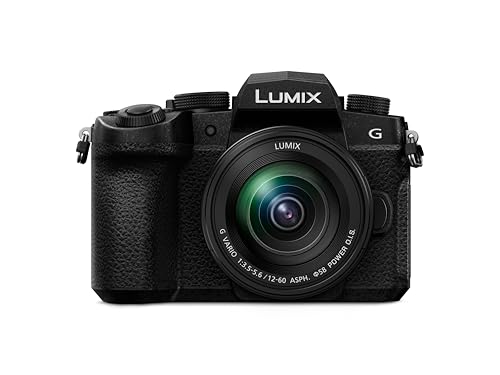
Kit lenses usually whisper their compromises, but the G97’s bundled Lumix G Vario 12-60mm F3.5-5.6 states its ambition in the range itself. Twelve millimetres at the wide end frames interiors and landscapes with room to spare on the Micro Four Thirds format, and sixty at the long end reaches portraits and compressed street scenes that the 18-45mm and 12-32mm kits in this guide simply cannot frame. One lens, carried all day, covering the span that elsewhere demands a bag and a swap: that is the G97’s argument, and for beginners it is a persuasive one.
Panasonic positions the model as a compact hybrid for content creators in photo and video, and the hybrid word does real work in that title. This is the pick for the beginner who refuses to declare a camp — who photographs a Saturday market in the morning and films a cooking session in the afternoon — and wants the kit lens to serve both without negotiation. The Micro Four Thirds mount again brings the small-lens ecosystem and the deep used market described in the G100 review.
Suits the one-lens traveller above all. A 12-60mm range on this format covers wide scenes, environmental portraits and moderate telephoto compression in a single barrel, so the learning photographer can spend a first year discovering which focal lengths their eye prefers before spending anything on primes. That discovery process is the real education a starter camera provides, and a wide-range kit teaches it faster than a narrow one.
Read the title’s silences with the same care as its claims. No megapixel count is printed for the G97 in this listing, and no stabilisation system is named, even though hybrid shooting is the pitch; both gaps sit in the spec box below in the standard wording. The aperture range, F3.5 at wide narrowing to F5.6 at the long end, is typical for the class and means dusk portraits at 60mm will lean on sensitivity. Buyers who need confirmed numbers on resolution or stabilisation should verify them in the manufacturer documentation before treating this as their final answer.
- Sensor format: Micro Four Thirds (megapixel count not stated in the listing title)
- Kit lens: Lumix G Vario 12-60mm F3.5-5.6
- Design brief: Compact hybrid for content creators in photo and video
- Stabilisation: Not stated in the listing title — verify with the manufacturer documentation
- Video resolution: Not stated in the listing title — verify with the manufacturer documentation
- Model code: DC-G97MK9
Strengths
- The 12-60mm kit zoom covers the widest focal span of any bundle in this guide.
- A hybrid photo-and-video brief suits beginners who shoot both from day one.
- The Micro Four Thirds mount opens a large, affordable used-lens market.
Trade-offs
- The listing title prints no megapixel figure for the sensor.
- No stabilisation system is named in the title despite the hybrid pitch.
- The zoom narrows to F5.6 at 60mm, limiting dusk telephoto work.
Best for: a one-lens beginner kit for mixed stills and video across travel, family and street subjects. Not suited for: a purchase process that requires a confirmed stabilisation specification on paper, because the listing title names none and the point must be settled from manufacturer documentation.
The G97 rewards a particular discipline: resist the second lens for six months. Its zoom already covers the diagnostic range, and a season of photographs will reveal, in your own files, whether your eye lives at the wide end or the long one. That evidence is worth more than any forum thread. If the one-lens logic appeals, visit the G97’s Amazon listing to see its current price, and weigh it against the combined cost of a narrower kit plus the second lens that kit would eventually force.
Versatility across a shooting day is where the long zoom quietly wins converts. Sunrise landscape at the wide end, a portrait session before lunch, details of a building across a square in the afternoon, a family dinner filmed in the evening: the G97’s single lens follows that itinerary without the owner once kneeling over a bag in public. Beginners underestimate how often a lens change simply does not happen — the moment passes, the light shifts, the child wanders off — and a camera that is always wearing the right-enough lens collects photographs that a technically superior two-lens kit misses entirely.
Canon EOS Rebel T7 — DSLR alternative (prose only)
The Rebel T7 is the honest outsider of this guide: a DSLR, with a mirror, an optical viewfinder and Canon’s EF-S 18-55mm f/3.5-5.6 IS II kit lens, included because shoppers in this price neighbourhood meet it constantly and deserve a clear account of what choosing it means. Its confirmed numbers are respectable — a 24.1 megapixel APS-C CMOS sensor matching the R100’s format and resolution class, built-in Wi-Fi, and a beginner brief stated outright in the title. On a specification table it looks like a peer. In the hand and in the workflow, it belongs to the previous generation of camera design.
What the older design still offers is real. An optical viewfinder shows the scene with zero lag and zero battery draw, which some photographers — particularly those shooting sport or wildlife on a budget — genuinely prefer. The EF-S lens back catalogue is enormous and inexpensive on the used market. And the DSLR body shape, deeper grip and all, suits larger hands. None of that makes it a mirrorless camera, and its title’s own ceiling tells the rest of the story: video stops at Full HD, where every linked pick in this guide records 4K.
Suits the deliberate traditionalist and the buyer whose entire budget, lenses included, must stay at the floor of the market. A school, club or family buying into a mountain of cheap used EF-S glass can defend this choice on arithmetic alone. It also serves as a stills-first teaching camera where video barely matters. But a buyer choosing it should do so knowing the mount’s future is archival rather than developing: Canon’s mirrorless RF line is where new lenses now appear.
The framing, then, is replacement rather than recommendation. If your search began with mirrorless — for the video, the size, the modern autofocus experience — the R100 above answers the same beginner brief inside the current system at a similar shelf position. The T7 earns its paragraphs here as the alternative to weigh consciously, not as a shortcut to stumble into because a search page ranked it beside mirrorless bodies.
- Camera type: DSLR (not mirrorless)
- Sensor: 24.1 Megapixel CMOS (APS-C)
- Kit lens: EF-S 18-55mm f/3.5-5.6 IS II
- Video: Full HD Videos
- Connectivity: Built-in Wi-Fi
- Electronic viewfinder features: Not stated in the listing title — verify with the manufacturer documentation
Strengths
- An optical viewfinder with no lag and no battery cost for stills shooting.
- The EF-S mount has a vast, inexpensive second-hand lens pool.
- A 24.1 megapixel APS-C sensor matches the format class of the R100.
Trade-offs
- It is a DSLR, so it sits outside the mirrorless brief of this guide.
- Video is capped at Full HD in the title, below every linked pick here.
- The EF-S mount is a legacy system; new lens development sits with RF.
Best for: a stills-first beginner buying into cheap used EF-S lenses with an optical viewfinder preference. Not suited for: any brief that includes 4K video, because the title confirms Full HD as this camera’s video ceiling.
Treat the T7 as a question to answer rather than a bargain to grab: do you value the optical finder and the used-lens mountain enough to accept Full HD video and a legacy mount? If yes, it remains a coherent teaching tool. If the question needs more than a minute’s thought, the mirrorless kits above have already answered it.
Longevity rounds out the T7’s honest ledger. DSLR shutters and mirrors are mechanical systems with finite lives, but the design is mature to the point of predictability, and the used market is deep enough that a replacement body is never a treasure hunt. Schools and clubs running fleets of teaching cameras value exactly that predictability. The individual buyer should weigh it against the direction of travel: every year, the mirrorless systems in this guide gain lenses, accessories and third-party support while the EF-S ecosystem holds its breath. Buying the T7 is buying into a complete, finished library — finished being both its comfort and its ceiling.
Comparison
| Pick | Sensor | Included lens | Video from title | Stabilisation from title |
|---|---|---|---|---|
| Canon EOS R100 | 24.1MP APS-C | RF-S 18-45mm | 4K | Lens IS named; body not stated |
| Sony ZV-E10 | 24.2MP APS-C | 16-50mm OSS II | UHD 4K30p | Lens OSS named; body not stated |
| Panasonic Lumix G100 | Micro Four Thirds | 12-32mm | 4K | 5-Axis Hybrid I.S. |
| Sony ZV-E10 II | 26MP APS-C | None, body only | 4K up to 60fps | Not stated in the listing title |
| Panasonic Lumix G97 | Micro Four Thirds | 12-60mm | Not stated in the listing title | Not stated in the listing title |
| Canon EOS Rebel T7 | 24.1MP APS-C DSLR | EF-S 18-55mm | Full HD | Lens IS II named; body not applicable |
Sort the rows by what arrives in the box and the table stops looking like a league ladder. Four cameras can take a photograph the day they arrive; one needs a lens added first; one belongs to an older design generation entirely. Sensor bragging rights belong to the ZV-E10 II, zoom range to the G97, confirmed stabilisation to the G100, and system familiarity to whichever brand already sits in your household’s other bags.
The empty cells are part of the evidence. Panasonic’s G97 title withholds both a megapixel count and a stabilisation claim, while Canon’s R100 title withholds a 4K frame rate. Those silences are reproduced rather than repaired, because a comparison that quietly fills its own gaps teaches readers to trust numbers nobody verified on the listing in front of them.
How to Choose an Inexpensive Mirrorless Camera
Choose the mount before the model. A starter body is a down payment on a lens system, and the three mounts here lead to different futures: Canon RF-S for Canon’s current development line, Sony E for the deepest shared catalogue across price tiers, and Micro Four Thirds for the smallest lenses and the friendliest used prices. Decide which future sounds like yours, then let the bodies within that mount compete.
Price the whole first year, not the box. Add the lens the kit lacks or the prime you already know you want, a second battery, cards and a bag that fits the actual kit. By that honest accounting, the body-only ZV-E10 II and the long-zoom G97 often swap places in the value order, and the Rebel T7’s cheap used lenses pull it back into contention for stills-only buyers. Shelf position is marketing; the basket total is the budget.
Match the video claims to your actual footage. Every linked pick records 4K, but the confirmed ceilings run from an unstated rate on the R100 through 30p on the first ZV-E10 to 60fps on its successor. If your channel publishes at standard rates and never slows footage down, the older ceilings cost you nothing. If slow motion is your signature shot, only one title here confirms the rate you need, and the choice makes itself.
Finally, handle the size question honestly. The Micro Four Thirds kits travel in coat-adjacent bags; the APS-C kits ask for a real camera bag. A camera left at home for size reasons takes no photographs at all, and beginners consistently overestimate their willingness to carry. When two finalists remain, pick the one you can picture on your shoulder during an ordinary Tuesday, not the one that wins a specification argument.
Does Sensor Size Matter at This Price, or Is It Snobbery?
It matters in two measurable places and hardly anywhere else. The first is low light: the APS-C sensors in the Canon and Sony picks gather more light per frame than the Micro Four Thirds chips in the Panasonics, so evening interiors and dim restaurants hold together at higher sensitivity settings with less visible noise. The second is depth of field: at the same aperture and framing, the larger sensor blurs backgrounds more readily, which is why portrait-chasers gravitate to APS-C and beyond.
Everywhere else, the smaller format answers back. Micro Four Thirds lenses are smaller and lighter at equivalent ranges, the G97’s 12-60mm being the standing example in this guide, and the format’s depth of field is an advantage for video presenters who want themselves and their desk in focus together. Daylight landscapes, travel diaries and social footage shot outdoors will not reveal which format made them. Buyers should therefore treat sensor size as a low-light and portrait question, not a general quality ranking.
Should a Beginner Buy a Kit Lens or Start With a Prime?
The kit zoom is the better teacher for almost everyone. Its range records your habits: after three months, your own files will show whether you live at the wide end, the long end, or the middle, and that evidence should choose your first prime. Buying a prime first means guessing your focal length before you have the data, and beginners guess wrong with impressive consistency — usually toward the portrait length they admire in other people’s work rather than the wider view their own life actually presents.
The exception is the buyer arriving with a defined job. A seller who photographs products on a table, or a parent committed to indoor portraits, already knows the brief and can skip the diagnostic stage. For them the body-only ZV-E10 II plus a chosen prime is a rational single purchase. Everyone else should let a kit lens earn its modest keep for a season; it remains useful afterwards as the lightweight travel option even when faster glass joins the bag.
Which Tests Should a First-Time Mirrorless Buyer Run Before the Return Window Closes?
Run the camera through your real life, not through test charts. Photograph the dimmest room you regularly shoot in, film a walking clip while talking, and transfer a day’s files to your phone using the wireless path the titles promise. Those three trials exercise the sensor, the stabilisation and the connectivity — the systems a beginner actually depends on — and they do it while the return window is still open. A camera that annoys you during the fortnight will not improve with familiarity; it will simply be resented at greater length.
Check the small logistics too. Confirm the kit lens’s range covers the distances your rooms impose, confirm the screen is readable in your garden’s daylight if outdoor work matters, and confirm the battery survives your longest typical outing or budget the spare immediately. Starter cameras fail their owners through these frictions far more often than through image quality, and every friction on that list is discoverable in fourteen days of honest use.
How Long Will a Starter Camera Stay Good Enough?
Longer than marketing suggests. The sensors in this guide resolve 24 megapixels or more, shoot 4K video, and sit on mounts with years of lens releases behind and ahead of them. A beginner’s skill curve, not the hardware, is the binding constraint for the first several years: light, timing, focus discipline and editing judgement all improve on a slope the camera does not obstruct. Most owners who replace a starter body in year two are buying a feature — a faster burst, a second control dial, a higher video ceiling — rather than escaping a failure.
The practical upgrade triggers are worth naming so they can be recognised rather than imagined. You have outgrown a starter body when a specific, repeated frustration appears in your files: low-light noise in the venues you shoot weekly, autofocus missing the sport your child now plays, a video ceiling your channel has genuinely reached. Vague dissatisfaction is not a trigger; it is usually a lens, a light or a technique asking for attention at a tenth of a body’s cost. The six cameras here were chosen so that moment arrives late, and so that when it arrives, the lenses already owned carry forward onto the next body on the same mount.
Common Mistakes When Buying a First Mirrorless Camera
Comparing body prices against kit prices. The ZV-E10 II is body only; the G97 includes a 12-60mm zoom. Any ranking that ignores what arrives in the box is arithmetic theatre.
Assuming inexpensive means a dead-end mount. All five linked picks sit on living systems with current lens development. The legacy mount in this guide belongs to the DSLR alternative, and it is labelled as such.
Believing 4K means the same thing on every box. Confirmed ceilings here run from unstated to 30p to 60fps. The frame rate beside the resolution is the number that decides slow-motion work.
Ignoring stabilisation until the first walking clip. Only the G100’s title confirms a stabilisation system outright. Everyone else is relying on a stabilised kit lens or on stillness.
Buying the DSLR by accident. Search pages mix designs freely. The Rebel T7 is a fine teaching camera and no kind of mirrorless camera; order it only on purpose.
Final Recommendation
For most beginners, the argument narrows to temperament. Choose the Canon EOS R100 for a calm, stills-led start inside Canon’s current system. Choose the original Sony ZV-E10 if your camera will earn its keep filming you, and its successor if you already own Sony glass or need 4K at 60 frames per second. Choose the Panasonic G100 to travel light with confirmed stabilisation, or the G97 when one lens must cover the whole day. The Rebel T7 stands as the conscious exception for optical-finder loyalists on a floor-level budget.
A first camera is a teacher before it is a tool, so pick the one whose lessons match the photographs you actually intend to make — and let the G100’s small bag, not a spec sheet, settle it if your best subjects live at the end of a long walk.
Frequently Asked Questions
Is 24 megapixels enough for a beginner?
Yes, comfortably. Every APS-C pick here sits between 24.1 and 26 megapixels, which supports large prints and generous cropping for learning photographers. Technique — light, focus, timing — will limit your results long before resolution does.
Can these cameras really shoot good video?
Within their confirmed ceilings, yes. All five linked picks record 4K; the differences are frame rate and stabilisation, both spelled out per pick above. A presenter at a desk is well served by any of them; a walking vlogger should weight the G100’s confirmed 5-Axis Hybrid I.S. heavily.
Why is a DSLR included in a mirrorless guide?
Because shoppers meet the Rebel T7 on the same pages at the same shelf position, and an honest guide names it as the DSLR alternative it is — prose only, no purchase link in its heading — rather than pretending the category boundary does not exist.
Which mount has the cheapest lenses later?
Micro Four Thirds, on the used market, with the EF-S pool of the Rebel T7 as the legacy rival. Sony E offers the widest choice across prices, and Canon RF-S is the youngest line, still growing its affordable end.
Do I need a second lens straight away?
Almost never. Spend a season learning the kit range, then let your own files show which focal length you keep reaching for. The body-only ZV-E10 II is the exception: it needs a first lens in the same order, by definition.
Related Guides
The starter shelf branches in three directions from here. Photographers who discover that events and celebrations are their real subject should read our shortlist of the best mirrorless cameras for wedding photography, from guest cameras to working second bodies. Those who shoot outdoors in all weathers will want the best mirrorless cameras with weather sealing, and an honest account of what sealing claims mean. And beginners whose camera will film more than it photographs belong with the best mirrorless vlogging cameras for solo creators and small channels.


