What's inside
- Where to Buy
- Introduction
- Key Takeaways
- Quick Picks
- How We Chose These Picks
- Comparison
- How to Choose a Street Camera
- Prime Lens or Zoom for Street Work?
- Does Weather Sealing Matter for Street Photography?
- How Small Is Small Enough to Go Unnoticed?
- Common Mistakes When Buying a Street Camera
- Final Recommendation
- Frequently Asked Questions
- Related Guides
As an Amazon Associate I earn from qualifying purchases. This post may contain affiliate links at no extra cost to you.
widgetverdict.com is reader-supported. When you buy through links on our site, we may earn an affiliate commission.
Where to Buy
The six cameras below reach Amazon in a mix of kits and bare bodies, and each name here links to its own listing. The Fujifilm X-E5 with the XF23mmF2.8 lens in silver opens the set — its page shows the live figure for the complete rangefinder-style kit. The OM System OM-3 body in silver follows as a body-only listing, so its number needs a lens added before it can be compared with the kits. The Fujifilm X-T50 body in silver is likewise bare; check its page for today’s ask. The Sony a7C II in silver carries the full-frame premium of the set, and its listing is the place to confirm the current figure. The Panasonic Lumix S9 with the 18-40mm lens in green is a complete kit whose price you can read on its own page, while the OM System OM-5 Mark II in sand beige closes the list as the second body-only option, its figure waiting on its listing.
Introduction
The best mirrorless street cameras are judged by a standard no specification sheet captures: whether the city notices them. Street photography is the genre of the unposed and the unrepeatable — a gesture in a market, light falling through a station concourse, two strangers composing themselves into a picture for exactly one second. The camera for that work must be small enough to carry all day, quiet enough in presence to leave a scene undisturbed, and ready quickly enough that readiness itself becomes a style. Every pick in this guide was chosen against that working picture.
The set divides along honest lines. Two are complete kits with lenses fitted — Fujifilm’s X-E5 with a 23mm prime and Panasonic’s S9 with an 18-40mm zoom — while four are bodies awaiting glass. Two are full-frame, the Sony a7C II and the Lumix S9, offering low-light reach for night streets. Two are OM System bodies whose titles print an IP53 weather rating, a genuine street asset in cities where the best light follows rain. And two Fujifilm bodies trade on the rangefinder-adjacent, dial-led handling that street photographers have favoured for a decade.
Title discipline matters doubly in this category because several of these listings are remarkably terse. The X-T50’s title states little beyond its name, finish and category; the a7C II’s is barely longer. This guide reports those cameras on what their titles confirm — format class, system, positioning — and records the rest as unstated, rather than dressing them in specifications borrowed from launch coverage. Where a title does speak, it is quoted closely: the X-E5’s support for over forty X Mount lenses, the OM bodies’ 20.4 megapixel sensors and stabilisation, the S9’s full-frame compact brief for social media and travel.
Key Takeaways
- Only two picks arrive ready to shoot: the X-E5 kit with its XF23mmF2.8 prime and the Lumix S9 with an 18-40mm zoom; the other four are body only.
- Weather evidence is strongest on the OM pair — both the OM-3 and OM-5 Mark II titles print IP53 Weather-Sealed.
- Full-frame street work is represented by the Sony a7C II and the Lumix S9, for night streets and shallow-focus candids.
- Silver and sand beige finishes dominate this set — these are cameras designed to be seen as objects, not hidden as tools.
- Two titles (X-T50, a7C II) state almost no specifications; their reviews rest on format, system and positioning, with the rest verified from manufacturer documentation.
Quick Picks
| Pick | Badge | Why it earns a place |
|---|---|---|
| Fujifilm X-E5 | Rangefinder kit, ready day one | Silver body with XF23mmF2.8 lens fitted and over forty X Mount lenses behind it. |
| OM System OM-3 | Styled, sealed, computational | 20.4MP body with creative dial, computational photography and IP53 in the title. |
| Fujifilm X-T50 | Compact Fujifilm body | A silver X-series body for the dial-led street shooter already holding X Mount glass. |
| Sony a7C II | Full-frame in a small body | Sony’s compact full-frame interchangeable-lens camera in silver for night streets. |
| Panasonic Lumix S9 | Full-frame social traveller | Compact full-frame body with 18-40mm lens, built for social media and travel, in green. |
| OM System OM-5 Mark II | Everyday sealed carry | 20.4MP compact lightweight body with IP53 printed in the title, in sand beige. |
How We Chose These Picks
The first filter was presence. A street camera is carried for hours and raised for seconds, so the shortlist favoured bodies a photographer can hold all day without the carry becoming the story: compact formats, rangefinder-adjacent shapes, kits whose lenses do not announce a professional at fifty paces. The two full-frame picks survived this filter because their makers built them specifically as compact lines — the a7C name and the S9’s stated compact brief are positioning claims printed in their own titles.
The second filter was readiness. Street photographs are not scheduled, so the set favours cameras that live on a strap in a ready state: kit lenses fitted where possible, small primes implied where not, and — on the OM bodies — a weather rating that keeps the camera out in the conditions where street light turns theatrical. A camera zipped in a bag for fear of drizzle misses the wet-pavement reflections that are half the genre’s glory.
Title verification ran third and cut both ways. It confirmed genuine assets — the X-E5’s forty-lens system depth, the OM pair’s IP53 and 5-axis stabilisation, the S9’s full-frame sensor in a travel body — and it exposed how little two of these listings say. Rather than exclude the quiet titles, the guide keeps them and labels the silence, because the X-T50 and a7C II are real shortlist members for system owners; a Fujifilm shooter does not need a listing to recite what the X system is, but a newcomer deserves to know which claims on this page are printed and which are inherited.
Finally, each pick had to suit the genre’s second life. Street cameras become travel cameras, family cameras, the body that lives by the door. Finishes that age gracefully, mounts with deep used markets and sizes that fit a coat-adjacent bag all counted. The six below can each plausibly be somebody’s only camera — which, in this genre more than any other, is the highest compliment available.
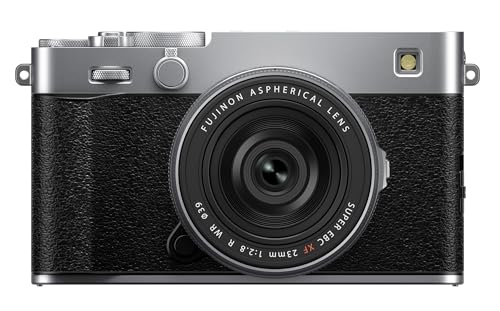
Fujifilm X-E5 — Rangefinder kit, ready day one
The X-E5 is the most completely realised street proposition in this guide because it arrives as photographers actually shoot: a silver rangefinder-style body with a fast prime already fitted, the XF23mmF2.8. A 23mm lens on Fujifilm’s APS-C format frames the classic street view — wide enough for a scene, tight enough for a subject — and a prime’s discipline, forcing the photographer to move rather than zoom, is the genre’s oldest training method. The kit asks nothing further of its buyer before the first walk, which is rarer on this page than it should be.
The title’s other claim is about depth: support for over forty X Mount lenses. That number is the system’s biography — a decade of compact primes and zooms that make the X-E5 a beginning rather than a dead end. A street photographer who starts on the 23mm can add the wider scene lens or the tighter portrait length from a catalogue built for exactly this body shape, much of it available used at friendly prices. Few starter kits anywhere in this batch stand in front of a lens library so precisely matched to their purpose.
Suits the deliberate street photographer: the one who shoots daily, favours a single focal length, and wants the camera to disappear into the rhythm of a walk. The silver finish participates in that disappearing act — a camera that reads as a handsome object rather than professional equipment draws a different quality of attention in a crowd, and street work is, in large part, the management of attention. Travel photographers will find the same kit serves a city break completely, with the prime’s speed covering evening streets.
The title’s silences set the verification list. No sensor resolution is printed for this body, no stabilisation system is named, and no sealing is claimed — each recorded below in the standard wording. A buyer comparing megapixels across this guide must take the X-E5’s figure from Fujifilm’s documentation. The fixed focal length of the kit is also a real boundary: scenes that need reach will be walked toward or left unmade, which most street photographers call the point and some call a limitation. Know which camp you are in before the first month ends.
There is a learning dividend to the prime kit that deserves emphasis. A month of shooting one focal length teaches a photographer to see in that frame before raising the camera — to pre-compose a street corner at 23mm while still half a block away. That pre-visualisation is the core skill of the genre, and a zoom, however convenient, postpones its acquisition. The X-E5 kit is therefore not merely a camera choice but a curriculum, and beginners who embrace it develop faster than their gear-collecting peers.
- Kit lens: XF23mmF2.8 Lens Kit, silver
- System: Supports over 40 X Mount lenses (as stated in the listing title)
- Sensor resolution: Not stated in the listing title — verify with the manufacturer documentation
- Stabilisation: Not stated in the listing title — verify with the manufacturer documentation
- Weather sealing: Not stated in the listing title — verify with the manufacturer documentation
- Format: Fujifilm X Mount mirrorless (APS-C system)
Strengths
- A complete kit with the classic street prime already fitted.
- Over forty X Mount lenses stand behind the body, per the title.
- The silver rangefinder styling draws an object’s attention, not a pro’s.
Trade-offs
- The fixed 23mm focal length cannot zoom; reach is walked, not dialled.
- No resolution, stabilisation or sealing figure is printed in the title.
- Buyers wanting a zoom kit must budget a second lens immediately.
Best for: a dedicated street photographer who wants a ready-to-shoot prime kit in a deep lens system. Not suited for: itineraries that need zoom reach for landmarks and details in one lens, because the fitted XF23mmF2.8 fixes the field of view at a single focal length.
Wear it for a week before judging it. The prime’s discipline feels like deprivation for two days and like fluency by the seventh, and the photographs from the second weekend will show the difference plainly. If the trial appeals, the X-E5 kit’s Amazon listing carries its current figure — the complete price of a working street camera, with no lens arithmetic left to do.
One more kit consideration belongs to the prime argument. Fujifilm’s X Mount primes are famously compact, and the used market for them is deep, so the X-E5 owner’s second lens — when the first month’s photographs demand one — is a modest, well-documented purchase rather than a leap. Systems reveal their character in their second purchases, and a street system whose growth steps are small, cheap and reversible is a system a photographer can grow inside for a decade without a single dramatic decision.

OM System OM-3 — Styled, sealed, computational
This listing sells the OM-3 as a body only, in silver, and its title is the richest of the six: a 20.4MP Four Thirds sensor, 4K 60p video, a creative dial, computational photography, 5-axis image stabilisation and IP53 weather sealing. For street work that list assembles a distinctive toolkit. The computational photography features serve the genre’s opportunism — scenes that last a second reward a camera that can stack, blend or extend an exposure internally rather than in evening software. The creative dial puts a repeatable colour character under the photographer’s thumb, which matters when a day’s frames must hang together as one walk’s story.
The IP53 rating, printed outright, changes street behaviour in the way this batch’s weather guide describes: the camera stays out when drizzle starts, and drizzle is when pavements turn to mirrors and umbrellas compose the frame. Most street cameras in most cities spend their wet days in bags; a rated body on a strap collects the genre’s best light as a matter of routine. Paired with the format’s small lenses, the sealed OM-3 kit remains a coat-pocket proposition — weather insurance without the expedition bulk.
Suits the all-weather urban photographer and the aesthetically minded: the silver body is designed to be looked at, and street photographers who treat the camera as part of their own presentation will find the OM-3 the most considered object in this guide. It also suits the hybrid walker who films the city as well as photographing it, since 4K 60p is confirmed in the title — the only video ceiling printed anywhere in this set — giving smooth slow-motion street footage from the same body.
Body only is the standing caveat, and here it carries a sealing corollary: the IP53 rating describes the body, so the lens fitted must be a sealed one for the system to behave as rated on a wet street. Budget the sealed standard zoom or a sealed prime in the same purchase. The Four Thirds sensor’s low-light ceiling also sits below the full-frame pair below; night streets at very high sensitivity will show it, and the night specialist should weigh the a7C II and S9 before committing.
There is a stylistic argument unique to this body. Street photography has always had a fashion of its own — the camera as a beautiful instrument is part of the genre’s romance from its film-era roots — and the OM-3 is the one digital body here that courts that romance deliberately. Buyers immune to it should buy on the rating and the stabilisation, which stand on their own; buyers susceptible to it may as well admit that a camera they love looking at is a camera they will carry, and carrying is the whole game.
- Sensor: 20.4MP Four Thirds
- Video: 4K 60p Video
- Weather sealing: IP53 Weather-Sealed (stated in the listing title)
- Stabilisation: 5-Axis Image Stabilization
- Features: Creative Dial, Computational Photography
- Kit lens: None — body only, silver
Strengths
- IP53 is printed in the title — street-ready weather evidence.
- Computational photography and a creative dial serve one-second scenes.
- 4K 60p video is confirmed, the strongest video claim in this set.
Trade-offs
- Body only, and the seal needs a sealed lens fitted to count.
- The Four Thirds sensor trails the full-frame picks in deep low light.
- Its styled premium prices above purely pragmatic rivals.
Best for: an all-weather street photographer who wants a sealed, styled body with hybrid video. Not suited for: heavy-rain shooting with an unsealed lens mounted, because the body’s IP53 rating cannot protect a system whose front element’s mount is unsealed.
Assemble the kit as the weather intends: body plus one sealed lens, carried on a strap through a wet week. If the frames from that week justify the pairing — and wet streets usually argue persuasively — the system has proved itself in the only court this genre recognises. The OM-3 body’s Amazon listing shows its current figure; add the sealed lens beside it before comparing with the complete kits on this page.
The OM-3 also asks a question of the genre’s purists, and it is worth hearing. Computational photography — the title’s own phrase — automates techniques that film-era street photographers performed with filters, long exposures and darkroom patience. Some will call that a shortcut; the working street photographer, whose subject is gone in a second, may call it the difference between the frame and the anecdote. Either way, the capability is printed in the title rather than rumoured, and a buyer can weigh it as a stated feature of a stated system.
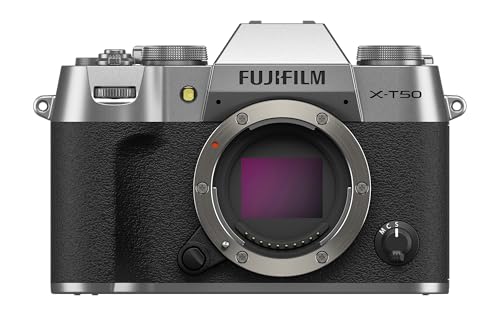
Fujifilm X-T50 — Compact Fujifilm body
The X-T50’s listing title is the tersest in this guide — a mirrorless digital camera body in silver, full stop — and this review honours that terseness by building its case on what a body-only Fujifilm means to the two audiences who buy one. For the existing X Mount owner, this is the compact second body or the upgrade that accepts every lens already on the shelf, in the silver finish that pairs with the system’s silver primes. For the newcomer, it is an entry ticket into the same forty-lens ecosystem the X-E5’s title quantifies, bought as a body because the buyer intends to choose their first lens deliberately rather than inherit a kit’s compromise.
What can be said from the title alone is the positioning: a current X-series body, body only, in silver. Sensor resolution, stabilisation, video specification and sealing are all absent from the listing, and each appears below in the standard not-stated wording. That is not a dismissal — Fujifilm’s documentation carries the full specification, and X-system photographers generally arrive knowing it — but a guide that printed those figures from memory would be breaking the rule that makes its other claims trustworthy.
Suits the Fujifilm loyalist first: the shooter whose cabinet holds X Mount primes and who wants the smaller, lighter body for daily street carry while a larger body stays home for assignments. It also suits the deliberate beginner who has handled both Fujifilm body styles and chosen this one’s handling, intending to pair it with a single prime — the X-E5’s kit logic, assembled by hand. In both cases the purchase is really about the system, and the system is the deepest compact-prime ecosystem in this guide.
The risks of a terse listing fall on the uninformed. A first-time buyer who orders this body expecting a kit will receive a camera that cannot take a photograph until a lens arrives; a buyer who assumes a sealing or stabilisation specification from the line’s reputation is assuming, full stop. Both risks dissolve with one evening in Fujifilm’s documentation and one lens added to the basket — homework this review assigns explicitly rather than leaving to chance.
There is also a pairing insight worth passing on. Body-only street cameras live or die by their first lens, and the street answer in this system is a compact prime in the low-twenties of millimetres, as the X-E5 kit demonstrates. Buyers assembling the X-T50 by hand should start there and resist the versatile zoom for a season; the prime teaches the genre’s seeing, and the zoom will still be on the shelf when the lesson is learned.
- Format: Fujifilm X Mount mirrorless camera body
- Finish: Silver, body only
- Sensor resolution: Not stated in the listing title — verify with the manufacturer documentation
- Stabilisation: Not stated in the listing title — verify with the manufacturer documentation
- Video specification: Not stated in the listing title — verify with the manufacturer documentation
- Weather sealing: Not stated in the listing title — verify with the manufacturer documentation
Strengths
- A current X-series body that accepts the full X Mount lens cabinet.
- Silver finish pairs with the system’s silver compact primes.
- Body-only pricing suits owners who already hold their lenses.
Trade-offs
- The listing title states almost no specifications at all.
- No lens is included; the first purchase is necessarily two purchases.
- Every key figure must be verified in Fujifilm’s documentation.
Best for: an X Mount owner adding a compact silver street body to an existing lens cabinet. Not suited for: a first purchase expected to shoot straight from the box, because this listing is a body alone and cannot record an image until a lens is bought and fitted.
Buy it as the system owners do: body in one hand, the prime you already own or intend in the other, and the documentation open for the figures this listing withholds. Judged that way — as a body within a known ecosystem — the X-T50 needs no borrowed specifications to justify itself. Its Amazon listing carries the body’s current figure; set it beside the X-E5 kit’s price to see exactly what the do-it-yourself route saves or costs.
Silver deserves a final word in the Fujifilm context. The X line’s audience has always included photographers for whom the camera’s appearance is part of the pleasure of the craft — the dials, the finish, the object quality — and street photography, a genre practised in public for love as much as for publication, legitimately counts that pleasure as a feature. A body its owner enjoys carrying gets carried. The X-T50’s silver finish is therefore not decoration on the purchase; for its intended owner, it is one of the mechanisms by which photographs happen.

Sony a7C II — Full-frame in a small body
Sony’s a7C line exists to answer the street photographer’s oldest objection to full-frame: the size. This listing’s title is nearly as terse as the Fujifilm’s — a full-frame interchangeable lens camera in silver — but the two claims it does make are the whole product. Full-frame, in a compact C-line body, on the E-mount. For the night street photographer, that format claim is decisive: full-frame sensors hold clean files at the sensitivities that sodium-lit alleys, neon districts and last-train platforms demand, and they separate a subject from a cluttered background at apertures where smaller formats keep everything sharp and flat.
The C-line’s compactness changes the full-frame bargain’s terms. Traditional full-frame bodies announce their owner; a compact silver body on a short strap reads as a hobbyist’s camera, which is precisely the camouflage street work prizes. Pair it with one of the E-mount’s small primes and the complete rig stays within the presence budget the genre imposes, while retaining the sensor that the genre’s hardest light requires. That combination — discretion by day, sensitivity by night — is the a7C II’s entire case, and it is a strong one.
Suits the night walker and the low-light documentarian: jazz-club streets, evening markets, the blue hour that becomes the black hour while the photographer is still working. It also suits the Sony-system photographer who wants the compact body as the daily carrier while a larger Alpha body handles assignments. The E-mount behind it is the deepest lens catalogue in this guide, shared with the vlogging chapter’s ZV bodies, so a creator-photographer’s glass serves both crafts.
The title’s silence is again the caveat, and it is extensive: no megapixel count, no stabilisation claim, no video ceiling, no sealing. Each is recorded below as unstated, and each is a documentation errand for the buyer whose work depends on the figure — particularly stabilisation, which handheld night work leans on heavily. Full-frame lens economics also apply in full: the small primes that suit this body are affordable joys, but the system’s fast zooms will test a street budget, and the body-only box means the first lens is part of the true price.
Handle one before committing if your hands are large. Compact full-frame bodies concentrate their controls, and street photography is a one-handed, eye-up discipline for many of its practitioners; the body that fits your grip at hour three is the right one, whatever the format argument says. That ergonomic hour in a shop is worth more than any paragraph in this guide, including this one.
- Format: Full-Frame interchangeable lens camera
- Finish: Silver, body only
- Mount: Sony E-mount (Alpha 7C line)
- Sensor resolution: Not stated in the listing title — verify with the manufacturer documentation
- Stabilisation: Not stated in the listing title — verify with the manufacturer documentation
- Weather sealing: Not stated in the listing title — verify with the manufacturer documentation
Strengths
- Full-frame sensitivity in a compact, discreet silver body.
- The E-mount catalogue is the deepest in this guide.
- The C-line’s small presence suits candid work in crowds.
Trade-offs
- The title states almost no specifications beyond format and finish.
- Body only — the first E-mount lens joins the basket immediately.
- Compact controls reward a handling test for larger hands.
Best for: a night street photographer who needs full-frame sensitivity without full-frame presence. Not suited for: a purchase that requires stabilisation and resolution figures confirmed on the listing, because this title prints neither and Sony’s documentation must supply both.
Price the body with one small prime as a single product — that pair is the camera. If the total fits and the night is your genre, the a7C II has no rival in this set, because it is the only one that pairs the largest sensor class here with a body the street will ignore. Its Amazon listing shows the body’s current figure; read it with your chosen prime’s listing open alongside.
Consider the second-shooter and partner dimension of the compact full-frame body. Couples and collaborators who both photograph often standardise on one mount, and a compact body like this becomes the shared camera — the one that travels to every dinner, site visit and holiday regardless of whose assignment it is. Full-frame files from that shared life match the professional body’s files in an album or an archive, which is a quiet, long-term argument for the format that has nothing to do with any single evening’s shooting.

Panasonic Lumix S9 — Full-frame social traveller
The S9’s title is the most cheerful in this guide and, read carefully, one of the most informative: a mirrorless digital full-frame compact travel camera, described as a compact digital camera for social media and travel with a full-frame mirrorless design, wearing an 18-40mm lens, in green, model DC-S9NG9. Panasonic is telling you the design centre outright — this is a full-frame camera miniaturised for the traveller who publishes — and the street photographer should hear a kindred brief, because travel and street are neighbouring crafts that share a bag, a strap and a suspicion of bulk.
The bundled 18-40mm lens deserves a street reading. Eighteen millimetres is genuinely wide — architecture, interiors, the crowd scene that needs its edges — and forty reaches the environmental portrait. A compact zoom of that span on a full-frame body is a one-lens city kit: dawn markets at the wide end, café portraits at the long one, and no lens change in between to announce a serious photographer at work. The green finish extends the camouflage-by-charm strategy the silver bodies use; this camera reads as a lifestyle object, and lifestyle objects are invisible in a way professional tools never are.
Suits the travelling creator whose street work feeds social channels directly, and the full-frame curious who want the sensor’s look without the system’s traditional bulk. It also suits the second-camera role for an L-Mount professional: same mount family as the S5II bodies elsewhere in this batch, in a body that goes to dinner. The compact brief, printed twice in its own title, is the rare marketing claim a buyer can test in a shop in thirty seconds — either the camera vanishes into your carry or it does not.
The silences follow the pattern of the set. No megapixel figure is printed, no stabilisation system is named, and no sealing is claimed in the title, so all three sit below in the standard wording for verification in Panasonic’s documentation. The kit zoom’s range, while ideal for streets and travel, ends where telephoto subjects begin, and its aperture is unstated here — evening buyers should confirm the low-light arithmetic in the documents before planning a night-market season around this lens alone.
There is a generational point in the S9’s favour. Full-frame compacts were once exotic; a major maker now builds one explicitly for social-era travellers, with a kit zoom designed for the body rather than adapted to it. Street photographers benefit from that industrial attention — accessories, cases and future compact L-Mount lenses follow a successful line — and buying into a growing compact system is a different wager from buying a mature one’s leftovers.
- Format: Full-frame mirrorless, compact travel design
- Kit lens: 18-40mm lens included
- Brief: Compact digital camera for social media and travel (as stated in the listing title)
- Finish: Green, model DC-S9NG9
- Sensor resolution: Not stated in the listing title — verify with the manufacturer documentation
- Weather sealing: Not stated in the listing title — verify with the manufacturer documentation
Strengths
- A complete full-frame kit — body and 18-40mm zoom in one box.
- The compact travel brief is stated plainly in the title.
- The wide end of the kit zoom suits architecture and crowd scenes.
Trade-offs
- No resolution, stabilisation or sealing figure is printed in the title.
- The kit zoom ends at 40mm, short of telephoto subjects.
- The zoom’s aperture is unstated here for low-light planning.
Best for: a travelling street photographer who wants full-frame files from a one-lens compact kit. Not suited for: night work planned around a kit-lens aperture confirmed on the listing, because this title does not state it and Panasonic’s documentation must be consulted.
Judge it in the hand against your travel bag’s smallest pocket; the S9 was designed for that test. If it passes, the kit’s single figure on its Amazon listing is the complete cost of a full-frame street camera — no lens arithmetic, no second order — and that completeness, at this sensor size, is the listing’s quiet coup.
The S9 also reframes what a kit lens can be for street work. An 18-40mm range invites a style the prime discourages: architectural frames that use the whole wide end, then an immediate step to a portrait without a lens change breaking the encounter’s spell. Street encounters are fragile — a subject who notices a lens swap notices the photographer — and a compact zoom that reframes silently inside one barrel preserves encounters that a two-lens kit would spend. That preservation is a genuine creative capability, and it belongs in the ledger beside the prime’s discipline.

OM System OM-5 Mark II — Everyday sealed carry
This listing is the sand beige variant of the OM-5 Mark II, and its title repeats the combination that made the camera a weather-guide pick: a 20.4MP Four Thirds sensor, 4K video, 5-axis image stabilisation, IP53 weather sealing and a compact, lightweight design. Translated into street terms, that is the camera that lives by the door. It goes out in the rain that produces the genre’s best reflections, it stabilises the dusk frame when the light goes, and it is small enough that taking it is never a decision — which is the entire secret of photographers who always seem to have been there when the moment happened.
The everyday-carry argument deserves its full weight. Street photography’s yield is a function of hours present, and hours present are a function of carry weight and weather courage. The OM-5 Mark II optimises both variables at once, in a finish — sand beige — that continues this set’s theme of cameras as unthreatening objects. A beige compact on a wrist strap is beneath the notice of almost any crowd, and its owner can work a wet evening market with the confidence of a printed ingress rating behind the casual appearance.
Suits the daily walker: the commuter-photographer, the dog-walking documentarian, the parent whose street is the school run and the market on Saturdays. It also suits the OM-3’s admirers who prefer the smaller body and the softer finish, accepting the video ceiling difference — this title states 4K without the 60p figure its sibling prints — in exchange for the most carryable rated body in the guide.
The chain rule applies as always: body only, so a sealed lens must join the purchase before the IP53 rating describes the system rather than the shell. The Four Thirds low-light ceiling applies too, below the full-frame pair for night work, though the confirmed 5-axis stabilisation claws back handheld shutter speed at dusk in a way the titles of the Sony and Panasonic bodies do not state. That stabilisation confirmation is, quietly, one of the strongest street specifications on this page: dusk is the genre’s prime time, and steadiness is dusk’s currency.
Consider the colour a working decision rather than a whim. Sand beige and silver bodies draw a different glance from black ones — curiosity instead of assessment — and street photographers who work close to their subjects learn to value that difference. It cannot be measured, and this guide will not pretend otherwise, but a decade of the genre’s practice stands behind the observation that the camera people smile at is the camera that gets the photograph.
- Sensor: 20.4MP Four Thirds
- Weather sealing: IP53 Weather-Sealed (stated in the listing title)
- Stabilisation: 5-Axis Image Stabilization
- Video: 4K Video
- Design: Compact Lightweight Design, sand beige finish on this listing
- Kit lens: None — body only
Strengths
- IP53 printed in the title on the most carryable body here.
- 5-axis stabilisation is confirmed for dusk handheld work.
- The sand beige compact design draws minimal attention in crowds.
Trade-offs
- Body only — a sealed lens completes the weather system.
- The title states 4K without the 60p ceiling its OM-3 sibling prints.
- Four Thirds low-light headroom trails the full-frame pair.
Best for: an everyday-carry street photographer who shoots through winter weather on foot. Not suited for: rainy work paired with an unsealed lens, because the system’s weather behaviour is set by the unsealed component, not by the body’s printed rating.
Make the purchase the way the camera will be used: body, one sealed compact lens, a wrist strap, done. That kit, priced from the OM-5 Mark II’s Amazon listing plus the lens, is the cheapest complete answer in this guide to the question of a camera that is always there — and in street photography, always there is the specification that outranks all others.
A closing note on the beige body and its genre. Everyday-carry photography has become a discipline of its own, with its own forums and its own aesthetics, and its central insight is the one this review keeps circling: the archive of a life is built by the camera that was present, and presence is an engineering specification before it is a virtue. The OM-5 Mark II is the most deliberate expression of that insight in this guide — rated, stabilised, compact and finished to be forgotten by everyone except its owner.
Comparison
| Pick | Format | In the box | Sealing evidence in title | Stabilisation from title |
|---|---|---|---|---|
| Fujifilm X-E5 | APS-C, X Mount | XF23mmF2.8 lens kit | Not stated in the listing title | Not stated in the listing title |
| OM System OM-3 | Four Thirds | Body only | IP53 Weather-Sealed | 5-Axis |
| Fujifilm X-T50 | APS-C, X Mount | Body only | Not stated in the listing title | Not stated in the listing title |
| Sony a7C II | Full-frame | Body only | Not stated in the listing title | Not stated in the listing title |
| Panasonic Lumix S9 | Full-frame | 18-40mm lens kit | Not stated in the listing title | Not stated in the listing title |
| OM System OM-5 Mark II | Four Thirds | Body only | IP53 Weather-Sealed | 5-Axis |
The table exposes this category’s unusual shape: the two most completely specified listings belong to the smallest-format bodies, while the full-frame pair and the Fujifilm pair ask to be bought on system and positioning. That inversion is honest data about how these cameras are sold, and a buyer should let it set the homework — the OM pair can be shortlisted from this page alone, while the other four each require an evening in their makers’ documents before money moves.
Sort by the box and the set divides into immediacy and intention. The X-E5 and S9 shoot on day one. The four bodies shoot on the day their owners’ chosen lenses arrive — which, for system owners, may be the same day, from their own shelves. Neither class is superior; they serve buyers at different points in a system’s life.
How to Choose a Street Camera
Begin with your hours. Street yield follows time on foot, so the right camera is the one whose weight and weather courage maximise your hours: the OM pair for the all-weather walker, the compact Fujifilm bodies for the prime-and-strap traditionalist, the full-frame pair for the photographer whose hours are specifically the dark ones. A camera that wins a specification argument and loses the carry argument will produce fewer photographs than every rival in this guide.
Decide the lens question before the body question. One focal length or a zoom? Fitted in the box or chosen by hand? The X-E5’s 23mm prime and the S9’s 18-40mm zoom are two complete answers; the four bodies are four questions. Beginners should usually take a complete answer first — the genre’s seeing must be learned before its equipment is optimised — while system owners rationally buy the body that completes their existing cabinet.
Weigh the light you actually shoot in. Daylight street work is served by every sensor here. Dusk and night work reorders the set: the full-frame pair’s sensitivity leads, the OM pair’s confirmed stabilisation answers with slower handheld shutter speeds, and the Fujifilm pair’s fast primes — chosen by their owners — split the difference. Name your hour honestly; photographers who claim to shoot everything usually mean they shoot weekends.
Finally, handle the finalists. Street cameras are worn, not carried, and the right one disappears against your body and into your hand. Finishes matter here beyond vanity: the silver and beige bodies in this set draw a different quality of attention in a crowd, and attention is the genre’s raw material. The camera people smile at is a specification, whatever the datasheets say.
Prime Lens or Zoom for Street Work?
The prime is the genre’s traditional answer, and the X-E5 kit embodies it: one focal length, a fast aperture, a small barrel, and the discipline of moving your feet. Prime shooters pre-visualise their frame from down the street, arrive inside the scene already composed, and produce bodies of work with a coherent spatial signature. The cost is the photographs that needed another focal length — the detail across the square, the compressed layers of a distant crowd — which the prime shooter learns to grieve briefly and forget.
The zoom’s answer is the S9’s: a compact 18-40mm that reframes without relocation, precious when the photographer cannot move — across a river, behind a barrier, inside a crowd that is itself the subject. Zoom street work trades the prime’s coherence for opportunism, and modern compact zooms have narrowed the size penalty that once settled the argument. Choose by your terrain: open streets reward the prime’s fluency; constrained vantage points reward the zoom’s reach. Many working photographers own both and let the day’s route decide, which is the system’s answer the body-only picks here are built for.
Does Weather Sealing Matter for Street Photography?
More than for almost any other genre, because street light peaks when weather breaks. Wet pavements double the city’s lighting, rain empties the tourist frame and fills the commuter one, and snow turns an ordinary street into a stage. A camera that retreats from those conditions surrenders the genre’s best hours. That is why the two IP53 titles in this set are treated as headline evidence rather than fine print: the OM-3 and OM-5 Mark II can be carried into the breaking weather on the strength of a printed rating.
The discipline of this guide still applies — four titles here state no sealing, and their makers’ claims must be verified in documentation by any buyer who plans wet work. And the chain rule applies with it: a sealed body behind an unsealed lens is an intention, not a system. Street photographers who shoot the rain seriously assemble the whole chain, then forget about it for years, which is the correct relationship with weatherproofing — bought once, verified once, and then simply present for every storm-lit evening the city offers.
How Small Is Small Enough to Go Unnoticed?
Small enough is a social measurement, not a dimensional one. A camera goes unnoticed when its presence reads as ordinary: a compact body, a short lens, a finish that suggests a hobby rather than a profession, carried the way tourists carry cameras rather than the way photojournalists carry them. Every pick in this set was chosen inside that social envelope — even the full-frame pair, whose makers shrank them specifically to pass as casual cameras.
Behaviour completes what size begins. The unnoticed photographer shoots from the hip or the chest, lingers without hovering, and treats the camera as one object among many rather than as a raised instrument. Equipment can only buy the opportunity for that discretion; it cannot perform it. Buy the body whose presence you can carry casually for six hours — in this set, that test favours the kits and the OM bodies — and then practise the carrying until the camera is furniture. The genre rewards the practised far more than the equipped.
Common Mistakes When Buying a Street Camera
Buying a body and forgetting it needs a lens. Four of these six listings are bodies alone. The first lens belongs in the same basket and the same budget line.
Assuming specifications a terse title never printed. The X-T50 and a7C II listings state almost nothing. Verify resolution, stabilisation and sealing in manufacturer documentation.
Choosing sensor size over carry weight. Street yield follows hours on foot. A full-frame body left at home photographs nothing at all.
Ignoring the weather half of the genre. The best street light follows rain. If wet work is your plan, the printed IP53 bodies or a verified sealed system are the honest shortlist.
Buying a zoom to avoid learning to see. A prime’s single frame teaches pre-visualisation, the genre’s core skill. Convenience now can cost fluency for years.
Final Recommendation
Take the complete kits if you are starting: the Fujifilm X-E5 for the prime discipline inside a deep system, the Panasonic Lumix S9 for full-frame files from a one-lens travel kit. Take the OM System pair if weather and carry decide your work — the OM-3 for its creative and computational toolkit, the OM-5 Mark II for the smallest rated everyday body. Take the Fujifilm X-T50 if your cabinet already holds X Mount glass, and the Sony a7C II if your streets are dark and your sensor must be full-frame.
Whichever of the six goes over your shoulder, give it a month of daily carrying before judging it — street cameras are not evaluated, they are inhabited, and the right one will have quietly become part of how you move through the city by the time the month is out.
Frequently Asked Questions
What focal length do street photographers use most?
The classic answer sits in the wide-to-standard band, and this guide’s complete kit embodies it: the X-E5’s fitted XF23mmF2.8 on its APS-C format. The S9’s 18-40mm zoom covers the same territory with flexibility. Both keep the photographer inside the scene rather than observing it from across the street.
Is full-frame necessary for street photography?
No — the genre’s history was written on smaller formats, and four of these six picks are APS-C or Four Thirds. Full-frame earns its place for night work and shallow-focus candids, which is why the a7C II and S9 are here, but daylight street work is served by every body in this guide.
Which of these can I shoot with in the rain?
On title evidence, the two OM System bodies: both print IP53 Weather-Sealed. Fit a sealed lens to complete the system. The other four titles state no sealing, so their wet-weather use should be verified against manufacturer documentation.
Should a beginner buy the X-E5 kit or a body and zoom?
The kit, for most beginners. Its prime teaches the genre’s seeing while removing every purchase decision between the box and the street. A zoom can be added once your own photographs show you which scenes keep escaping the prime’s frame.
Why do so many of these cameras come in silver or beige?
Because presence is a street specification. Light finishes read as lifestyle objects rather than professional tools, drawing curiosity instead of wariness in a crowd. In a genre built on unposed moments, that difference in attention is a working feature.
Related Guides
Street work borders three other crafts in this batch. The format behind the two sealed bodies is explored completely in the best mirrorless micro 4 3 cameras, from everyday carry to flagships. The desk-and-travel displays a street photographer edits on are covered by the best xbox series x monitors, whose fast panels double as editing screens. And the immersive end of the photographer’s desk setup continues in the best sim racing monitors for wide, wrap-around displays.


