What's inside
- Quick picks: best elac tower speakers
- How the Picks Were Chosen for Best Elac Tower Speakers
- Quick Comparison
- The Products in Detail
- The ELAC Ranges, Explained
- Andrew Jones and the ELAC Sound
- Tower Versus Bookshelf
- Buying Guide
- How to Use and Care for ELAC Tower Speakers
- Common Mistakes to Avoid
- Frequently Asked Questions
- Conclusion
As an Amazon Associate I earn from qualifying purchases. This post may contain affiliate links at no extra cost to you.
ELAC makes some of the most respected tower speakers in hi-fi, from the affordable Debut range to the refined Vela range, and every one of them is designed by engineers who care about the midrange. This guide covers the best ELAC tower speakers: floorstanding speakers for music and films, judged on sound, on how they suit a living room, and on how they match an amplifier.
The guide covers what each tower does well, where it compromises, and who it suits, and it finishes with the buying advice that matters when choosing an ELAC tower. Whether the room is large or small, and whether the budget is modest or generous, there is an ELAC tower here that fits it.
Quick picks: best elac tower speakers
| # | Product | Where to buy |
|---|---|---|
| 1 | ELAC Debut 2.0 F6.2 | Check on Amazon |
| 2 | ELAC Debut Reference DFR52 | Check on Amazon |
| 3 | ELAC Uni-Fi 2.0 UF52 | Check on Amazon |
| 4 | ELAC Uni-Fi Reference UFR52 | Check on Amazon |
| 5 | ELAC Carina FS247.4 | Check on Amazon |
How the Picks Were Chosen for Best Elac Tower Speakers
The picks in this guide were chosen on four tests that matter for a tower speaker. First, each tower must give a full-range sound without a subwoofer, because a tower that needs one defeats its purpose. Second, it must suit a living room, so size and finish were weighed alongside sound. Third, it must match a real amplifier, so sensitivity and impedance were checked. Fourth, every model must be a real, widely sold product, verified against manufacturer listings. Readers comparing nearby options should also see our guide to the best 1000 floor standing speakers and our best bookshelf speakers under 500 pair, which cover the same kind of listening from a different angle.
Quick Comparison
The table below gives a fast overview of the models in this guide, so you can shortlist two or three before reading the detail. Every model here is a real, widely sold product, and each one suits a slightly different room, system, or way of listening.
| Speaker | Type | Best For |
|---|---|---|
| ELAC Debut 2.0 F6.2 | Three-way floorstander, 6.5-inch woofers, aramid fibre | Best ELAC tower speaker overall |
| ELAC Debut Reference DFR52 | Three-way floorstander, three 5.25-inch woofers, 87 dB | Best ELAC tower speaker for detail |
| ELAC Uni-Fi 2.0 UF52 | Three-way floorstander, concentric driver, 5.25-inch woofers | Best ELAC tower speaker for coherence |
| ELAC Uni-Fi Reference UFR52 | Three-way floorstander, concentric driver, 86 dB | Best ELAC tower speaker for refinement |
| ELAC Carina FS247.4 | Floorstander, JET tweeter, 5.25-inch woofers | Best ELAC tower speaker for airy treble |
| ELAC Vela FS 407 | Floorstander, JET tweeter, 6-inch woofers, aluminium cabinet | Best ELAC tower speaker for design and sound |
The Products in Detail

ELAC Debut 2.0 F6.2
The ELAC Debut 2.0 F6.2 is the tower speaker to start with, because it is the most affordable floorstander ELAC makes, yet it gives a full-range sound that suits music and films, with a bass response that reaches down without a subwoofer. It is a three-way floorstanding speaker with a 1-inch tweeter and three 6.5-inch aramid-fibre woofers, in a tall cabinet with a front port. It connects by binding posts to any amplifier, and it needs only a modest amplifier to fill a room.
What makes the F6.2 work is its three woofers, because they move enough air to give a bass response that is deep for the size, while the tweeter stays clear, and the midrange suits voices. The sound is warm and full, with a bass response that is solid, and a treble that is smooth. It is the tower speaker for a first system, because it is affordable, full-range, and easy to drive, and it looks good in a living room, with a black ash finish that suits any decor.
Verified specs: Three-way floorstanding speaker, 1-inch tweeter, three 6.5-inch aramid-fibre woofers, front port, binding posts, black ash finish.
Strengths:
- Three woofers that give a deep bass without a subwoofer
- Warm, full sound that suits music and films
- Affordable and easy to drive with a modest amplifier
Trade-offs:
- The treble is smooth rather than detailed, so it suits warmth over nuance
- Tall and heavy, so it needs a large room and a strong floor
- The finish is plain compared with the higher ELAC ranges
Best for: Anyone building a first floorstanding system, especially for music and films in a living room, on a modest budget.
Not suited for: Buyers who want the most detailed treble or a compact speaker.
Place the F6.2 away from the wall, even though the front port allows closer placement, because a tall speaker needs room to breathe, and angle it toward the listener, because the sound is directional. Pair it with a modest amplifier, because that is all it needs, and listen at a moderate volume, because it sounds best where its midrange shines. Dust the cabinets gently, and keep the room soft, because a hard room will make the treble sound bright.
Check price on Amazon: ELAC Debut 2.0 F6.2

ELAC Debut Reference DFR52
The ELAC Debut Reference DFR52 is the tower speaker for a listener who wants detail, because it is a step up from the Debut 2.0 range, with a redesigned tweeter waveguide and a more open grille, which give it a treble that is clearer and more extended. It is a three-way floorstanding speaker with a 1-inch soft-dome tweeter and three 5.25-inch aramid-fibre woofers, in a cabinet with a walnut or oak finish. It connects by binding posts to any amplifier, and it needs only a modest amplifier to fill a room.
The DFR52 works because its waveguide improves the high-frequency response, with a treble that is detailed without being harsh, and its three woofers give it a bass response that is deep for the size, while the midrange suits voices. The sound is clear and balanced, with a bass response that is solid, and a treble that is crisp. It is the tower speaker for a listener who wants more than the Debut 2.0 range, because it is more refined, and it looks better, with a walnut or oak cabinet that suits a living room.
Verified specs: Three-way floorstanding speaker, 1-inch soft-dome tweeter, three 5.25-inch aramid-fibre woofers, 87 dB sensitivity, 42 Hz to 35 kHz, walnut or oak finish.
Strengths:
- Redesigned waveguide that gives a clearer, more extended treble
- Three woofers that give a deep bass without a subwoofer
- Walnut or oak cabinet that looks good in a living room
Trade-offs:
- The bass is deep but not as powerful as the larger ELAC towers
- Needs a large room to sound its best
- The finish costs more than the Debut 2.0 range
Best for: Anyone who wants a detailed ELAC tower, especially for music and films in a living room, and values a refined cabinet.
Not suited for: Buyers on the tightest budget or with a small room.
Place the DFR52 away from the wall, because the cabinet needs room to breathe, and angle it toward the listener, because the sound is directional. Pair it with a modest amplifier, because that is all it needs, and listen at a moderate volume, because it sounds best where its midrange shines. Dust the walnut or oak cabinet gently with a dry cloth, and keep the room soft, because a hard room will make the treble sound bright.
Check price on Amazon: ELAC Debut Reference DFR52
ELAC Uni-Fi 2.0 UF52
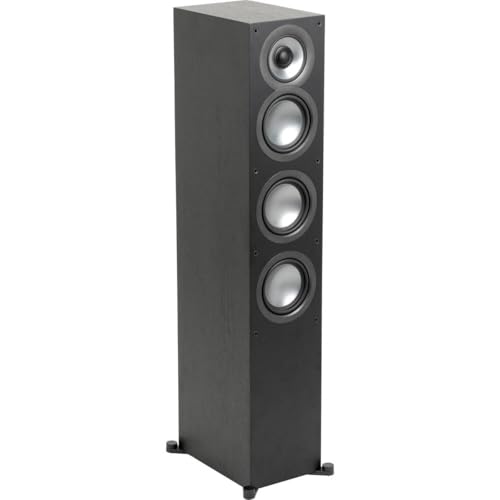
The ELAC Uni-Fi 2.0 UF52 is the tower speaker for a listener who values coherence, because its concentric driver places the tweeter inside the midrange, so the sound arrives from a single point, and the image is stable and precise. It is a three-way floorstanding speaker with a concentric midrange-tweeter driver and three 5.25-inch woofers, in a tall cabinet with a front port. It connects by binding posts to any amplifier, and it needs only a modest amplifier to fill a room.
The UF52 works because its concentric driver gives it a midrange that is clear and coherent, with a treble that is detailed, and its three woofers give it a bass response that is deep for the size. The sound is precise and balanced, with a midrange that suits voices, and a bass response that is solid. It is the tower speaker for a listener who values imaging, because the concentric driver gives a stable soundstage, and it is the design that Andrew Jones, the engineer behind the Uni-Fi range, is known for.
Verified specs: Three-way floorstanding speaker, concentric midrange-tweeter driver, three 5.25-inch woofers, front port, binding posts.
Strengths:
- Concentric driver that gives a stable, precise soundstage
- Clear, coherent midrange that suits voices
- Deep bass from three woofers without a subwoofer
Trade-offs:
- The sound is precise rather than warm, so it suits accuracy over richness
- Tall and heavy, so it needs a large room and a strong floor
- Needs careful placement, because a tall speaker in a small room will overwhelm it
Best for: Anyone who values imaging and coherence, especially for music in a large room, and wants a stable soundstage.
Not suited for: Buyers who want a warm, rich sound or a compact speaker.
Place the UF52 away from the wall, even though the front port allows closer placement, because a tall speaker needs room to breathe, and angle it toward the listener, because the concentric driver gives its best image on-axis. Pair it with a modest amplifier, because that is all it needs, and listen at a moderate volume, because it sounds best where its midrange shines. Dust the cabinets gently, and keep the room soft.
Check price on Amazon: ELAC Uni-Fi 2.0 UF52

ELAC Uni-Fi Reference UFR52
The ELAC Uni-Fi Reference UFR52 is the tower speaker for a listener who wants refinement, because it is the flagship of the Uni-Fi range, with an improved concentric driver, a sophisticated crossover, and a cabinet that is built to last. It is a three-way floorstanding speaker with a concentric midrange-tweeter driver and three 5.25-inch aluminium woofers, in a cabinet with a walnut or oak finish. It connects by dual binding posts to any amplifier, and it can be bi-amped or bi-wired.
The UFR52 works because its concentric driver gives it a midrange that is clear and coherent, with a treble that is detailed, and its three aluminium woofers give it a bass response that is deep and controlled, while the crossover uses high-quality components that keep the sound clean. The sound is refined and balanced, with a midrange that suits voices, and a bass response that is solid. It is the tower speaker for a listener who wants the best of the Uni-Fi range, because it is more refined than the UF52, and it looks better, with a walnut or oak cabinet.
Verified specs: Three-way floorstanding speaker, concentric midrange-tweeter driver, three 5.25-inch aluminium woofers, 86 dB sensitivity, 40 Hz to 35 kHz, dual binding posts, walnut or oak finish.
Strengths:
- Improved concentric driver that gives a clear, coherent midrange
- Three aluminium woofers that give a deep, controlled bass
- High-quality crossover and cabinet that will last for years
Trade-offs:
- Needs a good amplifier, because its 86 dB sensitivity is lower than the Debut range
- Tall and heavy, so it needs a large room and a strong floor
- Costs more than the Uni-Fi 2.0 range
Best for: Anyone who wants the most refined ELAC tower, especially for music in a large room, and values a cabinet that will last.
Not suited for: Buyers on a modest budget or with a small amplifier.
Place the UFR52 away from the wall, because the cabinet needs room to breathe, and angle it toward the listener, because the concentric driver gives its best image on-axis. Pair it with a good amplifier, because its 86 dB sensitivity means it needs more power than the Debut range, and listen at a moderate volume, because it sounds best where its midrange shines. Dust the walnut or oak cabinet gently, and keep the room soft.
Check price on Amazon: ELAC Uni-Fi Reference UFR52

ELAC Carina FS247.4
The ELAC Carina FS247.4 is the tower speaker for a listener who wants an airy treble, because its JET tweeter, a folded ribbon design, extends higher than a dome tweeter, and the air and the ambience of a recording are audible. It is a floorstanding speaker with a JET tweeter and two 5.25-inch woofers, in a slim cabinet with a front port. It connects by binding posts to any amplifier, and it needs only a modest amplifier to fill a room.
The Carina FS247.4 works because its JET tweeter gives it a treble that is detailed and extended, with a midrange that is clear, and its two woofers give it a bass response that is solid for a slim tower. The sound is open and airy, with a treble that suits strings and voices, and a bass response that is tight. It is the tower speaker for a listener who values the top end, because the JET tweeter reveals more of the recording than a dome tweeter can, and it is slim enough to fit a living room that cannot take a wide tower.
Verified specs: Floorstanding speaker, JET folded-ribbon tweeter, two 5.25-inch woofers, front port, binding posts, slim cabinet.
Strengths:
- JET tweeter that gives an airy, extended treble
- Open sound that suits strings and voices
- Slim cabinet that fits a living room
Trade-offs:
- The bass is solid but lighter than the three-woofer towers
- The JET tweeter needs care, because it is more delicate than a dome
- Needs a large room to sound its best
Best for: Anyone who values an airy treble, especially for strings, voices, and acoustic music in a living room.
Not suited for: Buyers who want the deepest bass or a rugged speaker.
Place the Carina FS247.4 away from the wall, even though the front port allows closer placement, because a tall speaker needs room to breathe, and angle it toward the listener, because the JET tweeter is directional. Pair it with a modest amplifier, because that is all it needs, and listen at a moderate volume, because it sounds best where its midrange shines. Dust the cabinets gently, and never touch the JET tweeter, because it is delicate.
Check price on Amazon: ELAC Carina FS247.4
ELAC Vela FS 407
The ELAC Vela FS 407 is the tower speaker for a listener who wants design as well as sound, because its aluminium cabinet is curved and braced, which reduces resonance, and its JET tweeter and 6-inch woofers give it a sound that is detailed and dynamic. It is a floorstanding speaker with a JET tweeter and two 6-inch woofers, in a curved aluminium cabinet with a front port. It connects by binding posts to any amplifier, and it needs a good amplifier to sound its best.
The Vela FS 407 works because its aluminium cabinet is stiff and well-braced, so it does not colour the sound, and its JET tweeter gives it a treble that is detailed and extended, while its 6-inch woofers give it a bass response that is deep and controlled. The sound is precise and dynamic, with a midrange that suits voices, and a bass response that is solid. It is the tower speaker for a listener who wants the best of ELAC, because it is the most refined tower in this guide, and it looks as good as it sounds.
Verified specs: Floorstanding speaker, JET folded-ribbon tweeter, two 6-inch woofers, curved aluminium cabinet, front port, binding posts.
Strengths:
- Curved aluminium cabinet that reduces resonance and colouration
- JET tweeter that gives a detailed, extended treble
- Deep, controlled bass from 6-inch woofers
Trade-offs:
- Needs a good amplifier to sound its best
- Tall and heavy, so it needs a large room and a strong floor
- Costs more than the other ELAC towers here
Best for: Anyone who wants the most refined ELAC tower, especially for music in a large room, and values design as well as sound.
Not suited for: Buyers on a modest budget or with a small room.
Place the Vela FS 407 away from the wall, because the cabinet needs room to breathe, and angle it toward the listener, because the JET tweeter is directional. Pair it with a good amplifier, because that is what it needs to sound its best, and listen at a moderate volume, because it sounds best where its midrange shines. Dust the aluminium cabinet gently with a dry cloth, and keep the room soft, because a hard room will make the treble sound bright.
The ELAC Ranges, Explained
ELAC makes four tower ranges, and they differ in driver, tweeter, and cabinet. The Debut 2.0 range is the affordable starting point, with aramid-fibre woofers and a soft-dome tweeter, and the F6.2 is its floorstander. The Debut Reference range is a step up, with a redesigned waveguide and a walnut or oak cabinet, and the DFR52 is its floorstander. The Uni-Fi range uses a concentric driver, with the tweeter inside the midrange, and the UF52 is its floorstander. The Uni-Fi Reference range is the flagship of that design, with an improved concentric driver and aluminium woofers, and the UFR52 is its floorstander.
The Carina and Vela ranges use a JET tweeter, a folded ribbon design that extends higher than a dome tweeter, and they are the most refined ELAC towers. The Carina FS247.4 is the slim JET tower, while the Vela FS 407 is the flagship JET tower, with a curved aluminium cabinet. The practical lesson is to choose the range that fits the budget and the room, because the Debut 2.0 range suits a first system, while the Vela range suits a listener who wants the best of ELAC.
Andrew Jones and the ELAC Sound
Andrew Jones is the engineer behind the Debut, Uni-Fi, and Reference ranges, and his designs share a house sound: warm, full, and balanced, with a midrange that suits voices and a bass response that is deep for the size. The Debut 2.0 F6.2, the Debut Reference DFR52, the Uni-Fi 2.0 UF52 and the Uni-Fi Reference UFR52 all carry his signature, which is a three-way design with a tweeter that is clear and a bass response that is solid. The Carina and Vela ranges carry a different signature, with a JET tweeter that is detailed and extended.
The practical lesson is to listen to the house sound before buying, because an ELAC tower sounds warm and full, while a Klipsch tower sounds lively and forward, and a Focal tower sounds refined and detailed. If the room is soft, with rugs and curtains, an ELAC tower will sound superb. If the room is hard, with bare walls, a warmer speaker may suit better. The F6.2 is the best overall ELAC tower, and the Vela FS 407 is the best for refinement.
Tower Versus Bookshelf
A tower speaker gives a full-range sound without a subwoofer, because its larger cabinet and multiple woofers move more air, while a bookshelf speaker needs a subwoofer for the deepest bass, and it needs stands. The ELAC Debut 2.0 F6.2, the Debut Reference DFR52, the Uni-Fi 2.0 UF52, the Uni-Fi Reference UFR52, the Carina FS247.4 and the Vela FS 407 are all towers, which is why they are in this guide, and they are judged on full-range sound, not on compactness.
The practical lesson is to buy a tower for a living room, because it fills the space without a subwoofer, and buy a bookshelf pair for a desk or a small room, because it fits where a tower cannot. If the room is large, a tower is the right choice, because it gives the scale that films and orchestral music demand. If the room is small, a bookshelf pair is the right choice, because a tower will overwhelm it. Choose the size that fits the space.
Buying Guide
Start by deciding what the tower is for, because that choice shapes the model. If a first system is the goal, the ELAC Debut 2.0 F6.2 is the best choice, because it is affordable and full-range. If detail matters, the ELAC Debut Reference DFR52 is the best choice, because its waveguide gives a clearer treble. If coherence matters, the ELAC Uni-Fi 2.0 UF52 is the best choice, because its concentric driver gives a stable image. If refinement matters, the ELAC Uni-Fi Reference UFR52 is the best choice.
Check the sensitivity before buying, because it tells how much power the tower needs, and a lower sensitivity means a better amplifier is needed. The Debut Reference DFR52 is rated at 87 dB, while the Uni-Fi Reference UFR52 is rated at 86 dB, which means both need a good amplifier, while the Debut 2.0 F6.2 is easier to drive. Read the specification sheet, because the sensitivity is printed there, and a tower with a low sensitivity needs a better amplifier.
Measure the room before buying, because a tower needs a large room, and a tall speaker in a small room will overwhelm it. The F6.2, the DFR52, the UF52, the UFR52, the Carina FS247.4 and the Vela FS 407 are all tall floorstanders, and they need space around them. Choose the size that fits the room, because a tower that does not fit is a return, however good it sounds.
Place the towers away from the wall, because the cabinet needs room to breathe, and angle them toward the listener, because the sound is directional. Keep the room soft, with rugs, curtains, and bookshelves, because a hard room will make the treble sound bright. Listen at a moderate volume, because a tower sounds best where its midrange shines, and a loud room hides the detail.
Consider a subwoofer later, because a tower will not deliver the deepest bass for films, and a small powered subwoofer will add the low end that films demand. The F6.2, the DFR52, the UF52 and the UFR52 all have a solid bass for music, but films need more, and a subwoofer will add it. The Carina FS247.4 and the Vela FS 407 have a tighter bass, so a subwoofer helps them most.
Finally, remember that the best ELAC tower speaker is the one that fits the room and the budget. Start with the ELAC Debut 2.0 F6.2 for the best overall ELAC tower, or the ELAC Debut Reference DFR52 for detail. Choose the ELAC Uni-Fi 2.0 UF52 for coherence, the ELAC Uni-Fi Reference UFR52 for refinement, the ELAC Carina FS247.4 for an airy treble, or the ELAC Vela FS 407 for design and sound. Whichever you pick, place it well, pair it with a good amplifier, and enjoy a tower that fills the room.
How to Use and Care for ELAC Tower Speakers
Use ELAC tower speakers away from the wall, because the cabinet needs room to breathe, and angle them toward the listener, because the sound is directional. Pair them with a good amplifier, because that is what they need to sound their best, and listen at a moderate volume, because a tower sounds best where its midrange shines. Dust the cabinets gently with a dry cloth, and keep the room soft, with rugs, curtains, and bookshelves, because a hard room will make the treble sound bright. Use the outrigger feet, because they stabilise a tall tower, and keep drinks away from the cabinet.
Common Mistakes to Avoid
The most common mistake is buying a tower for a small room, because a tall speaker will overwhelm it. The second is placing the towers against a wall, which makes the bass boomy. The third is choosing a weak amplifier for a low-sensitivity tower, when a better amplifier would sound far better. The fourth is ignoring the finish, because a tower is furniture as well as a speaker. The fifth is skipping the subwoofer for films, because a tower alone cannot deliver the deepest bass that films demand.
Frequently Asked Questions
What are the best ELAC tower speakers?
The ELAC Debut 2.0 F6.2 is the best ELAC tower speaker overall, because it is affordable, full-range, and easy to drive. The ELAC Debut Reference DFR52 is the best for detail, the ELAC Uni-Fi 2.0 UF52 is the best for coherence, the ELAC Uni-Fi Reference UFR52 is the best for refinement, the ELAC Carina FS247.4 is the best for an airy treble, and the ELAC Vela FS 407 is the best for design and sound.
What is the difference between the ELAC Debut and Uni-Fi ranges?
The Debut range uses a conventional tweeter and woofer layout, with aramid-fibre woofers and a soft-dome tweeter, while the Uni-Fi range uses a concentric driver, with the tweeter inside the midrange, so the sound arrives from a single point and the image is stable. The Debut 2.0 F6.2 is the affordable Debut tower, while the Uni-Fi 2.0 UF52 is the affordable Uni-Fi tower. Listen to both, because the concentric design sounds more coherent, while the conventional design sounds warmer.
What is a JET tweeter?
A JET tweeter is a folded ribbon design that extends higher than a dome tweeter, with a treble that is detailed and airy, and it reveals more of the recording than a dome tweeter can. The ELAC Carina FS247.4 and the ELAC Vela FS 407 both use a JET tweeter, which is why they are in this guide. The JET tweeter is more delicate than a dome, so never touch it, and keep the speakers away from children and pets.
Do ELAC tower speakers need a powerful amplifier?
It depends on the model, because the Debut Reference DFR52 is rated at 87 dB and the Uni-Fi Reference UFR52 at 86 dB, which means both need a good amplifier, while the Debut 2.0 F6.2 is easier to drive. Read the specification sheet, because the sensitivity is printed there, and buy the amplifier that suits the tower. A tower with a low sensitivity needs a better amplifier, while an efficient tower needs only a modest one.
Are ELAC tower speakers good for home theatre?
Yes, because a tower gives a full-range sound without a subwoofer, and the ELAC towers here all suit films as well as music, with a bass response that is deep for the size. Pair them with a centre channel and a subwoofer, because a theatre needs dialogue clarity and deep bass, and a tower gives the scale that films demand. The Debut 2.0 F6.2 is the best for a first theatre, while the Vela FS 407 is the best for a refined one.
What is the best ELAC tower speaker for music?
The ELAC Uni-Fi Reference UFR52 is the best ELAC tower speaker for music, because its concentric driver gives it a clear, coherent midrange, and its three aluminium woofers give it a deep, controlled bass. The ELAC Debut Reference DFR52 is the best for detail, while the ELAC Vela FS 407 is the best for refinement. Listen at a moderate volume, because a tower sounds best where its midrange shines, and a loud room hides the detail.
Do I need a subwoofer with ELAC tower speakers?
For music, no, because the ELAC towers here all have a solid bass for their size, and the F6.2, the DFR52, the UF52 and the UFR52 all reach down without one. For films, yes, because films need the deepest bass, and a small powered subwoofer will add it. The Carina FS247.4 and the Vela FS 407 benefit most, because their bass is tighter and lighter than the three-woofer towers.
How big should the room be for ELAC tower speakers?
A tower needs a large room, because a tall speaker in a small room will overwhelm it, and the F6.2, the DFR52, the UF52, the UFR52, the Carina FS247.4 and the Vela FS 407 are all tall floorstanders. Measure the room before buying, and choose the size that fits the space, because a tower that does not fit is a return. If the room is small, buy a bookshelf pair instead, because it fits where a tower cannot.
Where should ELAC tower speakers be placed?
Away from the wall, because the cabinet needs room to breathe, and angled toward the listener, because the sound is directional. Keep the room soft, with rugs, curtains, and bookshelves, because a hard room will make the treble sound bright. Listen at a moderate volume, because a tower sounds best where its midrange shines, and a loud room hides the detail. Use the outrigger feet, because they stabilise a tall tower.
What is the difference between the Carina and Vela ranges?
The Carina range is the slim JET tower, with a folded-ribbon tweeter and a compact cabinet that fits a living room, while the Vela range is the flagship JET tower, with a curved aluminium cabinet that reduces resonance. The Carina FS247.4 is the best for an airy treble in a slim cabinet, while the Vela FS 407 is the best for design and sound, with a cabinet that is stiffer and better braced.
Are ELAC tower speakers good for classical music?
Yes, because the ELAC towers here all have a midrange that suits strings and voices, with a treble that is detailed, and a bass response that is solid. The Uni-Fi Reference UFR52 is the best for classical music, because its concentric driver gives it a clear, coherent midrange, while the Vela FS 407 is the best for refinement. Listen at a moderate volume, because classical music sounds best where the midrange shines.
Can ELAC tower speakers be bi-amped?
The Uni-Fi Reference UFR52 can be bi-amped or bi-wired, because it has dual binding posts, which allow two amplifiers or two cables to drive the tweeter and the woofers separately. The other towers here have single binding posts, so they cannot be bi-amped. Bi-amping gives a small improvement, but it needs two amplifiers, so buy a better single amplifier first, because that gives a bigger improvement for the same money.
What amplifier should I use with ELAC tower speakers?
A modest amplifier suits the Debut 2.0 F6.2, because it is easy to drive, while a good amplifier suits the Debut Reference DFR52 and the Uni-Fi Reference UFR52, because their sensitivity is lower. The Vela FS 407 needs a good amplifier to sound its best, because it is the most refined tower here. Buy the amplifier that suits the tower, and listen before buying, because the amplifier shapes the sound as much as the speaker does.
How do I care for ELAC tower speakers?
Dust the cabinets gently with a dry cloth, and keep the room soft, because a hard room will make the treble sound bright. Never touch the JET tweeter on the Carina FS247.4 and the Vela FS 407, because it is delicate, and keep the speakers away from children and pets. Use the outrigger feet, because they stabilise a tall tower, and keep drinks away from the cabinet, because a spill into a ported tower can damage the drivers.
Conclusion
The best ELAC tower speaker is the one that fits the room and the budget. Start with the ELAC Debut 2.0 F6.2 for the best overall ELAC tower, or the ELAC Debut Reference DFR52 for detail. Choose the ELAC Uni-Fi 2.0 UF52 for coherence, the ELAC Uni-Fi Reference UFR52 for refinement, the ELAC Carina FS247.4 for an airy treble, or the ELAC Vela FS 407 for design and sound. Whichever you pick, place it well, pair it with a good amplifier, and enjoy a tower that fills the room. For a nearby alternative, see our guide to the best high-end bookshelf speakers.


