What's inside
- Key Takeaways
- Quick Picks
- How Did We Judge Style Desks Without Letting Style Do All the Talking?
- What Makes a Desk Mid-Century Modern Rather Than Merely Wooden?
- How Much Desk Does a Laptop-Era Writer Actually Need?
- The Six Mid-Century Desks, Read Closely
- Solo Writing Desks and One Long Table: The Comparison
- How Do You Style a Mid-Century Desk Without Building a Museum?
- How Do You Care for Walnut-Tone Wood Across Years of Desk Days?
- What Mistakes Do Buyers Make with Mid-Century Desks?
- Final Recommendation
- Frequently Asked Questions
- Related Guides
As an Amazon Associate I earn from qualifying purchases. This post may contain affiliate links at no extra cost to you.
widgetverdict.com is reader-supported. When you buy through links on our site, we may earn an affiliate commission.
Where to buy: the six desks in this roundup are all sold through Amazon, and with style-led furniture the listing photographs and finish descriptions matter as much as the dimensions — walnut is a family of tones, not a single colour, so compare the images against your room’s light before choosing.
The best mid-century modern desks ask to be judged twice: once as workstations, once as furniture. The style’s signatures — tapered legs, warm walnut tones, clean horizontal lines, storage that hides inside the silhouette instead of hanging off it — were designed in an era when a desk stood in a living room and had to behave like a guest there. That double duty is exactly what the modern home office needs again, now that the desk has moved back out of the spare room and into shared space. The six picks here span 42.5 to 63 inches, and they divide honestly by ambition: five are single-person writing and computer desks in the classic mould, while the sixth, the 63-inch NELYE, is a long two-person table that borrows the style’s walnut calm for a shared workstation — a different axis entirely, and it is reviewed as one.
A word on materials, because this category’s titles reward careful reading. Where a title says solid wood, this guide says solid wood: the Ytaoka and the Yuidirtu claim it for the whole desk, and the SilkWood Mesa claims solid pine for its tapered legs. Where a title says only “wood” — the NELYE’s “simple modern wood table” is the case in point — the guide says wood, and does not upgrade the claim. Walnut, similarly, appears here as a finish or tone on several picks and is described as such. Style categories invite material inflation; this roundup declines the invitation, pick by pick.
What unites the six is proportion. Mid-century desks are sized for writing first and computing second, which in practice means surfaces between roughly 42 and 50 inches for the solo desks — enough for a laptop, a notebook and a lamp arranged with air between them, not enough for a three-screen command centre. Buyers who understand that bargain get furniture they will keep for decades. Buyers who fight it end up with a beautiful desk buried under equipment it was never shaped to hold.
Key Takeaways
- Five picks are solo writing desks from 42.5 to 50 inches; the NELYE at 63 inches is a two-person long table and should be compared against workstations, not against the solo five.
- Solid wood is claimed precisely where titles claim it — the whole desk on the Ytaoka and Yuidirtu, the tapered legs on the SilkWood Mesa — and nowhere else.
- Drawers are the style’s native storage: two on the Ytaoka, drawers on the Mesa and Yuidirtu, a drawer plus open cubby on the 42.5-inch walnut desk.
- The Linon Melissa’s title is the briefest here — name, style, finish — so its dimensions and storage are listing-page questions, flagged in its review.
- The NELYE is the only pick whose title publishes a load figure: it holds 200 pounds across its 63 by 20 inch top.
Quick Picks
| Pick | Badge | Why it earns its place |
|---|---|---|
| Walnut Wood Desk with Drawer (42.5 Inch) | Compact classic | A 42.5-inch walnut desk with a drawer, an open storage cubby, a cable grommet and solid wood legs. |
| Linon Melissa Mid Century Walnut Desk | The name-brand minimalist | Linon’s Melissa in a mid-century walnut finish — the restrained, furniture-first entry in the six. |
| SilkWood Studio Mesa 50 Inch Mid-Century Desk | Elevated-top design | Fifty inches with drawers, a stylish elevated top and solid pine tapered legs in walnut. |
| Ytaoka Solid Wood Writing Desk (47 Inch) | Solid wood, two drawers | A 47-inch solid wood walnut desk with two drawers and a storage shelf — the material purist’s pick. |
| Yuidirtu 47 Inch Fluted Solid Wood Desk | Fluted-front statement | Solid wood with a fluted front and drawers, in walnut — the most decorative silhouette in the roundup. |
| NELYE Mid-Century Long Desk Table (63 Inch) | Two-person long table | A 63 by 20 inch walnut table rated to hold 200 pounds, built as an extra-long two-person workstation. |
Notice how the sizes cluster. The solo desks live between 42.5 and 50 inches because that is the span a writing desk needs and a living room forgives; the NELYE’s 63 inches belong to a different conversation about shared work. Keep that split in mind through the reviews — comparing the NELYE’s surface against the Ytaoka’s is comparing a dining table against a bureau, and both can win their own argument.
How Did We Judge Style Desks Without Letting Style Do All the Talking?
We applied a two-pass reading to every title. The first pass extracted the workstation facts: width, storage, any cable management, any load or material claim. The second pass read the furniture facts: finish, leg design, decorative treatment like the Yuidirtu’s fluting or the Mesa’s elevated top. A pick had to survive both passes. A beautiful silhouette with no drawer and no cable answer — the temptation of this category — was marked down as a desk, however it scored as an object; a well-stored desk in a finish that would fight every room it entered was marked down as furniture.
Material claims were audited word by word, because “walnut” and “solid wood” are the two most abused phrases in style furniture. This guide repeats a material claim only at the strength the title states it: solid wood for the Ytaoka and Yuidirtu desks outright, solid pine legs for the Mesa, solid wood legs for the 42.5-inch walnut desk, and plain “wood” for the NELYE, whose title claims nothing more specific. Where a title is silent about construction — the Linon Melissa’s says almost nothing beyond its name — the review says so and sends the dimension questions to the listing, in that pick’s own words.
One more filter deserves disclosure, because readers of style categories are right to be suspicious of it: we did not let the word “studio” or a maker’s heritage substitute for a stated fact. A brand’s history may predict build care, but this roundup scores what titles claim and listings can verify — dimensions, drawers, materials at their stated strength. Where a famous name and a detailed newcomer disagreed in specificity, the specific title won the benefit of the doubt, and the famous name’s review carries its homework openly.
The third pass was habitat. Mid-century desks earn their keep in rooms that are seen: living rooms, open-plan flats, bedrooms that receive guests, offices that appear on video calls. We favoured picks whose proportions and storage suit those rooms — surfaces that reset to calm, drawers that swallow the workday, cable answers like the 42.5-inch desk’s grommet that keep the furniture illusion intact when the laptop is open.
What Makes a Desk Mid-Century Modern Rather Than Merely Wooden?
The style is a grammar, not a colour. Its nouns are the tapered leg — angled or splayed, lifting the body of the desk so the floor shows beneath and the piece reads light even in dark walnut. Its verbs are horizontal calm: a long, unbroken top line, drawer fronts that sit flush and keep the silhouette smooth, storage integrated into the apron rather than stacked on the surface. Its adjectives are restraint — one finish, honestly presented, ornament limited to a single gesture like fluting or an elevated top edge.
That grammar explains the category’s working character. A mid-century desk hides its storage because the style was formed when desks stood in living rooms and paperwork was not decor. It keeps its surface clear because the surface is the composition — walnut, a lamp, a notebook, negative space. And it sizes itself for a writer because that was the job: letters, a typewriter, later a laptop, all single-machine pursuits at a single chair. The six picks here honour that grammar to different degrees, and the reviews note where a pick is fluent — the fluted Yuidirtu, the tapered-leg Mesa — and where one is merely speaking walnut with an accent.
The style also has a scale ethic that modern furniture often abandons. Mid-century pieces were designed for post-war rooms smaller than today’s open-plan expanses, which is why these desks sit lightly — raised on legs, floor visible beneath, air around them. In a small flat that ethic is not nostalgia but engineering: a desk you can see under occupies less of the room psychologically than a panel-sided desk of identical dimensions, and the difference decides whether a one-room home office feels like a corner or a takeover. Buyers in genuinely tight spaces should weigh that visual lightness as a feature with the same seriousness as a drawer count.
For the modern buyer, the practical translation is this: a mid-century desk will make your room calmer and your setup smaller. It rewards the worker whose kit is a laptop, a lamp and a notebook, and it quietly penalises sprawl. Choose it as you would choose a smaller house — for the discipline it lends your habits, not despite it.
How Much Desk Does a Laptop-Era Writer Actually Need?
Measure your working spread honestly. A laptop occupies roughly a square foot; the notebook beside it another; the lamp’s base a hand’s breadth. Arranged with the air the style demands, that is a 42-to-47-inch surface working at its designed capacity — which is why the solo picks cluster exactly there. The 50-inch Mesa buys margin for a separate keyboard or a tablet stand; the 42.5-inch walnut desk assumes the laptop is the only machine and organises the rest into its drawer and cubby.
The moment a second screen enters, the arithmetic changes character. A monitor on a stand can live on a 47-inch desk — the Ytaoka’s storage shelf even gives the arrangement a lower tier — but the composition tightens, and the desk stops being a writing desk with a screen and becomes a small workstation wearing walnut. That is a legitimate choice, provided it is a choice. Buyers whose day is genuinely multi-screen should read the NELYE’s long table, or leave this category for the workstation roundups, rather than asking a 42.5-inch writing desk to perform as a command centre and blaming the style when it feels crowded.
Paper, unfashionably, still arbitrates many of these purchases. A writer who works from printed drafts, reference books or a sketchbook consumes surface in a way a pure screen worker does not, and the honest test is to lay your actual working spread on a table and measure it with a tape. Households are often surprised in both directions — the novelist who needs only 40 inches and the administrator whose “laptop job” quietly involves three open folders. The solo desks here were sized by a paper-era style for paper-era work; if your spread measures beyond 50 inches, believe the tape over the aesthetic longing, and take the long table or a workstation desk.
Depth follows the same logic. Writing desks are shallower than gaming desks by tradition — the NELYE publishes 20 inches, the only depth stated among the six — because paper and laptops are shallower than monitor rigs. Where a title omits depth, treat the listing’s diagram as required reading, especially if a separate keyboard is part of your day.
The Six Mid-Century Desks, Read Closely

Walnut Wood Desk with Drawer (42.5 Inch) — Compact Classic
At 42.5 inches this is the smallest solo desk in the roundup, and its title is a model of useful specificity: a drawer and an open storage cubby, a cable grommet, solid wood legs, a reinforced structure. Read that list as the designer’s answer to the compact writing desk’s three eternal problems. The drawer takes the stationery and the charger; the cubby takes the book or tablet that is in current rotation, visible and reachable rather than buried; the grommet routes the laptop’s cable through the top so the surface’s clean line survives the machine it serves. Small desks rarely think this completely, and the thinking shows.
The solid wood legs deserve their own sentence in a category full of ambiguous timber. Legs carry the visual signature of the style — the taper, the stance — and they carry the desk’s daily knocks, chair bumps and floor drags. Solid wood there is a durability decision as much as an aesthetic one. The reinforced structure claim points the same way: this is a small desk built to feel planted rather than perched, which matters when the whole piece weighs less than the equipment buyers instinctively want to add to it.
Keep its scale in view. Forty-two and a half inches is a laptop, a notebook and a lamp, arranged with intent; it is not a monitor station, and the cubby-and-drawer storage, while clever, is a day’s worth rather than an archive’s. The title publishes no depth, so the front-to-back measurement is a listing check for shallow rooms. As the compact, complete expression of the category — walnut, drawer, cubby, grommet, solid legs — it is the pick against which the larger solo desks must justify their extra inches.
Picture it in its natural habitat: a living room’s quiet wall, between a bookshelf and the window, where a full office desk would look like an apology. At 42.5 inches the walnut desk reads as a piece of the room’s furniture that happens to hold a laptop, and the cubby earns its keep in that setting specifically — the current book lives there spine-out like a shelf of one, part of the room’s composition rather than clutter awaiting a drawer. Compact mid-century desks live or die by this trick of belonging, and this pick’s combination of small span, warm finish and thought-through storage is the roundup’s purest attempt at it.
- Width: 42.5 inches, per the listing title
- Storage: one drawer plus an open storage cubby
- Cable management: a cable grommet is built into the top
- Legs: solid wood legs, per the title
- Structure: reinforced structure is claimed in the title
- Depth: the title gives no front-to-back figure — take it from the listing’s diagram
Strengths
- The most completely thought-out small package: drawer, cubby and grommet together.
- Solid wood legs put real material where the style is most visible and most knocked.
- A 42.5-inch footprint enters rooms the 50-inch picks cannot.
Trade-offs
- The surface is a laptop-and-notebook arrangement, not a monitor station.
- Storage is a day’s worth — drawer and cubby, not an archive.
- Depth must be confirmed on the listing before a tight placement.
Best for: a living-room corner or bedroom that needs a complete, compact writing desk with its cables already answered. Not suited for: a separate monitor and keyboard setup, which would crowd a 42.5-inch top past the point the style — or the user — can enjoy.
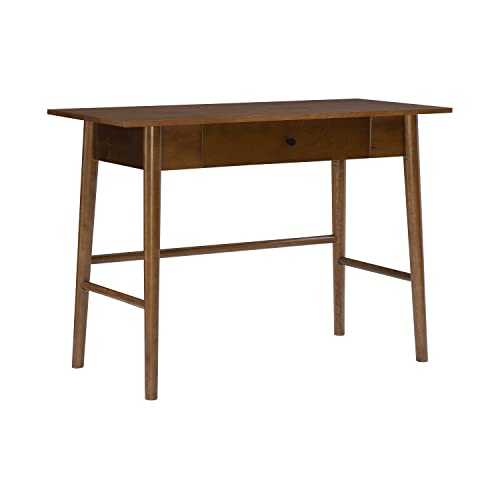
Linon Melissa Mid Century Walnut Desk — The Name-Brand Minimalist
The Melissa’s title is four facts long: Melissa, mid-century, walnut, Linon. No width, no storage claim, no construction detail. In a roundup built on reading titles literally, that brevity cuts two ways. It means the desk sells on the strength of a known furniture maker’s name and a clean style promise — Linon is an established furniture brand, and the Melissa is its mid-century walnut desk, presented without the feature-list anxiety of the marketplace-native picks around it. It also means this review can honestly tell you less from the title than any other in the six, and the listing page owes you the dimensions, the storage story and the materials before money moves.
What can be said on the evidence: the pick’s role in this roundup is the restrained furniture-first option. Where the Yuidirtu performs its fluting and the Mesa raises its top, a Melissa-style desk typically lets proportion and finish carry the whole effect — the desk for a room where the furniture should be calm and the objects on it should do the talking. Buyers furnishing a considered interior, who will measure the listing’s diagram against their wall and check its drawer arrangement against their habits, are this desk’s natural audience; it asks for a deliberate buyer and rewards one.
The cautions are procedural rather than damning. Do not assume a width from the company it keeps here — the solo desks span 42.5 to 50 inches, and the Melissa’s own figure lives on its listing. Do not assume drawers; the title does not name them. And do not assume solid wood anywhere; the title claims walnut as the desk’s finish identity and nothing more. Judged as what it verifiably is — a name-brand mid-century walnut desk of unstated dimensions — it earns its place as the roundup’s quiet option, with homework attached.
There is a buyer this restraint serves particularly well: the one furnishing from a plan rather than from a feed. If you are working from a room scheme — floor tone noted, wall colour chosen, a chair already owned — a desk specified by its maker as a clean mid-century walnut piece slots into the plan on the strength of its proportions and finish, and the listing’s photographs and diagram answer the rest in the order a planner asks. The feature-led picks in this roundup court the improviser; the Melissa courts the planner, and neither courtship is the wiser one in the abstract.
- Identity: the Melissa desk by Linon, per the listing title
- Style and finish: mid-century design in walnut
- Width: the title publishes no inch figure for this model — the listing’s diagram is the source
- Storage: no drawer or shelf is named in the title
- Materials: the title makes no solid-wood claim for this desk
- Power and cable features: none are claimed in the title
Strengths
- An established furniture maker’s restrained take on the style — proportion over features.
- Walnut finish and mid-century lines suit considered, furniture-led rooms.
- The absence of gimmicks keeps the silhouette clean from every angle.
Trade-offs
- The title alone cannot size it for your room; listing homework is mandatory.
- No storage is verifiable from the title — check before assuming drawers.
- Feature-led buyers get more certainty per glance from rival picks.
Best for: a deliberate furnisher who wants a calm, name-brand walnut desk and will verify dimensions and storage on the listing. Nothing about size or storage can be settled from a title that gives only a name, a style and a walnut finish, so both checks happen elsewhere.

SilkWood Studio Mesa 50 Inch Mid-Century Desk — Elevated-Top Design
The Mesa is the largest of the solo writing desks at 50 inches, and its title pairs that span with the roundup’s most architectural detail: a stylish elevated top design. An elevated top — the surface raised as its own plane above the drawer body — gives the desk a floating, layered profile that photographs beautifully and, in the room, separates the working plane from the storage body visually. It is the kind of gesture mid-century design loves: structure as ornament, nothing applied that is not also built.
The construction claim is precise and worth repeating precisely: solid pine wood tapered legs. Not solid wood throughout — the title does not say that — but real pine where the style’s signature lives, in legs that taper as the grammar requires. Drawers are included, answering the storage question inside the silhouette, and the walnut finish warms the pine-and-body composition into the category’s expected tone. Fifty inches with drawers makes this the most capable solo workstation of the style-first picks: a laptop, a separate keyboard if you insist, a notebook and a lamp, all with the drawers beneath for the rest of the day’s kit.
The trade-offs are gentle ones. The elevated top is a look to commit to — in a room of flush, plain furniture it will be the piece people notice, which is either the point or a problem. The title publishes no depth, so the usual listing check applies before a shallow placement. And buyers hunting an all-solid-wood desk should note the claim’s exact scope — legs, in pine — and look to the Ytaoka or Yuidirtu if whole-desk solid construction is the requirement rather than the preference.
The “Studio” in its maker’s name is a clue to its intended room. A studio — artist’s, photographer’s, a creative’s home office — is a space where the furniture is looked at as much as used, often by clients, and where a desk’s profile in the room’s sightlines matters commercially as well as personally. The Mesa’s elevated top gives it that profile: a horizon line with a step in it, recognisable from the doorway. Creative professionals who host, photograph their workspace, or simply think better in beautiful rooms are the audience; the drawers and the fifty inches make sure the beauty is not bought at the workflow’s expense.
- Width: 50 inches — the widest solo desk in the roundup
- Top design: elevated top, per the listing title
- Legs: solid pine wood tapered legs — the title’s solid-wood claim covers the legs
- Storage: drawers included
- Finish: walnut
- Depth: no front-to-back figure appears in the title; the listing carries the measurement
Strengths
- Fifty inches and drawers make it the most capable solo workstation among the style-led picks.
- The elevated top gives the desk an architectural profile nothing else here attempts.
- Solid pine tapered legs put genuine timber in the style’s signature component.
Trade-offs
- The solid-wood claim is scoped to the legs; the body is not claimed as solid.
- The elevated top is a strong look that will anchor the room’s furniture conversation.
- Depth is a listing-page confirmation, as with most of the solo five.
Best for: a home office or studio that wants the fullest solo workstation the style offers, with a top design worth looking at. Not suited for: a buyer requiring solid wood throughout the whole desk, since the title’s claim extends to the pine legs and no further.
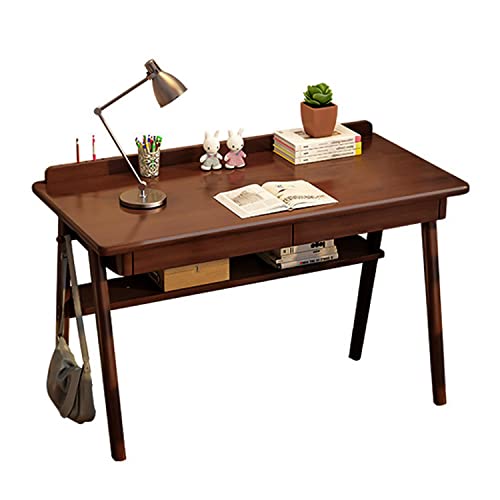
Ytaoka Solid Wood Writing Desk (47 Inch) — Solid Wood, Two Drawers
The Ytaoka’s title makes the claim the material purists are scanning for: solid wood, for the desk itself — a 47-inch mid-century modern walnut desk with two drawers and a storage shelf. In a category where “wood” can mean many things and often means a photograph of wood, an outright solid wood writing desk is the substantive article, with the weight, the repairability and the decades-long ageing that real timber brings. Forty-seven inches is the classic writing-desk span, and the storage arrangement is the classic one too: two drawers for the day’s instruments, a shelf for the books and boxes that drawers swallow awkwardly.
Think about what the shelf adds beneath a writing desk. It takes the laptop’s dock, the reference books, the storage box of cables — the low, heavy layer of a workstation — and keeps it off both the surface and the floor. Combined with the drawers, the Ytaoka’s storage is the most complete among the solo picks, arranged in the style’s own way: inside and beneath the silhouette, never on top of it. The title’s long tail of framings — laptop desk, study table, work desk station — reflects a desk that expects to be worked at, not merely admired.
Honest notes: walnut here names the desk’s tone in the title’s phrasing — “solid wood” is the construction claim, “walnut” the colour identity — and buyers for whom the species itself matters should confirm it on the listing. No depth is published in the title, and no cable feature is named, so a grommet-style answer like the 42.5-inch pick’s is not part of this desk’s story; a cable dropped neatly at the back will be your own arrangement. For the buyer whose first question is “what is it made of,” though, this is the roundup’s clearest answer.
Solid wood also changes the desk’s relationship with time in a way worth stating to first-time buyers of real timber. It can be sanded, re-oiled and repaired; a knocked corner is an afternoon’s restoration rather than a permanent confession, and the surface’s patina across years reads as character where a laminate’s wear reads as damage. Buyers furnishing a “forever” home office — the room that will not be redone for a decade — are precisely the people for whom the Ytaoka’s construction claim is not a luxury detail but the entire purchasing logic.
- Width: 47 inches, per the listing title
- Construction: solid wood — claimed for the desk itself in the title
- Storage: two drawers plus a storage shelf
- Finish identity: walnut, per the title
- Cable features: the title is silent on grommets and routing for the Ytaoka
- Depth: the title states no front-to-back dimension — verify it on the listing
Strengths
- Whole-desk solid wood construction — the material claim purists want, stated outright.
- Two drawers and a shelf give the solo picks’ most complete storage arrangement.
- The 47-inch span is the classic writing-desk proportion, sized for real work.
Trade-offs
- No cable management feature is named; routing is your own neat arrangement.
- Solid wood means real weight — plan the room before the delivery, not after.
- Depth must be taken from the listing before a shallow-room placement.
Best for: a buyer who wants a solid wood mid-century writing desk with proper drawers and a shelf, kept for the long term. Not suited for: a frequent mover, because a 47-inch solid wood desk is the heaviest solo pick here and travels accordingly.

Yuidirtu 47 Inch Fluted Solid Wood Desk — Fluted-Front Statement
Fluting — a run of vertical grooves across the drawer fronts — is the Yuidirtu’s signature, and it is the most decorative gesture in the roundup: texture that catches light and shadow across the desk’s face, turning the storage body into the ornament. The title pairs that gesture with substance: a 47-inch fluted solid wood desk with drawers, mid-century modern in walnut. Like the Ytaoka, the solid wood claim covers the desk; unlike the Ytaoka, the design spends some of its seriousness on theatre, and the result is the pick for buyers who want their furniture noticed.
The fluting has a practical side that pure minimalists underrate. A grooved front hides the hairline gaps and minor knocks that flush drawer fronts advertise, and it gives fingers purchase along the drawer edge. In a bedroom or study — the title names both, plus small spaces — the desk reads as a crafted object from across the room, which matters in the rooms mid-century furniture is bought for. Natural wood language in the title (“natural wood writing desk”) sits alongside the walnut identity, suggesting a finish that shows grain rather than hiding it; confirm the exact tone against your room on the listing images, because grain-forward finishes vary more between pieces than flat ones.
Its cautions mirror the Mesa’s in a different key. The fluted front is a commitment — the strongest visual statement among the solo five — and in a room already rich in texture it may compete rather than complement. No depth is stated in the title, and no cable feature is named. Storage is drawers without the Ytaoka’s additional shelf, so the under-desk layer of kit needs another home. Buy the Yuidirtu when you want the desk to be the room’s crafted centrepiece and your storage needs end at drawers; it makes that case more persuasively than anything else here.
Fluting also does quiet ergonomic work that a photograph cannot show. A bank of grooved drawer fronts breaks the desk’s face into a rhythm your peripheral vision registers as texture rather than as a wall of wood, which softens the desk’s presence in small rooms — the very bedrooms and studies its title names. Where a flush-fronted 47-inch desk can feel like a sideboard that wandered into the study, the Yuidirtu’s face keeps announcing “made object” at every glance, and in small spaces that announcement is what stops furniture from becoming bulk.
- Width: 47 inches, per the listing title
- Construction: solid wood, claimed in the title for the desk
- Design detail: fluted front — the roundup’s most decorative treatment
- Storage: drawers included; no shelf is named in the title
- Finish identity: walnut, with natural wood grain language in the title
- Depth: the front-to-back figure is absent from the title — the listing’s diagram holds it
Strengths
- Solid wood construction beneath a genuinely crafted, light-catching fluted front.
- Drawers integrated into the design’s statement rather than hidden from it.
- Sized and styled for bedrooms and studies where the desk is seen all day.
Trade-offs
- The fluted front is the strongest look here — a commitment, not a neutral.
- No storage shelf is named, so under-desk kit needs another home.
- Grain-forward walnut tones vary; check the listing images against your room.
Best for: a bedroom or study that wants its desk to be a crafted centrepiece in solid wood, with drawers for the day. Not suited for: a texture-rich room where one more patterned surface would compete, or a worker needing the extra shelf tier the Ytaoka provides.

NELYE Mid-Century Long Desk Table (63 Inch) — Two-Person Long Table
Now the axis changes. The NELYE is a 63 by 20 inch walnut table whose title calls it, in plain words, an extra-long two-person computer workstation — and that framing governs everything about its review. It is not a bigger writing desk; it is a shared surface, built for two chairs, two laptops, two people’s working days running in parallel along one calm walnut line. Compared against the solo five it will always look sparse — no drawers are named, no cubby, no grommet — because a shared table’s storage lives elsewhere in the room, and its surface belongs equally to both seats.
Its published figures are the roundup’s most complete after the narrow-desks champion in another guide: 63 inches wide, 20 inches deep, and a stated capacity — it holds 200 pounds. That load figure, spread across two workstations’ worth of laptops, lamps and books, is a genuinely useful planning number, and the 20-inch depth defines the desk’s character: shallow enough to sit against a wall in a shared room without annexing it, deep enough for a laptop per person with a notebook’s margin. Two people working back-to-back against a wall on one long table is a real household pattern — partners in a small flat, siblings in a shared study — and the NELYE is the only pick here built for it.
Material honesty, as promised in the introduction: the title says “wood table” and “simple modern wood table” — wood, unqualified. This guide does not call the NELYE solid wood, because its title does not. What the title does claim is the mid-century identity and the walnut tone, and on those the desk delivers the style’s long horizontal calm at a length the solo desks cannot reach. Buy it as the shared, simple, long table it declares itself to be, and the absence of drawers is not a flaw but a definition.
One more household pattern suits it beyond the two-worker headline: the single user with a genuinely wide workflow and a horror of depth. A crafter laying out materials in a row, a teacher marking across a line of books, a hobbyist with a cutting mat and a laptop in parallel — all of them use length the way the solo desks use drawers, and all of them are better served by 63 shallow inches than by 47 deep ones. The NELYE’s second life is as the long, calm worktable of a household’s projects, and its simplicity — no drawers to stick, no mechanisms to fail — suits that long service.
- Product type: Desk — long two-person table (not a solo writing desk)
- Dimensions: 63 inches wide by 20 inches deep, both stated in the title
- Capacity: holds 200 pounds, per the listing title — the only load figure in the roundup
- Material: wood, as the title states it; no solid-wood claim is made for this pick
- Storage: no drawers or shelves are named — a shared table’s storage lives elsewhere
- Finish identity: walnut
Strengths
- The only genuine two-person workstation here, at a full 63 inches of shared surface.
- A published 200-pound capacity lets two setups be planned with confidence.
- Twenty-inch depth keeps a long table wall-friendly in shared rooms.
Trade-offs
- No drawers or storage are named — each seat’s kit needs a home elsewhere.
- Its material claim is plain wood; do not read solid-wood substance into it.
- As a solo desk it leaves half its surface as expensive emptiness.
Best for: two people sharing one wall and one calm walnut surface — partners, siblings, a parent and a student. Not suited for: a solo worker wanting drawers at the desk, since this long table names none and its span would be wasted on one chair.
Solo Writing Desks and One Long Table: The Comparison
| Pick | Product type | Width | Storage named | Solid-wood claim (per title) |
|---|---|---|---|---|
| Walnut Wood Desk with Drawer | Desk — solo | 42.5 inches | Drawer, open cubby | Legs only |
| Linon Melissa | Desk — solo | Not stated in title | Not stated in title | None |
| SilkWood Studio Mesa | Desk — solo | 50 inches | Drawers | Legs (solid pine) |
| Ytaoka Writing Desk | Desk — solo | 47 inches | 2 drawers, shelf | Whole desk |
| Yuidirtu Fluted Desk | Desk — solo | 47 inches | Drawers | Whole desk |
| NELYE Long Desk Table | Desk — two-person table | 63 inches | None named | None — wood only |
Use the table the way the roundup was built: start with the product-type column to separate the five solo desks from the shared table, then read the solid-wood column at its literal strength, and only then let width and storage argue their cases. Buyers who reverse that order — falling for a width, then discovering the material claim was thinner than assumed — are the ones who write the disappointed reviews in this category.
The solid-wood column is this category in miniature: two whole-desk claims, two leg-scoped claims, and two silences. Read any mid-century listing through that column’s discipline and the marketing fog in this category thins considerably.
How Do You Style a Mid-Century Desk Without Building a Museum?
The failure mode of style-led buying is the period room — desk, lamp, chair and clock all shouting the same decade until the space feels like a film set nobody works in. The desks here are strong enough to be the room’s single mid-century statement. Let the desk carry the era, and let everything else be quiet and contemporary: a simple lamp, a comfortable modern chair chosen for your back rather than the theme, one plant or object with height to answer the desk’s horizontal calm. The walnut will do the rest.
Chair pairing is where most rooms go wrong, so decide it with the desk rather than after it. The era’s own chairs were low and light, but your back has modern requirements and no loyalty to 1958; a contemporary ergonomic chair in a quiet fabric sits perfectly happily at a walnut desk, and the mixture reads as a lived-in room rather than a themed one. What does jar is bulk — a massive gaming chair swallows a tapered-leg desk’s proportions whole. If your chair is large, give the desk a wall to itself and let the contrast be deliberate.
On the surface, honour the style’s own rule: the top is a composition, not a storage tier. Laptop, lamp, notebook, one personal object — and the drawers take the remainder. The picks with drawers and cubbies were designed for exactly this discipline. Cable behaviour decides whether the composition survives contact with reality, so route the laptop lead once, neatly, at the back — or lean on the 42.5-inch pick’s grommet — and never let a power strip colonise the walnut. A mid-century desk with a cable nest behind it is a modern desk in costume; the same desk with one tidy lead is the real thing.
How Do You Care for Walnut-Tone Wood Across Years of Desk Days?
Wood-faced desks ask for a small liturgy of care that laminate never demands, and the honest version is short. Dust with a soft cloth along the grain, because grit dragged across a finish is how hairline scratches are born. Use a coaster without being asked twice — a walnut tone shows a water ring like a headline — and keep a felt pad under the lamp and any metal object that lives on the surface, since the daily micro-slides of heavy objects are the other scratch factory. None of this is preciousness; it is the maintenance schedule of a material that can look better in year five than year one, which is the entire reason to buy it.
Sunlight is the slower adversary. A desk parked half in a window’s path will fade unevenly, the covered half staying dark under the laptop while the exposed half lightens — a tide line across your furniture. Rotate the desk’s small objects occasionally, or accept the patina as the room’s diary; the one indefensible option is surprise. For the solid wood picks, an annual wipe with a suitable wood oil or wax, per the maker’s guidance, keeps the surface fed; for finish-only surfaces, the maker’s own care note on the listing governs, and detergents meant for kitchen counters should stay in the kitchen.
The drawers deserve a sentence too. Wooden drawer boxes and runners settle with seasons and loads; a drawer that sticks in August may glide in January, and the fix is patience or a rub of wax on the runner, not force. Owners who learn these small behaviours keep mid-century desks for decades — which, given that longevity is the category’s founding promise, is rather the point of buying one.
What Mistakes Do Buyers Make with Mid-Century Desks?
The first is material wishfulness: reading “walnut” as a species and “wood” as solid, then feeling misled by a desk that only ever claimed a finish and a material family. Read titles at their literal strength — this roundup’s reviews model the habit — and check the listing’s materials section when the distinction matters to you. The second mistake is scale nostalgia: buying a 42.5-inch writing desk for a two-screen workflow because the silhouette charmed you, then spending a year resenting a desk that never promised the room.
Third, the storage oversight: falling for a clean front and forgetting to ask where the drawers are — or whether there are any, a live question for the Melissa and the NELYE in this very roundup. Fourth, tone gambling: walnut finishes range from honey to near-espresso, and a desk bought against a phone photograph in different light can arrive as a stranger. Compare listing images in daylight terms against your floor and walls before committing.
Final Recommendation
Choose by the claim you care about most. For whole-desk solid wood, the Ytaoka pairs it with the fullest storage, while the Yuidirtu wraps the same substance in the roundup’s most crafted front. For the most capable solo workstation, the Mesa’s 50 inches, drawers and elevated top lead; for the compact complete package, the 42.5-inch walnut desk’s drawer, cubby and grommet think of everything. The Melissa serves the furniture-first buyer who verifies before buying, and the NELYE stands apart — correctly — as the two-person long table. A mid-century desk is furniture you will look at for years; buy the one whose facts, read literally, still charm you.
A final calibration for the undecided, offered plainly: in this category you are buying two products fused together — a workstation that must survive your weekdays and a furniture piece that must survive your taste. The workstation half can be assessed from the titles and diagrams in an evening. The furniture half reveals itself across years, in whether the silhouette still pleases you when the room around it has changed twice. Every pick in this roundup was chosen to have a chance at passing both tests; the one you should buy is the one whose photograph you would still choose after the feature list is forgotten.
Frequently Asked Questions
Are mid-century modern desks big enough for a computer?
For a laptop-based setup, yes — that is the workload the solo picks here, at 42.5 to 50 inches, were shaped around, and several name laptop use in their titles outright. For a separate monitor, keyboard and tower, the surfaces tighten quickly; a single monitor can work on the 47-to-50-inch desks, but a multi-screen rig belongs on a workstation desk or on the NELYE’s 63-inch shared span, not on a writing desk.
Which of these desks are actually solid wood?
By their titles: the Ytaoka and the Yuidirtu claim solid wood for the desk itself. The SilkWood Mesa claims solid pine for its tapered legs, and the 42.5-inch walnut desk claims solid wood legs. The Linon Melissa and the NELYE make no solid-wood claim in their titles — the NELYE says “wood” plainly — so treat their construction as a listing-page question rather than an assumption.
What does walnut mean in these listings — the wood or the colour?
In most of these titles, walnut names the finish or tone identity of the desk, while construction is claimed separately — “solid wood,” “solid pine legs,” or nothing. The careful habit is to read the two claims independently: a desk can honestly be solid wood in a walnut tone without being made of walnut timber. If the species itself matters to you, the listing’s materials details are where to confirm it.
Can two people really work at the NELYE at once?
That is its stated purpose: the title calls it an extra-long two-person computer workstation, at 63 inches wide with a 200-pound capacity. Each person gets roughly half the span — a laptop’s worth of territory — at a 20-inch depth that suits laptop work against a wall. What it does not provide is storage for either seat, so plan a drawer unit or shelving nearby as part of the shared setup.
Do tapered legs make a desk less stable?
Not inherently — the style’s legs carried typewriters, ledgers and far heavier daily loads for decades, and the picks here add their own assurances, from the 42.5-inch desk’s reinforced structure claim to the NELYE’s stated 200-pound capacity on its long table. What tapered legs do ask is a level floor and honest assembly: a leg desk rocks when one foot is off the plane, and the fix is the adjustable glide or a shim, not a verdict on the design. If stability under a heavy monitor is your deciding worry, the load figures and structure claims in each title are the evidence to weigh.
How do I keep cables from ruining the look?
Route one tidy path and defend it: the laptop lead along the back edge or through a grommet where the desk provides one, as the 42.5-inch pick does, and the power strip on the floor or fixed beneath the top — never on the surface. Wireless peripherals remove two more leads. The style’s whole effect depends on the surface reading as furniture, and cables are the only everyday object that can break the illusion in seconds.
Related Guides
Style is one axis of the desk decision, and these companion roundups cover the neighbouring ones: the best minimalist desks guide pursues the same surface calm with a plainer, modern vocabulary, the best workstation desks roundup trades looks for capacity at the full-size end, and the best u-shaped computer desks collection wraps the worker entirely for rooms that can spare the floor.
Related guides
- Best 4K Monitors for MacBook Pro: USB-C Panels With Real Power Delivery
- Best Routers for Remote Work: VPN Gateways, Travel Routers and Home Wi-Fi That Holds a Call
- Best Acer Laptops for School: Six Picks for Pupils, Backpacks and Homework
- Best 32GB Memory SD Cards for Older Cameras and Everyday Devices


