Our Top Picks
What's inside
- What a multi-bit set really replaces, and what it should not
- Bit steel decides lifespan: S2, chrome vanadium and hardness
- The tip families you will actually meet
- Handles, retention systems and the feel of control
- Ratchets change the rhythm of repetitive work
- Extensions, flexible shafts and reaching the unreachable
- Cases, rolls and the discipline of putting bits back
- ESD awareness when the work turns electronic
- Household sets versus deep repair sets: drawing the line honestly
- Fit, tolerance and how to judge a bit before it meets a screw
- Power drivers, manual control and where each belongs
- Matching bits to screw materials and ages
- Magnets, demagnetised bits and controlling small screws
- Appliances, bicycles and toys: three proving grounds
- Left-handed screws, stubborn threads and other edge cases
- Teaching the next pair of hands
- Check prices on Amazon
- A shortlisting routine that works in one pass
As an Amazon Associate I earn from qualifying purchases. This post may contain affiliate links at no extra cost to you.
A multi-bit screwdriver set promises an entire toolbox folded into one handle, and that promise is both its charm and its trap. When the bits are well ground, the steel is honest and the handle keeps its grip under torque, a single kit opens laptops, tightens cabinet hinges, assembles furniture and rescues toys with dead batteries. When the tips are soft, the tolerances sloppy or the storage chaotic, the same kit chews screw heads, slows every job and teaches its owner to dread small repairs. Choosing well means reading a set the way a mechanic reads it: steel first, tips second, handle third, and only then the count printed proudly on the lid.
One disclosure belongs at the front, stated plainly before any recommendations follow. As an Amazon Associate we earn from qualifying purchases. Readers should know that relationship exists, and they should also know it does not soften the standards below, because a bit that rounds over inside a recessed electronics screw fails in the hand exactly the same way regardless of where the set was bought or what anyone earned from the sale.
Our research draws on tool steel references, manufacturer documentation for bit geometry and hardness, fastener standards covering drive types, and repair guidance from electronics and appliance communities. Those sources agree on an unfashionable truth: bit count is the least informative number on the box. Two sets with identical counts can differ enormously in steel grade, tip accuracy, coating quality and handle design, and those differences decide whether the set is still earning its drawer space five years later or quietly shedding mangled bits into the recycling.
What a multi-bit set really replaces, and what it should not
The core idea is simple. Instead of a drawer of fixed screwdrivers, one or two handles accept interchangeable bits, usually with a quarter-inch hex shank for general work or a smaller four-millimetre shank for precision electronics. A roll or case of bits covers the drive types a household or bench actually meets: slotted, Phillips, Pozidriv, hex, Torx and a long tail of specialist profiles for appliances, toys and security fasteners. The handle provides leverage and comfort; the bits provide reach into the fastener zoo modern products contain.
Interchangeability brings compromise, and naming it early prevents disappointment. A bit held in a magnetic holder adds a small amount of wobble compared with a forged one-piece screwdriver, the shank length limits access in deep wells, and very high torque jobs still belong to dedicated drivers or socket tools. For the broad middle of household and electronics work, though, a good set covers nearly everything, travels easily, and keeps the correct tip findable in seconds rather than after a rummage through a mixed drawer of worn singles.
Who benefits most from which style of kit
Households need breadth, durability and a case that survives a kitchen drawer. Renters assembling flat-pack furniture, adjusting hinges and opening battery compartments meet a predictable cast of fasteners, dominated by Phillips, slotted, hex and a few Torx sizes. Electronics hobbyists need the opposite emphasis: many small precision profiles, slender handles that spin between fingertips, and tips accurate enough to leave a tiny screw head unmarked. Technicians who open appliances, game hardware and security-fastened equipment need the specialist tail — tri-point, spanner, Torx security and pentalobe-style profiles — in steel that tolerates daily use.
Many owners eventually keep two sets rather than forcing one to do everything: a quarter-inch kit for the home and a precision kit for the desk. That split is not extravagance. It mirrors how the fasteners themselves divide, and it stops the common frustration of using an oversized, clumsy handle on a phone screw or a delicate precision driver on a stubborn door hinge. The sections below treat both families, flagging where their requirements overlap and where they pull in opposite directions.
Bit steel decides lifespan: S2, chrome vanadium and hardness
Tool steel is where inexpensive sets quietly cut corners, because a bit’s material is invisible once a coating goes on. S2 steel, a shock-resisting alloy developed for impact and high-stress tooling, is widely regarded as a premium bit material. It tolerates torsion, resists chipping at tip edges and holds its profile through repeated engagements with hardened fasteners. Specifications indicate that quality S2 bits are typically hardened into a range around the high fifties to low sixties on the Rockwell C scale, balancing hardness against the brittleness that excessive hardening invites.
Chrome vanadium, often stamped CR-V, is the other mainstream choice and a perfectly respectable one when heat treatment is done properly. It offers good toughness and corrosion behaviour at a friendlier cost, and generations of serviceable drivers have used it. The gap appears under sustained or abusive load: lesser CR-V bits tend to twist, round or mushroom sooner than good S2 equivalents, especially in small Phillips and hex sizes where contact area is tiny. Manufacturer documentation shows that the steel designation alone guarantees little without controlled hardening, so brand consistency and stated hardness ranges matter as much as the alloy name.
Reading hardness numbers without being fooled by them
Rockwell hardness is a useful signal when read with scepticism. Too soft, and tips deform against hardened screws; too hard, and tips snap or chip instead of flexing, sometimes leaving a fragment wedged in the fastener. The sweet region for general bits sits broadly in the upper fifties to low sixties HRC, while precision bits may run slightly softer to protect delicate screws in consumer electronics, where sacrificing the bit is preferable to destroying an irreplaceable device screw. A set that publishes a hardness range, rather than a single heroic maximum, is usually describing its process more honestly.
Coatings add another variable. Black phosphate, black oxide, sandblasted and titanium-nitride style finishes variously improve corrosion resistance, grip inside the holder or shelf appeal. A golden tint does not make soft steel hard, and a matte tactical finish does not correct a badly ground tip. Judge coatings as secondary protection layered over the real questions: what steel, hardened how far, ground to what tolerance. Bits sold as impact-rated form a separate category, engineered with flex zones for impact drivers, and they deserve selection by that standard only if an impact driver is genuinely part of your workflow.
The tip families you will actually meet
Phillips remains the household default, with sizes from PH000 in tiny electronics through PH0 and PH1 for gadgets and toys, up to PH2, which drives the majority of construction and furniture screws, and PH3 for heavier hardware. Phillips was designed with a degree of cam-out under excessive torque, which protects fasteners in production settings but frustrates users when a worn tip climbs out and chews the cross. Accurate tip geometry and full seating matter more with Phillips than with almost any other family; a half-inserted or undersized tip is the usual culprit behind a ruined screw head blamed on the screw itself.
Pozidriv looks deceptively like Phillips yet is a different drive, marked by additional tick lines between the main cross arms and engineered to resist cam-out more strongly. It dominates European furniture, cabinetry and many electrical fittings. Driving Pozidriv screws with a Phillips bit, or the reverse, produces a sloppy fit that damages both parties slowly. A set intended for furniture-heavy households should include PZ1 and PZ2 explicitly rather than assuming Phillips covers them, and users should learn the tick-mark recognition habit before the next flat-pack marathon.
Torx, Torx security and why star drives keep spreading
Torx, the six-lobed star profile, transmits torque through broad contact faces, resists cam-out, and has spread from automotive work into decking, appliances, laptops and power tools. Sizes run from T5 and below in electronics through T10, T15, T20 and T25, which cover a huge share of product assembly, and upward into structural territory. Torx security variants add a central pin in the screw recess, requiring a matching hole in the bit tip; a set without security versions will stop dead at the first tamper-resistant appliance cover or console shell. Including both plain and security Torx across the common sizes is one of the clearest markers of a thoughtfully assembled kit.
Hex bits serve furniture bolts, bicycle fittings, machinery and the ubiquitous recessed bolts of self-assembly furniture, in metric sizes from roughly one and a half millimetres upward, with imperial equivalents for older or regional hardware. Tri-point, sometimes called Y-type, appears in game hardware, small appliances and toys designed to discourage casual opening. Spanner bits, with two prongs, meet snake-eye security screws on public fixtures, elevators and some electronics enclosures. Add pentalobe-style profiles for certain phones, tri-wing for aviation-influenced and console fasteners, and square Robertson drives beloved in Canadian woodworking, and the specialist tail explains itself: rarely used, absolutely decisive when needed.
Slotted drivers and the sizes nobody lists
Slotted fasteners persist on electrical faceplates, older furniture, hose clamps and countless legacy fittings, and they punish poor fit more visibly than any cross drive. Width and thickness both matter; a blade too thin rocks and scars the slot edges, while one too narrow for the slot concentrates force and bends. Good sets include several slotted widths rather than a token single blade. Precision kits extend this logic downward with very small slotted sizes for watches, spectacles and battery covers, where a magnifier and patience accomplish more than torque ever will.
Reach into the workshop corner of this topic and a useful comparison appears. Anyone who already owns drivers for machinery work will recognise the fit-and-finish questions raised in best 3d printers kits about bundled tools in kit form, because printer kits, like screwdriver kits, often ship with a token driver that technically functions while quietly encouraging owners to upgrade to properly ground bits for repeated assembly and maintenance.
Handles, retention systems and the feel of control
The handle is the half of the tool your hand actually judges. For general work, a handle should fill the palm without forcing the fingers wide, resist rolling off a bench, and transmit torque without hot spots pressing into the hand during stubborn fasteners. Moulded tri-lobe and cushioned two-material grips dominate for good reason, while slender turned handles suit lighter duties. Handle diameter interacts with torque in a simple physical way: a fatter grip lets the hand apply more turning force comfortably, which is why precision handles deliberately stay slim, limiting the damage a careless wrist can do to a tiny screw.
Retention decides how the bit stays in that handle. Magnetic holders are quick, forgiving and strong enough for most household work, and they helpfully magnetise the bit so small screws cling to the tip during positioning. Their weakness appears with heavy bits, overhead work or worn holders, where a bit can pull out and remain stuck in the fastener. Mechanical locking holders answer with a collar or sleeve that positively captures the bit’s retention groove, trading a fraction of swap speed for certainty. Ball-detent and quick-release chucks sit between those poles. None is universally superior; match the mechanism to whether you swap bits constantly or lean hard on a few.
Swivel caps, spinner sleeves and precision handling
Precision handles borrow their ergonomics from watchmaking. A rotating cap rests in the palm or against a fingertip while the fingers turn the shaft, letting the user apply steady downward pressure and rotation independently — the exact combination that keeps tiny Phillips and tri-point tips seated instead of skating across a device cover. Knurled or faceted spinner zones help fingertips start fasteners before final tightening. When evaluating a precision handle, spin the cap and feel for grit or wobble, check that the shaft runs true, and confirm the collet or magnetic socket grips four-millimetre bits without slop.
Stubby handles deserve a mention for their niche: cramped spaces behind appliances, inside cabinets and under car dashboards where a full handle cannot swing or even fit. Some sets include a stubby or a low-profile ratchet for exactly those moments. Similarly, offset and pistol-grip variants exist for awkward access, though most households will use them rarely enough that a compact ratchet covers the same ground more versatilely.
Ratchets change the rhythm of repetitive work
A ratcheting handle converts screwdriving from a grip-release-regrip cycle into a continuous back-and-forth motion, and for furniture assembly, rack work or any job with dozens of similar fasteners, the time and wrist savings are immediate. Quality in a ratchet shows up as fine engagement teeth, minimal backlash before the mechanism catches, a direction switch that stays where it is set, and a gear housing slim enough to enter the spaces where ratchets are most needed. Coarse, sloppy mechanisms feel agricultural and can round fasteners when the pawl engages late under load.
Gear count is the figure most often quoted, and higher counts generally allow a smaller swing arc, which matters inside cabinets and equipment racks where the handle may only move a few degrees. Yet tooth count alone does not guarantee refinement; tooth shape, pawl design and housing tolerances decide whether the action feels crisp or crunchy after a year of dust. A locking mode that converts the handle into a fixed driver is a welcome extra for breaking fasteners loose or applying final torque with full control, because pure ratchets are not always the best tool for the first stubborn quarter-turn.
Precision ratchets and torque-limiting helpers for electronics
At the small end, miniature ratchets and torque-limiting handles protect electronics from enthusiasm. Device screws strip their plastic bosses or snap their heads when overtightened, and the damage is usually permanent. Some precision systems offer preset torque limiters or simple slip mechanisms that click at modest thresholds, guiding reassembly of laptops and consoles toward factory-like snugness. Even without limiters, a slim precision handle’s limited leverage acts as a natural governor, one more reason electronics work should not be done with the fat household driver simply because it happens to hold the right bit.
Flex-head ratchets and offset adapters extend this family into genuinely awkward territory: screws facing sideways inside a machine frame, fasteners tucked behind pipework, hinges whose barrels block a straight approach. They are specialists, bought after encountering the problem rather than before, but sets that include a simple universal joint or an offset adapter spare their owners a surprising number of skinned knuckles across a year of repairs.
Extensions, flexible shafts and reaching the unreachable
Extension bars turn a standard bit into a tool that reaches recessed screws inside appliance housings, deep toy battery wells, junction boxes and the backs of rack equipment. Magnetic extensions in a couple of lengths cover most needs; locking extensions earn their place when a bit must not be left behind inside a machine. Length is not free, though. Every added segment introduces flex and wobble, reducing the feel that tells an experienced hand whether a tip is fully seated, so use the shortest extension that reaches and support the shaft near the tip when starting delicate fasteners.
Flexible shafts bend around obstructions to reach screws hidden behind panels or around corners in cabinetry and automotive trim. They transmit modest torque happily and protest, by winding up and letting go unevenly, when asked to break loose a corroded fastener. Treat them as access tools for starting and running fasteners, not as torque tools. Right-angle attachments occupy similar territory with firmer manners, and a compact set that includes one flexible shaft plus one rigid extension has effectively covered the realistic access problems of a home and a small electronics bench.
Adapters, sockets and the edges of the system
Many sets bridge into socket work with a square-drive adapter that lets the handle turn small sockets, useful for hex-head screws on appliances, furniture and bicycles. Others include nut drivers in common metric sizes. These bridges add genuine versatility for light duties, provided nobody mistakes a screwdriver handle for a wrench; leverage is limited and should stay that way. Bit length variants matter too. Long-reach bits, sometimes called power bits at seventy-five millimetres and beyond, enter deep channels without an extension’s wobble, and double-ended bits pack two profiles into one slot of the case at the cost of protruding from the holder differently on each side.
Workshop cross-pollination helps here as well. Owners who maintain machinery around the home will recognise the access problems discussed in best cpu air coolers ryzen where recessed mounting screws and tight clearances reward long, well-ground bits and magnetic extensions, because cooler mounting hardware is exactly the sort of small, deep, easily dropped fastener work a good multi-bit set handles weekly.
Cases, rolls and the discipline of putting bits back
Storage sounds mundane until a missing T10 delays a repair by a day. A good case labels every position legibly, holds bits firmly enough that they stay put in a bag yet releases them without a fingernail battle, and opens flat or stands in a way that suits the workspace. Hard cases with moulded or foam inserts dominate workbenches, textile rolls travel beautifully and stay silent in a backpack, and compact pocket cases serve the precision world where the whole kit may live beside a laptop. The correct choice follows where the set will live, not which looks most impressive in a photograph.
Labelling quality separates thoughtful manufacturers from box-fillers. Printed size markings on the case that survive handling, plus markings stamped or etched on the bits themselves, turn identification into a glance. Bits identified only by position in a tray become anonymous the moment two are out at once, and small sizes are notoriously hard to distinguish by eye. Magnetic trays and spare loose storage for duplicate favourites, especially PH2 and T20, reflect how real work consumes a set: a few heroes do most of the turning while the specialist tail waits patiently for its annual moment of glory.
Organisation habits that extend a set’s useful life
Return bits immediately, wipe them if they picked up grit or metal filings, and keep the case closed in damp environments. A drop of light oil on a cloth, applied occasionally to uncoated bits stored in garages, discourages the surface rust that makes bits stick in holders and stain fasteners. Lost bits should be replaced singly where the system allows rather than by abandoning the set; systems with openly available individual replacements demonstrate a manufacturer’s expectation that the kit will be used for years. That replaceability is itself a selection criterion worth weighing alongside steel grade.
Bench organisation echoes lessons from other tool systems. The access and clearance thinking in best aftermarket cpu coolers about keeping the correct driver visible and reachable during assembly applies directly to bit storage: a set that lives open on the bench, sizes facing up and ordered by family, gets used correctly, while a set buried under a project invites the nearest wrong-sized substitute and the damaged screw head that follows.
ESD awareness when the work turns electronic
Electrostatic discharge is invisible, silent and capable of weakening or killing sensitive components without leaving a mark the user can see. Opening laptops, phones, game consoles and storage devices therefore calls for basic precautions that have nothing to do with bit quality and everything to do with handling discipline. Work on a dissipative mat where practical, wear a wrist strap connected to the same grounding point, keep the device unplugged, and touch a grounded metal surface before handling boards. Manufacturer documentation for electronics repair consistently treats these steps as standard practice rather than paranoia.
Tool choice intersects with discharge control in specific ways. Dedicated ESD-safe handles use dissipative materials that bleed charge slowly instead of letting it accumulate on an insulating grip. Standard handles are not automatically dangerous, but pairing any driver work with the mat-and-strap routine removes most of the risk, and keeping loose bits in closed containers prevents the small chaos of parts migrating across a work surface toward exposed boards. Plastic spudgers, tweezers with appropriate coatings and a magnetic project mat for screws complete the bench picture more usefully than any single premium bit.
Inside devices: patience, screw mapping and gentle torque
Modern devices hide screws under feet, labels and clips, and mix lengths within millimetres of each other. A long screw driven into a short boss can crack a board or dimple a screen from behind, which is why repair guides insist on mapping every screw to its hole on a mat or a sheet of paper. Multi-bit precision sets support that discipline when their cases keep sizes distinct and their tips fit accurately enough that each screw emerges undamaged and reusable. Work slowly at opening seams, prefer plastic tools against clips, and never let a powered driver near a device interior until experience and the specific product both justify it.
Battery safety belongs in the same conversation. Swollen lithium cells, punctured pouches and shorted terminals turn a routine opening into a hazard, and no screwdriver set compensates for ignoring those warnings. If a device shows a bulging case or a battery that resists gentle handling, stop and follow the device maker’s guidance for service. The best repair habit a set can encourage is the confidence to proceed carefully — and the equal confidence to pause when the object in front of you changes the risk calculation.
Household sets versus deep repair sets: drawing the line honestly
A household set optimises for the fasteners of domestic life: furniture, hinges, toys, bicycles, appliances at their outer panels, and the endless battery compartments of family gadgets. Its sweet spot is breadth across Phillips, Pozidriv, slotted, hex and mainstream Torx, in durable steel, with a comfortable handle, a ratchet if the budget allows, and a case a non-enthusiast can open without instructions. Depth beyond that — exotic security profiles, dozens of tiny precision sizes — often goes unused in a kitchen drawer, and money spent there might serve better as steel quality in the sizes that turn weekly.
A deep repair set inverts those priorities. It assumes consoles, phones, laptops, small appliances and equipment with tamper-resistant fasteners, so it stocks tri-point, pentalobe-style, tri-wing, spanner, Torx security and nut drivers across fine gradations, usually in the four-millimetre precision format with a spinner handle, tweezers and opening tools nearby. Its bits face smaller, harder, more easily damaged screws, so tip accuracy outranks brute durability, and its case functions as an indexed library rather than a grab box. Professionals and serious hobbyists often own both formats and reach instinctively for the correct one.
Counting bits like an auditor, not a marketer
Headline counts inflate easily. Adapters, extensions and duplicate sizes can swell a number without adding a single new fastener capability, while a leaner set may cover more distinct drive profiles. Audit a candidate set by listing unique profiles and sizes, checking the specific fasteners in your own home and devices against that list, and discounting duplicates beyond the genuinely useful spares in PH2, PZ2, T20 and T25. Also confirm the small end honestly: many general sets claim electronics coverage while stopping at PH0 and T6, leaving phones and handheld consoles, with their PH000 and T5 and tri-point needs, outside the gate.
The networking corner of the workshop offers a parallel worth borrowing. Guides such as best 1gbps fiber routers reward buyers who verify the exact port and standard a device supports instead of trusting a headline speed, and bit sets deserve the same scepticism: verify the exact profiles and sizes inside the case instead of trusting the large number printed across its lid.
Fit, tolerance and how to judge a bit before it meets a screw
A well-made bit enters its matching recess fully, seats without rocking, and resists a gentle twist with even contact rather than a single high spot doing all the work. That simple hand check, performed on a known screw, reveals more about grinding quality than any packaging claim. Tips should show crisp, symmetrical geometry under a bright light, with no burrs, rounded shoulders or visibly uneven lobes on Torx profiles. Hex bits deserve the same scrutiny, since undersized hexes round both themselves and the socket they turn, a failure mode common in furniture bolts that then resist every subsequent tool.
Wobble tells its own story. Chuck a bit, spin the handle, and watch the tip trace a circle; excessive runout points to a bent shank, a sloppy holder or both, and it will translate into cam-out and chewed heads during real work. Magnetic strength should be moderate and consistent: enough to hold a small screw for positioning, not so aggressive that the bit snatches filings and debris onto every fastener. These checks take two minutes in a shop or at a bench and predict years of behaviour with surprising accuracy.
Wear patterns and knowing when a bit is finished
Bits are consumables, and pretending otherwise damages screws. Phillips tips that have developed polished, tapered flanks, hex bits with visibly rounded corners, and Torx bits whose lobes shine asymmetrically have all begun the slide from tool to liability. Retire or demote them to rough duties before they ruin a fastener that matters. Keeping one fresh PH2 and one fresh T20 in reserve, still in the case, means the set’s most-used profiles are never being driven in their dotage while a replacement is supposedly on its way.
Damage to screws already in the wild calls for technique more than force. Seat the largest correct tip fully, apply firm inward pressure before turning, consider a drop of penetrating oil on corroded threads, and reach for extraction tools when the recess has truly surrendered. A quality set supports that rescue work with accurate, hard tips that grip what remains of the profile; a soft set merely polishes the evidence. Learning to stop early, before the last of a recess disappears, is the repair skill that saves the most hardware over a lifetime.
Power drivers, manual control and where each belongs
Electric screwdrivers and drill-drivers with clutch settings have earned a place beside manual sets, especially for furniture marathons and repetitive assembly. Their virtues are speed and consistency; their risks concentrate at the final turn, where torque arrives faster than a beginner’s reflexes. A manual multi-bit set remains the safer instrument for seating the first threads, feeling cross-threading begin, and finishing fasteners in plastic, softwood or electronics. Many experienced users run fasteners down electrically and finish by hand, combining both strengths in a single habit.
Bit format matters when crossing between worlds. Quarter-inch hex bits move freely between manual holders, ratchets and powered drivers, which is a genuine ecosystem advantage for the general format. Four-millimetre precision bits generally stay manual, sometimes with dedicated low-torque electric handles designed for electronics benches. Before buying a set intended to serve both manual and powered duties, confirm the bits carry the appropriate rating and retention groove for the powered tool, because a smooth-shanked manual bit in a quick-release chuck can slip or eject under load.
Safety habits that travel with the set
Eye protection during stubborn fastener work, a habit borrowed from the wider workshop, protects against the rare snapped tip or sprung clip. Isolate electrical fittings before opening them, verify absence of power where the work demands it, and remember that a driver shaft conducts electricity, which settles any question about working inside live enclosures: do not. Keep bits away from small children, whose curiosity targets shiny small objects, and store precision sets closed because their smallest members vanish into carpet with supernatural efficiency.
Torque discipline is the other travelling habit. Fasteners need snugness appropriate to their material, not a demonstration of forearm strength. Plastic bosses crack, brass inserts spin in their mouldings, and laptop hinge screws tear free when enthusiasm substitutes for judgement. A ratchet or fat handle multiplies whatever the wrist delivers, so scale effort to the fastener, stop at firm resistance, and add the final fraction of a turn only where the application, such as a bicycle fitting or a structural bracket, genuinely calls for it.
Matching bits to screw materials and ages
Fasteners are not interchangeable lumps of metal, and the material in front of you should adjust both bit choice and expectations. Stainless screws resist corrosion beautifully yet can gall and seize, rewarding slow, steady turning with a perfectly fitted tip rather than hurried force. Brass screws in hinges and electrical fittings are soft enough to deform under a poorly seated driver, so the largest correct tip and a gentle hand matter more than steel hardness. Zinc-plated furniture bolts sit between those extremes, tolerant but prone to rounding when a worn hex bit is allowed to keep slipping inside the socket turn after turn.
Age changes the encounter further. A screw that has lived in a bathroom cabinet for a decade carries corrosion products inside its recess, and the first job is excavation: clear the recess with a pick or an old toothbrush, confirm the true profile hiding under the grime, and only then select a bit. Many supposedly Phillips heads on older British and European fittings are Pozidriv in disguise, and many apparently stripped heads recover completely once debris leaves the recess and the correct tip seats to full depth. Patience at this stage is not fussiness; it is the difference between a five-minute adjustment and an extraction project.
Wood, metal and plastic demand different finishing touches
Driving into timber, the screw cuts or forms its own thread and the final turns should ease off as the head seats, because overtightening simply tears the fibres holding the thread. Metal-to-metal fasteners with machine threads behave more predictably, yet they punish cross-threading that a sensitive manual handle reveals early through a gritty, resistant feel. Plastic bosses are the least forgiving of all: their threads are often formed by the screw itself during first assembly, so reassembly should follow the original thread by turning backwards gently until the screw drops into its existing groove, then driving forward along that path instead of cutting a weaker second thread beside it.
That backward-turn trick, passed around repair benches for generations, illustrates why a manual set remains relevant in a powered age. Feel is information. A handle that communicates resistance, seating and the first hint of a tip lifting out of its recess lets the user correct course before damage happens. Powered tools mute that channel, which is why experienced hands still finish delicate work manually even when a motor did the bulk removal minutes earlier.
Magnets, demagnetised bits and controlling small screws
Magnetism in a bit holder divides opinion because its benefits and annoyances arrive together. A magnetised tip holds a screw vertical on the end of an extension while you guide it into a recess behind an appliance, a feat that feels like a third hand. The same magnetism collects metal filings, sticks the bit to every steel surface it passes, and can drag a tiny screw sideways into a mechanism during electronics work. Some technicians keep one magnetised holder for household duties and a plain precision handle for device work, separating the personalities instead of arguing about which is correct.
Magnetiser and demagnetiser blocks exist precisely because this preference changes by job. Passing a bit through the appropriate channel strengthens or weakens its field in seconds, letting one set adapt. Inside computers, a mildly magnetised tip is commonly tolerated and helps retrieve dropped screws from case corners, while work near magnetic storage of the genuinely old variety once demanded more caution. Modern devices care far more about the discharge precautions covered earlier than about a screwdriver tip’s modest field, so let the handling discipline, not folklore, set the routine.
Tweezers, trays and the supporting cast
No bit set works alone at the bench. Tweezers start screws in wells too narrow for fingers, a magnetic parts tray corrals fasteners in the order they left the device, and a small torch or headlamp reveals whether a recess is Torx or hex before the wrong bit mangles it. A loupe or inexpensive magnifier transforms precision work for anyone over forty, and even younger eyes identify PH000 versus PH00 faster under magnification than by guesswork. Counting these companions as part of the system, rather than as afterthoughts, is how a modest set outperforms a larger one used in poor light with screws rolling toward the floor.
Lighting deserves its own sentence because so many damaged screw heads are really lighting failures. A recess in shadow invites the first bit that roughly fits; a recess under a bright, angled lamp shows its profile honestly, including the pin that declares it a security variant or the tick marks that declare it Pozidriv. Before blaming steel, steel’s owner should fix the lamp.
Appliances, bicycles and toys: three proving grounds
Appliances test a set’s specialist tail and its extensions simultaneously. Washing machine panels, tumble dryer backs, oven trim and refrigerator fittings mix Torx security, hex and Phillips across a single product, often with recesses deep enough to defeat a bare bit in a fat holder. Safety comes first here: isolate the machine, allow capacitors and heating elements to become irrelevant by leaving the appliance unplugged and cool, and photograph wire and panel positions before removal. Within those boundaries, a set with security profiles, a locking extension and a stubby handle for the final awkward screw near the floor earns genuine gratitude.
Bicycles reward hex quality above almost everything. Stem, seat post, brake and accessory bolts cluster in four, five and six millimetre hex sizes, frequently tightened to specified torque values that a screwdriver handle cannot and should not attempt. The multi-bit set’s role on a bicycle is adjustment and roadside rescue — a loose bottle cage, a slipped accessory mount, a cleat tweak — while workshop torque work belongs to dedicated keys and torque tools. Recognising that boundary keeps both the bicycle and the bits honest, and it explains why cyclists often carry a tiny multi-tool rather than raiding the household case.
Toys, games and the security screw obstacle course
Children’s products are a museum of deliberate obstruction. Battery compartments use small Phillips screws designed to keep button cells away from small hands, a safety intention worth respecting by replacing those screws carefully after every battery change. Game hardware and electronic toys add tri-point and Torx security fasteners, partly for safety and partly to steer owners toward authorised service. A deep repair set opens them legitimately for cleaning, battery replacement and switch repair, extending product life instead of sending fixable objects to landfill because one proprietary profile stood guard over a dirty contact.
That sustainability angle is easy to overlook in a discussion of steel grades. Every successful opening, every replaced battery door screw and every cleaned contact returns a product to service. The environmental value of a good set is therefore measured in objects not replaced, and its economic value compounds quietly across years of small rescues that never appear in any single dramatic project. Few tools in a home repay their drawer space so steadily or so unglamorously.
Left-handed screws, stubborn threads and other edge cases
A small minority of fasteners tighten in reverse, appearing on certain rotating assemblies where normal thread direction would loosen under operation, on some bicycle pedals by side, and on selected fan and machinery fittings. Forcing such a screw in the conventional direction destroys threads with impressive speed. When a fastener refuses to move under reasonable, well-seated force, stop and question the assumption about its direction before escalating torque. Manufacturer documentation for the product, or a mark on the fitting itself, usually answers the question faster than a stronger arm.
Thread-locking compounds create a different flavour of stubborn. A drop of medium-strength compound from the factory can make a small screw feel welded, and gentle heat, patience or the correct solvent for the product context sometimes matters more than bit strength. Corrosion between dissimilar metals adds its own bond. In each case the set’s contribution is a hard, accurate tip that stays seated while steady pressure is applied, because impact and hurry are what convert a stuck screw into a drilled-out screw.
When to stop and change strategy entirely
Extraction kits, left-hand drill bits and screw removal pliers exist for the fasteners that have already lost. Knowing the threshold — a recess so damaged that no correct tip finds purchase — saves the remaining evidence for those tools. Continuing to grind with a driver rounds the last purchase away and can drive the screw tighter through wedging debris. A mature relationship with a multi-bit set includes this restraint: the set handles the ninety-five percent, recognises the five percent early, and steps aside before making the rescue harder than it already is.
Record what you learn from those edge cases on a card kept inside the case lid: which toy hides tri-point screws, which appliance uses security Torx at one size only, which bicycle bolt is reverse-threaded. That humble card turns a generic set into your set, indexed to your household’s actual fasteners, and it is the sort of personal documentation no manufacturer can ship on your behalf.
Teaching the next pair of hands
A good set is also a teaching instrument, because nearly every household repair skill begins with driving a screw correctly. Children and new homeowners learn, in order, to match the tip to the recess, to seat it fully, to turn steadily while pressing inward, and to stop at snug rather than heroic. Those four habits, practised on furniture assembly and battery doors, prevent more damage across a lifetime than any premium steel. A set with clear size markings and a case that shows at a glance which bit is missing makes those lessons easier to absorb, because the organisation itself demonstrates the care the work expects.
Supervision and tool condition complete the lesson. A beginner handed a worn Phillips bit learns that screws are miserable objects; the same beginner with a fresh, correctly sized bit learns that fasteners cooperate when approached properly. Keep the teaching set’s hero sizes fresh, retire its casualties promptly, and let learners feel the contrast between a tip that seats with a satisfying certainty and one that wobbles and skates. That tactile education transfers to every later encounter with machinery, long after the specific toy or hinge that taught it has been forgotten.
Storing the set where the work actually happens
Placement decides whether a set gets used or merely owned. A household kit buried in a garage under paint tins will lose every urgent job to fingernails, cutlery and other regrettable improvisations, while the same kit in a kitchen drawer or hallway cupboard handles the job in the moment it appears. Precision sets belong near the desk or bench where devices are opened, not travelling in a car boot where temperature swings and rattling storage punish small bits. Two modest sets in the right places routinely outperform one excellent set in the wrong one, a conclusion that surprises nobody who has searched a house at midnight for a T8 that was theoretically in the building.
Temperature and humidity finish the storage picture. Garages and lofts in many climates cycle between damp cold and summer heat, encouraging corrosion on unprotected steel and swelling in cheaper cases. Indoor storage, a closed lid and the occasional wipedown with a lightly oiled cloth keep a set ready for years. Readiness is the entire point: the set exists for the unplanned screw, the loose hinge noticed while leaving for work, the toy silenced ten minutes before a long drive. A kit that emerges clean, complete and legible honours that purpose every single time it is opened.
One final habit ties storage back to selection: audit the set twice a year against the household inventory that justified buying it. Homes change, devices arrive with new profiles, children outgrow toys and take up instruments, bicycles and consoles with entirely different fasteners. A ten-minute audit reveals the missing tri-point size before the repair that needs it, the PH2 that has quietly rounded, and the extension that never returned from a neighbour’s flat-pack emergency. Sets maintained this way rarely need wholesale replacement; they evolve, one honestly chosen bit at a time, alongside the home they serve. A notebook page taped inside a cupboard near the household set, listing the profiles your own furniture and devices use most, saves the next person the same detective work entirely.
That audit is also the moment to check the handle and holder with fresh eyes, spinning any ratchet through its full range, confirming the direction switch still clicks positively, verifying that the magnetic holder grips a heavy bit against a gentle shake, and replacing a swivel cap that has developed grit or play, because small degradations in the parts your hand touches every time will quietly lower the quality of every job the set attempts until somebody finally names the problem out loud. Treat that short inspection as part of owning the tool rather than as maintenance imposed on it, and the set will repay the attention by feeling familiar, predictable and ready whenever an unfamiliar fastener appears in an ordinary week at home.
Check prices on Amazon
Live listings for the shortlist in this guide are pulled from Amazon below, so prices and availability are always current at the moment you look.

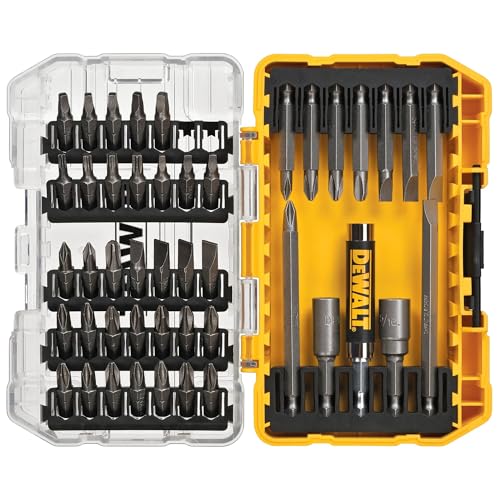
DEWALT Screwdriver Bit Set, 40 Pcs. Impact Ready, FlexTorq Impact Driver Bit Set with Storage Case (DWA2T40IR)
A shortlisting routine that works in one pass
Begin by inventorying your own fasteners. Walk the home with a notebook: furniture types, bicycles, appliances you would realistically open, devices you maintain, toys with security screws. That inventory, usually dominated by a dozen profiles, defines the set you need far better than any generic recommendation. Mark which items demand precision sizes and which demand torque, and note any security profiles already visible, because a single tri-point toy screw can justify an entire category in the case.
Then judge candidates in a fixed order. Steel and hardness first, because they cannot be upgraded later. Tip inventory second, audited as unique profiles rather than headline count. Handle and retention third, matched to whether the work is household, precision or mixed. Ratchet quality, extensions and case organisation follow, and only at the end should headline extras such as bundled sockets or novelty profiles sway the decision. A set that wins in that order will still please its owner when the novelty has faded, which is more than can be said for sets bought by counting the lid.
Budget thinking without false economy
Money in this category divides predictably. The least expensive sets economise on steel and grinding, and their cost reappears as damaged screws and early replacements. Mid-range sets with honest S2 or well-treated chrome vanadium bits, accurate tips and a decent case represent the durable centre of the market for most households. Premium systems add refinement: superior ratchets, replaceable individual bits, ESD-safe options, torque limiters and cases engineered like instrument boxes. Each step is defensible when matched to use; the indefensible purchase is the one that pays premium money for count and coatings while the underlying tips remain ordinary.
Longevity also has a service dimension. Brands that publish specifications, sell replacement bits individually and keep a system stable across years let a set grow and heal. A set that loses a critical size and cannot replace it becomes a partial tool that frustrates precisely when the missing profile reappears, as missing profiles reliably do, usually on a Sunday evening with a half-assembled something occupying the hallway.
Buy the set whose steel, tip accuracy and handle you would still respect after the case has lost its shine, because the right bit seated fully in a stubborn screw is the quiet moment every good repair is built on.