What's inside
- Key Takeaways
- Quick Picks
- How did we choose these picks?
- Why did the 4K shelf move to 42 and 43 inches?
- What do the extra two or three inches actually change in a room?
- What does 4K actually buy at the smallest sizes?
- Which televisions near 40 inches are worth your money?
- How do gaming and film divide this class?
- How do the six picks compare side by side?
- How do you decide between stepping up and staying at 40?
- What mistakes do buyers near this size keep making?
- Final Recommendation
- Frequently Asked Questions
- Related Guides
As an Amazon Associate I earn from qualifying purchases. This post may contain affiliate links at no extra cost to you.
widgetverdict.com is reader-supported. When you buy through links on our site, we may earn an affiliate commission.
Where to buy: all six televisions below carry verified Amazon listings, linked in the table, the reviews and the comparison. Two of the six are 1080p sets, not 4K sets, and they are labelled that way in every place this guide mentions them, because honesty about that fact is the entire point of the article.
Here is the fact this guide exists to state plainly: a 40-inch 4K television, as a panel you can actually buy, essentially does not exist. Panel makers cut their glass in sizes the market rewards, and at the small end of the 4K era the rewarded sizes settled at 42 and 43 inches, not 40. So the shopper searching for the best 40 inch 4K TVs is standing in front of a shelf that has quietly moved: the genuine 4K article now starts at 42 inches with OLED and at 43 inches with LED and Mini-LED, while the true 40-inch sets still on sale — and two of them are in this guide, labelled honestly — are 1080p machines. Anyone who sells you a 40-inch 4K panel without that context is selling you a search term, not a television. This guide refuses to do that. It gives you the four real 4K successors at 42 and 43 inches, and the two real 40-inch sets with their actual resolution printed wherever they are named.
Why include the 1080p pair at all? Because some buyers’ constraint is genuinely the number 40: a cabinet, a caravan, a room dimension that admits no more. Those buyers deserve to know what the 40-inch shelf actually stocks, from makers they trust, rather than being upsold into a size that does not fit or misled by a title. The Hisense 40 A4 and the TCL 40 S3 in this guide are good televisions. They are not 4K televisions. Both sentences are true, and this guide will keep both in view from the first paragraph to the last.
Key Takeaways
- True 40-inch 4K panels essentially do not exist in today’s market; the 4K shelf at this end of the range begins at 42 inches (OLED) and 43 inches (LED and Mini-LED).
- The four genuine 4K picks here are the LG C4 and C5 at 42 inches, Samsung’s QN70H at 43 inches and TCL’s S4 at 43 inches.
- The Hisense 40 A4 and TCL 40 S3 are 1080p sets, not 4K, and are included — labelled as 1080p everywhere — for buyers whose space truly stops at 40 inches.
- At typical small-room distances, the step from 40 to 43 inches is a modest change in the room and a complete change in resolution class.
- OLED at 42 inches (the two LGs) suits film-first and gaming-first small rooms; Mini-LED and LED at 43 suit brighter rooms and value-first budgets.
- Measure your space before deciding whether you are a 40-inch buyer with an honest 1080p answer or a 42/43-inch buyer with a true 4K one.
Quick Picks
| Pick | Badge | Why it earns its place |
|---|---|---|
| LG 42-inch OLED evo C4 | The true-4K film pick | A 42-inch 4K OLED with LG’s 4K processor and Magic Remote — the smallest genuine 4K cinema in the guide. |
| LG 42-inch OLED evo C5 | The newer OLED | The 2025 C5 at 42 inches, with AI Super Upscaling, Dolby Vision and Dolby Atmos in its title. |
| Samsung 43-inch QN70H Neo QLED | The bright-room 4K pick | A 43-inch Neo QLED Mini-LED 4K set with Samsung Vision AI and full colour volume claims. |
| TCL 43-inch S4 4K | The value 4K pick | A 43-inch 4K LED set with Google TV, Dolby Vision and HDR Pro at the accessible end of true 4K. |
| Hisense 40-inch A4 — 1080p, not 4K | The honest 40-inch option | A 40-inch Full HD Roku set for spaces that truly stop at 40 inches; a good TV that is not a 4K TV. |
| TCL 40-inch S3 — 1080p, not 4K | The other honest 40 | A 40-inch Full HD Google TV set, labelled 1080p here as everywhere in this guide. |
How did we choose these picks?
The selection began with the market’s own geography. We looked for 4K televisions as close to 40 inches as the industry actually builds them, and the industry’s answer was unambiguous: 42-inch OLED from LG, in two generations, and 43-inch sets from Samsung and TCL. Those four are the guide’s 4K picks, verified from listings whose titles state their size and 4K class. We then asked what a buyer with a hard 40-inch limit should be shown, and the honest shelf answered with 1080p sets from Hisense and TCL — the same two models, not coincidentally, that anchor the value end of this site’s 1080p coverage, included here at their true resolution so that the size-first buyer can compare knowingly.
Every pick carries a verified listing, and every specification discussed is drawn from its listing title. The honesty rule of this guide is mechanical as well as editorial: the two 1080p sets are never described with 4K language, never appear in a sentence that lets a skimming reader mistake them for 4K, and carry their not-4K label in the quick picks table, their review headings, the comparison table and this summary alike. If a reader finishes the article believing a 40-inch 4K panel was among the picks, the guide has failed at its one job, whatever else it achieved.
Ordering within the guide follows the likely reader’s journey: the true 4K successors first, because most searchers for this keyword want 4K and can absorb two or three extra inches, then the honest 40s for the minority whose space is genuinely fixed. Prices appear nowhere, per house policy, and the value judgements are made in words: OLED polish, Mini-LED brightness, LED value, and 1080p honesty.
Why did the 4K shelf move to 42 and 43 inches?
Panel economics, mostly. Television glass is manufactured in large sheets and cut into panels, and the cutting patterns that minimise waste at the small end of the 4K market favour 42- and 43-inch rectangles. Demand reinforced the geometry: as 4K became the default, the small-4K buyer was usually furnishing a bedroom or a gaming desk where 43 inches fit as easily as 40, so makers had no commercial reason to defend the 40-inch 4K diagonal. The 40-inch size survived, but it survived in the 1080p lines, where the same cutting logic and a price-sensitive audience kept it alive. The result is the strange map this guide charts: one size number, 40, belonging to the Full HD world, and its immediate neighbours belonging to 4K.
There is a second, quieter reason. At 40 inches and below, 4K’s benefit is distance-dependent in a way that made the size commercially awkward to defend. From a sofa, a 40-inch 1080p picture and a 40-inch 4K picture are closer than their specifications suggest; the 4K premium at that diagonal had to be justified to buyers who could not always see what they were buying. At 42 and 43 inches, especially in OLED and gaming contexts where viewers sit closer, the justification strengthens. The industry did not conspire against the 40-inch 4K buyer; it simply followed the distances and the glass, and the size was left behind as a side effect. Understanding that helps the buyer respond rationally: either move with the shelf to 42 or 43, or stay at 40 with clear eyes about what the shelf there stocks.
What do the extra two or three inches actually change in a room?
Less than the anxiety suggests, and the guide should quantify the feeling honestly. A 43-inch set is roughly three inches wider than a 40-inch set — about the width of a hand — and stands a little taller on the same furniture. In most rooms that difference is absorbed by the wall or the stand without negotiation. The exceptions are real but specific: fitted cabinets and alcoves built for a 40, caravan and camper mountings with fixed clearances, and desks where a 43-inch screen crowds the workspace. If your space is not on that exceptions list, the step up is a tape-measure question with an easy answer, and the reward is the entire 4K class: OLED contrast or Mini-LED brightness, current platforms, and panels that will be supported as the market’s mainstream rather than its remainder.
Viewing geometry moves slightly too. A 42- or 43-inch 4K panel can be watched closer than a 40-inch 1080p one before its pixel structure shows, which matters in the two postings where this class thrives: the gaming desk, where the screen is at arm’s length and doubles as a monitor, and the compact living room, where the sofa is nearer the wall than furniture catalogues assume. In both postings the successors are not merely bigger; they are usable nearer, and that nearness is a genuine expansion of the room’s possibilities rather than a specification trophy.
What does 4K actually buy at the smallest sizes?
Sceptics of small 4K ask a fair question, and the guide should answer it without salesmanship. At 42 and 43 inches, 4K buys three things. First, closeness: the pixel structure retreats far enough that a desk viewer or a front-row sofa can sit near the screen without the image dissolving into a grid, which converts these sets into credible monitor substitutes and compact cinema screens at once. Second, texture: film grain, fabric, skin and the fine print of game interfaces render as continuous surfaces rather than as approximations, and viewers register that continuity as realism without analysing it. Third, headroom: a 4K panel is the native canvas for the content the industry now masters first — streamed films, current games, prestige series — so the set meets its diet at full strength instead of downscaling it.
What 4K does not buy at this size is grandeur. A 43-inch screen remains a 43-inch screen across a large room, and no resolution makes it fill a wall. Buyers whose disappointment with their old 40 was really about scale should hear that plainly: the successors in this guide solve resolution and technology, not size, and a household craving cinema scale should be reading a larger guide entirely. The honest framing is that this class perfects the small screen rather than enlarging it, and perfection at small size is a legitimate ambition for the rooms — studies, bedrooms, gaming corners, compact flats — where these sets will actually live.
Which televisions near 40 inches are worth your money?

LG 42-Inch Class OLED evo C4 Series 4K Smart TV (OLED42C4PUA, 2024) — The true-4K film pick
The smallest genuine 4K cinema in this guide is an OLED, and it earns the opening review. LG’s C4 at 42 inches — verified title: a 42-inch class OLED evo C4 series smart TV with a 4K processor, flat screen, Magic Remote and Alexa built in, 2024 model — brings the picture technology of flagship living rooms down to a size a bedroom, a study or a gaming desk can hold. OLED’s defining trait, each pixel lighting and extinguishing itself, produces the black levels and contrast that make films at night look like films rather than like television, and at 42 inches that trait is available to rooms the flagship sizes cannot enter.
The C4’s audience is the viewer who sits close and cares. At a desk or in a compact room, 4K resolution on an OLED panel resolves fine detail — film grain, game interfaces, the text on a streamed documentary — with a calm that LED panels at this size approach but do not match, and the wide viewing angles keep the picture honest for a second viewer on the bed or the sofa’s end. LG’s 4K processor, named in the title, handles the upscaling of the broadcast and older content that still fills much of any week’s viewing, so the panel’s gifts are not reserved for native 4K material.
The Magic Remote is the interface half of the proposition: LG’s pointer-style remote, loved and loathed in roughly equal measure across the industry, paired here with Alexa built in for the voice route around it. Households should know their own feelings about pointer remotes before committing, because at this size the set will be operated nightly and the remote is the relationship. The panel itself asks for no such ambivalence.
Against its own successor below, the C4 is the previous generation at the same diagonal: a known quantity with a deep base of owner experience behind it. Buyers who value the newest processing should read on; buyers who value a settled model with its behaviour documented across a full model year will find the C4 the comfortable choice, and in the small-OLED class comfort is a rational criterion.
Desk duty deserves a paragraph of its own in the C4’s review, because 42-inch OLEDs have quietly become a monitor-class phenomenon. A screen that serves as a television at night and a vast, colour-honest workspace by day collapses two purchases into one object, and the C4’s size is the largest that most desks can absorb. Buyers intending that double life should plan the desk around it — depth enough to sit at a sane distance, a stand or arm that sets the panel at eye height — and will find the investment repaid in both shifts of the screen’s day.
The C5’s processing story has a second chapter for households with deep back-catalogues. A set bought in 2026 will spend much of its life showing material mastered years or decades ago, and upscaling is the technology that decides whether that material looks honoured or merely enlarged. LG’s AI-branded approach analyses content types rather than applying one filter, and owners of large film and series libraries — the exact people who buy OLED — are its intended beneficiaries. Judge the C5, if you audition it, with an old favourite rather than a demo reel; that is the comparison its engineers were working on.
- Size and class: 42-inch class OLED, true 4K, per the verified listing title
- Processing: LG 4K processor; Magic Remote; Alexa built in
- Model: OLED42C4PUA, 2024
- Character: the film-first small 4K set
Strengths
- OLED contrast and black levels at the smallest true-4K size in the guide.
- Close viewing rewarded: desk and compact-room audiences see the 4K benefit fully.
- A settled, well-documented model generation.
Trade-offs
- Previous generation beside its C5 successor below.
- Pointer-style Magic Remote divides households.
- OLED polish is priced as the class’s premium technology.
Best for: film-first viewers, gamers at desks and compact rooms that can take 42 inches. Not suited for: hard 40-inch spaces, or buyers who want the newest model year.

LG 42-Inch OLED evo AI 4K C5 Series Smart TV (OLED42C5PUA, 2025) — The newer OLED
The C5 is the C4’s argument updated, and its verified title reads like LG’s 2025 priorities in miniature: a 42-inch OLED evo AI 4K C5 series smart TV with AI Super Upscaling, Dolby Atmos and Dolby Vision, HDR10, Filmmaker Mode, Wow Orchestra and Alexa built in. Where the C4 sells OLED’s inherent virtues, the C5 sells processing on top of them — the claim that the set’s intelligence improves everything fed into the panel, including the vast majority of viewing that is not native 4K.
AI Super Upscaling is the headline for real households, because real households watch broadcast, older streaming and catch-up services alongside their 4K showcases. Upscaling quality is the difference between a 4K panel that flatters its whole diet and one that only flatters its highlights, and LG’s AI-branded processing is the company’s current best effort at that daily work. Dolby Vision and HDR10 support cover the HDR formats streamed films actually arrive in, and Filmmaker Mode offers the colour-and-motion settings the films’ makers intended, a feature film lovers genuinely use rather than merely admire in a list.
Dolby Atmos in the title, with Wow Orchestra — LG’s system for blending the television’s speakers with a compatible LG soundbar — addresses the small-OLED’s predictable weakness, sound, in two stages: processing now, orchestration later if a soundbar joins the room. At 42 inches in a bedroom or study, the built-in arrangement will satisfy most evenings; the upgrade path exists for the room that grows into a film room.
Choose the C5 over the C4 when the newest processing, the 2025 baseline and the longest support runway justify the step; choose the C4 when a settled generation at the same diagonal and the same OLED fundamentals is value enough. Either way, the pair define what the honest successor to the 40-inch 4K idea looks like: two inches larger, an entire technology class richer.
Desk duty deserves a paragraph of its own in the C4’s review, because 42-inch OLEDs have quietly become a monitor-class phenomenon. A screen that serves as a television at night and a vast, colour-honest workspace by day collapses two purchases into one object, and the C4’s size is the largest that most desks can absorb. Buyers intending that double life should plan the desk around it — depth enough to sit at a sane distance, a stand or arm that sets the panel at eye height — and will find the investment repaid in both shifts of the screen’s day.
The C5’s processing story has a second chapter for households with deep back-catalogues. A set bought in 2026 will spend much of its life showing material mastered years or decades ago, and upscaling is the technology that decides whether that material looks honoured or merely enlarged. LG’s AI-branded approach analyses content types rather than applying one filter, and owners of large film and series libraries — the exact people who buy OLED — are its intended beneficiaries. Judge the C5, if you audition it, with an old favourite rather than a demo reel; that is the comparison its engineers were working on.
- Size and class: 42-inch class OLED, true 4K, per the verified listing title
- Processing: AI Super Upscaling; Dolby Vision, HDR10, Filmmaker Mode
- Sound: Dolby Atmos; Wow Orchestra soundbar integration
- Model: OLED42C5PUA, 2025
Strengths
- The guide’s most advanced picture processing at 42 inches.
- Filmmaker Mode and full HDR format support serve film-first rooms.
- 2025 baseline with the longest runway in the OLED pair.
Trade-offs
- The premium step within an already premium technology.
- Wow Orchestra’s full value needs a compatible LG soundbar later.
- Still 42 inches: hard 40-inch spaces remain excluded.
Best for: film lovers and upgraders who want the current OLED generation at small size. Not suited for: fixed 40-inch postings or value-first budgets.

Samsung 43-Inch Class QN70H Series Neo QLED Mini-LED 4K Smart TV (2026) — The bright-room 4K pick
Samsung’s answer at this end of the shelf is brightness and colour volume, delivered at 43 inches. The verified title specifies a QN70H series Neo QLED Mini-LED 4K smart TV, 2026 model, with Samsung Vision AI, Quantum Mini-LED, a claim of full colour volume with Quantum Dot, an NQ4 AI processor, 4K upscaling and Alexa built in. Neo QLED is Samsung’s name for its Mini-LED backlighting programme, and Mini-LED at 43 inches is the technology for rooms OLED does not own: bright rooms, daytime viewing, spaces where the screen competes with windows rather than with darkness.
The colour volume claim is the one to understand rather than merely repeat. A panel that holds its colour saturation at high brightness keeps sport, animation and daytime programming vivid where lesser panels wash out, and in a kitchen-adjacent living space or a sunlit bedroom that quality is the picture. The NQ4 AI processor and its 4K upscaling do the same daily work as LG’s processing in the C5, raising broadcast and older streaming toward the panel’s standard, and Samsung Vision AI is the umbrella under which the 2026 model organises its picture and interface intelligence.
Samsung’s platform polish, described in this site’s smaller-size guides, applies here at full strength: the set is the choice for households already inside Samsung’s ecosystem, who will find its interface continuous with their phones and their main-room set. The 2026 model year is the freshest in this guide, giving the QN70H the longest runway of the four true 4K picks — a consideration this batch of guides treats as a genuine feature, since smart televisions age by software as much as by panel.
Against the LG pair, the Samsung trades OLED’s perfect blacks for Mini-LED brightness and a one-inch-larger canvas; against the TCL below, it trades value for processing and ecosystem. Bright rooms and Samsung households have their answer here, and it is a strong one.
Sport gives the QN70H its second showcase after brightness itself. Fast motion in bright stadiums, saturated kits, score graphics that must stay legible at a glance: the Mini-LED’s strengths align with the broadcast’s demands, and a compact living room that gathers for matches will feel the set’s colour volume as a social feature, visible from the room’s edges where guests actually sit. The guide’s dark-room advice stands — OLED for cinema — but households whose calendar is fixtures rather than film premieres should weight this pick accordingly.
- Size and class: 43-inch class, Neo QLED Mini-LED, true 4K, per the verified listing title
- Processing: NQ4 AI processor, Samsung Vision AI, 4K upscaling
- Colour: full colour volume claim with Quantum Dot
- Model year: 2026, the guide’s freshest
Strengths
- Mini-LED brightness suits bright and daytime rooms OLED does not own.
- Colour volume holds saturation where lesser panels wash out.
- Newest model year and Samsung’s ecosystem polish.
Trade-offs
- Blacks, while strong for LED, do not reach OLED’s per-pixel depth.
- 43 inches is the largest step from the 40-inch brief.
- Full ecosystem value assumes a Samsung-leaning household.
Best for: bright rooms, daytime and sport viewing, Samsung households stepping up from 40. Not suited for: dark-room film purists or fixed 40-inch spaces.

TCL 43-Inch Class S4 4K LED Smart TV with Google TV (43S450G) — The value 4K pick
TCL’s S4 is where true 4K becomes an ordinary purchase rather than an event. The verified title lists a 43-inch class S4 4K LED smart TV with Google TV, Dolby Vision, HDR Pro, Dolby Atmos, Google Assistant built in with a voice remote, and Alexa compatibility, in 2023 model form. Read that list against the premium picks above and the S4’s philosophy clarifies: the formats and the platform are current — Dolby Vision and Atmos, Google TV, voice control — while the panel technology is honest LED rather than OLED or Mini-LED. For a bedroom, a first flat or a family room’s second set, that is frequently the correct allocation.
Google TV’s presence matters to the value case more than it might appear. A value set whose platform is the same recommendation-led system found in premium rooms does not feel like a compromise in daily use; the home screen suggests, the voice remote searches across services, and the set behaves like a citizen of the household’s accounts. TCL built its reputation on exactly this trick — flagship software manners on value hardware — and the S4 is that reputation’s 4K expression at the size the old 40-inch buyer is being asked to adopt.
Dolby Vision and HDR Pro give the set HDR credentials that value panels once omitted, and while LED brightness bounds what HDR can achieve here, streamed films gain the steadier highlights and shadow detail the formats exist to deliver. Dolby Atmos processing similarly lifts the sound above the class’s floor without pretending to be a soundbar.
The 2023 model year is the S4’s dated note, shared with several sets in this batch of guides, and Google TV’s account-based updating blunts it as usual. For the buyer whose question is simply: what is the sensible way to own a true 4K set near this size without paying for OLED or Mini-LED? — the S4 is the guide’s answer, and it is not a reluctant one.
First-flat buyers deserve a direct word about the S4, because it is calibrated to their situation with unusual precision. A first serious television must be a main set immediately and a bedroom set eventually, when the household upgrades; the S4’s size, platform and formats survive that demotion gracefully, since a 43-inch Google TV with Dolby Vision is as welcome in a future bedroom as in a present living room. Buying for two postings at once is the opposite of compromise here — it is the value pick’s deepest argument, and households at that life stage should weigh it fully.
- Size and class: 43-inch class, 4K LED, true 4K, per the verified listing title
- Platform: Google TV, Assistant built in, voice remote, Alexa compatible
- Picture and sound: Dolby Vision, HDR Pro, Dolby Atmos
- Model: 43S450G, 2023 model year
Strengths
- True 4K with current HDR formats at the accessible end of the class.
- Google TV gives a value set premium software manners.
- The natural first 4K for bedrooms and first flats at this size.
Trade-offs
- LED panel cannot match OLED contrast or Mini-LED brightness.
- 2023 baseline is the oldest among the true 4K picks.
- Sound processing helps; a soundbar remains the upgrade for film rooms.
Best for: value-first buyers who want genuine 4K near the old 40-inch brief. Not suited for: buyers seeking OLED blacks or Mini-LED brightness.
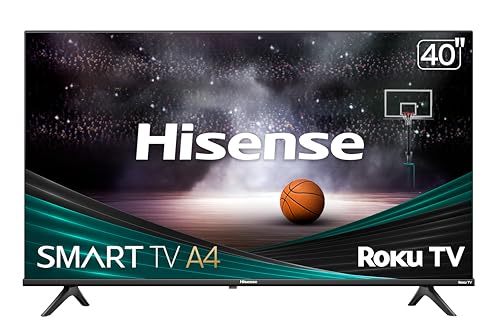
Hisense 40-Inch Class A4 Roku TV — 1080p, not 4K — The honest 40-inch option
The label comes first, as it does everywhere in this guide: this is a 1080p television, not a 4K television. Its verified title says so itself — a 40-inch class A4 series FHD 1080p smart Roku TV with Alexa compatibility, Dolby Audio and a slim bezel design, with Google Assistant compatibility declared. Hisense does not pretend otherwise, and neither does this review. The A4 is here because it is what the 40-inch shelf genuinely stocks from a major maker, and because for a defined group of buyers it is not a compromise but the correct purchase.
That group is defined by space and by diet. Space: the cabinet, alcove, caravan or room dimension measured at exactly 40 inches, where the successors above physically cannot go. Diet: broadcast, streaming and everyday viewing from a sofa at moderate distance, where Full HD at 40 inches delivers its picture without apology, as this site’s 1080p guide argues in detail. A spare room furnished around this set, with Roku’s guest-proof interface on the remote, is a well-furnished spare room. The dishonesty would be in calling it 4K; the television itself is honest equipment.
Roku’s platform is the A4’s daily virtue, and Dolby Audio its sound credential for the larger distance a 40-inch room implies. The slim bezel keeps the object light on its furniture, and dual-assistant compatibility lets the household’s existing voice habits drive it. Readers who met this model in the 1080p guide will find the same set described here from the opposite direction: there, it was a value pick among its own kind; here, it is the truthful answer to a size question, and its analysis changes accordingly — what matters in this guide is not how it ranks among 1080p sets but whether your constraint is truly the number 40.
If it is, buy this set with a clear conscience and spend the difference on the room. If it is not — if the tape measure allows 42 or 43 — the four picks above are the guide’s real recommendations, and this review’s job has been to make sure you choose between the two paths knowingly rather than by a search term’s sleight of hand.
There is a rental and second-home dimension to the honest 40s that the guide should acknowledge. A holiday property or a furnished let with a 40-inch alcove is a commercial posting: the set must fit, serve strangers simply and survive seasons of indifferent handling. The Hisense and TCL at exactly 40 inches, with mainstream platforms and replaceable price positions, answer that brief better than any premium successor could, and their 1080p panels are no liability to guests watching broadcast and streaming from a sofa. Not every television purchase is a shrine to picture quality; some are joinery, and joinery is measured in fit.
- Size and resolution: 40-inch class, FHD 1080p — not 4K, per its own verified title
- Platform: Roku TV
- Sound and design: Dolby Audio; slim bezel design
- Compatibility: Alexa and Google Assistant, per the title
Strengths
- A genuine 40-inch set from a major maker, for spaces that stop at 40.
- Roku’s interface is the guest-proof choice for spare rooms.
- Honest Full HD performance for broadcast and streaming diets.
Trade-offs
- It is not 4K, and no setting makes it so; close viewers will see the limit.
- Buyers with room for 43 inches get an entire resolution class more above.
- Future-proofing is bounded: the panel belongs to the Full HD era.
Best for: hard 40-inch spaces, spare rooms and caravans with everyday viewing diets. Not suited for: anyone whose actual requirement is 4K resolution.

TCL 40-Inch Class S3 with Google TV — 1080p, not 4K — The other honest 40
The second honest 40 carries the same label, stated as plainly: this TCL S3 is a 1080p television, not a 4K television. Its verified title confirms a 40-inch class S3 1080p LED smart TV with Google TV, Google Assistant built in with a voice remote, and Alexa compatibility, in 2023 model form. Note the platform carefully, because this is the Google TV edition of TCL’s 40-inch S3 — a different listing from the Roku edition of the same series that appears in this site’s 1080p coverage — and in a guide whose lesson is that software defines the set, the distinction is the substance.
Against the Hisense above, the comparison is the platform contest restated at exactly 40 inches. The TCL offers Google TV’s recommendation-led home screen, cross-service voice search and profiles; the Hisense offers Roku’s neutral grid and guest-proof calm. Panels are cousins, sizes identical, resolutions identically 1080p. A buyer whose space fixes the size and whose household must choose between these two is choosing an operating system, and should choose it by the household’s accounts and habits rather than by any panel argument, because there is no panel argument to be had.
TCL’s S3 line is the same family that anchors this site’s 32-inch smart coverage in two platform editions, and its 40-inch Google form inherits the line’s virtues: a Full HD LED picture that flatters streaming at room distances, mature manufacturing, and a platform that updates with Google’s account-based cadence. For the Google household with a hard 40-inch limit — the fitted cabinet in a Google-run home — this is the coherent purchase, made with eyes open about resolution.
And the eyes-open clause bears repeating one final time in this review, because repetition is the guide’s method: nothing in this set’s 4K-adjacent marketing neighbourhood changes what it is. It is a good 1080p television at the size you measured. Buy it for that, and it will not disappoint you; buy it believing otherwise, and no television could save the purchase.
- Size and resolution: 40-inch class, 1080p LED — not 4K, per its own verified title
- Platform: Google TV, Assistant built in, voice remote
- Compatibility: Alexa compatibility declared in the title
- Model: 40S350G, 2023 model year; Google edition, distinct from the Roku edition
Strengths
- Google TV’s recommendations and search at exactly 40 inches.
- The S3 line’s mature, well-understood hardware.
- Coherent choice for Google households with fitted spaces.
Trade-offs
- Not 4K; the resolution ceiling is Full HD at any distance.
- Recommendation-led software will not suit grid-loving households.
- 2023 baseline, as with its platform sibling at 32 inches.
Best for: Google households whose space truly stops at 40 inches. Not suited for: 4K seekers, Roku loyalists and close-range viewers.
How do gaming and film divide this class?
The two prestige uses of small 4K pull toward different picks, and naming the pull helps buyers self-sort. Film-first viewers gravitate to the OLED pair, because cinema is contrast: the night scene, the candlelit interior, the fade to a black that is actually black. The C5’s Filmmaker Mode and format support serve that viewer directly, and a small dark room with an OLED at its end is one of home entertainment’s great bargains in experience per inch. Gaming-first viewers split by room and by console habits: OLED’s response and contrast flatter atmospheric titles, while the Samsung’s brightness and colour volume flatter sport, racing and bright shared rooms where the television is watched as much as played.
The value S4, notably, serves both audiences honourably at its tier, which is why it may be the guide’s most consequential pick: it puts true 4K, Dolby Vision and a first-rate platform within reach of the buyer for whom the premium technologies are a stretch, and it does so at the size the old 40-inch shopper was already prepared to house. Classes are remembered by their value picks as much as by their flagships, and the small-4K class is fortunate that its value pick is this complete. The 1080p pair, by contrast, serve neither prestige use at full strength — which is not their indictment but their definition, and the reason their reviews keep returning the reader to the distance and diet audit.
One more honest observation about the two smaller sets, offered because their buyers deserve the complete picture rather than a tactful one. A household that chooses either of them knowingly is not settling for a lesser evening. Broadcast drama, streamed series, the evening news and the weekend match all arrive in forms these panels were built to show, and the rooms they serve — spare rooms, caravans, fitted cabinets, kitchens with a viewing corner — are rooms where company and convenience outrank spectacle. The guide’s insistence on labelling is about the word on the box, never about the worth of the evenings the box will provide, and a reader who finishes this article and buys either set with open eyes has used the guide exactly as it was written to be used.
How do the six picks compare side by side?
| Pick | Size | Resolution — stated honestly | Panel and platform |
|---|---|---|---|
| LG C4 | 42-inch | True 4K | OLED, LG platform with Magic Remote |
| LG C5 | 42-inch | True 4K | OLED, AI processing, Dolby Vision and Atmos |
| Samsung QN70H | 43-inch | True 4K | Neo QLED Mini-LED, Samsung platform |
| TCL S4 | 43-inch | True 4K | LED, Google TV |
| Hisense A4 40 | 40-inch | 1080p — not 4K | LED, Roku TV |
| TCL S3 40 | 40-inch | 1080p — not 4K | LED, Google TV |
Longevity completes the successors’ case, and it is worth stating without romance. A television bought from the market’s current mainstream — 42- and 43-inch 4K, current platforms, current formats — inherits the industry’s full attention: app updates, accessory ecosystems, replacement remotes on every high street, and resale interest when the household upgrades. A set bought from a remainder size class inherits a quieter afterlife, perfectly serviceable but progressively lonelier. Neither destiny is a scandal, and the 1080p pair will serve their postings honourably for years. But buyers choosing between the paths should know they are also choosing between those afterlives, and for a set expected to serve a decade the mainstream’s gravity is a rational weight on the scale.
There is also the matter of what the step up does to the room’s future. A 43-inch set that fits today sets the room’s expectation for its replacement in eight years, by which time the market will have standardised further around the larger small sizes, and the alcove that argued for 40 will have been re-measured by life anyway. Furniture changes, households move, and the hard 40-inch constraint that feels eternal in this purchase often proves to have been a season’s arrangement. None of that dissolves a genuinely fixed space — the caravan, the built cabinet — but it should prompt every other buyer to interrogate whether their 40 is a wall or merely a habit before letting it veto an entire resolution class.
Sound, finally, scales with the step up in ways worth a sentence. The larger successors carry larger cabinets and more ambitious processing, and the film-first rooms among them will still eventually meet a soundbar, but the starting point is higher than anything the smaller class offers. A buyer whose old set’s dialogue vanished into its furniture will feel the improvement before any resolution argument registers, which is a reminder that televisions are bought as whole instruments and judged, nightly, as whole instruments too.
How do you decide between stepping up and staying at 40?
Run the decision in the guide’s order. First, measure the space with the successors’ actual dimensions in hand — width and height of the specific 42- or 43-inch set, not the class number — and include the stand’s footprint and the wall mount’s depth. If a successor fits, the decision is already made in favour of true 4K, because no other consideration in this class outweighs an entire resolution generation plus a current panel technology. Second, if nothing larger fits, audit your viewing honestly: distance, diet, and how long you keep televisions. A 1080p set bought knowingly for a spare room’s broadcast-and-streaming life is a sound purchase; the same set bought as a decade-long main screen for a film-loving household is a slow disappointment, and the honest response to that audit may be to change the furniture rather than the television.
Third, whichever path you take, set the new set up for its actual room: picture mode matched to the light, dialogue-favouring sound settings, the platform’s profiles and home screen arranged in the first evening. A true 4K OLED left in a showroom picture mode and a humble 1080p set properly settled can trade reputations in a dark room, which is the final argument for buying deliberately and setting up carefully rather than buying impressively and neglecting the rest.
What mistakes do buyers near this size keep making?
The founding mistake is believing the search term: assuming that because 40-inch 4K is a phrase people type, it is a product factories make, and accepting a listing’s implication without reading its resolution line. Read the resolution line. The second mistake is the opposite snobbery — refusing the honest 1080p sets on principle when the space is genuinely 40 inches and the diet is genuinely broadcast and streaming, and contorting a room to fit a size it cannot hold. Third, buyers stepping up to 42 or 43 forget the stand and mount dimensions differ from the old set’s, and discover the fact with the television half out of its box; measure the successors as physical objects, not as numbers.
Fourth, OLED buyers in bright rooms and Mini-LED buyers in dark ones occasionally choose technology by reputation rather than by room, and this guide’s bright-versus-dark division exists to prevent exactly that swap. Fifth, buyers of the 1080p pair sometimes skip the distance audit — a 40-inch Full HD set watched from four feet in a gaming chair will show its grid, and the return window is the time to learn it, not the second year.
A final consideration belongs to the households furnishing for someone else: the parent moving into a smaller home, the student leaving for a first flat, the spare room being prepared for a long-stay guest. In those purchases the giver’s instincts run toward generosity of specification, while the recipient’s reality runs toward simplicity of life. The guide’s counsel is to let the recipient’s room and habits govern, even when that means the honest smaller answer, because a television that fits a life will be thanked for daily, while a television that merely impresses at unwrapping will be negotiated with for years. That principle, applied across every size in this batch of guides, is worth more than any single recommendation inside them.
And a word, in closing of this section, about patience. The small end of the television market renews itself on a yearly rhythm, and a buyer whose space allows either path loses little by waiting for the next model cycle if their current set still serves. The reverse is equally true: a buyer whose set has failed, or whose room stands empty, should not defer a good purchase in hope of a marginally better one, because the successors in this guide are mature expressions of their technologies and the honest pair are settled designs. Buy when the room asks, measure before you buy, and read the resolution line on whatever you bring home — the whole of this guide is contained in those three instructions.
Final Recommendation
Measure first, and let the tape decide which half of this guide is yours. If 42 inches fits, the LG C5 is the current-generation OLED answer and the C4 its settled predecessor, and between them they give the old 40-inch brief a better home than it ever had. If 43 inches fits and the room is bright or the house is Samsung’s, the QN70H is the step up to take; if the budget leads and Google TV is the household tongue, TCL’s S4 delivers true 4K without ceremony. And if the space truly, immovably stops at 40, then buy the Hisense A4 for Roku calm or the TCL S3 for Google intelligence, in the knowledge — stated here for the last time — that you are buying good 1080p televisions, not 4K ones, and that a purchase made in that knowledge is an honest one. The size class moved. This guide’s advice is simply to move with it knowingly, or to stay, knowingly, where you are.
Frequently Asked Questions
Does a 40-inch 4K TV exist at all?
Essentially not in the current market. Panel cutting and demand settled the small 4K sizes at 42 and 43 inches, and the 40-inch sets still sold by major makers are 1080p models. Historical and niche exceptions surface occasionally, but no buyer should plan around them, and any listing implying a mainstream 40-inch 4K panel deserves a careful read of its resolution line.
Will I notice the difference between the 40-inch 1080p sets and the 43-inch 4K sets?
At close range and with 4K content, yes, clearly — text, game interfaces and fine detail all sharpen. Across a spare room with broadcast and everyday streaming, the difference narrows considerably. The honest answer depends on your distance and diet, which is why the guide insists on the audit rather than a slogan.
Which is better at this size, the LG OLEDs or the Samsung Mini-LED?
Room decides. OLED’s per-pixel contrast owns dark and film-first rooms; the QN70H’s Mini-LED brightness and colour volume own bright and daytime rooms. Both are true 4K at near-identical sizes, so the choice is about light, not about resolution or brand loyalty.
Is the TCL S4 too basic to be a main television?
No. It is a true 4K set with current HDR formats and a premium-grade platform, on an honest LED panel. In a small living room it serves as a main set without apology; buyers seeking OLED contrast or Mini-LED brightness are shopping a different tier, not correcting a deficiency.
Why are two 1080p TVs in a 4K guide at all?
Because the alternative — pretending they are 4K, or omitting the only televisions that fit a true 40-inch space — would fail the readers who need them. They are labelled 1080p, not 4K, in their headings, their table rows and every summary, so that a size-constrained buyer can choose them knowingly.
What should I measure before ordering a 42- or 43-inch successor?
The set’s full width and height from its specification, the stand’s footprint depth, and the mount’s added depth if wall-mounting — against the cabinet, alcove or wall section it must occupy, with cable room behind. Class numbers round; furniture does not.
If I keep the 1080p set, what am I giving up in practice?
Three things, in descending order of daily importance: the ability to sit close without seeing pixel structure, the fine texture of native 4K content, and membership of the market’s mainstream for future support and accessories. For broadcast and streaming at spare-room distances, many households will miss none of the three. The guide’s position is that the sacrifice should be chosen, not discovered.
Can a 42-inch OLED serve as my only screen in a small flat?
Yes, and it is one of the class’s best uses. At studio and one-bedroom scale, the C4 or C5 anchors film, sport and gaming from a close sofa with quality that larger rooms spend far more to match. Add sound gradually if the room grows into a film room; the panel will not need revisiting.
Related Guides
See also Best 2160p 120Hz TVs for Gaming and Fast Sport, Best 10.1 Inch Tablets for Movies, Reading and Everyday Apps and Best 10.5 Inch Tablets: The In-Between Size That Still Works.



[…] with Best 40 Inch 4K TVs: The Size Class That Moved to 42 and 43, Best 2160p 120Hz TVs for Gaming and Fast Sport and Best 10.1 Inch Tablets for Movies, Reading and […]