What's inside
- Key Takeaways
- Quick Picks
- How did we choose these picks?
- What do IP ratings and nit figures actually mean in a garden?
- Where should an outdoor television live, and where should it never live?
- How concentrated is this market, and how should that shape your buying?
- How do Wi-Fi, streaming and sound actually behave outdoors?
- What changes across the seasons for an outdoor screen?
- Which of these six belongs in your garden?
- How do the six compare side by side?
- How should you install and care for an outdoor television?
- What mistakes do buyers make when taking television outside?
- Final Recommendation
- Frequently Asked Questions
- Related Guides
As an Amazon Associate I earn from qualifying purchases. This post may contain affiliate links at no extra cost to you.
widgetverdict.com is reader-supported. When you buy through links on our site, we may earn an affiliate commission.
Where to buy: Amazon carries the verified listings for every set in this guide, and each pick’s name — in the quick picks, in its full review and in the comparison table — takes you to the listing that review was checked against.
An outdoor television fights a war on two fronts that no indoor set ever meets: the weather trying to get in, and the sun trying to wash the picture out. The best outdoor TVs are therefore judged by a different rulebook, and this guide will be plain about the market it found. Outdoor television is a niche served by remarkably few manufacturers, and four of the six verified picks below come from one specialist, Sylvox, with RIXZSIW and Dornium completing the field. That concentration is not a failure of this guide’s research; it is the honest shape of the category, and the reviews treat it as information — one deep specialist range, read carefully, model by model — rather than disguising it as variety.
Every pick states a weatherproof rating in its own listing, from IP55 to IP66, and a brightness figure from 700 to 1500 nits, and those two numbers do more work outdoors than any panel specification does indoors. The sizes run from 43 to 55 inches, the sizes gardens, patios and pool decks actually accommodate, and the platforms are the familiar Google TV and WebOS wearing weatherproof clothing. Read on with your own outdoor space in mind: its sun path matters more than any showroom ever will.
Key Takeaways
- Four of the six picks are Sylvox models, because the outdoor TV market is concentrated in very few specialist hands — this guide says so openly.
- Every pick publishes an IP weatherproof rating in its listing: IP56 on the Sylvox sets, IP55 on the RIXZSIW and IP66 on the Dornium.
- Brightness is the outdoor headline: listings here span 700 nits on the Sylvox 43 to 1500 nits on the Dornium 43.
- Three of the six are 55-inch sets, two are 43-inch and one is 50-inch — the sizes real patios and pool decks accommodate.
- Partial-sun positioning is named on the Sylvox 50’s listing, a reminder that placement and shade are part of the product outdoors.
- Dolby Atmos support is named on the Sylvox 55 4K model, and HDR10 appears across the Sylvox 43, the second Sylvox 55 and the Sylvox 50 listings.
Quick Picks
| Pick | Badge | Why it earns its place |
|---|---|---|
| Sylvox 55 4K Outdoor TV | The all-round patio pick | A 55-inch 4K weatherproof set at 1000 nits with IP56 protection and Dolby Atmos support. |
| Sylvox 43 Outdoor TV | The compact terrace pick | A 43-inch IP56 Google TV at 700 nits, sized for smaller outdoor rooms and covered corners. |
| Sylvox 55 1000-Nit Outdoor TV | The anti-glare pick | Another 55-inch Sylvox at 1000 nits, this listing leading with anti-glare and HDR10. |
| Sylvox 50 Outdoor TV | The partial-sun pick | A 50-inch Google TV explicitly positioned for shaded and partially sunny spots, IP56 rated. |
| RIXZSIW 55 Outdoor TV | The WebOS alternative pick | A 55-inch IP55 set at 1000 nits running WebOS 25 with voice control, the non-Sylvox route. |
| Dornium 43 IP66 Outdoor TV | The maximum-protection pick | The highest figures in the guide: IP66 sealing and 1500 nits on a 43-inch Google TV. |
How did we choose these picks?
The gate for this guide was evidence in the listing itself. Each set had to publish its weatherproof rating and, where brightness is discussed, its nit figure in its own title, because outdoor specifications are exactly the kind that marketing elsewhere inflates and buyers cannot test until the first storm or the first sunny final. The six that passed are the verified field, and the guide covers the field as it is — Sylvox-heavy — rather than padding the list with indoor televisions in hopeful casings, which would be a disservice dressed as choice.
Within the field, the selection spreads the variables that matter outdoors. Ratings run IP55, IP56 and IP66; brightness runs 700, 1000 and 1500 nits; sizes run 43, 50 and 55 inches; platforms divide between Google TV and WebOS. That spread lets the reviews map each set to a kind of outdoor space — the covered terrace, the partial-sun patio, the exposed pool deck — which is the only mapping that decides satisfaction once a television leaves the house.
A discipline note, stated plainly: this guide uses only the IP ratings and nit figures printed in the listings, and adds no temperature ranges, no submersion claims and no brightness numbers of its own. Where a listing’s text is truncated — and outdoor listings truncate often — the review works with what is legible and says nothing beyond it. Outdoor buyers are spending on trust in sealed cabinets and bright panels; the least a guide can do is be exact about the evidence.
What do IP ratings and nit figures actually mean in a garden?
The IP code is two digits with distinct jobs. The first concerns solids such as dust; the second concerns water, and it is the second that gardens test — driven rain, splashes from a pool, the hose aimed carelessly at the flowerbeds. The listings in this guide publish IP55, IP56 and IP66. Without inventing laboratory detail beyond those figures, the practical reading is a ladder of sealing confidence: IP55 is weatherproofed for outdoor duty, IP56 is the Sylvox range’s consistent standard across four models, and IP66 on the Dornium is the highest water-and-dust protection figure printed anywhere in this guide, aimed at the most exposed installations.
Nits measure how brightly the panel can push light, and outdoors the figure is destiny. Indoor televisions live in controlled dimness; an outdoor screen competes with the sky itself, and a picture that cannot out-shout ambient daylight collapses into a reflective grey rectangle. The ladder in this guide — 700 nits on the compact Sylvox, 1000 nits on three of the larger sets, 1500 nits on the Dornium — maps onto shade. A covered terrace forgives 700; a partial-sun patio wants the 1000 class; a screen asked to perform in genuinely open sun should be reading the Dornium’s figure and thinking hard about placement even then.
A word about what these figures do not claim, because outdoor marketing elsewhere is not always so restrained. An IP rating describes protection against dust and water ingress under test conditions; it is not a promise about hail, falling branches, theft or the family dog’s opinion of the new wall furniture, and no figure in this guide should be read as covering them. Likewise, a nit figure describes the panel’s capability, not a guarantee that every hour of every day will look cinematic — the sun retains a vote. Buyers who hold those two clarifications in mind will read every listing in the category, including future ones, with appropriately calibrated trust.
The third variable is not printed in any listing because it belongs to the buyer: the sun path across the exact wall or stand position, hour by hour, in the season of heaviest use. Two gardens with the same television can produce opposite verdicts purely because one screen faces the evening sun and the other never meets it directly. This guide repeats the point because it is the cheapest performance upgrade available — choose the position before choosing the model, and half the brightness argument settles itself.
Where should an outdoor television live, and where should it never live?
The best outdoor position is boring on purpose: under some cover, out of the direct line of sprinklers and pool splash zones, on a wall or stand that keeps the screen vertical and shaded at the hours it will actually be watched. Covered terraces, pergolas with a roof line, and the wall beneath a deep eave are the classic sites, and they flatter every set in this guide, including the toughest. Partial sun — the Sylvox 50’s listing uses exactly that framing — means the screen meets direct light for part of the day and shade for the rest, and it is the realistic condition of most patios that owners describe, optimistically, as sunny.
Full, all-day exposure is the demanding end, and honesty requires saying that it tests even the highest-rated sets in this guide: not their sealing, which the IP figures address, but their picture, because no brightness figure in these listings turns midday sun into a cinema. Buyers with an unavoidably exposed position should weight the highest nit figures, consider the anti-glare listings, and still plan viewing for the hours when the screen’s corner of the garden is kindest. An outdoor television is a seasonal, social appliance; placing it where the garden already gathers — near seating, near the grill, within earshot of the house — matters as much as its specifications, because a screen nobody sits near is weatherproofed furniture.
How concentrated is this market, and how should that shape your buying?
Plainly: very. One specialist, Sylvox, supplies four of the six verified models, spanning 43, 50 and two different 55-inch sets, all at IP56, with brightness from 700 to 1000 nits and both Google TV and the company’s broader smart features across the range. RIXZSIW and Dornium each field a single set here, and each uses its one shot distinctively — WebOS and IP55 from RIXZSIW, the guide’s maximum IP66 and 1500 nits from Dornium. Indoor television’s sprawling brand bazaar simply does not exist outdoors, and buyers who accept that early shop better.
Concentration cuts the other way as well, and fairness requires noting it. A specialist that lives or dies by one category tends to engineer for it without distraction: the Sylvox range’s consistent IP56 standard across four sizes, its partial-sun labelling honesty and its anti-glare variant all read as decisions made by people who think about gardens professionally. The risk in a concentrated market is not quality but dependency — fewer alternatives if a particular model disappears — and the presence of RIXZSIW’s platform alternative and Dornium’s extremes keeps that risk honest company in this guide.
The practical consequence is that model-to-model comparison inside the Sylvox range matters more than brand comparison. The two Sylvox 55s differ in emphasis — one leads with Dolby Atmos support, the other with anti-glare and HDR10 — and the 43 and 50 fill different garden sizes and sun conditions. Read those distinctions carefully, treat the two outsiders as genuine alternatives where their figures or platforms appeal, and the concentrated market becomes navigable rather than suspicious.
How do Wi-Fi, streaming and sound actually behave outdoors?
The garden is further from the router than any room in the house, and an outdoor smart television lives or dies by that distance. Before mounting anything, stand at the intended position with a phone and check the household Wi-Fi’s strength there at the hour the street’s networks are busiest; a stream that stutters outdoors will be blamed on the television, but the culprit is usually geography. A weatherproof installation deserves a planned signal — a nearer access point, a repositioned router, or at least the knowledge of what the position receives — arranged before the screen makes the spot permanent.
Sound outdoors obeys physics rather than settings. Without walls to return it, audio disperses, dialogue thins with distance, and the temptation to simply turn everything up exports your film night to the neighbours. The civilised answers are seating geometry and restraint: arrange the chairs within the screen’s near field, aim the sound at the gathering rather than the garden at large, and treat the Atmos support named on the Sylvox 55’s listing as a head start on clarity rather than a licence for volume. Households that entertain often should budget the outdoor sound conversation alongside the mount, because a picture everyone can see paired with commentary nobody can hear is the category’s most preventable disappointment.
What changes across the seasons for an outdoor screen?
An outdoor television is the only screen in the house with a climate for a colleague, and the seasons rotate its challenges. Summer tests brightness and glare at the longest, brightest hours — the conditions the 1000 and 1500-nit listings were written for. Autumn tests sealing with driven rain. Winter, in colder gardens, tests the household’s realism about which evenings are truly television weather, whatever the cabinet can survive. Spring is inspection season, when mounts, seals and settings get the once-over described in the care section below.
The buyer’s translation of all this is simple: purchase for your garden’s worst relevant season, not its best afternoon. A household that watches outdoor sport through autumn should read IP figures the way a sailor reads a forecast; a household whose outdoor screen sleeps from October to April can weight summer brightness almost exclusively. The listings in this guide publish the figures needed for both readings, and the reviews keep returning to them because, outdoors, the environment is a specification.
Which of these six belongs in your garden?
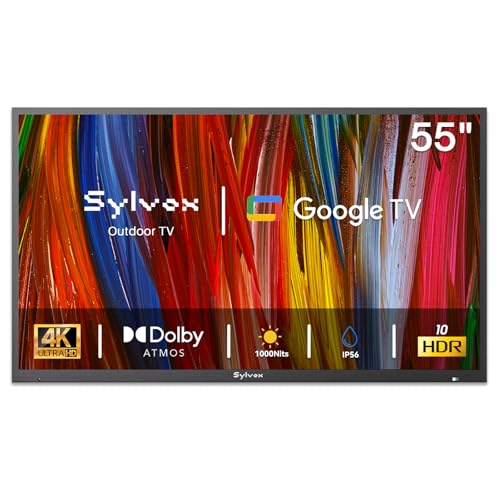
Sylvox 55 4K Outdoor TV — The all-round patio pick
This is the Sylvox range’s centre of gravity: a 55-inch 4K smart outdoor television, IP56 waterproof, rated at 1000 nits, with support for Dolby Atmos named in its listing. At 55 inches it is large enough to serve a real gathering — a final watched from loungers, a film night on the patio — and its brightness figure places it in the class suited to bright gardens and partial sun rather than only to deep shade. For most buyers entering this category, the combination of the biggest common size, the range’s standard IP56 sealing and the 1000-nit figure is the sensible default against which the other five argue their specialisms.
Dolby Atmos support is an interesting inclusion outdoors, where audio behaves nothing like it does in a living room. Gardens leak sound in every direction, and no television speaker creates a cinema bubble under an open sky; what good audio support buys outdoors is clarity and presence at the seating area, for commentary, dialogue and music, without straining. A set that names Atmos is at least thinking about the soundtrack as part of the outdoor experience, which several rivals’ listings do not mention at all.
Its compromises are the category’s honest ones. IP56 is the range standard rather than the Dornium’s IP66 maximum, and a fully exposed, unsheltered installation in driving weather is the Dornium’s argument to win. Nor does this listing lead with anti-glare language, which its sibling 55 does. But as the all-rounder — the set a buyer with a normal patio, normal gatherings and normal British-to-Texan weather uncertainty should shortlist first — it holds the centre of this guide firmly.
Think of the household it serves: the family whose summer evenings migrate outside, whose sport is watched from the deck, whose film nights run under festoon lights. That household does not need the extreme figure in any column; it needs every column to be strong at once, and that is precisely the shape of this listing.
Within a concentrated market, the all-rounder’s role grows in importance, because it is the model the specialist itself expects most gardens to buy. Sylvox has specified it accordingly, and this guide’s ordering agrees.
Hospitality is this model’s quiet metric. A patio screen gets driven by whoever is holding a drink and a opinion about what to watch next, and a mainstream smart interface with voice-led search keeps those transitions painless at dusk, when nobody wants to squint at a complicated menu. The all-rounder’s balance extends to its manners, and manners are what gatherings remember.
- Size: 55-inch
- Resolution: 4K
- Weatherproof rating in listing: IP56 waterproof
- Brightness in listing: 1000 nits
- Audio named in listing: Dolby Atmos support
- Platform: Smart TV
Strengths
- The balanced specification — size, sealing and brightness — for a typical patio.
- 1000 nits keeps the picture authoritative in bright gardens and partial sun.
- Dolby Atmos support shows attention to outdoor sound, not just survival.
Trade-offs
- IP56 sealing stops short of the Dornium’s IP66 for the most exposed sites.
- Anti-glare is not the headline here that it is on its sibling 55-inch model.
- Smaller gardens may find 55 inches and its mount more than the space wants.
Best for: the main patio or deck of a house whose summers are lived outdoors, with gatherings around sport and film.
Not suited for: a fully exposed, unsheltered position in harsh weather, or a tiny terrace where 43 inches fits the wall.

Sylvox 43 Outdoor TV — The compact terrace pick
Not every garden has a cinema wall, and the Sylvox 43 exists for the outdoor rooms that do not: the covered terrace, the balcony-adjacent patio, the hot-tub corner, the outdoor kitchen’s backsplash zone. Its listing specifies a 43-inch weatherproof Google TV, IP56 waterproof, at 4K UHD with HDR10 and 700 nits of brightness, with a temperature tolerance among its listed themes. Read those figures as a set designed for shelter-adjacent duty: the same IP56 sealing as its larger siblings, a brightness figure calibrated for shade and partial light rather than open sun, and a size that mounts where 55 inches simply cannot.
Google TV at this position in the garden is a thoughtful match. The outdoor kitchen cook, the hot-tub viewer, the terrace reader of morning news — these are glance-and-go viewing patterns, and a platform with strong voice control and quick app access serves them better than a cinema interface does. HDR10 in the listing gives streamed content a recognised dynamic standard to work with when the evening viewing turns more deliberate.
The discipline is placement. Seven hundred nits is the lowest figure in this guide, and the set should be bought by someone whose position is honestly shaded — under cover, north-facing, or sunlit only in hours when nobody watches. Bought for such a spot, its figure is not a compromise at all; bought for an open south-facing deck, it would be the wrong tool arguing with the sky. This guide’s respect for the little Sylvox is conditional on the buyer’s honesty about their own shade, which is true of every pick here and merely most visible with this one.
It is also the natural second outdoor screen: the house with a main patio set may add the 43 by the grill or the tub without re-litigating the whole category. Same specialist, same sealing standard, smaller canvas — an ecosystem of two gardens, run on one platform.
For small outdoor rooms, this is not the diminished option. It is the correctly sized one, and gardens, like living rooms, punish screens that ignore their proportions.
Renters with a prized terrace should note the 43’s particular mercy: it asks the least of a wall it does not own. A compact, sealed screen on a modest mount delivers the outdoor habit without the installation footprint of the 55s, and when the household moves, the garden cinema moves with it. Portability, in this category, is a form of value the larger sets cannot offer.
- Size: 43-inch
- Resolution: 4K UHD, HDR10
- Weatherproof rating in listing: IP56 waterproof
- Brightness in listing: 700 nits
- Platform: Google TV
- Noted in listing: temperature tolerance theme
Strengths
- IP56 sealing at a size that fits terraces, outdoor kitchens and tub corners.
- Google TV suits glance-and-go outdoor viewing with voice-led control.
- 4K with HDR10 keeps evening film respectable on the smaller canvas.
Trade-offs
- 700 nits is the guide’s lowest figure and demands an honestly shaded position.
- Group viewing at distance will wish for the 55-inch models’ scale.
- Open-sun decks should look at the 1000-nit class or the Dornium instead.
Best for: the covered terrace, outdoor kitchen or hot-tub corner in real shade, where 43 inches fits and gatherings are small.
Not suited for: an exposed sunny deck, or the main screen for large garden gatherings.

Sylvox 55 1000-Nit Outdoor TV — The anti-glare pick
The second Sylvox 55 in this guide is a study in how one specialist differentiates near-identical hardware. Its listing leads with 1000 nits ultra bright, IP56 weatherproofing, 4K UHD with HDR10 and an anti-glare screen — where its sibling led with Dolby Atmos support. The distinction is a genuine fork for buyers. Anti-glare treatment attacks the outdoor picture’s other enemy: not raw brightness competition, but reflections, the mirror image of sky, fence and viewer that a glossy screen throws back during dark scenes. On a patio where the screen faces open sky, that treatment can matter as much as the nit figure itself.
The shared foundations remain the range’s strengths: 55 inches of 4K, the IP56 sealing standard, and brightness in the 1000-nit class that suits bright gardens and partial sun. HDR10 gives streamed film and sport a dynamic standard to build on. If the all-rounder is the range’s centre, this model is its glare specialist — the one for the garden whose geometry puts the screen opposite the light rather than merely near it.
Choosing between the two Sylvox 55s is therefore a diagnostic exercise. Sit in the viewing seats at viewing hours and ask what ruins pictures in that spot: if the answer is a bright wash across the whole image, both sets answer with 1000 nits; if the answer is a recognisable reflection — the white fence, the bright sky — staring back from dark scenes, this anti-glare listing is speaking directly to your garden. Few buying decisions in this guide are as cleanly separable, and the specialist deserves credit for making the fork explicit in its own listings.
Its concessions mirror its sibling’s: IP56 rather than IP66 for the wildest exposures, and no Atmos headline for the sound-led buyer. Neither matters in the garden it was built for. A screen that keeps a dark thriller watchable at dusk on a bright-facing patio has solved the problem its owner actually had.
For households torn between the two 55s, this guide’s counsel is to let the reflection test decide, because it is the rare comparison that a single garden visit settles completely.
Evening sport is this model’s finest hour in the most literal sense. As the light drops and the sky stays bright behind the screen — the classic dusk problem, where reflections peak while the match reaches its climax — the anti-glare treatment earns its listing line. Buyers whose garden faces west will understand immediately why this Sylvox exists alongside its sibling.
- Size: 55-inch
- Picture: 4K UHD with HDR10
- Sealing (listing): IP56 weatherproof
- Brightness (listing): 1000 nits, ultra bright
- Screen in listing: anti-glare
- Platform: Smart TV
Strengths
- Anti-glare treatment answers reflections, the bright garden’s second enemy.
- 1000 nits plus HDR10 keeps sport and film punchy in partial sun.
- The range’s IP56 sealing and 55-inch scale carry over intact.
Trade-offs
- Dolby Atmos support is the sibling model’s headline, not this one’s.
- IP56 remains a step below the Dornium’s IP66 for extreme exposure.
- Deeply shaded gardens gain little from its glare specialism.
Best for: the patio whose screen faces open sky or bright fencing, where reflections haunt dark scenes.
Not suited for: a sound-first buyer, or a fully exposed site wanting the highest sealing figure.

Sylvox 50 Outdoor TV — The partial-sun pick
The Sylvox 50 is the most honestly labelled set in this guide: its listing describes a 50-inch outdoor TV at 4K UHD with HDR10, a smart Google TV, IP56 weatherproofing, and the positioning phrase partial sun — for shaded and partially sunny gardens. That phrase deserves respect, because partial sun is where most real patios actually live, and a manufacturer willing to print the intended condition on the listing is helping buyers match the tool to the site instead of discovering the mismatch in July.
Fifty inches is the diplomat’s size outdoors: large enough for a family gathering to read a score or follow a film, small enough for the walls and pergola posts that gardens actually offer. Google TV supplies the platform, with the voice-led convenience that outdoor viewing — hands full, distance variable, light changing — consistently rewards. The IP56 rating keeps it in the family standard for sealing, so the mid-size choice costs nothing in weather confidence against its siblings.
Its listing, in the text available to this guide, does not publish a nit figure, and the review will not invent one. Buyers for whom brightness is the deciding variable should compare the printed figures elsewhere in the guide — 700 on the Sylvox 43, 1000 on the 55s and the RIXZSIW, 1500 on the Dornium — and treat this model’s partial-sun labelling as its brightness statement: intended for shade-mixed positions, not for open-sun heroics. That is a perfectly honourable brief, and for the pergola, the eave-shaded wall and the garden that suns itself only in the morning, it may be the most precisely aimed listing here.
The 50 also suits the household graduating from indoor-outdoor improvisation — the old living-room set carried onto the patio for big matches — to a permanent, sealed installation. It formalises the habit at a sensible scale, on a familiar platform, without demanding the wall or the commitment of the 55-inch models.
In a guide full of extremes — highest sealing, highest brightness, largest canvas — the Sylvox 50 is the reminder that the correct outdoor television is usually the one matched to the garden’s actual light, and that its listing, unusually, tells you exactly which light that is.
The 50 also flatters the indecisive in the best way. Households unsure whether outdoor television will become a habit or a novelty can formalise the experiment at the range’s middle size and standard sealing, and discover within one summer which they are. If the habit takes, the set remains a correctly specified permanent installation rather than a starter compromise to be replaced.
- Size: 50-inch
- Picture format: 4K UHD, HDR10
- Sealing (listing): IP56 weatherproof
- Positioning in listing: partial sun, for shaded and partially sunny spots
- Platform: Smart Google TV
- Brightness: no nit figure published in the listing text used here
Strengths
- Partial-sun positioning is printed on the listing, matching the set honestly to real patios.
- The 50-inch size fits pergolas and eave walls that refuse the 55-inch models.
- IP56 sealing and Google TV keep it fully in the range’s standard.
Trade-offs
- No nit figure is published in the listing text, so brightness comparisons rely on its positioning.
- Open-sun positions should choose from the printed high-nit models instead.
- Large gatherings may still prefer the 55-inch canvas.
Best for: the pergola, eave-shaded wall or morning-sun garden whose light is honestly partial.
Not suited for: an all-day sun deck, or a buyer who needs a printed nit figure to commit.

RIXZSIW 55 Outdoor TV — The WebOS alternative pick
RIXZSIW’s single entry in this guide earns its place by being genuinely different in two directions at once. Its listing specifies a 55-inch outdoor TV, IP55 waterproof, at 1000 nits and 4K UHD, running WebOS 25 with voice control. The platform is the first distinction: WebOS is the only non-Google, non-Sylvox environment in the six, and households that already like LG’s television software — its pointer-friendly, card-based way of working — will find an outdoor set that speaks their language, which no Sylvox can offer them.
The figures are competitive where they are printed. A 1000-nit brightness rating puts it in the same daylight class as the Sylvox 55s and the Dornium’s smaller figure is the only higher one at this size — in fact only the Dornium prints more. IP55 is the honest point of comparison: a step below the IP56 that Sylvox standardises and the IP66 the Dornium boasts, and buyers should weigh that step according to their exposure. Under a roof line or on a sheltered wall, IP55’s weatherproofing serves the same garden; on an unsheltered post in driving rain country, the ladder’s higher rungs exist for a reason.
Voice control in the listing suits the outdoor pattern — commands from the lounger, the grill, the pool edge — and the 55-inch 4K canvas matches the guide’s gathering size. RIXZSIW is, in effect, the choice for the buyer whose first question is software and whose garden’s shelter makes the sealing step a fair trade. In a concentrated market, a credible alternative with a different platform is valuable out of proportion to its single listing, because it disciplines the specialist’s range and gives WebOS households a door into the category.
Its risk is the pioneer’s risk: a thinner track record in the category than the specialist’s, and a range of exactly one if the household later wants a matching smaller screen outdoors. Neither is disqualifying. Judged on its listing — size, brightness, platform, voice control, a published IP rating — it stands as a coherent, competitive outdoor television, and this guide includes it on exactly that evidence.
Choose it for the WebOS, keep it for the picture. That ordering will sound familiar to anyone who has bought a television indoors, which is rather the point: outdoors should not mean abandoning the platform preferences a household has already formed.
There is a second-home harmony to the RIXZSIW as well. A WebOS household with a cottage or a coastal retreat can standardise on one interface across both addresses, and the set’s 1000-nit figure suits the brighter light that holiday locations are usually chosen for. Consistency across houses is a luxury buyers rarely price, and feel every visit.
- Size: 55-inch
- Resolution: 4K UHD
- Weatherproof rating in listing: IP55 waterproof
- Brightness in listing: 1000 nits
- Platform: WebOS 25
- Control named in listing: voice control
Strengths
- WebOS 25 gives LG-software households an outdoor set in their own language.
- 1000 nits matches the Sylvox 55s for bright-garden and partial-sun duty.
- Voice control fits the hands-full, cross-garden pattern of outdoor viewing.
Trade-offs
- IP55 sealing sits a step below IP56 and two below the Dornium’s IP66.
- A one-model range offers no smaller sibling for a second outdoor spot.
- The specialist’s category depth belongs to Sylvox, not to this challenger.
Best for: the WebOS household with a sheltered or roof-lined patio that wants 55 inches and real brightness.
Not suited for: an unsheltered, storm-exposed post, or a buyer building a multi-screen outdoor setup from one range.

Dornium 43 IP66 Outdoor TV — The maximum-protection pick
Dornium’s single listing carries the two most extreme figures in this guide, and it is not close. A 43-inch outdoor TV with 1500 nits of brightness, IP66 waterproofing, 4K UHD, Google TV and an anti-glare screen: the sealing figure is the highest printed here, and the brightness figure exceeds the 1000-nit class by half again. This is the set for the position the other five would negotiate with — the unsheltered wall, the pool deck with weather on three sides, the coastal or mountain garden where conditions arrive horizontally.
The combination matters more than either figure alone. High sealing without brightness would survive the storm and lose the afternoon; high brightness without sealing would win July and fear October. Dornium has specified both, at a compact 43 inches that suits exposed positions where a larger sail of a screen would worry its mount in wind. Anti-glare completes the exposed-site brief, because a screen in open conditions faces open sky, and reflections are the tax it pays hourly.
Google TV keeps the software familiar, which matters for a set whose hardware story is so specialised — the household learns nothing new to operate the toughest screen in the guide. The trade-offs are the pioneer’s and the specialist’s in reverse: Dornium’s range here is one model deep, its name carries less category history than Sylvox’s, and buyers whose gardens are gentle will pay for protection and brightness they never invoice. For the genuinely exposed site, none of that outweighs the figures on the listing.
Consider the installations it unlocks: the pool house wall with no roof, the rooftop terrace, the garden room’s outside face, the sports club’s patio. Positions that would be described, for the other picks, with caveats and conditions are this set’s home turf. A category concentrated in few hands still manages, through listings like this one, to cover its extremes — and the extreme of exposure is Dornium’s to claim.
If your site visit ends with the words “there is nowhere sheltered to put it”, this review is the one to reread. The Dornium exists so that sentence is not the end of the outdoor television conversation.
Commercial-leaning buyers — the café terrace, the clubhouse, the rental villa whose listing promises an outdoor screen — should read the Dornium’s figures as duty-of-care numbers. Guests will not moderate the weather or the sun for your equipment, and a set specified for the worst the site delivers is the one still working in the reviews section three summers later.
- Size: 43-inch
- Resolution: 4K UHD
- Weatherproof rating in listing: IP66 waterproof
- Brightness in listing: 1500 nits
- Screen in listing: anti-glare
- Platform: Smart Google TV
Strengths
- IP66 is the highest sealing figure printed anywhere in this guide.
- 1500 nits gives exposed, sunny positions the strongest brightness case here.
- Anti-glare treatment suits screens facing open sky all day.
Trade-offs
- At 43 inches it will not serve a large gathering like the 55-inch models.
- Gentle, sheltered gardens pay for extremes they will never use.
- A one-model presence offers less range depth than the Sylvox line.
Best for: the unsheltered wall, pool deck or rooftop where weather and sun arrive without asking permission.
Not suited for: a big gathering’s main screen, or a covered terrace that never tests its protection.
How do the six compare side by side?
| Model | Size | IP rating in listing | Brightness in listing | Platform | Defining trait |
|---|---|---|---|---|---|
| Sylvox 55 4K | 55-inch | IP56 | 1000 nits | Smart TV | All-round patio balance, Atmos support |
| Sylvox 43 | 43-inch | IP56 | 700 nits | Google TV | Compact shaded-terrace fit |
| Sylvox 55 1000-Nit | 55-inch | IP56 | 1000 nits | Smart TV | Anti-glare for bright-facing walls |
| Sylvox 50 | 50-inch | IP56 | Not published | Google TV | Labelled for partial sun |
| RIXZSIW 55 | 55-inch | IP55 | 1000 nits | WebOS 25 | The platform alternative |
| Dornium 43 | 43-inch | IP66 | 1500 nits | Google TV | Maximum sealing and brightness |
Read the table as a map of gardens rather than a league table. The IP column sorts by exposure, the brightness column by sun, and the size column by gathering. A sheltered terrace with small gatherings lands on the Sylvox 43 almost by gravity; an exposed pool deck lands on the Dornium by the same force; and the wide middle of real patios divides among the 1000-nit 55s and the partial-sun 50 according to reflections, platform taste and sound. Notice, too, the honesty the table preserves: one brightness cell is empty because its listing published no figure, and this guide would rather show the gap than fill it.
How should you install and care for an outdoor television?
Install for the weather you actually get, not the weather in the brochure photograph. Use a mount rated for outdoor duty and for the set’s weight, keep the installation’s cable entries and connections as the manufacturers intend them, and position the screen so its worst sun hour and its worst rain angle were considered before the drill came out. A spirit-level photograph of the finished wall is worth taking for a different reason than indoors: if the set ever needs warranty conversation, evidence of a sane installation is the household’s best friend.
Power deserves outdoor respect. Supply the set through the house’s proper outdoor electrical arrangements, keep connections sheltered, and never let a permanent installation depend on an indoor extension lead through a window — the gap in the window seal will admit exactly the weather the television was sealed against. Sound planning follows garden rules: aim the seating, not the neighbours, and expect to run dialogue a little louder than indoors to defeat open-air dissipation, which is another reason the Atmos-minded Sylvox and a future outdoor soundbar conversation belong in the plan.
Viewing-position furniture completes the installation in a way indoor setups never consider. Outdoor seating is lower, deeper and more reclined than a sofa, so the screen’s height should be set from the lounger’s eye line rather than the standing installer’s, and its tilt given a thought for the dusk hour when the sky is bright and the audience is horizontal. A television aimed at the chairs people actually use, at the angle they actually recline, looks brighter and larger without a single specification changing — the garden’s version of the indoor height lesson, learned once and enjoyed all summer.
Care is mostly inspection. Each season, look at the mount’s fixings, the screen’s surface and the cabinet’s seals and vents with the same attention you would give a good bicycle, clear what the garden has deposited, and confirm the picture settings still suit the season’s light — a screen tuned in April’s soft sun may want its brightness revisited in July. Outdoor televisions are built to be left in their element, and a small rhythm of attention is all they ask in return.
What mistakes do buyers make when taking television outside?
The founding mistake is buying an indoor set for outdoor duty and reasoning that a roof overhang makes it fine. Indoor televisions carry no IP rating, no sealed cabinet and no brightness for daylight, and their failure outdoors is a matter of season rather than luck. Every pick in this guide exists because the category’s requirements are real; respect them from the first purchase rather than the second.
The second mistake is shopping brightness by hope. Buyers fall for a garden’s morning softness and forget its three-o’clock glare, then blame the television for a sun path they never mapped. Walk the site at viewing hours before ordering, and let the observed light — not the estate agent’s photograph — choose between the 700-nit, 1000-nit and 1500-nit classes. The third mistake is the mirror image: paying for the Dornium’s extremes to hang in a permanently shaded pergola, where the Sylvox 43 or 50 would have served identically for the household’s actual hours.
There is a sixth, quieter mistake: forgetting that outdoor viewing is seasonal theatre, and judging the purchase by a single perfect evening. The set that delights in June must also be forgiven in November, when nobody watches it and its job is simply to endure beautifully. Buyers who picture the whole year — the gatherings, the storms, the quiet months — choose ratings and positions with a steadiness that the first-evening romantics often have to retrofit at real expense.
Fourth, sound gets forgotten until the first gathering, when commentary dissolves into garden air and the volume wars with the neighbours begin. Plan the seating’s audio as part of the installation. And fifth, buyers neglect the mount’s environment: indoor-rated hardware corrodes outdoors on its own schedule, quietly, until the failure is not quiet. The television is weatherproof; everything holding it up must be chosen to the same standard.
Final Recommendation
One last perspective before the verdict: an outdoor television is judged by a household in a way no indoor set ever is, because its successes are social. Nobody remembers the evening the living-room set performed adequately; everybody remembers the final watched from the patio as the light failed, the film that ran under the pergola while the barbecue cooled, the grandparents following the news from the garden chairs. The six sets here are really six invitations to move a portion of family life outside, differing only in how much weather and sunlight each invitation can withstand.
Match the set to the sky it will live under. For the typical patio with mixed light and real gatherings, the Sylvox 55 4K is the guide’s centre of gravity, with its anti-glare sibling taking over where reflections rule the wall and the Sylvox 50 serving the honestly partial-sun garden at a gentler scale. The Sylvox 43 owns the shaded corners, the RIXZSIW gives WebOS households their door into the category, and the Dornium stands ready for the sites with no shelter at all. Buy for the garden you have — its sun path, its weather, its crowd — and the strangest sentence in home entertainment, “let’s watch it outside”, becomes the most natural one your house knows. By the second summer, the screen will simply be where the family’s best evenings happen, and the only surprise left will be remembering that the room it replaced ever had walls at all.
Frequently Asked Questions
Can I just use a regular indoor TV outside under a cover?
It is the category’s most expensive shortcut. An indoor set has no published IP sealing, no cabinet designed for temperature and moisture swings, and no brightness for daylight, so its outdoor life is a countdown rather than a service. The sets in this guide exist precisely because the requirements are real.
What is the difference between IP55, IP56 and IP66 here?
On the evidence of the listings, they are ascending levels of weatherproof sealing: IP55 on the RIXZSIW, IP56 across the Sylvox range, and IP66 on the Dornium as the highest figure in the guide. Match the rung to your exposure — sheltered walls need less, unsheltered posts need the top of the ladder.
How bright does an outdoor TV need to be?
Follow your shade. The listings here span 700 nits for the shaded compact Sylvox, 1000 nits for the bright-garden class and 1500 nits for the exposed Dornium. A covered terrace forgives the lower figure; a screen facing open sun should be shopping at the top of that ladder and thinking about anti-glare as well.
Why are four of the six picks from one brand?
Because that is the verified shape of this market. Outdoor television is a specialist niche, and Sylvox’s range covers most of its sizes and conditions. This guide reports the concentration openly and compares the models within the range carefully, rather than padding the list with indoor sets in disguise.
Does an outdoor TV work for morning news and radio-style listening?
Very well, and many owners find these quiet hours become the set’s most loyal service — headlines with coffee on the terrace, a programme murmuring by the outdoor kitchen. The smaller models suit the habit best, and a screen that earns its wall at breakfast as well as at the final has justified itself twice over.
Can an outdoor TV stay outside all year?
These sets are built and rated for outdoor installation, which is the point of their IP figures, and a sound mount plus sane power arrangements complete the setup. Seasonal inspection of fixings and seals is the owner’s side of the bargain, and local climate extremes are worth a thought when choosing between the IP56 standard and the IP66 maximum.
What if my garden is rented or the house is not mine for long?
Favour the compact, standard-sealed end of the guide — the Sylvox 43 or 50 — on a modest outdoor mount, and keep the installation reversible. The outdoor habit travels well, and a correctly sized set moves to the next garden without the ceremony the 55-inch models demand. Check the tenancy’s rules on wall fixings before the drill, as with any installation.
Do outdoor TVs need a special mount?
They need an outdoor-rated one, chosen for the set’s weight and the wall’s material, because indoor hardware corrodes on its own quiet schedule and the screen’s weatherproofing is only as good as what holds it up. Treat the mount as part of the television’s weather system, not as an accessory to economise on.
Will the picture really be watchable in daylight?
In shade and partial sun, yes, comfortably, for the 1000-nit class and above; that is what those figures are for. In direct midday sun, every set in this guide is negotiating rather than commanding, and the honest plan is to position the screen for the hours you actually watch and let the Dornium’s 1500 nits handle the most exposed cases.
What size suits a typical patio?
Most patios gather within a few metres of the screen, where 50 to 55 inches reads generously without overwhelming the space — hence three 55s and a 50 in this guide. Compact corners and outdoor kitchens suit the 43-inch models, and the gathering’s size, not the garden’s acreage, is the measure that matters.


