What's inside
- Key Takeaways
- Quick Picks
- How We Chose These Picks
- What Can You Actually Fit on a 32-Inch Desk?
- Where Do Small Desks Live Best in a Home?
- What Materials and Frames Hold Up Best at This Size?
- Should You Buy a Small Desk or a Wall-Mounted One?
- How Does a Small Desk Handle Gaming, Craft and Other Second Jobs?
- What Should You Budget Around the Desk Itself?
- The Six Desks, Reviewed One by One
- What Does a Tape-Measure Checklist for a Small Desk Look Like?
- How Long Should a Small Desk Last, and What Wears First?
- Which Small Desk Suits Which Kind of Worker?
- How Do the Six Compare Side by Side?
- How Do You Set Up a Small Desk So It Feels Bigger?
- How Do You Light and Power a Desk in a Leftover Corner?
- How Do You Stop a Small Desk Wobbling on Real Floors?
- What Are the Most Common Mistakes When Buying a Small Desk?
- What Upgrades Make Sense Later, and Which Do Not?
- How Should You Arrange Screen, Keyboard and Light in Thirty-One Inches?
- Does a Small Desk Work for a Growing Child or Teenager?
- How Do You Keep a Small Desk Presentable on Video Calls?
- Final Recommendation
- Frequently Asked Questions
- Related Guides
As an Amazon Associate I earn from qualifying purchases. This post may contain affiliate links at no extra cost to you.
widgetverdict.com is reader-supported. When you buy through links on our site, we may earn an affiliate commission.
Where to buy: all six desks in this roundup are sold through Amazon, and you will find the link on each desk’s name in the Quick Picks table and again in its full review. Small desks ship in small boxes, which makes delivery painless — but check the assembled dimensions on the listing against your alcove before you click, because at this size two inches is the difference between sliding in and not fitting at all.
The best small computer desks exist because most homes were not designed with a study in mind. The workspace has to be negotiated out of a bedroom corner, a landing, the end of a kitchen, a box room that also holds the ironing board. A desk around thirty-one or thirty-two inches wide is the negotiated settlement: wide enough for a laptop and a notebook, or a monitor and a keyboard with discipline, and narrow enough to fit the wall spaces that larger furniture ignores — between the wardrobe and the door, under the window, in the alcove the chimney breast creates.
Small does not have to mean makeshift. The six desks below divide into honest types. There are simple flat-pack tables that assemble in minutes and cost little commitment. There is a two-drawer desk for people whose small space must also store things. There is a shelf-sided desk that uses vertical room instead of floor room. There is a folding desk that disappears when guests arrive, and a height-adjustable rolling desk that refuses to commit to one spot or one posture. Each solves the small-space problem with a different trade, and the reviews are blunt about what each trade costs.
What none of them does is pretend to be a full office. A thirty-two-inch desk is a focused workstation: one screen, one person, one task at a time. Bought with that expectation, it can be the most productive square metre in the house. Bought hoping to spread out like a corner executive desk, it will disappoint by Wednesday. This guide is written for the focused buyer — the student, the spare-room worker, the bedroom-corner gamer, the anyone whose wall space is measured in centimetres of clearance.
Key Takeaways
- Thirty-one to thirty-two inches is the working width: one screen, one keyboard, one notebook, nothing more.
- The Pamray 32-inch is the storage pick, with two drawers where rivals offer bare legs.
- The Furinno EFFICIENT trades width for height, stacking three open shelves beside a 28.6-inch top.
- The Huuger folding desk is the only pick that can leave the room entirely when space is reclaimed.
- The QZMDSM adds wheels and height adjustment, suiting renters who rearrange often.
- Measure the chair as carefully as the desk — in small spaces the chair is half the footprint.
Quick Picks
| Pick | Badge | Why it earns its place |
|---|---|---|
| Furinno Simplistic 31-Inch Compact Computer Desk | Best simple starter desk | A straightforward 31-inch top in black espresso that assembles easily and asks nothing of the room. |
| Pamray 32 Inch Small Computer Desk with 2 Drawers | Best with drawers | Two drawers under a 32-inch top give a small workstation somewhere to put its clutter. |
| DUMOS 31.5 Inch Small Computer Desk | Best clean look | A black-and-white 31.5-inch design that reads as a modern study table rather than dorm furniture. |
| Furinno EFFICIENT Desk | Best vertical storage | Three open side shelves beside a 28.6-inch top, for rooms with height to spare and width to none. |
| Huuger Folding Desk for Small Spaces | Best disappears-when-needed | A 31.5-inch desk that folds away, for rooms that are only sometimes an office. |
| QZMDSM Small Computer Desk for Bedroom | Best adjustable and mobile | Height adjustment, casters and storage shelves on a rustic 32-inch frame that moves with you. |
How We Chose These Picks
Width came first, and the ceiling was strict: every pick had to fit the wall gaps small homes actually offer, which in practice means a top no wider than thirty-two inches. Within that ceiling we looked for variety of approach rather than six copies of the same table, because small-space buyers differ more than big-desk buyers do. One needs drawers. One needs to fold the office away before dinner guests arrive. One needs shelves because the floor is spoken for. A guide that recommended six identical rectangles would be no guide at all.
Assembly was the second filter. Small desks are often bought by people furnishing a first flat or a student room, frequently alone, frequently with a basic tool kit. Listings that promise easy assembly earned their place; a small desk that takes a Saturday to build has misunderstood its own market. Stability was third: a narrow desk with a monitor on it must not rock when you type, so frame design and leg bracing were read carefully in each listing’s construction details.
We paid attention to who else shares the room. A desk in a child’s bedroom, a desk in a studio flat and a desk in a hallway live different lives, and the roundup keeps a pick for each: the simple Furinno for the child’s room, the folding Huuger for the studio, the rolling QZMDSM for anywhere the layout is provisional. Versatility across households mattered more to us than a single winner’s podium.
We also policed honesty about size. A thirty-one-inch desk marketed with photographs of dual monitors and a sprawling setup is selling a lie the buyer pays for. The picks below are presented the way they will actually be used — one screen, a keyboard, and the small supporting cast of a working day — and the reviews keep returning to that reality, because satisfaction with a small desk is mostly expectation management done in advance.
What Can You Actually Fit on a 32-Inch Desk?
Run the inventory honestly. A laptop occupies the centre and leaves a hand’s width on each side — enough for a mouse if you use the trackpad’s side, a phone, and a mug that lives dangerously. A monitor-and-keyboard setup fits the same way: a screen up to the mid-twenties of inches, a compact keyboard, and the mouse travelling in the strip in front of it. What does not fit is the second screen, the full-size keyboard with a separate number pad plus a notebook open beside it, or a printer. Those belong on a shelf, a stand or another surface, and the desks below with shelves or drawers earn their keep precisely by absorbing that overflow.
The trick that makes small desks feel bigger is vertical thinking. A monitor riser creates a shelf layer and a parking slot for the keyboard. A small desk lamp with a clamp base steals no surface at all. A laptop stand plus an external keyboard turns one footprint into two levels. Buyers who think in layers routinely work happily at thirty-one inches; buyers who think in spread end up shopping for a bigger desk within the season.
Depth matters quietly too. These desks are shallow by design, which puts the screen closer than an ergonomic poster would choose. A laptop stand or a monitor arm that pushes the display to the back edge recovers most of the viewing distance, and a compact keyboard buys back forearm room. Plan those small additions into the budget and the small desk stops feeling like a compromise.
Where Do Small Desks Live Best in a Home?
The classic small-desk habitats reward a quick tour. The bedroom corner is the most common: the desk doubles as a dressing table’s rival and must look calm at night, which favours the plain Furinno and the two-tone DUMOS. The landing or hallway nook is the most underused: a thirty-one-inch desk under the stairs or at a wide landing’s end creates an office nobody had to give a room to. The living-room alcove is the most contested, and there the folding Huuger wins arguments, because an office that folds away cannot be accused of colonising the family’s room.
Students and dorm rooms form their own habitat with their own physics: the desk is also the dining table, the ironing board and the social centre. There, durability and price matter more than looks, shelves matter enormously because floor storage is nil, and the Furinno EFFICIENT’s vertical stack reads like it was designed by someone who has actually lived in a dorm. The rolling QZMDSM, meanwhile, suits the renter’s flat where the desk migrates between the window light in winter and the cool wall in summer.
What Materials and Frames Hold Up Best at This Size?
Small desks are built from the same menu as large ones — engineered wood tops, laminate finishes, steel or wooden legs — but the proportions change the physics. A narrow top on four slim legs can rack sideways when you lean on it, so look for a crossbar, a back panel or a drawer unit doing structural duty. The Pamray’s drawer bank, the EFFICIENT’s shelf tower and the QZMDSM’s shelved base all stiffen their desks as a side effect of storing things; the plain open designs rely on their leg frames alone, which is why bracing details in the listing deserve a read.
Surfaces at this size take concentrated wear: the same thirty inches host every meal-adjacent coffee, every pen, every laptop slid into place twice a day. Laminate shrugs that off. Painted finishes look better on day one and ask for coasters by day thirty. Edges matter more than finishes, because on a shallow desk your forearms live on the front edge — a rounded or profiled edge is a comfort feature you will feel for years, while a sharp one is a daily small annoyance with no fix short of a desk pad.
Feet and floor protection are the last check. Small desks get dragged — to vacuum, to rearrange, to chase a dropped cable — and unprotected feet score wooden floors a millimetre at a time. Felt pads cost almost nothing and belong under every leg from day one; on carpet, wider feet stop the slow sink that makes a light desk develop a lean.
Should You Buy a Small Desk or a Wall-Mounted One?
The neighbouring category deserves a hearing, because a wall-mounted folding desk is the small desk’s closest rival for the same alcoves. Wall mounting wins on floor space — zero footprint when folded — and loses on commitment: it needs a solid wall, studs or proper fixings, and it cannot move rooms when life changes. A freestanding small desk asks for a square metre of floor and repays it with total flexibility, a surface that is always ready, and no holes in a rented wall.
The deciding question is permanence of the work, not of the furniture. If the workspace is a daily, hours-long fixture, a freestanding desk with a real chair is kinder to your back and your routine. If the workspace is a twice-a-week laptop session in a room with another primary job, wall-mounted or folding furniture earns its flexibility. Many small homes end up with one of each in different rooms, which is not indecision — it is matching the tool to the session.
How Does a Small Desk Handle Gaming, Craft and Other Second Jobs?
Most small desks work two jobs, and the second job tests them differently from the first. Gaming asks for mouse travel, and a thirty-one-inch top with a monitor centred leaves a mouse a corridor rather than a field; a compact keyboard and a sensibly raised mouse sensitivity are the working answers, and the QZMDSM’s open top suits a wheel-and-pedal-free racing setup better than the drawer desks, whose banks can crowd a tall player’s knees. Console gaming from a chair pulled back is kinder: the desk becomes a screen stand, and every pick here plays that role without complaint.
Craft and hobby work ask for wipeability and light. A cutting mat covers most of a small top, which is fine — the mat is the work surface and the desk is its table. Sewing machines fit the width but bring vibration, favouring the sturdier drawer and shelf designs over the lightest open frames. Homework, the third common second job, asks mainly for a clear top and a lamp, and it is the job every desk here was born for. Judge your second job honestly when choosing: a desk that hosts it badly will be resented twice a day instead of once.
What Should You Budget Around the Desk Itself?
The desk is the headline purchase, but a small workstation has a supporting cast that belongs in the same budget conversation. A chair that fits the space and your back is the largest item and the one most often under-bought; a small desk paired with a dining chair is a posture complaint scheduled for next month. A monitor stand or laptop riser is next, then a lamp, then the cable kit — clips, a sleeve, one power strip. None of these is glamorous, and together they are the difference between a desk that merely fits and a workstation that works.
Sequence the spending if money is tight: desk and chair first, light second, elevation third, storage accessories last, because storage problems can be improvised with a box for a month while a bad chair cannot be improvised at all. The desks in this guide were chosen partly for how little they demand from that supporting cast — the drawer, shelf and folding designs each absorb a problem that would otherwise become another purchase.
The Six Desks, Reviewed One by One

Furinno Simplistic 31-Inch Compact Computer Desk — Best simple starter desk
The name is a fair warning and a promise: this is the simplest desk in the guide, a 31-inch rectangular top on a compact frame in black espresso, designed to be assembled without drama and used without ceremony. Furinno builds its reputation on exactly this kind of furniture — pieces that arrive in a manageable box, go together with clear instructions, and start working the same evening. For a first desk, a spare-room desk or a homework station, that simplicity is the feature.
What you get is surface and stability, and what you do not get is storage: no drawers, no shelves, so the desk’s tidiness depends on a box or a basket living underneath it. The open legs are a genuine virtue in small rooms, because a tower PC, a backpack or a pair of feet all fit under the top without negotiation. Treat it as the baseline against which the other five justify their extras — if your needs are a laptop, a lamp and a notebook, the extras may be money spent on furniture you do not use.
- Width: 31 inches
- Shape: rectangular compact top
- Finish: black espresso
- Assembly: easy, per the listing
Strengths
- The least complicated purchase in the guide, from box to working desk.
- Open under-desk space takes a tower, a bag or long legs without a fight.
- Plain styling disappears into bedrooms and spare rooms alike.
Trade-offs
- No storage of any kind; clutter needs a separate home.
- Basic construction will not impress anyone seeking furniture feel.
- Thirty-one inches is a hard ceiling on ambitions.
Longevity expectations should be set fairly: this is starter furniture, built to a price, and its natural life is measured in first flats and first jobs rather than decades. Within that honest frame it performs — the top is flat, the frame is square, and the desk asks nothing. Buyers who later graduate to a bigger office routinely keep a desk like this as the household’s second station, which says more about its usefulness than any specification could.
Best for: a first workspace, a homework corner or a guest room that moonlights as an office. Not suited for: anyone whose work involves paper, peripherals and paraphernalia that all need storing.
Pamray 32 Inch Small Computer Desk with 2 Drawers — Best with drawers
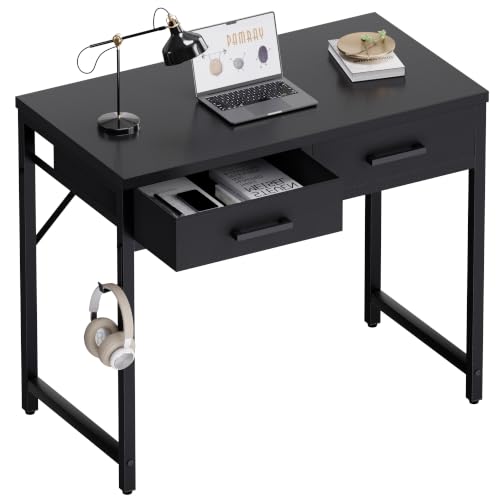
Drawers are the rarest luxury at this size, and the Pamray’s two of them transform what a 32-inch desk can be. The top handles the visible work — screen, keyboard, the notebook in play — while the drawers swallow the supporting clutter: chargers, pens, the external drive, the documents in progress. A small desk without storage exports its mess to the bed, the floor or the kitchen table. This one keeps the mess in-house, which in a one-room living situation is the difference between a workstation and a spreading stain.
The black finish keeps it visually quiet, and the format suits study and bedroom duty equally. The honest costs are knee room and assembly: a drawer unit occupies space under one side of the top, so cross-legged sitters and the very tall should picture their posture, and drawers add parts and time to the build. Neither cost is hidden, and for buyers whose small space must store as well as host, both are worth paying.
- Width: 32 inches
- Drawers: 2
- Finish: black
- Aimed at: bedroom, study and writing use
Strengths
- Two drawers give a small desk a real storage answer.
- Clear-top working becomes possible even in a single room.
- Sized for the bedroom and study corners it will actually inhabit.
Trade-offs
- Drawer unit reduces knee space on its side.
- Longer assembly than the open-frame rivals.
- Drawers invite accumulation; small ones fill faster than you expect.
The drawers also give this desk a second career: when a bigger office eventually arrives, a two-drawer 32-inch desk becomes a hallway console, a craft table or a child’s first real desk without looking lost. Furniture that can demote gracefully is worth more in a small home than furniture that cannot, because small homes cannot afford single-purpose pieces that stop suiting the plan.
Best for: a one-room worker or student whose desk must store the work as well as host it. Not suited for: tall users who sit cross-legged or sprawl under the desk.

DUMOS 31.5 Inch Small Computer Desk — Best clean look
The DUMOS is the pick for buyers who look at most small desks and see dormitory furniture. Its black-and-white finish and clean-lined modern design make a 31.5-inch workstation read as an intentional piece — a study table that happens to hold a computer — rather than a compromise apologising for existing. In a bedroom that is also a living space, or a flat where the desk sits in view of the sofa, that visual calm is a daily dividend.
Functionally it is a straightforward workstation top without the drawer or shelf machinery of its neighbours, aimed at laptop-and-monitor users whose kit is minimal and whose storage lives elsewhere in the room. The listing pitches it across study, writing, craft and gaming duty, which is believable precisely because a clean flat top is agnostic: it hosts whatever the day requires and wipes down afterwards. Buy it for the look, use it for everything, and add a drawer unit beside it later only if the clutter genuinely arrives.
- Width: 31.5 inches
- Finish: black and white
- Style: modern, clean-lined
- Aimed at: study, writing, craft and PC use
Strengths
- The most presentable design in the roundup for visible rooms.
- Flat, uncluttered top adapts to study, craft or gaming sessions.
- Two-tone finish lightens a small room instead of darkening its corner.
Trade-offs
- No built-in storage; tidiness is outsourced to the room.
- Light surfaces show pen marks and coffee rings sooner.
- Style-led pricing buys looks, not extra function.
One more consideration favours the DUMOS in rented homes: it looks deliberate in photographs and video calls, and a tidy-looking workstation behind you on camera is worth real money to remote workers whose colleagues judge the room they can see. Paired with a plant and a lamp, this desk stages a corner that reads as an office rather than an apology.
Best for: a design-conscious buyer whose desk sits in a bedroom or living space on show. Not suited for: a heavy-storage user, who will surround it with boxes within a month.

Furinno EFFICIENT Desk — Best vertical storage
The EFFICIENT makes the boldest spatial argument in this guide: when width runs out, go up. Its top is the narrowest here at 28.6 inches, but three open shelves stand beside it, stacking books, a printer, storage boxes and the second screen’s worth of gear into the vertical plane that small rooms waste. For a dorm room or a box room where the floor plan is a negotiation the desk cannot win, those shelves are worth more than three extra inches of top would ever be.
Open shelves behave differently from drawers: everything is visible and reachable, nothing is hidden, and dust is a recurring character. Organised people thrive with them; accumulators turn them into a public exhibition of clutter. The desk itself is a long-running Furinno design aimed at study rooms and dorms, and its laptop-first sizing is honest — a laptop and a notebook fit the top, while a monitor setup will want the shelves to absorb the keyboard’s rivals for space. Choose it when your problem is storage volume, not worktop width.
- Width: 28.6 inches
- Shelves: 3 open side shelves
- Aimed at: laptops, study rooms and dorms
- Layout: top plus side shelving tower
Strengths
- Three shelves add storage no same-footprint rival matches.
- Narrowest top here fits the tightest wall gaps.
- Shelves keep books and gear visible and grabbable mid-task.
Trade-offs
- The top alone is genuinely small for a monitor setup.
- Open storage shows clutter and collects dust.
- Shelf side is fixed by the design; plan the room around it.
The shelf tower also future-proofs the desk against the academic year: term one’s textbooks, term two’s printer, exam season’s archive boxes all find a level, and the top stays a top. In rooms where every other surface is a bed or a floor, a vertical organiser attached to the desk is not an accessory — it is the room’s entire storage strategy wearing a desk as its base.
Best for: a student or dorm dweller whose storage problem dwarfs their surface problem. Not suited for: a dual-screen hopeful, or anyone whose shelves would become a display of chaos.

Huuger Folding Desk for Small Spaces — Best disappears-when-needed
Every other desk in this guide negotiates for its floor space permanently. The Huuger negotiates by the hour: a 31.5-inch worktop when you need it, folded away when the room has other plans. For the flat where the office is the living room on weekdays and a guest room on weekends, or the studio where floor space is the scarcest resource in the building, a desk that leaves is not a compromise — it is the only honest solution.
Folding mechanisms live or die on their locks, so the working test is wobble: a properly locked folding desk should feel like furniture while you type and only reveal its trick when you release it. The Huuger also promises easy assembly, which for a folding design mostly means there is barely any — another point in favour of buyers who move often. The trade-offs are the category’s own: no storage, a top that hosts a laptop session rather than a permanent monitor installation, and a setup ritual, however quick, every time the office opens. If your monitor must live set up and waiting, choose a fixed desk; if your room must be a room again by evening, choose this one.
- Width: 31.5 inches
- Design: foldable, stores flat
- Assembly: easy, per the listing
- Aimed at: home office and study in shared rooms
Strengths
- Returns the floor to the room whenever work ends.
- Ideal for renters and multi-use rooms with no spare corner.
- Minimal assembly and easy to move house with.
Trade-offs
- No storage, and nothing can stay set up on it.
- Suits laptop sessions better than a permanent monitor rig.
- The fold-and-open ritual, though brief, happens every workday.
Guests are the folding desk’s finest hour: the office vanishes, the room returns, and nobody spends the evening looking at your monitor’s dark screen. Hosts in small flats consistently underrate how much that transformation matters to the feel of a home. A desk that can leave the room lets the room keep its identity, and the work keeps a proper surface while it lasts.
Best for: a studio flat or shared living room where the office must clock out completely. Not suited for: a worker with a fixed monitor setup who expects to sit down and start instantly.

QZMDSM Small Computer Desk for Bedroom — Best adjustable and mobile
The QZMDSM refuses two commitments the other five accept: one place and one height. It rolls on casters, so the desk can chase the light, dodge the radiator or relocate for a video call’s background, and its height adjusts, so the same desk serves a chair, a stool or a standing spell with a laptop. Storage shelves ride along underneath the rustic-finished 32-inch top, giving the mobile office somewhere to carry its own supplies.
Mobility cuts both ways, and the review would be dishonest without saying so: a desk on wheels must lock or settle firmly, or typing becomes a slow drift across the floorboards, and height mechanisms add a little flex that fixed frames do not have. For the right user those are trivial costs. Renters who rearrange quarterly, workers who split the day between sitting and standing at a laptop, and anyone whose workspace migrates between rooms will find the QZMDSM the only pick in this guide designed for their actual life rather than for a floor plan that never changes.
- Width: 32 inches
- Height: adjustable
- Mobility: rolling casters
- Storage: shelves; finish: rustic
Strengths
- Wheels plus height adjustment make it the most adaptable pick here.
- Shelves travel with the desk, keeping the setup self-contained.
- Suits standing laptop sessions without a separate standing desk.
Trade-offs
- Casters need locking or a settled spot to type without drift.
- Adjustment mechanisms add flex a fixed frame avoids.
- Rustic finish is a taste commitment in a modern room.
The shelves under the QZMDSM deserve their sentence: on a rolling desk they are not optional garnish but the cargo system that makes mobility real, because a desk that moves without its supplies is just a table commuting. Load the shelves with the day’s kit and the whole workstation — surface, storage, posture options — relocates as one unit, which is the entire point of the design.
Best for: a renter or restless rearranger who wants the desk to move and adapt. Not suited for: a heavy monitor rig that wants a permanently planted, rock-fixed base.
What Does a Tape-Measure Checklist for a Small Desk Look Like?
Work through the space in the order the desk will meet it. First the doorway and the route in: flat-pack boxes are slim, but check the longest panel against the tightest turn, especially in flats with a bend at the top of the stairs. Then the wall itself, measured at desk height and at floor level, because skirting boards and pipes steal width at the bottom that the wall above does not admit to. Then the floor area the chair will occupy, marked with tape on the boards and actually sat in — five minutes in a chair inside a tape outline teaches more than an hour of imagining.
Then the verticals. A shelf, a picture or a window sill above the desk line decides whether a monitor of your chosen size fits under it, and the EFFICIENT’s shelf tower needs its own ceiling of clearance for the top shelf to be usable rather than decorative. Finally, the socket audit: where the nearest outlet sits, what already plugs into it, and whether the desk’s position blocks access to it forever. A small desk placed over the room’s only free socket is a small desk with a permanent cable draped across it.
Write the numbers down and shop against the paper, not against memory. Small-desk regret is almost always a measurement that was estimated instead of taken, and at thirty-one inches the margin for estimation is roughly the width of a mug.
How Long Should a Small Desk Last, and What Wears First?
Set expectations by construction. Flat-pack desks in this class are built for years of ordinary use, and the parts that age are predictable: the front edge’s finish where forearms and chair arms rub, the leg fixings that loosen a fraction with every drag across the floor, and the drawer runners or shelf joints that carry daily loads. A five-minute tightening pass twice a year — the same hex key the desk arrived with, kept in the Pamray’s drawer or taped under the top — keeps a small desk feeling new far longer than its price suggests.
What kills small desks early is not time but overload and movement: a top used as a step, a frame dragged sideways with a monitor aboard, a folding mechanism forced past its stop. Treat the desk as the light furniture it is, move it empty, and the six picks here will outlast the tenancy, the course or the job that prompted the purchase. That, for most buyers, is the whole contract — and a fair one.
Which Small Desk Suits Which Kind of Worker?
Match by working style and the choice nearly makes itself. The laptop-only writer, whose entire office fits in a sleeve, is served by the plain tops — Furinno Simplistic for economy and openness, DUMOS when the room is on show. The paper-adjacent worker, marking, administering or studying from printed material, needs the Pamray’s drawers or the EFFICIENT’s shelves, and should choose between hidden storage and visible storage by asking whether they tidy by concealing or by stacking. The hot-desking household member, working wherever the day allows, belongs on the Huuger or the QZMDSM — one folds, one rolls, both respect a room with other claims.
Gamers in small rooms split by rig: a console-and-screen setup sits happily on any pick, while a PC gamer with a tower should favour the open-legged designs that give the tower floor room and the player knee room. Students should weight storage and price; home workers with daily video calls should weight looks and light. The desk is small, but the decision is the same size as any other — it is about the life around the desk, not the desk alone.
How Do the Six Compare Side by Side?
| Desk | Width | Storage | Special move | Assembly feel |
|---|---|---|---|---|
| Furinno Simplistic | 31 in | None | Pure simplicity | Easy |
| Pamray 32 Inch | 32 in | 2 drawers | Drawers at small size | Moderate |
| DUMOS 31.5 Inch | 31.5 in | None | Modern two-tone look | Easy |
| Furinno EFFICIENT | 28.6 in | 3 open shelves | Vertical storage | Easy |
| Huuger Folding Desk | 31.5 in | None | Folds away | Minimal |
| QZMDSM Rolling Desk | 32 in | Shelves | Wheels and height adjustment | Moderate |
The table’s lesson is that “small desk” is three different products wearing one name: the plain top (Furinno Simplistic, DUMOS), the storage desk (Pamray, EFFICIENT, QZMDSM) and the temporary desk (Huuger). Decide which product you are buying before comparing within the type, because a folding desk judged on storage or a drawer desk judged on looks will always seem to fail a test it never sat.
How Do You Set Up a Small Desk So It Feels Bigger?
Start by evicting everything that does not earn daily use. A small desk’s surface is prime land: the screen, the keyboard and the current notebook hold leases; everything else is a guest. Put the lamp on a clamp or a riser shelf, route cables down the back leg in one bundle, and give the chargers a single home — a drawer if you bought the Pamray, a box under the desk if you did not. The desk will feel larger the first morning you sit at it cleared.
Then tune the ergonomics that small desks squeeze. Raise the screen on a stand or a stack of the desk’s own shelf space until its top sits near eye level, pull the keyboard to the front edge so forearms rest supported, and choose a chair whose arms do not collide with the top when you roll in. Finish with light: a small desk against a wall under its own lamp feels like a workstation; the same desk in a room’s dimmest corner feels like a punishment. Bright, cleared and raised is the whole formula.
How Do You Light and Power a Desk in a Leftover Corner?
Leftover corners are leftover for reasons, and two of them are darkness and socket scarcity. Solve light first: a clamp lamp on the desk’s back edge or a slim bar light under a shelf puts illumination on the work without spending surface, and a bulb on the warmer side keeps a bedroom corner from feeling like an interrogation cell at night. Aim the light along the desk rather than down at the screen, and glare stays out of the bargain.
Power wants one strip, one route, no daisy chains. The strip lives on the floor behind the desk or fixed beneath the top’s rear edge; every device plugs into it; a single cable crosses to the wall socket. On a small desk this discipline is not optional tidiness — loose cables occupy a visible fraction of the whole workstation, snag the chair’s casters, and drag light objects off the back edge. Ten minutes of clipping on day one prevents the slow cable landslide that makes small desks look smaller every month.
How Do You Stop a Small Desk Wobbling on Real Floors?
Wobble in a small desk is rarely the desk’s fault alone. Real floors slope, real carpets pile unevenly, and a light four-legged frame reports every millimetre of it. Start by levelling: shim or adjust the shortest leg’s foot rather than forcing the frame, and check the desk on the exact patch of floor it will keep, because moving it half a metre can restart the whole problem. On carpet, let the desk settle for a day under its working load before judging — pile compresses, and yesterday’s rocker is often today’s stable desk.
If the wobble is in the frame rather than the floor, the fixings are the first suspects: flat-pack joints loosen in the first weeks as materials settle, and one re-tightening pass after a fortnight of use is normal maintenance, not a defect. Drawer and shelf models can also be steadied by loading their storage low and evenly, which lowers the centre of gravity of the whole piece. A desk that still rocks after levelling, settling and tightening is telling you the floor patch is wrong — move it a hand’s width and start the short checklist again.
What Are the Most Common Mistakes When Buying a Small Desk?
The first mistake is measuring the wall and forgetting the chair. A thirty-two-inch desk fits the alcove, but the chair needs its own square metre to roll, swivel and be sat in by a person with knees. Walk the space with the chair before ordering, especially in bedrooms where the bed competes for the same floor.
The second is buying a bare top while owning a cluttered life. If your work generates paper, cables and peripherals, a desk without drawers or shelves exports the mess to every other surface in the room. The Pamray and the EFFICIENT exist for exactly this buyer. The third mistake is the opposite vanity: buying storage machinery for a laptop-only life, then resenting the knee room it eats. Match the desk to the kit you own today, not the office you imagine.
Fourth, check the wall behind the desk for sockets before the desk arrives. Small desks live in leftover corners, and leftover corners are where builders put the fewest outlets. A desk whose only socket sits behind a drawer unit or across the room starts life with a cable problem that a five-minute check would have prevented.
What Upgrades Make Sense Later, and Which Do Not?
A small desk invites accessorising, and restraint is the skill. The upgrades that earn their surface are the ones that add a layer rather than occupy one: a monitor riser with a keyboard slot beneath it, a clamp lamp, a headphone hook on the desk’s edge, a slim drawer unit that rolls beside the desk and can roll away. Each adds capacity without shrinking the working rectangle, which is the only currency a small desk trades in.
The upgrades to refuse are the ones that consume the rectangle to decorate it: sprawling desk mats that leave no wipeable edge, multi-arm docks parked centre-back where the screen’s stand already lives, pen pots and organisers that individually seem small and collectively annex a quarter of the top. On a large desk these are styling. On a thirty-one-inch desk they are a tax. Buy layers, refuse taxes, and the small desk keeps the one virtue that justified it — everything you need, nothing you do not, all within reach.
How Should You Arrange Screen, Keyboard and Light in Thirty-One Inches?
Geometry first: the screen owns the centre-back, raised so its middle sits a little below eye level, and pushed as far back as the top allows, because on a shallow desk every centimetre of viewing distance is earned. The keyboard owns the front edge, close enough that elbows stay near your sides. The mouse lives on whichever side your hand prefers, in the corridor beside the keyboard — a compact keyboard without a number pad widens that corridor noticeably and is the single easiest upgrade a small-desk user can make.
Light goes high and to the side opposite your writing hand, so it falls on paper without shadowing it and never reflects off the screen into your eyes. The notebook, when open, takes the screen’s side at an angle, and when closed it slides under the riser or into the drawer. Arranged this way, thirty-one inches stops feeling like a ration and starts feeling like a cockpit: small, deliberate, and entirely within reach. Arranged any other way — screen low, keyboard central-deep, lamp behind the monitor — the same inches feel like a corridor in a house that shrank.
Does a Small Desk Work for a Growing Child or Teenager?
Yes, and it may be the most natural buyer of all: a child’s first real desk is almost always a small one, fitted into a bedroom that also holds a bed, a wardrobe and a floor’s worth of life. The plain Furinno and the DUMOS suit younger children, whose work is homework and drawing and whose storage can live in a box. Teenagers, whose kit multiplies — laptop, textbooks, chargers, the occasional console — graduate toward the Pamray’s drawers or the EFFICIENT’s shelves, and the desk that cannot absorb that growth gets replaced a year early.
Two habits future-proof the purchase. Choose a chair that adjusts in height, because the child will not stay the size the desk first met. And keep the desk against the wall with the best light rather than the most convenient wall, because homework done in good light is homework done with less complaint. A small desk bought with those two thoughts serves from first homework to exam season without drama.
How Do You Keep a Small Desk Presentable on Video Calls?
The camera sees a rectangle roughly the size of the desk itself, which is good news: thirty-two inches is a stage you can actually art-direct. Keep the wall behind the desk calm, the lamp in front of you rather than behind, and the desk’s surface down to the working minimum before calls. The DUMOS and the plain Furinno stage best because their finishes read clean on camera; the shelf tower of the EFFICIENT should be curated on its visible levels, since open shelves broadcast their contents to every meeting. A small desk, kept to its discipline, looks more professional on screen than a large desk left to sprawl — the frame is small, and everything in it looks chosen.
Final Recommendation
Most small-space buyers should start with the Pamray: its two drawers solve the problem that actually ruins small desks, which is not size but mess. If your life is genuinely laptop-light, the Furinno Simplistic does the same job with less furniture and less fuss, while the DUMOS is the one to choose when the desk must look good in a room that is watched. The EFFICIENT is the student’s and hoarder’s vertical answer, the Huuger is the disappearing act for shared rooms, and the QZMDSM serves anyone whose workspace refuses to sit still. Measure the alcove, count your clutter honestly, and a thirty-two-inch desk will stop feeling like a compromise by the end of the first working week — small desks reward honest buyers and punish hopeful ones, and the honesty is entirely in your hands before you order.
Frequently Asked Questions
Can a 32-inch desk hold a monitor and a laptop together?
Side by side, only awkwardly: the laptop usually ends up angled or half behind the monitor. A laptop stand that stacks the laptop’s screen above or behind the main display works better, or close the laptop and dock it. For daily dual-screen work, step up a size class.
Are small desks sturdy enough for a desktop PC?
The tower belongs on the floor beside the desk in almost every small setup, which also frees the whole top for the screen. Open-leg designs like the Furinno Simplistic make that easy. Keep heavy towers off small tops; the surface is for screens and arms, not for the machine room.
What chair fits a small desk setup?
A compact chair without wide fixed arms, ideally one that tucks under the top when not in use. In the smallest rooms, the chair is half the workstation’s footprint, so choose it with the same tape-measure discipline as the desk itself.
Is a folding desk stable enough for daily work?
For laptop-based work, yes, provided the frame locks positively and you set it on a level floor. It is the wrong tool for a permanent multi-monitor installation, which should live on a fixed desk that never has to move.
Can two people share a small desk?
Not simultaneously — thirty-two inches is one person’s honest width — but sequentially, yes, and households do it constantly. The sharing works when the desk resets between users: a drawer or a box per person, a clear-top rule, and a screen height both can live with. The Pamray’s drawers make the fairest division of territory.
How do I hide cables on a desk with no drawers or modesty panel?
Bundle the cables into one run down a back leg with clips or a sleeve, and put the power strip on the floor behind that leg or mounted under the top’s back edge. One disciplined bundle reads as tidy even when fully visible; five loose cables never do.
Related Guides
Best Desks for Triple Monitor Setups
Related guide: Best Computer Desks with a Printer Shelf
Related guide: Best No-Assembly Computer Desks