What's inside
- Key Takeaways
- Quick Picks
- How We Chose These Picks
- Is Tempered Glass Safe Enough for a Desk?
- What Is Living With Glass Actually Like, Day to Day?
- Glass, Wood or Metal — How Does the Top Material Change the Desk?
- Black, Clear or Tinted — Which Glass Suits Your Room?
- The Six Desks, Reviewed One by One
- How Do the Six Compare Side by Side?
- Are Glass Desks a Sensible Choice Around Children and Pets?
- How Do You Move House With a Glass Desk Without Incident?
- What Accessories Does a Glass Desk Genuinely Need?
- How Do You Set Up a Glass Desk So Cables Stop Showing?
- How Does a Glass Desk Age Over Five Years?
- What Are the Most Common Mistakes When Buying a Glass Desk?
- Where in the Room Does a Glass Desk Belong?
- Glass Desks for Gaming — What Changes?
- How Do You Style the Rest of the Room Around a Glass Desk?
- What Should You Check in the First Week With a Glass Desk?
- Who Should Not Buy a Glass Desk?
- How Does Glass Handle the Standing-Desk Question?
- What Is the Resale and Second-Life Story of a Glass Desk?
- A Short Word on Edges, Corners and Finishing Touches
- How Do Glass Desks Behave in Rented Homes and Shared Houses?
- Final Recommendation
- Frequently Asked Questions
- Related Guides
As an Amazon Associate I earn from qualifying purchases. This post may contain affiliate links at no extra cost to you.
widgetverdict.com is reader-supported. When you buy through links on our site, we may earn an affiliate commission.
Where to buy: all six glass desks in this guide are available through Amazon, linked at each desk’s name in the Quick Picks table and again at the head of its review. Glass is the one desk material where the listing photographs genuinely inform — study them for the frame design and the glass tint — but read the construction details too, because with glass, the frame is not the supporting act. It is half the product.
The best glass desks sell a feeling before they sell a surface: a room that breathes. A glass top does not block light, does not present a solid slab to the eye, and does not make a small room account for a large dark rectangle of furniture. Desks shrink visually to their frames, offices look designed rather than installed, and the floor — the thing a room’s size is judged by — stays visible through the worktop. For home offices in living rooms, bedrooms and bright modern flats, that transparency is not decoration. It is the reason the category exists.
The trade is equally honest, and this guide will not hide it. Glass shows fingerprints, dust and cable runs that a wooden top conceals. It reflects lamps and windows. It asks for coasters, for a mouse pad, for a certain tidiness of life underneath it, because everything under a glass desk is on display, including the power strip and the bin. Buyers who accept that bargain get the lightest-looking workstations in furniture; buyers who do not will spend their ownership armed with a cloth, resenting a desk that was only ever being itself.
The six picks divide by shape and temperament. Two are mid-size straight desks in black glass with modern frames. One is a 48-inch silver-framed design from an office-furniture name. One is an L-shaped corner desk with a keyboard tray, the only wrap-around layout here. Two come from Flash Furniture’s glass range — one with a pull-out keyboard tray and crisscross frame in cherry and clear, one a pedestal design in black — giving the traditional office end of the category its representation. All six use tempered glass where the listing says so, and the reviews keep the safety conversation where it belongs: in the open.
Key Takeaways
- Glass tops make a room look larger by letting light and floor show through the desk.
- The MANBUR and SAMERY are the modern black-glass pair at 55 inches, divided by frame design.
- The Techni Mobili is the only L-shaped pick, adding a keyboard tray to the corner layout.
- The Flash Furniture Jude hides a pull-out keyboard tray in a crisscross frame, in cherry and clear.
- Tempered glass is the safety standard in this category; every pick here is built around it.
- Everything under a glass desk is visible — cable discipline is not optional with this material.
Quick Picks
| Pick | Badge | Why it earns its place |
|---|---|---|
| Realspace Vista 48″ W Glass Computer Desk | Best compact office design | A 48-inch glass top on a silver frame from an established office-furniture range. |
| MANBUR Tempered Glass Computer Desk 55 Inch | Best modern X-leg design | Black tempered glass on an X-leg frame, styled for contemporary home offices. |
| Techni Mobili L Shaped Desk with Keyboard Tray | Best corner layout | An L-shaped tempered glass desk with a keyboard tray, for corner workstations. |
| SAMERY Computer Desk 55.1 Inch | Best simple black glass | A 55.1-inch black glass top in a clean, modern design for study, work and gaming. |
| Flash Furniture Jude Tempered Glass Computer Desk | Best with keyboard tray | Pull-out keyboard tray and a crisscross frame, in a cherry and clear finish pairing. |
| Flash Furniture Singleton Glass Desk | Best pedestal frame | A tempered glass top on a black pedestal metal frame with a powder coated finish. |
How We Chose These Picks
Safety architecture came first, because it must with glass. Tempered glass — heat-treated so that if it ever fails, it granulates into small blunt pieces rather than shards — is the category’s non-negotiable standard, and the picks here are built around tempered tops as their listings describe. Beyond the glass itself, we read the frames: how the top is supported, whether the load path runs through metal, and whether the design spreads weight across the panel rather than concentrating it at a few heroic points.
Size came second. Glass desks live disproportionately in rooms where space and light are contested, so the roundup runs from a 48-inch compact desk to 55-inch mid-size tops and one L-shaped corner layout, rather than chasing the executive sizes that wood dominates. Every pick hosts a monitor-and-keyboard workstation comfortably; none pretends to be a boardroom.
Third, we weighed the ownership realities the listings imply: keyboard trays that reclaim surface, frame finishes that will or will not show dust, tints that hide or display the cables beneath. A glass desk is a commitment to a certain kind of tidiness, and the reviews score each design on how gracefully it supports that commitment rather than pretending the commitment does not exist.
Is Tempered Glass Safe Enough for a Desk?
Tempered glass is a different material from the pane in a picture frame, and the difference is the whole answer. It is heat-treated to be substantially stronger than ordinary glass, and — the crucial property — if it is ever damaged beyond its limit, it breaks into small, relatively blunt granules rather than long sharp shards. That failure mode is why tempered glass is the standard for shower doors, car side windows and, here, desktops. A tempered desk top in normal service — monitors, keyboards, elbows, coffee — is well inside its design envelope.
The enemies of a glass top are specific and avoidable. Point impacts on the edge or corner, where the panel’s tension lives, are the classic cause of failure: a heavy object dropped on the edge, a metal corner swung into it during a move. Dragging sharp or gritty objects across the surface scratches rather than breaks, but scratches on glass are forever. Heat shock — a very hot pan set down on a cold top — belongs to kitchen thinking, yet the principle applies: use mats and coasters, treat the edges gently, and never stand on the desk to change a light bulb, because a desktop is rated for desks’ work, not for yours.
Frames matter to safety more than buyers expect. A top supported evenly along its span lives a calm life; a top carried on a few point mounts concentrates stress exactly where a knock will find it. The frame designs in this guide — X-legs, pedestals, crisscross bracing — are not merely styling, and the reviews treat them as the structural choices they are.
What Is Living With Glass Actually Like, Day to Day?
The first week teaches the fingerprint truth: glass records every touch, and a top that looked like water in the showroom will carry the map of your working day by Friday. The experienced owner’s answer is rhythm, not obsession — a microfibre cloth living in the desk’s vicinity, a wipe as the kettle boils, and the discovery that a thirty-second ritual keeps the surface at its best without becoming a second job. Black glass, as on the MANBUR and SAMERY, shows dust sooner and fingerprints less harshly under most lights; clear glass reverses the bargain.
Light is the second lesson. A glass desk near a window is a joy in the morning and a mirror at certain afternoon angles; a desk lamp reflected in the top will find your eyes unless it is positioned to the side. Matte mouse pads and desk mats are not admissions of defeat — most glass-desk owners run one, regaining a quiet working zone while the rest of the top stays transparent. And sound is the third lesson nobody warns about: a mug set down on glass speaks more loudly than on wood, which coasters solve while also protecting the surface, making them the hardest-working accessory in this entire category.
Glass, Wood or Metal — How Does the Top Material Change the Desk?
Wood forgives and hides: it swallows cables visually, muffles sound, warms a room, and records its history in dents it wears as character. Metal tops are rare in homes and read as workshop. Glass is the opposite pole from wood on almost every axis — it hides nothing, reflects light, feels cool, sounds bright, and makes the desk’s contents and surroundings part of its appearance. Neither pole is better; they serve different rooms and different temperaments, and the honest question is which set of daily behaviours you would rather live with: wood’s concealment and weight, or glass’s exposure and light.
The middle path many owners discover is glass plus textiles: a mat at the typing zone, a runner under the chair, curtains softening the window the desk faces. The glass keeps its architectural clarity while the room regains its softness, and the desk stops asking the whole interior to become minimalist on its account. The picks in this guide all accept that compromise gracefully, because none of them depends on a perfectly stark room to look right.
Black, Clear or Tinted — Which Glass Suits Your Room?
Clear glass is the purist’s choice: maximum light transmission, the floor fully visible, the frame carrying all the visual weight. It suits rooms where the floor deserves showing — good boards, a rug you love — and it hides dust the longest of the three while showing fingerprints at their most honest. The Jude’s clear top over its cherry frame is this guide’s representative, and the pairing shows clear glass’s talent for letting warm materials glow through it.
Black glass is the dramatist: it reads as a solid, glossy surface until light moves across it, hides the under-desk zone behind a dark mirror, and forgives cable sins that clear glass would publish. Its tax is dust visibility, paid daily in bright rooms. Tinted and frosted variants sit between the two, softening what shows through, though none of this guide’s picks takes that middle road. Choose by what lies beneath and beyond the desk — a beautiful floor argues for clear, a chaotic under-desk argues for black, and your cleaning rhythm casts the deciding vote.
The Six Desks, Reviewed One by One

Realspace Vista 48″ W Glass Computer Desk — Best compact office design
The Vista comes from Realspace, an office-furniture range that builds for workplaces rather than for social media, and its 48-inch glass top on a silver frame carries that professional DNA: proportioned like office furniture, finished like office furniture, sized for the single-monitor workstation that most home offices actually are. Forty-eight inches hosts a monitor, a keyboard and a notebook with the disciplined geometry an office desk assumes, and the silver frame keeps the whole piece light in rooms where a black frame would read as a hole in the light.
That compactness is the pick’s argument. Glass desks are often bought for rooms short on space, and the Vista is the only straight desk here under fifty inches, which makes it the natural fit for the bedroom corner, the studio flat and the spare room that must stay a spare room. The trade is surface ambition: a second screen or a sprawling paper workflow will outgrow forty-eight inches quickly, and the buyer with growth in mind should take the 55-inch pair below instead. For the settled single-screen worker, the Vista is the category’s most office-honest design.
- Width: 48 inches
- Top: glass
- Frame finish: silver
- Layout: straight compact desk
Strengths
- The most compact footprint in the guide for tight rooms.
- Silver frame maximises the light, airy effect glass promises.
- Office-range design language suits professional settings.
Trade-offs
- Forty-eight inches caps the setup at one screen comfortably.
- No keyboard tray or storage in the design.
- Silver finishes show scuffs differently — visible on close inspection.
The Vista’s office heritage shows in one more way worth naming: it photographs like a workplace on video calls, the silver-and-glass combination reading as intentional and calm behind a seated worker. In spare rooms that double as the household’s call studio, that background discipline is a working feature, not a vanity.
Best for: a settled single-screen worker in a small or shared room. Not suited for: a growing dual-screen setup, which will outgrow the width within a year.

MANBUR Tempered Glass Computer Desk 55 Inch — Best modern X-leg design
The MANBUR is the contemporary statement of the group: a 55-inch black tempered glass top carried on an X-leg frame, a silhouette borrowed from modern dining furniture and entirely at home in a designed interior. The X-legs are not only styling — crossing members brace the frame in both directions, which is the direction a desk gets pushed, leant on and lived with — and the black glass gives the top a depth that clear glass cannot imitate, reading as a dark mirror when idle and a calm work surface when lit by a screen.
Black glass has a personality in daily use that buyers should choose knowingly. It hides cable shadows and the underside’s clutter better than clear glass, forgiving the less-than-perfect cable run. It shows dust sooner, especially in sunlit rooms, where a day’s settling announces itself across the dark surface. Owners who wipe as they go will find it the most dramatic desk in this guide; owners who do not will find it the most honest about their habits.
At fifty-five inches it hosts a generous single-screen setup or a tight dual-screen one, across home office, study, writing and gaming duty as its listing suggests. It is the pick for the buyer whose desk is part of the room’s design argument, and who accepts the cloth as the price of the drama.
- Width: 55 inches
- Top: tempered glass, black
- Frame: X-leg design
- Aimed at: home office, study, writing and gaming
Strengths
- X-leg frame braces in both directions and looks designed.
- Black glass conceals cables and under-desk clutter.
- Full 55-inch surface for single or compact dual setups.
Trade-offs
- Black glass shows dust quickly in bright rooms.
- No tray or storage; the surface must stay disciplined.
- Bold styling commits the room’s look around it.
Evening is the MANBUR’s finest hour: under lamplight the black top turns reflective and deep, the X-legs cast deliberate shadows, and the desk looks like a piece of lounge furniture that happens to hold a workstation. Owners who entertain in the same room will find it the only pick here that improves after dark.
Best for: a design-led home office that wants the desk to be a feature. Not suited for: a dust-rich, sunlit room owned by someone who hates wiping surfaces.

Techni Mobili L Shaped Desk with Keyboard Tray & Tempered Glass Desktop — Best corner layout
An L-shaped glass desk sounds like a contradiction — corners are where furniture goes to look heavy — and the Techni Mobili exists to refute it. Its tempered glass desktop wraps a corner in two runs while keeping the transparency that makes the category worthwhile, so a corner workstation gains the L’s zoning (screens on one run, work on the other) without planting a solid wooden wedge in the room’s lightest corner. A keyboard tray slides beneath the main run, returning the glass surface itself to the screens and the notebook.
The keyboard tray deserves analysis, because on glass it does double duty: it moves the typing to a dedicated shelf, and it keeps the most fingerprint-intensive activity off the showpiece surface. Tray sceptics should note the usual caveat — a tray fixes keyboard height relative to the desk, so chair height becomes the adjustment — but for the corner home office this desk was designed for, the arrangement is coherent and long-proven; Techni Mobili has sold into the work-from-home corner niche for years, and this design’s longevity in the market is its own evidence.
Assembly is the honest cost: an L of glass panels and frame sections is the biggest build in this guide, and glass panels deserve two careful people and a soft floor covering during construction. Built once, levelled once, it becomes the most capacious glass workstation here.
- Layout: L-shaped corner desk
- Top: tempered glass desktop
- Extras: keyboard tray
- Aimed at: home office corner workstations
Strengths
- The only wrap-around layout in the guide, in glass.
- Keyboard tray frees the glass surface for screens and paper.
- Corner zoning without a heavy wooden presence.
Trade-offs
- The largest assembly project among the six.
- Keyboard tray fixes typing height; the chair must adapt.
- Needs a genuine corner with room on two walls.
The corner of a glass L is its quiet marvel: light passes through the angle that a wooden corner would turn into the room’s darkest wedge, so the workstation sits in the corner without the corner going gloomy. Rooms with one good window benefit disproportionately, because the desk stops taxing the light it borrows.
Best for: a corner home office wanting L-shaped zoning with a light look. Not suited for: a straight-wall room, or a solo assembler wary of large glass panels.
SAMERY Computer Desk 55.1 Inch — Best simple black glass
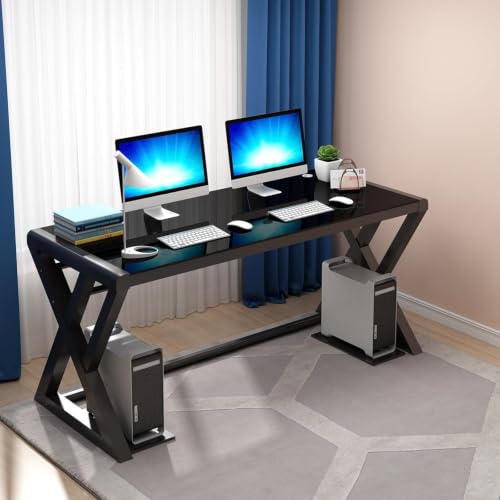
The SAMERY takes the same 55-inch black-glass brief as the MANBUR and answers it with simplicity: a modern, clean-lined desk whose listing emphasises the tempered strength of its glass top and a design intended to disappear into study, gaming and working life rather than to star in it. Where the MANBUR’s X-legs make a gesture, the SAMERY’s frame gets out of the way, and the choice between them is a genuine taste fork in this guide — drama or calm, at the same size and in the same black glass.
Calm has practical virtues. A simpler frame usually means a simpler assembly, fewer junctions to keep tight, and a silhouette that survives room redecorations without arguing. The 55.1-inch top hosts the same single-or-compact-dual setups as its rival, and the black surface plays the same cable-hiding trick while demanding the same dust discipline.
Buyers torn between the two black desks should decide by the room: a designed interior with strong furniture voices wants the MANBUR’s confidence; a room where the desk is a guest among other pieces wants the SAMERY’s restraint. Either way, the black-glass ownership experience — dramatic, forgiving of cables, honest about dust — is the shared substance beneath the styling.
- Width: 55.1 inches
- Top: black glass, tempered strength emphasised in the listing
- Style: modern, simple
- Aimed at: study, gaming and home office work
Strengths
- Clean design that survives redecoration around it.
- Full-size black glass surface hides the cable zone.
- Simpler frame promises a simpler build and upkeep.
Trade-offs
- Black glass dust discipline applies in full.
- No tray, storage or extras in the specification.
- Restraint may read as plain beside bolder furniture.
The SAMERY also suits the renter’s calculus: a desk that looks deliberate in any room it lands in, that assembles without ceremony and that photographs well for the listing when life moves on. Furniture that survives changes of address and taste without becoming the problem piece is worth more in mobile lives than its specification sheet can express.
Best for: a calm, modern room wanting black glass without the drama. Not suited for: a buyer seeking a statement piece, who should take the MANBUR instead.

Flash Furniture Jude Tempered Glass Computer Desk — Best with keyboard tray
The Jude is the traditionalist’s glass desk, and its details tell the story: a tempered glass top with a pull-out keyboard tray beneath it, carried on a crisscross frame, finished in a cherry-and-clear pairing that belongs to the warmer, wood-toned office rather than the monochrome modern one. Flash Furniture builds for offices and institutions at scale, and the Jude’s design reflects that heritage — a small computer desk for a home office that wants glass without surrendering the keyboard tray a generation of typists was raised on.
The tray on a small desk is a surface multiplier: keyboard and mouse live on the tray, the glass above holds the monitor, the notebook and the phone, and a compact top behaves like a larger one. The crisscross frame braces the structure diagonally, which suits a desk whose tray slides and whose owner leans. The cherry finish warms the glass’s coolness — an underrated pairing in rooms with wooden floors and traditional furniture, where black glass can look like a visitor from another decade.
Its scale is the small end of this guide, so it suits laptop-plus-monitor or single-screen setups in bedrooms and studies rather than growing battlestations. Judged as what it is — a compact, tray-equipped glass desk with warm styling — it has few direct rivals in this roundup.
- Top: tempered glass
- Extras: pull-out keyboard tray
- Frame: crisscross design
- Finish: cherry and clear
- Scale: small computer desk for home office
Strengths
- Keyboard tray multiplies a compact top’s usefulness.
- Cherry and clear finish suits warm, traditional rooms.
- Crisscross frame braces against daily leaning and sliding.
Trade-offs
- Compact scale caps multi-screen ambitions.
- Tray typing height is fixed relative to the top.
- Traditional styling will not suit a monochrome interior.
There is a handwriting case for the Jude that its gaming-era rivals cannot make: the tray parks the keyboard, the glass above becomes a clear, hard writing surface at full desk height, and paperwork sits flat and visible on a top that wipes clean of ink smudges in a second. Households whose desk still hosts letters, forms and homework will feel the difference daily.
Best for: a warm-toned study or bedroom wanting glass with a proper keyboard tray. Not suited for: a modern black-and-white office, where its cherry warmth will argue with the room.

Flash Furniture Singleton Glass Desk — Best pedestal frame
The Singleton takes the other classic route to supporting glass: a pedestal. Its tempered glass top rests on a black pedestal metal frame with a powder coated finish — a single, substantial support architecture instead of four legs — which gives the desk a sculptural, cantilevered presence and keeps the floor beneath it unusually open. Powder coating matters beyond looks: it is the durable, chip-resistant finish that keeps a metal frame from advertising every knock, and on a pedestal that carries the whole desk’s dignity, durability is aesthetics.
The pedestal layout changes the sitting experience. Legs vanish from the corners, chairs slide in from a wider arc, and the under-desk space reads as one volume rather than a forest of posts — a genuine comfort in a small room and a cleaning mercy in any room. The black frame grounds the glass visually, suiting offices that want the transparency without the floating effect of lighter frames.
Buyers should think about balance the way the design invites: a pedestal desk concentrates its support, so level floors and even loading are its friends, and heavy stacks belong near the supported zone rather than exiled to a far corner of the top. Treated as the design asks, the Singleton is the most architecturally confident desk in this guide.
- Top: tempered glass
- Frame: black pedestal metal frame
- Finish: powder coated metal
- Layout: pedestal-base straight desk
Strengths
- Pedestal base opens the floor and the chair’s approach.
- Powder coated finish resists the knocks frames collect.
- Sculptural presence suits designed offices.
Trade-offs
- Concentrated support prefers level floors and centred loads.
- No tray or storage features in the design.
- Bold base is a look rooms must be able to carry.
The Singleton’s open pedestal also makes it the vacuum cleaner’s favourite desk in this guide: no four-leg maze, no corner dust traps, one clean sweep underneath. In homes where the office floor is cleaned often — which is to say, in homes with pets — that small mercy recurs weekly and compounds into genuine affection for the design.
Best for: a designed office wanting glass with architectural confidence. Not suited for: an uneven-floored room, where a four-legged frame forgives more.
How Do the Six Compare Side by Side?
| Desk | Size / shape | Glass | Frame | Signature extra |
|---|---|---|---|---|
| Realspace Vista | 48 in, straight | Glass top | Silver frame | Compact office sizing |
| MANBUR | 55 in, straight | Black tempered | X-leg | Modern statement design |
| Techni Mobili | L-shaped corner | Tempered desktop | Corner frame | Keyboard tray |
| SAMERY | 55.1 in, straight | Black glass | Simple modern frame | Clean restraint |
| Flash Furniture Jude | Compact, straight | Tempered | Crisscross | Pull-out keyboard tray |
| Flash Furniture Singleton | Straight | Tempered | Black pedestal, powder coated | Pedestal openness |
The table’s real division is not size but philosophy: three desks chase modern minimalism (MANBUR, SAMERY, Singleton), two carry traditional office values in glass (Vista, Jude), and one rebuilds the corner desk in a material that refuses to look heavy (Techni Mobili). Choose the philosophy your room already speaks, and the size will usually follow.
Are Glass Desks a Sensible Choice Around Children and Pets?
Tempered glass changes the safety conversation from the one most people imagine: the top is not a fragile pane waiting to shard, and its failure mode, in the rare event of a damaging edge impact, is granular rather than jagged. The realistic household risks are more ordinary — a child swinging a hard toy onto the top’s edge, a cat using the desk as a launchpad, a dog’s tail clearing the surface of everything not weighted. None of these is a reason to ban glass from family homes, but they argue for the sturdier-framed picks, for coasters and mats as default armour, and for keeping genuinely heavy ornaments off the top.
Pets add the visibility dividend in reverse: hair shows on glass sooner than on wood, and the cloth ritual becomes a pet ritual too. Households that already live with that rhythm on kitchen glass and windowsills will find the desk no burden; households that chose wood everywhere to avoid it should believe their own history and choose wood here as well.
How Do You Move House With a Glass Desk Without Incident?
Glass desks travel better than their reputation, provided the move treats the top as the one fragile component it is. Disassemble rather than moving the desk whole: the frame becomes ordinary furniture, and the glass panel, wrapped in blankets with its edges and corners padded first, rides flat or on its long edge against a solid surface, never with weight stacked on it and never where a shifting box can strike an edge. Photograph the frame’s assembly before dismantling, bag the fixings per joint, and the desk reassembles in the new room in the time a wooden desk would take.
At the destination, inspect the panel in good light before building: chips announce themselves at edges, and a panel that survived should be celebrated by being levelled properly on its frame before the first monitor lands. Owners who move often consistently report that the discipline glass demands in transit is repaid by how completely a glass desk suits each new room — transparency is the most portable of all furniture styles, because it borrows the room’s own character instead of importing the last room’s.
What Accessories Does a Glass Desk Genuinely Need?
Four, and only four, earn the title of necessary. Coasters, because heat rings and condensation are the top’s daily enemies and a coaster habit is cheaper than regret. A mouse pad or a desk mat, because an optical mouse on bare glass is unreliable and a mat restores both tracking and quiet. Felt or rubber pads under every stand, tray and speaker, because they prevent the scratches and the small sliding movements that glass otherwise permits. And the microfibre cloth, kept within arm’s reach, because a cloth in a drawer in another room is a cloth that will not be used.
Everything beyond those four is taste. Monitor arms suit glass particularly well — a clamped arm at the back edge frees the whole transparent surface and looks like sculpture doing it — but choose a clamp with padded jaws and spread the load as the arm’s instructions direct, because a clamp concentrates force exactly where a panel least wants it. Under-desk trays, chosen in the frame’s colour, complete the cable composition described earlier. Buy the four necessities with the desk; audition the rest after a month of living with it.
How Do You Set Up a Glass Desk So Cables Stop Showing?
Accept the premise first: under a glass desk, cable management is interior design. The cables will be seen, so they must be composed. Run one power strip in a tray or mounted beneath the frame’s rear, feed every device from it, and bundle the runs into a single vertical drop at one leg — a composed bundle reads as intention, while five loose cables read as neglect, and glass broadcasts whichever you chose to the whole room.
Colour is your accomplice: cables and strips that match the frame or the floor disappear at conversational distance, and a black strip under black glass is effectively camouflage. Wireless peripherals remove the two most visible runs entirely. Finally, curate the under-desk zone as if it were a shelf — because visually, it is one: the PC tower aligned, the bin chosen rather than inherited, nothing stored under there that you would not put on display. That last rule is the glass desk’s whole lifestyle in one sentence.
How Does a Glass Desk Age Over Five Years?
Gracefully, if its owner kept the four habits. The glass itself does not fade, warp, swell with humidity or yellow under sunlight — the material failures that retire wooden and laminate tops simply do not apply, and a five-year-old glass top cleaned properly is optically new. What ages is everything around it: frame finishes collect their small scars, tray mechanisms loosen a fraction, felt pads want replacing. A single maintenance pass a year — tighten, re-pad, polish — returns the whole desk to as-new in an afternoon, a restoration no wooden desk can match at any effort.
The one irreversible ageing is scratching, which is why this guide has repeated the pads-and-lifting discipline like a refrain. A glass desk’s second decade is decided by its first year’s habits; owners who internalise them own the longest-lived desktop material in the furniture catalogue.
What Are the Most Common Mistakes When Buying a Glass Desk?
The first is forgetting glare. A glass top opposite a bright window becomes a second window at working height, and the desk that photographed beautifully at noon is unusable at three. Walk the room’s light through the day before choosing the desk’s position, and favour spots where light arrives from the side.
The second mistake is treating the top like wood: keys dropped, mugs uncoastered, a monitor stand dragged sideways during setup. Glass rewards gentleness with decades of clarity and punishes grit with permanent scratches, so felt pads under everything that lives on the top is the owner’s first ritual. Third, buyers underestimate the visibility of the floor beneath — a glass desk over a tired carpet or a cable swamp displays both, and the room should be ready for its close-up. Fourth, skipping the two-person rule during assembly and moves: glass panels are awkward before they are heavy, and edges chip when a solo lifter’s grip fails.
Where in the Room Does a Glass Desk Belong?
Placement is glass’s superpower and its exam question in one. The superpower: a glass desk can stand in the middle of a room’s light without darkening it, can sit in front of a window without blocking the view’s lower half, and can divide a studio’s sleeping and working zones while letting the eye travel through. No wooden desk can take the window position in a small room without becoming a silhouette; glass takes it and disappears.
The exam question is glare and backdrop. In front of a window, the screen’s backdrop is the bright outdoors, which tires eyes unless the monitor’s brightness and a blind share the work; perpendicular to the window is usually the sweet spot, with light raking the desk from the side and the screen facing a calm wall. Consider also what the desk will reflect: a glass top mirrors the ceiling and its lights, and a room with a busy ceiling fixture will see it doubled at working height. Walk the candidate spot at three times of day before committing the frame’s bolts to their final tightening.
Glass Desks for Gaming — What Changes?
Gaming stresses a desk differently from office work: longer sessions, more peripherals, a wheel or flight stick clamped to the front edge in simulation rigs, and a household audience for the setup’s looks. The surface itself suits gaming well — smooth for mouse pads, cool under forearms in hour three, and visually the most dramatic backdrop a rig can sit on, especially the black models under coloured light. The cautions are the clamp and the load: clamp accessories over padded jaws near frame-supported zones, keep the tower on the floor where its vibration and heat belong, and let the glass carry the screens and controls it was designed for.
Streamers get a specific dividend: a glass desk on camera reads as designed rather than accumulated, and the transparent top lets background lighting show through the setup instead of stopping at a wooden slab. In the economy of a stream room, that is a production value purchased once, in furniture.
How Do You Style the Rest of the Room Around a Glass Desk?
Glass asks the room for texture in exchange for the light it returns. A rug under the desk — visible through the top, which is the point — grounds the workstation and gives the chair’s casters a kind surface. One wooden or upholstered neighbour keeps the transparency from tipping into showroom coldness: a wooden chair, a fabric seat, a bookshelf with its spines showing. Plants earn their place doubly around glass, because their colour reflects in the top and their silhouettes show through it, and a single plant behind a glass desk does the decorative work of three around a wooden one.
Restraint is the other half of the styling: the desk’s transparency means the room is always on view through it, so the floor beneath and the wall behind join the composition whether invited or not. Keep that sightline curated — the aligned tower, the chosen bin, the cable bundle composed — and the glass desk becomes the room’s best argument for itself, which is precisely what its buyers hoped when they chose the material.
What Should You Check in the First Week With a Glass Desk?
Run the light test at your real working hours: sit at the desk morning, afternoon and evening, and note where reflections land; a lamp moved a foot or a blind adjusted once solves most of what you will find, but find it in week one, not month three. Run the sound test with your actual mug, mouse and keyboard, and let it choose your mat and coasters empirically. Run the level test after the full setup is loaded — glass shows a slope honestly, because pens roll and screens reflect at telltale angles — and adjust the feet before the arrangement settles into permanence.
Finally, run the cloth test on yourself: if the microfibre ritual has not become automatic by Sunday, move the cloth closer — onto the desk’s edge, into the tray, wherever your hand actually goes. Glass ownership succeeds or fails on that one habit more than on any specification in this guide.
Who Should Not Buy a Glass Desk?
The category deserves its honest exclusions. The workshop-minded worker whose desk hosts tools, soldering, model-making with blades, or a rotating cast of heavy equipment should buy wood or metal and never look back — glass is a surface for keyboards and paper, not for the bench crafts. The profoundly untidy, whose under-desk zone is a geology of cables and boxes, will find glass an accuser rather than a desk, unless the purchase is deliberately a reform project. And the household mid-renovation, where ladders lean and paint flies, should wait: glass rewards a finished room and resents a building site.
Everyone else — the office worker in a bright room, the gamer with a presentable rig, the studio dweller rationing light, the traditionalist who wants the tray and the transparency together — is the readership these six designs were built for, and one of them is built for you specifically.
How Does Glass Handle the Standing-Desk Question?
None of these six desks rises, and glass as a material rarely joins the height-adjustable world, because a moving frame multiplies the edge impacts and clamp stresses a panel least enjoys. Buyers who alternate sitting and standing should know the honest workarounds: a laptop on a tall stand for standing calls while the desk stays seated-height, or a separate standing surface elsewhere in the room. If full sit-stand movement is the non-negotiable heart of your setup, choose that desk first and let the glass go — a guide that will not say this plainly is selling material over posture, and posture wins every long year.
What Is the Resale and Second-Life Story of a Glass Desk?
Glass desks hold their appeal in the second-hand market unusually well, for a material reason: the top does not absorb the previous owner’s life. No coffee rings soaked in, no pen grooves, no laminate peeling at the edge where a chair worried it — a cleaned glass top is simply a glass top, and the buyer’s inspection reduces to the frame’s honesty and the edges’ condition. Sellers should photograph the top in raking light, which is either a boast or a confession, and buyers should run a fingertip along every edge, because chips are felt before they are seen.
The second life inside one household is equally kind: the office desk becomes the teenager’s study desk, then the hallway console, then the plant stand by the window, and at every demotion the transparency that justified the purchase keeps justifying it. Furniture that can change jobs without changing character is the kind that stays in houses for decades, and glass, indifferent to fashion’s swings between dark and light interiors, changes character least of all.
A Short Word on Edges, Corners and Finishing Touches
Run your eye along the top’s perimeter in the listing photographs and you are reading the manufacturer’s character. Polished, smooth edges are the mark of a panel finished for hands and forearms; the corners of a home desk should be softened rather than knife-square, both for the hips that will meet them in small rooms and for the panel’s own sake, since a softened corner tolerates the world’s knocks better than a sharp one. These details rarely headline a listing, which is why they reward the buyer who looks: in glass, the finishing is not cosmetic garnish on the product. It is a large part of the product, felt at every touch for the whole of the desk’s life.
How Do Glass Desks Behave in Rented Homes and Shared Houses?
Renters gravitate to glass for a reason beyond taste: it is the desk least likely to fight the room it lands in, and the room is rarely theirs to repaint. A transparent top borrows the landlord’s wall colour, the existing floor and the previous tenant’s curtains and somehow composes them, where a heavy wooden desk would declare war on at least one. When the tenancy ends, the desk disassembles into a panel and a frame that move in one trip, leaving no more trace than any furniture does.
In shared houses the glass desk earns a social dividend: it does not annex the living room visually, so housemates tolerate an office corner that a solid desk would make them resent. The owner pays for that tolerance with the visibility discipline this guide has described — in a shared room, your under-desk zone is everyone’s view — and most owners find the exchange fair within the first week.
Final Recommendation
Most buyers should start with the two 55-inch black desks and choose by temperament: the MANBUR if the desk is a design feature, the SAMERY if it is a calm guest in the room. The Vista is the compact professional for small spaces and single screens; the Techni Mobili is the corner solution for anyone wanting L-shaped zoning without the visual weight; the Jude serves the traditional room that insists on its keyboard tray; and the Singleton is the architectural choice for a designed office with a level floor. Whichever you choose, buy the coasters and the microfibre cloth in the same order, compose the cables like you mean it, and a glass desk will make its room look bigger and brighter every single day — the rare piece of office furniture that improves the room even when nobody is working at it.
Frequently Asked Questions
Can a glass desk hold two monitors?
The 55-inch models host a compact dual-screen setup comfortably, especially on a dual arm that spreads the load at the back edge. Keep the combined weight sensible and centred over the frame’s support, use felt or rubber pads under stands, and load the desk gradually the first day rather than all at once.
Does glass scratch easily?
Tempered glass resists everyday wear well, but grit dragged under a heavy object can mark it, and marks on glass are permanent. Felt pads under stands and trays, coasters under mugs, and lifting rather than sliding objects are the whole prevention programme — cheap habits that keep a top clear for years.
Is a glass desk cold or noisy to work at?
It feels cool to the forearm at first touch, which many people enjoy in warm rooms; a desk mat warms the typing zone if it bothers you. Objects do land with a sharper sound than on wood, and coasters plus a mat quiet the surface completely where it matters.
How do I clean a glass desktop properly?
A microfibre cloth and a standard glass cleaner, sprayed on the cloth rather than flooded on the top, handles fingerprints and dust in under a minute. Work in daylight or raking light so smears show, and keep a dry second cloth for the final pass — the two-cloth habit is what separates a wiped desk from a polished one.
Can I put a printer on a glass desk?
A compact printer is fine on the wider models, placed on a mat near a frame-supported area rather than at a free corner of the top. Printers vibrate and get refilled with enthusiasm, so give the machine a pad, keep paper loading gentle, and prefer a side surface or the floor for the largest all-in-one units.
Are glass desks suitable for gaming setups?
Yes, with the same discipline as any setup: the 55-inch black models in this guide are pitched at gaming as well as work, and their surfaces suit a monitor, keyboard and mouse with a pad. Keep tower PCs on the floor, manage the RGB cables as carefully as the look deserves, and the glass becomes part of the rig’s presentation.
Related Guides
Best L Shaped Computer Desks for Home Office


