What's inside
- Key Takeaways
- Quick Picks
- How Did We Choose These Picks?
- Why Do Marine Batteries Die Differently From Car Batteries?
- How Many Banks and Amps Does Your Boat Actually Need?
- How Do the Six Marine Chargers Compare Side by Side?
- How Should You Install and Live With an Onboard Charger?
- What Mistakes Do Boat Owners Keep Making With Chargers?
- How Do Lead-Acid and Lithium Batteries Change the Choice?
- What Does a Season of Good Charging Actually Save?
- How Does Shore Power Behaviour Make or Break the Whole System?
- What Should You Check at Spring Launch and Autumn Lay-Up?
- How Do Trolling Motors Reshape the Charging Question?
- Why Do Matched Batteries Deserve a Matched Charger?
- What Separates a Marine Charger From a Car Charger in a Waterproof Mood?
- How Should Saltwater and Freshwater Owners Read This Guide Differently?
- What Is the Right Response When a Bank Reports Trouble?
- Final Recommendation
- Frequently Asked Questions
- Related Guides
As an Amazon Associate I earn from qualifying purchases. This post may contain affiliate links at no extra cost to you.
widgetverdict.com is reader-supported. When you buy through links on our site, we may earn an affiliate commission.
Where to buy: Each onboard charger below is sold through Amazon, linked from the quick picks table and from its review heading. Count your boat’s batteries before anything else, because bank count — not brand — is the first decision in this category.
The best automatic marine battery chargers share one defining promise: connect them once, mount them aboard, and let them stand guard over your batteries every hour the boat sits at the dock. Automatic is the operative word. A marine charger is not a workshop tool you visit; it is a crew member that never sleeps, topping up after every outing, holding batteries at full charge through the off-season, and doing all of it in a damp, vibrating, salt-tinged environment that would kill ordinary electronics in a year. The six picks here are all onboard designs built for that life, and they divide along three honest axes: how many batteries they serve, how much current each battery receives, and how much sophistication stands behind the name on the housing.
Bank count is the vocabulary to learn first. A bank is one battery — or one battery group wired as a unit — charged through its own dedicated output. A two-bank charger tends a starting battery and a house battery independently, giving each exactly the charge its state requires. A single-bank unit serves the single-battery boat completely and asks nothing more. Every pick in this guide is a 12-volt design, and the listings lean heavily on IP68 waterproofing, which is the category’s way of saying the unit can be mounted in a bilge-adjacent locker and survive the wet reality of boating rather than the dry fiction of a showroom.
Key Takeaways
- Count batteries first: one-bank, two-bank and three-bank chargers serve different boats, and banks cannot be added later.
- Five amps per bank is the rhythm of this whole group — enough for overnight recovery and indefinite maintenance of typical marine batteries.
- The NOCO GEN5X1 and GEN5X2 bring the category’s most established name, IP68 sealing and temperature compensation to one- and two-bank boats.
- Three banks, as on the 5X3 model here, serve boats running a starting battery plus a two-battery trolling or house setup.
- The ECO-Worthy two-bank entry stands out for listing repair and activation modes for lead-acid and lithium batteries.
- A single-bank 10-amp unit, the last pick, gives one battery the fastest recovery in this guide.
Quick Picks
| Pick | Badge | Why it earns its place |
|---|---|---|
| NOCO GEN5X2 12V 10A 2-Bank OnBoard Marine Battery Charger & Maintainer | The two-bank benchmark | Ten amps across two banks, IP68 waterproofing, overcharge protection and temperature compensation from the category’s benchmark brand. |
| NOCO GEN5X1 12V 5A 1-Bank OnBoard Marine Battery Charger & Maintainer | The single-battery benchmark | Five amps to one bank with the same IP68 sealing and protective design language as its two-bank sibling. |
| 2 Bank Marine Battery Charger 5X2 10A (5A/Bank) – 12V Boat Charger | The 24/7 two-bank value | Two banks at five amps each, IP68 waterproofing and a design brief built around staying connected around the clock. |
| 3 Bank Marine Battery Charger 5X3 15A (5A/Bank) – 12V Boat Charger | The three-bank answer | Fifteen amps across three banks at five amps each, IP68 sealed, for boats whose trolling or house setup outgrew two banks. |
| ECO-Worthy 2 Bank Marine Battery Charger 5X2 | The repair-mode two-bank | Two banks at five amps each, IP68 waterproofing, and activate-and-repair functions for lead-acid and lithium batteries. |
| Marine Battery Charger 10X1: 1-Bank 10A Onboard Battery Charger | The single-bank sprinter | Ten amps devoted to one 12-volt battery, waterproof, and designed to stay connected and charging around the clock. |
How Did We Choose These Picks?
We required onboard mounting, fully automatic operation, 12-volt marine duty and a listing that states bank count and per-bank output without detective work. Those four requirements describe the genuine article in this category and exclude the automotive chargers that wander into marine search results wearing optimistic descriptions. A charger that lives aboard must be sealed, mounted and forgotten; anything that needs to be carried down the dock each time is a different product, however good.
We then arranged the six as a map of real boats: the single-battery runabout, the two-battery fishing boat, the three-battery trolling setup, and the owner whose batteries need reviving as much as maintaining. The NOCO pair anchors the map with the segment’s reference designs. The value-oriented multi-bank units test how much of that formula can be had from younger brands. The ECO-Worthy earns its place for one specific, listing-stated talent — its repair and activation modes — that none of the others claims in the same words.
Why Do Marine Batteries Die Differently From Car Batteries?
A boat battery lives a life of feast and famine. It may crank an outboard, run a trolling motor for six hours, power lights, pumps, sonar and a livewell, then sit untouched for three weeks in a damp hull. Deep discharges followed by long, low rests are precisely the pattern that shortens a battery’s life when no charger intervenes, because a battery left partially charged slowly damages itself from within. The automatic onboard charger exists to break that pattern at its weakest point: the rest. Plugged into shore power, it restores what the day took and then holds the battery at the level where time stops being an enemy.
The marine environment adds its own taxes. Vibration loosens connections and stresses plates. Humidity creeps along cables. Temperature swings between a sun-baked deck locker and a cold night on the water change what a battery needs from its charger hour by hour, which is why temperature compensation — named in the NOCO listings — is a meaningful feature rather than a brochure word: a charger that adjusts for heat and cold treats the battery in front of it, not an average battery in a laboratory.
How Many Banks and Amps Does Your Boat Actually Need?
Count physical batteries and how they are wired. A starting battery plus a separate house battery is two banks. A 24-volt trolling setup built from two 12-volt batteries wired in series is typically charged as two banks by a multi-bank onboard unit, each battery receiving its own output — one reason three-bank chargers exist, covering the starter plus the trolling pair. Batteries wired in parallel as one larger bank count as one. When in doubt, photograph your battery compartment and count again on land; buying one bank too few is the category’s least forgivable error, because the whole unit must be replaced to fix it.
Amps per bank decide recovery speed. Five amps per bank, the rhythm of most picks here, restores a typical marine battery overnight and maintains it indefinitely — the right tempo for boats used on weekends. Ten amps to a single bank, as the final pick offers, halves the recovery for the boat that fishes at dawn, returns at dusk and fishes again at dawn. More current is not automatically better for a battery’s health across years; it is better for a schedule. Match the tempo to the calendar, and let maintenance quality carry the rest.
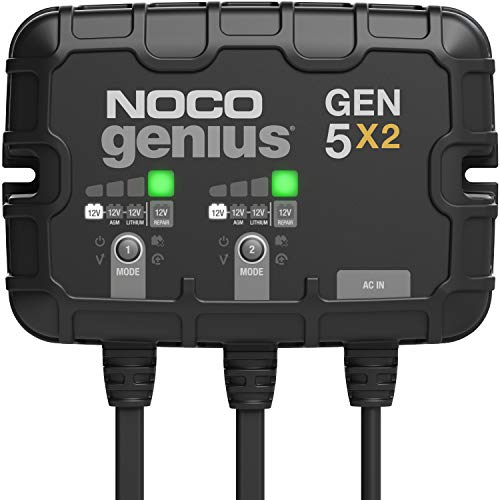
NOCO GEN5X2 12V 10A 2-Bank OnBoard Marine Battery Charger & Maintainer — The two-bank benchmark
The GEN5X2 is the reference point against which two-bank marine chargers are measured, and its listing states the formula cleanly: 12 volts, 10 amps total across two banks, charging two batteries at once, IP68 waterproof, with overcharge protection and temperature compensation. Two independent outputs mean the starting battery and the house battery each receive a charge shaped to their own state — the house battery, dragged low by a day of electronics, is not held hostage to the starting battery’s easy fullness, and neither is overcharged while the other catches up.
NOCO’s onboard line is engineered around a compact, sealed, mount-anywhere philosophy, and the IP68 rating is the credential that matters most in a bilge-adjacent world of spray, washdowns and condensation. Temperature compensation quietly separates serious marine chargers from adapted car chargers: the unit adjusts its behaviour for a freezing morning launch and a hot afternoon in a closed compartment alike. For the classic two-battery fishing or family boat, this is the charger that defines the expected experience — install it, wire it, plug in at the dock, and stop thinking about batteries as a category of worry.
The discipline it asks in return is installation done properly the first time: solid mounting, correct wiring to each battery, and a shore-power routine the household actually follows. Five amps per bank is maintenance-and-overnight tempo, so the tournament angler who flattens a house battery daily and needs it back by dawn should study recovery times honestly. For the great majority of two-battery boats, though, the GEN5X2 is not merely a safe choice; it is the choice the rest of this list is compared against, including by us.
- Banks: 2, charging two batteries at once
- Output: 12V, 10A total
- Sealing: IP68 waterproof
- Protection: overcharge protection, temperature compensation
- Role: onboard charger and maintainer
Strengths
- Independent banks treat starting and house batteries according to their own needs.
- IP68 sealing and temperature compensation suit real bilge-adjacent life.
- The segment’s benchmark brand and design maturity.
Trade-offs
- Five amps per bank is overnight tempo, not a rapid turnaround.
- Two banks cannot grow into three when the boat’s setup expands.
- Premium positioning within this group of six.
Best for: two-battery fishing and family boats that live on shore power between outings.
Not suited for: three-battery trolling setups or owners needing very fast single-battery recovery.
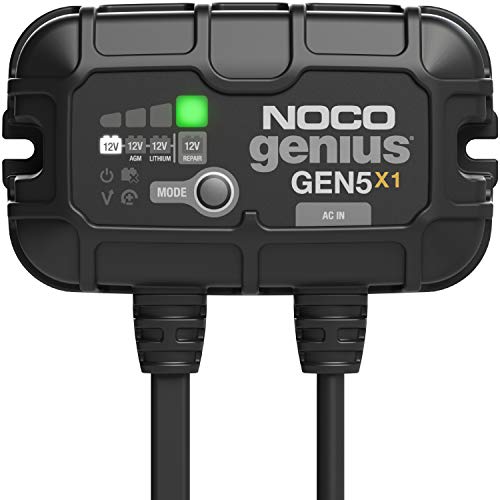
NOCO GEN5X1 12V 5A 1-Bank OnBoard Marine Battery Charger & Maintainer — The single-battery benchmark
Plenty of boats run one battery and run it well: the small centre-console, the jon boat with an electric start, the sailboat daysailer with a modest electrical appetite. The GEN5X1 serves exactly that fleet with the same design language as its two-bank sibling — the listing states 12 volts, 5 amps, one bank, IP68 waterproofing, overcharge protection and temperature compensation — scaled honestly to a single battery’s needs. Nothing about it feels like a cut-down apology; it is the benchmark formula with one output.
Five amps to one battery is a considered tempo. It restores a day’s starting and electronics use overnight with ease, then settles into the maintenance vigil that keeps a battery honest across a winter of disuse. For a boat stored on a trailer with a power point nearby, that vigil is worth more than any other feature in this guide, because the single-battery boat has no second battery to forgive neglect — when its one battery fades, the boat simply does not start, at the ramp, in front of an audience.
The limitation is written into its name: one bank is one bank forever. Owners who can see a second battery in their future — a dedicated electronics battery, a trolling motor joining the crew — should buy the two-bank sibling now and leave a channel ready. Owners certain of their single-battery life get the cleanest possible version of it here, from the brand whose name the category uses as shorthand.
- Banks: 1
- Output: 12V, 5A
- Sealing: IP68 waterproof
- Protection: overcharge protection, temperature compensation
- Role: onboard charger and maintainer for single-battery boats
Strengths
- Benchmark NOCO design scaled exactly to one battery.
- Temperature compensation protects across seasons of storage.
- Ideal maintenance vigil for trailer-stored single-battery boats.
Trade-offs
- No path to a second battery without replacing the unit.
- Five amps is gentle for a large, deeply drained battery.
- Owners pay for brand maturity in a simple specification.
Best for: single-battery boats that sit between outings and must start first try.
Not suited for: any boat planning to add a house or trolling battery soon.

2 Bank Marine Battery Charger 5X2 10A (5A/Bank) – 12V Boat Charger — The 24/7 two-bank value
This two-bank entry states its arithmetic in its name: 5X2, ten amps total, five amps per bank, charging two batteries at once, IP68 waterproof, and designed — in the listing’s own framing — to be charged around the clock, with overcharge and temperature protection. That 24/7 posture is the product’s thesis. It is built to be connected permanently and trusted permanently, which is either exactly what a boat needs or a claim the owner should test with a careful first season.
On paper it mirrors the GEN5X2’s core formula bank for bank and amp for amp, and that mirroring is its appeal: the two-battery boat on a budget gets the same architecture — independent outputs, sealed housing, automatic care — from a younger name. The honest unknowns are the ones no listing can settle: how its electronics age across five damp years, how its maker supports a unit in year three, how gracefully it treats an elderly battery on the edge. None of those unknowns disqualifies it; they simply define the trade being made.
Our counsel for value-tier onboard chargers is consistent: install meticulously, supervise the first several charge cycles, confirm the unit settles into maintenance rather than cooking or neglecting, and keep the boat’s shore-power connection itself in good order. An owner who does that diligence gets a two-bank guardian at a friendlier rung of the ladder, and the batteries — which cannot read brand names — will be charged exactly as well as the design allows.
- Banks: 2, charging two batteries at once
- Output: 12V, 10A total, 5A per bank
- Sealing: IP68 waterproof
- Design brief: connected and charging 24/7
- Protection: overcharge and temperature protection, per listing
Strengths
- Two independent banks at the category’s standard five-amp tempo.
- Built and described for permanent, around-the-clock connection.
- Value positioning for the classic two-battery boat.
Trade-offs
- Younger brand, so long-term marine durability is less documented.
- Rewards a supervised first season more than the benchmark names do.
- Same fixed bank count: no expansion path built in.
Best for: two-battery boats whose owners will verify the first season carefully.
Not suited for: owners who want the most documented long-term track record available.

3 Bank Marine Battery Charger 5X3 15A (5A/Bank) – 12V Boat Charger — The three-bank answer
Three banks exist because of one dominant layout: a starting battery plus a pair of 12-volt batteries wired for a 24-volt trolling motor, each wanting its own charging channel. This listing answers with 5X3 arithmetic — fifteen amps across three banks at five amps each — charging three batteries at once, IP68 waterproof, built for continuous connection with overcharge and temperature protection. For the bass boat and the serious angler’s rig, that third channel is not a luxury; without it, one battery in the trolling pair gets charged by improvisation, and improvisation is how battery pairs drift out of balance and age unevenly.
Balanced ageing is the unglamorous prize here. Batteries wired together live or die together, and a charger that treats each one individually — reading its state, feeding it accordingly — keeps the pair matched across seasons. The starting battery, meanwhile, lives its separate life undisturbed. Owners stepping up from a two-bank unit plus a portable charger for the third battery will feel the simplification immediately: one plug at the dock, three batteries tended, no rotation ritual to forget after a long day on the water.
The same counsel about younger brands applies as with its two-bank sibling above: verify behaviour across the first season, and confirm each bank’s leads are labelled and landed on the correct battery, because a three-bank installation has more ways to be wired confidently and wrongly. Boats with only two batteries should not buy the third channel as a souvenir; it will sit idle while the two-bank picks do the same work in a tidier housing. Boats with three, though, have exactly one correct shape of charger, and this is it.
- Banks: 3, charging three batteries at once
- Output: 12V, 15A total, 5A per bank
- Sealing: IP68 waterproof
- Design brief: connected and charging 24/7
- Role: starting battery plus two-battery trolling or house setups
Strengths
- Third channel keeps trolling pairs balanced and individually tended.
- One shore-power plug serves the whole three-battery boat.
- Standard five-amp-per-bank tempo suits overnight recovery.
Trade-offs
- Pointless capacity for boats that will only ever run two batteries.
- More leads to land correctly during installation.
- Younger brand track record, as with its two-bank sibling.
Best for: bass boats and anglers running a starter plus a two-battery trolling setup.
Not suited for: two-battery boats, which should buy the tidier two-bank designs.
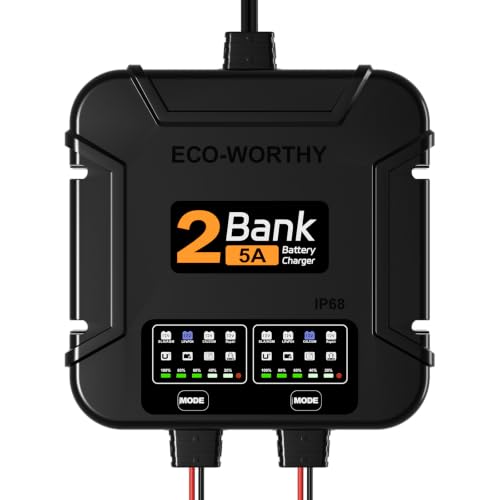
ECO-Worthy 2 Bank Marine Battery Charger 5X2 — The repair-mode two-bank
ECO-Worthy arrives in this category from the off-grid and solar world, and its two-bank marine charger carries a distinctive extra: alongside 12 volts, 10 amps at five amps per bank, onboard mounting and IP68 waterproofing, the listing specifies functions to activate and repair batteries, for both lead-acid and lithium types. That last clause earns the unit its own paragraph in any honest guide, because most marine chargers assume healthy batteries and merely feed them. This one claims a tool for the battery that has been left too long and reads as tired rather than dead.
Calibrate the claim the way this guide calibrates all such language: repair modes apply staged charging intended to help a sulphated or deeply rested lead-acid battery recover capacity, and activation addresses batteries sitting at very low states. They are not resurrection, and a battery with internal damage will not be argued back to life by any mode. But for the boat bought secondhand with neglected batteries, or the house battery that survived one winter too many unplugged, a charger that attempts recovery before the owner spends on replacements has a real, testable value.
The lithium mention matters for a growing fleet: boats repowering their house side with lithium batteries need chargers whose profiles suit that chemistry, and a unit listing both chemistries gives the owner one less compatibility question to chase. Pair that with the standard two-bank architecture and the ECO-Worthy becomes the tinkerer-friendly pick of the six — the charger for the owner who maintains an older boat, experiments with battery upgrades, and wants the unit aboard to participate in rescues as well as routines.
- Banks: 2
- Output: 12V, 10A total, 5A per bank
- Sealing: IP68 waterproof
- Special functions: activate and repair modes, per listing
- Chemistries named in listing: lead-acid and lithium
Strengths
- Repair and activation modes address neglected batteries, not just healthy ones.
- Lists both lead-acid and lithium suitability for evolving house setups.
- Standard two-bank, five-amp-per-bank architecture underneath the extras.
Trade-offs
- Repair modes cannot restore a battery with internal failure.
- Feature-rich design asks the owner to read and choose modes thoughtfully.
- Brand’s roots are in off-grid power rather than marine specifically.
Best for: owners reviving older boats or mixing battery chemistries across seasons.
Not suited for: anyone shopping for the plainest possible fit-and-forget unit from a marine-first brand.
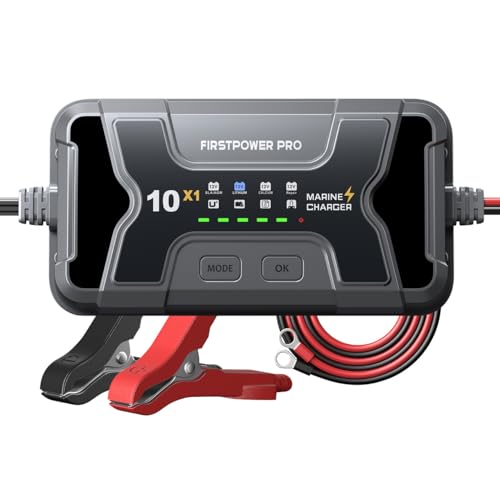
Marine Battery Charger 10X1: 1-Bank 10A Onboard Battery Charger — The single-bank sprinter
The 10X1 inverts the GEN5X1’s priorities: one bank again, but ten amps devoted to it, in a waterproof 12-volt onboard charger designed to stay connected around the clock with overcharge and temperature protection. Where the NOCO single-bank unit is a maintainer with charging manners, this one is a recovery engine for a boat whose single battery works hard and rests briefly — the guide boat, the rental, the fishing machine that launches again tomorrow and cannot wait for a gentle tempo.
Ten amps into one battery halves the arithmetic of an evening: a battery dragged down by a long day of trolling assist, electronics and repeated starts returns to full in a fraction of the night, leaving the charger to spend the remaining hours in maintenance. That pattern — fast restoration, long vigil — suits working boats better than any other profile in this guide. The single-bank limit remains absolute, so the boat must be honestly single-battery in its present and its plans.
As with the other value-tier names here, the counsel is verification: watch the first cycles, confirm the battery is neither undercharged nor kept cooking, and check that the unit’s behaviour with your particular battery chemistry matches its listing’s promises. A single-battery boat is a simple system, and a simple system makes verification easy — one battery, one charger, one clear answer about whether the pairing works. When it does, the 10X1 gives that boat the fastest recovery in this entire guide.
- Banks: 1
- Output: 12V, 10A to the single bank
- Sealing: waterproof, per listing
- Design brief: connected and charging 24/7
- Protection: overcharge and temperature protection, per listing
Strengths
- Fastest single-battery recovery in this guide at ten amps.
- Simple one-bank system is easy to install and verify.
- Built for permanent connection and daily working-boat rhythms.
Trade-offs
- One bank only, with no expansion when a second battery arrives.
- Ten-amp tempo is wasted on boats that rest all week.
- Younger brand, so the first season should be supervised.
Best for: hard-working single-battery boats that launch again the next morning.
Not suited for: multi-battery boats or laid-back weekend use where five amps suffice.
How Do the Six Marine Chargers Compare Side by Side?
| Pick | Banks | Output | Sealing | Defining trait |
|---|---|---|---|---|
| NOCO GEN5X2 | 2 | 10A total | IP68 | Two-bank benchmark, temp compensation |
| NOCO GEN5X1 | 1 | 5A | IP68 | Single-battery benchmark |
| 2 Bank 5X2 | 2 | 10A, 5A per bank | IP68 | 24/7 value two-bank |
| 3 Bank 5X3 | 3 | 15A, 5A per bank | IP68 | Three-battery trolling setups |
| ECO-Worthy 5X2 | 2 | 10A, 5A per bank | IP68 | Repair and activation modes |
| Marine 10X1 | 1 | 10A | Waterproof | Fastest single-battery recovery |
Read the table by banks first and brand second. The correct bank count in a lesser-known housing will outperform the finest brand one bank short, every single season, because a battery without a channel is a battery being neglected by design.
How Should You Install and Live With an Onboard Charger?
Mount the unit where its leads reach every battery without strain and where air can move around the housing, following the maker’s clearances rather than the tightest corner the compartment offers. Land each bank’s leads on the correct battery and label them while the wiring is fresh in your mind; a photograph of the finished installation, stored with the boat’s documents, will thank you at the first troubleshooting session two seasons later. Route the AC side so the shore-power connection is easy, dry and habitual — a charging routine that requires gymnastics is a routine that gets skipped.
Living with the charger is mostly a matter of plugging in without exception or apology whatsoever, at all, ever, in any season. Every return to the dock ends with shore power connected, whether the day felt demanding or gentle, because the maintenance hours are where battery life is actually manufactured. Glance at the indicators when you connect and when you leave; a charger that reports a fault in October is a gift compared with the same discovery at the April launch. Keep terminals clean, connections tight and the compartment as dry as the boat allows, and the automatic system will do the rest of its quiet work.
What Mistakes Do Boat Owners Keep Making With Chargers?
Under-buying banks leads the list, followed by its cousin: charging two unlike batteries from one output because a splitter seemed clever. Third comes installing a charger where bilge water can pool against it, trusting a waterproof rating to excuse a permanently submerged life it was never promised. Fourth, owners unplug shore power for weeks out of vague economy and return to batteries that aged a year in a month. Finally, many owners never check whether their charger’s profile suits a newer lithium house battery, an oversight the ECO-Worthy’s dual-chemistry listing exists to prevent.
How Do Lead-Acid and Lithium Batteries Change the Choice?
Most boats in this guide’s world still run lead-acid batteries in their various forms, and every pick here is written for that fleet first. Lithium house batteries are arriving steadily, though, bringing lighter weight and deeper usable capacity alongside a stricter demand: the charger must offer a profile the battery’s maker accepts. That is why listings that name lithium suitability, as the ECO-Worthy does, deserve a careful read from owners mid-conversion, and why owners planning a conversion next season should choose this year’s charger with next year’s chemistry in mind.
Starting batteries, meanwhile, remain lead-acid territory on most boats regardless of house-side experiments, which is why multi-bank chargers that treat each bank on its own terms age so gracefully through a fleet’s transition years. A two-bank unit can mind a lead-acid starter and a lithium house battery only if its profiles genuinely support each — verify per bank, in the documentation, rather than assuming a headline claim covers every channel. Chemistry questions are documentation questions, and the time to ask them is before the unit is mounted and wired, not after the first disappointing season.
What Does a Season of Good Charging Actually Save?
Batteries are consumables with a negotiable lifespan. The same battery, kept charged and compensated, can serve notably longer than its twin left to swing between deep discharge and neglect — and marine batteries, multiplied across banks, are not cheap consumables. An onboard automatic charger therefore pays for itself in the least dramatic way possible: replacements that happen later, launches that happen on time, and a trolling motor that pulls as hard in September as it did in May. None of that appears in a specification table, yet it is the entire economic argument for the category, and the reason experienced owners install the charger before they upgrade anything else electrical on the boat.
How Does Shore Power Behaviour Make or Break the Whole System?
An onboard charger is only as reliable as the habit and hardware feeding it. Marina shore power varies — pedestals trip, cords chafe, adapters corrode — and a boat that believes it is charging while its pedestal sits dead is ageing its batteries in confident ignorance. Build one small ritual: after connecting, look at the charger’s indicators before leaving the dock, every time, the way you check a mooring line. Ten seconds of confirmation converts the whole automatic system from an assumption into a fact, and it catches the tripped breaker, the unplugged neighbour and the cord that slipped its socket in the night.
At home, trailer boats face the same truth with an extension lead. The charger cannot guard what it cannot reach, so the stored boat’s power point deserves the same permanence as the charger itself: a proper exterior socket near the boat’s parking place, a lead routed where it will not be driven over or tripped across, and a household agreement that the boat stays connected between outings. Owners who arrange that infrastructure once report that battery anxiety simply leaves their boating — the fish finder boots, the engine turns, the trolling motor pulls, and nobody remembers when they last thought about any of it.
What Should You Check at Spring Launch and Autumn Lay-Up?
Spring is the audit season. Before the first launch, read the batteries’ state after a full charge, clean and tighten every terminal the charger touches, and confirm each bank’s indicator reports a healthy, completed cycle. A battery that wintered on a maintainer and still tests weak has given you its notice in the kindest possible circumstances — at home, in daylight, with time to replace it — rather than at a distant ramp in June. Treat that notice as the system working, and replace without resentment.
Autumn lay-up is where the next season is decided. Top every battery fully before storage, decide honestly whether the boat will stay connected to shore power or be stored away from it, and if it will be disconnected, plan mid-winter top-ups on the calendar rather than in your intentions. Record battery ages in the boat’s log while you winterise; batteries installed as a bank usually retire as a bank, and a written age prevents the false economy of replacing one member of a matched pair and wondering why the new one ages at the old one’s pace.
How Do Trolling Motors Reshape the Charging Question?
No accessory has changed small-boat electrics like the modern trolling motor. It is a heavy, hours-long, deep draw — closer to an electric vehicle’s duty than to a starter battery’s brief effort — and it is the reason so many boats carry two or three batteries where one used to do. A trolling pair discharged across a long day needs a charger that restores both members evenly before the next dawn, which is the three-bank pick’s entire reason for existing, and it needs owners who plug in promptly rather than letting the pair sit low while the week passes.
Spot-lock motors, sonar and livewell pumps add their own steady appetites on top, usually from the same house or trolling reserves. The practical lesson is that a fishing boat’s charging system should be sized from its longest day, not its average one: the tournament Saturday, the holiday weekend, the trip where everything ran from dawn to dark. Five amps per bank handles those days on an overnight rhythm for most setups, but owners who repeatedly return with the reserves nearly empty, and launch again at first light, should study their recovery honestly and consider whether their routine — earlier plug-in, prompt connection, disciplined maintenance — matters more than any hardware change. In this category, behaviour is a specification too.
Why Do Matched Batteries Deserve a Matched Charger?
Batteries wired together are a team, and teams decline at the pace of their weakest member. When one battery in a pair is older, weaker or differently maintained, the stronger one works harder, the weaker one is dragged through cycles it cannot support, and the pair’s useful life converges downward. A multi-bank charger fights that convergence at its root by treating each battery as an individual — measuring its state, feeding it what it accepts, and holding it at full without reference to its partner’s appetite. That individual attention is the deepest argument for bank-per-battery architecture, deeper than convenience and deeper than speed.
It also explains the buying discipline this guide keeps repeating: replace bank members together where they work together, install them together, and charge them individually from their first day. Owners who follow that triangle — matched age, matched type, individual charging — routinely extract the full service life the battery maker intended. Owners who mix ages and share single outputs across pairs are, without knowing it, running an experiment whose result the industry already knows.
What Separates a Marine Charger From a Car Charger in a Waterproof Mood?
Owners occasionally ask whether a good automotive charger, kept in a dry locker, can do this job at a friendlier price, and the honest answer is that the differences are structural rather than cosmetic. An onboard marine charger is designed to be mounted permanently, wired to several batteries at once, sealed against the atmosphere it lives in, and left connected for months under automatic control. An automotive charger is designed to be carried to a battery, supervised loosely, and put away. Using the second tool for the first job fails quietly — through connections never made on busy evenings, through a unit unplugged and forgotten in a locker, through corrosion at terminals nobody sealed — rather than dramatically, which is why the failure surprises people.
The products in this guide all accept the marine brief in full: permanent installation, per-battery attention, automatic vigilance. That shared acceptance is what makes their differences — bank count, tempo, repair modes, brand maturity — the interesting part of the decision, because the category question has already been answered the same way by all six. Choose among them by your boat’s battery count and your own appetite for verification, and the marine brief itself is covered either way.
How Should Saltwater and Freshwater Owners Read This Guide Differently?
Salt water accelerates everything electrical that boating involves: corrosion at terminals and connections, creep along cable ends, the slow greening of any metal left unprotected. Saltwater owners should read every installation note in this guide with emphasis — connections made cleanly and protected, the charger’s indicators checked often, the battery compartment inspected as part of washing down. The chargers’ sealed housings handle their own side of the bargain; the wiring and terminals remain the owner’s department, and in salt water that department has a shorter inspection interval.
Freshwater owners trade corrosion speed for temperature range: northern freshwater boats winter hard, and temperature compensation plus a maintainer’s vigil matter correspondingly more. Southern freshwater boats live in heat that bakes compartments and shortens battery patience. Neither fleet needs different products from this list — the same six serve both — but each should weight the features through its own climate. The guide’s structure supports that reading: banks and amps first, environment second, brand last.
What Is the Right Response When a Bank Reports Trouble?
An indicator complaining about one bank is information, not accusation. Work the simple sequence first: check that bank’s connections for tightness and corrosion, confirm the battery’s water and condition where serviceable, and swap nothing in haste. If the battery accepts a charge from another source and holds it, suspicion moves to the channel or its leads; if it refuses everywhere, the battery has delivered its verdict and replacement — of the matched set, where it works in a set — is the honest next step.
Keep notes when trouble appears. A bank that struggles every spring is describing a battery ageing on schedule; a bank that failed once after a lightning-adjacent storm is describing an event. Marinas and dealers troubleshoot faster with a written history than with a shrug, and the boat’s log — already holding battery ages and lay-up dates, if this guide has persuaded you — is where that history belongs. Automatic chargers reduce daily attention to nearly nothing; the attention they still ask for is exactly this: notice, record, and act while the boat is somewhere convenient.
One more portrait may help undecided readers locate themselves. The weekend freshwater angler with a starter and one trolling battery, launching from a trailer and parking beside a garage socket, is the GEN5X2’s home crowd, with the value 5X2 waiting if the budget argues. The coastal centre-console that lives in a marina slip, rinsed by salt air all week, should weight the NOCO pair’s sealing and temperature story heavily, because its charger will live the hardest atmospheric life of any boat in this guide. The charter or guide boat that fishes six days a week on a single hard-worked battery is the 10X1’s clear case. The project boat — older, bought with unknown batteries and big plans — is where the ECO-Worthy’s repair modes stop being a curiosity and become the first tool reached for. And the bass boat with its trolling pair has already been named: three banks, no substitutes, the 5X3.
Notice that none of those portraits mentions a favourite brand. They mention water, schedules, storage and battery counts — the facts of a boating life. That is deliberate, and it is the method this guide recommends carrying into the purchase itself. A charger chosen from the facts of the boat will still be the right charger when the boat’s electronics change, when a battery is replaced, even when the boat is replaced by its successor with the same layout. A charger chosen from a badge alone is one layout change away from the classified advertisements.
Finally, give the installation the respect the category assumes. These are permanently wired devices living beside large batteries in a moving, wet vehicle. Owners comfortable with 12-volt work can fit them carefully following the maker’s instructions; owners who are not should hand the job to a marine electrician without a moment’s embarrassment. The fee is small against the value of the batteries, the boat and the season the charger exists to protect, and a professional installation inspected once is the foundation every automatic promise in this guide quietly stands on.
There is a temptation, after reading six reviews, to keep researching a seventh and an eighth opinion until the season itself has slipped by. Resist it on this evidence: the differences that remain between these picks, once bank count and tempo are matched to the boat, are smaller than the difference between a charged battery and an uncharged one. Every week a boat sits without automatic care is a week its batteries spend ageing in the exact pattern this category exists to interrupt. Choose the unit your battery count names, install it properly, plug it in, and go boating — the charger will attend to the rest with more patience than any owner can.
And when the first full season closes with every battery alive, every launch uneventful and the trolling motor still pulling hard in the autumn, resist the urge to credit luck. That is the sound of a system doing precisely what it promised, in a bilge, in the damp, unthanked — which is the highest achievement available to any piece of marine equipment.
Before the order is placed, one last physical check closes the loop: open the battery compartment, measure the mounting space with the charger in mind, trace where each bank’s leads will run, and confirm the shore-power inlet or garage socket that will feed the whole arrangement. Chargers fail to be installed far more often than they fail to work, usually because a housing meets a compartment it does not fit or a lead meets a battery it cannot reach. Five minutes with a tape measure, on the actual boat, is worth more than another hour of comparison tables — including the honest one printed above.
Photograph that compartment while you are there. The photograph becomes the reference for the installation, the shopping list for cable protection and terminals, and the before picture against which next spring’s inspection is judged. Boats reward owners who document them, and battery compartments, hidden and humble, reward it most of all.
With the photograph taken and the space confirmed, the decision itself can be made in one sitting, because the guide has already done the narrowing honestly: your bank count selects the row, your schedule selects the tempo, your appetite for brand history or repair features selects within the row. What remains is not research but commitment — to the installation, to the plug-in habit, and to the log book that turns isolated seasons into a maintained boat. Owners who make that commitment rarely shop for marine chargers again for years, which is the quiet outcome every recommendation here is aimed at.
It is worth pausing on how modest that commitment really is compared with the rest of boat ownership. Engines demand services, hulls demand antifouling, trailers demand bearings and tyres, sails and canvas demand repair. The battery system asks for one correctly sized charger, one sound installation and one habit — plug in, every time — and in exchange it removes an entire category of failure from the boat’s life. No other system aboard offers that exchange rate, and none of the six chargers above asks for more than that modest commitment to deliver it.
So let the last word before the verdict be a practical one. Order the charger while the boat is accessible, not the week before a trip. Fit it on a quiet day, with the manual open and the camera handy, and run the first full cycle while you are there to watch the indicators settle. Then close the compartment, coil the shore-power lead the way you will coil it all season, and let the machine begin the long, unglamorous vigil it was bought for.
Seasons from now, when a neighbouring boat is jump-starting its morning away at the ramp while yours turns over on the first attempt, the vigil will explain itself without a word from anyone. That is the moment every product in this guide is ultimately selling, and it is bought not at the checkout but at the moment of correct sizing and careful installation that this guide has spent its length describing.
Hold on to the installation photographs and the battery log through every season that follows, and pass them to the boat’s next keeper if the boat is ever sold. A documented charging history is a genuine part of a used boat’s value, because it tells the buyer the batteries were citizens of a system rather than survivors of neglect — and systems, unlike batteries, do not wear out on a schedule.
That handover, when it comes, will also carry the simplest summary of everything argued above: count the batteries, respect the water, plug in without exception, and let an automatic charger do the remembering that human owners, however devoted, eventually forget to do.
Everything else in this guide is detail in service of those four habits, and the six chargers are simply six well-built ways of keeping them.
Choose the one whose bank count matches your compartment photograph, whose tempo matches your calendar, and whose maker you are content to trust across the seasons — then stop shopping, because the water is waiting and the batteries, properly tended, will be ready whenever you are.
That readiness, repeated across a whole season without a single anxious morning at the ramp or the slip, is the true product being bought here, and it is worth every small habit it asks in return, every single season, without exception.
Final Recommendation
Count your batteries and buy exactly that many banks: single-battery boats should take the GEN5X1 for its benchmark manners or the 10X1 when daily work demands faster recovery, two-battery boats should default to the GEN5X2 with the value 5X2 and the repair-minded ECO-Worthy as the considered alternatives, and three-battery trolling rigs have one honest answer in the 5X3 — because on the water, the charger you forget about is the one that was sized correctly in the first place.
Frequently Asked Questions
Can I leave an onboard charger plugged in all winter?
That is the job these units are designed for. Every pick here is an automatic charger and maintainer, and several listings describe around-the-clock connection explicitly. Keep the shore-power connection sound and check the indicators occasionally.
What does IP68 waterproofing mean for a boat charger?
It is the listing’s assurance that the sealed unit tolerates the wet marine environment, including spray and temporary immersion conditions under the rating’s terms. Mount it sensibly anyway; waterproof is protection, not an invitation to store it in standing bilge water.
How do I charge a 24-volt trolling motor setup?
Typically with a multi-bank charger giving each 12-volt battery in the pair its own bank — which is why the three-bank pick exists: one channel for the starter, one for each trolling battery.
Is five amps per bank enough?
For overnight recovery and indefinite maintenance of typical marine batteries, yes — it is the tempo this entire category is built around. Boats on a daily working rhythm with one battery are the case for the ten-amp single-bank pick.
Can a repair mode save my old battery?
The ECO-Worthy’s listing describes activation and repair functions aimed at tired lead-acid and lithium batteries. Such modes can help a neglected but sound battery; they cannot reverse internal damage, so test the battery after a full programme before trusting it offshore.
Do I need temperature compensation?
It helps wherever the boat lives through hot compartments or cold storage, because a battery’s charging needs shift with temperature. The NOCO listings name it explicitly, and owners in extreme climates should weight it accordingly.



[…] Best Automatic Marine Battery Chargers […]