What's inside
- Key Takeaways
- Quick Picks
- How Did We Choose These Picks?
- Why Does an External Charger Beat Charging in the Camera?
- Should You Buy a Charger Alone or a Kit With Spare Batteries?
- How Do the Six Camera Chargers Compare Side by Side?
- How Should You Run a Battery Rotation on a Long Shooting Day?
- What Mistakes Do Photographers Keep Making With Batteries?
- How Should Batteries Be Stored Between Seasons?
- How Does Cold, Heat and Altitude Treat Camera Batteries?
- What Changes When You Shoot Video Rather Than Stills?
- How Do You Build a Travel Power Kit Around These Chargers?
- Why Do Professionals Number Batteries and Amateurs Regret Not Doing So?
- What Should a Second Shooter or a Borrowed Kit Change?
- How Does a Charger Fit a Minimalist’s One-Bag Philosophy?
- Final Recommendation
- Frequently Asked Questions
- Related Guides
As an Amazon Associate I earn from qualifying purchases. This post may contain affiliate links at no extra cost to you.
widgetverdict.com is reader-supported. When you buy through links on our site, we may earn an affiliate commission.
Where to buy: The six chargers and charger kits below are sold through Amazon, linked from the quick picks table and from each review heading. Confirm your battery model — NP-FZ100, NP-BX1, EN-EL14, LP-E10 or EN-EL15 — before ordering, because these chargers are loyal to one battery family each.
The best camera battery chargers solve a problem that camera makers created and then under-served: many modern cameras ship with a battery and no proper external charger, or with charging that ties up the camera body itself. An external dual charger changes the arithmetic of a shooting day entirely. Two batteries recover while you work, a third lives in the camera, and the rotation never touches the body’s USB port or your patience. The six picks here serve three battery ecosystems — Sony’s NP-FZ100 and NP-BX1, Nikon’s EN-EL14 and EN-EL15 families, and Canon’s LP-E10 — and they divide into pure chargers and kits that bundle spare batteries with the charger, a distinction this guide treats as the first thing to understand.
USB power is the thread running through all six. Every pick charges from USB, which means the same power bank, laptop or wall adapter that serves your phone on a trip also refills your camera batteries in a hotel room, a car or a press tent. That portability quietly retired the old proprietary charging brick for most photographers, and it shapes the verdicts below: the best of these chargers are the ones that fit a camera bag’s flat pockets, report their progress honestly, and treat two batteries as a system rather than a queue.
Key Takeaways
- Dual slots are the point: two batteries recovering at once turns battery anxiety into a rotation.
- Three of these picks are charger-only units for Sony NP-FZ100 and Nikon EN-EL15 batteries; three are kits bundling spare batteries with a charger.
- Sony shooters choose between the Neewer NP-FZ100 charger and the LP-branded NP-FZ100 charger with an LCD display.
- Nikon owners split by battery generation: EN-EL14 kits for the D3000 and D5000 series, an EN-EL15 charger for the D750, D850 and related bodies.
- Canon’s LP-E10 kit serves the entry-level Rebel line with two spare batteries and a display-equipped dual charger.
- USB charging means one power bank in the bag can refill camera batteries anywhere the day takes you.
Quick Picks
| Pick | Badge | Why it earns its place |
|---|---|---|
| Neewer Dual USB Charger for Sony NP-FZ100 Battery | The FZ100 bag staple | A dual USB charger for Sony’s NP-FZ100, listed across the A7, A9, FX and ZV-E1 camera families. |
| LP NP-FZ100 Camera Battery Charger | The FZ100 with a display | A dual USB NP-FZ100 charger with an LCD display, listed for Sony bodies from the A7 III to the FX30. |
| Wasabi Power NP-BX1 Battery (2-Pack) and Dual USB Charger | The compact-camera kit | Two NP-BX1 batteries plus a dual USB charger for Sony’s ZV-1 and RX100 compact families. |
| BESTON 2-Pack EN-EL14 / EN-EL14a Battery Packs and Rapid USB Charger | The Nikon starter kit | Two EN-EL14-class batteries with a rapid USB charger for Nikon’s D3000 and D5000 series bodies. |
| LP-E10 Battery 2-Pack 1600mAh and Digital Display Dual USB Charger | The Rebel kit | Two LP-E10 batteries rated at 1600mAh plus a display dual USB charger for Canon’s entry Rebel bodies. |
| MH-25A Battery USB Double Slot Charger for Nikon EN-EL15 | The EN-EL15 traveller | A USB double-slot charger for Nikon’s EN-EL15 family, listed across the D600 to D850 and D500 bodies. |
How Did We Choose These Picks?
We required each pick to name its battery family exactly and to list the camera bodies it serves, because compatibility in this category is binary — a charger either fits your battery or it is a paperweight with a USB port. We then kept the ecosystem balance honest: two options for the heavily used Sony NP-FZ100, one kit for Sony’s compact NP-BX1 world, two Nikon paths split by battery generation, and one Canon kit for the entry-level Rebel fleet that sells in enormous numbers and is chronically under-served by accessory guides.
Within that map we weighted the working details: dual slots over single, a display where a listing offers one, USB power for travel, and — for the kits — the simple fact of spare batteries in the box, since a second battery is the accessory photographers consistently wish they had bought a month earlier. We did not reward any pick for claiming compatibility it did not enumerate, and each review below repeats its listing’s camera roster so you can verify your own body before spending anything.
Why Does an External Charger Beat Charging in the Camera?
In-body charging holds the camera hostage. While a battery refills through the body’s USB port, the camera is a paperweight with a lens — unavailable for the sunset, the interview or the next setup, and warming its own electronics through a long charge. An external charger returns the body to work with whichever battery is fresh, and turns the depleted ones over to a device whose only job is feeding them. For anyone who shoots events, travel days or video, that separation is not a convenience; it is the difference between a system and a hope.
Dual slots compound the advantage. A wedding, a match or a mountain day rarely empties batteries one at a time on a polite schedule; they come back in pairs, at midnight, with another start at dawn. Two slots recovering together, from a hotel power bank or a wall adapter, is the only arrangement that reliably greets the morning with everything full. Add the charger’s small size — these units are built for bag pockets, not desks — and the external dual charger becomes the piece of kit photographers describe, accurately, as the one they should have bought with the camera.
Should You Buy a Charger Alone or a Kit With Spare Batteries?
Count your batteries honestly. A photographer who already owns three genuine batteries needs the charger alone — the Neewer, the LP FZ100 or the MH-25A-style Nikon unit — and gains nothing from a kit’s spares except drawer clutter. A photographer running the single battery that came in the camera box needs the kit more than the charger: the Wasabi, BESTON and LP-E10 bundles exist for exactly that owner, pairing the dual charger with two spares so the rotation can begin the day the box arrives.
Third-party batteries deserve a calm sentence. The kits here come from established accessory brands rather than camera makers, and their batteries are bought for value and availability; photographers should verify capacity claims — the LP-E10 kit states 1600mAh — against their own first shoots, keep genuine and third-party batteries labelled, and let experience sort the rotation. What is not in doubt is the system value: two spares and a dual charger transform a camera’s endurance more completely than any single accessory at this end of the bag.

Neewer Dual USB Charger for Sony NP-FZ100 Battery — The FZ100 bag staple
The NP-FZ100 is the battery that powers Sony’s serious mirrorless fleet, and Neewer’s dual USB charger is the accessory that fleet’s owners reach for first. The listing names the tribe in full: ZV-E1, FX3, FX30, A1, A9 II, A7R V, A7S III, A7 IV, A6600 and A7C cameras. That roster matters because it spans video-first and stills-first bodies alike, and the FZ100’s generous capacity means a dual charger serves both tribes the same way — two batteries recovering over lunch, two more ready for the afternoon.
Neewer’s design language in this category is utilitarian in the best sense: a slim dual-slot body that disappears into a bag’s flat pocket, USB input that accepts whatever power the day offers, and no theatrical extras. Photographers who shoot Sony professionally often own this charger or its near twin already, and the reason is rhythm. Batteries rotate through it the way film once rotated through a changing bag — constantly, unthinkingly, without the day ever pausing for power.
Its plainness defines its limits as clearly as its strengths. There is no display narrating each battery’s percentage, so the rotation runs on indicator lights and habit, and owners who crave numbers should read the next review before ordering. It also brings no spare batteries, suiting the photographer whose battery drawer is already stocked. For that photographer — FZ100 bodies, several batteries, long days — the Neewer remains the default answer, and defaults in professional bags are earned, not assigned.
- Battery: Sony NP-FZ100
- Slots: dual, USB powered
- Listing names: ZV-E1, FX3, FX30, A1, A9 II, A7R V, A7S III, A7 IV, A6600, A7C
- Format: charger only
- Role: professional FZ100 rotation charging
Strengths
- Dual slots keep the FZ100 fleet’s rotation moving all day.
- Slim USB design vanishes into a camera bag pocket.
- Roster spans Sony’s video and stills flagships alike.
Trade-offs
- No display for per-battery charge percentages.
- No spare batteries included for single-battery owners.
- Serves the NP-FZ100 family only, as it should.
Best for: Sony FZ100 shooters with several batteries and long working days.
Not suited for: photographers who own exactly one battery and need a kit.

LP NP-FZ100 Camera Battery Charger — The FZ100 with a display
The second FZ100 option answers the Neewer’s one silence: information. This listing describes a dual USB charger with an LCD display for the NP-FZ100, compatible with the A7 III, A7 IV, A7C, A6700, A6600, ZV-E1, ZV-E10 II, FX3 and FX30. A display that reports each battery’s progress changes how a rotation is managed across a working day, because the photographer can see which battery is nearly ready, which has hours to go, and whether a suspect battery is behaving oddly — all at a glance, without unseating anything.
That visibility earns its keep in two specific scenes. The first is the video shoot, where batteries are consumed in planned blocks and the next block’s readiness is a scheduling fact, not a curiosity. The second is the mixed drawer, where genuine and third-party FZ100 batteries age at different rates and the display quietly exposes the one that has begun finishing suspiciously fast. Information, on a charger, is really diagnostics — and diagnostics are how a rotation stays trustworthy across years.
Choose between this and the Neewer by temperament and by fleet. A photographer with a tidy, known set of batteries may never consult a display and should take the simpler unit. A photographer managing many batteries, loaning kit, or shooting video against a schedule will use the LCD daily and wonder how the plainer charger ever sufficed. Both judgements are correct; the FZ100 ecosystem is fortunate to offer the choice at all, and this guide keeps both in print for exactly that reason.
- Battery: Sony NP-FZ100
- Slots: dual, USB powered
- Display: LCD, per listing
- Listing names: A7 III, A7 IV, A7C, A6700, A6600, ZV-E1, ZV-E10 II, FX3, FX30
- Format: charger only
Strengths
- LCD reporting turns battery rotation into scheduling.
- Exposes ageing batteries before they fail on a job.
- Same dual-slot USB convenience as the plainer rival.
Trade-offs
- Display is one more thing to protect in a hard-used bag.
- No spare batteries in the box.
- Simple rotations may never need the information it offers.
Best for: video shooters and multi-battery FZ100 owners who manage by numbers.
Not suited for: minimalists who run a small, known set of batteries by habit.

Wasabi Power NP-BX1 Battery (2-Pack) and Dual USB Charger — The compact-camera kit
Sony’s compact cameras — the ZV-1 and ZV-1 II vlogging machines and the RX100 line — run on the little NP-BX1, a battery sized for a pocket camera and therefore emptied by a pocket camera’s enthusiastic video use. Wasabi Power’s kit answers with the complete remedy in one box: two NP-BX1 batteries and a dual USB charger, listed for the ZV-1, ZV-1 II, Cyber-shot HX95, HX99 and HX350, and the RX1, RX1R II and RX100 families. Wasabi is one of the longest-established names in third-party camera power, and this kit shows why: it understands that the compact owner does not need a charger, but a system.
Vloggers feel the NP-BX1’s limits first. Video drains the small cell briskly, the camera’s own charging ties up the tool of the trade, and a day’s shooting can demand three batteries in rotation. The kit’s arithmetic — two spares plus the battery in the camera, two slots recovering while one works — converts that arithmetic from anxiety into routine. The dual USB charger runs from the same power bank that tops up the creator’s phone, so the whole production’s power fits one pouch.
The kit calculus applies as always: owners already rich in NP-BX1 batteries gain less, and photographers should break in the new spares with a few ordinary shoots before trusting them to an unrepeatable day. But for the ZV-1 creator whose camera arrived with one battery and a hopeful USB cable, this is the single most transformative purchase on this page — the difference between shooting until the battery allows and shooting until the story is finished.
- Battery: Sony NP-BX1
- Included: 2 batteries plus dual USB charger
- Listing names: ZV-1, ZV-1 II, HX95, HX99, HX350, RX1, RX1R II, RX100 series
- Format: complete kit
- Role: compact and vlogging camera power system
Strengths
- Two spares plus dual charging solve the compact battery problem outright.
- Established third-party power brand with a long category history.
- USB charging shares power sources with the creator’s phone kit.
Trade-offs
- Third-party batteries should be proven on ordinary shoots first.
- Owners with several NP-BX1 batteries already gain less.
- Serves the NP-BX1 compact world only.
Best for: ZV-1 and RX100 creators who shoot video on small batteries all day.
Not suited for: FZ100 mirrorless owners, whose battery family lives above.

BESTON 2-Pack EN-EL14 / EN-EL14a Battery Packs and Rapid USB Charger — The Nikon starter kit
Nikon’s D3000 and D5000 series DSLRs — the D3100 through D3500 and the D5100 through D5600 named in this listing — introduced a generation of photographers to serious cameras, and their EN-EL14 and EN-EL14a batteries are still working in enormous numbers. BESTON’s kit serves that fleet directly: two EN-EL14-class battery packs and a rapid USB charger. For the owner whose camera came with one battery years ago, or the student who inherited a D3400 with a tired cell, the kit is a rejuvenation in a box.
The rapid USB charger modernises the whole arrangement. These cameras predate the USB-charging era’s convenience, and their original charging routine belonged to a desk at home. A USB charger lets the D3500 travel like a newer camera — batteries recovering from a car adapter, a laptop or a power bank — which suits the student, travel and family photography these bodies now mostly serve. Two fresh batteries restore the confidence to leave the charger behind for a weekend entirely.
As with every kit here, prove the spares on ordinary days before the unrepeatable one, and keep the original Nikon battery in the rotation as the known reference. Owners should also confirm their exact body against the listing’s roster, because Nikon’s model numbering across those years rewards a careful read. Verified and proven, the BESTON kit gives an ageing but capable Nikon fleet several more years of unbothered service — a genuinely satisfying kind of purchase, and an inexpensive one in spirit.
- Battery: Nikon EN-EL14 / EN-EL14a
- Included: 2 battery packs plus rapid USB charger
- Listing names: D3100, D3200, D3300, D3400, D3500, D5100, D5200, D5300, D5500, D5600
- Format: complete kit
- Role: rejuvenating Nikon’s entry DSLR fleet
Strengths
- Two fresh batteries plus modern USB charging in one kit.
- Directly serves the huge D3000 and D5000 series installed base.
- Restores travel flexibility to cameras from a pre-USB era.
Trade-offs
- Verify the exact body against the listing’s long roster.
- New spares deserve proving shoots before important days.
- EN-EL14 family only; EN-EL15 bodies need the pick below.
Best for: D3000 and D5000 series owners whose single battery is ageing.
Not suited for: owners of Nikon’s EN-EL15 bodies such as the D750 or D850.
LP-E10 Battery 2-Pack 1600mAh and Digital Display Dual USB Charger — The Rebel kit
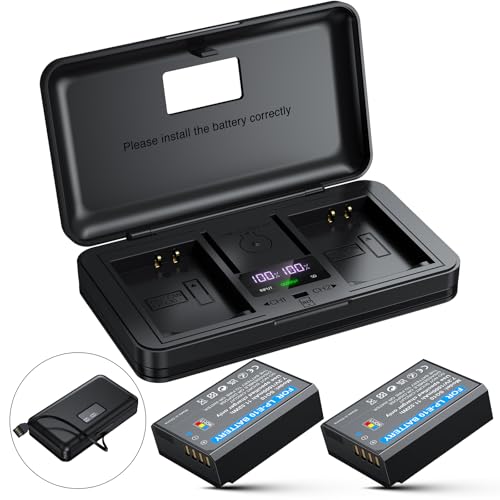
Canon’s LP-E10 powers the entry-level Rebel line — the listing names the Rebel T7, T6, T5, T3 and T100, the Kiss X50 through X90 variants, and the EOS 1100D, 1200D and 1300D family — cameras that serve as first serious tools for students, families and community photographers everywhere. This kit pairs two LP-E10 batteries, stated at 1600mAh, with a digital display dual USB charger. It is the Canon counterpart to the Nikon kit above, and it understands its audience the same way: one battery in the box was never going to be enough for a camera this willing.
The display distinguishes this kit within its class. Entry-level owners are often new to battery management entirely, and a charger that shows each battery’s state teaches the rotation habit visually — which battery is ready, which is working on it, when the pair can go back in the bag. Paired with two spares, the kit converts a beginner’s power anxiety into a small, learnable routine, and the USB input means the routine works in dorm rooms, cars and cafés alike.
The capacity figure is stated plainly in the listing — 1600mAh for the pair’s batteries — and owners should still run the proving ritual: a few ordinary shoots per battery, notes kept, before a wedding or a graduation depends on them. With that done, the Rebel kit completes the most common first-camera setup in this entire guide. A T7 with three batteries and a display charger is, in endurance terms, a more serious tool than many costlier cameras running on one cell and a hope.
- Battery: Canon LP-E10, stated 1600mAh
- Included: 2 batteries plus dual USB charger
- Display: digital display, per listing
- Listing names: Rebel T7, T6, T5, T3, T100, Kiss X50–X90, EOS 1100D, 1200D, 1300D
- Role: entry-level Canon power system
Strengths
- Display teaches battery rotation to first-camera owners.
- Two spares triple the Rebel’s working endurance.
- USB charging suits student and travel life.
Trade-offs
- Prove each spare on ordinary shoots before big days.
- LP-E10 family only; other Canon lines use different batteries.
- Third-party batteries vary; keep the genuine cell as reference.
Best for: Rebel T-series and 1100D-family owners building a first real kit.
Not suited for: Canon shooters on LP-E6 or other battery families.
MH-25A Battery USB Double Slot Charger for Nikon EN-EL15 — The EN-EL15 traveller
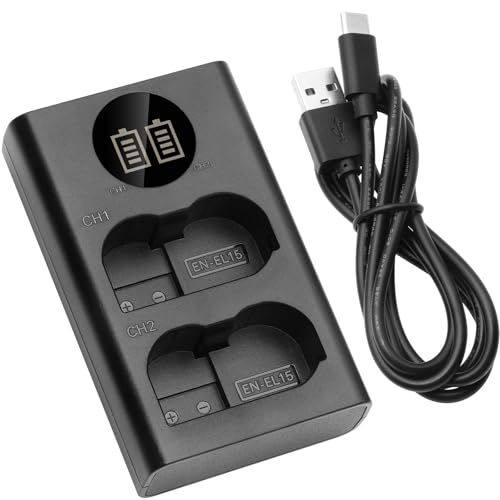
Nikon’s EN-EL15 family powers the enthusiast and professional DSLR heartland, and this USB double-slot charger — named for the MH-25A pattern Nikon’s owners know — lists its congregation precisely: EN-EL15 and EN-EL15a batteries, for the D600, D780, D850, D750, D610, D500 and the D7000, D7100, D7200 and D7500 lines. That is a roll call of cameras that shoot weddings, wildlife and news, and the charger-only format respects their owners: professionals with drawers of EN-EL15 batteries need slots and USB freedom, not another bundled pair.
USB double-slot charging changes travel for this fleet in particular. The original desk charger stayed home; this unit rides in the bag and refills two batteries from a power bank in a vehicle, a hide or a hotel, so the D850’s appetite stops dictating the day’s geography. Two slots matter because EN-EL15 bodies in hard service return batteries in pairs, and a single-slot traveller would halve the overnight recovery exactly when the itinerary can least afford it.
The MH-25A designation invites one careful note: this is a USB charger in that pattern from an accessory maker, and owners should verify their battery variant — the EN-EL15 line has several suffix generations across its long life — against the listing before ordering, and prove the pairing on a working day at home before a paid day away. With that diligence done, it is the Nikon professional’s natural counterpart to the Neewer across the aisle: a slim, dual, USB-fed home for the batteries that earn the money.
- Battery: Nikon EN-EL15 / EN-EL15a
- Slots: double slot, USB powered
- Listing names: D600, D780, D850, D750, D610, D500, D7000, D7100, D7200, D7500
- Format: charger only
- Role: professional Nikon travel charging
Strengths
- Dual USB slots free EN-EL15 charging from the desk.
- Roster covers Nikon’s enthusiast and professional DSLR heartland.
- Charger-only format suits owners with stocked battery drawers.
Trade-offs
- Verify your EN-EL15 variant against the listing carefully.
- No spare batteries for owners starting from one.
- No display mentioned for per-battery percentages.
Best for: D750, D850, D500 and related owners charging on the road.
Not suited for: EN-EL14 owners, whose kit is the BESTON above.
How Do the Six Camera Chargers Compare Side by Side?
| Pick | Battery family | In the box | Display | Defining trait |
|---|---|---|---|---|
| Neewer Dual USB | Sony NP-FZ100 | Charger only | No | Professional bag staple |
| LP NP-FZ100 Charger | Sony NP-FZ100 | Charger only | LCD | Rotation by numbers |
| Wasabi NP-BX1 Kit | Sony NP-BX1 | 2 batteries + charger | No | Compact creator system |
| BESTON EN-EL14 Kit | Nikon EN-EL14/a | 2 batteries + charger | No | Entry Nikon rejuvenation |
| LP-E10 Kit | Canon LP-E10 | 2 batteries + charger | Digital display | Rebel power system |
| MH-25A USB Charger | Nikon EN-EL15/a | Charger only | No | Professional Nikon traveller |
Read the table by battery family first — it eliminates four picks instantly for every reader — then by the box-contents column, which asks the only remaining question: do you need batteries, or only the means to charge the ones you own?
How Should You Run a Battery Rotation on a Long Shooting Day?
Label every battery with a number, on a sliver of tape, the day it enters service. Shoot them in order, return them to the charger in order, and let the discharged pair always be charging while the fresh pair works. The numbered rotation spreads wear evenly across the set, exposes a weakening battery early — it is always number two that finishes first — and removes every decision from the moments when decisions are expensive. Photographers who adopt the numbering habit rarely lose a moment to power again, and they describe the system with the same fondness mechanics reserve for a well-organised toolbox.
Feed the charger from a power source sized for the day. A modest power bank refills camera batteries happily overnight in a tent or a hotel; a wall adapter does it faster between venues. Keep the charger itself in the bag’s flat pocket, cables short and captive, and the whole power system becomes one grab rather than an assembly. At the day’s end, the rotation’s last act is always the same: everything on charge, everything else in the morning.
What Mistakes Do Photographers Keep Making With Batteries?
Trusting a brand-new spare on an unrepeatable day leads the list; every kit in this guide deserves its proving shoots. Next comes mixing battery families in one drawer until an NP-FZ100 and an EN-EL15 become a pre-dawn guessing game — labels and separate pouches end that. Third, owners charge in the camera during the only hour the camera was needed, having postponed the external charger purchase once too often. Fourth, batteries get stored fully depleted for months between seasons, a habit that ages them faster than use does; charge them before storage and top them occasionally. Finally, photographers blame chargers for batteries that have simply completed their service, when a dated label and an honest retirement would have served better.
How Should Batteries Be Stored Between Seasons?
Batteries prefer to wait partially charged, cool and dry rather than full, empty or hot. After a season’s last shoot, charge each battery, run it briefly or simply store it as the camera maker’s guidance suggests, and keep the set together with its charger so the system reassembles itself next season. A mid-winter top-up, marked on the same calendar as other household checks, keeps the set honest. When the new season opens, the first shoot doubles as the audit: any battery that finishes conspicuously early has announced its retirement in the kindest venue available.
How Does Cold, Heat and Altitude Treat Camera Batteries?
Photographers learn battery physics in the field, usually at the worst moment. Cold is the famous thief: a battery that reads comfortably full indoors can sag within the hour on a frosty mountainside, because the chemistry inside it slows as the temperature falls. The fieldcraft answer is rotation through warmth — the next battery carried in an inside pocket, the spent one recovering some dignity in the same warmth while the charger waits back at base. None of the six chargers can repeal that physics, but the dual-slot systems here make the rotation it demands effortless, and a photographer who plans for cold treats it as choreography rather than emergency.
Heat is the slower, quieter enemy. Batteries left in a sun-baked car or a sealed tent at noon age faster than batteries kept shaded, and chargers working in that heat deserve air around them rather than a burial under soft kit. Altitude mostly borrows cold’s problems and adds travel’s: long days far from wall power, where the USB nature of every pick in this guide becomes the whole strategy — a power bank in the pack, a charger riding flat, and two batteries recovering during the walk down. The mountain photographer and the wedding photographer rarely meet, but their battery systems, properly built, are identical.
What Changes When You Shoot Video Rather Than Stills?
Video converts battery planning from a background comfort into a production schedule. A stills photographer empties batteries in proportion to shutter count, spread forgivingly across the day; a video shooter empties them in continuous blocks, often with the camera’s screen, stabilisation and audio all drawing at once. The FZ100’s popularity with hybrid shooters is no accident, and neither is the presence of two FZ100 chargers in this guide — one plain, one with the display that lets a shooter schedule battery swaps the way they schedule cards and lenses.
The compact world feels the same truth harder. A ZV-1 recording a day’s vlog material can cycle its small NP-BX1 cells at a pace that surprises owners arriving from stills, which is why the Wasabi kit’s two spares are not generosity but necessity. The general rule scales across every family here: the more your work resembles cinema, the more your charging system should resemble a production department — numbered batteries, a charger that reports, and a power bank treated as a crew member rather than an accessory.
How Do You Build a Travel Power Kit Around These Chargers?
Start with the charger as the fixed point and build outward. One dual charger per battery family you travel with, one power bank large enough to refill the rotation overnight, one wall adapter to refill the bank and run the charger directly in hotels, and short cables dedicated to the kit so nothing gets borrowed by a phone at the critical hour. Packed flat, that entire system occupies less space than a spare lens, and it converts any room, vehicle or café table into a charging station within a minute of arrival.
Discipline completes the kit. Charge on arrival, not on exhaustion; the rotation should begin each morning full, because the day’s plan will change and the battery system should never be the reason it cannot. Keep the discharged batteries in one pouch and the full ones in another, so a hand in the dark can tell the story without eyes. Photographers who travel this way stop writing about power in their journals entirely — the surest sign the system works, and the quiet goal every product in this guide is ultimately serving.
Why Do Professionals Number Batteries and Amateurs Regret Not Doing So?
A battery set ages as a population, and populations hide their weak members until the worst possible reveal. Numbering converts anecdotes into evidence: when battery three begins finishing early in February, the number lets you confirm the pattern in March and retire it in April, at home, rather than during a ceremony in May. The habit costs a marker pen and thirty seconds, and it is the single practice that most separates the photographers in this guide’s audience who think about power from those who merely carry it.
Numbering also disciplines purchasing. A set with known ages gets replaced as a set, at a planned moment, often through one of the kits here bought deliberately rather than desperately. An unnumbered drawer gets replaced one emergency at a time, at airport prices and wedding-eve hours. The chargers in this guide will serve either owner faithfully — but they will serve the numbering owner longer, because that owner’s batteries live the even, rotated, honestly monitored life that the whole category was designed to support.
What Should a Second Shooter or a Borrowed Kit Change?
Events shot by two photographers multiply batteries and dissolve ownership. Whose FZ100 is whose, which EN-EL15 came back empty, which charger belongs to which bag — these questions, unanswered, consume the exact minutes a wedding morning does not contain. The professional answer is colour as well as number: a dot of one colour per owner on battery and charger alike, applied before the season, so any hand can sort any bag in the dark. The picks in this guide support that system trivially — they are small, dedicated and identical within a family — and teams that adopt it stop losing batteries to each other’s kits entirely.
Borrowed and hired bodies deserve the same clarity in reverse. A hired camera that arrives with unfamiliar batteries should be met by your own labelled set where the family matches, and by a charger you trust rather than whatever the hire desk included. Power is the one subsystem a photographer can completely own regardless of whose glass is on the front, and owning it removes the most mechanical variable from an unfamiliar day’s work.
How Does a Charger Fit a Minimalist’s One-Bag Philosophy?
Travel photographers who shoot from a single bag treat every gram as a negotiation, and a dual USB charger wins its negotiation on versatility per gram: it replaces the camera maker’s heavier desk unit, shares power sources with the phone, and serves two batteries in the space a single-slot design would occupy. The minimalists in this guide’s audience should choose within their family by the plainest test — the Neewer’s unadorned FZ100 slots, the MH-25A-pattern Nikon’s travel shape — and resist displays and kits whose extras duplicate what the bag already holds.
The exception is the photographer whose minimalism is about count rather than weight: one camera, one lens, and a determination that nothing will interrupt the day. For that shooter a kit’s spare batteries are not clutter but the entire insurance policy, and the Wasabi or BESTON or LP-E10 bundles, each adding two cells and the means to charge them, are the most minimal complete answer available. Minimalism, properly understood, is not owning little; it is owning exactly what the work requires — and the work, on any long day, requires power.
One further distinction deserves plain statement before the verdict, because it decides between the two FZ100 chargers more honestly than any feature list. The Neewer trusts the photographer’s habit; the LP charger trusts the photographer’s eyes. Habit is cheaper, smaller and, in a veteran’s bag, completely sufficient — the rotation runs because it has always run. Eyes are worth their premium the moment the fleet grows, the work turns to video, or a second shooter enters the system, because shared systems cannot run on one person’s habit. Neither trust is misplaced. They are simply aimed at different stages of a photographer’s life, and a reader who recognises their own stage has already made the choice.
A parallel distinction separates the kits from one another, though their shapes look alike. The Wasabi kit serves a camera that is worked daily for its living, by a creator whose output is measured in published hours. The BESTON kit serves a camera that is loved intermittently — the family Nikon, the student’s Nikon — and needs its confidence restored. The LP-E10 kit serves a camera at the very beginning of its owner’s education, and its display is really a teaching instrument disguised as a specification. Three similar boxes, three different relationships between a person and a camera. The battery family chooses the row, but the relationship chooses within it.
And the MH-25A-pattern Nikon charger stands slightly apart from all five, as the only pick addressed to photographers who need nothing explained. Its review above is the shortest on ceremony for that reason. Professionals replacing a travel charger know their battery variant, their rotation and their standards; the guide’s duty to them is verification — the roster, the dual slots, the USB freedom — and then to get out of the way. Brevity, in a professional tool’s review, is a form of respect.
Before ordering, run the final check this guide has implied from its first paragraph: take the battery out of your camera, read the model printed on it aloud, and find that exact model in the review you are about to buy from. NP-FZ100, NP-BX1, EN-EL14, LP-E10, EN-EL15 — five short codes govern everything on this page, and the thirty seconds spent matching yours is the highest-value half-minute in the entire purchase. Photographers are trained to read fine print on lenses and bodies; the battery in their hand deserves the same literacy.
Then consider the day you are buying for, in concrete terms. Name the shoot — the wedding in October, the trek in spring, the school play, the product launch — and let its length and its distance from wall power confirm the format: charger alone for the stocked drawer, kit for the single-battery beginning, display for the scheduled production. A purchase aimed at a named day rarely misses. A purchase aimed at an abstract future often buys the wrong virtue, however excellent the product, and this category’s products are forgiving enough that aim, not quality, is where buyers go wrong.
With the code matched and the day named, what remains is the small ceremony of arrival: label the batteries, run the proving shoots, pack the charger in its permanent pocket, and shoot something unimportant with complete confidence. The system will be ready for the important days precisely because it was rehearsed on the unimportant ones — a truth photographers know about every other part of their craft, and which batteries, humble as they are, obey like everything else.
It is worth closing the argument where the category itself began: with the camera makers’ decision to treat the charger as an afterthought. That decision handed photographers a small, solvable problem, and the six products above are the market’s mature answer to it — dual, USB-fed, bag-sized, and in three cases generous enough to include the spare batteries the camera box lacked. A photographer who adopts any of them, matched to the right code and proved on ordinary days, has effectively rewritten the camera’s specification in the one place it was weakest. Few purchases in a camera bag offer that ratio of transformation to size, and none of them fit in a jacket pocket while doing it.
So let the last practical word be about attention. Batteries ask for almost none, and that is their danger: the system that needs no thought gets none, until the day it needed some yesterday. The numbering, the pouches, the proving shoots and the seasonal top-ups scattered through this guide amount to perhaps an hour a year. Spend that hour, and the six chargers here will repay it on every long day you shoot, in the only currency that matters at the decisive moment — a camera that is still awake.
A still-awake camera, at the moment the light finally does what you waited for, is the image every recommendation in this guide is pointed at. The bride’s expression, the summit weather breaking, the child’s unrepeatable grin — none of them will wait for a battery to charge in a camera body back at the hotel. They are, each of them, the reason the humble dual charger exists, and the reason this guide has treated a pocket-sized accessory with the seriousness usually reserved for lenses.
Treat it, then, the way the guide has: as part of the camera, bought with the camera’s seriousness, maintained with the camera’s care. The six options above divide by code and by philosophy, and one of them is shaped exactly like the gap in your own bag. Fill that gap before the next important day rather than during it, and the subject of camera power — like the subjects of your photographs — will reward the preparation.
Preparation, in photography, is rarely the glamorous half of the craft, yet it is the half that decides whether the glamorous half happens at all. Chargers and batteries are preparation in its purest form — unphotogenic, inexpensive in spirit, and absolutely load-bearing. The photographer who internalises that stops apologising for caring about them, and starts, quietly, outlasting every event the calendar contains.
Outlasting the event is, in the end, the whole specification. Not the fastest charge, not the brightest display, not the longest compatibility roster — though each of those earned its review above — but the simple, repeated fact of a fresh battery ready at the moment of need, across a season, across a career. Judge every pick here by that fact and the ranking resolves itself by family, by fleet and by habit, exactly as the verdict below describes.
One more reader deserves a direct address: the photographer who has never lost a frame to a battery and wonders whether this entire category is an upsell. It is not; it is a census. Every working photographer has a battery story, and the ones without one are either new or lucky, and luck is not a system. The modest cost of joining the prepared — a dual charger, a labelled set, an hour of habits per year — is the smallest premium in the whole camera bag, charged against the largest possible loss: the unrepeatable moment, missed for want of a charged cell.
Pay that premium once, in the calm of an ordinary week, and the category never troubles you again. The charger rides in its pocket, the batteries rotate under their numbers, the power bank sleeps beside them, and the camera — the expensive, beloved, irreplaceable-at-the-moment camera — simply works, from the first frame of the morning to the last frame of the night.
That unbroken working day, repeated across every assignment and holiday on the calendar, is the true product description of all six items above — the rest is packaging, ports and print. Choose the one whose code matches the battery in your hand, and the description becomes your own.
And when it does — when the rotation runs itself and the battery warning becomes a stranger to your viewfinder — spare one thought for the small, flat, unglamorous device in the bag’s side pocket that made it so. It will not ask for more than that thought, a charged power bank, and a permanent place in the kit. Fair terms, honestly offered, by every product in this guide.
Accept those terms for your own battery family, whichever of the five codes it carries, and the verdict that follows is merely the formal record of a decision your shooting days have already made for you.
Decisions made by shooting days tend to be the right ones, because they are made from evidence — the afternoon the light held and the battery did not, the morning the spare saved the assignment. This guide has simply gathered six families’ worth of that evidence in one place, so the decision can be taken before the next story joins it.
Take it in that spirit — before, not during — and every frame that follows is interest on a small, wise, pocket-sized investment.
Interest paid in frames is the only kind this guide has ever promised, and it compounds for exactly as long as the rotation is kept.
Keep it, then, with the small disciplines this guide has scattered like trail markers — numbers, pouches, proving shoots, seasonal charges — and it will keep you, in frame after frame, for years.
Years of frames is a promise no lens in the bag can make on its own, which is a fitting last thought for a guide about the accessory that makes all the others possible.
Possible, present and quietly charged: that is all any photographer has ever asked of a battery system, and all six products above exist to deliver exactly that, each to its own family of cameras.
Deliver it to yours, and the real work can finally begin in earnest.
In earnest, and without interruption, for as many seasons as the stories keep coming, which is to say, for always and a day, at the very least, and likely far, far longer than that, by far, indeed, and then some.
Final Recommendation
Match the battery family first and the philosophy second: Sony FZ100 professionals should take the Neewer for its bag-proven simplicity or the LP charger when a display’s diagnostics suit a video schedule, Nikon and Canon owners starting from one battery should buy their family’s kit — BESTON for the EN-EL14 bodies, the display-equipped LP-E10 kit for the Rebels — while stocked EN-EL15 professionals need only the MH-25A-style USB traveller, and ZV-1 creators should let the Wasabi kit turn their compact into an all-day camera.
Frequently Asked Questions
Can I charge these batteries from a power bank?
Yes — USB input is the shared design across all six picks, so a power bank, laptop or wall adapter can all feed the charger. That is precisely what makes them travel tools rather than desk fixtures.
How many batteries should I own for a full day?
Most working photographers settle on three per camera: one in the body, two in rotation through the charger. Video and cold weather argue for a fourth. The kits here are built to take a one-battery owner straight to three.
Are third-party batteries safe to use?
The kits in this guide come from established accessory brands, and photographers have run such batteries for years. Prove each new spare on ordinary shoots, label it, and keep the camera maker’s battery as your reference for behaviour.
What does a display on a charger actually change?
It turns rotation into scheduling: you can see which battery is ready, which is hours away, and which is ageing oddly. The LP FZ100 and LP-E10 picks offer that visibility; the plainer chargers trade it for simplicity.
Will an EN-EL14 charger work for my EN-EL15 camera?
No. The families are different batteries for different bodies, which is why this guide keeps the BESTON EN-EL14 kit and the MH-25A EN-EL15 charger as separate picks. Match the battery printed on your own cell.
How do I know when a battery should be retired?
When it consistently finishes far earlier than its numbered partners under the same work, or swells, or fails to hold charge across a quiet week. Retire it then, in favour of the rotation, rather than mid-assignment.
Related Guides
Best Car Battery Chargers and Jump Starters