What's inside
- Key Takeaways
- Quick Picks
- How We Chose These Picks
- Comparison Table
- Why has Canon stopped developing DSLRs, and what does that mean for a buyer today?
- How do the Rebel T7 and Rebel SL3 actually differ where it matters?
- What should a beginner know about the two kit lenses in the double-zoom bundles?
- How do you check the condition of a Canon DSLR listing before paying?
- How do you set up a new Rebel kit for a first afternoon of shooting?
- How should a Rebel owner clean and store an end-of-line DSLR?
- What does a first year of Rebel ownership actually look like, month by month?
- How should you photograph people with a Rebel kit lens?
- What accessories are genuinely worth buying for a Rebel, and in what order?
- How do you judge whether a used EF lens is a safe buy for your Rebel?
- How does the Rebel line handle family video, honestly?
- What should a Rebel owner do when the upgrade itch eventually arrives?
- How do you photograph a school play or sports day with a Rebel kit?
- What settings should a Rebel beginner learn first, and in what order?
- How do you keep a Rebel’s sensor clean in real household conditions?
- Which Rebel should a photography student buy for a course?
- How do bundle warranties and returns actually work for third-party camera kits?
- What photographs will a Rebel take in five years that a phone still will not?
- Common Mistakes
- Final Recommendation
- Frequently Asked Questions
- Related Guides
As an Amazon Associate I earn from qualifying purchases. This post may contain affiliate links at no extra cost to you.
widgetverdict.com is reader-supported. When you buy through links on our site, we may earn an affiliate commission.
Anyone searching for the best canon dslr cameras in late 2026 deserves the plain version first: Canon has ended DSLR development, the mirrorless EOS R line is where the company now spends its effort, and the DSLR shelf that remains is essentially two beginner bodies sold through a thicket of kits and bundles. Those two bodies are the EOS Rebel T7 and the EOS Rebel SL3. Everything in this guide is a variation on one of them, and pretending otherwise would be the easiest way to write a dishonest camera roundup.
That honesty does not make the remaining Rebels pointless. A Rebel kit still delivers a genuine optical viewfinder, an APS-C sensor far larger than anything inside a phone, a deep catalogue of EF and EF-S lenses that circulate cheaply second-hand, and controls a beginner can learn photography on properly. For a student, a parent documenting family life, or a hobbyist who prefers mirrors and prisms to screens, a closeout Rebel kit can be sensible money — provided the listing is read carefully.
Reading listings carefully matters more here than in almost any other camera class, because end-of-line stock attracts bundles assembled by third-party sellers and a flood of renewed cameras wearing near-identical product pages. Five renewed listings were excluded while this shortlist was built, and the six survivors below are separated by exactly the details that decide value in this class: which lenses sit in the box, which accessories are genuinely useful, and whether the warranty language names a USA warranty or stays vague.
Key Takeaways
- The Canon DSLR range is finished as a developing line: the Rebel T7 and Rebel SL3 are the bodies still circulating as kits.
- All six picks below are kit or bundle variants of those two bodies, so lens and accessory contents — not sensor bragging — separate them.
- The Rebel SL3 is the more modern body here, adding Dual Pixel CMOS AF and a vari-angle touch screen the T7 lacks.
- Renewed stock dominates this class, so checking the condition wording on any listing matters as much as choosing the kit.
- EF and EF-S lenses remain plentiful and inexpensive second-hand, which keeps a Rebel kit expandable long after purchase.
Quick Picks
| Pick | Badge | Why it made the cut |
|---|---|---|
| Canon EOS Rebel T7 Double Zoom Kit | Most complete factory two-lens starter | Canon’s own pairing of the 18-55mm kit zoom with a 75-300mm telephoto covers beginners from room interiors to distant wildlife in one box. |
| Canon EOS Rebel T7 Kit (USA Warranty) | Clearest warranty wording | The listing states USA Warranty outright and adds a memory card plus a Deco Gear deluxe case kit to the standard 18-55mm package. |
| Canon EOS Rebel T7 Bundle (64GB + Bag) | Accessory bundle built around the standard kit | A third-party bundle wrapping the 18-55mm T7 kit with a 64GB card, camera bag, 58mm UV filter and cleaning cloth. |
| Canon EOS Rebel SL3 Kit | The more modern Rebel body | The SL3 brings Dual Pixel CMOS AF and a 3.0-inch vari-angle touch screen to the Rebel formula, in Canon’s compact SLR shell. |
| Canon EOS Rebel T7 Double Lens Bundle | Two-lens bundle with card and bag included | The T7 with both 18-55mm and 75-300mm lenses, plus a 64GB card and camera bag, sold as a beginner bundle under Canon’s 2727C002 kit code. |
| Canon EOS Rebel T7 Kit | The plain single-lens kit | The straightforward T7 with EF-S 18-55mm f/3.5-5.6 IS II lens — the baseline every bundle in this guide should be priced against. |
How We Chose These Picks
Selection started from a deliberately uncomfortable question: what would we tell a friend who specifically wants a Canon DSLR today, knowing the line has ended? The answer shaped every inclusion. Only kits built on bodies with a continuing lens ecosystem, available service knowledge and a large owner community qualified, which is why the list collapses honestly onto the Rebel T7 and Rebel SL3 rather than padding itself with discontinued bodies of doubtful stock status.
Within those two bodies, kits were ranked by what actually changes ownership. A second zoom lens changes what a beginner can photograph on day one. A named USA warranty changes who answers the phone if the shutter fails. A memory card and bag change nothing about image quality yet decide whether the camera can be used the morning it arrives. Renewed listings were removed at the pool stage, and bundle filler — filters and cloths of trivial value — was scored as filler, never as a reason to rank one kit above another.

Canon EOS Rebel T7 Double Zoom Kit — Most complete factory two-lens starter
The Double Zoom Kit is the configuration Canon itself designed for a first DSLR, and its logic still holds. The EF-S 18-55mm handles the everyday range — rooms, streets, group portraits — while the EF 75-300mm reaches the far touchline, the bird feeder and the zoo enclosure that a kit zoom simply cannot frame. A beginner learns more about focal length in one afternoon swapping between these two lenses than from a month of reading about it.
Underneath sits the Rebel T7 body with its 24.1 megapixel APS-C sensor, Full HD video and built-in Wi-Fi for moving pictures to a phone. The T7’s live-view focusing is leisurely compared with the SL3 further down this list, and its fixed rear screen belongs to an earlier generation, yet through the optical viewfinder — the entire point of choosing a DSLR — it focuses confidently and shoots like a proper camera. As a factory kit with matched Canon lenses, it is the cleanest way into the system.
- Body: Canon EOS Rebel T7
- Sensor: 24.1 Megapixel CMOS (APS-C), as listed
- Lenses: EF-S 18-55mm and EF 75-300mm included
- Video: Full HD, as listed
- Connectivity: Built-in Wi-Fi
- Listing notes: Canon double zoom kit configuration
Strengths
- Two genuine Canon lenses span wide-angle to telephoto from the first day
- Factory kit contents are predictable, with no third-party filler to evaluate
- The 75-300mm teaches telephoto technique a single kit zoom never can
Trade-offs
- The T7 body focuses slowly in live view beside the SL3 in this guide
- Rear screen is fixed, which hampers low-angle and overhead framing
- No memory card or bag is named in the listing, so budget for both
Best for: a first-time DSLR owner who wants one factory box that covers family, travel and distant subjects immediately.
Not suited for: a beginner who plans to shoot mostly through the rear screen, where this body’s focusing feels dated.

Canon EOS Rebel T7 Kit (USA Warranty) — Clearest warranty wording
Plenty of Rebel listings murmur about warranties; this one prints USA Warranty in its title, and in a class where grey imports and renewed stock blur together, that clarity is a feature worth ranking. The camera itself is the familiar Rebel T7 with the EF-S 18-55mm f/3.5-5.6 IS II lens, 24.1 megapixels and Wi-Fi, so the photographic proposition matches the single-lens T7 kit at the foot of this list almost exactly.
What separates this bundle is the supporting cast: a memory card so the camera works out of the box, and a Deco Gear deluxe case kit that gives the body somewhere safer than a kitchen drawer to live. Neither item improves a single photograph, yet both remove the small frictions that leave new cameras sitting unused. Buyers comparing this against the plainer T7 kit are really deciding how much they value documented warranty cover and day-one completeness.
- Body: Canon EOS Rebel T7
- Sensor: 24.1MP, as listed
- Lens: EF-S 18-55mm f/3.5-5.6 IS II
- Warranty: USA Warranty stated in the listing
- Extras: Memory card and Deco Gear deluxe case kit
- Connectivity: Wi-Fi, as listed
Strengths
- USA Warranty is stated plainly rather than implied or omitted
- Memory card and case make the kit usable and storable immediately
- The IS II kit lens carries image stabilization for handheld shooting
Trade-offs
- Only one lens, so telephoto subjects stay out of reach until a second purchase
- Bundle accessories are convenience items, not optical upgrades
- The underlying T7 body remains the older of the two bodies in this guide
Best for: a cautious gift buyer who wants warranty paperwork and a ready-to-use box rather than the cheapest possible listing.
Not suited for: a parent hoping to photograph school sports from the stands, because the single 18-55mm lens cannot reach that far.

Canon EOS Rebel T7 Bundle (64GB + Bag) — Accessory bundle built around the standard kit
This listing is the standard Rebel T7 and 18-55mm lens dressed by a bundle seller, and it should be judged exactly that way. The photographic core — 24.1 megapixel APS-C sensor, Full HD video, Wi-Fi — is identical to the other T7 kits here. Nothing in the accessory list changes resolution, focusing or low-light ability, and the review scores it as a convenience purchase rather than a different camera.
The extras themselves are a mixed drawer. A 64GB memory card is genuinely necessary and sensibly sized for a beginner. A camera bag earns its place. The 58mm UV filter is the classic bundle ornament: some owners like one as lens protection, many photographers skip filters entirely on kit lenses, and its presence should never swing a buying decision. The microfiber cloth is worth pennies. Price this bundle against the plain kit, and pay only a small premium for the card and bag.
- Body: Canon EOS Rebel T7 with 18-55mm lens
- Bundle contents: 64GB memory card, camera bag
- Also included: 58mm UV filter and microfiber cleaning cloth (5 items total, as listed)
- Sensor: Rebel T7 APS-C sensor
- Video: Full HD on the T7 body
- Seller type: third-party bundle around the standard kit
Strengths
- The 64GB card removes the most common day-one omission
- A fitted bag protects the camera between outings
- The underlying kit is the well-documented standard T7 package
Trade-offs
- The UV filter and cloth add negligible photographic value
- Bundle pricing can drift above the plain kit by more than the extras are worth
- Warranty wording is not a headline feature of this listing
Best for: a buyer who wants card and bag settled in a single order and will compare the premium against buying them separately.
Not suited for: a value hunter who already owns a bag and cards, because the bundle’s extras would duplicate items on the shelf.

Canon EOS Rebel SL3 Kit — The more modern Rebel body
If one body in this guide feels like a bridge between the DSLR era and what followed, it is the Rebel SL3. Its Dual Pixel CMOS AF transforms live-view and video focusing from the T7’s hesitant hunting into smooth, confident tracking, and the 3.0-inch vari-angle touch screen swings out for selfies, vlogging angles and waist-level shooting. For anyone who expects to use the screen as much as the viewfinder, this is the Rebel to buy.
The SL3 keeps the DSLR essentials intact: an optical viewfinder, the EF-S 18-55mm kit lens, built-in Wi-Fi and Canon’s compact SL-series body, the smallest shell in the company’s DSLR history. It asks a higher price than T7 kits and arrives with a single lens, yet its focusing system and screen make it the pick most likely to still feel current in three years. Among two surviving bodies, this is the one with a future-facing spec sheet.
- Body: Canon EOS Rebel SL3
- Lens: EF-S 18-55mm kit lens
- Autofocus: Dual Pixel CMOS AF, as listed
- Screen: 3.0-inch vari-angle touch screen
- Connectivity: Built-in Wi-Fi
- Colour: Black, as listed
Strengths
- Dual Pixel AF makes live view and video focusing genuinely pleasant
- Vari-angle touch screen suits video, selfies and awkward angles
- Compact SL body is the easiest Rebel to carry all day
Trade-offs
- Costs more than T7 kits while including only one lens
- No second telephoto lens for distant subjects in the box
- Still an end-of-line system, so future body upgrades mean switching mounts
Best for: a learner who splits time between viewfinder stills and screen-based video, and wants the most capable Rebel body left.
Wildlife work exposes its clearest limit: the single 18-55mm kit lens leaves distant subjects small, unlike the double-zoom kits alongside it.
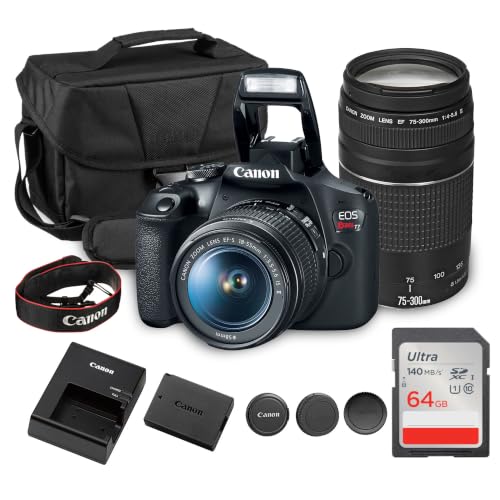
Canon EOS Rebel T7 Double Lens Bundle — Two-lens bundle with card and bag included
This bundle attacks the same brief as Canon’s factory Double Zoom Kit — two lenses, wide to telephoto — then adds the two accessories that factory kit omits. The 64GB memory card and camera bag listed here mean the box genuinely covers a first month of shooting, and the listing’s 2727C002 code corresponds to Canon’s own double-lens kit configuration, which helps when cross-checking what should be inside.
The camera remains the Rebel T7: 24.1 megapixel APS-C sensor and Full HD 1080p video, aimed squarely at beginner photography as the listing itself says. Choosing between this and the factory kit at the top of the guide comes down to seller and bundle arithmetic. Add the card and bag prices to the factory kit, compare totals, and check the condition and warranty wording on both listings with equal care before paying.
- Body: Canon EOS Rebel T7
- Sensor: 24.1MP APS-C, as listed
- Lenses: 18-55mm and 75-300mm double lens bundle
- Video: Full HD 1080p, as listed
- Extras: 64GB memory card and camera bag
- Kit code shown in listing: 2727C002
Strengths
- Two-lens reach plus the card and bag the factory kit leaves out
- Kit code in the listing helps verify contents against Canon’s configuration
- Covers the complete beginner checklist in a single purchase
Trade-offs
- Bundle seller terms need the same condition check as any third-party listing
- The T7’s live-view focusing remains the older, slower system
- Telephoto lens is an entry-level zoom with entry-level sharpness at full stretch
Best for: a beginner who wants the two-lens education and the accessories settled together, after comparing the total against the factory kit.
Not suited for: a student whose course requires extensive video work, where the SL3’s Dual Pixel focusing would serve far better.

Canon EOS Rebel T7 Kit — The plain single-lens kit
Every bundle in this guide needs a baseline, and this is it: the Rebel T7 with its standard EF-S 18-55mm f/3.5-5.6 IS II lens, 24.1 megapixel CMOS APS-C sensor, Full HD video and built-in Wi-Fi, sold as Canon packaged it for beginner photographers. There is no case kit, no filter set and no card to inflate the listing — just the camera, its kit lens and a price that other sellers must justify exceeding.
That plainness is its virtue. A buyer can add exactly the bag, card and second lens they actually want, in the sizes and quality they choose, rather than accepting a bundle seller’s selections. The stabilized kit lens handles the learning phase well, and the T7’s viewfinder shooting remains honest, responsive DSLR photography. When the bundles above ask for more money, this listing is the number their extras must beat.
- Body: Canon EOS Rebel T7
- Sensor: 24.1 Megapixel CMOS (APS-C), as listed
- Lens: EF-S 18-55mm f/3.5-5.6 IS II lens kit
- Video: Full HD, as listed
- Connectivity: Built-in Wi-Fi
- Positioning: Beginner photographers, per the listing
Strengths
- Clean baseline price with no bundle padding to unpick
- Stabilized kit lens is the right learning tool for viewfinder shooting
- Buyer chooses their own card, bag and future lenses deliberately
Trade-offs
- Nothing else is in the box, so first accessories are separate purchases
- Single lens limits reach until a telephoto joins the kit
- Shares the T7’s slower live-view focusing and fixed screen
Best for: a deliberate beginner who prefers choosing each accessory personally and wants the unbundled price as their starting point.
Not suited for: a gift buyer who needs the recipient shooting on day one without a separate trip for a memory card.
Comparison Table
| Pick | Badge | Headline fact from its listing |
|---|---|---|
| Canon EOS Rebel T7 Double Zoom Kit | Most complete factory two-lens starter | Canon EOS Rebel T7 DSLR Camera Double Zoom Lens Kit |
| Canon EOS Rebel T7 Kit (USA Warranty) | Clearest warranty wording | Canon EOS Rebel T7 DSLR Camera with EF-S 18-55mm F3.5-5.6 is II Lens Bundle |
| Canon EOS Rebel T7 Bundle (64GB + Bag) | Accessory bundle built around the standard kit | Canon EOS Rebel T7 DSLR Camera with 18-55mm Lens Bundled with 64GB Memory Card + Camera Bag + 58mm UV Filter |
| Canon EOS Rebel SL3 Kit | The more modern Rebel body | Canon EOS Rebel SL3 Digital SLR Camera with EF-S 18-55mm Lens kit, Built-in Wi-Fi, Dual Pixel CMOS AF and 3.0 |
| Canon EOS Rebel T7 Double Lens Bundle | Two-lens bundle with card and bag included | Canon EOS Rebel T7 DSLR Camera with 18-55mm & 75-300mm Double Lens Bundle |
| Canon EOS Rebel T7 Kit | The plain single-lens kit | Canon EOS Rebel T7 DSLR Camera EF-S 18-55mm f/3.5-5.6 is II Lens Kit |
Why has Canon stopped developing DSLRs, and what does that mean for a buyer today?
Canon’s development energy now sits entirely with the EOS R mirrorless system, and the company has wound down its DSLR programme as that transition completed. For a buyer, the practical meaning is narrower than the headlines suggest. No new Canon DSLR bodies or EF lenses are coming, so a Rebel purchase is a finished-system purchase: what exists today is the entire menu, forever.
A finished system is not a dead one. The EF and EF-S lens back catalogue is enormous, service knowledge is widespread, and millions of Rebel owners keep the used market liquid. What ends is the upgrade path inside the mount — a photographer who outgrows a Rebel in four years will move to mirrorless then, likely keeping nothing but the memory cards. Buy a Rebel for what it does now, at closeout-era prices, and that bargain is honest.
The second consequence is stock behaviour. As factory supply thins, bundles multiply and renewed units fill the gaps, which is why this guide treats listing condition as a first-class buying criterion rather than fine print.
How do the Rebel T7 and Rebel SL3 actually differ where it matters?
Both bodies share the DSLR fundamentals: APS-C sensors, optical viewfinders, EF-S lens mounts and Canon’s beginner-friendly menu logic. The headline sensor figures are close enough that image quality alone should not decide between them. The differences that owners feel daily live in focusing and the rear screen.
The SL3’s Dual Pixel CMOS AF gives it smooth, decisive focusing when the rear screen is used for live view or video, where the T7 relies on an older, slower contrast-based approach that hunts visibly in dim light. Through the viewfinder both cameras use their dedicated focus systems and the gap narrows sharply, which is why stills-first shooters can save money with the T7 in good conscience.
The SL3 also swings its 3.0-inch touch screen out and around, while the T7’s screen is fixed. Vloggers, selfie shooters and anyone filming themselves will feel that difference in the first week. Stills photographers working at eye level may never miss it.
What should a beginner know about the two kit lenses in the double-zoom bundles?
The EF-S 18-55mm is the general-purpose lens: wide enough for interiors and landscapes at 18mm, tight enough for portraits at 55mm, and light enough to leave mounted permanently. Its stabilized IS II version, named in the single-lens kits here, helps handheld shots at slower shutter speeds. Image quality is respectable in daylight and entirely adequate for learning composition, which is the real curriculum of a first year.
The EF 75-300mm is the reach lens. It frames distant birds, sports from a sideline and shy wildlife that the kit zoom renders as specks. It is an entry-level telephoto, so expect softer results at maximum zoom and in poor light, and expect to raise ISO or use support as the light falls. Its educational value is enormous regardless: telephoto compression, background isolation and the discipline of bracing a long lens are lessons no phone teaches.
Together the pair covers the focal range most hobbyists use for years. The classic upgrade afterwards is a fast prime for low light, bought used, once the owner knows which focal length they favour.
How do you check the condition of a Canon DSLR listing before paying?
Start with the condition field itself, not the headline. Listings in this class may be new, new-old stock, renewed, refurbished or used, and sellers sometimes let a kit photograph imply more than the condition line promises. Read that line literally, then read the seller’s own description for the words inspected, restored, or as-is, each of which signals a different level of backing.
Next, separate the body from the bundle. Confirm the shutter count language if any is offered, check whether the battery and charger are Canon originals or third-party substitutes, and verify the lens names character by character — an 18-55mm and a 75-300mm are specific items, and bundle substitutions do happen. Photographs of the actual unit, where provided, outrank stock images.
Finally, weigh the return window and warranty wording together. A stated USA warranty or a clear returns period is worth real money in a class this crowded with renewed stock. Five renewed listings were cut from this guide’s shortlist before writing began; a buyer browsing alone should apply the same suspicion and walk away from any listing that will not state its condition plainly.
How do you set up a new Rebel kit for a first afternoon of shooting?
Charge the battery fully before anything else, format the memory card inside the camera rather than on a computer, and set the date so files sort correctly later. Mount the 18-55mm lens by aligning the mount index marks until it clicks, then remove the cap and switch the lens to autofocus. These small rituals prevent the three most common first-day failures: a flat battery, a card the camera dislikes, and a lens seated halfway.
Begin in the camera’s fully automatic scene mode for the first hour, watching what settings the camera chooses through the viewfinder display. Then move to aperture-priority mode, set the lens near its middle apertures, and photograph the same subject at several settings to see depth of field change. The DSLR learning loop — decide, shoot, review — is the entire reason to own one.
End the session by transferring a few frames over Wi-Fi to a phone and backing the card up to a computer or drive. Beginners lose more early photographs to neglected backups than to any camera fault, and the habit formed on day one tends to stick.
How should a Rebel owner clean and store an end-of-line DSLR?
Store the camera in its bag with the body cap or a lens mounted, in a dry cupboard away from radiators and steamy bathrooms. A small rechargeable dehumidifier pack in the bag earns its keep in humid climates, because fungus inside a lens is the one repair that can exceed an entry-level lens’s value. Keep the bag zipped against dust, which DSLR mirrors and sensors attract readily.
Clean the front lens element with a blower first, then a microfiber cloth if marks remain — the cloth bundled with one kit in this guide is genuinely useful here. Never touch the mirror. Sensor dust spots that appear at small apertures are normal in this class; a rocket blower with the mount facing down clears most of them without contact.
Exercise the camera monthly even in quiet periods. Batteries dislike long storage fully flat or fully charged, shutters dislike years of stillness, and a camera that gets regular small outings rarely surprises its owner on the one big occasion that matters.
What does a first year of Rebel ownership actually look like, month by month?
The first month with a Rebel is mostly about permission: the camera gives a beginner permission to slow down. Framing through an optical viewfinder hides the phone’s notifications and forces a single decision at a time — where to stand, what to include, when to press. Owners consistently describe the early weeks as a pleasant shock, discovering that a scene they would have snapped once and forgotten now gets three considered attempts, each reviewed on the rear screen with the histogram beside it. The kit lens stays mounted, the mode dial creeps from full auto toward aperture priority, and the first personal rule forms: no photograph leaves the camera until its focus point was chosen deliberately rather than inherited from the camera’s guess.
By the third month the limitations begin teaching. Indoor birthdays expose the kit lens’s modest apertures, and the owner learns to raise sensitivity settings, brace against doorframes and accept a little grain as the price of a sharp, unposed moment. Outdoor trips expose the opposite lesson — in good light the same humble kit produces files of startling quality, and the beginner starts planning outings around morning and evening light rather than midday convenience. This is the month the second lens, whether the 75-300mm from a double kit or a used prime bought separately, stops being an accessory and becomes a vocabulary.
The rest of the first year is consolidation. The owner develops a personal focal length, a preferred way of carrying the camera, and a backup habit that survives contact with real life. The Rebel’s dated live view stops mattering because viewfinder shooting has become the native language. What the camera cannot do — and by year’s end the owner can list the gaps precisely — defines the next purchase far better than any review could, which is the deepest service an end-of-line beginner system can perform.
How should you photograph people with a Rebel kit lens?
Portraits with an 18-55mm kit lens begin at the long end. Zooming toward 55mm and stepping back flatters faces, separates the subject from the background as much as the lens’s aperture allows, and keeps the photographer far enough away that children and relatives behave naturally. Placing the subject a few steps in front of a hedge, wall or open shade multiplies the separation, because distance behind the subject blurs backgrounds more effectively than any setting on an entry-level lens. Window light indoors, angled rather than frontal, gives the APS-C sensor the soft directional light it renders best.
Focus discipline decides whether the portrait survives enlargement. Use a single focus point placed on the nearer eye rather than letting the camera average across the face, and take several frames of any group, because in every set of six group photographs someone blinks in five. The T7 and SL3 both reward this patience; the SL3’s touch screen adds the trick of tapping the eye on screen when shooting in live view, which beginners often find more intuitive than moving a focus point with buttons.
Posing matters more than equipment at this level. Ask subjects to angle their shoulders, give hands something honest to do, and talk while you shoot rather than freezing everyone into a countdown. The Rebel’s optical viewfinder keeps the interaction human — the subject sees a person, not a screen — and that small social advantage is one reason families often prefer these cameras’ portraits to technically superior phone shots taken the same afternoon.
What accessories are genuinely worth buying for a Rebel, and in what order?
The order matters more than the items. First comes storage discipline: a second memory card, because cards fail and fill at the worst moments, and a simple card reader for the computer. Second comes power — a spare battery transforms a camera from an afternoon device into a weekend device, and Rebel batteries are inexpensive precisely because the system is mature. Third comes carry: a strap that distributes weight better than the thin bundled one, and a bag sized for the body plus both lenses if a double kit was chosen.
Only after those foundations should optics enter the conversation, and the classic fourth purchase is a fast prime lens bought used. A prime teaches fixed-focal-length composition, opens the low-light world the kit zoom cannot enter, and costs less used in the EF ecosystem than in almost any living mount. Owners who buy in this order report a pattern: the camera gets used more each month, because each purchase removed a friction rather than adding a novelty.
What to skip is equally instructive. Filter sets, macro attachment rings, cleaning kits with nine components and novelty straps fill drawers across the hobby. The UV filter question divides photographers, but nobody’s portfolio was ever saved by a decorative accessory bundle. Spend on cards, power, carry and glass — in that order — and a closeout Rebel becomes a system that feels deliberately assembled rather than accidentally accumulated.
How do you judge whether a used EF lens is a safe buy for your Rebel?
The used EF market is the Rebel system’s superpower, and it rewards a short inspection ritual. Start with the glass: shine a phone torch through the lens at an angle and look for fungus, which appears as branching threads or a hazy bloom, and for coating damage at the edges. Dust specks inside are normal and photographically irrelevant; fungus spreads and matters. Then work the zoom and focus rings through their full travel — they should move smoothly without gritty patches or loose wobble.
Mount the lens, or ask the seller for test frames, and shoot a detailed subject at several apertures. Check the corners for asymmetry that suggests a dropped element group, and listen to the autofocus motor: it should be decisive, not hunting or grinding. On Rebel bodies, also confirm the lens’s electronic contacts are clean and bright, because tarnished contacts cause the intermittent errors sellers describe as character.
Price research completes the ritual. The EF market is liquid enough that any lens’s fair price is discoverable within minutes, and a listing dramatically below that level is asking a question the buyer should answer before paying. Bought with these checks, used EF glass is how a modest Rebel kit grows into a serious outfit for a fraction of mirrorless money — the economic heart of the entire DSLR proposition in this guide.
How does the Rebel line handle family video, honestly?
Family video is where the two bodies in this guide part company most visibly. The T7 records perfectly serviceable Full HD clips of birthdays and school plays when the camera sits on a tripod or a steady pair of hands and the subject stays near the focus point set before recording. Its live-view focusing, asked to track a moving toddler, hunts in a way that dates the design instantly. Owners learn to pre-focus, keep subjects at a consistent distance, and accept the camera as a stills instrument that occasionally films.
The SL3 changes that verdict materially. Dual Pixel CMOS AF follows faces smoothly, the vari-angle screen lets a parent film themselves with the children, and touch focus pulls attention between subjects the way phone users expect. Families who know video will be half the camera’s work should weight this difference above every other in the guide — it is the one gap no accessory can close after purchase.
Audio deserves a sentence of realism for both bodies: built-in microphones record the room, including the camera operator’s breathing and the lens’s focusing sounds. A small external microphone, where the body accepts one, transforms family footage more cheaply than any other upgrade. Set expectations this way — stills first on the T7, genuinely hybrid on the SL3 — and neither camera will disappoint the household that buys it.
What should a Rebel owner do when the upgrade itch eventually arrives?
It arrives for almost everyone, usually around the moment a specific photograph fails for a specific reason: the indoor shot too noisy, the bird too small, the video focus too slow. That failure, named precisely, is the upgrade specification. Owners who upgrade against a named failure buy once and settle; owners who upgrade against a vague feeling of obsolescence buy repeatedly and settle never. The Rebel’s gift is that a year of shooting with it produces the evidence for that decision in the owner’s own archive.
The realistic paths are three. Stay and deepen: add the used prime or telephoto the failure demands, and discover how much headroom the EF ecosystem still holds. Switch to mirrorless with open eyes, accepting that lenses do not follow and budgeting the system change honestly. Or run both, keeping the Rebel as the risk-it camera for beaches, worksites and lending — a role its low replacement cost makes uniquely comfortable.
None of these paths makes the original purchase a mistake. A closeout Rebel that taught its owner photography, documented two years of family life and then became the household’s spare camera has repaid its price several times over. The end of Canon’s DSLR line closes the system’s future, not its usefulness, and the owners who understand that distinction are the ones still happily shooting these cameras a decade from now.
How do you photograph a school play or sports day with a Rebel kit?
School events compress every beginner weakness into one evening: distance, dim light and movement. Arrive early and claim the aisle seat nearest the stage that politeness allows, because ten rows closer beats any lens upgrade in this guide. Set the camera before the lights fall — continuous autofocus through the viewfinder, a sensitivity setting you have tested at home, and the 75-300mm mounted if your kit includes it, since swapping lenses in the dark invites dust and fumbles.
During the performance, shoot in short, considerate bursts at entrances, gestures and applause rather than machine-gunning through quiet scenes, and never let a flash fire in a darkened hall. Review nothing until the interval; the play will not repeat its best moment because a screen distracted you. Parents who work this way with a Rebel come home with a dozen honest frames, which is a dozen more than the phone footage shaking two rows ahead will yield.
For sports day, reverse the geometry: position for the finish line and the presentation table, pre-focus on the ground where the action will arrive, and let the children run into your composition. Bright outdoor light is the kit lens’s native country, and the telephoto’s reach turns a distant speck of a child into a portrait worth framing.
What settings should a Rebel beginner learn first, and in what order?
The order is exposure, then focus, then everything else. Exposure begins with aperture priority: choose the aperture for the depth of field the scene wants, let the camera set the shutter, and watch what it chooses until its choices stop surprising you. Portraits want the lens near its widest setting at the long end; landscapes want the middle apertures where kit lenses are sharpest; the mode dial’s other letters can wait a month each.
Focus comes second, and it means taking command of the focus point. A single, deliberately placed point over the subject’s eye or the product’s label teaches more than any automatic area mode, because it forces the photographer to decide what the photograph is of. The SL3’s touch screen makes this tactile; the T7’s buttons make it deliberate. Both routes arrive at the same skill.
Sensitivity, white balance and picture styles follow in that order, one new variable per outing, never three at once. Beginners who change everything simultaneously learn nothing, because no result can be attributed to any cause. The Rebel’s forgiving nature — endless cheap frames on a memory card — exists to make this one-variable method affordable, and it remains the fastest honest route from snapshots to photographs.
How do you keep a Rebel’s sensor clean in real household conditions?
Sensor dust announces itself as soft spots on plain areas — skies, walls, white dresses — most visible at small apertures. Prevention is mostly storage: keep a lens or body cap on at all times, change lenses indoors with the camera facing down and switched off, and never leave the body sitting mount-open while you hunt for the next lens across the room. These habits, boring as they sound, eliminate most of the dust a household Rebel ever meets.
When spots arrive, escalate gently. The camera’s own cleaning cycle handles loose particles surprisingly often. A hand blower, mount down, clears most of the rest. Wet cleaning with proper swabs is a learnable skill, but on an entry-level body many owners sensibly pay a camera shop for the ten-minute job rather than buying the kit and risking a smeared sensor before a holiday.
Judge the problem by the photographs, not by pixel-peeping at maximum enlargement. A speck visible only at the smallest aperture on a blank sky is a thirty-second fix in editing; the same speck multiplied across a wedding’s white dress is a cleaning appointment. DSLR sensors have survived decades of household ownership with nothing more than this proportionate response.
Which Rebel should a photography student buy for a course?
Course requirements decide first: read the syllabus before the listings. A course built around manual exposure, studio flash and viewfinder craft is served by either body in this guide, and the T7 kits’ value leaves budget for the tripod, backdrop and printing the course will also demand. A course with a film-making module changes the answer, because the SL3’s Dual Pixel focusing and vari-angle screen are the tools the assignments silently assume.
Durability argues for the mature system in a second way. Student cameras get borrowed, transported daily and knocked against studio furniture, and a body whose used replacement costs little is a body a student can actually use without anxiety. Lenses matter similarly: the EF ecosystem lets a cohort share, swap and buy used glass collectively, a small economy that has carried many classes through expensive semesters.
The student’s own trajectory casts the final vote. A one-semester requirement points to the cheapest honest kit and a resale afterwards. A multi-year programme points to the SL3 and a used prime in the second term. Either way, the Rebel’s role is educational infrastructure — and on that brief, an end-of-line price for a fully documented teaching tool is close to a perfect purchase.
How do bundle warranties and returns actually work for third-party camera kits?
A bundle’s warranty has two layers that listings often blur. The camera body carries whatever warranty its channel provides — the USA Warranty listing in this guide states its layer plainly — while the bundle’s accessories carry the seller’s own terms, which may be generous or may be a returns window and nothing more. Before paying, separate the layers mentally and ask what happens in month seven if the body fails: that answer, not the accessory list, is the warranty you are buying.
Returns are the practical protection, and they reward prompt inspection. Unbox methodically, photograph the contents against the listing’s item list, charge and test the body within the first days, and keep every insert until the window closes. Bundle discrepancies — a smaller card, a substituted bag — are common, usually honest packing errors, and almost always corrected when reported inside the window with photographs.
None of this makes bundles suspect; two of this guide’s six picks are bundles chosen for genuine convenience. It makes them a distinct purchase type with its own diligence, exactly as renewed stock is. The buyer who applies new-camera expectations to a bundle listing, or bundle suspicion to a factory kit, misprices both — and in a class this crowded, mispricing is the only real enemy.
What photographs will a Rebel take in five years that a phone still will not?
The optical viewfinder’s photographs, paradoxically, are the first kind: not because the file differs, but because the photographer does. Framing without a screen’s distractions, feeling the mirror’s confirmation, working a scene in deliberate frames — this method produces a different archive from the phone’s ambient capture, and families notice the difference in albums without knowing its cause. The camera’s presence at events also changes subjects: people pose, gather and perform for a camera in ways they no longer do for a phone.
The telephoto’s photographs are the second kind. A 75-300mm lens on an APS-C body frames the moon, the heron and the grandchild’s stage solo at sizes no phone process can honestly reach, and those frames — printed, framed, kept — are disproportionately the ones households treasure. Add the used prime’s low-light portraits, with backgrounds melted by real optics rather than simulated by software edges that fail around hair and glasses.
Project forward and the pattern holds: phones will keep absorbing the casual centre of photography, and the Rebel’s territory — deliberate, distant, dim and printed — will remain its own. A camera bought for that territory in 2026 will still be earning its shelf space in 2031, long after the development line that produced it has been forgotten by everyone except its owners.
Common Mistakes
Paying bundle prices for filter-and-cloth padding
A 58mm UV filter and a cleaning cloth are worth very little, yet bundle listings photograph them prominently to make a standard kit look generous. Price every bundle against the plain single-lens kit in this guide, value the card and bag honestly, and refuse to pay a large premium for the decorative remainder.
Assuming six listings means six different cameras
Shoppers in this class routinely comparison-shop kit variants as though they were distinct models, then feel cheated when the same Rebel T7 arrives. The bodies here number exactly two. Decide the body first — T7 for viewfinder stills value, SL3 for screen and video work — and only then compare the boxes built around it.
Skipping the condition line on a discounted listing
The deepest discounts in this class are frequently renewed or grey-market units whose headlines borrow the language of new stock. Five such listings were excluded while this guide was assembled. Read the condition field, the warranty wording and the returns terms before the price, every time.
Buying a DSLR expecting a mirrorless upgrade path
A Rebel is a finished system. Owners who later want Canon’s newest bodies and lenses will switch mounts entirely, so the purchase only makes sense when the camera earns its price through photographs taken now. Buyers who know they will upgrade within a year should price mirrorless starter kits before committing.
Final Recommendation
The Canon DSLR story ends with two competent beginner bodies and a crowd of boxes built around them, and the honest recommendation follows that shape. Choose the body by how you shoot: the Rebel SL3 if screens, video and smooth live-view focusing matter; the Rebel T7 if the viewfinder is home and value leads. Then choose the box by its lenses and paperwork, not its padding.
On that basis the Double Zoom Kit is the default recommendation for a stills-first beginner, the SL3 kit is the pick for anyone filming regularly, and the plain T7 kit is the yardstick that keeps every bundle honest. Whichever listing wins, read its condition line one final time before paying — in the last chapter of Canon’s DSLR line, that single habit separates a bargain from a disappointment the courier delivers.
Frequently Asked Questions
Are Canon DSLRs still worth buying now that development has ended?
For the right buyer, yes. A Rebel kit offers an optical viewfinder, a large APS-C sensor and access to a vast, inexpensive used lens market at closeout prices. The purchase fails only when it is made expecting future Canon DSLR development, because none is coming. Judge the camera on the photographs it will take during the next few years and the value case is clear.
Which is better for video, the Rebel T7 or the Rebel SL3?
The SL3, comfortably. Its Dual Pixel CMOS AF focuses smoothly and confidently during video and live view, and its vari-angle touch screen makes framing from in front of the camera practical. The T7 records Full HD video as listed, but its live-view focusing is slower and its fixed screen limits angles. Occasional clips are fine on either; regular video work points to the SL3.
What does renewed mean on a camera listing, and should it be avoided?
Renewed generally means a returned or refurbished unit that has been inspected and resold, rather than factory-new stock. It is not automatically a bad purchase, but it must be priced and warranted as what it is. The danger in this class is renewed stock presented ambiguously beside new kits. This guide excluded renewed listings so its comparisons stay like-for-like.
Can Rebel cameras use the lenses from older Canon DSLRs?
Yes — that compatibility is a major reason to buy into the class. Rebel bodies accept EF-S lenses designed for APS-C and the enormous range of EF lenses built for full-frame Canon DSLRs, which circulate widely second-hand. Lenses for Canon’s mirrorless RF mount do not fit, and no adapter bridges that gap in this direction.
How long will a Rebel T7 or SL3 remain usable?
Nothing about the end of DSLR development stops existing cameras working. Batteries, chargers and EF lenses remain easy to source, independent repairers know these bodies thoroughly, and the cameras will keep making the same images for years. The realistic limit is the owner’s ambitions, not the equipment’s lifespan.
Related Guides
Keep exploring with our cross-brand survey of the remaining digital DSLR bodies, then compare the companion guide to Canon’s PowerShot compact range, and finish with our optical zoom explainer for point-and-shoot cameras.



[…] map closes its printer loop here: best canon dslr cameras for Canon imaging beyond the desk, best digital dslr cameras for the cross-brand viewfinder […]