What's inside
- Key Takeaways
- Quick Picks
- How We Chose These Picks
- Why Has the Executive Desk Become an L?
- What Storage Does an Executive Desk Really Need?
- How Do You Get a 78-Inch Desk Into a Room?
- Where Should the Tower, Printer and Cables Live?
- How Should an Executive Desk Handle Two Monitors?
- What Does the Decade Test Ask of an Executive Desk?
- How Do You Keep a Desk This Size Looking Executive?
- What Should You Budget Beyond the Desk Itself?
- The Six Executive Desks, Reviewed One by One
- Six Executive Desks, One Table: The Differences That Matter
- What Mistakes Do Executive Desk Buyers Keep Making?
- How Do You Choose Between the Three SEDETA Models?
- Final Recommendation
- Frequently Asked Questions
- Related Guides
As an Amazon Associate I earn from qualifying purchases. This post may contain affiliate links at no extra cost to you.
widgetverdict.com is reader-supported. When you buy through links on our site, we may earn an affiliate commission.
Where to buy: Amazon sells every desk in this guide, and each name links to its listing in the Quick Picks table and again in its detailed review. Executive desks are the largest furniture most homes ever buy flat-packed, so study the listing’s full dimension diagram — both wings, the cabinet positions, the delivery carton — before ordering, and measure the room’s door and the stairwell turn while you are at it.
The best executive desks make a promise that smaller desks do not: this is the desk of the person in charge of the room. Size is the visible half of that promise — every pick here is between 70.8 and 78.7 inches — but the real substance is what the size carries: file drawers that take actual files, storage cabinets, CPU stands that get the tower off the floor, charging built into the surface, and enough depth of top for a large monitor, a laptop, a blotter and the day’s papers to coexist without negotiation. An executive desk is bought for a decade, not a season, and it is judged accordingly.
Honesty requires one clarification before the picks, because the word “executive” conjures a mahogany pedestal desk with a leather top, and that is not what this market sells. Most of these six — four of them, including the three largest — are L-shaped corner-format desks. The modern executive desk, as actually manufactured and bought, is an L: the main wing for the screens and the work, the return for the files, the printer and the second surface, the whole arrangement wrapping its owner in the corner of a home office. Two picks, the SEDETA Farmhouse and the larger Tribesigns workstation, keep the straight, face-the-room format. Neither shape is the impostor; they are the two living branches of the category, and this guide reviews them as such rather than pretending the L-shaped majority is something it is not.
What unites the six is storage with intent. Every pick carries file drawers or a file cabinet — the executive category’s defining furniture — and five of the six integrate power or charging at the desk, because a desk this size buries its wall sockets more completely than any other furniture in the house. Read the reviews with your own office in mind: the corner you have, the files you actually keep, and whether the desk will face a wall or command a room.
Key Takeaways
- Four of the six picks are L-shaped corner desks — that is the modern executive format, and this guide says so plainly.
- Every pick includes file storage: drawers, a file cabinet, or a rolling cabinet in the SEDETA 71-inch model.
- Sizes cluster tightly: 70.8 to 78.7 inches. These are room-defining desks; measure before anything else.
- Three picks come from SEDETA, each with a different storage personality — charging station, farmhouse cabinet, or pegboard and shelves.
- The Tribesigns 70.8-inch workstation is the purist’s pick: a big straight desk with no storage furniture attached.
- CPU stands appear on both large SEDETA L-desks, getting the tower off the floor and into the layout.
Quick Picks
| Pick | Badge | Why it earns its place |
|---|---|---|
| SEDETA 78.7″ L Shaped Executive Desk with Charging Station | Best full executive L | The largest desk here, with a charging station, file drawers, an adjustable cabinet and a CPU stand. |
| SEDETA Farmhouse 70.9″ Executive Desk | Best farmhouse executive | File drawers and a storage cabinet in a farmhouse finish, with a power outlet at the desk. |
| Tribesigns 78″ L-Shaped Executive Desk | Best light walnut L | A 78-inch L with drawers and a file cabinet in light walnut and black. |
| SEDETA 71″ Executive Desk with Rolling File Cabinet | Best flexible storage | A rolling file cabinet, pegboard and shelves on a 71-inch L with power outlets and a CPU stand. |
| Tribesigns 70.8-Inch Executive Desk | Best straight workstation | A large, simple straight desk for the office that wants surface, not furniture. |
| Jocoevol 78.7″ L-Shaped Executive Desk | Best open-shelf L | File drawers balanced by open shelves, in walnut and black, at the full 78.7 inches. |
How We Chose These Picks
Scale was the entry requirement and it was applied without mercy: an executive desk must dominate its wall or its corner, so nothing under seventy inches was considered, and the field settled between 70.8 and 78.7. Within that band we judged what the inches contain. A long empty top is a table; an executive desk wraps its length around storage, and we scored file drawers and cabinets as the category’s core furniture — the feature that separates an executive desk from a merely large computer desk. Every pick carries file storage of some form, and the reviews distinguish the forms carefully, because a fixed file drawer, an adjustable cabinet and a rolling cabinet are three different relationships with your paperwork.
Power was the second criterion, and at this size it approaches necessity. A 78-inch desk against a wall entombs the sockets behind it more thoroughly than any bookcase; the owner who must reach them unloads the desk or crawls. Five of the six picks integrate outlets or a charging station at the surface, and we credited the SEDETA 78.7’s charging station as the fullest answer, since an executive desk’s surface hosts the phone, the tablet and the laptop that all charge daily. The one pick without integrated power, the Tribesigns workstation, earns its place on other grounds and its review says what those grounds cost.
Shape honesty governed the write-ups. The L-shaped majority is reviewed as L-shaped — with the corner’s implications for room layout, chair position and which wall the desk commands — and the two straighter designs are reviewed as the face-the-room furniture they are. Finish was the final filter: black and brown pairings dominate, light walnut and gray widen the field, and the farmhouse model serves the rooms where modern black reads as an intruder. We also weighed the CPU stand where offered, because a tower on the floor beside a desk this size is an unfinished thought, and two of the SEDETA L-desks finish it.
Assembly realism closed the judging. Desks of this size arrive as serious flat-pack projects, and we favoured listings whose storage is integral to the design rather than bolted on as an afterthought, on the reasoning that a decade-long piece of furniture should be engineered as one object. None of that appears in a specification table, but it is the difference between an executive desk and a large desk with drawers nearby, and it is the difference this category charges its premium for.
Why Has the Executive Desk Become an L?
Because the work changed shape. The pedestal desk belonged to an era of paper, a blotter and a telephone: one surface, facing the door, with drawers for the files the day required. The modern executive works across two surfaces simultaneously — screens on one, documents and devices on the other — and sits in the angle between them, turning rather than reaching. The L is that workflow made furniture. The return also solves the modern office’s second problem, which is that the executive desk must now host the printer, the second monitor, the video-call background and the charging shelf, none of which the pedestal era imagined.
There is a room-geometry argument too. An L uses a corner, and corners are the home office’s wasted asset: no other furniture wants them, and a straight desk against a wall leaves them empty while consuming the wall’s best length. A 78-inch L in a corner commands the room from its least valuable floor space. The owner sits wrapped by the desk, back to the corner, facing the door — the executive position, arrived at by floor-plan logic rather than by tradition.
None of this abolishes the straight executive desk, and the two straighter picks here exist for the offices that still work that way: the desk in the middle of the room with a visitor’s chair opposite, the practice or studio where clients sit across the top. That arrangement needs a finished back and a clear knee space facing out, which is a different design brief from the corner L’s. Choose by how your office actually receives people — including whether it receives them at all.
What Storage Does an Executive Desk Really Need?
Start with the files, because they are the category’s reason for existing. A file drawer that takes hanging files converts the desk from a surface into a system: the active projects live at the chair, the archive lives elsewhere, and the desktop stays clear because paper has a destination. Buyers who keep no paper files — a larger share every year — should translate that requirement rather than skip it: the file drawer’s volume becomes the home for the laptop bag, the tablet, the notebooks and the hardware that otherwise colonises the top. Either way, the volume is the point; what fills it is generational.
Cabinets answer a different question: where do the ugly, bulky things live? The printer’s paper stock, the router, the spare drives, the reference binders — objects too big for drawers and too unsightly for shelves. The SEDETA 78.7’s adjustable cabinet and the farmhouse model’s storage cabinet both address that layer, and adjustability matters because the bulky layer changes faster than the file layer: this year’s cabinet holds binders, next year’s holds a small server or a shredder. Open shelves, the Jocoevol’s counterweight to its file drawers, serve the opposite instinct — the books and objects you want visible and grabbable, at the price of dust and visual noise.
The rolling file cabinet on the SEDETA 71 deserves its own logic: storage that moves. It parks under the return as a pedestal, rolls out as a side table during a paperwork session, and relocates entirely when the office rearranges. For renters and rearrangers it is the most forgiving storage form in this guide; for owners who want the desk to feel like one immovable object, it is the least. Neither reaction is wrong, but know which owner you are before the cabinet is in the house.
How Do You Get a 78-Inch Desk Into a Room?
By planning the journey as carefully as the purchase, because desks of this class fail at doorways more often than at any other point in their lives. The desk arrives flat-packed — no 78-inch top travels through a house assembled — but the cartons are long, heavy and awkward, and the route from the front door to the office deserves a walk-through with a tape measure: door widths, the stairwell’s turn, the hallway’s narrowest point. Two people carry these cartons; arrange the second person before delivery day, not during it.
Assembly belongs in the room of final residence, full stop. A built 78-inch L is effectively a fixture: it will not turn the landing, it will not pass the door at an angle, and it will not forgive being dragged. Clear the corner, lay out the parts, and build where the desk will live. The same logic applies in reverse to the desk’s whole life — an L of this size is a commitment to the room, and buyers in short tenancies should weigh the rolling-cabinet SEDETA or the straight Tribesigns workstation, whose forms move house more gracefully.
Floor protection is the last logistical note. A loaded executive desk concentrates serious weight on its feet and cabinet bases, and on wood floors the felt pad goes under before the first book lands, not after the first scratch. On carpet, expect the desk to settle over the first month and plan a re-levelling afternoon; big furniture beds in like a mattress, and the wobble of week one is usually the floor’s adjustment, not the desk’s defect.
Where Should the Tower, Printer and Cables Live?
The tower question is answered by two of these desks outright: a CPU stand, built into both large SEDETA L models, lifts the machine off the floor into the desk’s own footprint, where it gathers less dust, breathes better than it does against a skirting board, and keeps its cables short. Owners of the other four picks should plan the tower’s home with the same deliberateness — a floor stand beside the return, never the desktop, where a tower eats the surface the executive premium paid for.
The printer belongs on the return, near the cabinet that holds its paper, with its own cable run kept short. The return’s far end is the natural site: reachable from the chair by a swivel, far enough that its bulk does not crowd the working angle. What the printer should never do is occupy the main wing’s end, where it will annex the surface the second monitor or the paperwork needs by month two.
Cables, at this scale, are a system rather than a nuisance. A desk with a charging station or outlets at the surface shortens the daily runs to nothing; the permanent runs — monitors, tower, printer — should be routed once, along the desk’s back edges, in a tray or clips, with slack at the wall and labels at both ends. Do that routing on assembly day, while the desk is empty and its back is reachable, and the executive desk’s famous socket-entombment problem never materialises. Skip it, and every cable change for a decade involves a torch and strong language.
How Should an Executive Desk Handle Two Monitors?
The executive desk’s size earns its keep most visibly in the two-monitor layout, because width is what that layout consumes. Two large screens across the main wing of a 78-inch desk still leave a wing-end free — for the laptop, the phone, the notebook lying open — and that leftover space is the difference between a dual-screen desk and a dual-screen compromise. On the L models the second screen often migrates to the angle itself, one screen on each wing meeting at the corner, with the owner seated diagonally between them; it is the arrangement the corner format was born for, and it keeps both screens at reading distance without either dominating the room.
Depth decides the comfort of either arrangement. Large monitors on their stands need the top’s full depth if the keyboard is to keep its territory, and the executive class’s generous tops are the quiet reason these desks feel calm under big screens where a standard desk feels invaded. Owners planning monitor arms should confirm the back edge’s construction from the listing — arms clamp, and a clamp wants a solid edge — while owners using stands should budget the stand’s footprint into the wing’s plan before the drawers’ contents are promised the space beneath.
The video call has become the third layout constraint, and it argues for the L. A camera at the corner angle, an owner framed against shelves or a cabinet rather than a bare wall, and the second screen free for notes during the call — the executive L arranges all of that by default. The straight workstation answers with symmetry: screens centred, owner facing the room, the classic broadcaster’s frame. Neither is wrong; they are two different broadcasts, and the desk chooses which one you send.
What Does the Decade Test Ask of an Executive Desk?
Executive desks are bought on a ten-year horizon, and the ten-year questions differ from the ten-day ones. Will the finish survive the room’s sunlight without fading unevenly where the monitor stands? Will the drawers still run true when they hold a decade of files rather than a month of them? Can the fixings be re-tightened when the frame loosens in year three, and does the storage adapt when the work changes — because it will change, twice, inside the desk’s life. The picks here were judged against those questions insofar as a listing lets anyone judge them: integral storage over bolted-on, adjustable elements over fixed, finishes that hide wear over finishes that publish it.
The decade test also asks about the owner’s life, not just the desk’s construction. A desk bought for a corner office in a house you will leave in two years is a different purchase from the same desk in a house you will keep — the L models especially, which are fixtures in all but name. Renters and the soon-to-move should weight the rolling cabinet and the straight workstation more heavily than their specifications alone suggest, because a desk’s quality includes its ability to come with you.
Finally, the decade test asks what the desk will look like when its style’s moment passes. Farmhouse, light walnut, gray, black — every finish here will date at its own speed, and the owners who fare best choose the finish their room will still love in year eight rather than the finish the current season prefers. An executive desk outlives several decorating decisions made around it; choose the one that can preside over all of them.
How Do You Keep a Desk This Size Looking Executive?
Scale magnifies clutter. A small desk with three objects on it looks busy; a 78-inch desk with thirty looks like a warehouse, and the executive impression — the thing the premium bought — dissolves into surface noise. The discipline the big desk demands is zoning: the working zone at the chair, kept to the day’s tools; the display zone, where the few objects that represent the office live; and the empty zone, deliberately empty, which is what makes visitors read the desk as command rather than storage. The storage in these six exists to make that zoning possible — everything else has a drawer, a cabinet or a shelf to be in.
The end-of-day reset is the habit that maintains it, and the desks here differ in how well they support it. Closed storage — the SEDETA cabinets, the Tribesigns file cabinet — swallows the day in a minute and returns a clear top. Open shelves demand the objects themselves be worth displaying, which is a higher standard maintained daily. Rolling storage resets fastest of all, because the cabinet can be parked wherever the mess needs to go. Choose the storage philosophy your own habits can sustain at 6 p.m. on a tired Friday, not the one you admire at 9 a.m. on a motivated Monday.
Lighting completes the impression more cheaply than any accessory. A lamp placed to wash the working zone, the screens’ brightness balanced against the room, and the background behind the chair kept composed — these cost little and decide whether a large desk reads as an executive’s headquarters or as a big table with a computer on it. The desk provides the stage; the owner still has to light it.
What Should You Budget Beyond the Desk Itself?
The desk’s price is the beginning of the office’s bill, and honest planning names the rest. A chair worthy of the desk is the first item — an executive desk paired with a kitchen chair is a sentence the owner’s back will finish. Cable management for the models without integrated power is the second: a tray, clips and a surface strip, bought with the desk so the routing happens on assembly day. A lamp is the third, and floor protection the fourth — pads under a loaded 78-inch desk are cheap insurance bought exactly once.
Delivery and assembly deserve a line of their own. These are heavy cartons; confirm whether delivery is to the door or into the home, arrange the second pair of hands, and consider honestly whether professional assembly is worth its fee for the storage-heavy models — for owners whose weekends are scarce, it can be the best money in the whole purchase, because a cabinet built square is a cabinet that works for a decade.
None of this argues against the category. It argues for buying the desk as the centre of a budget rather than as the whole of it, so that the chair, the light and the cables arrive with the same planning as the furniture. An executive office fails at its edges, not its centre, and the edges are all in this paragraph.
The Six Executive Desks, Reviewed One by One

SEDETA 78.7″ L Shaped Executive Desk with Charging Station — Best full executive L
This is the fullest expression of the modern executive format in the guide: 78.7 inches of L, a charging station built into the desk, file drawers, an adjustable storage cabinet and a CPU stand, finished in black and brown. Read the specification as a checklist of the category’s problems, each answered in turn — power at the surface, files at the chair, bulky storage behind a cabinet door, the tower lifted into its own stand. Desks that answer one or two of those are common; the SEDETA answers all four in one frame, which is why it leads this list.
The adjustable cabinet is the detail to dwell on, because adjustability is what a decade-long desk needs from its storage. Shelves that move let the cabinet begin life holding binders and end it holding a shredder, a small safe or the household’s router-and-drives shelf, without the desk changing. The charging station plays the same long game at the surface: the devices change yearly, the need to charge them at the desk does not. Black and brown is the safe executive palette — dark enough to command, warm enough not to read as gaming furniture.
The costs are the format’s costs, stated plainly: this desk needs a large corner, a room that can surrender it, and an owner committed to both for years. Assembly is a project, the built desk is a fixture, and the corner it fills is filled. Buyers with the room and the tenure are buying the category’s complete answer; buyers without them should not mistake the specification for an obligation and force this desk into a space that will resent it.
- Overall size: 78.7 inches, L-shaped
- Power: built-in charging station
- Storage: file drawers, adjustable storage cabinet
- Tower: CPU stand included
- Finish: black and brown
Strengths
- Answers power, filing, cabinet storage and tower placement in one desk.
- Adjustable cabinet adapts as the stored objects change.
- Largest footprint here gives both wings genuine working room.
Trade-offs
- Demands a large corner and a settled room.
- Assembly is the biggest project in this guide.
- Once built and loaded, it is effectively a fixture.
Best for: a permanent home office whose owner wants every executive feature in one desk. Not suited for: a short tenancy or a room that rearranges often.

SEDETA Farmhouse 70.9″ Executive Desk — Best farmhouse executive
The farmhouse model is SEDETA’s answer to a different room: the office that is also a dining room’s corner, a bright spare room, a house where black-and-walnut modern would clash with everything else the owner loves. At 70.9 inches it keeps executive scale — file drawers, a storage cabinet, a power outlet at the desk — and wraps it in a farmhouse finish that reads as furniture first and workstation second. For the professional whose video calls show the room behind them, that warmth is a working feature, not a decoration.
The storage pairing is the classic executive combination, drawers for files and a cabinet for the bulky layer, without the L’s corner commitment. A straighter format suits the office that places the desk against a wall with the owner facing into the room, and it moves house and rearranges with less drama than the corner models. The power outlet keeps the daily charging at the surface, which in a farmhouse-styled room also keeps the cable clutter out of sight lines that the styling worked to keep calm.
Farmhouse is a commitment of its own: the finish will either harmonise with the house or fight it, and there is no middle state. Buyers in modern rooms have four other picks; buyers in farmhouse rooms have been waiting for an executive desk that does not make them choose between scale and style, and this is it. At the smallest size here it is still a large desk — measure with the same care as the 78-inch models.
- Overall size: 70.9 inches
- Storage: file drawers and storage cabinet
- Power: built-in outlet
- Style: farmhouse
- Finish: black and brown
Strengths
- Executive storage in a warm farmhouse finish.
- Straighter format rearranges and moves more easily than the Ls.
- Power at the surface keeps cables out of the styling.
Trade-offs
- Farmhouse styling fights modern rooms rather than blending.
- Smallest desk here, though still a large piece of furniture.
- No CPU stand; the tower’s home is yours to arrange.
Best for: a farmhouse-styled home that needs a real executive desk. Not suited for: a minimalist modern office, where the finish will argue with the room.

Tribesigns 78″ L-Shaped Executive Desk — Best light walnut L
Tribesigns’ 78-inch L makes its case on two legs: full executive scale with drawers and a file cabinet, and a light walnut and black finish that brightens the corner the desk occupies. That finish matters more at this size than at any other — a 78-inch desk is a wall of furniture, and in a dark finish it darkens the room’s whole corner; light walnut keeps the mass while returning the light. Rooms with limited windows, and owners who find the black-brown executive palette heavy, are this desk’s constituency.
The storage is the traditional pairing — drawers plus a file cabinet — integrated into the L rather than rolling free, which gives the desk the single-object solidity that the category’s traditionalists want. The layout is the full corner format: main wing for screens, return for the second surface, the owner wrapped in the angle. Tribesigns builds a great deal of home-office furniture at this scale, and the design reads as the work of a maker who knows the corner office brief by heart.
Power is the gap to plan around: unlike the SEDETA models, this desk’s listing leads with furniture rather than charging, so the cable system — a surface strip or a tray, routed at assembly — is the owner’s project. That is a solvable afternoon, not a defect, but it should be priced into the decision honestly. Buyers who want the light finish and the traditional build, and who will route their own cables, get the corner’s most handsome large desk here.
- Overall size: 78 inches, L-shaped
- Storage: drawers and file cabinet
- Finish: light walnut and black
- Positioning: modern business furniture for the home office
Strengths
- Light walnut keeps a 78-inch desk from darkening its corner.
- Integrated drawers and file cabinet give single-object solidity.
- Full corner format with genuine room on both wings.
Trade-offs
- No headline charging station; cable power is your own project.
- Large corner required, as with all the 78-inch models.
- Light finishes show ink and ring marks sooner than dark ones.
Best for: a bright or small-windowed office wanting a large traditional L. Not suited for: a buyer who wants charging built in rather than added.
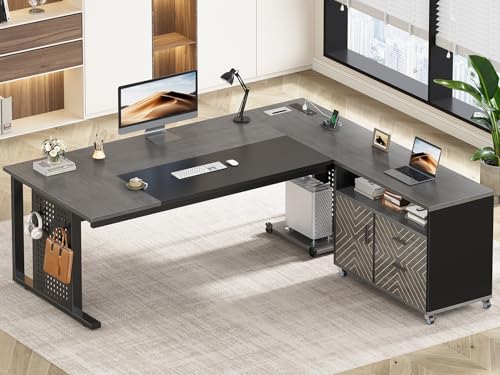
SEDETA 71″ Executive Desk with Rolling File Cabinet — Best flexible storage
The rolling file cabinet is this desk’s thesis: executive storage that is not bolted to the desk’s decisions. At 71 inches, L-shaped, in gray, the SEDETA pairs its drawers with a cabinet on wheels — park it under the return as a pedestal, roll it out as a side surface during a paperwork session, or move it across the room when the office changes its mind. Add power outlets, a CPU stand, a pegboard and storage shelves, and the desk becomes the most reconfigurable object in this guide, aimed at the office that evolves.
The pegboard deserves its moment. Executive desks usually hide everything; a pegboard does the opposite, putting the tools, cables, headphones and stationery on vertical display within reach of the chair. In a working office — a maker’s, a designer’s, a streamer’s — that visible, grabbable layer is worth more than another closed drawer, and it uses the wall above the return that other desks leave empty. The shelves extend the same philosophy. Owners who like their kit visible will read this specification as the first desk designed for them; owners who want everything behind doors should look at the cabinet models instead.
Gray is the third distinction: the only gray finish here, suiting the modern, lighter office that black overpowers and farmhouse does not fit. The flexibility has one cost to name — a desk assembled from a rolling cabinet, a pegboard and shelves will never feel like a single carved object, and owners seeking that monolithic executive presence should choose the integrated models. Owners seeking a desk that adapts have found the guide’s clearest answer.
- Overall size: 71 inches, L-shaped
- Storage: drawers, rolling file cabinet, storage shelves
- Power: built-in outlets
- Tower: CPU stand included
- Extras: pegboard for vertical tool storage
- Finish: gray
Strengths
- Rolling cabinet reconfigures with the office instead of resisting it.
- Pegboard and shelves put working kit visibly within reach.
- Outlets and a CPU stand cover power and tower placement.
Trade-offs
- Visible storage means visible clutter if you let it accumulate.
- Modular build lacks the monolithic feel of integrated models.
- Gray finish is a specific taste the room must share.
Best for: an evolving office whose owner likes tools visible and storage movable. Not suited for: a formal office where everything must disappear behind doors.

Tribesigns 70.8-Inch Executive Desk — Best straight workstation
Every other pick wraps its owner or fills its corner with furniture; this Tribesigns makes the opposite argument, and at 70.8 inches it has the scale to make it stick: a large, modern, simple workstation — surface, presence, and nothing competing with either. The listing’s own words are workstation and business furniture, and the design serves the office that works across a desk rather than inside one: the professional who spreads plans, books and devices across a top, the pair who sit on opposite sides, the studio where the desk is a table for the work itself.
The straight format is the point. Placed in the middle of a room, this desk receives a visitor’s chair opposite and conducts a meeting across its width; placed against a wall, it gives a single unbroken run for a wide monitor setup and the day’s spread. There are no cabinets annexing the knee space, no return dictating which corner the desk must marry. For offices whose storage lives in separate furniture — a filing cabinet, shelves, a cupboard — a desk that refuses to duplicate that storage is not missing features; it is declining redundancy.
The honesty paragraph: buyers who need file drawers at the chair will not find them here, and power is the owner’s arrangement. This desk spends its whole budget on size and simplicity, and the buyers it suits — surface-first workers with storage elsewhere — will feel the trade as a relief rather than a lack. Brown and black keeps it in the executive palette. It is the guide’s reminder that “executive” once meant a great deal of desk and very little else, and that some offices still run best on exactly that.
- Overall size: 70.8 inches, straight format
- Style: modern, simple workstation
- Storage: none integrated — surface is the feature
- Finish: brown and black
- Aimed at: laptop and study work, business use, meetings across the desk
Strengths
- Unbroken 70.8-inch surface for spread-out work and meetings.
- No storage furniture annexing the knee space on either side.
- Simplest assembly and the easiest move of the six.
Trade-offs
- No file drawers or cabinets anywhere in the design.
- No integrated power; charging is entirely your arrangement.
- Storage must exist elsewhere in the room or not at all.
Best for: a surface-first office with storage in separate furniture. Not suited for: an owner whose files must live inside the desk itself.

Jocoevol 78.7″ L-Shaped Executive Desk — Best open-shelf L
The Jocoevol splits its storage personality down the middle, and the split is the design’s intelligence: file drawers for the paperwork that must be hidden, open shelves for the books and objects that should be reachable and visible. At 78.7 inches in walnut and black, it matches the largest SEDETA for scale while making the opposite storage argument — that an executive’s desk should display as well as conceal, because the reference shelf you can see is the one you actually use.
Open shelves on the return change the desk’s daily rhythm. The current project’s binders, the reference books, the printer’s paper and the objects that give an office its character all live in the open, at swivel distance, without a door or drawer between the hand and the thing. The cost is the known cost of all open storage: it must be kept honest, because a shelf that becomes a dumping ground advertises itself. Owners with tidy instincts get the most accessible large desk in this guide; owners without them should choose doors.
Walnut and black is the warm-modern pairing — darker and richer than the Tribesigns’ light walnut, less stark than full black — and at this size it gives the corner presence without gloom. Power is not the listing’s headline, so plan the cable system as you would for the Tribesigns L: surface strip or tray, routed at assembly. As the second 78.7-inch option, the Jocoevol is the choice for the owner who looked at the SEDETA’s closed cabinets and charging station and preferred their storage open and their shelves working.
- Overall size: 78.7 inches, L-shaped
- Storage: file drawers and open shelves
- Finish: walnut and black
- Positioning: extra-large home office workstation
Strengths
- File drawers hide paper; open shelves keep references grabbable.
- Full 78.7-inch scale matches the largest desk here.
- Walnut and black gives presence without a black room’s gloom.
Trade-offs
- Open shelves demand tidiness and collect dust.
- Charging is not built in as a headline feature.
- Needs the same large corner as every 78-inch L.
Best for: a book-and-binder worker who wants references open at the chair. Not suited for: a household whose shelves become storage for everything unnamed.
Six Executive Desks, One Table: The Differences That Matter
| Pick | Size & shape | Storage | Power | Finish |
|---|---|---|---|---|
| SEDETA L with Charging Station | 78.7 in, L | File drawers, adjustable cabinet | Charging station | Black + brown |
| SEDETA Farmhouse | 70.9 in, straighter format | File drawers, cabinet | Outlet | Black + brown, farmhouse |
| Tribesigns L-Shaped | 78 in, L | Drawers, file cabinet | Plan your own | Light walnut + black |
| SEDETA with Rolling Cabinet | 71 in, L | Drawers, rolling cabinet, shelves | Outlets | Gray |
| Tribesigns Workstation | 70.8 in, straight | None integrated | Plan your own | Brown / black |
| Jocoevol L-Shaped | 78.7 in, L | File drawers, open shelves | Plan your own | Walnut & black |
Three questions sort the table. Shape first: corner L, or a straighter desk that faces the room? Storage second: closed and integrated, rolling and flexible, open and visible, or none because the room provides it? Power third: built in, or an afternoon’s project of your own? The finishes then choose themselves, because each shape-and-storage answer arrives in a limited palette. Buyers who answer the three questions in order rarely end up with the wrong desk; buyers who start from the photograph often do.
What Mistakes Do Executive Desk Buyers Keep Making?
The first is measuring the room and forgetting the journey. A desk can fit its corner perfectly and still fail at the stairwell turn as a carton, or at the office door as an assembled frame. Measure the route, plan two carriers, and build in the room. The second is buying the L for a corner that does not exist — placing a corner desk along a flat wall wastes the return’s logic and exposes its unfinished thinking; if the office has no corner to give, the straighter picks in this guide are the honest purchase.
The third is under-buying storage in the name of minimalism, then annexing the desktop with the overflow. An executive desk’s surface is its working capital; every object stored on it because the desk has no drawers is interest paid daily. The Tribesigns workstation is the exception that proves the rule — it works only when the room’s other furniture genuinely holds the storage. The fourth mistake is deferring the cable plan until after assembly, at exactly the moment the desk’s back becomes unreachable behind 78 inches of loaded furniture. Route on build day, while the desk is empty and the wall is a rumour.
A sixth error is ordering the desk before the chair. The pair work as one machine: the desk’s height, the return’s position and the knee space all assume a chair of a certain scale, and the owner who buys the desk first and the chair as an afterthought discovers the mismatch at sitting height, where it cannot be returned as easily as a cushion. If a new chair is part of the office plan, spec the two together and let each veto the other’s excesses.
The fifth is ignoring the chair’s other side. An executive desk implies a visitor, a client, a child with homework, a colleague with a laptop — and the knee space, the return’s position and the desk’s orientation all decide whether that second person is hosted or merely tolerated. Decide who sits opposite, and where, before the desk fixes the answer in furniture.
How Do You Choose Between the Three SEDETA Models?
Three picks from one maker is unusual in a guide like this, and it happened because SEDETA’s range maps the category’s three live philosophies unusually cleanly — so the choice between them is worth making explicit. The 78.7-inch charging-station model is the integrationist’s desk: everything built in, everything closed, the office as one engineered object. Choose it when the room is settled and the workflow is known. The farmhouse model is the stylist’s desk: the same seriousness about files and cabinets, expressed in a finish that serves the house rather than the office genre. Choose it when the room’s look is non-negotiable. The 71-inch rolling-cabinet model is the adapter’s desk: pegboard, shelves and movable storage for an office whose shape is still being discovered. Choose it when the next two years will rearrange something. None of the three is the budget version of another; they are three answers to three different briefs, and the buyer’s brief — settled, styled or evolving — names its own desk.
Final Recommendation
For the complete modern executive desk — charging, files, cabinet, tower stand, full 78.7-inch corner presence — the SEDETA with the charging station is the guide’s first recommendation, and it is not close. The alternatives each win a specific office: the farmhouse SEDETA wins the warm-styled home, the rolling-cabinet SEDETA wins the office that rearranges, the light walnut Tribesigns wins the bright corner, the Jocoevol wins the reader with open shelves of references, and the straight Tribesigns workstation wins the room that meets across a desk and stores elsewhere.
Measure the corner, the route and the room’s patience for assembly, in that order, and let the answers pick the desk. Then give the purchase one night’s sleep: a desk of this size will outlast the enthusiasm that ordered it, and the model that still looks right in the morning is the one the office will thank you for in year five. An executive desk chosen that way stops being furniture shopping and becomes what it should be — the founding decision of an office you intend to run for years.
Frequently Asked Questions
Are these really executive desks if most of them are L-shaped?
Yes — the L is the modern executive format, and this guide names it rather than disguising it. The category’s defining features are scale, file storage and presence, and the L-shaped models deliver all three while using the corner a pedestal desk wastes. Buyers who want the traditional straight format are served by the farmhouse SEDETA and the Tribesigns workstation.
How much room does a 78-inch L-shaped desk actually need?
The corner must offer the desk’s full length along one wall and the return’s depth along the other, plus the chair’s swivel space in front of the angle and walking room behind the chair. In practice, treat any room that cannot spare a clear corner and a metre of chair space in front of it as too small, and look at the 71-inch class instead. Always check the listing’s dimension diagram against your own tape measurements, skirting included.
Do file drawers on these desks take hanging files?
The file drawers and file cabinets in this guide are designed around document storage — that is their stated purpose in the listings — but file hardware varies, so confirm the drawer format against the listing’s interior dimensions if your filing system is non-negotiable. Buyers with an existing archive should measure a representative folder before ordering, not after assembly.
Which executive desk is best for video calls and client meetings?
For calls, any of the L models with the owner in the corner gives a composed background of shelves or cabinets. For in-person meetings across the desk, the straight Tribesigns workstation is the design that receives a second chair properly, with clear knee space opposite. The farmhouse SEDETA suits the practice whose clients expect warmth rather than corporate polish.
How long does assembly take on a desk this size?
Plan on a substantial session with two people for the storage-heavy models — the cabinets, drawers and returns are real furniture projects — and rather less for the straight workstation. Build in the room of residence, keep the fixings organised by step, and route cables before the desk is pushed into its corner and loaded. Rushing a 78-inch build is how cam locks get cross-threaded and corners get chipped.
What is the difference between a file drawer and a file cabinet in these desks?
In this guide’s usage, the file drawers are the desk’s own drawers sized for documents, reached from the chair without standing; a file cabinet is a larger, dedicated storage unit — integrated into the Tribesigns L’s frame, or rolling free in the SEDETA 71-inch model — that holds the archive rather than the week’s files. Working offices use both layers: the drawer for what is live, the cabinet for what is merely kept. Paperless owners can read both as general volume and fill them with hardware and notebooks instead.
Can an executive desk work in a living room?
The farmhouse SEDETA was designed for exactly that trespass, and the light walnut Tribesigns manages it in brighter modern rooms. The discipline is storage: choose a model whose cabinets and drawers swallow the whole office at the end of the day, and the living room gets its evenings back. Open-shelf models ask the household to look at the work permanently, which some living rooms accept and most eventually resent.
Related Guides
Readers furnishing an office for the long term often ask whether natural timber beats these engineered finishes, and our roundup of the best solid wood desks examines what solid construction honestly means at desk scale. The executive desk’s one unfinished system is usually its wiring, which the best home office desks with cable management guide addresses through desks built around trays, outlets and routing. And for the office’s second workstation — the producer’s or partner’s desk — the best studio desks for music covers desks built around keyboard trays and monitor platforms instead of filing.


[…] a room can keep a desk permanently and the work turns senior, our guide to the best executive desks covers the large statement pieces that anchor a proper office. Buyers drawn to natural materials […]