What's inside
- Key Takeaways
- Quick Picks
- How We Chose These Picks
- What Does “No Assembly” Actually Buy You?
- How Much Work Fits on 31.5 Inches?
- Where Does a Folded Desk Actually Live?
- How Do You Keep a Folding Desk Steady?
- Which Rooms Gain Most From a Desk That Disappears?
- How Do You Work Comfortably at a Desk This Small?
- What Should You Check in the Listing Before Ordering?
- How Long Should a Folding Desk Last?
- The Six Folding Desks, Reviewed One by One
- Side by Side: How the Six Folding Desks Differ
- Can a Folding Desk Be a Child’s First Desk?
- What Mistakes Do Folding Desk Buyers Keep Making?
- Final Recommendation
- Frequently Asked Questions
- Related Guides
As an Amazon Associate I earn from qualifying purchases. This post may contain affiliate links at no extra cost to you.
widgetverdict.com is reader-supported. When you buy through links on our site, we may earn an affiliate commission.
Where to buy: the six desks reviewed here are all listed on Amazon, linked from their names in the Quick Picks table and in the detailed reviews below. With a folding desk, read the listing’s folded dimensions as carefully as its open ones — the folded size is the one your cupboard, your car boot and your hallway will actually live with.
The best folding desks exist for the rooms that cannot keep a desk. The dorm room that is also a bedroom and a social space, the rented flat where the landlord’s furniture leaves one free wall, the spare room that hosts guests six weekends a year, the RV where every object must justify its footprint twice — in all of these, a desk that folds is not a compromise version of a desk. It is the only version that fits the life being lived around it. When it is up, it must be a real desk: steady under a laptop and a lamp, deep enough for a notebook in front of the keyboard. When it is down, it must genuinely disappear: flat against a wall, inside a cupboard, under a bed, in the boot of a car.
The six picks divide along the two honest axes of this category. The first is how the desk arrives: the HMFOR and the GreenForest need no assembly at all — unfold and work — while the Huuger, WOHOMO, VASAGLE and DUMOS ask for a short, easy assembly once, then fold for storage thereafter. The second axis is size: most of the field clusters at 31.5 inches, the classic one-person folding width, with the HMFOR stretching to 35.8 inches for those who need a little more elbow room and the GreenForest shrinking to 27.3 inches for the tightest corners. Finishes split between rustic brown, oak tones and one black metal-framed option.
What none of these desks pretends to be is a permanent workstation for a dual-monitor rig. A folding desk’s frame is engineered around a hinge, and a hinge is a decision: mobility and storage in exchange for the absolute rigidity of a fixed frame. Within that honest bargain, though, there is a wide spread of competence, and the reviews below separate the desks that fold gracefully and work steadily from the ones that merely fold.
Key Takeaways
- Two picks — the HMFOR and the GreenForest — need no assembly at all: unfold them and start working.
- Most of the field is 31.5 inches wide; the HMFOR’s 35.8 inches is the roomiest top here, the GreenForest’s 27.3 inches the most compact.
- The GreenForest is the only two-tier design, with a shelf that lifts the laptop or holds the second layer of kit.
- The VASAGLE’s one-piece desktop folds without a seam across the working surface.
- The DUMOS is the black, metal-framed option for rooms where wood tones do not belong.
- Judge a folding desk by its folded dimensions and its hinge, not by its open photograph.
Quick Picks
| Pick | Badge | Why it earns its place |
|---|---|---|
| HMFOR Folding Table Computer Desk – 35.8″ No Assembly Folding Desk | Best no-assembly, widest top | Thirty-five point eight inches that unfold straight from the box, sized for dorms and RVs. |
| Huuger Folding Desk for Small Spaces | Best mainstream folder | The 31.5-inch rustic brown all-rounder for home office, study and dorm duty. |
| WOHOMO Folding Desk | Best oak finish | A 31.5-inch oak desk that assembles easily, folds flat and reads as furniture. |
| VASAGLE Folding Desk | Best one-piece desktop | A seamless 31.5-inch top that travels from bedroom to balcony to campsite. |
| GreenForest Folding Desk No Assembly | Best two-tier compact | A 27.3-inch no-assembly desk whose second tier lifts the screen or stores the kit. |
| DUMOS 31.5″ Folding Computer Desk | Best black metal frame | A black 31.5-inch desk on a metal frame, for study and work in modern rooms. |
How We Chose These Picks
The fold itself was the first test, applied before any question of style. A folding desk lives or dies by its hinge and its folded profile: how flat it lies, whether the legs tuck inside the frame’s thickness, whether folding is a ten-second job or a wrestling match that owners will quietly stop doing — because a folding desk that nobody folds is just a small desk with a wobble. We favoured designs whose folded state is a genuine storage proposition: against a wall, in a cupboard, under a bed. The two no-assembly picks earned their places partly here, since a desk with nothing to assemble usually has the simplest, most honest folding mechanism of all.
Open-state steadiness came second. The listing language we weighted was structural — frames, one-piece tops, the way legs lock — because a folding desk’s job is to hold still while feeling temporary. The VASAGLE’s one-piece desktop removes the centre seam that lesser folding tables write across your wrists; the DUMOS’s metal frame is its maker’s argument for rigidity; the HMFOR’s folding-table construction is the proven pattern of every banquet and dorm desk that has survived a decade of students. We did not convert any of this into invented load figures; the listings describe builds, and we reason from builds.
Size honesty came third. This category’s photographs are generous with perspective, so we anchored on the stated widths: 35.8 inches is a real step up from 31.5 for a laptop-plus-notebook worker, and 27.3 inches is a real step down that only makes sense where the space truly demands it — which is why the GreenForest pairs its small footprint with a second tier, reclaiming vertically what it surrenders horizontally. Finish and setting closed the judging: rustic brown for the mainstream small-space market, oak for rooms that want furniture rather than equipment, black for the metal-framed modern option.
Finally, we checked each desk against the settings its own listing claims — dorm, RV, balcony, camping, apartment — and kept only the claims that the design supports. A desk pitched at RV life must fold genuinely flat and travel without rattling itself apart; a desk pitched at camping must shrug at being carried and set up on imperfect ground. The six below are the ones whose designs and whose stated purposes agree with each other.
What Does “No Assembly” Actually Buy You?
More than the half hour it saves, though it does save that. A no-assembly folding desk — the HMFOR and the GreenForest here — arrives as a finished mechanism: the hinge, the legs and the top are aligned at the factory, and the desk you unfold on day one is the desk as designed, not the desk as your interpretation of a diagram. There are no fixings to under-tighten, no cam locks to work loose over a year of folding, and no leftover bag of screws haunting a drawer. For dorms, where the desk will be set up and struck a dozen times a term by someone in a hurry, that factory alignment is worth real money.
The trade is that no-assembly designs offer nothing to adjust. An assembled desk can be re-tightened when it loosens, levelled when a leg sits unevenly, and understood — its owner knows where every bolt lives because they put it there. A sealed folding mechanism that develops play has fewer user-serviceable answers. Neither philosophy is wrong; they suit different owners. The student, the RV traveller and the grandparent who needs a desk for visiting grandchildren should buy the unfolding kind. The long-term renter who will fold the desk monthly for years may prefer the kind they can maintain.
There is a subtler point about the first five minutes. A no-assembly desk goes from box to working before the kettle boils, which means it gets used for the small, unplanned tasks — the form that needs a table, the laptop call taken away from the kitchen — that an assembly-required desk, still in its box in the hallway, never serves. Furniture that is easy to deploy gets deployed; the category’s whole value lives in that sentence.
How Much Work Fits on 31.5 Inches?
Thirty-one and a half inches is the width of this category’s mainstream for a reason: it is the smallest surface that runs a complete one-person station without negotiation. A laptop sits centre with its screen at a comfortable distance; a notebook opens in front of it if the laptop is pushed back, or beside it at a slight angle; a phone, a mug and a lamp divide the remaining corners. What does not fit is a second full device — a laptop and a separate monitor, a laptop and an open textbook at full spread, a laptop and a drawing tablet side by side. Those layouts are the honest territory of the HMFOR’s 35.8 inches, and even there they are snug.
Depth matters as much as width at this scale, and it is the dimension listings photograph worst. A shallow folding desk puts the laptop’s screen close and leaves no landing strip for your wrists or a notebook; the two-tier GreenForest answers the depth problem vertically, raising the laptop or the storage so the main surface stays clear for hands and paper. When you compare listings, compare the depth figure before the finish: an extra inch of depth is felt at every sitting, while an extra inch of width is felt only when the notebook comes out.
The mental test that settles it: lay out your actual kit on a table you already own, measure the rectangle it occupies, and buy the desk whose top contains that rectangle with an inch to spare on each side. Owners who run that test stop being surprised by small desks; owners who buy from photographs join the returns queue. Every desk in this guide is honestly sized for something — the buyer’s task is matching the something to their own kit.
Where Does a Folded Desk Actually Live?
The folded state’s address is the question that decides whether a folding desk succeeds in a home. The realistic addresses are few: flat against a wall behind a door, inside a wardrobe or cupboard, under a bed, standing in the gap beside a bookcase, or lying in a car boot between trips. Each address has a maximum thickness, and that thickness — the desk’s folded depth — is the specification to extract from the listing before anything else. A desk that folds to a slim profile fits the under-bed and behind-door addresses; a bulkier fold is limited to the cupboard, and a desk with no address becomes a permanent object leaning in a hallway, which is a folding desk that has failed at its one job.
Weight is the address’s second condition. A folding desk gets carried — from cupboard to room, from flat to car, from floor to floor — and a desk that one person can carry comfortably in one trip gets moved willingly, while a heavy one gets left set up “temporarily” for a year. The compact picks here are one-person carries; the HMFOR, at 35.8 inches, is the one to check against your own strength and your staircase’s turns if it will travel often.
Plan the address before the desk arrives, and measure it with the same care as the open footprint. The owners who love their folding desks are, without exception, the ones who can answer “where does it go?” in one sentence. The owners who return them discovered the question on delivery day.
How Do You Keep a Folding Desk Steady?
Start with the floor. Folding desks have small feet and light frames, and on hard floors they telegraph every bump; felt pads under the feet quiet them and stop the slow sideways walk that typing vibration causes on laminate. On carpet, let the desk settle for a day before judging its level — the pile compresses unevenly, and a desk levelled on hour one is a desk re-levelled on day three. The lock is the second habit: every folding mechanism here has a locked open state, and using the desk on a half-engaged lock is how folding desks acquire their wobbly reputation. Open it fully, confirm the lock, then load it.
Load placement is the third habit, and it is free. Heavy items — a monitor on a stand, a stack of books, a desktop tower that should not be on any folding desk — belong over the legs, not at the centre of the span, and never cantilevered at an edge. A laptop and a lamp ask nothing of any desk here; a printer asks more, and belongs on the widest, sturdiest pick or on the floor beside it. Treat the desk as a bridge with known strong points and it will feel far more solid than its weight suggests.
Finally, fold it correctly and it stays steady longer. Mechanisms wear at their hinges, and hinges wear fastest when the desk is dragged open sideways, forced past resistance, or folded with objects still on top sliding into the joint. Clear it, fold it along its designed path, and the mechanism you bought is the mechanism you keep. These are small disciplines, but a folding desk is a machine in a way a fixed desk is not, and machines repay being operated as designed.
Which Rooms Gain Most From a Desk That Disappears?
The dorm room is the category’s homeland, and the HMFOR’s listing says so outright. A dorm desk must host study at midnight and vanish — socially if not physically — when the room becomes a gathering place; even folded against the wall it returns floor to the room’s other life. The RV is the harder test the same listing claims: space measured in inches, a vehicle that moves, and a desk that must fold flat, travel quietly and set up on arrival without tools. A desk that serves both settings has proven the two ends of the folding idea — social flexibility and genuine travel.
The spare room is the quieter case, and for many households the decisive one. A guest room with a permanent desk is a study that occasionally hosts a guest; a guest room with a folding desk is a guest room that can become a study in two minutes and return just as fast when the doorbell rings. The VASAGLE’s balcony and camping claims point at the last setting: outdoor and occasional work, where the desk is carried to the light or the view, used for an afternoon, and struck before the weather changes. Each of these rooms asks the same question — what is this space when the desk is not in it? — and a folding desk is the only furniture that lets the answer change daily.
How Do You Work Comfortably at a Desk This Small?
Small-desk ergonomics are mostly subtraction. The laptop’s screen is too low on any flat desk, folding or not, and the cheapest correction — a stack of books, a stand, or the GreenForest’s built-in tier — pays for itself in neck comfort within a week. The keyboard should sit where your forearms rest level, which on a small top means the laptop pushed back and, for long sessions, a separate compact keyboard in front; that arrangement is also why depth matters more than width at this scale, since the keyboard and the raised laptop must share the desk’s front-to-back inches rather than its left-to-right ones.
Chair choice matters more at a folding desk than at a fixed one, because the desk cannot be raised or lowered to meet the chair. A chair with adjustable height is the folding desk’s natural partner: the desk’s height is what it is, so the seat does the adapting. Foot position follows — feet flat, knees clear of the frame — and folding frames, with their crossbars and hinge hardware under the top, deserve a knee check in the listing’s photographs before you commit your shins to them for a working day.
Light is the last ergonomic, and the folding desk’s mobility is its advantage: the desk can move to the window for the morning and away from the afternoon glare, a freedom no fixed desk offers. A small lamp that clamps or stands on the desk travels with it. Owners who use that mobility deliberately — desk follows light, chair follows desk — routinely report that the small folding setup feels better by evening than the larger fixed one they left in another room, which says more about light than about furniture.
What Should You Check in the Listing Before Ordering?
Four figures decide whether a folding desk fits your life, and all four hide in the dimensions block rather than the photographs. First, the open width and depth, tested against your kit’s rectangle. Second, the folded thickness, tested against the storage address. Third, the desk’s height, tested against your chair and your knees — small desks vary more in height than buyers expect, and a desk two inches too low is a desk you hunch over for years. Fourth, the weight, tested against the person who will carry it up the stairs and the arms that will lift it into the cupboard in month six, not the enthusiasm of delivery day.
Beyond the figures, read for the mechanism’s description. Listings that explain how the desk folds — which part moves, what locks, whether the top is one piece — are telling you the maker thought about the fold as the product. Listings that mention folding only in the title and the first bullet, then move on to generic small-desk praise, are selling a small desk that happens to fold. The six in this guide were chosen from the first kind of listing; the wider market is full of the second, and the difference shows up in the hinge within a year.
Finally, check the returns terms with the folded size in hand. Folding desks are returned disproportionately for fit — the fold did not fit the cupboard, the top did not fit the kit — and both failures are knowable before ordering from the four figures above. Ten minutes with a tape measure against your own rooms is the whole of the diligence this category asks, and it is cheaper than a return label.
How Long Should a Folding Desk Last?
Longer than its reputation suggests, if it is used as designed. The wear points are known: the hinge or folding joint, the locks, the feet, and the fixings on assembled models. Hinges wear from being forced and from being folded with loads still on the desk; locks wear from being half-engaged under weight; fixings loosen with vibration and travel. Every one of those failure modes is a usage pattern rather than a date, which means the desk’s lifespan is substantially in its owner’s hands. Folded gently, locked fully, tightened yearly, a folding desk serves a degree course, a tenancy, or a childhood of visiting grandchildren without complaint.
The honest limit is the duty cycle. A desk folded twice a day, every day, for years is doing mechanism work that a weekly folder never asks, and daily folders should buy at the sturdier end of the category — the metal-framed DUMOS, the sturdiness-first WOHOMO — and expect to replace the desk sooner than a fixed desk would need replacing. That is not a scandal; it is the price of the fold, stated plainly. The scandal would be a category that promised otherwise, and this guide declines to.
Care is minimal but real: keep the mechanism clean of the grit that balconies and campsites introduce, dry the desk before folding it away after outdoor use, and store it folded in its planned address rather than leaning open in a damp hallway. A folding desk’s enemies are corrosion and neglect, not work.
The Six Folding Desks, Reviewed One by One
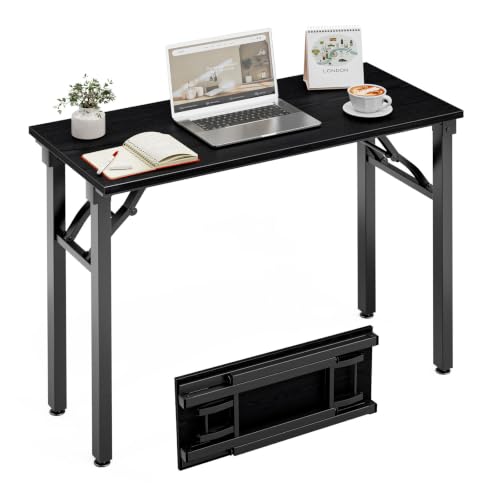
HMFOR Folding Table Computer Desk – 35.8″ No Assembly Folding Desk — Best no-assembly, widest top
The HMFOR is the desk for people who have read one furniture instruction manual too many. It arrives ready: unfold it and the 35.8-inch top — the widest in this guide by a clear margin — is a working desk, in dark oak, with no screws, no cams and no allen key to lose. The listing names its habitats precisely: dorm, RV, bedroom, the small spaces where a desk must earn its floor. The folding-table construction is the proven pattern — a top on a folding frame — and its virtue is that the mechanism has been understood by generations of users before you.
Those extra four inches over the 31.5-inch mainstream change the desk’s daily character. A laptop and an open notebook sit side by side without the negotiation the smaller desks demand; a small monitor joins a laptop without either feeling exiled. In an RV, where the desk may also serve as the spare table, the width doubles the object’s usefulness. In a dorm, it is the difference between a study surface and a study surface that can also hold the textbook the laptop is summarising. Dark oak keeps the look sober and hides the scuffs that travel inflicts.
The honest trade-offs are the folding table’s own. It looks like what it is — a folding table refined for desk duty — rather than like furniture, and its open underside offers no storage, because storage does not fold. Owners whose small space also needs drawers should look at the room, not the desk, for that answer. But judged on the category’s core promise — a real desk that appears in seconds and disappears as fast — the HMFOR is the fullest expression of the idea here.
- Width: 35.8 inches, the widest top in this guide
- Assembly: none — unfolds ready to use
- Finish: dark oak
- Aimed at: dorm, RV, bedroom and small-space use
- Storage: none — the top is the whole desk
Strengths
- No assembly at all; box to working desk in moments.
- Widest surface here fits a laptop and an open notebook together.
- Folding-table design travels between dorm, RV and home duty.
Trade-offs
- No storage of any kind; the room must hold your supplies.
- Utilitarian folding-table looks, not furniture styling.
- The largest fold here still needs its storage address planned.
Best for: dorm and RV life, and anyone who refuses to assemble furniture. Not suited for: a room that wants the desk to look like permanent furniture.

Huuger Folding Desk for Small Spaces — Best mainstream folder
If the HMFOR is the category’s purist, the Huuger is its mainstream: 31.5 inches of rustic brown folding desk, easy assembly once, then a fold-away life across home office, study, bedroom and dorm. Huuger sells a great many small-space desks, and this design reads like the distilled version of what that market asks for — a top that looks like a desk rather than a table, a finish that matches the rustic brown furniture already in most spare rooms, and dimensions aimed squarely at the laptop worker whose room has one free wall.
The easy-assembly bargain deserves spelling out, because it is the middle path of this category. You spend a short session once — the frame, the top, the fixings — and in exchange the desk’s structure is yours: you know how it goes together, you can re-tighten it in year two, and the folding thereafter is a simple, repeatable motion. For the renter who folds the desk monthly rather than daily, that maintainability is the right trade against the no-assembly pair’s sealed convenience.
Rustic brown is doing quiet work here too. A folding desk spends part of its life visible and folded — against a wall, beside a wardrobe — and a finish that reads as furniture makes that folded presence unobtrusive in a way a bare utility frame is not. None of this makes the Huuger the widest, the fastest or the cleverest pick; it makes it the one with the fewest arguments against it, which in a category of compromises is a genuine distinction.
- Width: 31.5 inches
- Assembly: easy, once; folds thereafter
- Finish: rustic brown
- Aimed at: home office, study, bedroom, dorm
- Format: foldable computer table for small spaces
Strengths
- Balanced mainstream design with no awkward compromises.
- Assembled structure can be re-tightened and maintained.
- Rustic brown finish looks like furniture even when folded.
Trade-offs
- Assembly is required once, unlike the two no-assembly picks.
- Standard 31.5-inch width is a one-device working surface.
- No shelf or second tier for vertical storage.
Best for: the renter or spare-room worker who wants the default good folding desk. Not suited for: a buyer who wants to unfold and work within a minute of delivery.
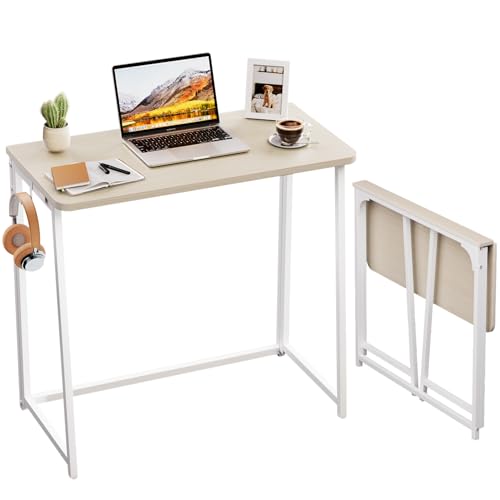
WOHOMO Folding Desk — Best oak finish
The WOHOMO’s case rests on a word in its listing that the others do not use: sturdy. A 31.5-inch oak folding desk pitched at study, bedroom and dorm work, it promises easy assembly and an easy fold, and it aims at the buyer who has handled a flimsy folding table before and is not buying another. Oak as a finish matters here beyond taste: the pale, warm tone suits the bedrooms and apartments where these desks live, and it photographs — and, more importantly, lives — lighter than the rustic browns, which in a small room is a daily effect rather than a styling footnote.
The desk’s stated territory is the apartment study corner: the desk that stands against the wall all week as a writing and laptop station, then folds when the room must become something else — guests, a workout, a child’s play space. That rhythm, fold weekly rather than daily, is the WOHOMO’s natural tempo, and its assembled frame suits it: solid in use, serviceable over time, and honest about being furniture first and a folding mechanism second.
Writing work deserves a specific mention, because the listing names it and small desks often fail writers specifically. A writing surface wants depth for the notebook and a top that does not drum under a pen; a one-level 31.5-inch oak top gives the notebook its place beside the laptop rather than beneath it. Writers who draft on paper before typing will find this the most congenial of the six, with the Huuger its rustic-toned alternative.
- Width: 31.5 inches
- Assembly: easy; folds for storage
- Finish: oak
- Aimed at: study, bedroom, dorm and apartment writing work
- Design note: sold on sturdiness for a folding desk
Strengths
- Oak finish brightens small rooms and reads as furniture.
- Sturdiness is the design’s stated priority.
- Surface suits paper-and-laptop writing workflows.
Trade-offs
- One flat level; no tier or shelf for extra kit.
- Assembly required before the first fold.
- Same 31.5-inch ceiling on layout as its mainstream rivals.
Best for: a study or bedroom corner that wants a light oak writing desk. Not suited for: a two-device setup needing width or a second tier.

VASAGLE Folding Desk — Best one-piece desktop
One phrase in the VASAGLE’s listing earns its place in this guide: one-piece desktop. Many folding tables fold the top itself, leaving a seam or hinge line across the middle of the working surface — a ridge your wrist crosses a thousand times a day, a groove that collects crumbs and catches the mouse cable. The VASAGLE’s 31.5-inch top is a single piece, rustic brown, on a folding frame: the fold lives in the legs, where it belongs, and the surface you work on is as continuous as any fixed desk’s. For writers, drawers and anyone whose hands travel the top all day, that continuity is the difference between a folding desk and a desk that folds.
The listing’s claimed territory is the widest here: bedroom, balcony, camping. That breadth is credible precisely because of the design — a one-piece top on a folding frame is a table you can carry to the light, set up on a balcony for a morning’s work in the sun, or take camping as the camp kitchen’s and laptop’s shared surface, then fold into the car. VASAGLE’s furniture generally arrives with tidy instructions and a finish a notch more considered than the utility end of the market, and this desk’s rustic brown is chosen to sit in a bedroom without announcing that it also goes camping.
The compromise is the mirror of the HMFOR’s: at 31.5 inches the top is mainstream-sized, so the laptop-plus-notebook negotiation returns, and there is no storage in a design whose whole virtue is a clean top on folding legs. Buy it for the surface and the portability, and it will not disappoint; buy it expecting a workstation with places for things, and no folding desk in this guide will save you.
- Width: 31.5 inches
- Desktop: one piece — no seam across the surface
- Assembly: easy
- Finish: rustic brown
- Aimed at: bedroom, balcony and camping use
- Model: ULWD151KD01
Strengths
- Seamless one-piece top feels like a fixed desk under your hands.
- Genuinely portable: bedroom to balcony to campsite.
- Rustic brown finish suits indoor rooms between trips.
Trade-offs
- Mainstream width; no room for a second full device.
- No storage, shelves or tiers.
- Assembly required, though simple.
Best for: anyone who hates the centre seam of folding tables, and outdoor workers. Not suited for: a setup with a monitor and laptop to house side by side.

GreenForest Folding Desk No Assembly — Best two-tier compact
The GreenForest is the smallest desk here — 27.3 by 22 inches — and the only one that answers smallness with architecture: a second tier. That shelf changes what the footprint can do. The laptop rises onto the tier with its screen at a better height and the main surface clears for a notebook and your hands; or the tier holds the printer, the books and the stationery while the laptop works below. Either way, the desk stores and works in two layers, which is how a 27-inch desk hosts a setup that would suffocate a flat 27-inch top.
No assembly is the second half of the design: unfold, and the two tiers are already aligned, which matters more in a tiered desk than a flat one — a shelf you must bolt square yourself is a shelf that can sit crooked, and the factory has removed that possibility. The oak finish keeps the small desk looking like a piece of bedroom or dorm furniture rather than equipment, and the listing’s territory — home office, dorm, apartment — is the honest map of where a desk this size earns its keep: the corner of a studio flat, the dorm’s one free wall, the apartment nook.
The size is the size, and no tier repeals it. This is a one-person, one-laptop desk for spaces where the alternative is the kitchen table or the bed. Within that honest brief it is the cleverest design here, and for the smallest rooms it is not the budget choice but the only choice that adds a desk without subtracting a room. Buyers with even a little more wall should step up to the 31.5-inch class; buyers without it have found their desk.
- Footprint: 27.3 x 22 inches, the most compact here
- Assembly: none
- Levels: two tiers, with a shelf
- Finish: oak
- Aimed at: home office, dorm and apartment corners
Strengths
- Second tier reclaims vertical space the footprint surrenders.
- No assembly; the tiers arrive factory-aligned.
- Smallest folded and open footprint in this guide.
Trade-offs
- A laptop-and-notebook desk only; no second device fits.
- The tier’s load is light kit, not heavy equipment.
- Compact depth rewards a compact keyboard.
Best for: the smallest dorm, studio and apartment corners. Not suited for: anyone whose kit exceeds one laptop and a notebook.

DUMOS 31.5″ Folding Computer Desk — Best black metal frame
Every other pick here wears a wood tone; the DUMOS wears black, on a metal frame, and that difference is its whole candidacy. Some rooms — the modern flat, the gaming corner, the office with black shelving and a black chair — make a rustic brown desk look like a visitor from another house. The DUMOS’s 31.5-inch black top and metal frame belong in those rooms, and the listing pitches it plainly at study, work and writing across bedroom, dorm and apartment, which is the mainstream brief delivered in the minority finish.
The metal frame is the functional half of the argument. In a category where frames are often the afterthought, a maker who specifies the frame is making the sturdiness case in structural language: metal where the loads and the hinge stresses live. Combined with easy assembly, the DUMOS is the pick for the buyer whose first question about a folding desk is not “how small does it fold?” but “how solid does it feel at midnight before a deadline?” — a legitimate first question, and one the wood-toned mainstream answers less directly.
Black’s costs are the familiar ones: dust shows on it under window light, and scuffs read brighter against black than against oak. Neither is a defect; both are the known upkeep of the finish, and buyers choosing black for a gaming or modern setup have usually already accepted them for the rest of the room’s furniture. As the only black option in a field of browns and oaks, the DUMOS does not need to beat the others on features — it needs to be competent and black, and it is both.
- Width: 31.5 inches
- Frame: metal
- Finish: black
- Assembly: easy
- Aimed at: study, work and writing in bedrooms, dorms, apartments
Strengths
- The only black finish here, for modern and gaming rooms.
- Metal frame makes the structural case explicitly.
- Mainstream size and brief with no eccentric compromises.
Trade-offs
- Black shows dust and scuffs more than the wood tones.
- No tier, shelf or storage beyond the top itself.
- Assembly required before first use.
Best for: a black-themed study, gaming or modern apartment setup. Not suited for: a warm wood-toned room, where it will read as an intruder.
Side by Side: How the Six Folding Desks Differ
| Pick | Width | Assembly | Finish | Defining trait |
|---|---|---|---|---|
| HMFOR Folding Table | 35.8 in | None | Dark oak | Widest top, unfolds ready |
| Huuger Folding Desk | 31.5 in | Easy, once | Rustic brown | Mainstream all-rounder |
| WOHOMO Folding Desk | 31.5 in | Easy | Oak | Sturdiness-first furniture look |
| VASAGLE Folding Desk | 31.5 in | Easy | Rustic brown | One-piece seamless desktop |
| GreenForest Folding Desk | 27.3 in | None | Oak | Two tiers in the smallest footprint |
| DUMOS Folding Desk | 31.5 in | Easy | Black | Metal frame, modern finish |
The table reduces to three decisions. First, assembly philosophy: unfold-and-work (HMFOR, GreenForest) or assemble-once-and-maintain (the other four). Second, footprint: the GreenForest for the tightest corners, the HMFOR for the most surface, 31.5 inches for everything between. Third, the room’s palette: oak lightens, rustic brown blends, black commits. A buyer who answers those three questions has already chosen; the table merely confirms it.
Can a Folding Desk Be a Child’s First Desk?
It is one of the category’s most sensible uses, and several of these listings name the bedroom-and-study territory where it happens. A child’s desk needs change on a two-year cycle — homework appears, grows, moves rooms, and eventually leaves for a dorm, quite possibly with the same desk folded into the car. A folding desk absorbs that whole arc: it serves the primary-school corner, folds away during the years the room belongs to other things, and travels when the student does. The Huuger and WOHOMO, in their furniture finishes, suit the bedroom years best; the HMFOR, needing no assembly and folding flattest in spirit, suits the travelling years.
Two cautions are specific to children. The first is the mechanism: little fingers and folding joints are a poor combination, so the folding and unfolding should be an adult’s job until the child is old enough to treat the hinge with respect — and the desk should always be locked open before use, a habit worth teaching alongside the desk’s arrival. The second is stability under a child’s load pattern, which includes leaning, perching and the occasional sibling. Loads stay centred, heavy books live low, and the desk is a desk, not a step. Observed, those cautions leave a genuinely practical first desk — one that never becomes the bulky hand-me-down nobody has room to store.
What Mistakes Do Folding Desk Buyers Keep Making?
The first is buying the open photograph and ignoring the folded dimensions. A folding desk is two objects — the desk and the flat parcel it becomes — and both must fit the home. Measure the cupboard, the under-bed clearance and the behind-door gap before ordering, and compare them with the listing’s folded size, not with a guess. The second mistake is the opposite: buying for a fold that will never happen. If the desk will stand in one place for three years, a fixed small desk would serve better and steadier; the folding premium is only repaid by folding.
The third is overloading. Folding desks are engineered around hinges and light frames, and the buyer who parks a heavy monitor, a tower and a printer on one is conducting an experiment the maker did not design for. Keep loads centred over the legs, keep towers on the floor, and let the desk carry what a desk that folds should carry. The fourth mistake is neglecting the lock: half-engaged mechanisms account for most folding-desk wobble, and the two seconds spent confirming the open lock are the cheapest stability in this entire category.
A sixth mistake is treating the fold as a party trick and demonstrating it weekly to no purpose. Every fold cycle is mechanism wear, trivial in itself, but the owners who fold the desk because it can be folded — rather than because the room needs it back — spend the hinge’s life on theatre. Fold when the room asks, unfold when the work asks, and the mechanism will outlast the tenancy, the course and possibly the laptop it was bought to hold.
The fifth is forgetting the chair. A folding desk solves the desk’s footprint and nothing else; the chair still needs its square metre, and a room that fits the desk but not the chair has gained a shelf, not a workstation. Measure the working footprint — desk plus chair plus the human’s knees — before deciding the room can host a desk at all.
Final Recommendation
A word about sequencing the purchase, because folding desks are often bought in a rush — the course starts Monday, the job goes remote next week, the guests arrive Friday. Resist speccing the desk from the rush. The measurements that decide success in this category take ten minutes: the kit’s rectangle, the storage address, the wall’s length, the chair’s footprint. Buyers who spend those ten minutes keep their desks for years; buyers who skip them join the category’s unusually honest returns statistics, which are full of perfectly good desks that were simply the wrong shape for a real room.
Choose by the room’s constraint, not by the desk’s charm. No wall space and no patience: the HMFOR unfolds widest and asks nothing. The tightest corner in the building: the GreenForest, whose second tier makes 27 inches behave like more. The mainstream spare room: the Huuger, with the WOHOMO as its oak-toned, sturdiness-first alternative. Hands that live on the surface: the VASAGLE’s seamless top. A black room: the DUMOS, unapologetically. Every pick here folds honestly and works steadily; the differences are of size, finish and philosophy, and your room has already decided most of them.
Measure the folded address, test your kit’s rectangle on a table you own, and the desk that arrives will be the desk the room needed — present when work calls, and gone, completely gone, when the room wants to be a room again.
Frequently Asked Questions
Can a folding desk hold a monitor as well as a laptop?
A small monitor on the widest pick, the 35.8-inch HMFOR, is workable if the laptop closes or moves aside; on the 31.5-inch desks a monitor plus an open laptop is a crowd, and on the GreenForest the sensible arrangement is the laptop on the tier and the surface kept for work. A permanent dual-device station is a fixed desk’s job; folding desks serve it only as a temporary courtesy.
How flat do these desks actually fold?
Flat enough for the standard addresses — behind a door, under a bed, inside a cupboard — but the exact folded thickness differs by design, and it is printed in each listing’s dimensions. Check that figure against your intended storage space before ordering; it is the single most skipped measurement in this category and the cause of most returns.
Are folding desks sturdy enough for daily work?
For laptop work, writing and study, yes — provided the mechanism is fully locked open and loads stay sensible. The sturdiness-first designs here, the WOHOMO and the metal-framed DUMOS, make that case most strongly. What folding desks do not forgive is heavy, off-centre loading and half-engaged locks; respect those two limits and the desk feels like a desk.
Which folding desk is best for a dorm room?
The HMFOR is the dorm archetype: no assembly on arrival day, the widest top for study, and a fold that returns floor space when the room turns social. The GreenForest is the alternative when the dorm’s free wall is genuinely tiny, trading width for a second tier. Both avoid the assembly session that dorm move-in day has no time for.
Can I take a folding desk camping or onto a balcony?
The VASAGLE is the pick designed with exactly that range in mind — bedroom, balcony and camping are its stated territory, and its one-piece top travels better than a seamed folding table. Keep any folding desk dry, fold it before moving it, and remember that outdoor ground is uneven: a desk that is steady on a floor may need its feet settled on grass or decking.
What is the difference between no-assembly and easy-assembly models?
No-assembly desks — the HMFOR and GreenForest — unfold from the box as finished mechanisms, with nothing to tighten and nothing to adjust. Easy-assembly models ask for one short session with the supplied fixings, and in return their structure can be re-tightened and maintained over years of folding. Choose by temperament: instant and sealed, or assembled and serviceable.
Do folding desks work on carpet?
Yes, with one adjustment of expectations: the desk will settle into the pile over the first day or two and may need its level re-checked once the carpet has compressed under its feet, after which it stays put. Small feet concentrate the desk’s weight, which on thick pile can mean a slight initial rock that disappears as the fibres bed down. On hard floors the same small feet benefit from felt pads, which stop both noise and the slow sideways creep that typing vibration causes on laminate.
Related Guides
When a room can keep a desk permanently and the work turns senior, our guide to the best executive desks covers the large statement pieces that anchor a proper office. Buyers drawn to natural materials should read the best solid wood desks roundup next, which separates genuinely timber tops from desks that merely wear a wood-look finish. And once any desk is permanent, the cables arrive — the best home office desks with cable management guide covers the desks that route, tray and hide the wiring from the start.



[…] to a small room; a desk that disappears when the work ends is another, and our roundup of the best folding desks covers the designs that fold flat for dorms, spare rooms and rented corners. If your corner is […]