What's inside
- Key Takeaways
- Quick Picks
- How did we judge affordable desks without simply sorting by price?
- How do the six best affordable desks compare side by side?
- What size desk does a laptop worker actually need?
- Folding desk or fixed desk: which suits your home?
- How can you make a small affordable desk ergonomic?
- What should you check in the first week with a new desk?
- How do you keep an affordable desk looking good for years?
- How should two people share one small desk fairly?
- What flooring and wall checks matter before a desk arrives?
- How do you light a small desk without wasting its surface?
- What mistakes do people make when buying an affordable desk?
- Final Recommendation
- Frequently Asked Questions
- Related Guides
As an Amazon Associate I earn from qualifying purchases. This post may contain affiliate links at no extra cost to you.
widgetverdict.com is reader-supported. When you buy through links on our site, we may earn an affiliate commission.
Where to buy: five desks below link to verified Amazon listings, and one long-running budget favourite is discussed without a link because we could not confirm a matching current listing for it. Shoppers hunting the best affordable desks usually share one constraint that has nothing to do with furniture fashion: the desk must arrive, assemble without drama, and leave money in the budget for a chair, a lamp and the monitor it exists to hold.
Affordable is a discipline, not a synonym for flimsy. The desks that earned places here spend their limited budgets on the parts you touch and load daily — tops that resist wobble, frames that stay square, storage where it helps — and save money on ornament, oversized footprints and mechanisms most home workers never adjust. Each review names what was sacrificed, because at this end of the market the sacrifices are the specification.
Two shapes dominate the list. Compact fixed desks with drawers or shelves suit a permanent corner, while folding desks suit rooms that must return to being spare rooms, dining rooms or nurseries by evening. Choosing between those shapes honestly matters more than choosing between brands, and the guide sections after the reviews are built to force that decision early.
Measure before you fall in love with any photograph in a listing. Door widths, stair turns, radiator positions and the swing of a wardrobe door have killed more desk plans than weak particleboard ever has, and every pick below lists its footprint plainly so you can tape the outline on your floor first.
Key Takeaways
- Pamray’s 32-inch desk with drawers is the permanent-corner choice: real storage in the smallest footprint here.
- Huuger’s folding desk sets up and vanishes fastest, suiting rooms that change jobs daily.
- WOHOMO’s folding desk adds a monitor shelf, lifting the screen without a separate stand purchase.
- Furinno’s Simplistic desk is the assembly-light option for a first flat or a child’s homework corner.
- TEMI’s folding desk is the widest folder here, giving laptop-plus-notebook workers more elbow room.
- Sauder’s Beginnings writing desk is the traditional prose-only alternative for buyers who prefer a classic frame-and-drawer layout.
Quick Picks
| Pick | Badge | Why it made the cut |
|---|---|---|
| Pamray 32in Small Desk with Drawers | Storage in a 32-inch footprint | Two drawers and a compact top for a permanent laptop corner in a bedroom or hallway nook. |
| Huuger Folding Desk 31.5in | Folds flat in under a minute | No-assembly folding frame that opens for work and leans behind a door when the room is needed back. |
| WOHOMO Folding Desk 31.5in | Folding desk with a monitor shelf | A folding frame plus a raised rear shelf that lifts a screen or laptop to a kinder viewing height. |
| Furinno Simplistic 31in Desk | Lightest assembly, simplest form | A minimalist flat-pack desk with open shelving, sized for a first room, a child or a spare laptop spot. |
| TEMI Folding Desk 35.8in | The widest folding top here | Extra width for a laptop plus notebook side by side, on a frame that still folds for storage. |
| Sauder Beginnings Writing Desk | Prose-only: the traditional alternative | A classic writing-desk layout with a drawer, from a long-running American flat-pack furniture line. |
How did we judge affordable desks without simply sorting by price?
Stability came first, tested on paper the way owners test in life: a desk that rocks when you type will annoy you ten thousand times a year. We favoured designs with cross-bracing, wider stance or wall-friendly straight backs, and we treated manufacturer weight capacities as claims to compare relatively rather than gospel, since test methods vary wildly between brands.
Surface realism came second. A laptop, a notebook, a mug and a phone define the true minimum working area, and several fashionable mini-desks fail it. Every pick here fits that quartet with room to spare, and the reviews note which ones also swallow a separate keyboard, a second screen or a printer without turning work into a stacking puzzle.
Assembly burden was scored honestly. Folding desks that arrive ready to open scored highest, flat-pack desks with clear hardware and modest part counts scored next, and anything notorious for misaligned holes was cut. Your Saturday has value; a cheap desk that eats it is not cheap. We also checked that instructions and spare fittings are realistically obtainable.
Finally, we looked for desks whose limitations are visible before purchase. A folder with no storage is honest; a fixed desk pretending its two small drawers replace a filing cabinet is not. The verdicts below therefore stress who should walk away from each model, because at this budget the wrong desk costs more in replacement than the right desk costs in money.
We also excluded desks whose affordability depended on ignoring obvious costs: models needing a separate stabilising wall kit, finishes notorious for peeling within a season, and designs whose replacement parts are unobtainable. A desk’s price is what you pay across its life, including the second purchase when the first fails, and the six survivors were chosen with that fuller arithmetic in mind.
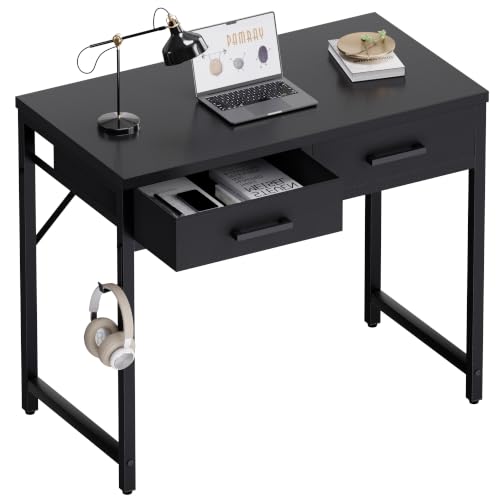
Pamray 32in Small Desk with Drawers — Storage in a 32-inch footprint
A 32-inch desk sounds like a compromise until you map what it replaces: the kitchen-table sprawl, the laptop on the bed, the paperwork migrating across every surface in a small home. The Pamray parks a complete workstation — laptop, notebook, lamp, mug — on a footprint smaller than many suitcases, and its two drawers swallow the chargers, notebooks and stationery that otherwise colonise the top.
Those drawers are the reason to choose it over the folding desks below. They are modest, not filing-cabinet deep, but a drawer you open twenty times a day beats a storage box across the room every time. Pens stop vanishing, the laptop’s power brick stops living on the floor, and the desk can be cleared for dinner guests or a sewing project in under a minute.
Build expectations should stay calibrated. The top is an engineered-wood surface over a metal frame, finished neatly at this price, and it carries a laptop setup and books without complaint. It is not a workbench, and leaning your full weight on a front corner while reaching behind it will remind you of its class. Within laptop-desk duties it feels composed rather than creaky.
Assembly is a typical flat-pack hour with labelled parts, best done where the desk will live because the finished frame is awkward to carry through doorways. Cable mess needs your own solution — a small adhesive channel under the rear edge works well — since no management tray is built in.
Choose this Pamray if the desk gets a permanent home and storage tops your list. Its combination of drawers and footprint is genuinely scarce among affordable desks, and it is the pick here most likely to still be in daily use, in the same corner, three years from now.
Drawer organisation repays a small system: left drawer for power and cables, right for paper and pens, or whatever split your work suggests. Without a system, drawers become junk accumulators with better PR. With one, the Pamray’s top stays photograph-clean, which matters in a bedroom where the desk is visible from the pillow and visual clutter leaks into rest.
A monitor stand transforms this desk’s capacity, lifting a screen over the drawer zone and freeing the centre for a keyboard. Owners pairing it with a laptop stand report the same effect. Because the footprint is fixed, vertical thinking is the whole game — shelves on the wall above, a stand on the top, drawers below — and the Pamray supports that stacking gracefully.
In hallways and landings — the dead zones of small homes — this desk turns wasted square footage into a paying tenant. A landing wide enough for its 32 inches gains a complete admin station for household paperwork, and the drawers keep that paperwork from colonising the stairs. Few furniture purchases return their cost in reclaimed space as directly as this one can.
Sound is an overlooked comfort at a small desk, and the Pamray’s drawers give rattling pens and loose change a padded, enclosed home instead of a desktop chorus. Line one drawer with a felt sheet or an old tea towel and the effect doubles. In a quiet bedroom where a partner sleeps metres away, that hush is a genuine feature.
- Footprint: about 32 inches wide, suited to nooks and bedroom corners
- Storage: two drawers for stationery, chargers and notebooks
- Frame: metal legs and frame with engineered-wood top
- Assembly: flat-pack, roughly an hour for one person
- Seating: fits a standard chair; no modesty panel
- Cable care: no built-in tray — plan an adhesive channel
- Finish: wipe-clean surface for daily mug duty
- Extras: pairs naturally with a small monitor stand
Strengths
- Two real drawers end desktop clutter properly
- Small footprint fits corners other desks waste
- Feels settled and permanent once assembled
Trade-offs
- Drawers are shallow — not filing storage
- Flat-pack assembly takes a patient hour
- No built-in cable management
Best for: a renter claiming the alcove by a bedroom window as a permanent laptop office, who needs drawers for chargers and notebooks within arm’s reach
Not suited for: anyone planning dual monitors or a desktop PC tower on the surface

Huuger Folding Desk 31.5in — Folds flat in under a minute
Huuger’s folding desk treats work as something a room hosts rather than something it is. The frame arrives assembled; you unfold the legs, lock them, and sit down. When the shift ends, it folds to a slim slab that slides behind a door, beside a wardrobe or under a bed. For spare rooms, studio flats and dining corners, that vanishing act is worth more than drawers.
The top, at about 31.5 inches wide, is honestly sized for a laptop, a notebook and a drink — the exact load it was designed around. A separate keyboard fits if the laptop rides on a stand, but a second monitor crowds it. Within that envelope the surface feels firm, the folding mechanism positive, and the leg locks reassuring rather than decorative.
Wobble is the folding desk’s ancestral enemy, and this design fights it with a wide stance and cross supports. Typing on carpet is calm; typing on uneven floorboards asks for the usual folded-card shim under one foot. It will never feel like a built-in bench, and pretending otherwise helps nobody, but for its class the composure is good.
Storage is entirely your problem, which is the honest price of folding flat. Owners who thrive with this desk keep a small caddy or laptop sleeve system: everything that lives on the desk travels in one container, so setup and clear-away each take two minutes instead of ten. Adopt that ritual and the desk’s discipline becomes a feature.
Pick the Huuger if your workspace must disappear nightly or weekly. Students in shared houses, hybrid workers hot-desking a dining table’s territory, and anyone whose landlord forbids furniture sprawl will understand its appeal within one working day.
Travel is an underrated use: this desk rides in a car boot to holiday lets, relatives’ spare rooms and exam-season retreats, giving a student or remote worker the same workstation anywhere. Familiar setup has real productivity value, and a desk that folds into luggage-adjacent shape delivers it more completely than any laptop stand can.
Pairs of these desks appear in training rooms and community classes for good reason: they store stacked, deploy in minutes and survive being moved by volunteers. A household that hosts study groups, craft circles or games nights can borrow that playbook, owning two folders that live in a cupboard and emerge as a matched pair of workstations.
Its plainness is a strategic asset in rented homes where the deposit depends on walls and floors staying unmarked. No assembly screws into anything, no heavy dragging during moves, and felt pads under its feet leave hard floors innocent. When the tenancy ends, the desk folds into the car in seconds, owing the landlord nothing and the owner no van hire.
Garden offices and conservatories tempt owners to leave folders set up in damp air, so a word of care: wipe the frame dry when seasons change and store it indoors over winter. The mechanism rewards that minimal attention with years of smooth service, while neglect shows up first as stiff hinges and then as the wobble nobody can shim away.
- Footprint: about 31.5 inches wide when open
- Storage: none built in — pair with a caddy or sleeve
- Frame: folding metal legs with locking mechanism
- Assembly: none; unfold and lock the legs
- Folded form: slim slab for behind-door storage
- Surface: engineered-wood top, wipe-clean
- Seating: open legroom, no crossbar at shin height
- Extras: felt pads help on hard floors
Strengths
- Genuinely no assembly — open, lock, work
- Folds slim enough for behind-door storage
- Leg locks feel positive and secure
Trade-offs
- Zero storage for anything at all
- Top is laptop-scale, not dual-screen scale
- Needs a levelling shim on uneven floors
Best for: a hybrid worker whose dining corner must become a dining corner again every evening, with the desk folded behind the door
Not suited for: a worker who keeps reference books, a printer and paperwork permanently spread out
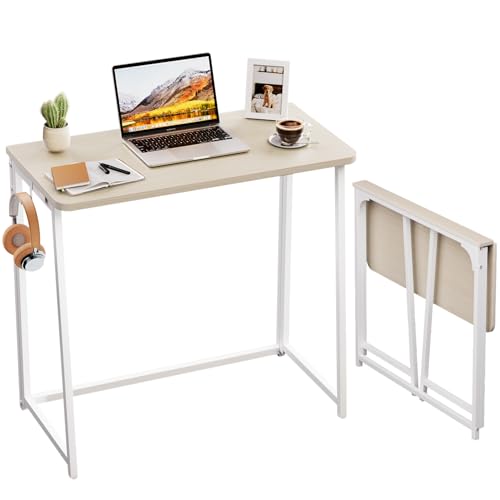
WOHOMO Folding Desk 31.5in — Folding desk with a monitor shelf
WOHOMO takes the folding formula and fixes its ergonomic flaw. Most small desks leave a laptop screen far below eye level, and the raised shelf across this desk’s rear edge lifts that screen — or a small monitor — toward a posture your neck will appreciate by Thursday. The shelf also corrals the notebook and phone layer behind the keyboard zone, keeping the main surface clearer than its dimensions suggest.
Like the Huuger, it arrives essentially ready: unfold, lock, work. The shelf is part of the fixed structure rather than an accessory to misplace, so the whole unit still folds away as one piece, slightly bulkier than a plain folder but still entirely storable in a cupboard or against a wall. That single-piece discipline matters in small homes.
Load the shelf sensibly. A laptop or a lightweight monitor sits happily; a heavy older display plus a stack of textbooks tests both shelf and your optimism. The main top handles keyboard, mouse and paperwork with the same firmness as its folding sibling, and the frame’s bracing keeps typing wobble modest on level floors.
The shelf’s fixed height is its main caveat. Tall users may still want a book or stand under a monitor, and anyone planning a separate keyboard tray should measure knee clearance, because the frame’s cross-members sit where long legs wander. Try your chair with the desk early in the returns window rather than discovering a shin conflict in month two.
Choose the WOHOMO if you fold your desk away but refuse to hunch while it is up. It is the most posture-aware affordable folder here, and for laptop-only workers it can postpone — sometimes permanently — the purchase of a separate monitor stand.
The shelf also disciplines cable routing in a way plain tops never do. Chargers live on the shelf tier, cables drop behind it, and the main surface stays free of the power-brick sprawl that makes small desks feel smaller. Add a short cable from shelf to laptop and the whole setup packs down without unplugging anything except the wall end.
For shared flats, the WOHOMO’s shelf makes the desk feel personal even when it is technically communal: your monitor stays parked at your height while the surface clears for the next person. Households that rotate a workspace between partners on different shifts will recognise the value of that fixed, ready layer immediately.
Video-call workers should note the shelf’s background benefit: a raised laptop camera sits nearer eye level, which is the difference between colleagues seeing your face and seeing up your nose. That single ergonomic accident of design improves every meeting held at this desk, and it costs nothing beyond choosing this folder over a flat-topped rival.
Its shelf doubles as a charging shelf in the evenings: phone, earbuds case and smartwatch lined up behind where the laptop sat, all fed from one strip. Households drowning in bedside chargers can move the whole ritual to the desk, and the WOHOMO’s two-tier shape makes that migration feel organised rather than merely relocated.
- Footprint: about 31.5 inches wide, shelf across the rear
- Storage: raised shelf for screen, notebooks and phone
- Frame: folding metal frame, shelf fixed to structure
- Assembly: minimal; unfold and lock
- Screen fit: laptop or lightweight monitor on the shelf
- Surface: engineered-wood top with shelf tier
- Seating: check knee clearance against cross-members
- Extras: shelf edge keeps small items from sliding off
Strengths
- Raised shelf improves screen height for free
- Still folds away as a single piece
- Rear shelf keeps the main top clearer
Trade-offs
- Shelf height is fixed, not adjustable
- Shelf load suits light screens only
- Cross-members can meet tall users’ shins
Best for: a laptop worker in a studio flat who folds the desk away on weekends but wants the screen at eye level during the week
Not suited for: a dual-monitor user or anyone with a heavy older display

Furinno Simplistic 31in Desk — Lightest assembly, simplest form
Furinno’s Simplistic line exists for buyers who want a desk, not a project. The design is a top, legs and open side shelving in a footprint near 31 inches, assembled from a modest count of parts with basic tools. It suits the classic first-desk jobs: a child’s homework station, a laptop perch in a guest room, a dressing-table double duty in a bedroom corner.
Open shelving replaces drawers here, and that suits some households better. Textbooks, a small printer or storage baskets sit visibly and accessibly, and nothing hides the clutter you meant to file — a discipline some families prefer. The shelves also stiffen the structure, giving the little desk a planted feel once loaded with books.
Materials are the lightest-duty in this guide, and honesty matters. The composite panels and simple fittings handle a laptop, lamp and schoolbooks gracefully; they resent being moved fully loaded, overtightened screws, or service as a step to reach a high shelf. Treat it as light furniture and it behaves; treat it as gym equipment and it will not.
Because it is small and light, it also works as the household’s floating desk: carried to whichever room needs it for exam season, tax season or a visiting relative working remotely. Few affordable desks are genuinely portable once assembled; this one is, by one person, without swearing.
Pick the Furinno when the job is simple and the budget is strictest. It asks little money, little time and little floor, and it returns an honest, usable desk for light work — which describes a surprising share of the desks actually bought.
Children outgrow desks slower than they outgrow chairs, so this Furinno often serves a second life as a hallway console, a plant stand with shelves, or a landing spot for post and keys. Light panel furniture earns its keep through these reassignments, and a desk that can retire gracefully into another job is better value than its first role suggests.
Buyers should order storage baskets with it from the start, sized to the shelves, because open shelving looks intentional with baskets and accidental without them. That small pairing decision, made on day one, is the difference between visitors reading the corner as a study nook and reading it as stored clutter with a laptop on top.
Assembly confidence is a fair reason to choose it for a teenager’s room: a young person can build this desk with a parent in half an hour and own the result in a way bought-and-built furniture never delivers. The skills are small — cam locks, dowels, patience — but the desk that results is theirs, and furniture you have built gets treated better.
Colour and finish choices in this line let it disappear into a child’s room scheme or a neutral spare room without visual argument. That camouflage is worth having in furniture bought for utility: the desk does its job, matches nothing in particular and offends nothing at all, which is precisely what most spare-room furniture should aspire to.
- Footprint: about 31 inches wide, among the lightest here
- Storage: open side shelves for books and baskets
- Frame: panel construction with simple fittings
- Assembly: flat-pack, basic tools, modest part count
- Surface: composite top for light loads
- Seating: open front, suits smaller chairs
- Portability: light enough to move between rooms
- Extras: shelves double as printer or basket space
Strengths
- Simple, quick assembly with few parts
- Open shelves suit books and baskets well
- Light enough to relocate single-handed
Trade-offs
- Lightest-duty materials in this guide
- Open shelves display clutter rather than hiding it
- Not built for heavy desktop setups
Best for: a parent setting up a first homework desk in a child’s bedroom, where books and a laptop are the whole load
Not suited for: a home worker with a desktop PC, dual screens and reference files

TEMI Folding Desk 35.8in — The widest folding top here
TEMI’s folder answers the complaint that folding desks are all laptop trays in disguise. At roughly 35.8 inches wide, its top fits a laptop and an open notebook genuinely side by side, with a phone and mug still accommodated — the working pattern of students, writers and anyone whose job involves paper next to a screen. That extra hand-span of width changes the desk’s character entirely.
The frame folds with the same open-lock-work simplicity as the other folders here, and the wider top folds to a still-manageable slab for storage. Two people can pass it through a flat easily; one person can store it behind a sofa. For renters who move yearly, a desk that is both spacious in use and undemanding in transit is a rare combination.
Stability at this width is respectable rather than absolute. The bracing keeps typing calm in the centre of the desk; leaning heavily on an outer corner while standing reminds you it is a folder. On hard floors the feet grip well, and on carpet the wider stance actually settles more confidently than narrower rivals.
No storage is provided, as with all true folders, and the width tempts owners to accumulate a permanent sprawl that defeats the folding purpose. The households that love this desk run a nightly two-minute reset — laptop in sleeve, notebook in tote, desk folded twice a week — and treat the width as working room, not storage room.
Choose the TEMI if your work is wide but your home is small. Writers drafting from notebooks, students revising with textbooks open, and crafters who laptop alongside materials will feel the extra inches every single session.
Art and craft work suits the TEMI surprisingly well: a laptop showing a tutorial at one end, materials spread across the rest, and the whole station folded away before dinner. The wipe-clean surface shrugs off glue sticks and pencil, and the width that writers love turns out to be exactly what a cutting mat plus supplies demands.
Its width also makes it the best gaming-capable folder here for a laptop plus a separate keyboard and mouse, where narrower tops force the cramped elbows-in posture that ruins long sessions. It remains a folding desk, not an esports rig, but for student gaming after study hours it covers both jobs without a furniture change.
Heat is a mundane but real consideration for laptop-heavy work on any desk, and the TEMI’s open frame lets air circulate around a hard-working machine better than panel-sided desks do. Paired with the width to keep a laptop off piles of paper, it quietly suits long rendering, gaming or study sessions where a hot, throttled laptop would otherwise slow the evening.
Two TEMI desks pushed together form a credible four-person project table for group coursework or family admin marathons, then separate back into individual stations. Few affordable desks scale socially like that, and student houses that buy them in pairs tend to keep them through several tenancies and several cohorts of users.
- Footprint: about 35.8 inches wide — widest folder here
- Storage: none built in; width is the feature
- Frame: folding metal frame with cross bracing
- Assembly: none beyond unfolding and locking
- Surface: fits laptop plus open notebook side by side
- Seating: generous knee width for taller users
- Folded form: wider slab; check your storage spot
- Extras: wide stance settles well on carpet
Strengths
- Real room for paper beside the laptop
- Folds away despite the wider top
- Wide stance feels planted on carpet
Trade-offs
- Width tempts permanent clutter build-up
- Corner lean reveals folding-frame flex
- No storage, like every true folder
Best for: a student revising with a textbook open beside the laptop in a rented room, who folds the desk away when friends visit
Not suited for: a worker needing drawers, filing or a permanent multi-screen rig
Sauder Beginnings Writing Desk — Prose-only: the traditional alternative
Sauder’s Beginnings writing desk represents the older school of affordable desk: a rectangular top, a centred drawer, and a frame that looks like furniture rather than equipment. It is covered here without a sales link, deliberately — we could not confirm a current listing matching this exact model through our verified pool, so it is discussed as a design alternative to research through reputable furniture retailers rather than linked as a pick.
That traditional layout has real virtues. A single wide drawer under the top suits letters, tablets and a laptop sleeve; the styling blends with bedroom and living-room furniture instead of announcing a home office; and the Beginnings line’s long production run means assembly advice, spare-part routes and second-hand examples are easy to find.
Expect classic flat-pack realities. Panel construction is heavier than the folding desks here, assembly is a sit-down job with many fasteners, and once built the desk is a piece of furniture that moves house with effort. Buyers who relocate yearly should weigh that permanence against the folders’ easy transit.
Ergonomics are conventional: a fixed working height, knee space interrupted by the drawer unit in the centre, and no cable provision. Tall users should check drawer-to-thigh clearance, a classic writing-desk trap, before committing. A chair with a lower seat or a cushion adjustment usually resolves it.
Consider the Sauder if your desk must look like furniture in a shared living space and you value a centre drawer over folding tricks. Research current availability carefully, verify the exact model’s dimensions from the seller, and treat any listing’s claims as needing the same scepticism applied throughout this guide.
Second-hand examples deserve a specific mention, because long-running flat-pack lines accumulate in local listings at very low cost. Inspect panel edges for swelling, confirm the drawer runner is present and smooth, and check that assembly hardware survived the previous owner. A sound used example delivers the traditional layout for the price of a takeaway meal.
Styling flexibility is the other quiet strength. The Beginnings aesthetic sits comfortably beside traditional bedroom furniture, rental-standard bookcases and inherited pieces in a way that black metal-frame desks never attempt. In a living room that must host both guests and paperwork, that camouflage can matter more than any ergonomic refinement.
Writers in the literal sense — letters, journals, fountain pens — remain its natural constituency, and the flat, uncluttered top with a single drawer for paper and ink explains the model’s longevity. If your desk work is handwriting-first and computer-second, the traditional layout stops being old-fashioned and becomes simply correct, which is why the design refuses to disappear.
Its centre drawer also suits the household command-centre role: stamps, tape, scissors, the good pens, birthday cards awaiting posting. Placed in a hallway or kitchen corner, the Sauder becomes the home’s stationery headquarters, a job description no folding desk can hold because the job requires the drawer to stay exactly where it is.
- Footprint: writing-desk proportions; verify exact dimensions with seller
- Storage: single centre drawer in classic layout
- Frame: panel construction, furniture-style finish
- Assembly: full flat-pack with many fasteners
- Seating: check drawer clearance for tall users
- Cable care: none built in
- Finish: warm laminate tones that suit traditional rooms
- Extras: long-running line with plentiful second-hand examples
Strengths
- Furniture styling blends into living rooms
- Centre drawer suits letters and a laptop sleeve
- Long production run means advice is plentiful
Trade-offs
- Heaviest assembly in this guide
- Drawer can crowd tall users’ thighs
- Buying means researching furniture retailers yourself
Best for: a homeowner furnishing a living-room writing corner that must look like furniture, who values a centre drawer and classic styling
Not suited for: a yearly mover who needs a desk that folds or carries easily
How do the six best affordable desks compare side by side?
| Pick | Standout trait | Watch out for | Suits |
|---|---|---|---|
| Pamray 32in Small Desk with Drawers | Drawers plus the smallest permanent footprint here | Shallow storage and an hour of assembly | Permanent small corners |
| Huuger Folding Desk 31.5in | No-assembly folding with a slim folded profile | No storage whatsoever | Rooms that change jobs daily |
| WOHOMO Folding Desk 31.5in | Folding frame with a built-in raised shelf | Fixed shelf height and light load limit | Posture-conscious laptop work |
| Furinno Simplistic 31in Desk | Minimal flat-pack with open shelving | Light-duty panels only | First desks and light loads |
| TEMI Folding Desk 35.8in | Widest folding top for paper-plus-laptop work | No storage and some corner flex | Wide work in small rooms |
| Sauder Beginnings Writing Desk | Traditional writing desk with centre drawer | Full flat-pack build and no linked listing | Living-room writing corners |
Storage divides the table cleanly. The Pamray hides clutter in drawers, the Furinno displays it on shelves, the Sauder centres it in one drawer, and the three folders refuse the question entirely in exchange for disappearing. Decide how your household actually handles paper and chargers, because a desk that fights your habits loses to a desk that flatters them.
Permanence divides it again. Fixed desks reward a settled corner with steadiness and storage; folders reward unsettled lives with freedom. Neither virtue is superior in the abstract — the correct desk is the one whose compromise matches the next two years of your housing, not the next two weeks.
What size desk does a laptop worker actually need?
Start from the objects, not the room. A laptop is roughly 13 to 15 inches wide; an open notebook beside it needs 9 more; a mug, phone and lamp base claim the margins. That arithmetic lands near 32 inches as the honest minimum for paper-plus-laptop work, which is why the picks cluster there and why the wider TEMI exists for writers and students.
Depth matters as much as width and is easier to get wrong. Shallow desks push the screen close, cramping posture; around 19 to 24 inches of depth lets a laptop sit at a comfortable viewing distance with a separate keyboard in front. Measure your chair’s footprint too — a desk that fits the wall but leaves no room to sit back has not actually fit.
Tape the outline on the floor before ordering anything. Live with the tape for a day: open the wardrobe, walk past with laundry, let the door swing. Floor tape has saved more buyers from returns than any review, including this one, because rooms reveal their truths at full scale and in motion.
Folding desk or fixed desk: which suits your home?
Count how often the room changes jobs. A spare room that hosts guests monthly, a dining area that hosts dinner nightly, a nursery that hosts everything — these are folding-desk territories, where the ability to reclaim floor in two minutes outweighs drawers. A room with a dedicated work corner is fixed-desk territory, where stability and storage compound daily.
Consider your temperament honestly. Folders reward tidy rituals and punish sprawl, because everything on top must have a travelling home. Some workers find that discipline liberating and their rooms calmer; others find the nightly reset becomes the reason they stop working at the desk at all. Your past behaviour with gym kits and meal prep predicts your future behaviour here.
Hybrid answers exist. A fixed desk in the bedroom plus a folder for overflow — exam season, a partner’s work-from-home days, visiting family — covers most households’ real patterns. Buying both shapes, each cheap and fit for purpose, often beats buying one expensive desk that compromises at both jobs.
How can you make a small affordable desk ergonomic?
Screen height is the first fix and the cheapest. A laptop on a stand or shelf, with a separate keyboard and mouse, transforms posture at any desk in this guide; the WOHOMO builds the lift in, while the others accept a stand happily. Your eyes should meet the top third of the screen without tilting your head down.
Chair and desk interact, so adjust them as a pair. Elbows should rest near desk height with shoulders relaxed; if the chair cannot rise enough, a cushion is a legitimate ergonomic tool, not a makeshift embarrassment. Feet belong flat on the floor or a footrest — a storage box serves — rather than dangling or hooked around chair legs.
Light finishes the trio. Place the desk so daylight comes from the side, not behind the screen or into your eyes, and add a small lamp for evening work rather than relying on a ceiling light behind you. Glare fatigue masquerades as desk dissatisfaction in many households; fix the light before blaming the furniture.
What should you check in the first week with a new desk?
Work at it daily and interrogate the annoyances while returns remain easy. Does the top edge press your wrists? Does a leg meet your shin when you swivel? Does the surface mark from your usual mug? Small frictions identified in week one can be padded, shimmed or returned; the same frictions discovered in month three become permanent grievances.
Tighten fasteners after the first week of use, because flat-pack joints settle as panels and frames find their working positions. That single ten-minute ritual, repeated at six months, is the difference between a cheap desk that stays square for years and one that develops the wobble its critics predicted. Keep the hex key taped under the top.
Photograph your cable arrangement once it works. Chargers migrate, partners borrow cables, and the tidy state is easier to restore from a picture than from memory. Cable order is part of a desk’s ergonomics — a cable tugging a laptop sideways will annoy you more than any specification in this guide.
How do you keep an affordable desk looking good for years?
Coasters and a desk mat are not fussiness; they are surface insurance. Engineered-wood finishes at this price shrug off daily use but swell at standing water and scar under dragged ceramics. A mat also quiets typing, defines the work zone visually, and can be replaced for little money when it wears — unlike the top beneath it.
Clean with a damp cloth, not a soaking one, and lift objects rather than sliding them. Keep the desk out of direct all-day sun where possible, since budget finishes fade unevenly, and rotate decorative items occasionally so fading, if it comes, arrives evenly. These habits cost nothing and double the presentable life of inexpensive furniture.
Repair early and simply. A loose leg tightened today is a stable desk; ignored for a season it becomes elongated holes and permanent rock. A dab of wood glue in a tired screw hole, a felt pad under a foot, a touch-up pen on an edge — small interventions, promptly made, are how affordable furniture becomes long-lived furniture.
How should two people share one small desk fairly?
Split time before splitting space. A small desk shared by schedule — one person’s mornings, another’s evenings — keeps both setups intact, while a desk split down the middle satisfies nobody and stores everything badly. A caddy per person, swapped at handover, makes the schedule system physical and quick.
Agree the reset standard in advance: what the desk looks like when handed over, where chargers live, whose mug is whose. Most shared-desk friction is not about the desk at all but about finding it altered. Photograph the agreed state, keep the ritual under two minutes, and a 32-inch desk can serve two workers surprisingly peacefully.
What flooring and wall checks matter before a desk arrives?
Floors slope in older homes, sometimes enough to turn a rigid desk into a rocking one. Check with a marble or a phone level app where the desk will stand, and favour designs with any levelling tolerance — or keep furniture pads and shims ready. Carpet pile also shortens effective leg stability for folders, which settle as pile compresses over the first week.
Walls matter for desks pushed against them: skirting boards steal an inch of depth, radiators forbid some positions outright, and sockets decide where chargers can live. Map sockets before choosing which wall hosts the desk, because an extension lead trailing across a doorway is a daily annoyance disguised as a minor detail.
How do you light a small desk without wasting its surface?
A clamp lamp is the small desk’s best friend, gripping the rear edge or a shelf and returning the whole footprint to work. Choose one with an adjustable arm so light can rake across paper for handwriting or aim at the wall for softer evening illumination. Warm light for living spaces, neutral for detailed paperwork — and keep the bulb out of your direct sightline.
Daylight positioning deserves one rehearsal before the desk’s position becomes permanent. Sit at the taped outline at the time you usually work and watch where reflections land; a screen facing a bright window will tire your eyes by lunch regardless of the lamp you add later. Side-on to the window is the classic answer because it lights paper without fighting the display.
What mistakes do people make when buying an affordable desk?
Measuring the wall but not the journey is the classic failure. A desk that fits its destination perfectly still has to survive the front door, the hallway turn and possibly a staircase. Folding desks dodge this trap by design; flat-pack desks dodge it by arriving in pieces; an assembled bargain from a local seller does neither, so measure the route before the room.
Buying for the setup you wish you had is the second failure. A wide desk for the dual monitors you may buy next year crowds the room you live in today, while a tiny desk for your current laptop suffocates the paperwork job starting next month. Buy for the work you can describe in detail now, and let future upgrades justify future furniture.
Skipping the chair in the budget distorts everything. A desk paired with a dining chair at the wrong height produces aches that get blamed on the desk, the mattress and the job in turn. Reserve part of any desk budget for seating and screen height; the most affordable desk in this guide plus a decent chair beats a costlier desk plus misery.
Assuming drawers equal organisation disappoints many buyers. Two shallow drawers organise stationery and cables beautifully and swallow almost nothing else, so a paperwork-heavy job still needs files or boxes elsewhere. Match storage type to clutter type — drawers for small things, shelves for big things, folders for rooms that must reset — rather than counting storage as a single score.
Ignoring assembly reviews is the avoidable failure. At this price, instructions and hole alignment vary more than materials do, and other buyers report both faithfully. Ten minutes reading recent owner comments about assembly saves the specific Saturday-ruining surprises that specifications never mention.
Overlooking delivery and returns logistics completes the common error set. Flat-pack furniture is heavy, awkward to repackage and expensive to return once assembled, so the pre-purchase checks in this guide — tape outlines, route measurements, assembly reviews — carry unusual weight. An hour of scepticism before ordering beats a month of living around a mistake.
Final Recommendation
For a permanent corner, the Pamray with drawers is the easiest recommendation in this guide: it stores the clutter, fits the nooks other desks waste, and asks only an hour of assembly in exchange. Most single-laptop households will be well served by it for years.
For rooms that change jobs, choose between the folders by your work’s shape: the Huuger for pure laptop sessions and the fastest vanish, the WOHOMO for laptop posture with its raised shelf, the TEMI for paper-heavy work needing width. The Furinno serves first rooms and light duties with the least fuss and money, while the Sauder remains the traditionalist’s route, researched through furniture retailers.
Whichever you choose, tape its footprint on the floor tonight and sit in the space with your laptop before ordering. Affordable desks succeed or fail on fit — to the room, to the work and to your habits — far more than on finish or brand, and five minutes with tape is the cheapest expertise in this entire guide.
One last encouragement: an affordable desk chosen carefully is not a placeholder for a real desk later. For the work most homes actually contain — laptops, letters, study, admin, the occasional project — these six are real desks, full stop, and the money they leave in your budget for a chair, a lamp and a life is part of their design intelligence rather than an apology.
Frequently Asked Questions
Can an affordable desk really last several years?
Yes, if its duties match its class and its joints are maintained. Laptop loads, prompt tightening of fasteners, coasters under drinks and lifting rather than dragging during moves are the whole secret. Budget desks usually die from overload, water and neglected wobble rather than from age itself.
Is a folding desk sturdy enough for daily work?
For laptop-based work, the folders here are sturdy enough for daily use, with calm typing on level floors and only corner-lean moments revealing their design. They are not suited to heavy desktop towers, large printer loads or being leaned on while standing. Match the load to the design and stability stops being a worry.
What desk size suits two monitors on a budget?
None of the 32-inch class truly suits two monitors plus working space; that setup wants a wider top than this guide’s compact picks provide. Consider the widest folder here for one screen plus a laptop, or step up in size deliberately rather than crowding a small desk and hating it. Honest sizing beats hopeful sizing.
Are drawers or shelves better in a small desk?
Drawers hide small clutter — cables, stationery, notebooks — and keep a top visually calm. Shelves hold larger items like textbooks, printers and storage baskets, and keep them visible. Most small households benefit from one of each across their furniture, so choose the desk storage that complements what the room already has.
How long does assembly take for the flat-pack picks?
Plan on roughly an hour for the drawer desk, less for the simplest panel desk, working alone with the instructions open and parts laid out first. Building on carpet protects finishes, and a second pair of hands helps when flipping a part-assembled frame. The folding desks, by contrast, need no assembly at all.
Can these desks work as dressing tables or study desks too?
Happily. The compact fixed desks double as dressing tables in bedrooms, and the light panel desk suits children’s study corners. Dual duty is a strength of simple designs: no cable grommets or office styling to fight the room’s other life. Just agree the nightly reset ritual with whoever shares the space.
Which of these desks suits a desktop PC rather than a laptop?
None is ideal with a tower on top, but the fixed drawer desk handles a compact PC and one monitor most gracefully, with the tower better placed on the floor beside it. Folding desks should keep towers off their tops entirely. If a full desktop rig is your main setup, size and sturdiness requirements outgrow this affordable compact class.
Should an affordable desk go against a wall or face into the room?
Against a wall suits small homes because it returns floor space and hides cables, but facing into the room can feel better for full-time work, giving your eyes distance to rest on and making video calls tidier with a wall behind you. Try both during the first week if the room allows; the position you stop noticing is the right one, and folders make the experiment painless.
What is the quickest upgrade for any desk in this guide?
A separate keyboard and mouse, paired with anything that lifts the screen — a stand, a shelf or a stack of sturdy books. That trio costs little, fits every pick here, and improves posture more than moving up a desk price bracket ever would.
Related Guides
Best apartment office desks Best desks for small spaces Best standing desks for home offices
Related guide: Best Streaming Desks
Related guide: Best No-Assembly Computer Desks


